© 2017, IRJET | Impact Factor value: 5.181 | ISO 9001:2008 Certified Journal
| Page 461
Design and Development of a Prototype Assistive Mobility
Solution for the Visually Impaired
Anuraag Daniel Ravi, Rajnish Kumar Pandey, Nayan Kiran Ringane , Ashish Narayan Mahajan
B.E. ,
Department of Computer Science Engineering,
Sinhgad Institute of Technology, Lonavala, Maharashtra
---***---Abstract - In this paper, we have introduced an elaborateassistive mobility aid system for visually impaired individuals. In this system, a visually impaired individual is aided through a networked system comprising mainly an android device and ultrasonic sensors. The phone is placed in the individual’s pocket and the sensors are fitted at the individual’s feet and temple. The visually impaired individual, or ‘user’ for further reference, is guided through the environment through English voice guidance produced by the application as per the current position of the user and the relative position of obstacles in the line of the user’s path. The user can navigate around the app using voice commands. The app is made accessible using aural feedback. Navigation is supported using GPS with Google Maps (GPS is only applicable in outdoor navigation). Obstacle detection is done using ultrasonic sensors, the aggregate results of the readings are conveyed to the user through aural feedback. Location data and location history is uploaded and synced with a remote server at regular intervals to allow guardians and/or loved ones keep track of the user’s whereabouts. A panic feature is interposed among the features which will send an SOS message with last recorded location attached to an ICE contact and also place a call to the same.
Key Words: Visual impairment; mobility aid; assistive technology; location tracking; Android application; navigation; ultrasonic sensors.
1. INTRODUCTION
According to a global survey report on visual impairment around the world by WHO in 2010, there were estimated over 285 million visually impaired people in the world. Of the 285 million, 13.7% are blind and 86.3% ie. 246 million people have low vision. And on a further note, 21.9% of the world’s visually impaired are from India, whereas 26.5% are from China.[1]
Given a look at the numbers, it is clear there is a populace that can be served to fulfil a need. Most of the impaired are found to be in developing nations, over a wide range of ages. These individuals are hindered from a normal life and wages. A innovative step towards accessibility and portability would make life easier and, furthermore, a lot more interesting. There have been many aids developed with this goal in mind, like the smart stick[2] with transducers and lasers fitted on a white cane
to identify hinderances and obstacles, and there will furthermore be many more developments in the days to come. But here is our take on the problem. This is a solution for
improving the mobility of visually impaired persons. Albeit the consequent goal is to improve the lives of the blind, for practical purposes, this system will gratify low vision individuals more than it would for the total blind.
This is a system where the visually impaired user can achieve better mobility despite his/her impairment with little to no help from another person. Mobility is described by Emerson Foulke as “The ability to travel safely, comfortably, gracefully, and independently, referred to hereafter by the single term “mobility,” is a factor of importance in the life of a blind individual.” [3]
The term ‘blindness’ is qualitative, and it describes the clinical condition where the individual has total vision loss: that is no light perception. It could also describe certain individuals who have very low to negligible vision. Moreover, the term ‘visual impairment’ is also a qualitative term used to describe loss of vision that is a consequence to various diseases that affect parts of the eye at an organ level. ‘Low vision’ is a description of lesser degree of vision.
2. LITERATURE REVIEW
© 2017, IRJET | Impact Factor value: 5.181 | ISO 9001:2008 Certified Journal
| Page 462
Table.1:Sr. Reference
Paper Inference Advantages Disadvantages
1
Design and Developmen t of a Prototype Rehabilitativ e Shoes and Spectacles for the Blind[4] This paper addresses a prototype, smart rehabilitative shoes and spectacles, designed and developed to facilitate safe navigation and mobility of blind individuals. Obstacle Detection, Vibration alerts, Ergonomic Design
None so far
2 Automated Mobility and Orientation System for Blind or Partially Sighted People The traditional white cane was fitted with a GSM-GPS module for location sensing and ultrasonic sensors for detecting obstacles. Obstacle Detection, Location Sensing Excessive physical weight 3 Android Assistant EyeMate for Blind and Blind Tracker [13]
A blind assistive and tracking embedded system is presented. The blind person is guided through Bengali/English voice commands generated by the application according to the obstacle position.
GPS and Navigation, Voice Commands, Voice initiated phone call
System fails to perform in certain situations involving elevations
Sr. Reference
Paper Inference Advantages Disadvantages
4 Smart
Walker
The Smart Walker is an apparatus designed to overcome the demerits of using a cane, and at the same time monitoring the health stats of the user. The entire system is interfaced with an Android device. Takes care of balance, monitor’s health stats such as heart rate and blood pressure, has obstacle detection sensors, results can be monitored on the android device Trouble concerning the different interfaces and wiring challenges. The system is bulky, it may increase mobility along a linear path, but would fail in other situations.
In 2012, Abu-Faraj et al. presented a paper on a prototype mobility system which implements ultrasonic sensors and vibrating motors mounted on shoes and spectacles[4]. We chose this paper as the foundation of our
work.
In 2013, Abdel Ilah Nour Alshbatat, from Jordan, decided to improve upon the traditional white cane by affixing a GPS-GSM module to it. The module would help in locating the blind individual[5].
Md. Siddiqur Rahman Tanveer, in 2015, designed an impressive all round system which aids the blind individual in navigating around the city[6].
Greg Olmschenk et al. developed a crowd assisted navigation system where the blind individual is guided by an online community[7]. The system is implemented as an mobile
© 2017, IRJET | Impact Factor value: 5.181 | ISO 9001:2008 Certified Journal
| Page 463
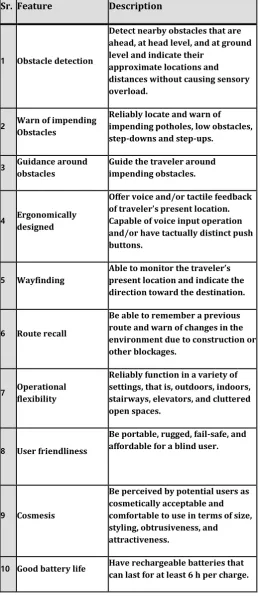
TABLE 2Sr. Feature Description
1 Obstacle detection
Detect nearby obstacles that are ahead, at head level, and at ground level and indicate their
approximate locations and distances without causing sensory overload.
2 Warn of impending
Obstacles
Reliably locate and warn of impending potholes, low obstacles, step-downs and step-ups.
3 Guidance around
obstacles
Guide the traveler around impending obstacles.
4 Ergonomically
designed
Offer voice and/or tactile feedback of traveler’s present location. Capable of voice input operation and/or have tactually distinct push buttons.
5 Wayfinding
Able to monitor the traveler’s present location and indicate the direction toward the destination.
6 Route recall
Be able to remember a previous route and warn of changes in the environment due to construction or other blockages.
7 Operational
flexibility
Reliably function in a variety of settings, that is, outdoors, indoors, stairways, elevators, and cluttered open spaces.
8 User friendliness
Be portable, rugged, fail-safe, and affordable for a blind user.
9 Cosmesis
Be perceived by potential users as cosmetically acceptable and comfortable to use in terms of size, styling, obtrusiveness, and
attractiveness.
10 Good battery life Have rechargeable batteries that
can last for at least 6 h per charge.
For system design and ergonomics we peruse Szteo’s research in REHABILITATION ENGINEERING and ASSISTIVE TECHNOLOGY from 2012 who emphasises that despite all technological implements can make accomplishing tasks easier, technology alone cannot mitigate all the difficulties that accompany a disability; and that the technology affects people with the same disability in different ways since the attention to process information they receive real-time require thought to make sound decisions[7]. Szeto also describes an ideal mobility
method in a another selection[8]; which is adapted and
presented in Table 2.
Furthermore, for more insight into some impressive adaptive technologies developed so far for the blind, Velázquez, compiled his research in these technologies in 2010; We see work done on devices that can be mounted on the head, feet, fingertips, belt, etc[9].
Another mobility system we encountered was the Smart Walker: a visually impaired individual can utilize the contraption and move around in a controlled domain, such as a house; the user is likewise equipped for being monitored remotely for a sense of safety and security as somebody is always there to respond to need[10].
A voice acknowledgment security process is utilized by a team in their work for the visually impaired clients[11]. Unique
characteristic samples of the clients voice are isolated and used for comparison at authentication time; it also uses Google Maps API to guide the user in mobility.
Regarding the safety of the individual we read the work of Yarrabothu et Thota[12], although their system is SMS based, we
consider the idea of transmitting location history at regular intervals as they did, but to an online server instead.
TTS (Text to Speech) is utilized as a part of framework to provide navigation through voice to the visually impaired person and it makes use of Google Maps to utilize its rich map data.
3.
MOTIVATION
Our paramount objective throughout this venture was the drive to fabricate something that helped the outwardly weakened populace of this developing nation, considering the large numbers thereof[1], by consolidating ubiquitous
© 2017, IRJET | Impact Factor value: 5.181 | ISO 9001:2008 Certified Journal
| Page 464
him/her remotely. We started out with the following intentions for our goal:
•Use information given by sensors in the wearables to caution the individual about any obstacles on current heading.
•Connect the wearable to an Android device wirelessly using Bluetooth, so that the said Android device may process the information collected by sensors. •Design an arrangement which wouldn't hinder the
individual from his regular life. •Make the arrangement economical.
•Build-on and overcome any shortcomings of previous works.
4.
PROPOSED SYSTEM DESIGN
A.HARDWAREDESIGN
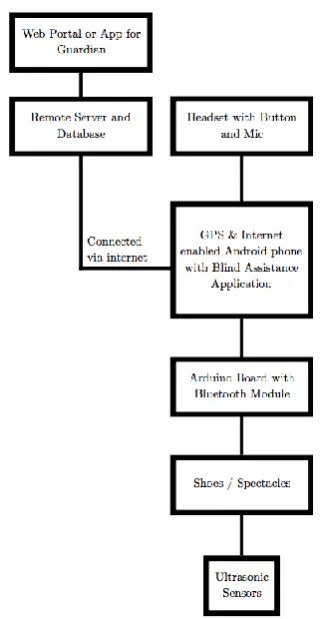
The shoes are mounted with ultrasonic sensors. Sensors are place on the medial, central, and lateral aspects of the front of the shoe. Sensors are also placed at the temple by mounting it on spectacles. These sensors can detect obstacles situated at different levels.
The sensors are connected to an Arduino board which also includes a Bluetooth module connected to it. The Bluetooth module is used to interface and send messages to the android phone wherein the app, to guide the user, is installed.
The board is mounted with ultrasonic sensors to find obstacles in the path of the visually impaired individual.
To recognize the position and vicinity of the visually impaired individual, and for navigation, we depend on Global Positioning System (GPS). The application proposed in this paper utilizes TTS and Google Maps API so as to furnish routing with voice guidance. This recommended framework utilizes a smartphone which is ubiquitous, and is genuinely modest and gives a simpler versatility.
The hardware to be used is to be designed to be ergonomic and minimal. It is desired to have something lightweight and sturdy. We need it to be portable.
B
.
ANDROID APP DESIGN
The android app is installed on the user’s phone. And it is required to have the following design specifications and features:
1.Design Specifications:
i. Single tap to speak selection ii.Double tap to confirm selection iii.High Contrast UI
iv.Colour-blind friendly v.Differentiable and clear font vi.Large font
2.Features:
i. Feedback when obstacle is detected ii.GPS
iii.Live tracking
iv.Voice input and output v.Call a cab/driver button vi.Emergency call/SMS button
C. REMOTE SERVER AND DATABASE
We need a server to store the location of the visually impaired individual into a remote database. The latitude and longitude, essentially the coordinates, along with timestamps.
This is essential for the guardians to retrieve this information. We need to implement a remote server to establish connection with the remote database. The database would be used to hold coordinates data received from the visually impaired person. The server needs to be actively running to provide round the clock service. This server is also an essential part to this system. The interaction between the said remote server and android phone application can be done using JSON, a lightweight data-interchange format.
D.
GUARDIAN
ANDROID
APP/WEB
PORTAL
FOR
MONITORING
© 2017, IRJET | Impact Factor value: 5.181 | ISO 9001:2008 Certified Journal
| Page 465
[image:5.595.55.216.105.415.2]interface will be used to display the results retrieved from the database, and display them as required on a Google Maps outline.
Fig - 1: Architecture of proposed system
5.
TECHNICAL IMPLEMENTATION
The proposed framework has hardware sensors, an Android phone, GPS and an online framework fit together for helping the visually impaired individual in the following ways:
A.OBSTACLEDETECTION
The function of detecting obstacles along the path is to be done by ultrasonic sensors. The working of ultrasonic sensors is truly simple yet brilliant. The sensor compromises of a transmitter and receiver; the transmitter sends off pulses of ultrasonic sound, and the receiver picks up reflections. The time interval is measured and the distance is determined. These sensors are connected to a Arduino Uno board.
In the model, we use bluetooth as a means to send data about the detected obstacle along the path to the android device.A bluetooth module, HC-05, is mounted to the board to transmit data readings of obstacle location to the android application
B.NAVIGATIONUSINGANDROIDPHONE
An android phone is one of the most ubiquitous technology available today. It has most commonly required sensors, pre-installed from the manufacturer, such as GPS.
The android phone will have installed onto it the guidance application for the visually impaired individual. The app is interfaced with the hardware module using Bluetooth. It receives the obstacle position data from the Arduino board and also provide navigation.
The phone will receive commands from the visually impaired person through voice commands.
C.TRACKINGANDVISUALLYIMPAIREDINDIVIDUALS
A web interface or android app will be used by the guardian to find the location history and current location of the visually impaired individual. Server and android application interaction will be done.
© 2017, IRJET | Impact Factor value: 5.181 | ISO 9001:2008 Certified Journal
| Page 466
distinguished question the android application. The Bluetooth module is extremely shoddy, yet simple to interface with the micro-controller and android phone. So we utilized this module to provide communication between the equipment module and the android application. We executed both, in light of the fact that when the visually impaired individual strolls under the open sky then GPS satellites give a rather precise result however GPS will be weakened by the tall structures, trees and within the building and the underground. So hence GPS can't be utilized constantly, and the network supplier is to be utilized when GPS supplier is inaccessible.
Since visually impaired individual does not think much about the android interface, we have built up our application in a manner that the visually impaired individual can control the application including but not limited to utilizing his/her voice. In the design of the framework, the visually impaired individual does not have to touch the telephone to give voice commands - he/she simply needs to press the headset catch and can give the voice order effortlessly.
The app is meant to track the current location and whereabouts of the individual. The app allows us to receive the coordinates of the present area of the visually impaired individual from the server. And thus export these coordinates to discover the visually impaired person’s position in Google Maps. Along these lines we can, without much of a stretch, find the visually impaired individual in the event that he/she is lost and safeguard him/her quickly
6. FUTURE SCOPE
The system is made to better the mobility of a visually impaired individual. In the future scope of this system, navigation could be supported using GPS with Google Maps and also with Crowd Assistance. Crowd assistance is made possible using a camera phone and volunteers over the world who would help the user navigate in scenarios where the computational devices fail. Although it is subject to availability, volunteers can access the video stream which is live-casted from the user's camera phone and offer guidance though pre-recorded aural (and visual clues for low vision users) or simply through a phone call.
Furthermore, voice recognition, which is a way for identifying, understanding and processing voice signals into information or data, can also be explored. There are a diverse variety of validation components which we have accessible to us today which can be implemented, if required, to provide a level of voice identification, security, and personalization.
7. CONCLUSION
We began with the goal to create a aid which would enable visually impaired persons to move more conveniently and navigate to places they desired. The final product of our work is a device capable of guiding the visually impaired
along a route and also features a design integrating the setup with the Internet. This enables guardians to monitor the impaired individual online. The framework has been tried through a few experiments. This assistive gadget powered by an android device is significantly valuable to a visually impaired individual to move without the assistance of others and can look for help in a crisis through an emergency phone call. The application also keeps a record of location history on an online server which is accessible through an application on the guardian’s phone.
REFERENCES
[1] World Health Organization, “Visual impairment and
blindness,”
http://www.who.int/mediacentre/factsheets/fs282/en /
[2] Faria, J., Lopes, S., Fernandes, H., Martins, P., & Barroso, J.
“Electronic white cane for blind people navigation assistance,” In World Automation Congress (WAC) IEEE, pp. 1-7, 2010.
[3] E. Foulke, “The perceptual basis for mobility,” AFP
Research Bulletin, Vol. 23, pp. 1-8, 1971.
[4] Ziad O. Abu-Faraj, Paul Ibrahim, Elie Jabbour, Anthony
Ghaoui, “Design and Development of a Prototype Rehabilitative Shoe and Spectacles for the Blind,” 2012 5th International Conference on Biomedical Engineering and Informatics (BMEI 2012).
[5] Abdel Ilah Nour Alshbata, “Automated Mobility and
Orientation System for Blind or Partially Sighted People,”
INTERNATIONAL JOURNAL on SMART SENSING and INTELLIGENT SYSTEMS VOL. 6, NO. 2, APRIL 2013.
[6] Greg Olmschenk, Christopher Yang, Zhigang Zhu,
Hanghang Tong, William H. Seiple, “Mobile Crowd Assisted Navigation for the Visually Impaired,” UIC-ATC-ScalCom-CBD-IoP 2015.
[7] Andrew Y. J. Szeto, Assistive Technology and
Rehabilitative Engineering. Chapter 5 in: John Enderle & Joseph Bronzino, “Introduction to Biomedical Engineering,” 2011.
[8] Andrew Y. J. Szeto, Blind And Visually Impaired,
Assistive Technology For. Chapter in: John G. Webster,
“Encyclopedia of Medical Devices and Instrumentation,”
2006.
[9] R. Velázquez, Wearable Assistive Devices for the Blind.
Chapter 17 in A. Lay-Ekuakille & S.C. Mukhopadhyay (Eds.), “Wearable and Autonomous Biomedical Devices and Systems for Smart Environment: Issues and Characterization,” LNEE 75, Springer, pp 331-349, 2010.
[10] Gaby Abou Haidar, Richard Maalouf, Batoul Mchiek,
Houssein Allam, Abdul Rahim Moussa, “SMART WALKER,” 2014 International Conference on Future Internet of Things and Cloud.
[11] Nandish M. S. , Mr. Chetan Balaji , Prof. Shantala C P. “An
Outdoor Navigation With Voice Recognition Security Application For Visually Impaired People,” International Journal of Engineering Trends and Technology (IJETT), V10(10),500-504 April 2014. ISSN:2231-5381.
[12] Ravi Sekhar Yarrabothu, Bramarambika Thota, “Abhaya:
© 2017, IRJET | Impact Factor value: 5.181 | ISO 9001:2008 Certified Journal
| Page 467
[13] Md. Siddiqur Rahman Tanveer, M.M.A. Hashem and Md.