Perception-based Modelling of System Behaviour
Julie Wall, BSc (Hons)
School of Computing and Intelligent Systems
Faculty of Engineering
University of Ulster, Magee Campus
Abstract
This paper presents a new approach for the navigation of mobile robots. Human perception, that remarkable aptitude for performing a vast array of physical and mental tasks, is combined with fuzzy logic to create a perception-based model of system behaviour. This model will reduce the need for high precision, expensive equipment and overcome problems with conditions in the environment that can affect navigation.
Keywords
:
Perception, Behaviour, Modelling, Perception-based control, Fuzzy perception, Mobile-robot.1 Introduction
The problem of navigation of a mobile robot in an unknown environment is a very difficult task and demands high precision sensing equipments, sophisticated sensing strategy and control architectures, which are both very computationally intensive and expensive. Traditionally, robot control methods are based on conventional mathematical modelling, that involves considering the external environment and the data received from sensors to make a robot follow a distinct path. But conventional modelling lacks the incorporation of uncertainty in the model. Initial works mainly focused on probabilistic methods, where “Bayesian probabilities were used to represent partial beliefs” [Zadeh and Nikravesh, 2002]. Unfortunately, these approaches cannot distinguish between lack of information and uncertain information. As a result, the performance of the control mechanism is not deemed to be thoroughly reliable as factors such as the external environment and the data from the sensors can vary drastically and abruptly. These can further cause unstable oscillations between different types of behaviours. Efforts have been made to overcome such problems by using extremely precise sensors and complicated sensing strategies from high range cameras to radar and control architectures that can control the robot in a robust way. However, even with these, the sensor data can be corrupted in the following three ways [Young, 1994]:
(i) Spurious sensor data where there is noise in the output
(ii) Missing sensor data
(iii) Corrupt sensor data
Within a noisy environment and on a critical task, robots need to be dependable and consistent. Rather than controlling each step of the robots path, allow the robot to learn from the data they are receiving via their sensors and make the appropriate action. Therefore, an alternative approach has been an interest for researchers.
the environment by interpreting the natural language and reacting accordingly. The framework created by the authors was implemented and tested in two phases. The first phase involved the robot following instructions based on what the operator perceives. For example, an instruction could be “Move left until see a line obstacle”. For the second phase, the robot makes its own movement decisions based on what is depicted to it. For example, if the environment was described as “There is an obstacle in the front left”, the possible action of the robot could be to “Move a little bit to the right”. The second mode is more similar to human communication and thus more operator friendly. Although their proposed framework involves less precision, this in return provides lower cost and less complex sensory systems. However, no experimental results were provided, therefore it is unclear as to the success of their proposed framework [Ghaffari et al., 2004].
ROACH, a quadruped walking robot was created by Pack, D. J., which incorporated perception-based control to aid navigation. Perception was incorporated into the model for the recognition of objects and resulting locomotion. Experimental results illustrated that ROACH had the ability to recognise and climb a staircase using perception based modelling. Yet, a clear and distinct definition for perception was not provided in the paper [Pack, 1996].
Armingol et al. have used fuzzy perception to plan the route of a mobile robot. This fuzzy perception planner will account for the time cost, the suitability of landmark detection and the ambiguities that the robot will encounter along its path. The authors have shown that perception planning is necessary because of the spurious quality of incoming sensor data. This paper proves that when perception is taken into account for robot mobility, the robot almost always finds a suitable landmark so that the robot does not have to stop, or if not, the time interval for stopping is as short as possible. Results show that this fuzzy perception planner has proven to be computationally efficient and precise enough for a mobile robot running indoors with no special lighting [Armingol et al., 1998].
From the review of the literature, it is obvious that the issue of perception and modelling is amazingly vast. However, many of the papers failed to define perception in a detailed and complex manner and few gave complete and convincing experimental results. Therefore, this research will address these problems and those issues that are particularly relevant to the problem of robot navigation, and for which solutions based on fuzzy perception have been proposed. The main objectives of this research are, firstly, to define fuzzy perception, secondly to develop a perception-based behaviour model based on fuzzy logic and finally to verify the control performance of a Khepera robot using this system.
This paper is organised as follows: In section 2 Fuzzy Perception will be defined and a perception based model of system behaviour proposed. Section 3 gives implementation details and some experimental results. Then in Section 4 the research carried out will be concluded.
2 Fuzzy
Perception-based Controller
Perceptions are intrinsically imprecise and fuzzy perceptions are values that have assigned an intuitive assessment of the original value [Young, 1994]. Perceptions relate easily to fuzzy logic as they are the perceived values of variables that are not sharply defined [Mobahi and Ansari, 2003]. For example, the fuzzy perception of distance could be ‘about 2 feet’, perception about time could be ‘about 2 hours’, and perception about speed could be ‘nearly 15mph’.
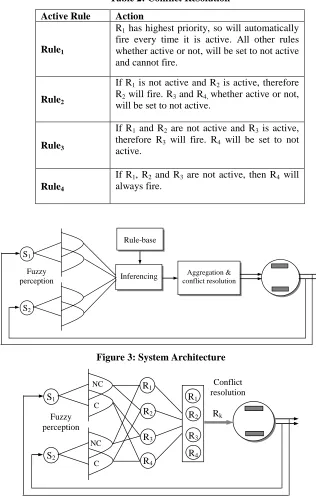
This paper proposes a perception-based model of system behaviour and to implement this model on a real experimental set-up. Using this model, a robot will be able to perceive its environment, make decisions, represent sensed data and infer rules concerning the environment. It will have the ability to move to a target point while avoiding obstacles in the work space. The basic system architecture is shown in Figure 3. Using only two infra-red sensors, the robot will be able to perceive the distances S1 and S2 from an obstacle and decide
)))
(
*
(
1
/(
.
1
])
,
[
,
(
X
A
C
EXP
A
X
C
sigmf
(1) [image:3.612.206.420.143.262.2]The sigmoid membership function constrains the perceived sensor values between the limits of zero and one, see Figure 1 .
Figure 1: Sigmoid Membership Function
These fuzzy values then go through the inferencing process using a rule base. After inferencing, the robot will be able to decide on the appropriate action to take. For example, if S1 perceives it is very close to an obstacle,
and if S2 also perceives that it is close to an obstacle, then the robot should move backwards as shown in Figure
[image:3.612.221.406.357.448.2]2.
Figure 2: Perception of Distance
The perceptions about distances are quantified by fuzzy linguistic variables NC and C that are defined as NC
ˆ
Not Close and C
ˆ
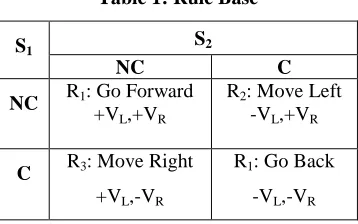
Close. It is obvious from the system architecture and the rule-base, shown in Table 1, that more than one rule can fire at the same time, which induces conflict between fired rules causing the robot not to move to any direction, stuck at a corner or leading to indecision.Table 1: Rule Base
S1 S2
NC C
NC R1: Go Forward +V
L,+VR
R2: Move Left
-VL,+VR
C R3: Move Right
+VL,-VR
R1: Go Back
-VL,-VR
[image:3.612.226.405.561.673.2]problems. The rule-base in Table 1 can be replaced with a rule-network and the aggregation unit is replaced with a conflict resolution unit. The modified system architecture is shown in Figure 4. The modified system architecture works in a similar fashion to the original architecture, however, each rule has a fixed priority according to (2) and only one rule will be fired at one time.
1,
2,
3,
4
max
priority
R
R
R
R
R
k
,k
1
,
2
,
3
,
4
(2)Rule1 has the highest priority and if active, will always fire. The action for each rule is outlined in Table 2.
Table 2: Conflict Resolution
Active Rule Action
Rule1
R1 has highest priority, so will automatically
fire every time it is active. All other rules whether active or not, will be set to not active and cannot fire.
Rule2
If R1 is not active and R2 is active, therefore
R2 will fire. R3 and R4, whether active or not,
will be set to not active.
Rule3
If R1 and R2 are not active and R3 is active,
therefore R3 will fire. R4 will be set to not
active.
Rule4
If R1, R2 and R3 are not active, then R4 will
always fire. S1 S2 Inferencing Rule-base Aggregation & conflict resolution Fuzzy perception Figure 3: System Architecture
[image:4.612.145.461.202.706.2]S1 S2 Fuzzy perception R4 R3 R2 R1 R4 R3 R2 R1 Conflict resolution Rk NC C NC C
3 Experimental Results
[image:5.612.356.506.205.388.2]In this section, the paper presents experimental results of the developed methodology when applied to a Khepera robot and its simulator KIKS. Khepera is a research oriented mobile robot that was developed by Prof. Jean-Daniel Lacoud as a teaching tool in the mid nineties. It is both small and fast and manufactured around a Motorola 68331. It has eight infrared proximity and ambient light sensors, two of which will be used in this research. Khepera allows for the real-world testing of algorithms for trajectory planning, obstacle avoidance, pre-processing of sensory information, etc. [K-Team, 2006]. The Khepera robot and its functional block diagram are shown in Figure 5 and Figure 6. Although Khepera has eight infrared sensors, for the purpose of this model only two will be used, S1 and
[image:5.612.110.250.242.368.2]S2.
Figure 5: Khepera Robot
Left
wheel
Right
wheel
Sensor
S
1Sensor
S
2Figure 6: Functional Diagram of Khepera
Initial tests were carried out on a simulated version of Khepera. Under simulation, Khepera does not collide with any obstacles, each one is avoided. However, the movement of the robot is quite erratic and in real-world situations this could prove to be problematic. Figure 7 shows the trajectory of a simulated Khepera when moving in a confined space with a number of obstacles included.
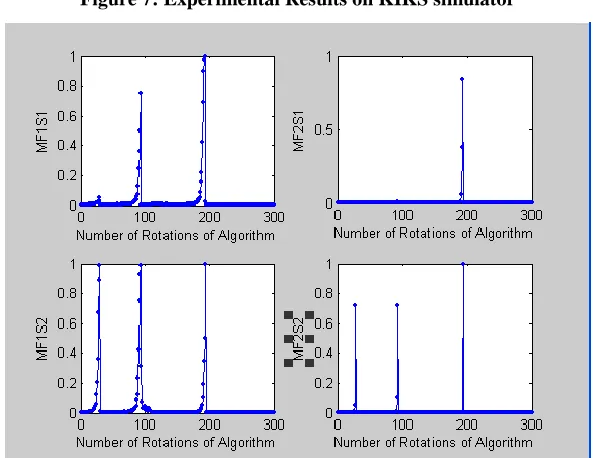
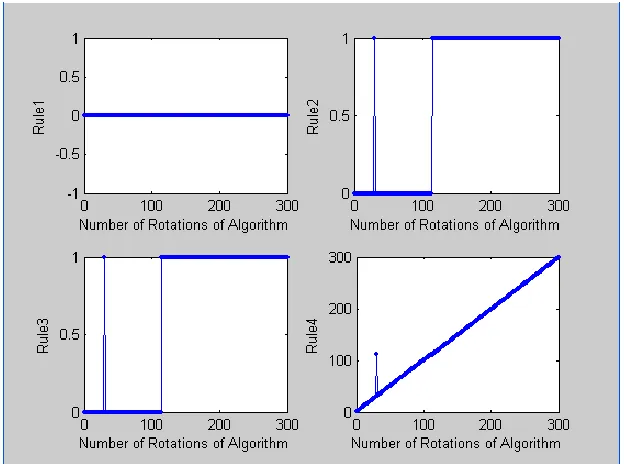
When the algorithm was tested on a real world model, Khepera, the results were different than expected. The algorithm was not as successful in a real world situation compared to simulation. The first problem was that the values gathered by the sensors were much larger than in simulation. These larger values proved problematic when entered into membership functions. A modification had to be made to the algorithm to counter these larger values. Before the sensor values entered the membership functions they were reduced by dividing each one by 100. This brought them back to more workable sizes. Another problem was the movement of Khepera. Although it worked according to the algorithm, when approaching an obstacle it got caught in a cycle of moving forwards and backwards. This was caused by new fuzzy values being generated during each cycle of the algorithm. When the robot moved close to an obstacle the rule was fired to activate Khepera to move away, but as soon as the robot had moved away a short distance, another rule was fired to allow it to move forward again. The resulting action taken to improve upon this was to remove the option for Khepera to turn right. This allowed Khepera to continue moving freely without being caught in the forward backward cycle. With minor modifications to the algorithm, Khepera successfully avoids obstacles and travels in a smooth movement. Figure 8 shows a plot of the membership function values during each cycle of the algorithm. The algorithm was rotated 300 times. Figure 9 shows a plot of the number of times each rule was fired during each cycle of the algorithm. Clearly, every time Khepera is tested, different results are given as according to the work space Khepera moves in a different trajectory.
Nevertheless, future work could involve refining the algorithm to realize both smooth trajectory and obstacle avoidance simultaneously.
Figure 7: Experimental Results on KIKS simulator
[image:6.612.157.457.452.681.2]Figure 9: Rules Fired
4 Conclusions
For robots to achieve the remarkable capabilities of humans, they need to progress counter-traditionally from relying on measurements to utilizing and exploiting perceptions. A perception-based system of control will allow a robot to carry out tasks in an unknown environment with changeable conditions. The robot will perceive their surroundings and according to a rule base, will decide on an appropriate course of action. Incorporating perceptions will remove the need for explicit and exact sensor data and possibly reveal a new approach to robot navigation.
5 References
[Armingol et al., 1998] Armingol, J. M. et al. (1998) “Landmark Perception Planning for Mobile Robot Localization”, Robotics and Automation, Vol. 4, pp. 3425 – 3430.
[Berenji et al., 1993] Berenji, H. R. et al. (1993) “An Introduction to Intelligent and Autonomous Control”, Kluwer Academic Publishers, ISBN: 0-7923-9267-1.
[Fukuda and Kubota, 1999] Fukuda, T. and Kubota, N. (1999) “An Intelligent Robotic System Based on a Fuzzy Approach”, Proceedings of the IEEE, Vol. 87, No. 9. pp. 1448 – 1470.
[Ghaffari et al., 2004] Ghaffari, M. et al. (2004) “A Framework for the Natural Language Perception-Based Creative Control of Unmanned Ground Vehicles”, Proc. of SPIE Defence and Security Symposium, 5422, Orlando (Kissimmee), Florida.
[Ghaffari et al., 2004] Ghaffari, M. et al. (2004) “A Perception-Based Approach toward Robot Control by Natural Language”, Intelligent Engineering Systems through Artificial Neural Networks, Vol. 14, pp. 391 – 396.
[Goodridge, 1994] Goodridge, S. G. (1994) “A Fuzzy Behaviour-Based Nervous System for an Autonomous Mobile Robot”, URL: http://sggoodri.home.mindspring.com/thesis/contents.htm, Accessed: 10 July 2006, 18:32:38.
[Graefe, 1998] Graefe, V. (1998), “Perception and Situation Assessment for Behaviour – Based Robot Control”,
[Hangos, 2004] Hangos, K. (2004) “Fuzzy Rule-Based Systems, Fuzzy Sets and Calculus”, University of Veszprem, URL: http://daedalus.scl.sztaki.hu/PCRG/education/ve/Phd_AI/fuzzy.pdf, Accessed: 26 June 2006, 15:36:32.
[K-Team, 2006] Khepera Robot, K-Team Corporation, URL:
http://www.k-team.com/kteam/index.php?site=1&rub=22&page=17&version=EN, Accessed: 05 June 2006, 13:45:33.
[Kubota et al., 2003] Kubota, N. et al. (2003) “A Perceptual System for Vision-Based Evolutionary Robotics”, IEEE International Conference on Neural Networks and Signal Processing, (ICNNSP 2003), China.
[Kubota et al., 2003] Kubota, N. et al. (2003) “A Sensory Network for Perception-Based Robotics Using Neural Networks”, Proceedings of the International Joint Conference on Neural Networks, Vol. 4, pp. 3151 – 3156.
[Mobahi and Ansari, 2003] Mobahi, H. and Ansari, S (2003), “Fuzzy Perception, Emotion and Expression for Interactive Robots”, IEEE International Conference on Systems, Man and Cybernetics, Vol. 4, pp. 3918 – 3923.
[Oren and Yilmaz (2004)] Oren, T. I. and Yilmaz, L. (2004) “Behavioural anticipation in agent simulation”, Proceedings of the 2004 Winter Simulation Conference, Vol. 1, pp. 806 – 812.
[Pack, 1996] Pack, D. J. (1996) “Perception-Based Control for a Quadruped Walking Robot”, Robotics and Automation, Vol. 4, pp. 2994 – 3001.
[Petriu, 2001] Petriu, E.M. (2001) “Robot Sensing and Perception”, Sensing and Modelling Research Laboratory, School of Information Technology, University of Ottawa.
[Roy, 2005] Roy, D (2005), “Grounding words in perception and action: computational insights”, Trends in Cognitive Sciences, Vol. 9 No. 8, pp. 389 – 396.
[Saffiotti, 1997] Saffiotti, A. (1997), “The uses of fuzzy logic in autonomous robot navigation”, Soft Computing – A Fusion of Foundations, Methodologies and Applications, Vol. 1, No. 4, pp. 180-197.
[Seraji and Howard, 2002] Seraji, H., Howard, A. (2002), “Behavior-Based Robot Navigation on Challenging Terrain: A Fuzzy Logic Approach”, IEEE Transactions on Robotics and Automation, Vol. 18, No. 3, pp. 308-318.
[Silva, 2005] Silva, C. W. (2005) “Intelligent Control Presentation Part 2”, University of British Columbia, URL:
http://www.researchcentre.apsc.ubc.ca/MECH523/2-mech-523-presentation.pdf, Accessed: 05 June 2006, 16:55:56
[Simon, 2000] Simon, D. (2000), “Design and Rule Base Reduction of a Fuzzy Filter for the Estimation of Motor Currents”, International Journal of Approximate Reasoning, Article No. 6108, pp. 1-23.
[Sowell, T., (2006)] Sowell, T. (2006) “Fuzzy Logic for ‘Just Plain Folks’”, URL: http://www.fuzzy-logic.com/, Accessed: 15 June 2006, 14:21:23.
[Sugeno and Nishida, 1985] Sugeno, M. and Nishida, M. (1985), “Fuzzy Control of Model Car”, Fuzzy Sets and Systems, Vol. 16, Issue 2, pp. 103-113
[Zadeh, 2002] Zadeh, A. L. (2002) “From Computing with Numbers to Computing with Words – From Manipulation of Measurements to Manipulation of Perceptions”, IEEE Transactions on Circuits and Systems, Vol. 45, pp. 105 – 119.
[Young, 1994] Young, J. F. (1994) “Rice ELEC 201: Introduction to Engineering Design” Course Notes, Rice University, URL: http://www.owlnet.rice.edu/~elec201/Course_Notes.htm, Accessed: 10August 2006, 11:23:56.