The London School of Economics and Political Science
‘The Social Dynamics o f Student Mobility in the European Union
9
by
Apostolos Dimitropoulos
This Thesis is submitted in fulfillment of the requirements for the degree Doctor of Philosophy
UMI Number: U615243
All rights reserved
INFORMATION TO ALL USERS
The quality of this reproduction is dependent upon the quality of the copy submitted.
In the unlikely event that the author did not send a complete manuscript and there are missing pages, these will be noted. Also, if material had to be removed,
a note will indicate the deletion.
Dissertation Publishing
UMI U615243
Published by ProQuest LLC 2014. Copyright in the Dissertation held by the Author. Microform Edition © ProQuest LLC.
All rights reserved. This work is protected against unauthorized copying under Title 17, United States Code.
ProQuest LLC
789 East Eisenhower Parkway P.O. Box 1346
Abstract of Thesis
Table of Contents
Table o f Contents 1
List o f Tables 3
Abbreviations 7
Acknowledgements 8
Introduction
1 Rationale for the study 10
2 Main argument o f the Thesis 13
3 Structure of the Thesis 16
Chapter 1; Approaches to student mobility
Introduction 17
1 Early approaches on student mobility and foreign study 17
2 Student mobility as internationalisation of higher education 21
3 Economic approaches 26
4 Other approaches 30
5 Research on student motives for study abroad 32
6 Research on student motives in the UK 42
Conclusions 44
Chapter 2: Theoretical underpinnings of the Thesis and main concepts used
Introduction 46
1 Student mobility, the structuration of the European educational space,
European social integration 46
2 Hierarchies and social action 50
3 Hierarchies, educational systems and educational choices 52
4 Higher education choice in mass higher education systems 55
5 System and social regulation of the social demand for higher education
across EU countries 57
6 The UK higher education system. System and social integration 59 7 Dimensions of globalisation and European integration and their effects
on labour markets 65
8 Research questions and hypotheses 70
Chapter 3: Flows, patterns, and trends in student mobility in the EU
Introduction 72
1 European student mobility in the global context 73
2 Patterns and trends in European student mobility from early 1980s
to mid-1990s 75
3 Student mobility flows within the EU mobility programmes 89
4 Students from EU countries in UK higher education institutions:
enrolments and applications 100
Chapter 4: Macro and meso level actors, student mobility, and the structuration of the European educational space
Introduction 124
1 The EU level 124
2 The Bologna process 131
3 The national level 132
4 The institutional level 137
5 EU students and the UK policy 140
Conclusions 142
Chapter 5: The research methodology
Introduction 145
1 Data collection tools 146
2 Qualitative Data 147
3 Quantitative data 151
Chapter 6: Results and analysis of quantitative data
Introduction 157
1 Sample description 157
2 The choice to study abroad 171
3 Frequencies 171
4 Principal Component Analysis and Analysis o f Covariance 179
5 The choice o f the UK as the place to study abroad 203
6 Frequencies 203
7 Principal Components Analysis and Analysis of Covariance 209
Summary o f main findings 225
Chapter 7: Discussion of main findings and conclusions of the Thesis
Introduction 226
1 Limitations o f the study 229
2 Understanding the choice to study abroad 230
3 Understanding the choice o f the UK as the place to study abroad 239
4 Conclusions o f the study 245
5 Further research and directions o f study 250
REFERENCES 253
APPENDICES
Appendix 1: Flows and patterns o f European student mobility 268
Appendix 2: Factors extracted with Principal Component Analysis 280
Appendix 3: Results of Analysis o f Covariance: Mean estimates offactor scores 285
Appendix 4: The ADMIT project 294
List of Tables
Chapter Three
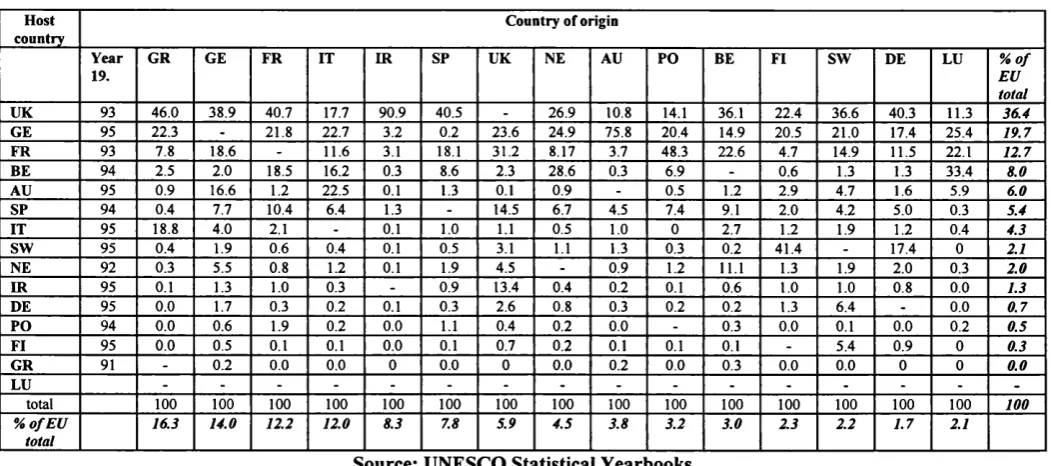
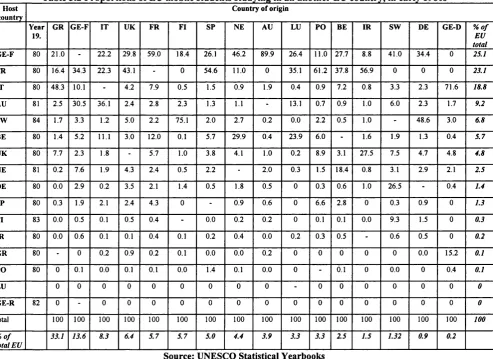
Table 3.1 Share of foreign students studying abroad in OECD countries, by region of origin Table 3.2 Proportions of EU mobile students studying in an another EU country, in early 1980s Table 3.3 Incoming and outgoing student ratios, by country in early 1980s
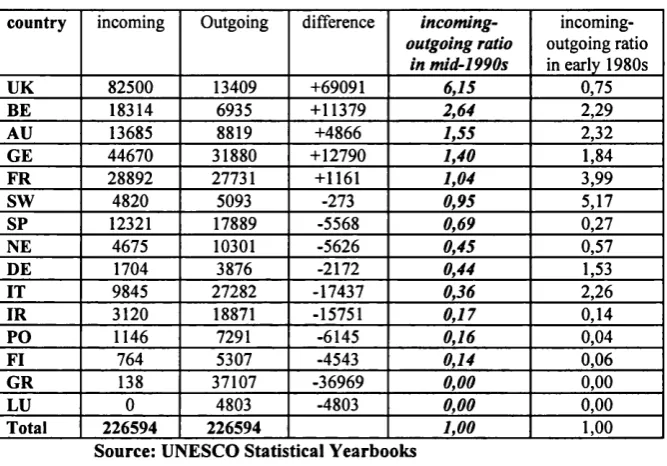
Table 3.4 Proportions of EU students studying in another EU country in mid-1990s Table 3.5 Outgoing students in early 1980s and mid-1990s, by country o f origin Table 3.6 Incoming and outgoing students in mid- 1990s
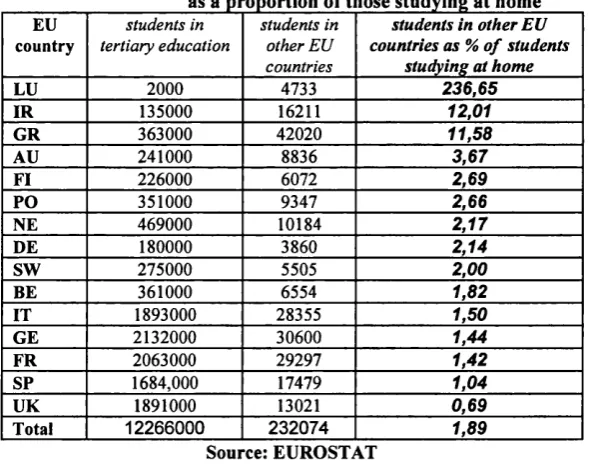
Table 3.7 EU students studying in an EU country other than their own, as a proportion of those studying at home
Table 3.8 Actual number of ERASMUS students, by field of study (1987-2000)
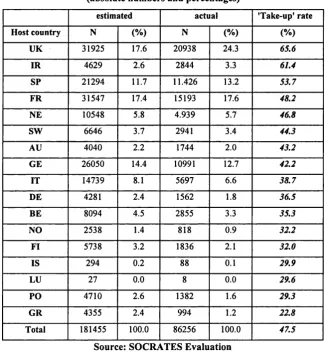
Table 3.9 Home country of the 'estimated' and 'actual' numbers o f ERASMUS students in 1997/98 (absolute numbers and percentages)
Table 3.10 Host country of the 'estimated' and 'actual' numbers of ERASMUS students in 1997/98 (absolute numbers and percentages)
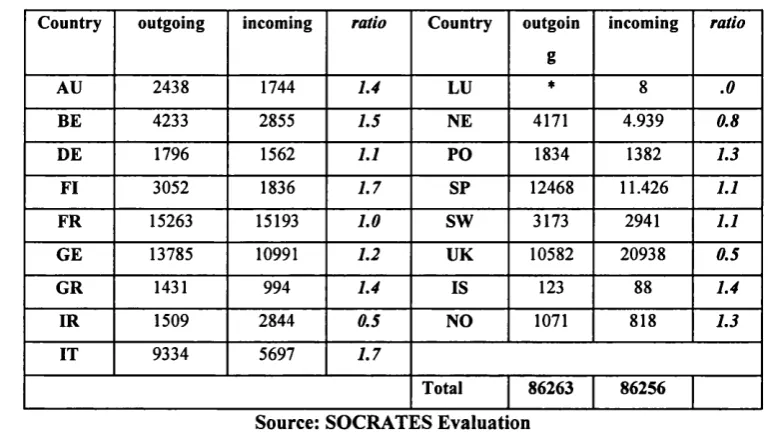
Table 3.11 Number and ratio of incoming and outgoing ERASMUS students, 1997/98
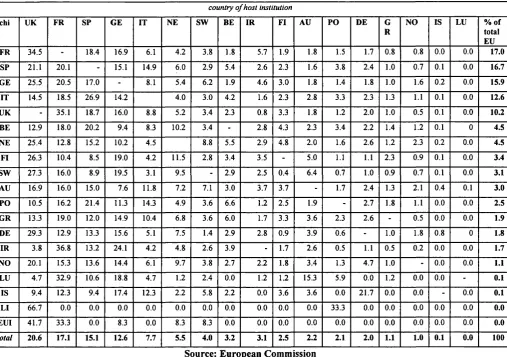
Table 3.12 Actual student mobility within the ERASMUS programme, by country of home institution, and host country in 1999/2000 (percentages rounded)
Table 3.13 TMR applicants, by level and panel, 1994-98
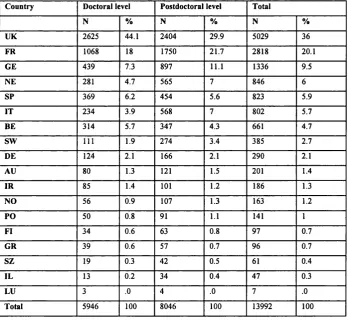
Table 3.14 TMR applicants, by level, and country of nationality, 1994-1998 Table 3.15 TMR applicants, by level, and host country of application, 1994-1998 Table 3.16 International students in the UK, 1979/80 to 1998/99
Table 3.17 EU domiciled students in UK higher education, by EU country of domicile level of study, and sex, 1997/98
Table 3.18 Proportions of EU students in the UK, by subject, and country of domicile, 1997-98 Table 3.19 EU domiciled student enrolments, by subject, and sex, 1997/98
Table 3.20 EU undergraduate applicants, by country of domicile, 1994-1999 (absolute numbers and percentages)
Table 3.21 Rates of shifts of EU student applicants by country of domicile, 1994-1999 (undergraduate level only)
Table 3.22 EU applicants, by subject group, 1994-1999
Table 3.23 EU student applicants, by subject group, 1994-1999 (undergraduate level only)
Table 3.24 Percentages of EU applicant students, by country of domicile, and preferred subject group, 1999
Chapter Six
Table 6.1 Students by type of study, and sex Table 6.2 Level of study of degree students
Table 6.3 EU country of student origin, by type of study Table 6.4 Mean age and Std Deviation of students Table 6.S Degree students: subject group studied
Table 6.6 Period of study students: subject group studied at home institution Table 6.7 Perceived family socio-economic status, by type of study abroad Table 6.8 Level of mother education, by type of study
Table 6.9 Level of father education, by type of study Table 6.10 Parental education, by type of study
Table 6.11 Type of UK university where EU students study, by type of study Table 6.12 Main source of finance, by type of study
Table 6.13 Proportions of prior experience abroad, by type of study Table 6.14 Language competence of students, by type of study Table 6.15 Family experience abroad, by type of study
Table 6.16 Year of beginning course in the UK, degree students
Table 6.17 Reasons for studying for a degree abroad: percentage rating each as important/very important
Table 6.18 Reasons for studying for a period abroad: percentage rating each as important/very important
Table 6.19 Principal Component Analysis: reasons for choosing to study for a degree abroad Table 6.20 Significant associations of factors for choosing to study for a degree abroad Table 6.21 Principal Component Analysis: reasons for studying for a period abroad Table 6.22 Significant associations of factors for choosing to study for a period abroad
Table 6.23 Reasons for choosing to study in the UK for a degree: percentage rating each important/very important
Table 6.24 Reasons for choosing to study in the UK for a period: percentage rating each important/very important
Table 6.25 Principal Component Analysis: reasons for selecting the UK as the place to study abroad for a degree
Table 6.26 Significant associations of factors for selecting the UK as the place to study for a degree abroad
Table 6.27 Principal Component Analysis: Reasons for selecting the UK as the place to study for a period.
Appendices
Appendix 1
Table A .l EU mobile students studying in another EU country in early 1980s (absolute numbers) Table A.2: EU mobile students in the mid-1990s (absolute numbers)
Table A.3 Actual mobility of students within ERASMUS by country of home institution and host country, 1994-95 (absolute numbers)
Table A.4 Actual mobility of students within ERASMUS by country of home institution and host country in 1994/95 (percentages)
Table A.5 Actual student mobility within the ERASMUS programme, 1999-2000 (absolute numbers)
Table A.6 EU domiciled students in UK higher education by EU country o f domicile level of study, and sex, 1997/98
Table A.7 EU students in the UK, by subject and country of domicile, 1997-98 (absolute numbers)
Table A.8 EU domiciled enrolments by subject and sex, 1997/98
Table A.9 EU student enrolments in the UK, 1997/98 (absolute numbers)
Table A.10 EU applicants by country of domicile and preferred subject group, 1999 Table A .l l EU applicants by country of domicile and preferred subject group, 1994
Table A.12a Percentages of EU applicants by country of domicile and preferred subject group, 1994 and 1999
Table A.12b Percentages of EU applicants by country of domicile and preferred subject group, 1994 and 1999
Appendix 2
Table A13 Mean estimates of factor scores, by student origin (grouped) Table A14 Mean Estimates of factor scores, by parental education Table A15 Mean estimates of factor scores, by type of university Table A16 Mean estimates of factor scores, by sex
Table A17 Mean estimates o f factor scores, by subject Table A18 Mean estimates of factor scores, by level of study
Table A19 Mean estimates o f factor scores, by perceived socio-economic status Table A20 Mean estimates o f factor scores, by main source of finance
Table A21 Mean estimates of factor scores, by student origin (grouped) Table A22 Mean Estimates of factor scores, by parental education Table A23 Mean estimates of factor scores, by type of university Table A24 Mean estimates of factor scores, by sex
Table A26 Mean estimates of factor scores, by level of study
Table A27 Mean estimates of factor scores, by perceived socio-economic status Table A28 Mean estimates of factor scores, by main source of finance
Table A29 Mean estimates of factors, by student origin (grouped) Table A30 Mean estimates of factors, by level of mother education Table A31 Mean estimates of factors, by type of university Table A32 Mean estimates o f factors, by sex
Table A33 Mean estimates, by subject group studied at home
Table A34 Mean estimates of factors, by socio-economic status Table A35 Mean estimates of factors, by mode of study abroad Table A36 Mean estimates of factors, by main source of finance Table A37 Mean estimates of factor scores, by student origin (grouped)
Table A38 Mean estimates of factor scores, by type of university Table A39 Mean estimates of factor scores, by level of mother education
Table A40 Mean estimates of factor scores, by socio-economic status Table A41 Mean estimates of factor scores, by sex
ABBREVIATIONS
ADAR: Art and Design Admissions Registry AU: Austria
BE: Belgium DE: Denmark
DfEE: Department for Education and Employment FI: Finland
FR: France GE: Germany
GE-D: Democratic Republic of Germany GE-F: Federal Republic of Germany GR: Greece
HESA: Higher Education Statistical Agency HU: Hungary
IR: Ireland IS: Island IT: Italy
LI: Liechtenstein LU: Luxembourg NE: Netherlands NO: Norway
OECD: Organisation for Economic Cooperation and Development PO: Portugal
SP: Spain SW: Sweden SWI: Switzerland SZ: Switzerland
UCAS: Universities and Colleges Admissions System UK: United Kingdom
UKCOSA: The UK Council for International Education
Acknowledgements
Many people from different parts of Europe have provided invaluable support and help in carrying out this research and should be acknowledged.
I should, first, thank Professor Anne West, Director of the Centre for Educational Research (CER) at the London School of Economics, and Coordinator of the EU- fimded ADMIT project, for all the support and efforts made in coordinating and guiding the ADMIT project, making the EU student survey possible to happen, and providing additional financial support needed. Without Anne’s kind support, close guidance, and understanding this research would not have been initiated.
I should thank all my colleagues at the CER for their help in carrying out the student survey, and particularly Dr Philip Noden for his valuable comments, encouragement, and support in all kinds of pitfalls encountered.
I would also like to thank all ADMIT project partners for their valuable comments and suggestions in the project meetings and for giving me the opportunity to gradually develop a more Europe-wide understanding o f issues related to student mobility and higher education internationalisation.
I am deeply indebted to my supervisor John Barnes for all his critical comments, suggestions, and kind support. John’s comments have always been a source of intellectual stimulation. Without him the Thesis would have not taken its present form.
I am also indebted to Dr Michael Bruter for taking over the supervision of this research at the final stages, after John’s retirement. Michael’s comments contributed a lot to the Thesis improvement and final form.
I should also acknowledge the invaluable help with the statistical analysis that Dr Amani Siyam (in London), and Professor Giannis Matsinos (in Athens) readily and patiently offered.
It is no need to add that this research would have not been possible without the cooperation o f the staff of the UK universities participated, and those students that offered themselves to be interviewed and completed the questionnaire. I ought a great deal to them too.
Finally, I would like to thank all my friends and particularly Dr Costas Vouyoukas, Dr Artemis Kourtessis, Professor Pavlos Lefas, and Dr Chrisafis Iordanoglou for listening to my ideas, constructive commenting on them, and all kinds o f emotional and practical support they always readily offered.
Introduction
1 Rationale for the study
At a world level, the European Union is the macro-region that has achieved the highest degree of integration among its members. The European Union (EU) is distinguished from other regional cooperation patterns, for the gradually increasing role of European institutions in the formulation and development o f public policies, the gradual extension of competencies of European institutions in new policy areas, and the expansion over new territories, with subsequent enlargements to include new members.
The study o f the European integration process and its outcomes, to date, has been mainly subject to economics, international relations, political science, and law approaches. In particular, economists focus on the process and development of European economic integration, and the interactions among economic actors. International relations approaches examine the relationships and interactions of European national governments. Political scientists explore the interactions and roles of European institutions and national or transnational interests in the development of EU public policies and the transfer o f policy competencies from national to European institutions. Legal approaches examine the role of European law in the process of European integration. The study, however, of the interactions and effects o f European social actors and social systems and the development of transnational social spaces within the EU region is less often investigated and less well developed.
educational institutions -and particularly higher education institutions- with a European or other international dimension are central in the EU educational policies. Prominent among them is the promotion of mobility of staff and students across the EU member states. European educational institutions, staff and students have found additional support for such activities.
The European educational space creation, higher education internationalisation, and the rapprochement o f European national societies, their social systems and actors are ongoing and growing social processes involving actions and responses o f multiple, actors, public or private, collective or individual with unequal resources at their disposal. These mainly include European institutions (European Commission, European Parliament, European Court of Justice, European Council o f Ministers), national and regional governments, national or transnational business associations, higher education institutions and departments, transnational associations and networks of higher education institutions, individual academics and other higher education staff, and students. Policies adopted and promoted by public authorities set the stage, and shape the contexts within which social actors operate. Such contexts of opportunities or constraints may be shaped by deliberate policies, by consequences of other policies, often rational and intended but also unintended.
Focusing on mobile students, the Thesis seeks to provide a theoretically informed empirical understanding of the factors influencing student choice to study abroad in the EU. Specifically, it seeks to shed light on the social dynamics and the 'driving forces' o f the growing process of complete or partial internationalisation o f higher learning processes and o f the student population in EU higher education institutions. Such an understanding of the social dynamics o f student mobility in the EU also contributes to our understanding of the process o f the European educational space creation and the broader process of rapprochement of European higher education institutions and societies, that is, the social dynamics of European social integration. In addition, such an understanding can provide a basis for a partial evaluation of policies supporting the development of student mobility and further inform policy making and policy design at the EU, the national, and the level o f higher education institutions.
Student mobility is a phenomenon that has a historical and global dimension. Students have been found to study abroad even before and without the policy support of national and European authorities or other international organisations, but on their own initiative. The number, however, of students studying in a country other than their own for a short period of study, the full duration o f a higher level degree or for their whole higher level learning is on the increase, with sometimes a regional dimension. Although, reliable statistical data at a global level is difficult to obtain-and those available must be treated with much caution- it appears that such an increase is, particularly, observed in the EU region.
2 The Thesis' main argument
This investigation set out to contribute to our understanding of the growing phenomenon o f student mobility and the variable patterns o f mobile student flows in the European Union. It approaches students as social actors, and their educational choice to study abroad as social action resulting in the structuration of the European educational space. The European educational space is a transnational social space o f actions and interactions of multiple actors with unequal resources at their disposal, acting at different levels (European, national, or the level of higher education institutions). Such superordinate actors, acting at macro or meso levels, develop policies and regulations, setting limits and constraints or providing opportunities to subordinate social actors acting at lower and micro levels.
The Thesis takes the case of students from EU countries studying in UK universities, as subordinate micro-level social actors, and seeks to provide an evidence based and theoretically informed understanding of the social factors influencing such choice and action. It thus seeks to contribute to our understanding o f the social dynamics of student mobility, the internationalisation of higher education, the structuration o f the European educational space, and the process of European social integration. Therefore, it examines how student choice to study abroad increases student's cultural capital in their social struggle for successful entry and development within labour markets, the hierarchies of occupations, and social hierarchies in European societies. Specifically, it examines the role of globalisation and European integration processes, the massification o f higher education systems, the stratification o f higher education systems and institutions in the EU, and the diversity of systems and traditions across EU countries, in student educational choices and actions.
provides evidence that the dynamics o f student mobility appear to transcend and constrain such educational policies developed at a European, national or institutional level.
Therefore, the Thesis argues that a better understanding of student mobility in the EU can be provided by focusing on the social factors shaping student motives for studying abroad and influencing student educational choices. Specifically, the evidence o f students from EU countries studying in the UK, for a degree or for a period, suggests that international educational mobility o f students may be best understood as a social action, choice, and strategy relating to student's social aspirations for either upward social mobility or maintaining student's high social position.
to best explain the popularity of the UK (and other English speaking countries at a global level) as destination country among EU mobile students. It may also best explain changes in the direction of student flows towards the UK that have occurred in the same period. The effects, however, of globalisation and European integration on student perceptions and educational choices does not seem to be spread in a uniform way across labour market segments and social domains. Such uneven effects may also account for differences in student mobility flows across subjects mobile students more frequently choose to study abroad.
3 Structure o f the Thesis
Chapter One reviews main themes in the literature on student mobility with emphasis
on student motives for study abroad. It shows that little empirical research has been carried out on motives for studying abroad of students from, particularly, developed countries, and little theoretically informed understanding has been provided to date.
Chapter Two places student mobility into the conceptual framework o f social and
educational choice, action, and the structuration of the European educational space, discusses the theoretical underpinnings o f the Thesis, clarifies main concepts used, and presents the research questions for investigation.
Chapter Three o f the Thesis examines mobile student flow trends and patterns and
argues that student mobility in the European Union is on the increase but flows across countries are highly asymmetric. It also examines EU student flow patterns towards the UK and shows the rapidly increasing trends with large differences across country of domicile, sex, field, and level of study.
Chapter Four o f the Thesis focuses on macro and meso level actors and the
structuration of the European educational space. It argues that although such actors, developing policies and regulations, set limits or provide opportunities to students in their educational choices, a focus on the existing policy and regulatory context does not provide satisfactory explanations for the growing trends, flow patterns and the dynamics o f student mobility in the EU.
Chapter Five presents the methodology employed and guided the collection of
qualitative and quantitative student data and the analytic approach adopted.
Chapter Six presents the results and analysis of quantitative data collected.
Chapter Seven discusses main findings (and limitations of this study), presents
Chapter One
Approaches to student mobility
Introduction
This chapter reviews the literature and research on foreign students and international study. Literature and empirical studies in this area are large and diverse bringing in different social science disciplines, such as sociology, economics, political science, international relations, and psychology. 1 Therefore, this review adopts a historical perspective and focuses on main themes and approaches o f international study and student mobility. Throughout this review connections are made with policy developments, rationales, and approaches on student mobility at a national or international level. The last sections of this chapter reviews research and literature on students and their motives for study abroad. Emphasis is given on students in the European Union and the UK context, reflecting the focus of the overall research project.2
1 Early approaches on student mobility and foreign study
The international role of higher education institutions o f developed countries is historical and multiple. Higher education institutions of western -and more developed- countries have a long tradition in developing activities with an international dimension, also including foreign student recruitment. As Knight and de Wit (1995) argue in the period from the 18th century, and until the Second World War, western universities served mainly the national objectives of nation-states. In this period,
European universities, in particular, had three main international roles and activities i) they served as models adopted by, and transferred in other countries, ii) international communication of academics in scientific research, and iii) individual mobility of students and mainly scholars. Flows and patterns of such mobility were mainly shaped by the colonial relationships within, for example, the British Empire and France and its colonies.
In the first post-war period and in the context of the 'cold war' the international activities of universities were rather limited and -with few exceptions- were mainly replaced by nation-state cultural agreements, as part o f their foreign policy activities (Knight and de Wit, 1995:5-9). In such a policy context at the national level, international organisations such as UNESCO, the Council o f Europe, the World Bank, and the OECD seems to have played an important role supporting international activities of higher education institutions and encouraging international co-operation and development . Support for international mobility o f students and, particularly, academics was seen as an instrument of cultural communication, promoting mutual understanding and international peace. It must, however, be also added that the role of national competitions over spheres o f influence within and between the international divisions brought about within the cold war dogma cannot be underestimated4. This is also reflected in patterns of student mobility mainly developing within the two blocs, and the limited mobility o f students between Eastern and Western Europe throughout the post-war period and until 1989 (see UNESCO statistics). In the European region, it seems that the Council of Europe, operating above the European divide, has sought to support communication channels between Eastern and Western European universities promoting particularly mobility o f academics. The role, however, o f the
3 The role played by international organisations throughout this period is also illustrated in the historical experiences and development o f the European University Association (known as CRE before 2001), a non-governmental association o f European universities, set up in 1959 to promote academic cooperation and mobility in Europe, presented by Barblan (2002).
Council of Europe and its activities in the educational and cultural domains throughout this period, appear not to have been thoroughly examined yet.
In the '60s and '70s and in the context of post-colonialism a one-way relationship was established in the international relations of universities and other higher education institutions. International relations and activities of higher education institutions in this period were characterised by: i) the growing number of students (as well as young scientists and scholars) from less developed and developing countries studying and receiving high level training in developed countries, and ii) the financial support and knowledge transfer (technical assistance) from developed to developing countries. International organisations, national governments and higher education institutions of receiving countries played an important role supporting, encouraging, and facilitating such activities (Knight & de Wit, 1995:5-9). Mobility of academics and students was also encouraged within the Commonwealth countries5.
In this period two main theoretical approaches on the international role o f education were developed, the development theory (also referred to as modernisation theory) and the dependence theory (see also Goodman, 1984) largely reflecting ideological and political conflicts within the developed countries. These approaches influenced the direction and provided the conceptual lenses for empirical research and studies carried out. Development theory approaches international study and the international role of educational institutions -particularly higher education institutions- from the perspective of human capital development and provided the theoretical underpinnings for policy development. In this perspective, the international mobility o f students constitutes an instrument for the transfer o f knowledge and technology ('know-how') across countries. Such knowledge was seen as crucial for the economic and social development of less developed and developing countries. Critical approaches, however, emphasised the curriculum within developed countries and its relevance to the developing countries' needs. As Altbach and Lulat argue, in relation to the US, empirical research in this area is still limited and 'the few studies that have looked at this issue indicate that, in general, US curricula are not particularly suited to the needs
of international students coming from Third World countries- especially with respect to the technical disciplines (engineering, agriculture, etc.) at the advanced levels'6 (1985:32). It appears, however, that no research has been carried out on the curriculum relevance of study abroad for students from less developed or developed countries studying in another developed or less developed country. Critics also pointed to the 'brain-drain' from developing to developed countries as students with high level expertise and ability tend to settle in host countries after the completion of
n
their studies .
Dependence theory points to the role of international study in the cultural integration of third world countries to the international economic and political system and to western culture and values. In the context of this approach emphasis was given to the integration of international students -and through them their countries of origin- in the values, beliefs, ideas, and consumer patterns of hosting countries. Students from less developed and developing countries studying at high levels abroad are usually a social elite group that upon their return play influential roles in their home countries. In this perspective international student mobility was seen as an instrument more of imposition of western culture on developing countries and cultures (cultural imperialism) than an instrument for their economic and social development (Camoy,
1974, Kumur, 1979, 1980).
This approach -and particularly the political socialisation aspect within it- is not, however, uncontested. As Williams, for example, notes with respect to students from British colonies studying in British universities, 'the widespread belief that many ideas about national independence were learned in the lecture rooms o f the LSE casts some doubt on this hypothesis. If it was imperialism it was an imperialism of ideas and not a narrow pursuit of British national interests' (1987b: 10)
6 For empirical studies on this issue see Altbach and Lulat (1985), p.32,
2 Student mobility as internationalisation of higher education
Since early 80s, and particularly in the 90s, the policy interest on student mobility and other international activities of higher education institutions has grown. Such activities of higher education institutions have attracted more the attention and
O Q
support of international organisations (e.g. OECD , UNESCO ) and the European Union institutions (Neave, 1984, Field, 1988). In addition, at the national level, although differences pertain (see Smith et. al, 1981, Kalvermark, 1997) governments have also developed policies supporting the international dimension of higher education institutions. The rationales underpinning such policy developments are multidimensional and interrelated, including economic, political, educational and cultural aspects. As Wende (1997:226-231) argues the economic rationale refers to policy objectives related to economic benefits (i.e. institutional income, net economic effect o f foreign students and commercial benefits). Political rationale refers to the role and position of a country in the world and the political and ideological influence it exercises on a world level. The educational rationale refers to educational aims and functions of higher education, and the cultural rationale refers to the importance of intercultural communication and understanding and the position of a country's own culture and language. In the EU context importance is also assigned to the educational implications and prerequisites of the development and successful operation of a European labour market and the political requirements for enhancing European identity and citizenship10.
Recent studies and literature relate the growing policy interest in the international role and activities of higher education institutions with the intensification of international interdependence and competition at a global level (Knight and de Wit, 1995), the
8 For research activities and OECD seminars related to the internationalisation o f higher education and foreign study see A. Dimitropoulos, (2000:pp.40-41). Internationalisation o f higher education and international trade o f educational services is also a priority theme in the current work programme o f the OECD educational services, as reflected by the growing studies and seminars on this theme organised under its auspices.
9 See for example the IAU (International Association o f Universities) Statement 'Towards a Century o f Cooperation: Internationalisation o f Higher education' developed by the IAU Task Force as a Framework for Action and tabled at the UNESCO Conference on Higher Education in October 1988 in BangkoK.
regional development and co-operation (regionalism) between different states in certain world regions (Blumenthal et al, 1996), and the growing globalisation of economies, societies, and knowledge (Wende 1997, Green 1997). In particular, Knight and de Wit stress the role o f the intensification o f international economic competition and interdependence with the dynamic entry into world economic developments o f Japan and the European Union. At the end of 1980s, those developments were reinforced and expanded with the collapse o f the Soviet Union and the re-entry o f Central and Eastern European countries into the western economic and political system. The impact of those developments Knight and de Wit argue was to give 'more emphasis to the globalisation of economic, social and political relations and knowledge' and 'to economic arguments for the promotion of international co operation and exchanges in higher education' (1995:9). Similarly, Smith (1981) also argues that the growing policy interest over higher education internationalisation, in this period, have been accompanied by more emphasis on the economic aspects, effects, and benefits accrued by related policy programmes and initiatives.
Blumental et al (1996) also point to the role of intense international interdependence and the emerging regional patterns of groups of nation states in different world regions. Regional cooperation and development is seen as an effort made by policy authorities, acting at different levels (international, national, subnational, institutional) to respond effectively to the new developments and the challenges set by growing international interdependence and competition. Among the educational implications of regionalism, prominent stands the development of policies, strategies and processes for the internationalisation of higher education systems and institutions.
as a means for increasing higher education institution's income as well as the national economic interest accrued by incoming students from other countries, ii) the use of new technologies in education services provision, and iii) the erosion o f traditional relations of nation state, educational systems, and values caused by the unlimited diffusion of knowledge and information made possible by information technologies11.
In this socio-economic, political and policy context, the study o f student mobility is placed within a novel conceptual framework. In particular, study abroad is approached within the wider concept of higher education internationalisation. The term internationalisation, although it is used in different ways (see Wende, 1997:17- 20) it generally refers either to policies and strategies developed at different levels (i.e. international, European Union, national, institutional) or as a process taking place
19
within higher education institutions and systems . Internationalisation either as policy or as process aims at or effects in the integration o f 'an international dimension into the research, teaching and services functions of an institution of higher education' (Knight & de Wit, 1995).
In such a context of growing policy interest at the international, European and national level policy programmes were developed supporting international activities in higher education institutions and mobility of students. Evaluation studies of related policy programmes, although of an empirical orientation, have focused on different aspects related to higher education internationalisation and student mobility within the developed countries. Such studies have, thus, expanded the knowledge base on the processes of higher education internationalisation and student mobility13. The growing policy interest in this area and the expansion o f international activities within higher education have also instigated studies o f a more theoretical orientation. Such studies approach higher education internationalisation and student mobility as
11 For a critical perspective and assessment o f the impact o f globalisation on national education systems see Green, 1997. Green disputes the notion o f a radical transformation o f national education brought about by the internationalisation o f national economies and societies. He does, however, accepts that national education systems have become more 'porous* as a result o f growing internationalisation.
12 For an analysis higher education internationalisation and a conceptual distinction between internationalisation as policy or process see also Callan, (1998).
approach higher education internationalisation and student mobility as processes of innovation and change at the institutional or system level and, more broadly, as processes o f social change.
Internationalisation activities as processes of innovation and change at an institutional and system level has been recently examined within an organisational perspective. Specifically, Wende (1999), drawing on organisational and innovation theories, and adopting a top-down perspective, sought to examine the factors determining the institutionalisation and stabilisation o f internationalisation processes and strategies within higher education institutions and systems. Important factors for internationalisation processes and changes to be successful Wende argues, are i) their compatibility with norms, values, and goals of higher education institutions and ii) their profitability, i.e. the satisfaction o f organisations' needs such as economic benefits or social benefits in the form of social prestige. This perspective, however, does not account for persistent variation in the responses, strategies and practices of higher education systems, institutions, departments, academics, and students to policies for internationalisation of higher education institutions within and across countries. For, neither all higher education institutions nor all departments across an institution are equally active in attracting non-national students, developing and sustaining exchange schemes or other activities with an international dimension14. Moreover, not all places available to students to study abroad within ERASMUS are taken up by students, and there are wide differences in the take-up rates o f such places across EU countries.15
Teichler (1999) adopting a broader social process approach to internationalisation has focused on the impacts and outcomes of internationalisation policies and strategies in the European Union. In this perspective Teichler argues that EU mobility programmes (and particularly the ERASMUS programme) had positive qualitative effects ('quantum leaps') on higher education systems and institutions in the EU. Specifically, Teichler argues that EU mobility programmes 1) fostered international co-operation
14 For such variation in the responses and strategies o f higher education institutions see, for example, Barblan et al, 1998.
on more equal terms among European higher education institutions and systems, 2) they had a positive impact on a broader internationalisation of higher education in Europe, 3) they contributed towards a de-nationalisation of higher education as far as the substance and processes of teaching and learning are concerned. Teichler also argues that international activities (also including student exchanges) within higher education institutions expanded in volume and, despite differences across EU countries and institutions, are treated in more systematic ways with the development o f international strategies at the institutional level. It must, however, be noted that although the quantitative leaps in the international activities o f European higher education institutions would be difficult to be disputed, the qualitative leaps need further cross-country evidence before firm conclusions are drawn.
Murphy-Lejeune (1998, 2002)16 has also adopted a sociological perspective, drawing on Bourdieu's theory o f cultural capital, and on the basis of qualitative analysis of interviews with mobile students, has developed the concept of 'mobility capital'. Mobility capital refers to the social dispositions of students that make them more likely to choose to study abroad. Murphy argues that such social dispositions mainly include family and personal history and legacy of mobility (e.g. mixed family, migration legacy, multiple nationalities, multilingualism), prior experiences abroad, foreign language competences, adaptation experiences, and personality characteristics of students (travelling personality, curiosity, sociability, and intellectual, cultural, and social openness to the international). Quantitative research, however, is needed, comparing mobile and non-mobile students in terms o f their social, cultural, and personal dispositions, if strong evidence of the role of such dispositions in the choice to study abroad were to be provided. It would also be interesting such research to compare students from different countries and assess whether and how cross-country cultural dispositions and differences influence students in their choice to study abroad.
3 Economic approaches
A series of studies have sought to examine the economics o f student mobility and higher education internationalisation. Recent research in this area reflects mainly the growing policy interest in higher education internationalisation and the increasing numbers of mobile students at international level. In the UK context, such studies have been, initially, developed as a response to governments' policy introducing tuition fees for international students in 1980 (e.g. Blaug, 1981). Recent research in this area (Tuck and Greenaway, 1995) seems however, to be more related to the growing flows of international students in the UK and the growing dependence o f UK institutions on international students fees, as a source for institutional income. Although, such studies have advanced our knowledge and understanding of the subject matter, there is still much to be done.
Studies carried out in the context o f the OECD/CERI work on higher education
• • 1 7 •
internationalisation have sought to assess the economic impact of student mobility from the perspective of the home and the host country and the cost-effectiveness of policy programmes for the internationalisation o f higher education. In this context, research carried out in Germany (Schnitzer et. al., 1996) analysed the direct and indirect costs and benefits o f internationalised higher education. The focus of the study was on the costs and benefits for the individual, the state, and society in general associated with German students studying abroad and non-German students studying in Germany. Methodological limitations allowed only for initial conclusions to be drawn. Specifically, the study concluded that 'costs for outgoing students are found to outweigh benefits by a sizeable amount, although this is due to (current) difficulties in quantifying the benefits of foreign study. The opposite is true o f incoming students, for whom benefits outweigh costs....Here, too, one should bear in mind that yet other yields -in particular, due to how earnings and employment rates affect tax revenues and social insurance budgets - could not be taken into account' (Schnitzer et. al., 1996, p. 70). Research carried out in Sweden provided a tentative assessment o f costs and benefits of outgoing students. Based on rough estimations o f the costs and resource savings deriving from outgoing students indicated an overall balance (Kalvermark & Lindstrom, 1996).
Research on the cost-effectiveness of different policy programmes for higher education internationalisation and cost-benefit analysis o f incoming foreign students was carried in the Netherlands (Bremer, 1996). With respect to cost-effectiveness, the study concluded that 'unilateral programmes are most efficient in terms o f numbers of student months produced by amount o f programme funds and administration costs at national level. Multilateral programmes, in these terms, are also efficient, while bilateral programmes score rather badly. Secondly, the size o f the programme has an impact on the efficiency of a programme: the larger it is, the more efficient it is. (p. 80). The effort made to conduct a cost-benefit analysis o f foreign students faced complex methodological difficulties and therefore the scope o f the analysis was limited. First, 'hidden' costs (such as accommodation, information material and
services and other facilities, proportion o f teaching, counselling and curriculum development costs) foreign students incur was not possible to be calculated. Therefore, the study concluded that 'it is not possible to obtain a clear and comprehensive picture of the full costs of internationalisation (here, the receiving of foreign students)' (p. 65). Second, concerning benefits the study concluded that with the exception of tuition fees quantitative information is not available particularly 'on the long-term intangible socio-economic benefits in the form of the effects on diplomatic and trade relations between countries' (p. 65). Therefore, the study called for further research on this complex issue.
In the UK context, studies carried out assessing the economic impact of international students, at the level o f institutions and the national economy, have sometimes
1 fi
reached to conflicting conclusions mainly due to conceptual and methodological difficulties involved, the assumptions made in defining costs and benefits, and practical problems for their accurate calculation.
Tuck and Greenaway (1995) recently sought to assess the economic impact of international students and carried out cost-benefit analysis at the level of institution, the local and the national UK economy. At the institutional level the study calculated average costs per international student (based on average costs per full-time- equivalent for all students) and weighted averages o f student fees as revenues of international students. The study covered only 'old' UK universities as such data were not available for 'new' UK universities at the time the study was carried out (1992-93). It also excluded EU students as they are entitled to 'home' fee. The study concluded that when average research and teaching costs are calculated and compared with direct revenues (tuition fees) for the institution, the contribution o f international students is variable, but often positive. It must be noted that this calculation takes no account of the economic and non-economic value of research. When only teaching costs are calculated the benefit is typically higher and positive. It thus appears that
international students incur higher benefits for, particularly, UK institutions with little engagement in research activities.
At the level of local and national economy, for Tuck and Greeaway, international students represent exports of educational services similar, for example, to tourism. Calculating tuition fees and student expenditure, (for example, subsistence, accommodation, entertainment) the study concluded that international students constitute an injection to the circular flow of income, raising income and employment. Specifically, the study estimated that international students as exports contributed (in 1992/93) to a total of £716.4 million (with no adjustment for import content), equivalent to 0.11% o f 1992 GDP, 0.20% of final consumer's expenditure, and 0.50% of aggregate exports. It was also estimated that such injection multiplied through the circular flow effects in an eventual increase in GDP in excess of £1 billion and initiates an increase to employment by approximately 40,000 jobs.
Tuck and Greenaway also point to non-economic costs and benefits of international students for higher education institutions and the UK as a whole. In particular, international students offer higher education institutions the opportunity for benchmarking and, albeit informal, a quality control devise; they may stimulate innovation in terms of curriculum development and course delivery; and they provide home students with opportunities for cultural enrichment, fostering of mutual understanding, and broadening of horizons. For the UK, no-economic benefits include promotion of English language and British culture, goodwill, and stimulate the flow of future students, other visitors, or tourists. Non-economic costs in terms of reputation and goodwill may include a decline o f entry standards and in-appropriate quality control procedures or course delivery, in the effort of institutions to attract and recruit large numbers of international students. Tuck and Greenaway note that there is no hard evidence o f such costs (p. 34).19
Throsby (1995:7) summarising recent research carried out in this area (including research carried out within the OECD/CERI work and Tuck and Greenaway's study) argues that from the viewpoint of receiving countries, such as the UK and Australia, 'the revenue from fee income and the costs of servicing foreign students do seem to be more or less in balance in the years studied, suggesting that neither country is making a significant surplus or deficit on this internationalisation activities in the higher education sector'. Concerning sending countries existing research seems to suggest that costs are rather higher than benefits.
Despite the methodological and conceptual progress made by recent research carried out on the costs and benefits of international student mobility, it seems that more research is needed in this area. Existing evidence seems to suggest that it is the quantification and measurement of the benefits than the costs of international mobility o f students for individuals, higher education institutions and systems, and national economies and societies that further research is required to tackle (see also Throsby, 1996:53-54). The conceptual and methodological complexities involved in assessing the overall economic impact of foreign study highlighted by existing research and literature calls for the development of more sophisticated methodologies before firm conclusions are drawn.
4 Other approaches
Social and learning experiences of mobile students and their adjustment in the cultural and educational context of the host country have been persistent themes and subject to a series o f studies. The Spaulding review o f the literature (Spaulding, 1976) found
that the social and educational experiences of international students in the host country context was the subject of the larger number o f studies in the period before early 1970s. As early as 1955 Lysgaard (Lysgaard, 1955) developed the U-curve hypothesis on the process of international student adjustment in the host country socio-cultural setting. Lysgaard argued that the process of social adjustment evolves in a U-shape starting from an 'easy' feeling, that is followed by a less well feeling of adjustment that, subsequently, turns in an acculturation into the new socio-cultural environment. Empirical research carried out does not, however, seem to support the argument that the social adjustment and the process o f acculturation into the host society are processes associated with the duration of the living experience abroad. Klingberg and Hull (Klingberg & Hull, 1979) found that one quarter o f international students reported suffering from psychological problems and depression. The study also found that personal depression, loneliness, and homesickness were problems not associated with the duration of the living experience abroad. Empirical research in this area has also sought to identify the variables determining positive social adjustment and integration into the foreign cultural and educational context as well as academic achievement of international students. The Klingberg and Hull study found that prior travel experience, language proficiency, and discrimination attitudes by natives are important factors for student social adjustment. White and White (1981) also found that international student attitudes towards the host country may also influence the adjustment process. It appears, however, that the association o f student social adjustment with student motives for study abroad has not been explored.
Other studies have focused on the advising and counselling services for international students and sought to assess their role in the adjustment process. As Hull argues (Hull, 1978) advisers need to 're-emphasise their functions as educators within the educational community as well as within the surrounding communities' (p. 188). It remains, however, to be investigated to what extent such research findings have impacted upon policy and practice at the national and the institutional level as well as the factors determining the national and the institutional response to international student difficulties in social and cultural adjustment.
stressed the important and dominant role played by proficiency in the language of instruction (see for example, Heil & Aleamoni, 1974). Other important factors identified were student prior academic background, the source o f financial support, and the similarity or diversity of educational traditions between the home and host country. Sex, age and marital status seem to have little significance for student academic performance and scores in aptitude tests taken prior their admission. As Altbach argues (1985:31) 'evidence suggests that departments would do better in terms of evaluation of an international applicant's ability to succeed academically by relying on two principal indicators: the applicants' prior academic track record and his/her performance on a language proficiency test'21.
5
Research on student motives for study abroadThis section reviews empirical research and studies carried out on student motives for studying abroad and for selecting the place to study abroad. Emphasis is given to research and studies in the EU and the UK context. The review shows that although research interest in this area is growing little theoretical development has been provided on the social dynamics o f student mobility within the EU and other developed countries.
The Spaulding (1976) review of the literature on international students noted a paucity of research on student motives for studying abroad. That review found only three references that were devoted exclusively to foreign students and their motives for study in the US (p. 23). Byers (1971) using informal interviews with Asian students concluded that the leading industrial position of the US, the extensive use o f English language (lingua franca), the quality and availability o f US higher education are among the most important factors attracting students in the US. Byers also pointed out to the lack o f higher education structures and facilities in home countries as well as
unsettled political or economic conditions as factors inducing students to study in a country other than their own. Meredith (1968) compared American and Asian-Pacific students and their motivational structure for studying at higher education level and found differences between the two groups with respect to reasons given, values, interests, influences, and needs related to such choice. Cowan (1968) examined the relationships between English ability of Japanese students and their reasons for studying in the US and found no correlation, Spaulding and Flack (1976:23) argued that 'from these studies and from data presented in broader studies....we may conclude that the major reasons for coming to the United States are to get advanced education or training that is not available at home, to acquire prestige through a degree from a US institution, to take advantage of available funds, to escape unsettled political or economic conditions, and, simply, to learn more about the United States.
Ever since, some evidence on students from developed countries and their motives for study abroad has been provided in the context of policy evaluation studies. The development of policy programmes supporting study abroad reflects the growing policy interest in the internationalisation of study within developed countries and particularly in the EU. Such empirical evaluation research has improved the empirical knowledge base in this area. For example, the 'Study Abroad Evaluation Project' (SAEP) examined study abroad programmes in five different European countries (UK, France, Federal Republic of Germany, Sweden, US) and their impact on students (Opper, et. al., 1990). This study also examined the motives o f students from those countries for studying abroad and at different disciplines. The main findings of the SAEP study were that the most important motivating factors were students' interest to experience a foreign setting, improving foreign language, and improving their career prospects. Some noteworthy differences were found between students from different countries. Specifically, travelling around in different countries was most important for students from the UK, US, Sweden. On the contrary, French students expected more to receive better marks or examination results after a study abroad period. Swedish and British students assigned less importance than students from other countries to furthering their understanding of the host country. Some differences were also observed between students studying in different fields. Those studying foreign languages and business showed more interest to use or improve their foreign language skills and expected more that their study abroad period would reflect on their marks or examination results. No interpretation of differential motives has however, been provided.
the degree programme at home, expectation to get better marks or examination results after return, etc.). The most frequent reasons given as highly important (categories 1 and 2 on a scale from 1= 'strong influence' to 5= 'no influence at all') were: learning a foreign language (86%), self-development (81%), academic learning in a foreign country (77%), enhancing understanding o f host country (72%), desire to travel (62%), wanted a break (56%), experience of new teaching methods (49%), desire to gain another perspective on own country (49%). The ERASMUS students survey also found that motives varied substantially by home country o f student but only moderately by host country. Specifically, 'gaining new experiences was most often given by Irish and Italian students (79% each), as a reason for studying abroad while students from Greece (51%), Portugal (53%), and Spain (54%) viewed this factor as relatively unimportant. Conversely, students from Mediterranean countries stated more often that academic matters were important in their decision to study abroad, than students from Northern EC countries. German students most often stated cultural reasons (88%), while only half o f the Portuguese students viewed such motives as important. The proportion of Irish students who stated that they had not thought much beforehand about their decision to study abroad was surprisingly high (31% as compared to 9% of all ERASMUS students' (p. 42).
The survey o f 1998/99 ERASMUS students analysed 1,366 questionnaires (rate of
99
return 49%) . No major changes in student motives to study abroad were observed when compared with those of the 1990/91 survey findings. The report noted, however, that the response 'strong reason' increased by 4% on average across all categories. Therefore, it concludes that 'recent students...expressed the high and manifold expectations they harboured to a greater extent than those of the early 1990s' (p. 69). Some differences were also found between students studying in different fields o f study. Specifically, 'students of agriculture, architecture, fine arts, and mathematics are more interested in academic and educational matters, students of education underscore cultural reasons, and students of economics mainly hope for a career advancement. Students of humanities, languages, law, social sciences and natural sciences are close to the average, whereas students of geography, medical
fields and communication underscore 'various reasons' less strongly than the average and are less interested in other matters' (p.69)
The purpose of these empirical studies has been to evaluate the EU ERASMUS programme and, therefore, the researchers gave no interpretation of differential patterns o f motives shown between students. ERASMUS surveys have, however, provided evidence o f some differences of student motives for study abroad within the EU countries (and particularly between Southern and Northern European countries) and fields o f study.
In Sweden, research carried out by the National Agency for Higher Education examined the effects of study abroad on Swedish students, Swedish education and society. It also examined the motives of students for studying abroad. Specifically, 1,820 questionnaires were completed (out of 3,000 sent, response rate 61%)) by Swedish students studying abroad within exchange programmes or for the full duration of their study (free movers). The most frequent reasons given by students (exchange and free movers) for studying abroad were personal development, cultural experience, interest in the host country, and to improve their foreign language skills. Minorities of students also gave as reasons that 'it was cheaper to study abroad', 'they were not admitted to the programme at home', and 'to be together with friends' (HSV,
1999).
The study carried out in 1994 in Sweden by the National Board of Student Aid (CSN) examined the reasons of Swedish students ('free movers' only) for studying in different countries abroad in 1991/92. This study found that the single most frequent reason given was 'It is interesting to study in a foreign environment' (especially) for the women. Other differences by sex found were: female students gave more frequently than men reasons 'I was interested in that particular country' and 'I was interested in the subject'. Male students gave more frequently than females that they chose to study abroad because the course seemed better abroad, or because it was not available in Sweden.