Dynamic Security Scheme with Multiple Key Generation for Data
Protection
A. Meena
1R. Srinivasan
21
PG Scholar
2Professor & Head of Department
1,2
Department of Information Technology
1,2
P.S.V College of Engineering & Technology, Krishnagiri, TN, India
Abstract— Mobile sinks (MSs) are fundamental in numerous remote sensor organize (WSN) applications for effective information collection, confined sensor reinventing, and for recognizing and disavowing traded off sensors. Nonetheless, in sensor arranges that make utilization of the current key pre-distribution plans for pair-wise key foundation and verification between sensor hubs and portable sinks, the work of versatile sinks for information accumulation hoists another security challenge: in the fundamental probabilistic and q-composite key pre-distribution conspires, an assailant can without much of a stretch get countless by catching a little division of hubs, and henceforth, can pick up control of the system by conveying a reproduced portable sink preloaded with some traded off keys. This article portrays a three-level general structure that allows the utilization of any pair-wise key pre-distribution plot as its fundamental part. The new system requires two separate key pools, one for the versatile sink to get to the system, and one for pair-wise key foundation between the sensors. To additionally diminish the harms caused by stationary access hub replication assaults, we have reinforced the confirmation component between the sensor and the stationary access hub in the proposed system. Through point by point investigation, we demonstrate that our security structure has higher system versatility to a portable sink replication assault when contrasted with the polynomial pool-based plan.
Key words: Distributed, Security, Wireless Sensor Networks
I. INTRODUCTION
RECENT advances in electronic innovation have cleared the route for the advancement of another age remote sensor systems (WSNs) comprising of an expansive number of low-control, minimal effort sensor hubs that convey remotely [1]. Such sensor systems can be utilized as a part of a extensive variety of utilizations, for example, military detecting and following, wellbeing checking [2], information securing in perilous situations, and environment observing [1]. The detected information frequently should be sent back to the base station for examination. Nonetheless, when the detecting field is too a long way from the base station, transmitting the information over long separations utilizing multi hop may debilitate the security quality (e.g., a few middle of the road may change the information cruising by, catching sensor hubs, propelling a wormhole assault [3], a Sybil assault [4], particular sending [5], [6], sinkhole [7]), and expanding the vitality utilization at hubs close to the base station, diminishing the lifetime of the system. Accordingly, versatile sinks (MSs) (or versatile warriors, portable sensor hubs) are fundamental segments in the operation of numerous sensor organize applications, incorporating information accumulation in dangerous
situations [8], [9], [10], confined reinventing, oceanographic information gathering, and military route [11]. In a considerable lot of these applications, sensor hubs transmit basic data over the system; in this manner, security administrations, for example, validation and pair-wise key foundation between sensor hubs and portable sinks, are critical. Be that as it may, the asset imperatives of the sensors and their tendency of correspondence over a remote medium make information privacy and respectability a nontrivial assignment. Customary plans in impromptu systems utilizing filter keys are costly due of their stockpiling and calculation cost. These constraints make key pre-distribution plans [12], [13], [14], [15], [16], the apparatuses of decision to give minimal effort, secure correspondence between sensor hubs and versatile sinks.
[image:1.595.316.537.459.578.2]In any case, the issue of verification and pair-wise key foundation in sensor systems with MSs is as yet not understood notwithstanding portable sink replication attacks. For the fundamental probabilistic [12] and q-composite [13] key pre-distribution plans, an aggressor can without much of a stretch get countless by catching a little division of the system sensor hubs, making it workable for the assailant to take control of the whole system by conveying a repeated versatile sink, preloaded with some bargained keys to validate and after that start information correspondence with any sensor hub.
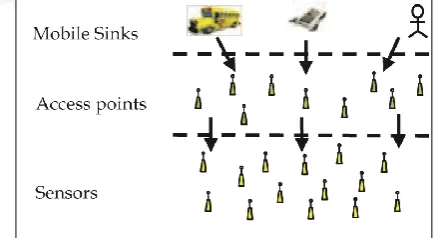
Fig. 1: The three-tier security scheme in WSN with mobile sinks
portable sink replication assault. In the new security structure [19], a little portion of the preselected sensor hubs (see Fig. 1), called the stationary access hubs, go about as confirmation get to focuses to the system, to trigger the sensor hubs to transmit their collected information to versatile sinks. A versatile sink sends data request messages to the sensor hubs by means of a stationary get to hub. These information request messages from the versatile sink will start the stationary access hub to trigger sensor hubs, which transmit their information to the asked for portable sink. The plot utilizes two separate polynomial pools: the versatile polynomial pool and the static polynomial pool. Utilizing two separate key pools and having few sensor hubs that convey keys from the versatile key pool will make it more troublesome for the aggressor to dispatch a mobile sink replication attack on the sensor organize by catching just a barely any discretionary sensor hubs. Or maybe, the assailant would likewise need to catch sensor hubs that convey keys from the versatile key pool. Keys from the portable key pool are utilized predominantly for portable sink verification, and hence, to pick up access to the system for information gathering. In spite of the fact that the above security approach makes the system stronger to mobile sink replication attacks contrasted with the single polynomial pool-based key pre-distribution conspire [14], it is as yet defenseless to stationary get to hub replication attacks. In these sorts of assaults, the assailant can dispatch a replication assault like the mobile sink replication attack. After a small amount of sensor hubs have been traded off by a foe, caught static polynomials can be stacked into a reproduced stationary access hub that transmits the recorded portable sink's information ask for messages to trigger sensor hubs to send their accumulated information. To influence the three-level security to plot more vigorous against a stationary get to hub replication assault, we have fortified the validation component between the stationary access nodes and sensor hubs using one-way hash chains calculation [20] in conjunction with the static polynomial pool-based plan [14]. Our scientific outcomes demonstrate that the new security system makes the system stronger to both mobile sink replication attacks and stationary access hubs replication assaults contrasted with the single polynomial pool-based approach.
This paper is sorted out as takes after. Area 2 talks about some current plans applicable to those proposed in this paper. Area 3 displays the security and danger examination for a mobile sink replication attack, utilizing the proposed conspire [19]. Segment 4 demonstrates the security examination and the danger examination for stationary access hubs replication assault, and Area 5 makes determinations.
II. RELATED WORK
The key administration issue is a dynamic research zone in remote sensor systems. Eschenauer and Gilgor [12] proposed a probabilistic key pre-distribution plan to bootstrap the underlying trust between the sensor hubs. The principle thought was to let every sensor hub arbitrarily pick a set of keys from a key pool before organization, with the goal that any two sensor hubs had a specific likelihood of
sharing at minimum one regular key. Chan et al. [13] additionally expanded this thought and created two key pre-distribution plans: the q-composite key pre-pre-distribution plot and the arbitrary pair-wise keys plot. The q-composite key pre-distribution conspire likewise utilized a key pool, however required two sensor hubs to figure a pair-wise key from at least q pre-distributed keys that they shared. The arbitrary pair-wise keys conspire haphazardly picked sets of sensor hubs and alloted each match a special irregular key. The two plans enhanced the security over the fundamental probabilistic key pre-distribution conspire. The pair-wise key foundation issue, in any case, is still not unraveled. For the fundamental probabilistic [12] and the q composite [13] key pre-distribution plans, as the number of traded off hubs expands, the portion of influenced pair-wise keys likewise increments rapidly. Thus, a little number of bargained hubs may influence a substantial division of pair-wise keys. In spite of the fact that, the arbitrary pair-wise key does not experience the ill effects of the previously mentioned issue, given a memory requirement, the system measure is entirely restricted by the coveted likelihood that two sensor hubs share a pair-wise key, as additionally by the quantity of neighbor hubs with which a sensor can convey. An improved plan utilizing the degree vicariate key polynomial was proposed by Liu et al. [14]. They built up a general system for pair-wise key foundation utilizing the polynomial-based key pre-distribution convention and the probabilistic key appropriation in [12] and [13]. Their plan could endure close to traded off hubs, here the esteem off was restricted by the memory accessible in the sensor hubs.
III. THE THREE-TIER SECURITY SCHEME
known as the stationary access hubs. They go about as confirmation get to focuses for the system and trigger sensor hubs to transmit their accumulated information to the versatile sinks.
A portable sink sends information ask for messages to the sensor hubs by means of a stationary access hub. The versatile sink's data request messages will start the stationary get to node to trigger sensor hubs to transmit their totaled information to the asked for sink. Each stationary access node may share a portable polynomial with a versatile sink. All sensor hubs, including the stationary get to hubs, haphazardly select a subset of polynomials from the static polynomial pool. The benefit of utilizing discrete pools is that portable sink verification is autonomous of the key circulation plot used to interface the sensor organize. We separate our plan into two phases: static and portable polynomial pre-distribution and key revelation between a versatile sink and a sensor hub.
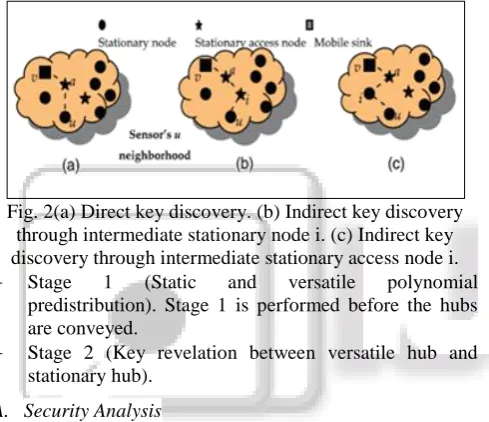
Fig. 2(a) Direct key discovery. (b) Indirect key discovery through intermediate stationary node i. (c) Indirect key discovery through intermediate stationary access node i. Stage 1 (Static and versatile polynomial
predistribution). Stage 1 is performed before the hubs are conveyed.
Stage 2 (Key revelation between versatile hub and stationary hub).
A. Security Analysis
We have broken down the execution of the proposed conspire utilizing two measurements: security and network [19]. For security, we exhibit the likelihood of a versatile polynomial being traded off; thus, an assailant can make utilization of the caught portable polynomial to dispatch a versatile sink replication assault against the sensor arrange. In availability, we evaluate the likelihood Pconn (see Appendix A for point by point induction, which can be found on the Computer Society Digital Library at http://doi.ieeecomputersociety.
Organization/10.1109/TPDS.2010.185) of a versatile sink building up secure connections with the sensor hubs from any validation get to point in the system as where n represents the aggregate number of sensor hubs in the network, c is the normal number of neighbor hubs for each sensor hub before arrangement of the stationary get to hubs, and m is the quantity of stationary access nodes in the organize. Fig.2 shows Pconn versus the proportion of stationary get to hubs.
B. Threat Analysis
In this segment, we dissect the security execution of the proposed plot against a mobile sink replication attack. As expressed in the past segment, for an assailant to dispatch a
portable sink replication attack on the system, the enemy needs to trade off no less than one polynomial from the portable polynomial pool. To accomplish this, the enemy must catch no less than a particular number of stationary get to hubs that hold a similar portable polynomial. It takes after from the security investigation of the Blundo plot, that for any polynomial win the versatile polynomial pool of degree tm, an assailant can't recuperate the polynomial w, if no more than tm stationary access hubs that had picked product caught by the assailant. On the off chance that more than stationary get to nodes with was their portable polynomial are caught by the aggressor, at that point the assailant can recuperate the versatile polynomial w, and hence have the capacity to dispatch a portable sink replication assault against the sensor organize. We accept that an assailant arbitrarily captures Rc sensor hubs, Rc >tm. To improve our estimation for the probability Pr of a versatile polynomial being bargained, we think about the catches of sensor hubs are autonomous.
IV. THE ENHANCED THREE-TIER SECURITY SCHEME
As depicted in the past area, the three-level security conspire gives better system strength against versatile sink replication assault contrasted with the single polynomial pool approach. This plan conveys a similar security execution as the single polynomial pool approach when the system is under a stationary access hub replication assault. In the two plans, for any sensor node u that necessities to confirm and build up a pair-wise key with a stationary get to hub A, the two hubs must share no less than a typical polynomial in their polynomial rings. To play out a stationary access hub replication assault on a system, the foe needs to trade off no less than a solitary polynomial from the static pool. This can be gotten effortlessly by catching discretionary sensor hubs in the system. At that point, the enemy can make utilization of this traded off polynomial by an imitated stationary access hub to empower uncertain access to the system. At the point when effective access to the arrange has been acquired through the traded off static polynomial, the reproduced stationary access hub transmits recorded portable sink information ask for messages. Next, the sensor hubs that have the bargained polynomial in their rings will unreliably verify and build up a pair-wise key with the replicated hub and therefore convey their information to the duplicated hub. In this segment, we cure the security execution of the proposed plot on account of a stationary access hub replication attack. We use a one-way hash chain[20] calculation in conjunction with the polynomial pool plot. In expansion to the static polynomial, a pool of haphazardly produced passwords is utilized to upgrade the validation between sensor hubs and stationary get to hubs.
A. Security Analysis
Like the security investigation displayed in it, we assess the availability of the upgraded three-level security conspire. We assessed the Pconn, checked by the following equations:-
Pconn=1-(1-c/n)m --- (1) Pm= Km /|M| --- (2)
[image:3.595.49.294.275.486.2]These equations are the preloaded hash esteems of Pwi in each of stationary get to nodes and the sensor hubs, individually.
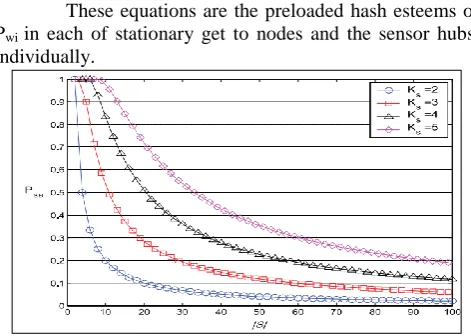
Fig. 3: The probability Psa that a sensor and stationary access node share a static polynomial versus the size jSj.
B. Threat Analysis
In the stationary access hub replication attack, the enemy necessities to catch no less than one polynomial from the static pool what's more, no less than one hash value Hr1 () of a picked watchword. To dissect the security execution of the upgraded three-level conspire, we assessed probability Php of a non-compromised sensor hub being under a stationary get to hub replication assault, when x number of hubs were being caught. To ascertain the probability Php for a non-compromised sensor hub that had a hash value Hr PwiÞ in its hash esteem ring what's more, static polynomial y in its static polynomial ring, we were required to get the probabilities of both equations (1) and (2) what's more, polynomial y, as they were being traded off when the x nodes were caught.
[image:4.595.49.283.600.744.2]V. RESULT
Fig.3 and Fig.4 determined that the connection between the probability and in this way the mix severally. To influence the three-level security to subject extra solid against a stationary access hub replication a , to reinforce the validation instrument between the stationary access hubs and sensor hubs abuse unidirectional hash chains algorithmic control in conjunction with the static polynomial pool-based topic. Our explanatory outcomes show that the new security strategy makes the system extra flexible to every portable sink replication assaults and stationary access hubs replication assaults contrasted with the main polynomial pool-based approach.
Fig. 4: The probability Pa that two sensors share a static or a mobile polynomial versus the size jSj.
VI. CONCLUSION
In this paper, we proposed a general three-level security structure for validation and pair-wise key foundation between versatile sinks and sensor hubs. The proposed plot, in light of the polynomial pool-based key pre-distribution conspire considerably enhanced system flexibility to versatile sink replication attacks contrasted with the single polynomial pool-based key pre-distribution approach [14]. Utilizing two separate key pools and having few stationary get to nodes carrying polynomials from the portable pool in the system may ruin an aggressor from social occasion sensor information, by sending a recreated versatile sink. Investigation shows that with 10 percent of the sensor hubs in the arrange conveying a polynomial from the portable pool, for any versatile polynomial to be recuperated, the assailant would need to catch 20.8 times more hubs when contrasted with the single polynomial pool approach. We have additionally enhanced the security execution of the proposed conspire against stationary get to hub replication attack by reinforcing the validation component between stationary access nodes and sensor hubs. We utilized the one-way hash chains calculation in conjunction with the static polynomial pool-based plan [14].
REFERENCES
[1] I.F. Akyildiz, W. Su, Y. Sankarasubramaniam, and E. Cayirci,“Wireless Sensor Networks: A Survey,” Computer Networks,vol. 38, no. 4, pp. 393-422, 2002. [2] T. Gao, D. Greenspan, M. Welesh, R.R. Juang, and A.
Alm, “Vital Signs Monitoring and Patient Tracking over a Wireless Network,” Proc. IEEE27th Ann. Int’l Conf. Eng. Medicine and Biology Soc.(EMBS),Sept. 2005.
[3] L. Hu and D. Evans, “Using Directional Antenna to Prevent Wormhole Attacks,”Proc. Network and Distributed System Security Symp.,2004.
[4] J.R. Douceur, “The Sybil Attack,”Proc. First Int’l Workshop Peer-toPeer Systems (IPTPS ’02),Mar. 2002. [5] B.J. Culpepper and H.C. Tseng, “Sinkhole Intrusion Indicators in DSR MANETs,”Proc. First Int’l Conf. Broadband Networks (BroadNets ’04),pp. 681-688, Oct. 2004.
[6] H. Deng, W. Li, and D.P. Agrawal, “Routing Security in Wireless Ad Hoc Networks,”Proc. IEEE Comm. Magazine,pp. 70-75, 2002.
[7] C. Intanagonwiwat, R. Govindan, and D. Estrin, “Directed Diffusion: A Scalable and Robust Communication Paradigm for Sensor Networks,”Proc. MobiCom,pp. 56-67, 2000.
[8] Kansal, A. Somasundara, D. Jea, M. Srivastava, and D. Estrin, “Intelligent Fluid Infrastructure for Embedded Networks,”Proc. Second ACM Int’l Conf. Mobile Systems, Applications, and Services (MobiSys ’04),June 2004.
[9] Y. Tirta, Z. Li, Y. Lu, and S. Bagchi, “Efficient Collection of Sensor Data in Remote Fields Using Mobile Collectors,” Proc. 13th Int’l Conf. Computer Comm. and Networks (ICCCN ’04),Oct. 2004.
Networks,”Proc. Third Int’l Conf. Intelligent Sensors, Sensor Networks and Information Processing, 2007. [11]W. Zhang, G. Cao, and T. La Porta, “Data
Dissemination with Ring-Based Index for Wireless Sensor Networks,”Proc. IEEE Int’l Conf. Network Protocols (ICNP),pp. 305-314, Nov. 2003.
[12]L. Eschenauer and V.D. Gligor, “A Key-Management Scheme for Distributed Sensor Networks,”Proc. ACM Conf. Computer Comm. Security (CCS ’02),pp. 41-47, 2002.
[13]H. Chan, A. Perrig, and D. Song, “Random Key Pre-Distribution Schemes for Sensor Networks,” Proc. IEEE Symp. Research in Security and Privacy,2003. [14]D. Liu, P. Ning, and R.Li. Establishing, “Pairwise Keys
in Distributed Sensor Networks,”Proc. 10th ACM Conf. Computers and Comm. Security (CCS ’03),pp. 52-61, Oct. 2003.
[15]H. Chan, A. Perrig, and D. Song, “Key Distribution Techniques for Sensor Networks,”Wireless Sensor Networks,pp. 277-303, Kluwer Academic, 2004. [16]D. Liu and P. Ning, “Location-Based Pairwise Key
Establishments for Static Sensor Networks,”Proc. First ACM Workshop Security Ad Hoc and Sensor Networks,2003.
[17]S. Zhu, S. Setia, and S. Jajodia, “LEAP: Efficient Security Mechanisms for Large-Scale Distributed Sensor Networks,”Proc. 10th ACM Conf. Computers and Comm. Security (CCS ’03),pp. 62-72, Oct. 2003. [18]Rasheed and R. Mahapatra, “An Efficient Key
Distribution Scheme for Establishing Pairwise Keys with a Mobile Sink in Distributed Sensor Networks,”Proc. IEEE 27th Int’l Performance Computing and Comm. Conf. (IPCCC ’08),pp. 264-270, Dec. 2008.
[19]Rasheed and R. Mahapatra, “A Key Pre-Distribution Scheme for Heterogeneous Sensor Networks,” Proc. Int’l Conf. Wireless Comm. and Mobile Computing Conf. (IWCMC ’09),pp. 263-268, June 2009.