http://dx.doi.org/10.4236/jpee.2014.24094
Modeling, Steady-State Analysis of a SEPIC
dc-dc Converter Based on Switching
Function and Harmonic Balance Technique
Ajayi Samuel Taiwo, Joseph Yakubu Oricha
Electrical and Computer Engineering Department, Ahmadu Bello University, Zaria, Nigeria Email: [email protected], [email protected]
Received November 2013
Abstract
The paper presents modeling approach of a Single Ended Primary Inductance Converter (SEPIC) system. The complete model derivation of the SEPIC converter system has been presented in dif-ferent modes of operation. Steady state and small signal analysis was carried out on the converter dynamic equations using the method of Harmonic balance Technique. The steady state variables and their respective ripple quantities obtained were plotted against duty ratio D. The results
ob-tained for a supply input voltage of 60volts to the converter at a duty ratio of D=0.8, compares
well with simulation results.
Keywords
SEPIC Converter;Switching Function; Harmonic Balance Technique
1. Introduction
Fourth order converter had made applications of power possible where the demand for such requires less input voltage and high output voltage. Zeta, Cuk and SEPIC converter are examples of these. These converters have the ability to either buck or boost the voltage applied to their inputs depending on their applications. Analysis of these converters using averaging technique and waveform approach for transient and steady state study is very tedious and takes much computational time because of two storage element inclusion to the circuit. Solar based systems find interesting application when used with these converters to furnish the load with power. The SEPIC converter system as an example could be integrated with rural lightening systems, solar water pumping, Tele-communication industries and electric vehicle charging systems due to it buck-boost abilities.
tech-nique are one key point for accurate performance of a dc-dc converter feeding a load with power. In [6] [7] a model and steady state analysis of their respective converters for different power source were set forth for dif-ferent operating condition of the load.
In this paper a switching function based technique is presented. The derivatives are used to study the large signal and small signal dynamic behavior of the SEPIC converter on a large scale computer simulation in conti-nuous current mode (CCM). In view of these, the resulting non-linear equation obtained due to this switching function approach coupled with applying harmonic balance technique help to produce dynamic equations which predict the average and ripple quantities respectively. This paper is organized as follows: section II is the studied SEPIC converter it’s model derivations in CCM together with the harmonic balance technique, section III present Fourier series of the switching functions. Section IV is the simulation and steady state results. Section V is the conclusion.
[image:2.595.190.406.595.704.2]2. Studied Converter
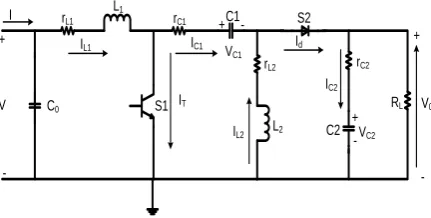
Figure 1, Shows the circuit diagram of the SEPIC converter used for this paper, it consist of an input capacitor
0
C , which serves as a voltage bank to the input of the SEPIC converter. Two inductors L1 and L2 with each parasitic resistance rL1 and rL2. Two capacitors C1 and C2 with each associate equivalent series parasitic resistance rC1 and rC2. One active switch and a passive switch. For continuous conduction modes (CCM), there are two states of the switch within the switching period T. S1 could be a Mosfet, power bipolar junction transistor (BJT), Insulated gate bipolar transistor (IGBT), or any high power switching device which is switched on by a pulse width modulation signal (PWM) generated from a control module. During the first switching in-terval S1 is on for a period defined by tε
[
0,DT]
, while S2 is off. During the next interval S1 is off and2
S is on for a period within the interval tε
[
DT T,]
.2.1. Model Derivation
Equation (1) Gives the equation that describes two modes of operations of the SEPIC converter. Note; p d dt
=
2 2 C L
C L
r R
r R
ϕ= +
, 2
L
C L
R
r R
β= +
; throughout this paper.
(
)
(
)
(
)
(
)
1 1 1 1 2 1 1 2 2 1
2 2 1 1 2 2 1 2 1 2 1 2 2 2
1 1 2 1 2 1
2 2 2 1 2 2
2
0 2 2 1 2
1
L L L L C L C C
L C L L L C L L C
C L L
C L L C
C L
C L L
L p i v i r S i r i v v
L p i S v i r S i r S i i S v
C p v i S S i
C p v S i i v
r R
v v S i i
ϕ ϕ β
ϕ β
β
β ϕ
− − × + + × + +
− − − + × − ×
− +
+ × −
=
=
=
=
=
+
+ + ×
(1)
Current and voltages of the transistor and diode are;
Figure 1. SEPIC converter. C0
rL1
L1
S1 IT
rC1 C1
rL2
L2
rC2
VC2
RL V0
Id
C2 VC1
IL2
-+
+ -IC2
I
IL1 IC1
V +
(
)
(
)
[
]
1 1 2
2 1 1 2 2 1
2 1 2 2
1 2 1 2 1
T L L
T C L L C C
d L L
d L C C C
i S i i
v S r i i v v
i S i i S
v S i r v v
ϕ ϕ β
β +
+ − − +
=
=
= +
− =
−
(2)
2.2. Harmonic Balance Technique
The technique unlike transient analysis assumes that the circuit steady state consist of a sum of sinusoids that best describe the differential equations. The method will involve imposing on Equations (1) and (2) values, with average values together with their respective a.c variations, (ripple quantities). From these analysis, the steady state response solution of the system can be obtained and their respective ripple quantities. These equations are used to predict the performance of the system at steady state.
(
)
(
)
(
)
(
)
(
)
(
)
(
)
(
)
(
)
1 10 11
2 20 21
1 10 11
2 20 21
0 1
0 1
0 1
0 1
0 1
s
s
s
s
s
s
s
s
s
j
L L L
j
L L L
j
C C C
j
C C C
j
T T T
j
d d d
j
T T T
j
d d d
j
i i i
i i Re i e
i i Re i e
v v Re v e
v v Re v e
i i Re i e
i i Re i e
v v Re v e
v V Re v e
S d Re d e
v v
θ
θ
θ
θ
θ
θ
θ
θ
θ
= +
= +
= +
= +
=
= +
= +
= +
= +
= +
(3)
where; v, vC10, vC20, vT0, vd0, iL10, iL20, id0, iT0, di0 are the average (dc) values of supply voltage, ca-pacitor voltage C1, capacitor voltage C2, transistor voltage T, diode voltage D, inductor current L1, in-ductor current L2, transistor current, diode current and switching function d. Moreso, vC11, vC21, vT1, vd1,
11 L
i , iL21, iT1, id1, di1 are complex ripple harmonic peaks of capacitor voltage C1, capacitor voltage C2, inductor current L1, inductor current L2, transistor Current, diode current and switching function d. Where I
= 1, 2, 3···,
, ? s st θ =ω
where ωs angular switching frequency in radians/seconds and t is time in seconds. For continuous conduc-tion mode (CCM), then the switching of the converter is conforms to this constraint S2 = −1 S1. The Equations (1) and (2) have been used for simulation of the model. Putting Equation (3) into Equations (1) and (2) and con-sequently applying harmonic balance technique separating the steady state and ripple quantities, the dynamic equations for the average quantities and their ripple quantities counterpart are derived.
3. Fourier Series of the Switching Function
S = 1, for tε
[
0,DT]
and S = 0, for tε[
DT T,]
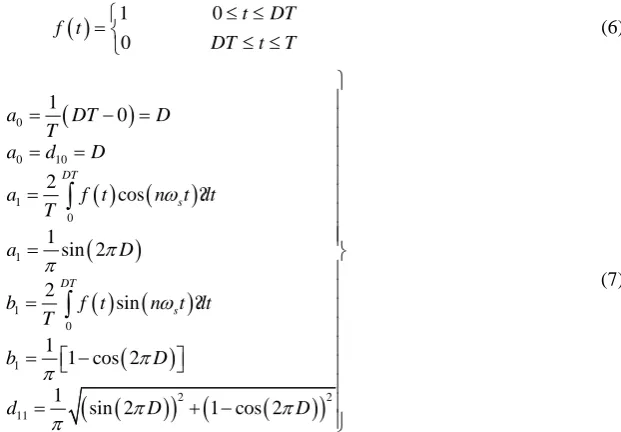
The Fourier expression of the periodic sequence of the pulse can be represented by a trigonometric series represented of the form [8].( )
0(
)
1 sin
n s n
n
f t a D nωt
∞
=
= +
∑
+ ∅ (4)where:
( )
( ) (
)
( ) (
)
0 0 2 2 1 0 0 1 tan 2 cos ? 2 sin ? Tn n n
n n T n s T n s
a f t dt
T
D a b
a b
a f t n t dt
T
b f t n t dt
T ω ω − = = + ∅ = = =
∫
∫
∫
(5)T is the period, represented as
1 s
f T =
where fs denote the switching frequency. ωs is the radian frequency define by s 2 fs 2
T π
ω = π =
For n=1
The average value and the ripple quantities can be quickly found as a decided advantage for the value of 1. For this case,
( )
1 00
t DT
f t
DT t T
≤ ≤
= ≤ ≤
(6)
(
)
( ) (
)
(
)
( ) (
)
(
)
(
)
(
)
(
(
)
)
0 0 10 1 0 1 1 0 1 2 2 11 1 0 2 cos ? 1 sin 2 2 sin ? 11 cos 2
1
sin 2 1 cos 2
DT
s
DT
s
a DT D
T
a d D
a f t n t dt
T
a D
b f t n t dt
T
b D
d D D
ω π π ω π π π π π = − = = = = = = = − = + −
∫
∫
(7)The results of Equation (7) put in to Equation (3) and substituted into Equations (1) and (2), are used for steady state average quantity calculations and ripple quantity calculations which are as presented in the next sec-tion.
[image:4.595.226.537.421.637.2]4. Simulation and Steady-State Results Discussions
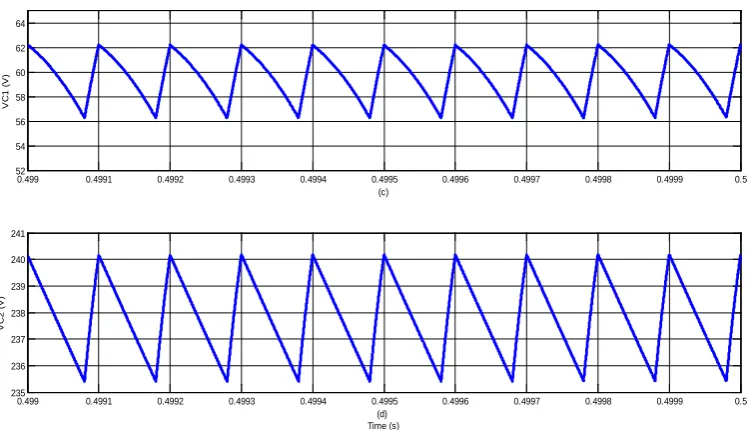
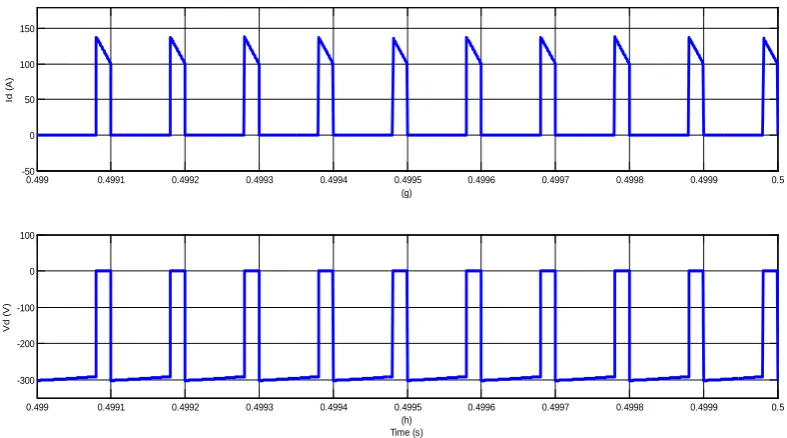
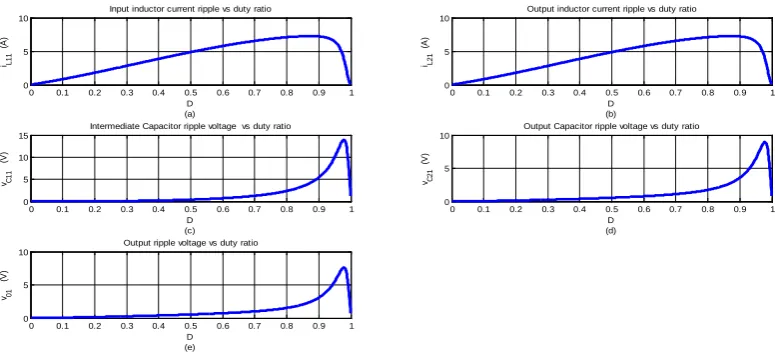
simulation results for of the inductor currents, capacitor voltages show in Figures 2 and 3. Voltages and currents impressed on the transistor and diode shown in Figures 4 and 5. The simulation and steady state results are ob-tained at duty ratio of 0.8. The steady state results plots against the duty ratio D, is shown in Figures 6 and 7. Also results for ripple quantities are shown in Figures 8 and 9. By comparing the simulation and calculated re-sults there is a good correlation between them Figures 2-5. Shows simulation results of the converter variables operating at duty cycle 0.8 the graph shows their simulation steady state results. Figures 6-9 shows the result obtained after the application of harmonic balance technique to the converter model equations. A close observa-tion to the graph of Figure 6(f) shows that as the duty ratio varies between 0 and 0.9 the efficiency
η
falls slightly. But as the duty ratio increases the efficiency falls significantly. In that note It can also be noted that av-erage value of the simulation graph of Figure 3(d) at a duty ratio of 0.8 are closed to that obtained from har-monic balance model at steady state at that particular point as shown in Figure 6. The graph of Figure 9 at a particular duty ratio give one the choice of selecting the voltage withstand capabilities of switching devices used.Figure 2. Simulation: state variables at steady state for D=0.8. (a) iL1;(b) iL2.
Figure 3. Simulation: state variables at steady state for D=0.8 (c) vC1; (d) vC2.
0.499 0.4991 0.4992 0.4993 0.4994 0.4995 0.4996 0.4997 0.4998 0.4999 0.5
85 90 95 100 105 110
(a)
IL1 (
A
)
0.499 0.4991 0.4992 0.4993 0.4994 0.4995 0.4996 0.4997 0.4998 0.4999 0.5
15 20 25 30 35
(b) Time (s)
IL2 (
A
)
0.499 0.4991 0.4992 0.4993 0.4994 0.4995 0.4996 0.4997 0.4998 0.4999 0.5
52 54 56 58 60 62 64
(c)
VC
1
(
V)
0.499 0.4991 0.4992 0.4993 0.4994 0.4995 0.4996 0.4997 0.4998 0.4999 0.5
235 236 237 238 239 240 241
(d) Time (s)
VC
2
(
[image:5.595.112.487.483.698.2]Table 1. SEPIC converter parameters.
voltage supply 60 V
Inductance 250 µH
uctanceInd 250 µH
Capacitance 300 µF
Capacitance 470 µF
Rated load 10 Ω
Duty ratio 0.8
[image:6.595.101.495.480.699.2]switching Frequency 10 KHZ
Figure 4. Simulation: transistor current and voltage at steady state for D=0.8. (e) iT; (f) vT.
Figure 5. Simulation: diode current and voltage at steady state for D=0.8. (g) id; (h) vd.
0.499 0.4991 0.4992 0.4993 0.4994 0.4995 0.4996 0.4997 0.4998 0.4999 0.5
-50 0 50 100 150
(e)
IT
(A
)
0.499 0.4991 0.4992 0.4993 0.4994 0.4995 0.4996 0.4997 0.4998 0.4999 0.5
-50 0 50 100 150 200 250 300 350
(f) Time (s)
VT
(
V)
0.499 0.4991 0.4992 0.4993 0.4994 0.4995 0.4996 0.4997 0.4998 0.4999 0.5
-50 0 50 100 150
(g)
Id
(A
)
0.499 0.4991 0.4992 0.4993 0.4994 0.4995 0.4996 0.4997 0.4998 0.4999 0.5
-300 -200 -100 0 100
(h) Time (s)
Vd
(
Figure 6. Steady state average quantities (state variables), (a) iL10; (b) iL20; (c) vC10; (d) vC20; (e) v00; (f) η.
Figure 7. Steady state average quantities (devices current and voltage), (a) iT0; (b) vT0; (c) id0; (d) vd0.
Figure 8. Steady state average ripple quantities (state variables), (a) iL11; (b) iL21; (c) vC11; (d) vC21; (e) v01.
0 0.1 0.2 0.3 0.4 0.5 0.6 0.7 0.8 0.9 1
0 200 400 600
Input inductor current vs duty ratio
iL1
0
(A
)
D (a)
0 0.1 0.2 0.3 0.4 0.5 0.6 0.7 0.8 0.9 1
0 50 100 150
Output inductor current vs duty ratio
iL2
0 (A ) D (b)
0 0.1 0.2 0.3 0.4 0.5 0.6 0.7 0.8 0.9 1
0 50 100
Intermediate Capacitor voltage vs duty ratio
vC1
0
(V
)
D (c)
0 0.1 0.2 0.3 0.4 0.5 0.6 0.7 0.8 0.9 1
0 500 1000 1500
Output Capacitor voltage vs duty ratio
vC2
0 (V ) D (d)
0 0.1 0.2 0.3 0.4 0.5 0.6 0.7 0.8 0.9 1
0 500 1000 1500
Output voltage vs duty ratio
v00
(V
)
D (e)
0 0.1 0.2 0.3 0.4 0.5 0.6 0.7 0.8 0.9 1
0 50 100
Efficiency vs duty ratio
η
D (f)
0 0.1 0.2 0.3 0.4 0.5 0.6 0.7 0.8 0.9 1 0 100 200 300 400 500 600
Transistor T1 Current vs duty ratio
iT0
(A
)
D (a)
0 0.1 0.2 0.3 0.4 0.5 0.6 0.7 0.8 0.9 1 0 20 40 60 80 100 120 140
Diode d1 Current vs duty ratio
id0
(A
)
D (c)
0 0.1 0.2 0.3 0.4 0.5 0.6 0.7 0.8 0.9 1 0 10 20 30 40 50 60 70
Transistor T1 Voltage vs duty ratio
vT0
(V
)
D (b)
0 0.1 0.2 0.3 0.4 0.5 0.6 0.7 0.8 0.9 1 -1400 -1200 -1000 -800 -600 -400 -200 0
Diode d1 voltage vs duty ratio
vd0
(V
)
D (d)
0 0.1 0.2 0.3 0.4 0.5 0.6 0.7 0.8 0.9 1
0 5 10
Input inductor current ripple vs duty ratio
iL1
1
(A
)
D (a)
0 0.1 0.2 0.3 0.4 0.5 0.6 0.7 0.8 0.9 1
0 5 10
Output inductor current ripple vs duty ratio
iL2
1
(A
)
D (b)
0 0.1 0.2 0.3 0.4 0.5 0.6 0.7 0.8 0.9 1
0 5 10 15
Intermediate Capacitor ripple voltage vs duty ratio
vC1
1
(V
)
D (c)
0 0.1 0.2 0.3 0.4 0.5 0.6 0.7 0.8 0.9 1
0 5 10
Output Capacitor ripple voltage vs duty ratio
vC2
1
(V
)
D (d)
0 0.1 0.2 0.3 0.4 0.5 0.6 0.7 0.8 0.9 1
0 5 10
Output ripple voltage vs duty ratio
v01
(V
)
[image:7.595.104.492.523.699.2]Figure 9. Steady state ripple quantities (devices current and voltage), (a) iT1; (b) vT1; (c) id1; (d) vd1.
5. Conclusion
In this paper, the steady state and the dynamic behavior of the SEPIC converter are studied. Based on the graphs obtained, it can be seen that the results from the simulation and steady state results are in agreement. The har-monic balance technique simplifies the analysis for the non-linear equations of the state variables and devices. The steady state average and ripple quantity calculation was obtained by varying the duty ratio from 0 to 1. The advantage of the method is that switching stress withstand capability on the devices due to switching action can be predicted.
References
[1] Aranda, E.D., Galan, J.A.G., de Cardona, M.S. and Marquez, J.M.A. (2009) Measuring the I-V Curve of PV Genera-tors. Industrial Electronic Magazine, 3, 4-14. http://dx.doi.org/10.1109/MIE.2009.933882
[2] Akbaba, M. and Akbaba, M.C. (2001) Dynamic Performance of a Photovoltaic-Boost Converter Powered dc Motor- Pump System. IEEE Electric Machines and Drive Conference, 356-361.
[3] Rivetta, C. and Jayabalan, R. (2006) Analysis and Control of Buck dc-dc Converter Operating with Constant Power Load in Sea and Undersea. IEEE Transaction on Industrial Applications, 42, 559-572.
http://dx.doi.org/10.1109/TIA.2005.863903
[4] Nardo, A.D., Fermia, N., Nicolo, M., Petrone, G. and Soagnuolo, G. (2008) Power Stage Design of Fourth Order dc-dc Converter by Means of Principal Component Analysis. IEEE Transaction on Power Electronics, 23, 2867-2877. [5] Yang S., Goto K., Imamura, Y. and Shoyama, M. (2012) Dynamic Characteristics Model of Bi-Directional dc-dc
Converter Using State Space Averaging Method. IEEE Telecommunications Energy Conference (INTELEC), 1-5. [6] Veerachary, M. (2012) Two-Loop Controlled Buck-SEPIC Converter for Input Source Power Management. IEEE
Transaction on Industrial Electronics, 59, 4075-4087.http://dx.doi.org/10.1109/TIE.2011.2174530
[7] Karimi-Davijani, H. and Ojo, O. (2011) Modeling and Steady-State Analysis of a Stand-Alone Potovoltaic Three Phase Inverter Power System. IEEE Applied Electronics Conference and Exposition (APEC), 1259-1266.
[8] Edwin, K. (2006) Advance Engineering Mathematics. 9th Edition, Wiley International Edition.
0 0.1 0.2 0.3 0.4 0.5 0.6 0.7 0.8 0.9 1
0 50 100 150 200 250 300
Transistor T1 Current ripple vs duty ratio
iT1
(A
)
D (a)
0 0.1 0.2 0.3 0.4 0.5 0.6 0.7 0.8 0.9 1
0 20 40 60 80 100 120
Transistor T1 Voltage ripple vs duty ratio
vT1
(V
)
D (b)
0 0.1 0.2 0.3 0.4 0.5 0.6 0.7 0.8 0.9 1
0 50 100 150 200 250 300
Diode d1 Current ripple vs duty ratio
id1
(A
)
D (c)
0 0.1 0.2 0.3 0.4 0.5 0.6 0.7 0.8 0.9 1
0 20 40 60 80 100 120 140
Diode d1 voltage ripple vs duty ratio
vd1
(V
)