http://dx.doi.org/10.4236/jep.2014.59076
Comparative Study of Environmental
Institutional Framework and Setup in the
GCC States
Said Al-Saqri
1, Hameed Sulaiman
21EcOman Centre, Petroleum Development Oman LLC, Muscat, Oman
2Department of Biology, College of Science, Sultan Qaboos University, Muscat, Oman
Email: [email protected]
Received 5 April 2014; revised 2 May 2014; accepted 1 June 2014
Copyright © 2014 by authors and Scientific Research Publishing Inc.
This work is licensed under the Creative Commons Attribution International License (CC BY).
http://creativecommons.org/licenses/by/4.0/
Abstract
Establishing environmental institutions will aid in providing effective responses on any changes in the status of environment by improving the current policies by having solid management strate-gies to combat environmental degradation. All the six member countries in the Gulf Cooperation Council (GCC) have established similar environmental institutional bodies that serve with the mandate of conserving and protecting the environment. Degrees of implementation, wealth, state of environment reporting and strategic planning are varying and closer inspection has to be done. Institutionalization in GCC states has to be promoted to cover major framework of sustainable de- velopment strategies. This will guarantee the use-effectiveness of those polices and other envi-ronmental management tools to ensure sustainable development of the natural resources. This paper attempts to list and examine the current status of all GCC country’s environment institu-tional framework and setup through comparison of the available information, highlighting the achievement of some and providing some guidance for others on how it could be enhanced.
Keywords
Environmental Institutional Framework, Gulf Cooperation Council, Authority
1. Introduction
studies the human society’s involvement on different aspects of the country development and its interaction with the environment [2]. Three main components have to be taken into account to conduct such environmental ma- nagement assessment-economy, environment and society. One of the major country’s contributors to its econo-my is the local industries. In the last two decades, the GCC states step up to increase their GDP by industrializ-ing the region to produce goods and services to safeguard their economy and reduce the sole dependence on oil economy. Many researches and studies were conducted to explore the potential ability to have an economic growth with minimum environmental problems [3]-[5]. The goal here is to have an environmental system that is economically viable, socially acceptable and environmentally compatible.
Economic boom of the 1950s led to rapid industrialization. This generated a huge amount of waste to handle and improper disposal of these waste created huge contaminated sites throughout the world [6]. As a result, dur-ing early 1970s, several discussions and formal gatherdur-ings (Stockholm conference in 1972) began to take place involving industrialized and developing countries addressing the issues of environmental control, prevention and protection as well as mitigation of environmental impacts of developments. This led to development of large en-vironmental institutions and organizations with mandates on environment that creates a system that deals with all aspects of the environmental management. Nowadays, most countries implemented this strategy in having environmental institutions of their own; some countries build such comprehensive environmental related organ-izations with full authority dealing with this aspect. Enforcement has been practiced (most of the time) where local developers are asked to submit a comprehensive environmental status reports such as Environmental Im-pact Assessment (EIA) reports to seek environmental clearance and to have the environmental objectives as a main component of the industry’s organizational setup.
In developing countries such as GCC, the concept of interpolating the environment component into public and private sectors was widely accepted by almost all. Many problems related to biophysical and socio-economic environments in GCC are of concern and people are becoming aware of their surrounding environment. There-fore, some of the development projects face social resistance due to the adverse effects on local and surrounding environment. All GCC states share similar characteristics; they all depend on oil production as the main and the valuable source of energy and it is also the reason behind GCC infrastructure development leading to increase in economy and GDP growth with their combined nominal GDP reaching close to $340 billion [7]-[9]. Water scar- city, land degradation and waste generation etc. are major concerns and it reflects the desire and need of GCC countries to develop a solid environmental institutions, framework and setup by taking integrated environmental management system to cope up with the continuing industrial development and economic growth while solving other socio-economic and environmental problems. Therefore, the aim of this paper is to inspect on the current status of the environment institutional framework and setup in all GCC states through comparative measures of the available information, listing the outstanding achievement of some and provide for others some guidance for enhancement.
2. Environment Institutional Setup in GCC
2.1. Oman [10] [11]
Oman has very early strategies in environmental aspects. It undergoes a long series of development and en-hancement till Ministry of Environment and Climate Affairs (MECA) was established in 2007 by royal decree (91/2007). MECA is the prime responsible body in the Sultanate which takes care of all environmental issues in the country, providing licensing, permits and clearance. MECA’s role is to monitor industry’s compliance to le- gislations and check their requirements to meet the environmental clearance criteria. EIAs and other environ-mental status reports are reviewed by MECA for environenviron-mental clearance. The work of non-governenviron-mental orga- nizations (NGOs) has been widely practiced in Oman. Environment society of Oman (ESO) is a non-profit orga- nization taking major part in public awareness of any related environmental issues in Oman. Private sector has been involved in environmental protection and waste management in Oman. Bea’a (Oman environment services holding co.) is a private company and was established in 2009 by royal decree no. (46/2009). It’s main responsi-bilities are solid and liquid waste management and management of sanitary landfills.
2.2. United Arab Emirates (UAE) [12] [13]
es-tablished in 1972. Its principal activities include controlling and protecting the environment, natural resources and water in the UAE. Three major departments are combined in the same ministry: water resources & nature preservation affairs, agriculture & animal affairs and environmental affairs. The establishment of an environ-ment agency in Abu Dhabi is the outcome of that establishenviron-ment of a well-defined system. The principal activi-ties of the agency include environmental operations, policy and strategy making, environmental information and awareness, forestry projects and animal welfare. NGOs are working to protect the environment with community and public involvement, education, and action programs. Other national NGOs aim to promote the conservation of nature in the UAE. Examples of those NGOs are Emirates Wildlife Society and Emirates Environment Group.
2.3. Kingdom of Saudi Arabia (KSA) [14] [15]
The presidency of meteorology and environment is the principal responsible authority in the KSA. It has a de-tailed and well defined institutional structure covering almost all biophysical environment of the country. The institutional setup is mainly divided into two main subdivisions Meteorology and Environment and it is some-times combined. In the aspect of combination they operate as a centre for meteorology and environment where they have an emergency team that act upon natural disasters and flood as well as erosion control in KSA. The Saudi Environmental Society (SENS) is an NGO dedicated to support the government in its environmental pro-tection effort and enhance public participation and voluntary work of all community sectors in this regards in KSA. The Saudi Gulf Environmental Protection Company (SEPCO) was established in 1997 as a unique com-pany in the field of environmental protection focused on biological waste management.
2.4. Qatar [16]
Qatar has exclusive Ministry for Environment and its role is to protect the environment through sustainable growth for future generation. The ministry is responsible in creating environmental legal frameworks and setups that proposes and develops policies and laws to protect and control the environment and ensures the quality of environmental health and safety. It also supports the national, regional and international cooperation regarding related issues and activities. The ministry of environment is the only environmental body in the Qatari govern-ment; it has six major units ranging from administrative to quality and planning, livestock and environmental management. The Friends of the Environment in Qatar is an NGO that works in parallel with the ministry of en-vironment targeting the local communities, aims to provide public awareness in enen-vironmental issues such as recycling and biodiversity protection.
2.5. Bahrain [17]
Bahrain adopted very early strategies in environment conservation and protection. Public Commission for the Protection of Marine Resources, Environment & Wildlife is the only environmental organization in the Bahraini government. Their mission is to help the government in adopting environmental practices and activities in envi-ronment and natural resources management, and that is by conducting some related research and studies, pro-posing environmental laws and enhances public awareness keeping in mind the balance between country’s eco-nomic and social development and the environment to ensure sustainability for future generations. Bahrain was also the first of its kind in GCC to implement e-Environment Friends, an online forum where public audience and communities can exchange and share the knowledge, ideas or thoughts on environmental issues and aware-ness.
2.6. Kuwait [18]
3. Similarities, Differences and Uniqueness
In general, all GCC countries have established similar environmental institutional bodies that serve the purpose of environmental conservation and protection. Majority has enabling EIA legislation while others have specific localized legislations and regulations [19]-[21]. Main environmental administrative bodies in GCC countries are under the government provisions and control. Most of government administrative institutions in GCC countries are centrally governed and have its base in the capital cities. However, many countries are gradually starting to decentralize to the local level. United Arab Emirates has established many environmental agencies under the su- pervision of federal government. Oman, Qatar and Saudi Arabia set up offices and directorates in remote regions that are working in coordination with the main central administration.
Environmental authorities in GCC countries are responsible bodies for issuing permits and clearance for de-velopment projects. Studies showed that there has been a steady increase in EIA and other environmental legis-lative tools implementation and documentation [22]-[26]. The reasons being, rapid economic growth, raising public awareness on environmental issues and at the same time the importance of economic development to im-prove the standard of living and enforcement of EIA documentation by governments [27]. All this actions will require tremendous efforts and paper works. Therefore, institutions have to be propagated to handle such tasks.
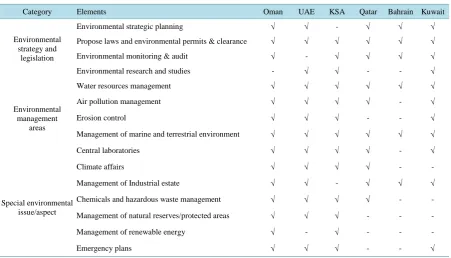
[image:4.595.87.539.451.709.2]Some of GCC institutions have the environment as separate mandate like Oman, Bahrain, Saudi Arabia and Kuwait. Others like United Arab Emirates and Qatar have incorporated the environmental affair with other ma-jor sectors like water, agriculture and livestock. Table 1 summarizes the institutional categories on which the comparison study is based on. The environmental institutional framework of the six GCC countries is classified into three main categories; environmental strategy & legislation, Environmental management division and Spe-cial environmental issue/aspects. Environmental strategy and legislation setup has been grouped into four major elements as environmental strategic planning; institutions that propose laws, environmental permits & clearance; environmental monitoring & auditing and environmental research & studies. Second category covers environ-mental management divisions such as water resources, air pollution, erosion control, marine & terrestrial envi-ronments and central laboratories. Special environmental issue/aspects are covered in the third category with list of environmental aspects of country’s special enactment with regards to environment protection and reservation. Aspects included are; chemical and hazardous waste management, management of protected area, industrial areas, renewable energy, climate affairs and department for emergency plans.
Table 1. Comparative assessment of the environmental institutional framework of GCC states.
Category Elements Oman UAE KSA Qatar Bahrain Kuwait
Environmental strategy and
legislation
Environmental strategic planning √ √ - √ √ √
Propose laws and environmental permits & clearance √ √ √ √ √ √
Environmental monitoring & audit √ - √ √ √ √
Environmental research and studies - √ √ - - √
Environmental management
areas
Water resources management √ √ √ √ √ √
Air pollution management √ √ √ √ - √
Erosion control √ √ √ - - √
Management of marine and terrestrial environment √ √ √ √ √ √
Central laboratories √ √ √ √ - √
Special environmental issue/aspect
Climate affairs √ √ √ √ - -
Management of Industrial estate √ √ - √ √ √
Chemicals and hazardous waste management √ √ √ √ - -
Management of natural reserves/protected areas √ √ √ - - -
Management of renewable energy √ - √ - - -
Emergency plans √ √ √ - - √
Degrees of adoption among the six GCC countries are varying. Most of them share in responsibility of propo- sing laws and providing permits as well as environmental clearance. Water resources management is the main concern in these countries and it is the priority of almost all governmental institutions in which it tends to allo-cate financial and human resources to better sustain the precious water assets [28]. Nevertheless, management of marine and terrestrial environment element is developed in all GCC environmental institutions. Climate change is a concern in all GCC countries [29] [30]. Most of GCC countries except Bahrain and Kuwait developed the climate affairs institutional sections as well and allocate resources in finding alternative energy resources (other than oil) such as renewable energy [31]. Bahrain and Kuwait govern special aspects like industrial estate in co-operation with other relevant ministries. Emergency plans as a measure for environmental disaster are found in environmental institution other than Qatar and Bahrain with other stakeholders like ministries of health, agricul-ture and civil defense etc.
From here it is now well established that most GCC governments has its own system for environmental man-agement and control but it is not well practiced and the implementation in this countries may be weak or even non-existing. It is very important to enhance the implementation measures in these countries since the facilities and equipment have been made and ready to be effectively used. Non-adopting countries in certain areas could follow suit their neighbors only if it is necessitate to do so. Extensive meetings and regular gathering could help in addressing this issue as well as the need of developing an environmental commission for GCC. This will help in designing and preparation of the future strategic plans for sustainable development and conservation of the valuable nature resources and environment for GCC at large. Most of the environmental strategic plans are adopted from developed countries, the fact is that the environmental conditions of these countries are different and has to take in to account GCC’s requirements and also this has to be considered into account during en-hancement and implementation of environmental management in GCC countries.
4. Conclusion and Recommendations
All the six GCC states share similar interest in many aspects including geography, political issues, economic, social and religion. In general the management system in GCC is centralized, mostly understaffed and with in-experienced authorities. But this could be a good starting point for GCC union to come together and develop comprehensive and detailed environmental strategic plans to ensure sustainable development of the existing natural resources in the region. Based on the survey of this study, it is recommended that it needs a serious look at the implementation measures and how each division of the institution is running and functioning. It is sug-gested to promote inter-agency collaboration and decentralization to the local level. GCC countries have to link its socio-economic growth factors with the emerging national, regional and global bio-physical environmental concerns. The best way is also to activate public participation by making people aware about state of environ-ment they live in and to understand cause of the human induced impacts and appreciate the need for protection and conservation. The larger intent for the member state should be to follow suit on best practices and build on the good works available within one another GCC states, support & share knowledge among them to help in promoting to achieve sustainable development.
References
[1] NETCAB (1999) State of the Environment (SOE) Report, SOE Info.
[2] Pahl-Wost, C. (2007) The Implications of Complexity for Integrated Resource Management. Environment Modelling and Software, 22, 561-569. http://dx.doi.org/10.1016/j.envsoft.2005.12.024
[3] Ahmed, B. and Sammy, G.K. (1985) Guidelines to Environmental Impact Assessment in Developing Countries. Hod-der and Stoughton, London.
[4] Ahmed, B. and Wood, C. (2002) A Comparative Evaluation of the EIA Systems in Egypt, Turkey and Tunesia. Envi-ronment Impact Assessment Review, 22, 213-234. http://dx.doi.org/10.1016/S0195-9255(02)00004-5
[5] Dalkmann, H., Herrera, R.J. and Bongardt, D. (2004) Analytical Strategic Environmental Assessment. Developing a New Approach to SEA. Environmental Impact Assessment Review, 24, 385-402.
http://dx.doi.org/10.1016/j.eiar.2003.10.021
[6] Hari, S. and Krishna, R.R. (2004) Geoenvironmental Engineering. John Wiley and Sons.
[8] Fasano, U. and Zubair, I. (2003) GCC Countries: From Oil Dependence to Diversification, International Monetary Fund 2003.
[9] Mohamed, M.A. (2004) Treatment Techniques of Oil-Contaminated Soil and Water Aquifers. International Confe-rence on Water Resources and Arid Environment, King Saud University, Riyadh.
[10] Ministry of Environment and Climate Affairs (Oman) (2011) Administrative and Technical Structure.
http://moeca.gov.om/Default3.aspx
[11] Environment Society of Oman (ESO) (2011) Administrative and Technical Structure.
http://www.eso.org.om
[12] Ministry of Environment and Water (UAE) (2011) Administrative and Technical Structure.
http://moew.gov.ae/portal/default.aspx
[13] Environment Agency-Abu Dhabi (2011) Administrative and Technical Structure.
http://www.ead.ae/ar/
[14] Presidency of Meteorology and Environment (KSA) (2011) Administrative and Technical Structure.
http://www.pme.gov.sa/index.asp
[15] Saudi Environmental Society (KSA) (2011) Administrative and Technical Structure.
http://www.sens.org.sa
[16] Ministry of Environment (Qatar) (2011) Administrative and Technical Structure. http://www.moe.gov.qa
[17] Public Commission for the Protection of Marine Resources, Environment & Wildlife (Bahrain) (2011) Administrative and Technical Structure. http://www.pmew.gov.bh/
[18] Environment Public Authority (Kuwait) (2011) Administrative and Technical Structure. http://www.epa.org.kw/
[19] El-Fadl, K. and El-Fadel, M. (2004) Comparative Assessment of EIA Systems in MENA Countries. Challenges and Prospects Environ Impact Asses Review, 24, 553-593.
[20] Dalal-Clayton, B. and Sadler, B. (1999) Strategic Environmental Assessment: A Rapidly Evolving Approach. Environ- mental Planning, 18.
[21] Briffett, C.E. (1999) Impact Assessment in Southeast Asia: Facts and Fiction? Geo Journal, 49, 333.
http://dx.doi.org/10.1023/A:1007142422219
[22] Appah-Sampong, E. (2003) Public Hearing within the Environmental Impact Assessment Review Process in UNEP EIA Training Resource Manual: Case Studies from Developing Countries.
[23] Huges, R. (1998) Environmental Impact Assessment and Stakeholder Involvement: International Institute for Environ- ment and Development, Environment Planning.
[24] Ebisemiju, F.S. (1993) Environmental Impact Assessment: Making It Work in Developing Countries. Journal in Envi-ronmental Management, 38, 247-273. http://dx.doi.org/10.1006/jema.1993.1044
[25] George, C. (2000) Comparative Review of Environmental Assessment Procedures and Practice. John Wiley and sons Ltd., Chichester, England.
[26] Lim, G.-C. (1985) Theory and Practice of EIA Implementation: A Comparative Study of Three Developing Countries. Environment Impact Assessment Review, 5, 133-135. http://dx.doi.org/10.1016/0195-9255(85)90039-3
[27] Economic Commission for Africa (UNECA) (2005) Review of the Application of EIA in Selected African Countries.
[28] Al-Rashed, M.F. and Mohsin, M.S. (2000) Water Resources in the GCC Countries: An Overview. Water Resources Management, 14, 59-75. http://dx.doi.org/10.1023/A:1008127027743
[29] Raouf, M.A. (2008) Climate Change Threats, Opportunities and the GCC Countries. The Middle East Institute Policy Brief, No. 12.
[30] Reiche, D. (2010) Energy Policy of GCC Countries—Possibilities and Limitations of Ecological Modernization in Rentier States. Energy Policy, 38, 2395-2403. http://dx.doi.org/10.1016/j.enpol.2009.12.031
currently publishing more than 200 open access, online, peer-reviewed journals covering a wide range of academic disciplines. SCIRP serves the worldwide academic communities and contributes to the progress and application of science with its publication.
Other selected journals from SCIRP are listed as below. Submit your manuscript to us via either