http://dx.doi.org/10.4236/jmf.2015.55041
Conditional Law of the Hitting Time for a
Lévy Process in Incomplete Observation
Waly Ngom1,21IMT, University of Toulouse, France
2F.S.T, University Cheikh Anta Diop, Dakar, Sénégal
Received 8 October 2015; accepted 27 November 2015; published 30 November 2015
Copyright © 2015 by author and Scientific Research Publishing Inc.
This work is licensed under the Creative Commons Attribution International License (CC BY). http://creativecommons.org/licenses/by/4.0/
Abstract
We study the default risk in incomplete information. That means we model the value of a firm by a Lévy process which is the sum of a Brownian motion with drift and a compound Poisson process. This Lévy process cannot be completely observed, and another process represents the available information on the firm. We obtain a stochastic Volterra equation satisfied by the conditional den-sity of the default time given the available information. The uniqueness of solution of this equation is proved. Numerical examples of (conditional) density are also given.
Keywords
Conditional Density, Default Time, Lévy Processes, Filtering Theory, Stochastic Voltera Equations
1. Introduction
Here we consider a jump-diffusion process X which models the value of a firm. This is a Lévy process. Details
on this class of processes can be found in [1] and [2]. Their use in financial modeling is well developed in [3].
We study the first passage time of process X at level x>0 modeling the default time. We investigate the
behavior of the default time under incomplete observation of assets. In the literature, there exists some papers in
relation to this topic. Duffie and Lando [4] suppose that bond investors cannot observe the issuer’s assets
directly; instead, they only receive periodic and imperfect reports. For a setting in which the assets of the firm are geometric Brownian motion until informed equity holders optimally liquidate, they derive the conditional distribution of the assets, and give the available information. In a similar model, but with complete information,
Kou and Wang [5] study the first passage time of a jump-diffusion process whose jump sizes follow a double
sup
t s t s
S = ≤ X , is too obtained. To finish, they give numerical examples. Bernyk et al. [6], for their part,
consider stable Lévy process X of index α∈
] [
1, 2 with non negative jumps and its running maximum. Theycharacterize the density function of St as the unique solution of a weakly singular Volterra integral equation of
the first kind. This leads to an explicit representation of the density of the first passage time. To unify the noisy
information in Duffie and Lando [4], X. Guo, R. A. Jarrow and Y. Zang [7] define a filtration which models
incomplete information. By simple examples, they give the importance of this notion. Similarly to Kou and
Wang, without specifying the jumps size law, Dorobantu [8] provides the intensity function of the default time.
That is very important for investors, but the information brought by this intensity is low. Furthermore, Roynette
et al. [9] prove that the Laplace transform of the random triplet (first passage time, overshoot, undershoot) satisfies an integral equation. After normalization of the first passage time, they show under some convenient
assumptions that the random triplet converges in distribution as level x goes to ∞. Gapeev and Jeanblanc [10]
study a model of a financial market in which the dividend rates of two risky asset’s initial values change when certain unobservable external events occur. The asset price dynamics are described by a geometric Brownian motion, with random drift rates switching at independent exponential random times. These random times are independent of the constantly correlated driving Brownian motion. They obtain closed expressions for rational values of European contingent claims given the available information. Moreover, estimates of the switching
times and their conditional probability density are provided. Coutin and Dorobantu [11] prove that the default
time law has a density (defective when
( )
X1 <0) with respect to the Lebesgue measure in case of a stationaryindependent increment process built on a pair (compound Poisson process, Brownian motion).
We extend this approach studying the conditional law of the first passage time of Lévy process at level x
given a partial information. We solve this problem using filtering theory inspired by Zakai [12], Pardoux [13],
Coutin [14], Bain and Crisan [15], based on the so called “reference probability measure” method. The paper is
organized as follows: Section 2 sets the model; Section 3 gives the results on the existence of the conditional density given the observed filtration and on the integro-differential equation satisfied by this conditional density; Section 4 gives the proofs of the results. To finish, we conclude and give some auxiliary results in Appendix.
2. Model and Motivations
This section defines the basic space in which we work and announces what we will do. Subsection 2.1 gives the model of the firm value and defines the default time. Subsection 2.2 recalls some important results in the complete information case. Subsection 2.3 defines the signal and observation process and the model for available information. Basically, it introduces the notion of filtering theory. Subsection 2.4 gives our motivation.
2.1. Construction of the Model
Let
(
Ω, ,(
t,t≥0 ,)
0)
be a filtered probability space satisfying the usual conditions on which we define astandard Brownian motion W, a sequence of independent and identically distributed random variables
( )
Yi i∈*with distribution function FY, a Poisson process N with intensity λ >0 and a stochastic process Q. We assume
that all these elements are independent,
(
W Q,)
is a Brownian motion and(
Y N,)
is a compoundPoisson process with intensity ν under 0defined for any Borel set A by
(
d ,)
Y( )
d dA
t A F y t
ν =λ
∫
. On thisprobability space, we define a process X as follows:
.
t
N
t t i
i
X =mt W+ +
∑
Y (1)X models a firm value and the default is modeled by the first passage time of X at a level x>0. Hence the
default time is defined as
{
}
inf 0 :
x t Xt x
τ = ≥ ≥ . (2)
We suppose that X is not perfectly observable and that observation is modeled by process Q.
2.2. Some Results When X Is Perfectly Observed
By (5.12) page 197 of [16], τz has the following law on +:
( )
0(
) ( )
, d z d
f u z u+ τ = ∞ δ∞ u (3)
where
( )
(
)
2 ] [( )
0(
)
0, 3
1
, exp and 1 e .
2 2π
mz mz z
z
f u z z mu u
u u
τ −
+∞
= − − = ∞ = −
1
The function f
( )
.,z is ∞ on[
0,+∞[
, and all its derivatives admit 0 as right limit at 0 and therefore belongsto ∞
(
[
0,+∞[
)
. For σ >0, Roynette et al. [9] consider as a firm value the process N1tt t i i
X =mt+σW +
∑
=Y andas a default time the random variable τx =inf
{
t≥0 :Xt≥x}
. They let Kx:=Xτx −x namely overshoot and:
x
x
L = −x Xτ− namely undershoot. They prove that the Laplace transform of
(
τx,K Lx, x)
satisfies an integralequation. After a suitable renormalization of τx that we can note here τx, they show that
(
τx,K Lx, x)
converges in distribution as x goes to ∞. Overall they have obtained an asymptotic behavior of the defaut time,
the overshoot and the undershoot.
For a general Lévy process, Doney and Kiprianou [17] give the law of the quintuplet
(
, , , ,)
x x x x x x
Gτ τ −Gτ− Xτ −x x−Xτ− x−Xτ− where Xt =sups t≤ Xs and Gt =sup
{
s<t X: s=Xs}
.Coutin and Dorobantu [11] consider (1) and (2) and show that τx admits a density with respect to the
Lebesgue measure. They give the following closed expression of this density
( )
(
(
)(
)
)
(
(
)
)
( )
( )
(
)
(
( )
( )
)
1 1 1 , if 0
,
2 if 0,
2 4
x t Y t x TNt Nt TNt
Y Y Y Y
F x X f t T x X t
f t x
F x F x F x F x t
τ τ
λ
λ λ
> >
− −
− − + − − >
=
− − + − =
(4)
where
(
*)
,
i
T i∈ is the sequence of the jump times of the process N.
2.3. The Incomplete Information
Our work is inspired and is in the same spirit as D. Dorobantu [8]. In her thesis, Dorobantu assumes that
investors wishing to detain a part of the firm do not have complete information. They don’t observe perfectly the
process value X of the firm but a noisy value. She defined a process Q independent of W N Y, , and satisfying
the following evolution equation
( )
0 d ,
t
t s t
Q =
∫
h X s+B t∈+with h a Borel and bounded function and B a standard Brownian motion.
Definition 1. The process X is called the signal. The process Q is called the observation and is perfectly observed by investors.
This leads us to a filtering model and we introduce the filtering framework inspired of Zakai [12], Coutin [14]
or Pardoux [13].
Since the function h is bounded, the Novikov condition, ( )
2 0
1 d
0 2
0, e ,
T s
h X s
T ∫
∀ > < ∞
is satisfied and we
define the following exponential martingale for the filtration
( )
0
t t≥
by
( )
2( )
0 0
1
exp d d , .
2
t t
t s s s
L = h X Q − h X s t∈ +
∫
∫
For a fixed maturity T>0, the process
(
Lt T∧ ,t∈+)
is a uniformly integrable(
( )
)
0 0
, t t≥
-martingale.
Definition 2. For fixed t>0, let us define a probability measure on t by
0 |t:=Lt | t
We also note that the law of X, so the one of τx, under
0
additional information on the firm which is modeled at time t by
(
1 ,)
.x
t=σ τ≤u u≤t
Then all the available information is represented by the filtration
(
)
:= t= tQ∨ t, t≥0
where the σ-algebra tQ is generated by the observation of the process Q up to time t.
2.4. Motivations
D. Dorobantu [8] obtains the -intensity of the default, namely the -predictable process
( )
λt t≥0, such that0 d , 0
x
t
t t s
M =1τ > −
∫
λ s t≥is a -martingale. With this result, using their available information, the investors can predict the default time.
More precisely, given that default did not occur at time t, the probability that it occurs at time t+dt is
approximated by λtdt. But the information brought by the knowledge of
( )
λt t≥0 is low. This motivates us toshow that the conditional law of default time τx given admits a density with respect to Lebesgue measure
and to give its dynamic evolution.
This section presents our basic model of a firm with incomplete information about its assets. More generally,
we treat a continuous time setting, staying with the work of D. Dorobantu [8] in her thesis second part. Next
section gives our main results.
3. The Results
3.1. Existence of the Conditional Density
We recall that τx=inf
{
t≥0 :Xt ≥x}
is the default time of a firm and t is the available information ofinvestors at time t. In this subsection, we prove that conditionally on the σ-algebra t, τx admits a density
with respect to the Lebesgue measure.
Proposition 1. For all t>0, on the set
{
τx >t}
, the t conditional law of τx has the following form(
, ,)
d(
|) ( )
d and(
|)
(
(
,)
|)
,x
x t x t t t t
f r t x r+ τ = ∞ δ∞ r τ = ∞ =1τ > G ∞ −x X (5)
where
(
, ,)
:(
, t)
| t .f r t x =f r−t x−X
And
( )
(
)
0(
)
( )
, : x x , d .
t
G t x = τ > =t τ > =t
∫
∞f u x uRemark 1 Referring to [9], for all x>0, the passage time τx is finite almost surely if and only if
( )
1 0m+ Y ≥ .
3.2. Mixed Filtering-Integro-Differential Equation for Conditional Density
In this subsection, we give our main results. Indeed, we first show that the conditional law of the hitting time τx
given the filtration
( )
t t≥0 satisfies a stochastic integro-differential equation. Afterwards, we give a uniquenessresult. This type of equation is the same as the one studied in [18] with the only difference that here, we have
more general Voltera random coefficients.
Theorem 1. Let t>0 be a real number. For any r>t, on the set
{
τx>t}
, the conditional density of τx given t satisfies the stochastic integro-differential equation:(
)
(
( )
)
( )(
)
(
)
(
)
(
)
( )( )
(
)
(
)
(
)
( )( )
( )(
) ( )( )
1
0 0
2 1
0 0
, , ,
, , , , d , d
, |
, ,
, d , , , d .
, |
x
x
t t
u u
x u u u
t t
u u u
f r x f r u x
f r t x h r t u Q h t u Q
t G t u x X
f r u x
h t u u h r t u h t u u
G t u x X
τ
τ
τ >
>
= + Π − Π
> − −
+ Π − Π Π
− −
∫
∫
∫
∫
1
1
where
( )(
)
(
( ) (
)
)
(
)
(
)
1 , |
, , ,
, |
x x
u u u u
u u u
X f r u x X
r t u
G t u x X
τ τ >
>
Φ − −
Π Φ =
− − 1 1
( )( )
(
( ) (
)
)
(
)
(
)
, | , , | x xu u u u
u u u
X G t u x X
t u
G t u x X
τ τ >
>
Φ − −
Π Φ =
− − 1 1
and G is defined in Proposition 1.
Proposition 2. If Equation (6) admits a solution, this one is unique.
3.3. Some Technical Results
Here, we give some technical and auxiliary results which are useful to prove Theorem 1 and Proposition 2.
Proposition 3. For any bounded function ϕ such that ϕ τ
( )
x is X TF -measurable, ∀ ≤t T
( )
(
)
( )
( )
( )
0 0 0 0
0
| | | d .
x t x t x
t
Q Q
x τ LT t x τ L h Xu u τ t x u u Qu
ϕ τ > = ϕ τ > +
∫
>ϕ τ 1 1 1 (7)
By this proposition, we establish two corollaries which give a representation more accessible of the processes
(
|)
x
Q b a b t
t L1< <τ and 0
(
|)
x
Q T T t
t 1τ> L : we apply Proposition 3 respectively to the functions
] [( )
{ , }
:y a b y
φ →1 and φ:y→1{]T,∞)( )y}, the second expressions being consequence of the fact that on the event
{
τx > ⊂t} {
τx>u}
, τx=u+ τx X− uθu (θistheshiftoperator)and0 0
| | .
x t a x b u x u a u x Xu b u u
τ > < <τ τ > − <τ− < −
=
1 1 1 1
Corollary 1. For all t< <a b, we have 0−a s.
1) 0
(
)
0(
)
0(
( )
0)
0
| | | d ,
x x x
t
Q Q
b a b t x u u t a b u u u
L 1< <τ = a<τ <b +
∫
L h X 1τ >1 < <τ Q (8)
and equivalently
2) 0
(
)
0(
)
0(
( )
(
)
(
)
)
0
| , , | d .
x x
t
Q Q
b a b t x u u u u u u u
L < <τ = a<τ <b +
∫
L h X τ > G a u x− −X −G b u x− −X Q 1 1 (9)
Corollary 2. For t≤T,
1) 0
(
)
0(
)
0(
( )
0)
0
| | | d ,
x x x
t
Q Q
b T t x u u t T u u u
L 1τ > = τ >T +
∫
L h X 1τ >1τ > Q (10)
and equivalently
2) 0
(
)
0(
)
0(
( )
(
)
)
0
| , | d .
x x u
t
Q Q
TLT t x T L h Xu u G T u x Xu u Qu
τ > = τ > +
∫
τ> − − 1 1 (11)
Proposition 4. For any 0< < <t a b, we have on the set
{
τx >t}
,(
)
(
)
(
(
)
)
( ) (
)
(
)
(
)
(
)
(
)
(
( ) (
)
)
(
)
(
)
( )
0 0 0 00 0 0
0 0 2 0 0 0 0 0 , , | | d | | | , | d | | x x x x x x x x x Q Q
t u u u u u u
b a b t x
u
Q Q
x
t t t t u u
Q Q
t u a b u u u u u u
u Q
t u u
Q
u a b u u u u
t
L h X G a u x X G b u x X
L a b
Q t
L L
L L h X G t u x X
Q L
L L h X G t
τ τ τ τ τ τ τ τ τ τ τ > < < > >
< < >
>
< < >
− − − − −
< <
= + > − − − +
∫
∫
∫
1 1 1 1 1 1 1 1 1 (
(
)
)
(
)
( ) (
)
(
)
(
)
(
( ) (
)
)
(
)
2 3 0 0 0 2 0 0 , | d | , |, , | d .
| x x x x Q u u Q t u u
Q
t Q u u u u u
u u u u u u
Q t u u
u x X
u L
L h X G t u x X
L h X G a u x X G b u x X u
Remark 2. Equation (12) of Proposition 4 can be rewriten as:
(
)
(
)
( )( )
( )( )
( )( )
( )( ) ( )( )
0
1
0 0 0
2 1
0 0
, d , d
, d , , d .
t t
x
t u u u
x
t t
u
a b
h t u Q h t u Q
t
h t u u h t u h t u u
τ
σ σ
τ
σ σ σ
< <
Γ = + − Γ
>
+ Γ −
∫
∫
∫
∫
Where
(
)
(
)
0
0
| , |
x x
Q b a b t
t Q
t t t L
L τ τ
< < >
Γ =
1
1
( )( )
{ }(
( ) (
)
(
)
)
(
)
0 1
0
, , |
, ,
|
x x
x
Q
u u u u u u
t Q
t u u
L h X G a u x X G b u x X
h t u
L τ
τ
τ
σ > >
>
− − − − −
=
1 1
1
( )( )
, { } 0(
( ) (
0(
,)
)
|)
. |x x
x
Q
u u u u u
t Q
t u u L h X G t u x X h t u
L τ
τ
τ
σ >
>
>
− −
=
1 1
1
This equation is similar to the non normalized conditional distribution Equation (3.43) in A. Bain and D.
Crisan [15], called Zakai equation.
In the same way, Equation (6) which is derived from (12) is similar to the normalized conditional distribution
Equation (3.57) in A. Bain and D. Crisan [15], called Kushner-Stratonovich equation.
3.4. Numerical Examples
We simulate the density of the first passage time respectively in complete information and in incomplete
information. We suppose that the jump size follows a double exponential distribution, i.e, the common density of Y
is given by
( )
1 e 1 0 2 e 2 0y y
Y y y
f y = ⋅ ⋅p η −η 1 ≥ + ⋅q η ⋅ η 1< where p q, ≥0 are constants, p+ =q 1 and η η1, 2>0.
Here, 1 1 , 2 1 , 1
0.02 0.03 p 2
η = η = = and x=0.1. The difference between the figures is on one hand due to the
information and on another hand to the values taken by the parameters m and λ.
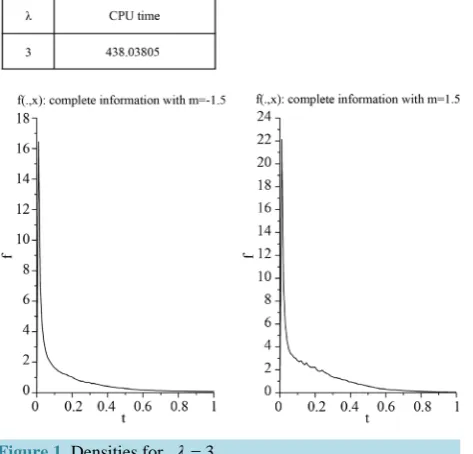
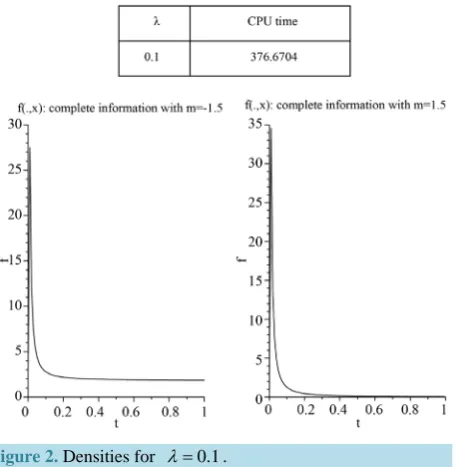
[image:6.595.198.435.490.717.2]These four first figures (Figue 1 and Figure 2) represent the densities of the first passage time for a jump
Figure 2. Densities for λ=0.1.
diffusion process (case of complete information). The variable t∈
[ ]
0,1 and Monte Carlo results are based on5000 simulation runs.
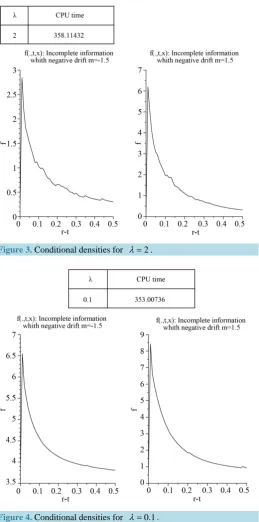
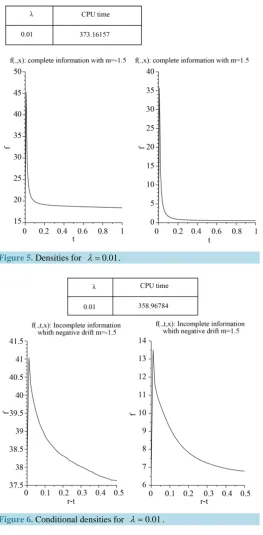
Figure 3, Figure 4 and Figure 6 are those of the conditional density f r t x
(
, ,)
(case of incompleteinformation), for fixed t=0.1 and the variable r is such that r∈
]
0.1, 0.6]
. Part II of A. Bain and D. Crisan[15], namely Numerical Algorithms, where the authors give some tools to solve the filtering problem is really
useful. The class of the numerical method used is the particle method for continuous time framework.Here, the Monte Carlo results are based on 120 simulation runs.
We observe that the maximum reached is greater if the drift m is positive, meaning the positive level x is more
probably reached in a shorter time.
In incomplete information, the distance between the curve and axis is greater than in complete information
case, this would mean that in case of incomplete information, the level x is more difficult to be reached in a short
time.
The choice of the small value of λ serves to compare the results with the limiting Brownian motion case
(λ =0). In complete information case, the formulae for the first passage times of Brownian motion can be
found in [16].
A large value of λ implies a lot of jumps, a large computing time and less regular curve.
In these last four figures (Figure 5 and Figure 6), the maximum reached is greater if the drift m is negative,
meaning the positive level x is more probably reached in a shorter time. This is due to the very small value of
λ.
4. Proofs
Proposition 1
Proof. First note that, since X is a
(
,)
-Markov process and t⊂t, we have(
)
(
(
)
)
(
)
(
)
(
)
( )
(
)
| | | 1 |
, | , where . . | .
x x x x Xt
x
t
t t t t t
t
t G x Xt t t
τ τ τ τ
τ
−
=∞ =∞ > =∞
>
= =
= ∞ − =
1 1 1
1
The fact that τx is a
(
,)
-stopping time justifies the last equality.Secondly, for any b≥ >a t the
(
,)
Markov property of the process X and the fact that on the set{
τx>t}
, τx= +t τx X− tθt ensure(
x< |)
(
(
x< |)
|)
(
x>(
x Xt<)
|)
. ta≤τ b t = a≤τ b t t = τ t a t− ≤τ− b t− t
Figure 3. Conditional densities for λ=2.
Figure 4. Conditional densities for λ=0.1.
The t-conditional law of τx X− t has the density (possibly defective) f
(
.−t x, −Xt)
, thus(
|)
(
,)
d | .x x
b
a≤ <τ b t = τ >t
∫
af r−t x−Xt r t 1 1
By hypothesis, we have r− ≥ − >t a t 0. It follows from Lemma 3 of Appendix that
(
,)
d .x
b
t af r t x Xt r τ>
− − < ∞
∫
1
Figure 5. Densities for λ=0.01.
Figure 6. Conditional densities for λ=0.01.
(
,)
d |(
,)
| d . .x x
b b
t af r t x Xt r t a t f r t x Xt t r a s
τ > τ>
− − = − −
∫
∫
1 1
Now, we show the equality almost surely for all b≥ >a t. Let M1 and M2 be the processes defined by
(
)
(
)
1: x , d | and 2: x , | d .
b b
t a t t a t t t
M b τ > f r−t x−X r M b τ> f r−t x−X r
∫
∫
1 1
These processes are increasing, then they are sub-martingales with respect to the filtration b=t ∀ ≥b t.
they have same càd-làg modification for all b, meaning that
(
,)
d |(
,)
| d . . .x x
b b
t af r t x Xt r t a tf r t x Xt t r a s b
τ > τ >
− − = − − ∀
∫
∫
1 1
We conclude that, almost surely, for all b≥ >a t,
(
1 |)
(
,)
| d .x x x x
b
t a b t t a tf r t x Xt t r
τ> < ≤τ = τ>
∫
τ > − − 1 1 1
Taking a t 1
n
= + , letting n going to infinity and using monotone Lebesgue Theorem yield that, −a s. ∀ ≥b t,
(
t< ≤τx b| t)
=∫
tb τx>tf r(
−t x, −Xt)
| td .r 1 1
□
Proposition 2
Proof. Let f and g be two solutions of Equation (6) and δ = −f g. It follows that
(
r t x, ,)
0t(
r u x K t u x, ,) (
, ,)
dQu 0t(
r u x K t u x, ,) (
, ,) ( )( )
h t u, duδ = −
∫
δ +∫
δ Π (13)where
(
)
( )( )
(
)
(
,)
, , .
, |
x u u u
h t u K t u x
G t u x X
τ> Π =
− −
1 (14)
We recall the expression
( )( )
(
( ) (
)
)
(
)
(
,)
|,
, |
x x
u u u u
u u u
h X G t u x X
h t u
G t u x X
τ τ >
>
− −
Π =
− −
1
1
and remark that Π
( )( )
h t u, ≤ h∞. Then(
)
(
)
(
)
, , .
, |
x x
u
u u u
h K t u x
G t u x X
τ τ
∞ >
>
≤
− −
1 1
Markov property implies
(
, ,)
(
)
.|
x x
u
t u h
K t u x τ
τ ∞ >
>
≤
1 1
We use Lemma 4 with t=uY =1τ >x t and b=t and it follows that
(
, ,)
00(
(
|)
)
|
x x
x
Q u u u
u Q
t t u L
K t u x h
L τ τ
τ > >
∞
>
≤
1 1
1
and Lemma 7 (22) with the pair
( )
t u, gets(
)
(
)
(
)
0
0
| , ,
|
x x
x
Q u u u
u Q
t u u L
K t u x h
L τ τ
τ > >
∞
>
≤ 1 1
1
.
All computations are done on the set
{
τx>t}
. We observe too 0(
)
1
|
x
Q t t u u
L τ >
→
1 is a positive
submartingale. Then for all T≥ ≥t u, we obtain by Lemma 7 (22) with the pair
( )
t T, , Doob’s inequality and{
τx>T} {
⊂ τx>t}
,(
)
(
)
(
)
2 2 2
0 0 0
0 0 0
1 1 1
sup 4 4
| | |
x x x
Q Q Q
u T
tLt u tLt T TLT T
τ τ τ
≤ > > >
≤ ≤
1 1 1
Thanks to Jensen inequality and Lemma 8 with α=2 and t=T, it follows that
(
)
0 0 1 sup . | x Q u TtLu u τ
≤ >
< ∞
1
Concerning the numerator, 0
(
1 |)
0(
|)
.x
Q Q
uLu u Lu u τ > ≤
Since Novikov condition ( )
2 0 1 d 0 2 e T s
h X s
∫ < ∞
is satisfied then 0
(
)
| Q
u u L
is a locally square integrable
(
0)
, Q
-martingale. Once again Doob’s
inequality gets
(
)
0 0
sup x u u| uQ .
u T
L τ > ≤
< ∞
1
So finally
(
)
(
)
0 0 |sup . .
|
x x
Q u u u
Q u T
t t u L a s L τ τ > ≤ >
< ∞ −
1
1 (15)
Let
( )
(
)
(
)
0
0
|
inf 0 : ,
|
x x
Q u u u
n Q
t u u L
T t n
L τ τ ω > > = ≥ ≥ 1
1 and
(
)
(
)
0 0 | : | x x Q u u un Q
t t u L n L τ τ ω > >
Ω = ≤
1
1 . On the set Ωn ,
(
, ,)
,K t u x ≤n h∞ Tn
( )
ω ≥t. Moreover (15) proves that Tn→ ∞ so
nΩ = Ωn .It follows using (13) that
(
)
(
) (
)
(
) (
) ( )( )
(
) (
)
(
) (
) ( )( )
(
) (
)
(
) (
) ( )( )
0 0 0 0 0 0, , , , , , d , , , , , d
, , , , d , , , , , d
1 , , , , d , , , , , d .
n n
n n
n
n n n
t t
u
t T t T
u
t t
u T u u T
r t x r u x K t u x Q r u x K t u x h t u u
r u x K t u x Q r u x K t u x h t u u
r u x K t u x Q r u x K t u x h t u u
δ δ δ
δ δ
δ δ
Ω Ω
∧ ∧
Ω
Ω ≤ ≤
= − + Π
= − + Π
= − + Π
∫
∫
∫
∫
∫
∫
1 1 1 1 1Taking
(
, ,)
(
, ,)
n
n r t x δ r t x Ω
∆ = 1 , we obtain
(
, ,)
0t(
, ,) (
, ,)
d 0t(
, ,) (
, ,) ( )( )
, d .n r t x n r u x K t u x Qu n r u x K t u x h t u u
∆ = − ∆
∫
+ ∆∫
Π (16)Then
(
)
(
) (
)
(
) (
) ( )( )
(
)
(
)
2 2 0 2 0 2 2 2 0, , 2 , , , , d
2 , , , , , d
2 1 , , d
t
n n u
t n
t n
r t x r u x K t u x Q
r u x K t u x h t u u
n h∞ h∞ r u x u
∆ ≤ ∆
+ ∆ Π
≤ + ∆
∫
∫
∫
.By Gronwall’s lemma, we deduce that ∆n
(
r t x, ,)
=0 is the unique solution of (16) on the set Ωn, so ∀n(
, ,)
0.n
r t x
δ 1Ω = Uniqueness of solution of (6) is a consequence of Ω =
nΩn . □Proposition 3
Proof. Let be a process S∈ where the set of processes is defined in Lemma 5 and a time t. Lemma 7
applied to Y=ϕ τ
( )
x 1τx>t which belongs to(
)
0
, , TX
L∞ Ω F implies
( )
(
)
( )
(
( )
( )
)
0 0 0
0 d .
x t x t x
t
x τ L ST t x τ x τ tL Su u uh Xu u
ϕ τ > = ϕ τ > +
∫
ϕ τ > ρ 1 1 1
( )
(
)
( )
(
(
( )
( )
)
)
0 0 0 0
0 | d .
x t x t x
t Q
x τ L ST t x τ Su u L h Xu u τ t x u u
ϕ τ > = ϕ τ > +
∫
ρ >ϕ τ 1 1 1
Conversely compute the expectation of the product of
0
1 t d
t u u u
S = +
∫
S ρ Q by right hand of (7):( )
(
( )
( )
)
(
)
( )
(
(
( )
( )
)
)
0 0 0
0
0 0 0
0
| d
| d
x t x
x t x
t Q
t x u u t x u u
t Q
x u u u u t x u
S L h X Q
S L h X u
τ τ
τ τ
ϕ τ ϕ τ
ϕ τ ρ ϕ τ
> > > > + = +
∫
∫
1 1 1 1 .Since is dense in 2
(
0)
, Q, ,
L Ω
( )
(
)
( )
( )
( )
0 0 0
0
| | d .
x t x t x t
t
Q Q
x τ LT t x τ L h Xu u τ x u Qu
ϕ τ > = ϕ τ > +
∫
>ϕ τ 1 1 1
Finally we could replace 1τx t>ϕ τ
( )
x by its u conditional expectation since .Q u ⊂ u
□
Proposition 4
Proof. Applying Lemma 4, it follows that
(
)
00(
(
)
)
| | . | x x x x Q b a b t
a b t t Q
t t t L L τ τ τ τ < < < < >
> = 1 1 1
1 (17)
But, since the condition 0
(
2(
)
)
0 , d
t
u
f t−u x−X u< ∞
∫
is not necessarily satisfied, we are not able to provethat 0
(
|)
x
Q tLt t τ>
1 is a semi martingale (e.g. see Protter’s Theorem 65 Chapter 4 [20]). This leads us to
consider for t< ≤ +T t 1, the expression 0
(
)
|
x
Q TLT t τ>
1 instead of 0
(
)
|
x
Q tLt t τ>
1 at denominator of
(17). But Lemma 7 of Appendix ensures that
(
)
(
)
(
(
)
)
0 0 0 0 | | . | | x x x x Q Qb a b t t a b t
Q Q
T T t T t t
L L
L L
τ τ
τ τ
< < < < > > = 1 1 1 1
We apply Ito formula to the ratio of processes
(
)
(
)
0 0 | | x x Q b a b tQ T t t L L τ τ < < > 1
1 . For this end, we let two processes
satisfying the stochastic equations respectively (9) and (11):
(
)
(
)
( )
0 0
| , | and ,
x x
Q Q
t t a b t t T t t
x
X L Y L f x y
y
τ τ
< < >
= 1 = 1 =
The Itô’s formula applied to f X Y
(
., .)
from 0 to t gives us(
)
(
)
(
(
)
)
( ) (
)
(
)
(
)
(
)
(
)
(
( ) (
)
)
(
)
(
)
( )
0 0 0 00 0 0
0 0 2 0 0 0 0 0 , , | | d | | | , | d | | x x x x x x x x x Q Q
t u u u u u u
b a b t x
u
Q Q
x
T T t T u u
Q Q
t u a b u u u u u u
u Q
T u u
Q
u a b u u u u
t
L h X G a u x X G b u x X
L a b
Q T
L L
L L h X G T u x X
Q L
L L h X G T
τ τ τ τ τ τ τ τ τ τ τ > < < > >
< < >
>
< < >
− − − − −
< <
= + > − − − +
∫
∫
∫
1 1 1 1 1 1 1 1 1 (
(
)
)
(
)
( ) (
)
(
)
(
)
(
( ) (
)
)
(
)
2 3 0 0 0 2 0 0 , | d | , |, , | d .
| x x x x Q u u Q T u u
Q
t Q u u u u u
u u u u u u
Q T u u
u x X
u L
L h X G T u x X
L h X G a u x X G b u x X u
We achieve the proof letting T→t using the monotonous Lebesgue theorem since 1τ >x T increases to 1τ >x t
when T→t. □
Theorem 1
Proof. Let us now find a mixed filtering-integro-differential equation satisfied by the conditional probability density process defined from the representation
(
|)
(
, ,)
d for some .x
b
a< <τ b t =
∫
af r t x r a>t 1 (18)
We fix a and t such that a>t. Let be u≤t, recalling the
(
0)
,
-Markov property of X at point u and the
fact that Q⊂
justify
(
)
(
)
0
0 0
|
| | .
x
x x Xu
Q u a b u
Q
u u a u b u u u
L
L
τ
τ τ−
< <
> − < < −
=
1
1 1
By definition of G, we have
(
)
(
)
(
)
(
)
0 / , ,
, d .
x Xu
a u b u u u u
b
u a
G a u x X G b u x X
f r u x X r
τ−
− < < − = − − − − −
=
∫
− −1
Then
(
)
(
)
(
)
0
0
|
, d | .
x
x
Q u a b u
b Q
u u a u u
L
L f r u x X r
τ τ
< <
>
=
∫
− −1
1
By Tonelli Theorem,
(
)
(
)
(
)
0
0
|
, | d .
x
x
Q u a b u
b Q
u u u u
a L
L f r u x X r
τ τ < < >
=
∫
− −1
1
Similarly
(
)
(
(
)
)
0 | 0 , | .
x x
Q Q
tLu u Lu uG t u x Xu u τ > = τ> − −
1 1
In Equation (12) of Proposition 4,
(
)
( ) (
)
(
)
(
)
0
0
| and
, , |
x x
Q u a b u
Q
u u u u u u
L
L h X G a u x X G b u x X
τ τ
< <
> − − − − − 1
1
are respectively replaced by
(
)
(
)
( ) (
)
(
)
0
0
, | d
and , | d .
x
x
b Q
u u u u
a
b Q
u u u u u
a
L f r u x X r
L h X f r u x X r
τ τ
>
>
− −
− −
∫
∫
1
1
By hypothesis, we have r− ≥ − >u a u 0.
For T =t, Lemma 8 of Appendix ensures that
(
)
(
)
0
2 0 0
d
.
, |
x
t
Q
u u u u
u
L G t u x X τ >
< ∞
− −
∫
1
The numerators being bounded by h∞Lu, we can apply stochastic Fubini’s theorem to Equation (12) Pro-
(
)
(
)
( )
(
( ) (
(
)
)
)
(
)
(
)
(
( ) (
)
)
(
)
(
)
(
)
( )
00 0 0
0 0 2 0 0 0 0 0 , | 1
| , d d d
| , | , | d d | , | x x x x x x x x Q
b b t u u u u u
a b t a a Q u
x t u u
Q Q
b t u u u u u u u u u
u
a Q
t u u
Q
u u u u u u u
b t
a
L h X f r u x X
f r x r Q r
t L
L f r u x X L h X G t u x X
Q r L
L f r u x X L h X G t u
τ τ τ τ τ τ τ τ τ > < < > > > > > > − − = + > − − − − − − − − +
∫
∫ ∫
∫ ∫
∫ ∫
1 1 1 1 1 11
(
1(
)
)
(
)
( ) (
)
(
)
(
( ) (
)
)
(
)
2 3 0 0 0 2 0 0 , | d d | , |, | d d .
| x x x x Q u u Q t u u
Q
b t Q u u u u u
u u u u u
a Q
t u u
x X
u r L
L h X G t u x X
L h X f r u x X u r
L τ τ τ τ > > > > − − − − − −
∫ ∫
1 1 1 1To express this result with conditional expectation instead of 0
conditional expectation, each fraction
under the integral is multiplied and divided by the same term 0
(
)
| .
x
Q uLu u τ >
1 To manage the indicator func-
tion, we use the filtration
(
t,t≥0)
since τx is a -stopping time.Therefore, using (20) in Lemma 4, on the set
{
τx >t}
, we obtain(
)
(
)
( )
(
( ) (
)
)
(
)
(
)
(
)
(
( ) (
)
)
(
)
(
)
(
)
(
( ) (
)
)
(
)
(
)
0 2 0 2 0 , | 1, , d , d d d
, |
, |
, , d d
, | , | , , , | x x x x x x
b b b t u u u u
u
a a a
x u u u
b t u u u u
u a
u u u
u u u u
b t
a
u u u
h X f r u x X
f r t x r f r x r Q r
t G t u x X
h X G r u x X
f r u x Q r
G t u x X
h X G r u x X
f r u x
G t u x X
τ τ τ τ τ τ τ > > > > > > − − = +
> − −
− − − − − − − + − −
∫
∫
∫ ∫
∫ ∫
∫ ∫
1 1 1 1 1 1( ) (
)
(
)
(
( ) (
)
)
(
)
(
)
3 2 0 d d , | , | d d , | x x xb t u u u u u u u u
a
u u u
u r
h X f r u x X h X G t u x X
u r
G t u x X
τ τ τ > > > − − − − − − −
∫ ∫
1 1 1which finishes the proof. □
5. Conclusion
This paper extends the study of the first passage time for a Lévy process in [5] from complete to incomplete
information and D. Dorobantu’s work in [8] from intensity to conditional density. Here, we are proving the
existence of the density of τx law given an information set, giving a stochastic differential integral equation
satisfied by it and some numerical examples. All this gives us a behavior of the default time. In future works, we will be interested by the same studies in discrete time, in another kind of information set or under another process modeling the firm value.
Acknowledgements
We thank my PhD advisor Laure Coutin for her help and pointing out error. We thank too Monique Pontier for her careful reading. We thank the Editor and the referee for their comments. This work is supported by A.N.R. Masterie. This support is greatly appreciated.
References
[1] Bertoin, J. (1998) Lévy Processes. Vol. 121, Cambridge University Press, Cambridge.
Ma-thematics, Cambridge University Press, Cambridge, Translated from the 1990 Japanese Original, Revised by the Au-thor, 1999.
[3] Cont, R. and Tankov, P. (2004) Financial Modeling with Jump Processes. Chapman & Hall/CRC, Boca Raton, London, New York.
[4] Duffie, D. and Lando, D. (2001) Term Structure of Credit Spreads with Incomplete Accounting Information. Econo-metrica, 69, 633-664. http://dx.doi.org/10.1111/1468-0262.00208
[5] Kou, S.G. and Wang, H. (2003) First Passage Time of a Jump Diffusion Process. Advances in Applied Probability, 35, 504-531. http://dx.doi.org/10.1239/aap/1051201658
[6] Bernyk, V., Dalang, R.C. and Peskir, G. (2008) The Law of the Supremum of a Stable Lévy Process with No Negative Jumps. The Annals of Probability, 36, 1777-1789. http://dx.doi.org/10.1214/07-AOP376
[7] Guo, X., Jarrow, R. and Zeng, Y. (2009)Credit Model with Incomplete Information (Earlier Version Information Re-duction in Credit Risk Models). Mathematics of Operations Research, 34, 320-332.
http://dx.doi.org/10.1287/moor.1080.0361
[8] Dorobantu, D. (2007)Modélisation de risque de défaut en enterprise. Thèse de l’Université de Toulouse 3.
[9] Roynette, B., Vallois, P. and Volpi, A. (2008) Asymptotic Behavior of the Hitting Time, Overshoot and Undershoot for Some Lévy Processes. ESAIM: PS, 12, 58-93.
[10] Gapeev, P.V. and Jeanblanc, M. (2010) Pricing and Filtering in Two-Dimensional Dividend Switching Model. Interna-tional Journal of Theoretical and Applied Finance, 13, 1001-1017. http://dx.doi.org/10.1142/S021902491000608X
[11] Coutin, L. and Dorobantu, D. (2011) First Passage Time Law for Some Lévy Process with Compound Poisson: Exis-tence of a Density. Bernoulli, 17, 1127-1135. http://dx.doi.org/10.3150/10-BEJ323
[12] Zakai, M. (1969) On the Optimal Filtering Diffusion Process. Zeitschrift für Wahrscheinlichkeitstheorie und Ver-wandte Gebiete, 11, 230-249. http://dx.doi.org/10.1007/BF00536382
[13] Pardoux, E. (1991) Filtrage non linéaire et équations aux dérivées partielles stochastiques associées. Ecole d’Eté de Probabilités de Saint-Flour-1989, Lecture Notes in Mathematics 1464, Springer-Verlag, Heidelberg, New York. [14] Coutin, L. (1996) Filtrage d’un système càd-làg: Application du calcul des variations stochastiques à l'existence d'une
densité. Stochastics and Stochastics Reports, 58, 209-243. http://dx.doi.org/10.1080/17442509608834075
[15] Bain, A. and Crisan, D. (2009)Fundamentals of Stochastic Filtering. Springer-Verlag, New York.
http://dx.doi.org/10.1007/978-0-387-76896-0
[16] Karatzas, I. and Shreve, S.E. (1991) Brownian Motion and Stochastic Calculus. Second Edition, Springer-Verlag, New York.
[17] Doney, R.A. and Kiprianou, A. (2005) Overshoot and Undershoot of Lévy Process. The Annals of Applied Probability,
16, 91-106. http://dx.doi.org/10.1214/105051605000000647
[18] Protter, P. (1985) Volterra equations driven by semi martingale. Annals of Probability, 13, 518-530.
http://dx.doi.org/10.1214/aop/1176993006
[19] Revuz, D. and Yor, M. (1999)Continuous Martingales and Brownian Motion. Third Edition, Springer-Verlag, Berlin, Heldelberg, New York. http://dx.doi.org/10.1007/978-3-662-06400-9
[20] Protter, P. (2003) Stochastic Integration and Differential Equation. Second Edition, Springer, Berlin.