Assortment of Materialized View: A Comparative Survey
in Data Warehouse Environment
Deepika Kirti
University School of Information and Communication Technology Guru Gobind Singh Indraprastha University
Dwarka, New Delhi
Jaspreeti Singh
University School of Information and Communication Technology Guru Gobind Singh Indraprastha University
Dwarka, New Delhi
ABSTRACT
Data warehouse is a repository of large amount of data collected from multiple heterogeneous and distributed data sources. Data warehouse stores lots of data in the form of views, referred as materialized views which provide a base for decision support or OLAP queries. Materialized views store the result of queries which improves the query performance. One of the most important aspect in data warehousing is the selection of materialized views which minimizes the query response time and maintenance cost, given a limited storage space. In this paper, analysis of various approaches of view selection in data warehousing environment is done that have been proposed in the recent past and also provided a comprehensive study of these approaches based on various parameters such as issues addressed, query language supported, comparison to benchmark etc.
Keywords: Data warehouse; materialized view; view
selection; benchmark.
1. INTRODUCTION
A data warehouse (DW) is a relational database that is designed for query processing and analysis rather than transaction processing. It usually contains historical data derived from transactional data, but can include data from other sources also. According to W.H. Inmon, “A data warehouse is a subject-oriented, integrated, time-variant and non-volatile collection of data in support of management's decision making process”[1].
Data warehouse stores lots of data in the form of views, referred as materialized views (MV), these views are generated as per user requirement specified in queries [2]. A materialized view is a database object that stores the result of a query and makes them available for future use which is used to answer the query in a data warehouse [6]. Database retrieval of materialized view is just like a cache, which is copy of the data which can be retrieved quickly. However, the use of materialized views requires additional storage space and overhead of view maintenance when refreshing data warehouse [3]. The process of reflecting changes to a materialized view in response to the changes (inserts or update or delete) in the original database is known as View Maintenance that incurs view maintenance cost.
Generally, these are the following choices for materialized views [4]:
• Materializing all views in Data Warehouse: gives best performance at highest cost of maintenance. • Leaving all the views virtual: gives poorest
performance but lowest maintenance cost.
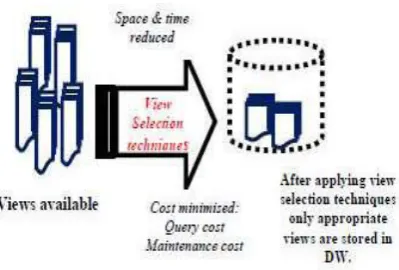
[image:1.595.328.528.276.411.2]• Materializing some views: if some views materialized and some virtual, especially when there are some shared views on common data involved, then an optimal balance between performance and maintenance can be achieved.
Figure 1: selection of materialized view
Because of view maintenance cost, it is impossible to make all views materialized under storage space constraints. There is need to select an appropriate set of views to materialize for answering queries, which is called materialized view selection (MVS) [3]. The materialized views are considered the best subset if it results in a minimum query cost as well as satisfies all the constraint. The materialized view selection problem is NP-hard [2].
The proposals about materialized view selection differ in several points [5] which are as follows: the way of determining candidate views; the framework used to capture relationships between candidate views; query optimization; selection of views in relational or multidimensional context; multiple or single query optimization; theoretical or technical solutions. For the purpose of a better understanding of materialized view selection based on the major driving factors of query processing and view maintenance cost, a comparison of the approaches that have been proposed so far has been done.
The paper organization is as follows:
2. STATE- OF- ART
In this section, a brief description of various approaches designed for effective view selection in the recent past is given. From the beginning of data warehouse evolution, the main concern has been problem of view selection.
The most important issue while designing a data warehouse is to identify and store the most appropriate set of materialized view in data warehouse. Materialization of all views is not possible due to memory space and time constraints [11]. The main aim of view selection problem is to minimize either one of the constraint or a cost function (query processing cost and view maintenance cost)[7]. Hence, view selection problem is defined as a process of identifying and selecting a group of materialized views that are most closely associated to user defined requirements in the form of queries in order to minimize the query response time, maintenance cost and query processing time under certain resource constraints. This involves the optimization of two costs included in materialization of views: query processing cost and materialized view maintenance cost.
In [6] a framework is presented that automatically selects the materialized views and indexes for SQL databases. It has been implemented for performance tuning in SQL Server 2000. Authors in [3] explore the use of an evolutionary algorithm for materialized views selection based on multiple global processing plans for queries. Also hybrid evolutionary algorithm is applied to solve three related problems i.e. query optimization, choose best global processing plan from multiple global processing plan and select materialized view from given global processing plan.
A VRDS algorithm [7] is developed for selecting views in data warehousing environment and also developed a framework based on view relevance.
In [2] AND /OR graph based approach is developed which handle the view selection problem in data cubes present in data warehouse by taking an example of TPC-D benchmark database. Authors have also proposed an optimization algorithm to select certain views.
Another graph based approach has been discussed in [8] in order to select a set of views for special cases under disk space and maintenance cost constraints. AND view graph have been discussed to evaluate the global plan for queries and OR view graphs focus on data cubes. Authors have proposed greedy heuristic based algorithm to handle the same.
In [36] authors developed a competitive A* algorithm for selection of materialized views under disk space constraint. In this paper, authors defined a new H-function, which guarantees to find the optimal solution, NIBS order is proposed to insert views during A* search, developed two powerful pruning techniques and two novel sliding techniques. And in [9] author revisit the problem of materialized view selection under disk space constraint. A new competitive A* algorithm is proposed and shows experimentally that new algorithm is powerful and efficient, and flexible approach.
The authors in [10] have used clustering techniques for computation of reduced tables and then materialized views are
computed based on these reduced tables . Also presented a clustering based algorithm named as ASVMRT.
An approach to solve the issue of balancing the trade-off between performance and view maintenance [11]. The Authors have presented a two phase optimization technique (2PO) which is combination of simulated annealing (SA) and iterative improvement (II), using multiple view processing plan (MVPP).
The authors in [4] focus on reducing the cost of views refreshment on the basis of greedy algorithm and dynamic selection problem. In contrast to greedy algorithm, the application of views refreshment can be more suitable to queries. In contrast to dynamic selection algorithm, the strategy of materializing views based on cache updating can avoid the frequent substitution of views in the materialized view set, which can lower the efficiency.
A new approach for materialized view selection based on parallel simulated annealing(PSA) is presented in [12] that selects views from an input MVPP. The PSA algorithm approach generates solutions lesser than the heuristic algorithm. Authors experimentally shows that PSA provides significant improvement in the quality of the obtained set of materialized views as compared to heuristic method and sequential SA.
A MA based algorithm, based on memtic algorithm(MA) is presented in [13]. The memtic algorithm has been successfully applied to several NP-Hard combinatorial optimization problems and efficiency of the algorithm has been confirmed. Experiment result shows that the proposed algorithm performs better than heuristic algorithm and genetic algorithm.
Another approach for fast materialized view selection in distributed environment is node selection algorithm[14]. This algorithm shows that it performs better for query processing as compared to other materialized view selection strategies. An approach based on metaheuristic cooperation is presented in [15]. This study shows that, the meta heuristic cooperation offers: very good performance ratio with an exact algorithm for reduced problem size; better result than the individual metaheuristics,; scalable approach.
In[16] authors have proposed a framework for candidate view selection using I-Mine algorithm, Index Support for item set mining to mine the frequent queries.
In EMVSDIA algorithm[17], authors have implemented dynamic adjustment for static materialized views selection algorithm. The authors have conducted experiments to prove reduction of search space and time consumption.
In [18], author presents two algorithms to generate MVPP: one to generate a feasible solution expeditiously and the other provides an optimal solution by mapping the optimal MVPP generation problem as a 0-1
An algorithm of view selection to materialize in specialized data warehouse on the basis of data domain information is developed in [20]. The purpose of the algorithm is to minimize the materialization cost by selecting an optimal set of materialized view constrained by actual space from candidate view subsets.
A framework is proposed in [21] to provide an optimized version of view selection problem which intend to give the best combination of low query processing cost, low view maintenance cost and good query response.
3. COMPARITIVE STUDY
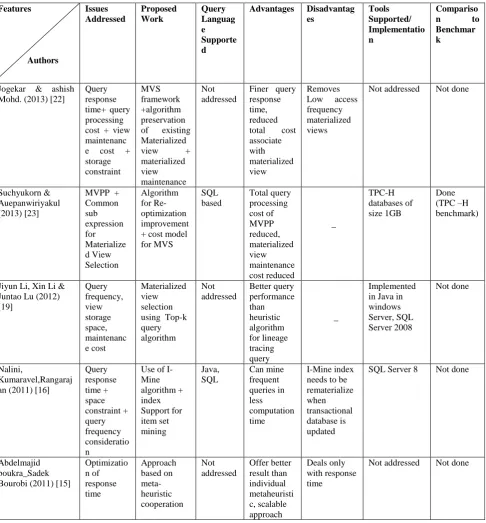
[image:3.595.61.548.237.761.2]The analysis of the various research works done in the area of materialized views of data warehouse has been done on the basis of several parameters such as issues addressed, proposed work, query language supported, advantages, disadvantages, tools supported or implementation and comparison to benchmark. The analysis and comparative study presented in this paper summarizes various aspects of materialized views of data warehouse that helps in understanding them in a convenient manner. This tabular comparison is presented in the reverse chronological order to understand the development in this area and shows the evolution for the same.
Table 1: comparision of various research work
Features
Authors
Issues Addressed
Proposed Work
Query Languag e Supporte d
Advantages Disadvantag
es
Tools Supported/ Implementatio n
Compariso
n to
Benchmar k
Jogekar & ashish Mohd. (2013) [22]
Query response time+ query processing cost + view maintenanc e cost + storage constraint
MVS framework +algorithm preservation of existing Materialized view + materialized view maintenance
Not addressed
Finer query response time, reduced total cost associate with materialized view
Removes Low access frequency materialized views
Not addressed Not done
Suchyukorn & Auepanwiriyakul (2013) [23]
MVPP + Common sub expression for Materialize d View Selection
Algorithm for Re-optimization improvement + cost model for MVS
SQL based
Total query processing cost of MVPP reduced, materialized view maintenance cost reduced
_
TPC-H databases of size 1GB
Done (TPC –H benchmark)
Jiyun Li, Xin Li & Juntao Lu (2012) [19]
Query frequency, view storage space, maintenanc e cost
Materialized view selection using Top-k query algorithm
Not addressed
Better query performance than heuristic algorithm for lineage tracing query
_
Implemented in Java in windows Server, SQL Server 2008
Not done
Nalini,
Kumaravel,Rangaraj an (2011) [16]
Query response time + space constraint + query frequency consideratio n
Use of I-Mine algorithm + index Support for item set mining
Java, SQL
Can mine frequent queries in less computation time
I-Mine index needs to be rematerialize when transactional database is updated
SQL Server 8 Not done
Abdelmajid boukra_Sadek Bourobi (2011) [15]
Optimizatio n of response time
Approach based on meta-heuristic cooperation
Not addressed
Offer better result than individual metaheuristi c, scalable approach
Deals only with response time
KV Badmaeva (2011) [20]
Optimal set of
materialized view constrained by actual space from candidate view subset
Algorithm of view selection for materializatio n
Not addressed
Support the administrato r by proactive method of materialized view selection in specialized data warehouse , designing cost reduced
Depend upon data domain character
Not addressed Not done
Karde & Thakare (2010 ) [14]
Query cost +
maintenanc e cost + storage space
Algorithm for creation and maintenance of views + algorithm for node selection
Not addressed
Query performance improved
Only distributed environment highlighted
Not addressed Not done
Xin Li, Xu Qain, Junlin jiang, ziqiang wang(2010) [24]
Total maintenanc e cost + query response time
SFL algorithm for Materialized View Selection
Not addressed
Outperforms greedy heuristic algorithm & genetic algorithm in terms of total maintenance cost, find global optimization solution
_
Not addressed Done (TPC-D benchmark)
Xiangquian Song & Lin Gao (2010) [25]
Sub optimal selection in global search area
Ant colony based algorithm for materialized view selection
Not addressed
Global optimal solution will be found by the feedback of ACA materialized view selection algorithm
_
Kingbase ES v6.1 database
Not done
Seyed Hamid Talebian & Sameem Abdul Kareem (2010) [26]
Disk space constraint
Multi objective view selection problem using lexicographic Genetic algorithm
Not addressed
High degree of
optimality as compared to optimal solution
Does not exhibit excellent diversity
Not addressed Not done
Ashadevi,
Balasubramanian & Navneetham (2010) [21]
Maintenanc e, storage of most cost effective views to be materialize
OSVP against OCEMS with aid of time
Not addressed
Low query processing and view maintenance cost in given storage space constraint
Only maintenance cost & storage space constraint have been taken into account
Implemented in java
Not done
Zhou Zhang , Xia Sun, Ziqiang wang [13]
Cost effective view selection under storage
MA algorithm for selecting view
Not addressed
Faster computation time + comparison of GA space constraint
Only optimal research
HA algorithm Lijuan, Xuebin,
Linshuang & Qian (2009) [17] Search space and time consumptio n consideratio n for view selection EMVSDIA algorithm SQL based Reduces search space and time
consumption _
Windows 2003 server, Database platform SQL server 2005 Not done
Dhote & Ali (2009) [8] Selection of views to minimize query response time AND/OR DAG + Optimization algorithm SQL based Heuristic based algorithm Does not work well for some cases, works only on lattice
Not addressed Done
Ziyu lin, Dong qing yang, song & wang (2007) [27] MVS + overall query performanc e User oriented method for MVS called SOMES Not addressed Better performance for view selection problem _ Implemented in C++, HP Proliant DL585 Server, windows server 2003 & oracle 10g
Not done
Derakshan, stantic, korn & Dehne (2007) [12]
Minimized view maintenanc e and query processing cost Materialized view selection using parallel simulated annealing SQL based Increased the quality of obtained sets of materialized view, improvemen t in query processing time & view maintenance cost Trapped to local minimum Implemented in C++, SUN microsystems v20 dual AMD Opteron 2.6 GHz with 4GB RAM
Not done
Aouiche, Emmanuel jouve & Darmount (2006) [5] Automatic strategy for materialized view selection Framework for materialize view selection that exploits clustering Not addressed Efficiently share the available storage space between indexes and views Performs static optimization only 1GB data warehouse + oracle 9i + 2.4 GHz PC
Done (ad-hoc benchmark)
Gui shang Yin & Xiang Yu, Liandong Lin (2007) [4]
Reduced time of response time Strategy on materialize view selection based on cache updating Not addressed Strategy of ad-hoc adjustment, improves the efficiency of the system, avoid repeating computation s Efficiency decreased
Not addressed Not done
Phuboonob and auepanwiri yakul (2007) [11]
Addresses the trade off between performanc e and view maintenanc e Two phase optimization, a combination of PSA and MVPP SQL based Provides a better result than deterministi c algorithm and simulated annealing algorithm Only query response time factor has been made as the main focus TPC-H database of size 1GB Done (TPC-H benchmark)
Jing Li, Yao wang, qiang liu(2006) [28]
Query frequency + source data Information content + density based Not addressed Efficiency transmission of data
Focus only on selecting spatial tuples
+ spatial Complexity
selective materializatio n
Gang gou, Jeffrey Xu Yu & Hongjun Lu (2006) [9]
View selection under disk space constraint
A* algorithm Not addressed
High solution quality, high running performance , high flexibility
Find optimal solutions only when S is small
Not addressed Not done
Yang &
Chung(2006) [10]
Attribute value density + clustered tables + selection of views based on clustered /reduced tables
ASVMRT Algorithm for view selection
SQL based
Faster computation time, Reduced storage space, 1.8 times performance better than conventional algorithms
Maintenance of reduced tables not addressed, updating reduced tables needs attention
In pubs
database + ETRI
Not done
Gupta & Mumick (2005) [2]
View selection under disk space constraint
AND/OR view graphs + greedy heuristic based algorithm
SQL based
Optimal solution for special cases +
polynomial time heuristics
Approximatio n concerns not addressed + problem in AND view graph not NP-hard
Not addressed Done
Valluri, Vadapalli, Karlapalem (2002) [7]
Minimizatio n of total query processing cost
Framework based on view relevance + VRDS algorithm to minimize processing cost
Not addressed
Better than greedy and MVPP, strikes a balance between query processing and view maintenance cost
Optimality could have been more
Not addressed Not done
Zhang, yao & jian yang
(2001) [3]
Query Optimizatio n + Multiple query optimizatio n + materialized view selection
Combination of heuristic and evolutionary algorithm
Not addressed
Gives better performance than both heuristic and evolutionary algorithm, performed alone
Trade-off between computation time and cost saving has not been answered
SUN OS 5.5 + GAlib + simulation software
Done
Aggarwal, Chaudhari & Narasayya (2000) [6]
Automated view and index selection
Framework for index and view selection + Candidate selection & enumeration technique
SQL based
Robust tool support + Both indexes & view Selected
Only a part of physical design space addressed
SQL Server 2000
Done (TPC-H Benchmark )
4. CONCLUSION
In this paper, an analysis of different approaches proposed by the research community to deal with selection of materialized views in data warehouse environment has been done. Most of the techniques in materialized view selection mainly focus on reducing the total cost associated with the materialized view i.e. total query processing cost and maintenance cost which improves the query performance and select the views to
study work summarizes the research work done in the best possible manner.
5. FUTURE WORK
In this paper, comparison of various research work based on several parameters has been provided. As future work, direct this research towards various strategies of view adaptation and synchronization and batch oriented view maintenance strategies. A thorough investigation of methodologies to handle materialized view in highly distributed environments for query processing and analysis seems worth attention.
6. ACKNOWLEDGMENT
My sincere thanks to my honourable guide Ms. Jaspreeti Singh and others who have contributed towards the preparation of the paper.
7. REFERENCES
[1] W. H. Inmon, Building the data warehouse, 2nd edition, John Wiley and Sons, Canada, ISBN: 0471-14161-5, 1996.
[2] A. Gupta and I. Mumick, 'Selection of views to materialize in a data warehouse', IEEE Transactions on Knowledge and Data Engineering, Vol. 17, No. 1, pp. 24-43, 2005.
[3] Chuan Zhang, Xin Yao and Jian Yang, 'An Evolutionary Approach to Materialized Views Selection in a Data Warehouse Environment', IEEE transactions on systems, man, and cybernetics-Part C: Applications And Reviews, Vol. 31, No. 3, pp. 282-294, 2001
[4] Guisheng Yin, Xiang Yu and Liandong Lin, ”Strategy of selecting Materialized view based on Cache updating”, IEEE International conference on Integration Technology,2007.
[5] Kamel Aouiche, Pierre-Emmanuel Jouve and Jerome Darmont, 'Clustering-Based Materialized View Selection in Data Warehouses', 10th East-European Conference on Advances in Databases and Information Systems (ADBIS06), Vol. 4125, pp. 81-95, 2006
[6] S. Agrawal, S. Chaudhari and V. Narasayya, 'Automated selection of materialized views and indexes for SQL databases', Proceedings of 26th International Conference on Very Large Databases, Cairo, Egypt, 2000.
[7] Satyanarayana R Valluri, Soujanya Vadapalli and Kamalakar Karlapalem, 'View Relevance Driven Materialized View Selection in Data warehousing Environment', Australian Computer Science Communications, Vol. 24, Issue 2, pp. 187-196, 2002. [8] C. A. Dhote and M. S. Ali, 'Materialized view selection
in Data warehouse: A survey', Journal of Applied Sciences, Vol. 9, No. 3, pp. 401-414, ISSN 1812-5654, 2009
[9] Gang Gou, Yu, J.X. and Hongjun Lu,” A* Search: An efficient and flexible approach to materialized view selection”, IEEE Transactions on Applications and Reviews (Volume:36 , Issue: 3 ),2006.
[10] Jin-Hyuk Yang and In-Jeong Chung, 'ASVMRT: Materialized View Selection Algorithm in Data Warehouse', International Journal of Information Processing Systems, Vol. 2, No. 2, pp. 67-75, 2006.
[11] Jiratta Phuboonob and Raweewan Auepanwiriyakul, 'Two-Phase Optimization for Selecting Materialized Views in a Data Warehouse', World Academy of Science, Engineering and Technology, Vol. 19, pp. 277-281, 2007.
[12] Roozbeh Derakhshan, Bela Stantic, Othmar Korn and Frank Dehne, 'Parallel Simulated Annealing for Materialized View Selection in Data Warehousing Environments', 8th international conference on Algorithms and Architectures for Parallel Processing, pp. 121-132, ISBN: 978-3-540-69500-4, 2008.
[13] Qingzhou Zhang, Xia Sun, Ziqiang Wang,” An Efficient MA-Based Materialized Views Selection Algorithm”, 2009 Iita International Conference On Control, Automation And Systems Engineering
[14] P. Karde, and V. Thakare,” Selection of materialized views using query optimization in database management: An efficient methodology”, In International Journal of Management Systems, vol. 2.
[15] Abdelmadjid Boukra and Sadek Bouroubi, 'Selection of views to materialize in data warehouse: A cooperative approach', Studia Informatica Universalis, Vol. 9, No. 2, pp. 19-37, 2011.
[16] T. Nalini, A. Kumaravel and K. Rangarajan, 'An Efficient IMINE Algorithm for Materialized Views in a Data Warehouse Environment', International Journal of Computer Science Issues, Vol. 8, Issue 5, No 1, ISSN (Online): 1694-0814, 2011.
[17] Zhou Lijuan, Ge Xuebin and Wang Linshuang,Shi Qian, 'Efficient Materialized View Selection Dynamic Improvement Algorithm', 6th International Conference on Fuzzy Systems and Knowledge Discovery, Vol. 7, pp. 294-297, 2009.
[18] B. Ashadevi and R. Balasubramanian, 'Cost Effective Approach for Materialized Views Selection in Data Warehousing Environment', International Journal of Computer Science and Network Security, JC&T, Vol. 8 No. 10, pp. 236-242, 2008.
[19] Jiyun Li, Xin Li and Juntao Lv, “ Selecting Materialized View based on Top-K query algorithm for lineage tracing” , Third Global Congress on Intelligent Systems (GCIS), 2012
[20] KV Badmaeva, “Algorithm of view selection for Materializing in specialized Data Warehouse”, Proceedings of the 34th International Convention MIPRO, 2011.
[21] B. Ashadevi, P. Navaneetham and R. Balasubramanian 'A Framework for the View Selection Problem in Data Warehousing Environment', International Journal on Computer Science and Engineering, Vol. 02, No. 09, pp. 2820-2826, 2010.
[22] Ravindra N. Jogekar, Ashish Mohd, “Design and Implementation of Algorithms for Materialized View Selection and Maintenance in Data Warehousing Environment”, International Journal of Emerging Technology and Advanced Engineering ISSN 2250-2459, ISO 9001:2008 Certified Journal, Volume-3, Issue 9, 2013.
for Materialized View Selection”, World Academy of Science, Engineering and Technology Vol.: 7 2013-07-24, 2013.
[24] Xin Li, Xu Qian, Junlin Jiang and Ziqiang Wang, “Shuffled Frog Leaping Algorithm for Materialized Views Selection”, Second International Workshop on Education Technology and Computer Science (ETCS) (Volume: 3), 2010.
[25] Xiangqian Song, Lin Gao, “An Ant Colony based algorithm for optimal selection of Materialized view”, International Conference on Intelligent Computing and Integrated Systems (ICISS), 2010.
[26] Talebian, S.H, Kareem, S.A, “A Lexicographic Ordering Genetic Algorithm for Solving Multi-objective View Selection Problem”, Second International Conference on Computer Research and Development, 2010.
[27] Ziyu Lin, Dongqing Yang, Guojie Song and Tengjiao Wang, “User-oriented Materialized View Selection”, Seventh International Conference on Computer and Information Technology,2007.
[28] JingJing Li, Yao Wang, and Rui Qiang Liu, “Selection of Materialized View Based on Information Weight and Using Huffman-Tree on Spatial Data Warehouse”, IEEE Computer Society, (2006).
[29] Jian yang, kamlakar karlapalem and Qing ling, ”Algorithms for Materialized view Design in Data warehousing environment” ,Proceedings of the 23rd VLDB Conference Athens, Greece, 1997.
[30] Garima Thakur and Anjana Gosain, 'A Comprehensive Analysis of Materialized Views in Data warehouse
Environment', International Journal of Advanced Computer Science and Applications, Vol. 2, No. 5, pp. 76-82, 2011
[31] Alka and Anjana Gosain, “A Comparative Study of Materialised View Selection in Data Warehouse Environment” 5th International Conference on Computational Intelligence and Communication Networks (CICN), 2013.
[32] P. P. Karde and V. M. Thakare, 'Materialized View Selection Approach Using Tree Based Methodology', International Journal of Engineering Science and Technology, Vol. 2, No. 10, pp. 5473-5483, 2010. [33] Himanshu Gupta, 'Selections of Views to materialize in a
Data warehouse', International Conference On Database Theory, Delphi, Greece, Pg. 98-112, 1997
[34] T. Nalini, A. Kumaravel and K. Rangarajan, 'A comparative study analysis of materialized view for selection cost', International Journal of Computer Science & Engineering Survey, Vol. 3, No. 1, pp. 13-22, 2012 [35] B. Ashadevi and R. Balasubramanian, 'Optimized Cost
Effective Approach for Selection of Materialized Views in Data Warehousing', Journal of Computer Science and Technology, Vol. 9, No. 1, pp. 21-26, 2009.