©IJRASET 2015: All Rights are Reserved
1
An Optimized Network Throughput and Delay
Control in Hybrid Multi Channel Wireless Mesh
Networks
Mrs. M. Devi Sri Nandhini1
1
Assistant Professor, Department of M.Sc (Software Engineering & Information Technology) [PG], A.V.C College of Engineering, Mayiladuthurai, Nagapattinam District, Tamilnadu, India
Abstract- A wireless mesh network is a multi-hop wireless network consisting of a large number of wireless nodes, some of which are called gateway nodes and connected with a wired network. Using multiple channels instead of a single channel in multi hop wireless networks has been shown to be able to improve the network throughput dramatically. The throughput of a wireless mesh network can be dramatically increased by utilizing multiple channels instead of a single channel. However, there exists a tradeoff between throughput and delay, especially when dynamic channel allocation strategies are used. In this section, we propose a dynamic channel allocation protocol, which tries to optimize for both network throughput and packet delay, while adapting to changing traffic. A hybrid wireless mesh network architecture, where each mesh node has both static and dynamic interfaces, is proposed. Two contributions have been made. First, an adaptive dynamic channel allocation protocol to be used on dynamic interfaces is proposed. Compared with MMAC, ADCA reduces the packet delivery delay without degrading the network throughput. In addition, an interference and congestion aware routing algorithm in the hybrid network is proposed, which balances the channel usage in the network and therefore increases the network throughput. Keywords— Adaptive Dynamic Channel Allocation, Multichannel medium access control, Interference and congestion aware algorithm
I. INTRODUCTION
A. Overview of Wireless Mesh Networks
As various wireless networks evolve into the next generation to provide better services, a key technology, wireless mesh networks (WMNs), has emerged recently. In WMNs, nodes are comprised of mesh routers and mesh clients. Each node operates not only as a host but also as a router, forwarding packets on behalf of other nodes that may not be within direct wireless transmission range of their destinations. A WMN is dynamically self-organized and self-configured, with the nodes in the
network automatically Another application of WMN is an enterprise-scale wireless backbone, where access points inter-connect using wireless links to
form a connectivity mesh. Most of today's enterprise wireless LAN deployment is only limited to the access network role, where a comprehensive wired backbone network is still needed to relay traffic from/to wireless LAN access points. Use of WMN can effectively eliminate the wired backbone and enable truly wireless enterprises. WMNs consist of two types of nodes: mesh routers and mesh clients. Other than the routing capability for gateway/repeater functions as in a conventional wireless router, a wireless mesh router contains additional routing functions to support mesh networking. To further improve the flexibility of mesh networking, a mesh router is usually equipped with multiple wireless interfaces built on either the same or different wireless access technologies. Compared with a conventional wireless router, a wireless mesh router can achieve the same coverage with much lower transmission power through multi-hop communications. Optionally, the medium access control (MAC) protocol in a mesh router is enhanced with better scalability in a multi-hop mesh environment.
©IJRASET 2015: All Rights are Reserved
239
Intuitively, the goal of channel assignment in a multichannel WMN is to bind each network interface to a radio channel in such a way that the available bandwidth on each virtual link is proportional to the load it needs to carry. This problem is different from the channel assignment problem in cellular networks, because adjacent base stations in a cellular network are connected through wired networks, whereas adjacent nodes in a WMN can only communicate with each other through wireless links. Therefore, if one simply assigns a least-used channel to a WLAN interface, there is no guarantee that the resulting mesh network is even connected. An access point node needs to share a common channel with each of its communication-range neighbors with which it wishes to set up a virtual link or connectivity. On the other hand, to reduce interference a node should minimize the number of neighbors with whom to share a common channel. More generally, one should break each collision domain into as many channels as possible while maintaining the required connectivity among neighboring nodes.The channel assignment problem can actually be divided into two sub problems: Neighbor-to-interface binding, and interface-to-channel binding. Neighbor-to-interface binding determines through which interface a node uses to communicate with each of its neighbors with whom it intends to establish a virtual link. Because the number of interfaces per node is limited, each node typically uses one interface to communicate with multiple of its neighbors. Interface-to channel binding determines which radio channel a network interface should use. The main constraints that a channel assignment algorithm needs to satisfy are
1) The number of distinct channels that can be assigned to a WMN node is bounded by the number of NICs it has. 2) Two nodes that communicate with each other directly should share at least one common channel.
3) The raw capacity of a radio channel within an interference zone is limited. The total number of non-overlapped radio channels is fixed.
C. WMN Architecture
The wireless mesh network (WMN) architecture that this work targets at consists of fixed wireless routers, each of which is equipped with a traffic aggregation access point that provides network connectivity to end-user mobile stations within its coverage area. In turn, the wireless routers form a multi-hop ad hoc network among themselves to relay the traffic to and from mobile stations. Some of the WMN nodes serve as gateways between the WMN and a wired network. All infrastructure resources such as file servers, Internet gateways and application servers reside on the wired network and can be accessed through any of the gateways. In the most general case, the physical links between gateways and the wired network can be a wired link, or a point-to-point 802.11 or 802.16 wireless link. Each node in a multi-channel WMN is equipped with multiple 802.11-compliant NICs, each of which is tuned to a particular radio channel for a relatively long period of time, such as several minutes or hours. For direct communication, two nodes need to be within communication range of each other, and need to have a common channel assigned to their interfaces. A pair of nodes that use the same channel and are within interference range may interfere with each other's communication, even if they cannot directly communicate. Node pairs using different channels can transmit packets simultaneously without interference.
D. Problem Statement and Scope
The idea of exploiting multiple channels is appealing in wireless mesh networks because of their high capacity requirements to support backbone traffic. The goal is to reduce interference of the wireless mesh networks by using multi-channel. The major problem in wireless mesh networks (WMN) is the capacity reduction due to wireless interference. Technology advances have made it possible to equip a wireless mesh router with multiple radios, which can be configured to different channels, and thus reducing network interference. Therefore, a major challenge in multi-channel wireless mesh networks is the allocation of channels to interfaces of mesh routers so as to maximize the network capacity. There are currently two approaches of channel allocation, that is, static approach and dynamic approach. In static channel allocation, each interface of every mesh router is assigned a channel permanently. In dynamic channel allocation, an interface is allowed to switch from one channel to another channel frequently. Both strategies have their advantages and disadvantages.
Due to the inflexibility of purely static channel allocation and the high overhead of purely dynamic channel allocation, we propose a hybrid architecture, which combines the advantages of both approaches. In this architecture, one interface from each router uses the dynamic channel allocation strategy, while the other interfaces use the static channel allocation strategy.
II. SYSTEM MODEL
240
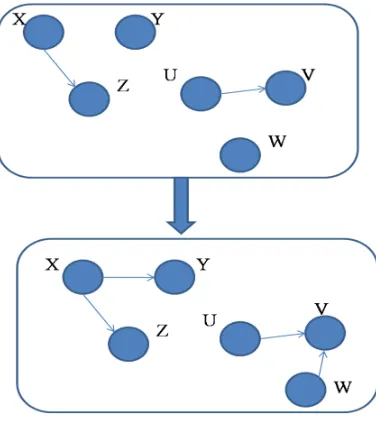
system model in a view to combine the advantages of these two approaches. G(V,E) be the network topology, where V is the set of mesh routers and E represents pairs of mesh routers that are within radio communication range. Assume each mesh router has multiple interfaces. In the hybrid architecture, we let one interface of each mesh router be able to switch channel frequently, and the other interfaces work on fixed channels. The former is the dynamic interface and the later is termed as static interface. For each mesh node, one interface would work as dynamic interface, and the others work as static interfaces. The channel allocation of static interfaces aims at maximizing the throughput from end-users to gateways, which usually constitutes a major portion of the traffic in the network. For this purpose, heuristic algorithms could be used. In the algorithm, a load balanced tree is constructed for each gateway. The goal of the tree construction is to allocate bandwidth fairly to each user with regard to the user-gateway throughput. After the topology has been constructed, each link can then be assigned channels. The links closer to the gateways are given higher priority to be allocated with less congested channels. [image:4.612.268.381.347.405.2]Dynamic interfaces work in an on-demand fashion. Two dynamic interfaces that are within radio transmission range of each other are able to communicate by switching to a same channel when they have data to transmit. These links are known as dynamic links. The two problems that are to be focused are: 1) How dynamic interfaces schedule channels to transmit data? We propose a dynamic channel allocation protocol, which optimizes for both throughput and packet delay. 2) How to route traffic in the hybrid network? We propose a routing mechanism, which utilizes both static and dynamic links in the selection of routes. The existing approach to perform dynamic channel allocation is MMAC. The working method is that every two nodes that wish to communicate would choose a least congested channel and would commence the transmission of data. The pitfall of this strategy is that only two nodes could perform channel negotiation at a time. This increases the delay. This strategy does not make any attempt to reduce the packet delay when network traffic is below saturation point. It is optimized only for throughput. Consider that three are nodes X, Y and Z. Assume in time interval, t1, nodes X and Y negotiate a common channel and that in time interval t2, nodes Y and Z negotiate a common channel. In this case the data transmission requires more than one time interval. This is illustrated in Figure 1 below.
Figure 1 Delay caused in MMAC when the traffic is under manageable levels
III. PROPOSED SYSTEM ARCHITECTURE
The proposed system is a hybrid multichannel multi radio wireless mesh network architecture where each mesh node has both static and dynamic interfaces. An adaptive dynamic channel allocation (ADCA) is proposed which optimizes not only throughput but also reduces the packet delay when network traffic is under manageable levels. In addition, an Interference and Congestion Aware Routing (ICAR) protocol is proposed that balances channel usage in the network.
Static channel allocation is done through heuristic algorithms. Dynamic channel allocation works in on-demand basis. The Figure 2 below illustrates the proposed system architecture which aims in improving throughput and reducing packet delay.
[image:4.612.199.427.548.704.2]241
A Channel Negotiation using ADCAThe channel negotiation process varies between MMAC and ADCA. In MMAC, at a given time interval only a single pair of nodes negotiate common channel, This is the reason that causes unnecessary delay adding up to the prevailing packet delay in the network. The motivation behind ADCA is that if more than two nodes can perform channel negotiation in a given time interval then the delay in transmission could be reduced to a greater extent. ADCA makes use of a similar approach as MMAC. The time is partitioned into fixed length intervals; where each interval is further split into two portions namely control interval and data interval. Let the time interval be denoted by T. Let Tc denote control interval and Td denote data interval. During the control interval, all the nodes switch over to the default channel and perform negotiation of channels. During the data interval the nodes perform transmission and reception of data among each other.
Multiple queues are maintained by each dynamic interface in ADCA with one queue for each neighbor. Each queue stores the data to be sent to the corresponding neighbor. The initial step of negotiation in ADCA is similar to MMAC. If a dynamic interface has some data to transmit, then it selects a neighbor that it wants to communicate with. Then it performs the negotiation of a common channel with the neighbor. There are many aspects in choosing neighbors. A neighbor with the longest queue may be chosen if the only consideration is the throughput. But, this approach could result in the worst condition of starvation. So, some fairness conditions could be added to this existing approach, in which, we scrutinize a neighbor’s priority by considering both the length of its queue as well as how long the queue has not been served. During this step, pairs of nodes finally have negotiated common channels among them.
[image:5.612.229.417.332.546.2]ADCA allows further channel negotiation if possible between nodes. The Figure 3 below shows how ADCA allows further channel negotiation.
Figure 3 Channel Negotiation in ADCA
Let the node that initiated the channel be termed as the sending node, and the other node be the receiving node. Let the node that has not negotiated a common channel be the pending node. The channel negotiation process can be done by having the sending node and pending node broadcast their present status to all the other nodes and the receiving node may share the common channel with the sending node or pending node accordingly from which node it received the request. If the queue length is above the threshold, the traffic load may become unmanageable, and there will not be any benefit with further channel negotiation.
B Balanced usage of channels
The metrics that were proposed in wireless mesh networks include Round Trip Time, Expected Transmission Count, hop count. Their goal is to find a good quality path only for a single flow. In this paper, our aim is to optimize the collective throughput in the hybrid network with both static links and dynamic links. The routes of different flows need to be selected efficiently such that the channel usages are balanced at each node and thereby avoiding congestion in the network.
242
route additional traffic through this link. “Median” means the channel utilized by the link has a significant amount of load, but still it is able to route some more traffic. “Low” means the channel has fewer loads, and hence the link is desirable to be used to route additional traffic.Two other issues are, the finding of links states and interfering links. The link states can be determined from the queue length. In our proposed architecture, there is one queue for each static interface and each dynamic interface maintains multiple queues, one for each neighbor. The state can be inferred from the respective queues of the both end interfaces. If the average queue length is longer, then there is more likelihood that the link would be a congested one.
A dynamic link may use different channels during several intervals. So, if in a pair of links, there is a dynamic link, then we cannot conclude that they will interfere with each or not. There is another approach for solving this problem in which the probability of interference could be estimated.
IV. PERFORMANCE ANALYSIS
A Statistics of packet delay and throughput
The performance of the proposed system is evaluated by comparing it with the existing methods. In this evaluation, the bit rate of each interface is set to 11 Mbps. The radio communication range is 250 meters. The interference range is set to twice the radio communication range. A random topology of 50 nodes in 1200 * 1200 m area is taken.
Each node has at most 8 neighbors within radio range. Three protocols are analyzed: 1) 802.11, a single channel MAC protocol; 2) MMAC, a multichannel MAC protocol; 3) ADCA- an adaptive MMAC.
[image:6.612.190.426.325.465.2]The Table 1 below illustrates the average packet delay.
Table 1 Statistics of average packet delay
ADCA reduces the delay of MMAC by half. ADCA achieves significantly low delay among all the three protocols. 802.11 suffers from larger delay because of the long waiting time in queue. MMAC experiences larger delay as it allows the packets to be delivered only one hop for each time interval. When the network traffic gets saturated at higher loads, the improvement of ADCA over MMAC is not much significant.
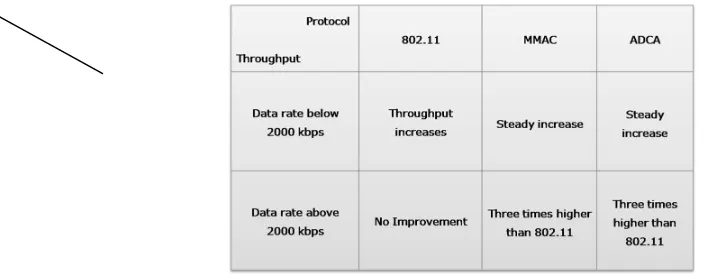
The Table 4.2 below illustrates the statistics about throughput performance of the three protocols 802.11, MMAC, ADCA.
[image:6.612.75.429.557.696.2]©IJRASET 2015: All Rights are Reserved
243
In practice the user to gateway traffic is not always uniform over the network. For example, consider a wireless mesh network that covers a campus, the traffic load is usually high in classrooms in day time, but in hostels at night. In this scenario, the entire traffic is user to gateway type, but we skew the traffic distribution. We split the network into two portions uniformly, and let each node in one portion have a probability of pa to generate a flow to the gateway, and each node has a probability of pb in the other area. The ratio pa=pb is varied and 50 random flows were generated in our experiment. The static network works best when the ratio is 1. That is each node has equal chance to cause a flow to the gateway. However, with the ratio increasing, the throughput of the static network reduces drastically. On the other hand, the hybrid architecture is good in coping with the non uniform traffic.B Usage of ICAR and ETX in Hybrid and static architecture
Under low traffic, the hybrid architecture involves higher delay. This is because certain flows are sent through a path across the less congested area using dynamic links. When the traffic is high, the hybrid architecture attains lower delay when compared to the static architecture. This is due to the fact that the hybrid architecture has high network capacity. The throughput of the hybrid network is evaluated and it is compared with the purely static architecture. We consider a wireless mesh network with 50 nodes randomly deployed in a certain area. One of the nodes is assigned as the gateway node in the central area. Every node is to have three interfaces. With a static architecture, all the interfaces work with static channels. But in the hybrid architecture, two interfaces of each node work with static channels and the remaining one interface works with dynamic channels. Both ICAR and ETX routing metrics were used in both on the static architecture and hybrid architecture. For ICAR, the weights used are 1, 0.2, 0.1, respectively. It results in best performance.
C Evaluation of Hybrid architecture under varying traffic patterns
Under varying traffic patterns evaluations were performed. The hybrid architecture adapts to the changing traffic in a fast way. This is due to the fact that the dynamic interfaces renegotiate channels every few milliseconds. In another setting, we consider two types of traffic in the network: a) User to Gateway traffic, connections between end-users and the gateway; b) Peer to Peer traffic, connections between end-users. In either case of traffic, end-user nodes are chosen randomly. In our setting, we generate 50 random flows. Each flow is assumed to have the same data rate. The ratio of the number of U2G flows over all flows is varied. The collective network throughput is measured by the total throughput of all flows when the network is getting saturated The static architecture gives best results when the ratio is 1 , when there is only user to gateway traffic. If ratio begins to decrease, the throughput of the static network decreases drastically. This is because it is not possible to offer best routing paths for peer to peer traffic. On the other hand, there is no drastic throughput degradation for hybrid architecture with the varying ratio. It could be observed that the hybrid network with ICAR routing metric is always outstanding than the static architecture except when the ratio is nearly equal to 1. Even if ICAR routing metric is used with static architecture, the improvement in throughput will not be significantly large as the static network is not well connected as hybrid architecture. Due to this reason, some network links easily get congested, and this results in disconnection in the network. Compared to ETX, ICAR works better on hybrid architecture, because it is good at decreasing the congestion in the network
D Performance of Hybrid architecture Vs. HMCP
Our hybrid architecture is compared with HMCP. In HMCP, some interfaces are assigned with fixed channels and the other interfaces can frequently switch channels. This is the case which is true for each and every node in the network. Each node informs its neighbors regarding its fixed channels. This is accomplished by broadcasting a message on all the channels to its neighbors. Consider that a node wishes to send some packets to a neighbor. First of all, it will switch one of its switchable interfaces to a channel, in which a fixed interface of its neighbor is working on. Next, it will send the packets through the switchable interface. Even though this strategy results in good adaptivity to changing traffic, it leads to a high delay for multi hop data transmission. This is because the data transmission on each hop requires a channel switching to be performed.
©IJRASET 2015: All Rights are Reserved
244
V. CONCLUSION
Hybrid wireless mesh network architecture is implemented, where each mesh node has both static and dynamic interfaces. Two contributions were made in this project. First, an adaptive dynamic channel allocation protocol to be used on dynamic interfaces is proposed. Compared with MMAC, ADCA reduces the packet delivery delay without degrading the network throughput. In addition, an interference and congestion aware routing algorithm in the hybrid network is provided, which balances the channel usage in the network and therefore increases the network throughput. The simulation results have shown that, compared to the purely static architecture, our approach is more adaptive to the changing traffic without significant increase in overhead. Moreover, compared to existing hybrid architecture, this approach achieves lower delay, while maintaining the adaptivity to the changing traffic. In the future work, improvement can be achieved with respect to the adaptability through the novel protocols that has been designed to adopt the features and improve the efficiency of the wireless mesh networks.
VI. SUMMARY
This paper has proposed a hybrid architecture which acquires the benefits of both static links and dynamic links. The static links involve no switching overhead and the dynamic links used in this architecture assists in adapting to the widely varying network traffic which in reality is a complex traffic.
REFERENCES
[1] Agarwal. S, Padhye. J, Padmanabhan.V.N, Qiu.L, Rao. A and Zill. B (2005), “Estimation of link interference in static multi-hop wireless networks,”in Internet Measurement Conference.
[2] Akyildiz. I. F, Wang. W, and Wang. X (2004), “Wireless mesh networks: A survey,” in Computer Networks
[3] Bhatia. R, Li. L, Alicherry. M (2005), “Joint channel assignment and routing for throughput optimization in multi-radio wireless mesh networks,” in MobiCom.
[4] Chiueh. T, Gopalan. K, Raniwala. A (2004), “Centralized channel assignment and routing algorithms for multi-channel wireless mesh networks,” in MC2R. [5] Chiueh. T, Raniwala. A (2005), “Architecture and algorithms for an IEEE 802.11-based multi-channel wireless mesh network,” in INFOCOM.
[6] Habiba skalli, Luciano lenzini, Marco conti, Samik ghosh (2007), Channel assignment strategies for multiradio wireless mesh networks:Issues and solutions [7] Kodialam. M and Nandagopal. T (2005), “Characte0rizing the capacity region inmulti-radio multi-channel wireless mesh networks,” in MobiCom.
[8] Lin. C.-Y, Sheu. J.-P,Tseng. Y.-C, Wu. S.-L (2000), “A new multi-channel mac protocol with on-demand channel assignment for multi-hop mobile ad hoc networks,” in Proceedings of the 2000 International Symposium on Parallel Architectures, Algorithms and Networks (ISPAN).