Study to Achieve Minimum Surface Roughness on
En-31 Steel Using One Variable at a Time Method
on Wire Cut EDM
Harsh Kumar1
1
Department of Mechanical Engineering, College of Engineering & Management, Kapurthala, Punjab
Abstract: Wire Electrical Discharge machining (WEDM) is nontraditional recent types of advance machining process which is used to machining of complex shapes. The process performance depends up on tool and work piece material also on manufacturing method. An appropriate selection of tool can reduce machining cost. The machining performance depends on the pulse on time, pulse off time, wire feed and wire tension parameters. This paper deals with investigation optimum surface roughness on EN-31 Steel material and copper wire (Zinc coated)as electrode having diameter 0.25 mm was used for conducting experiments. One variable at a time approach is implemented to regard as work surface roughness by deviation of parameters such as wire feed, wire tension, pulse on time and pulse off time.
Keyword: Wire Electrical Discharge Machining (WEDM), Surface Finish (SF), Surface Roughness (SR), Pulse off Time (TOFF), Pulse on Time (TON).
I. INTRODUCTION
WEDM is one of non-traditional machine where electrical energy is utilized to produce spark between the electrode and the work piece. A dielectric fluid flows throughout the certain gap maintained between the wire and work piece. The material is wash out by flowing dielectric fluid from this gap [1]. The gap usually maintained between the wire and work piece and from 0.025 to 0.075 mm by a computer controlled system. The each electric spark produces approximately at around150000to 210000 Fahrenheit heat [2].Cutting shape is formed on the work piece by the programmed moving pathway of wire electrode. The WEDM is generally utilized for making dies and molds works. Working principle of WEDM cutting process is shown in figure 1.
Fig.1.Working principle of WEDM cutting process [4]
II. EXPERIMENTAL METHODOLOGY
having dimensions 125 mm × 125 mm × 25 mm. During the experiments work piece having dimensions 10 mm × 10 mm square was used to cut rectangular punch of 10 mm × 10 mm × 25 mm.
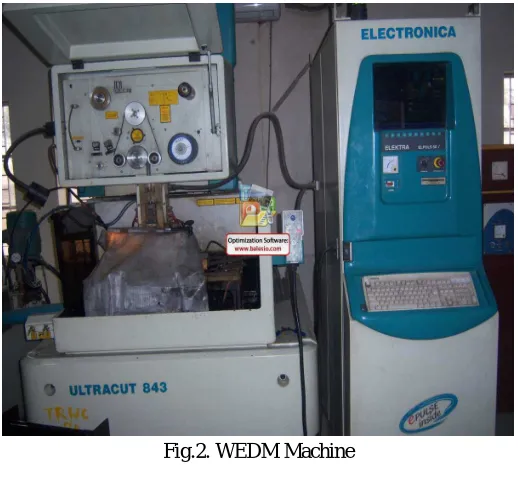
Fig.2. WEDM Machine
III. OBSERVATIONS
For first group of experiments pulse off time, wire tension, wire feed parameters were fixed at constant value. Pulse on time (TON) is changed from 100(µs) to 121 (µs) at regular interval of 3 units for obtain optimum value of surface roughness. The pulse on time effect on the surface roughness is described in Table1.During experiments fixed input experiments are:
TOFF =48 (μm); WF = 8 m/min; WT = 8 N.
Table I
Surface roughness and pulse on values Sr.
No.
Pulse on time
(µs) Surface roughness (μm)
1 100 1.23
2 103 1.35
3 106 1.61
4 109 1.91
5 112 2.10
6 115 2.32
7 118 2.34
8 121 2.37
[image:3.612.168.445.439.677.2]TOFF= 114 units; WF = 8 m/min; WT = 8 N.0
Table II
Surface roughness and pulse off values
Sr. No. Pulse off time (µs) Surface roughness(μm)
1 63 2.27
2 58 2.32
3 53 2.36
4 48 2.41
5 43 2.45
6 38 2.47
During third group of experiments wire tension (WT) is decrease from 15 (N) to 3 (N) at the steps of 3. Parameters pulse on time, pulse off time wire feed, are kept at some fixed value. With respect to change in wire tension thevariant in surface roughness as represented in Table 3.During experiments input fixed parameters are:
[image:4.612.165.449.395.494.2]TON = 115 (µs); TOFF = 48(µs); WF = 8 m/min.
Table III
Surface roughness and Wire tension
Sr. No. Wire tension (N) Surface roughness(μm)
1 15 1.66
2 12 1.79
3 9 1.93
4 6 2.15
5 3 2.33
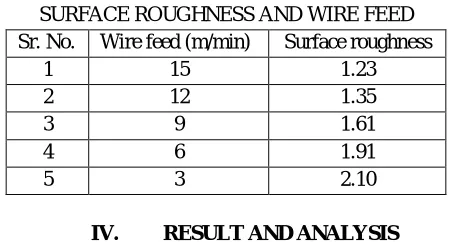
In last group of experiment wire feed (WF) is increased in the steps of 3 units from2 m/min to 12 m/min. Other parameters like pulse on time, pulse off time and wire tension are fixed to some value. Due to due to the change in wire feed the effect on change in surface roughness is described in Table 4. During in forth set of experiments fixed input parameters are:
TON = 115 (µs); TOFF = 48 (µs); WT = 8 N
Table IV
SURFACE ROUGHNESS AND WIRE FEED Sr. No. Wire feed (m/min) Surface roughness
1 15 1.23
2 12 1.35
3 9 1.61
4 6 1.91
5 3 2.10
IV. RESULT AND ANALYSIS
[image:4.612.193.419.581.702.2]2.15 2.2 2.25 2.3 2.35 2.4 2.45 2.5 63 58 53 48 43 38
Pulse off Tim e
S u rfa c e r o u g h n e s s 0 0.5 1 1.5 2 2.5 15 12 9 6 3
Wire te nsion
S u rf a c e r o u g h n e s s
Fig.3Pulse on time vs. Surface roughness
The diagrams how that by increase pulse on time the value of surface roughness increases. So the pulse on time can be adjusted to get the desired surface roughness. In next set of experiments effect of pulse off time (TOFF) on the surface roughness is shown in the Figure 4.
Fig.4 Pulse off time vs. Surface roughness
The above graph shows that the surface roughness diminishes with increment in the pulse off time. So to get the desired surface roughness the value of pulse off time can be selected with awareness. During third set of experiments the effect of wire tension (WT) on surface roughness is consider.
Fig.5 Wire tension vs. Surface roughness
The figure 5 reveals that the surface roughness decreases with respect to increase wire tension. So the value of wire tension can be selected in such a way that to get the surface roughness. During fourth group of experiments the effect of wire feed (WF) on the work piece surface roughness is shown in the Figure 6.
Fig.6 Wire Feed vs. Surface roughness
This graph shows that the surface roughness remains nearly constant with difference in the wire feed.
0 0.5 1 1.5 2 2.5
100 103 106 112 115 118 121
Pulse on Tim e
S u rf a c e r o u g h n e s s 0 0.5 1 1.5 2 2.5 3 3.5 4 15 12 9 6 3
Wire Fee d
V. CONCLUSIONS
Experimental examination on wire electrical discharge machining of EN31steel has been done using copper wire of 0.25mm. The following conclusions are made
A. Surface roughness is not affected by wire feed (WF) parameters.
B. The surface roughness is direct affected by the pulse on time, as increase the pulse on time the value of surface roughness also increases.
C. With variation of the pulse off time and wire tension the value the of surface roughness decreases.
D. Wire feed is neutral input parameters. By increases pulse on time (TON), MRR increases also increase surface roughness value and while increase in pulse off time (TOFF) decreases with MRR also decrease surface roughness value
REFERENCES
[1] S. Kalpakjian, R.Steven, Schmid “Manufacturing Process for Engineering Materials”, Fourth Edition, Pearson Publishers, 2010.
[2] S. Kumar, M. Kumar, N. Nirmal “A Literature review on Optimization of Machining Parameter in Wire EDM”, International Journal of Latest Research in Science and Technology vol 2(1),p.492,2013.
[3] V.Kumar, A. Kumar Yadav, I.Singh“A review on current research trends in wire-lectrical discharge machining (wedm)”, International Journal of science & technology, Vol05, pp 101–112, 2016.
[4] A.Bhatia, S.Kumar, P.Kumar “A study to achieve minimum surface roughness in wire EDM”, International conference on advanced Manufacturing and Materials Engineering, AMME, pp. 560 –566,2014.
[5] S.S.Mahapatra,A.Patnaik “Optimization of wire electrical discharge machining (WEDM) process parameters using Taguchi method”, International Journal of Advanced Manufacturing Technology, Vol. 34, pp.911–925, 2014.
[6] A.B. Puriand B Bhattacharyya “An analysis and optimizations of the geometrical inaccuracy due to wire lag phenomenon in WEDM”, International Journal of Machine Tools & Manufacture, Vol. 43, pp 151–159,2003.
[7] E.I. Shobert “What happens in EDM”, in: E.C. Jameson (Ed.), Electrical Discharge Machining: Tooling, Methods and Applications”, Society of Manufacturing Engineers, Dearbern, Michigan, pp. 3–4,1983
[8] Tsai, H.C., Yan, B.H. and Huang, F.Y. “EDM performance of Cr/ Cu-based composite electrodes”, International Journal of Machine Tools and Manufacture, Vol. 43, 2003, PP. 245–252
[9] Boothroyd, G. and Winston A.K. “Non-conventional machining processes”, Fundamentals of machiningandmachine tools, Marcel Dekker, New York, 1989, pp. 491
[10] S.F. Krar,A.F. Check A.F. “Electrical discharge machining, Technology of Machine Tools”, Glencoe/McGraw-Hill, New York, pp. 555–567.
[11] D.Scott, S. Bovina, K.P. Rajurkar, “Analysis and optimization of parameter combinations in wire electrical discharge machining”, International Journal of ProductionResearch, Vol. 29, Issue 11,1991, pp.2189– 2207
[12] Y.S. Tarng, S.C. Ma,L.K. Chung “Determination of optimal cutting parameters in wire electrical discharge machining”, International Journal of Machine Tools & Manufacturing, Vol. 35 ,Issue 12,1995, pp. 1693–1701.
[13] Y.S. Liao, J.T. Huang , H.C. Su“A study on the machining parameters optimization of wire electrical discharge machining”, Journal of Materials Processing Technology, Vol. 71, Issue 13, 1997,pp. 487– 493.