SPARSH: Data Transmission from Pc to Pc
Through Ban
Swati A. Rathod1,Prof. Dinesh D. Patil2
1
M.E. Student, Dept. of Computer Science and Engineering, SSGBCOET, Bhusawal, Maharashtra, India 2
HOD, Computer Science and Engineering, SSGBCOET, Bhusawal, Maharashtra, India
Abstract: in today’s world or day to day life, everyone uses their Personal Computers, Laptops, etc everywhere such as any organization, companies, Hospitals, colleges, etc. So while using these PC’s or Laptops many times at some extent if anyone needs some data to transfer from PC to PC there may be many ways to transfer data such as using USB Cable, transfer cable, Drive etc. So extant system consists Firstly, routing of the cable for wired network. Second, the wireless network is not procure because of the data signal are emitted outward. Third, data transmission speed is less because of the packet collision and security risk from unwanted signal prevention. Fourth, the power is exhausted by the system is more.The aim of this project is to develop an Intra body Communication System to transfer data from one Personal computer to another Personal computer through Human body This technology enables communication by touching, a technology we call RedTacton. Technology includes the use of the person body as a signal path for communication. Here, the human body operates as a transmission medium supporting half duplex communication at 10Mbit/s. RedTacton technology was developed by NTT, Japan.
Data such as Word file, PDF file, Image file, Audio and Video files, etc can be transmitted without using any radio links just by touching the application at both the communicating devices.
Keywords: Intra body Communication, RedTacton, Body Area network, WBAN, Human Area Network.
I. INTRODUCTION
In our day to day life, we always work on our Personal Computers or Laptops. Everyone uses PC’s and laptops in every organization such as Company, Colleges, etc. while working on Computer certain times there will be always need of data transfer such transferring data from one PC to another PC. From the distinct location, people used to download immense scope of core data. These technologies promote far-away communication for the users. Most electronic devices including personal digital assistants (PDA’s), pocket video games and digital cameras have cutback in size, so that they can be fetch around and used at the occurrence of requirement. These are the main requirement used to displace variant personal or public information and communications in everyday activities. Though, manageable ubiquitous services commit more than just networking between remotely based terminals. Wired connections between electronic devices in human area networks are inconvenient and can easily become entangled. Tactical wireless communication systems such as Bluetooth and wireless local area networks have some complications. Throughput is downsized by packet collisions in compact spot such as meeting rooms and auditoriums filled with people and communication is not protected because signals can be appropriate.
The dogma flaw of infrared communication (IrDA) is the stable directionality of beams between terminals is needed for the system to be adequate. The eventual human area network solution to all these motive of current technologies is “intra body” communication, in which the human body assist as the transmission medium. In ubiquitous services (which imply communication between electronic devices embedded in the environment in close proximity to people), if we could use the human body itself as a transmission medium, then this would be an optimal way of implementing human area networks because it would solve at a feat all the obstacles including throughput minimization, low security and high network setup value.
II. LITERATURESURVEY
The concept is to use a human body as communication channel among mobile computing terminals with which a man is equipped. The concept of Personal Area Networks (PANs) - Near field Intra Body Communication, to demonstrate how electronic devices on and near the human body can exchange digital information by capacitive coupling pico amp currents through the body. A comparison between body channel communications with other four relevant RF technologies. Taking the IEEE 802.15.1 (Bluetooth) standard as an example, the carrier has to be modulated to as high as 2.4-2.5GHz, but only 2.1Mbps data rate is achieved. For IBC, the carrier frequency range usually varies from couples of kHz to couples of MHz, but its data rate can be as high as 10Mb/s. The transmission performance has been greatly enhanced due to the fact that the attenuation of body channel has proved to be much lower than that of the air channel with frequency up to 1GHz. Due to the special body channel characteristics, many IBC transceivers are implemented with signals transmitted in basebands by direct-coupling to ensure high data rate. The use of OOK and PSK modulations can offer a more robust channel, but data rate will invariably suffer. In a state of the arts design, data rate can reach 60Mb/s based on a 3-level direct Walsh-coded signaling strategy. Thanks to the direct-coupling scheme using electrodes instead of antenna, IBC becomes a more and more popular strategy for small size and low power personal area communications [1].
To improve the communication performance of galvanic coupling Intra-Body Communication (IBC). Towards this objective, an in vivo measurement is firstly carried out to obtain the channel characteristics of human body in the frequency range from 100 Hz to 1 MHz. Severe gain variation and phase non-linearity are observed in the frequency response lower than frequency of 200 kHz. Then pulse shaping and channel equalization are introduced for QPSK and 16QAM modulation systems to eliminate the channel impairments in both simulations and experiments. The results show that root raised cosine pulses can significantly reduce Bit Error Rate (BER). Furthermore, the channel equalization improves BER 1-10% for QPSK, and more than 20% for 16QAM. The results indicate pulse shaping and channel equalization are effective ways for BER reduction, which are very important for the design of IBC system [2].
Galvanic coupling intra-body communication involves the formation of a network between small terminals applied to the surface of the human body and bio-signal sensors embedded within the body. To enable the design of a communication device, it is important to fully understand the signal transmission loss characteristics of the human body, while developing a method that optimizes the transmission efficiency. This is analyse the signal path loss during galvanic-coupling intra-body communication of a human arm through the application of a four-terminal circuit and a finite-element method (FEM) model, with special attention given to the return path. The effect of the interface circuit of an LC series–parallel circuit that injected the signal into the human body was also examined. Without the LC series–parallel circuit, the attenuation of the transmitted signal was minimized within a range of 2−5 MHz in the circuit model and 3−7 MHz in the FEM model. The addition of the LC series–parallel circuit improved the attenuation by 1.9−5.8 dB at the resonant frequency (2 MHz) [3].
Developing a suite of analytical expressions for modeling the resulting communication channel for weak electrical signals in a three dimensional multi-layered tissue structure, validating and verifying the model through extensive finite element simulations, published measurements in existing literature, and experiments conducted with porcine tissue, designing the communication framework with safety considerations, and analyzing the influence of different network and hardware parameters such as transmission frequency and electrode placements. So, the simulation, literature and experimental findings, pointing to the suitability of the model for quick and accurate channel characterization and parameter estimation for networked and implanted sensors [4]. The application of using the capacitive coupled body area network (BAN) to build up the communication between a mobile phone and a wearable device is presented in this letter. The proposed system operates at 26MHz, the capacitively coupled BAN channel is discussed and electrode designs for wearable devices and smart phones are proposed. The transmission coefficient of the BAN channel is increased by 6.5dB in the wearable device and 15dB in the mobile phone with our optimized design of electrodes. Another 10dB increment is also achieved by adding a parallel resonant circuit [5].
III. SYSTEMDESIGN
A. Personal Computer (PC)
We have designed a system to transmit data between two handheld devices. Here we have chosen computer as a handheld device. A Graphical user interface has been created on the computer to send and receive the data. For creating GUI, Microsoft VB.Net platform is used.
1) ARM 7: This unit is the heart of the complete system. It is actually responsible for all the process being executed. It monitors& controls all the peripheral devices or components connected in the system. The controller here used is of LPC21XX family, i.e LPC 2148. This unit requires +3.3V DC for its proper operation. For its functioning, code is written in Embedded C and burned or programmed into the code memory using a programmer.
2) Power Supply: This unit supplies the various voltage requirements of each unit. It consists of transformer, rectifier, filter and regulator. The rectifier used here is Bridge Rectifier. It converts 230V AC into desired 5V/12V DC.
3) Touch Pad: This unit is used to provide the connection between the system designed and the body. When the person touches the touch pad on both the side it transfers the data from one end to the other end and that transferred data displayed on the computer screen.
4) Amplifier: This is the device which is used to amplify the received signal to increase the strength of the signal. Here we are using LM358 as amplifier. This unit requires +5VDC for its proper operation.
5) LCD:LCD is simply used to acknowledge the beginning of transmission process once it started.
6) USB:It is used to connect the one of the port of computer to the designed hardware to transmit/ receive data between computer
and designed hardware.
7) Body: Finally its human body which is used as an innovative media to transfer data between devices.
B. Mounting
Here, ARM7 Processor PCB, Power Supply and LCD Display are then mounted on the general purpose board with the mounting size 18*15 of two boards. Copper Pad is used as touch pad for transferring of data. Bazar is used for the initialization of hardware. Following figure 5.4 is of transmitter. USB TTL is used the connection of personal computer for transferring data from the hardware to the computer and receiving data from the hardware to the computer. In receiver side hardware, one extra IC chip is used that is OPAM IC LM358.This hardware is used for short circuit protected outputs. These circuits consist of two independent, high gain, internally compensated OPAM, specifically supplied single power supply over a wide range of voltages. These circuits are directly supplied with standard +5V.its bandwidth is 1.1MHz.
In transmitter and receiver side, LM1117 regulator is available in 1.8V, 2.5V, 2.8V, 3.3V, 5V and adjustable versions.LM1117 Regulator gets 5V from the power supply and sends 3.3V to the ARM7 Processor.ARM7 processor works with 3.3V current
C. Interfacing
1)Interfacing from USB TTL to ARM 7 Microprocessor: USB TTL is connected to pin, Pin 0.9(Rx) and Pin 0.8(Tx) in which data will be received from Pin 0.9 from the USB TTL and transmitted to Pin 0.8 to ARM 7 Microprocessor through LM358(OPAM).OPAM is the preset.
2)Interfacing from ARM 7 Microprocessor to Copper Pad: The ARM 7 microprocessor is interfaced with copper pad to provide touch interface for user. Pin 0.0 is connected to copper pad. It serves as input to Copper Pad. Output of copper pad is given to Pin 0.1 in ARM 7 through LM358(OPAM).
D. Steps for Execution
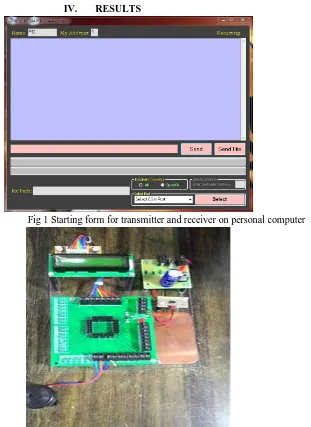
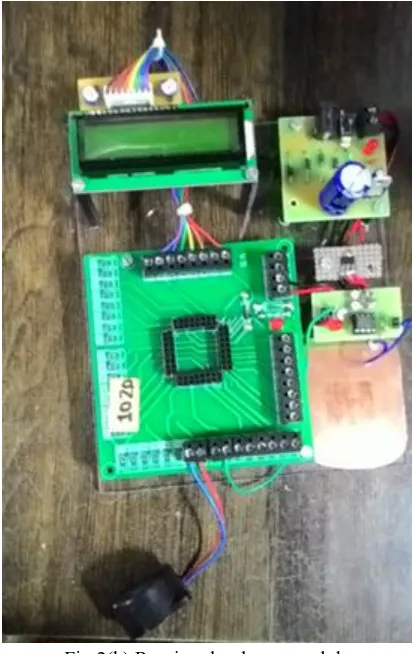
1) The developed system working is given below and the GUI of the system is shown in figure 1 the common GUI form for both
transmitter and receiver and figure 2 is the Hardware module of Transmitter and Receiver.
2) On the computer side, GUI elements such as text field and different buttons for data transmissions are created and are filled with all required data. Establishment of connection between PC device and system hardware is done by searching in device manager in we can see com port in which USB TTL is inserted on side (Transmitter side and Receiver side).
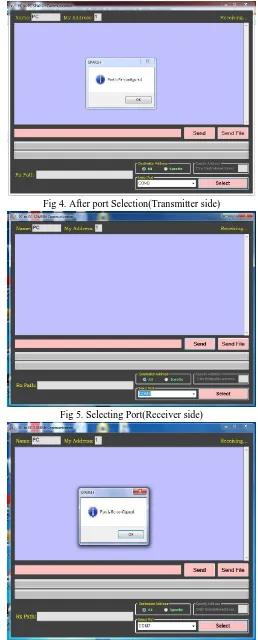
3) After verifying the com port, when we open GUI form on both Transmitter PC and Receiver PC, assign the com port as shown
4) As we come GUI form we can see on the left corner side there is Name and My Address means we assign name for our laptop or PC or we assign address of the specific laptop or PC by numbering them. There is chat box in which Transmitter can send data from transmitter to Receiver for chat or message communication from transmitter side PC to receiver side PC.
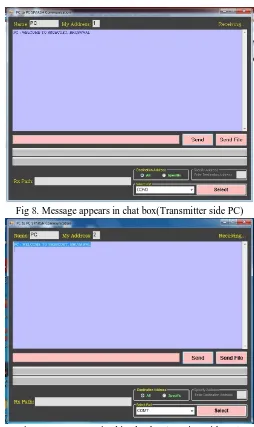
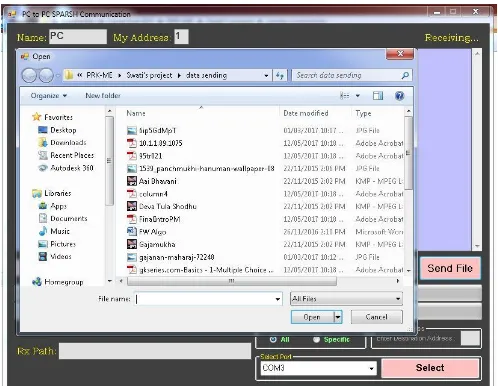
5) When we type message in text field it comes on transmitter chat box and ready to send on receiver side as shown in figure 7.after that when we touch on touch pad on sides by palm fingers on copper touch pad on hardware on both transmitter and receiver side and click send button on transmitter side as shown in figure 8 that message will pass through our body from transmitter side to receiver side as shown in figure 9. This means the proposed system is properly executed. After that we can see Send File button on GUI on transmitter side PC as shown in figure 10 , clicking this button we can choose any file such as word file, PDF file, Image File, Audio or Video file, etc.
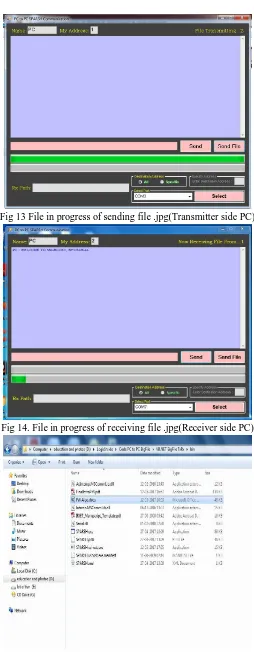
6) If we select an image file .jpg image as shown in figure 11 after selecting the jpg file ready to send from transmitter side PC as shown in figure 12.when the file is sending through body first status bar in progress is shown in transmitter side in figure 13 though body data will be transmitted to receiver side we can see the second status bar in progress as shown in figure 14.
7) When the both progress bar is completed the file which is send from transmitter side PC to receiver side then that file which is send from transmitter will automatically saved in BIN folder in receiver side as shown in figure 15.
8) In the same way we can send files such as word file, PDF file, audio or video, etc.
IV. RESULTS
Fig 1 Starting form for transmitter and receiver on personal computer
[image:5.612.179.490.282.709.2]Fig 2(b) Receiver hardware module
[image:6.612.204.411.77.404.2]Fig 4. After port Selection(Transmitter side)
Fig 5. Selecting Port(Receiver side)
Fig 7. Sending text message in chat box(Transmitter side PC)
[image:8.612.178.432.295.722.2]Fig 8. Message appears in chat box(Transmitter side PC)
Fig 10. Selection of file of your choice(Transmitter side PC)
Fig 11. Selected file to send .jpg(Transmitter side PC)
Fig 13 File in progress of sending file .jpg(Transmitter side PC)
[image:10.612.180.434.64.716.2]Fig 14. File in progress of receiving file .jpg(Receiver side PC)
V. CONCLUSIONS
IBC is a new short range non-RF wireless communication technology specified by the IEEE 802.15.6 using human body as a transmission medium. Many authors have presented the issues and challenges of this field in their papers. Still research is going on to address different issues.
It is realized that one of the category of IBC system i.e. transmission of data between two devices which are portable or say mobile and for that we developed an external transceiver hardware for transmission of data between two computers. Further in future we can place designed external hardware inside the system. Data transmission security can be provided. Video, audio or image file can also be transmitted with increased data rate in raw format.
VI. ACKNOWLEDGMENT
I take this opportunity to thank the teachers and guide who provided constant encouragement and made it possible for me to take up challenge doing this project. I am grateful to Prof. Dinesh D. Patil for their technical support, valuable guidance encouragement and consistent help. They are constant source of inspiration and information for me.
REFERENCES
[1] Hao Wang, Xian Tang, Chiusing Choy and Gerald Sobelman “Cascaded Network Body Channel Model for Intra Model Communication ”,IEEE journal of Biomedical and Health Informatics JBHI-00638-2014 R2, page no. 1-9, IEEE 2015.
[2] Meng Wang, JiaWen Li, HuiJuan Huang, "Towards Improving Performance of Galvanic Coupling Intra body Communication", IEEE 2015.
[3] Kinechi Ito, Yu Hotta, “Signal Path Loss Simulation of Human Arm for Galvanic Coupling Intra Body Communication uses Circuit and Finite Element Method Models”, page no. 230-235, IEEE 2015.
[4] Meenupriya Swaminathan, Ferran Simon Cabrera, Joan Sibastia Pujol, Ufuk Muncuk, Guner Schirner, “Multipath Model and Sensitivity Analysis for Galvanic Coupled Intra-Body Communication through Layered Tissue”, IEEE Transactions on Biomedical Circuits and Systems, Vol. 10,No. 2, April 2016..
[5] Kun Zhao, Zhinong Ying, IEEE Member Sailing He, “Intra-Body Communication Between Mobile Devices and Wearable Devices at 26 MHz”, IEEE 2016. [6] Sang Don Kim, Sang Muk Lee, Seung Eun Lee, “Secure Communication System for Wearable Devices Wireless Intra Body Communication ”,page no.
381-382, International Conference on Consumer Electronics IEEE 2016.
[7] Tan Chee Phang, Mohammad Harris Mokhtar, Mohd Nazim Mokhtar, Fakhrul Zaman Rokhani, and “Time Division Multiple Access Based Intra Body Communication for Wearable Health Hacker”, page no. 468-472, IEEE 2016.
[8] Daiki Ayuzawa, Yasuaki Takizawa, Sayaka Sugo, Kazuki Matsumoto, Mitsuru Shinagawa, “Measurement System of Wearable Devices of Intra Body Communication Using Electro-Optic Technique”,4th Global Conference on Consumer Electronics”, IEEE 2015.
[9] Khai Zhang, Kun Hao, Yong Song, Jingwen Wang, Ruobing Huang, Yue Liu, “Modeling and Characterization of the Implant Intra Body Communication Based on Capacitive Coupling Using a Transfer Function Method”, Article Sensors 2014.
[10] P. Lakshmi Narayana, B. Meena Bharghavaand P. Lakshman Kumar, “Human Body as a Medium of Communication” IJECS Volume 2, Issue 3, March 2013, ISSN: 2319-7242, Page no.741-745.
[11] Ajay Rathore, Mukesh Agrawal, Gajeandrav Sharma, Monika Sharma, “RED TACTAN-An Innovative Human Area Networking Technology”, IJRITCC Volume 1, Issue 4, Page No. 297-304, April 2013.
[12] Ms. B. Veera Jyothi, Ms.N.Sania Rasheed, Ms.V. Mounika, “RED TACTON- The Forward Thinking of Human Area Network”, IJRET Volume 1, Issue 3, ISSN:2319-1163, Page No.319-324, 2012 .
[13] MirHojjat Seyedi, Behailu Kibret, Michael Faulkner, “A Survey on Intra Body Communication for Body Area Network Applications” , page no. 1-13, IEEE 2013.
[14] Nimjun Cho, Jerald Yoo, Jeabin Lee, Seonghyun Jeon, “The Human Body Characteristics as a Signal Transmission Medium for Intra Body Communication”, Vol. 55, No.5, IEEE 2007.