Technology (IJRASET)
Smart Live Tracking Garbage Collection
using RFID
Vasantha Sena Reddy. N1, Abdul Quadir. Md2
1,2
Department of School of SCSE, CSE Specialization with Cloud Computing VIT UNIVERSITY, CHENNAI, India
Abstract: This paper was talk about smart bin living with smart bin implementation, solid waste monitoring and management system, the system was integration of communication technologies such as RFID, GPS, GSM and GIS for truck monitoring system. In proposed system, smart bin implementation using ultrasonic, GSM and RFID based system.
The garbage was filling into the bins after the garbage bin is full the system will sends message to the driver to collect the garbage bin from that area. The proposed system would be able to monitor the garbage collection and monitor the garbage driver of the truck where the truck. It would provide in garbage collection of that particular area, tracking the vehicle position through the GIS database and also notice that to reduce the minimum route distance and make it clean and green of the surroundings we can reduce the fuel consumption while reduce the truck no need to visit to that particular place. After the bin is full the particular vehicle is reached to that particular area we identify did the vehicle is reached or not by the RFID. Once RFID reader is detected the tag so it will sends data to the server by the MQTT protocol. After reaching to the server it will store is some database for further clarifications. In proposed system the social issues for the garbage collection the overflow of dustbins will be overcome. The techniques which we are used for the good practical knowledge of Smart garbage collection.
Keywords: GPS, GSM, Smart Bin, Vehicle Tracking, RFID, Garbage waste, MQTT protocol.
I. INTRODUCTION
Now a days Internet of things and its applications have become an essential way part of today human life. . It has turned into a fundamental tool in each angle. Regularly, the metropolitan or corporation specialists keep up clean garbage bins at particular places in the local zones where the occupants are told to arrange their family wastage. In spite of the fact that the specialists are told to gather up the wastage inside a particular day , they wind up clearing them following few days when, the dustbins begin once again flooding and noticing. Along these lines, corruption of the waste likewise causes bacterial and infections to develop, accordingly influencing the general good health. For the reason strong waste administration happens by observing the step by step accumulation and transfer prepare with IoT based system proposed. In this paper the everyday observing of waste gathering process utilizing android application is created. This paper exhibits a vigorous method for dealing with the waste, help in diminishing time taken to gather and arrange strong waste. The essential objective of strong waste administration is decreasing and taking out unfavorable effects of waste materials on human good health and condition to bolster financial improvement and good personal satisfaction.
II. SYSTEMDETAILS
A. Smart Garbage Bin System
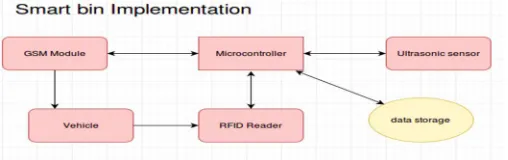
[image:2.612.187.441.626.706.2]The application of “garbage Bin” is used in manages the garbage collection system of a whole city. The Ultrasonic sensors will enables the smart garbage bins which is connects to the cellular network (GSM) that which will generates a large amount of data, it will monitor the total system of smart bins if the bin was about to fill then it will intimated by the message which is coming from the GSM module we will monitor garbage around the city. The architecture of smart garbage bin implementation system as shown below figure.
Technology (IJRASET)
B. Vehicle Tracking and Monitering System
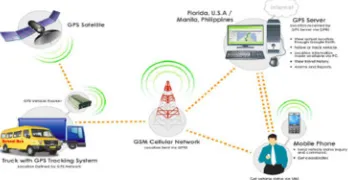
The framework can be mounted or fitted in your vehicle in a covered up or appropriate compartment. After this establishment, we can track your vehicle easily utilizing your cell phone by dialing the portable number of the SIM joined to the GSM modem. We will naturally get the area of the vehicle as a SMS (short message) on your cell phone. This framework permits you to track your vehicle whenever and anyplace. Fig. 2 demonstrates the circuit of a GPS-and GSM-based vehicle following framework. It comprises of a microcontroller, GPS module, and GSM modem and 9V DC control supply. GPS module gets the area data from satellites as scope and longitude. The microcontroller forms this data and sends it to the GSM modem. The GSM modem then sends the data to the proprietor's cell phone. GPS is a space-based satellite route framework. It gives area and time data in every climate condition, anyplace on or close to the Earth. GPS receives are utilized for route, positioning of the location, time spread the resource purposes.
C. Hardware Spcifications
1) Raspberry Pi Board: Raspberry pi is an open-source physical platform based on microcontroller board. It was originally designed for the education purpose. The goal is to create low – cost device which will improve the programming skills and the hardware understanding of the level. The Raspberry pi is small minicomputer which it is compactable for the Linux environment at low power consumption microcontroller.
a) The processor which is used in this raspberry pi is “Broadcom BCM2835” which is equivalent to the first generation of the Smartphone
b) The Raspberry pi 2 model which the processor will use “Broadcom BCM2836” with the 900 MHz 32-bit core processor.
c) The Raspberry pi 3 model which the processor will use “Broadcom BCM2837” with the 1.2 GHz 64-bit quad core processor. With the 512 MB of cache of shared.
d) in this project I am using Raspberry Pi 3 model for developing smart Garbage collection.
D. Features of Raspberry Pi Board
1) CPU: Quad-core 64 - bit ARM Cortex xs A53 clocked at 1.2 GHz
2) GPU: 400MHz VideoCore IV multimedia
3) Memory: 1GB LPDDR2-900 SDRAM (i.e. 900MHz)
4) USB Ports: 4
5) Video Outputs: HDMI, composite video (PAL and NTSC) via 3.5 mm jack
6) Network: 10/100Mbps Ethernet and 802.11n Wireless LAN
7) Peripherals: 17 GPIO plus specific functions, and HAT ID bus
8) Bluetooth: 4.1
9) Power Source: 5 V via Micro USB or GPIO header
10) Size: 85.60mm × 56.5mm
11) EEPROM: 1 KB (ATmega328)
12) Clock Speed: 16 MHz
E. Ultrasonic Sensor
Ultrasonic distance sensors use a sound transmitter and a receiver. An ultrasonic distance sensor creates an ultrasonic pulse, often called a "ping", and then listens for reflections (echo) of the pulse. Ultrasonic ranging module provides 2cm – 400cm non-contact measurement function, the ranging accuracy can reach to 3mm. The module includes ultrasonic transmitters, receivers and control unit. There are 4 pins out of the module VCC, Trig, Echo, GND .So it's a very easy interface for controller to use it ranging. The all process is : pull the Trig pin to high level for more than 10us impulse , the module start ranging ; finish ranging , If you find an object in front , Echo pin will be high level , and based on the different distance, it will take the different duration of high level. So we can calculate the distance easily.
Distance = elapsed time x speed of sound/2
Technology (IJRASET)
system. It requires a SIM (Subscriber Identity Module) card just like mobile phones to activate communication with the network. Also they have IMEI (International Mobile Equipment Identity) number similar to mobile phones for their identification. A GSM/GPRS MODEM can perform the following operations:
a) Receive, send or delete SMS messages in a SIM.
b) Read, add, search phonebook entries of the SIM.
c) Make, Receive, or reject a voice call.
The MODEM needs AT commands, for interacting with processor or controller, which are communicated through serial communication. These commands are sent by the controller/processor. The MODEM sends back a result after it receives a command. Different AT commands supported by the MODEM can be sent by the processor/controller/computer to interact with the GSM and GPRS cellular network.
F. GPS Module
Global position system (GPS) is used in vehicles for both navigation and tracking. Tracking systems enable a base station to keep track of the vehicles without the intervention of the driver where, as navigation system helps the driver to reach the destination. Whether navigation system or tracking system, the architecture is more or less similar. When an accident occurred in any place then GPS system tracks the position of the vehicle and sends the information to the particular person through GSM by alerting the person through SMS or by a call.
G. Radio-Frequency Identification Module (RFID)
RFID (radio frequency identification) is a technology that incorporates the use of electromagnetic or electrostatic coupling in the radio frequency (RF) portion of the electromagnetic spectrum to uniquely identify an object, animal, or person. The advantage of RFID is that it does not require direct contact or line-of-sight scanning. An RFID system consists of three components: an antenna and transceiver (often combined into one reader) and a transponder (the tag). RFID reader can pull information from a tag at distances up to 300 feet. RFID readers can interrogate, or read, RFID tags much faster; read rates of forty or more tags per second are possible.
III. WORKDONE
A. Implementation of Smart Bin
[image:4.612.193.418.502.704.2]Smart dustbin is implemented by using Arduino, Ultrasonic and GSM based system as shown in figure1.The bin is filling up Ultrasonic sensor read the amount of waste in the dustbin continuously. The dustbin is filling up full ultrasonic sensor sends information to GSM for sending SMS to the Vehicle driver. The vehicle driver will conform the message and went for collecting waste; while he reaches the bin RFID reader reads the vehicle tag sends data/message to server as “Vehicle reached, I am free now”. This processes repeats for every vehicle in the city.
Technology (IJRASET)
[image:5.612.219.393.609.699.2]Figure 3: Ultrasonic based garbage bin reading
Figure 4: Message sent by GSM
IV. VEHICLETRACKING/MONITORINGSYSTEM
The Block diagram for vehicle monitoring system as shown in figure2. In This project we are using SIM 800 module, GPS and GSM which is mounted on the single Raspberry pi board as shown in below figure.
Technology (IJRASET)
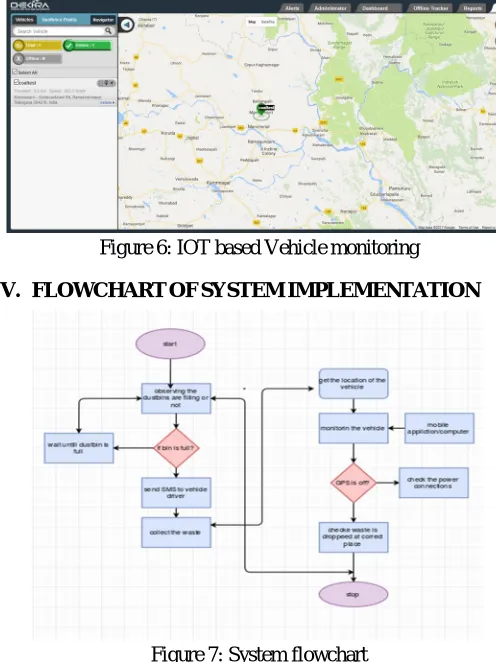
[image:6.612.187.441.118.238.2]Vehicle tracking module is placed in vehicle and power up it then we get vehicle status in the database by entering the vehicle number. In the database we will get the vehicle status as “running/parking” and the travelling distance of the vehicle also be displayed. If GPS/GSM module is disconnect from the power. In database that device as in “offline” appears.
Figure 6: IOT based Vehicle monitoring
[image:6.612.184.432.120.451.2]V. FLOWCHARTOFSYSTEMIMPLEMENTATION
Figure 7: System flowchart
VI. MQTTPROTOCOL
Messaging system is the Data Transfer function, and it operates above the physical layer protocols. In the below diagram, the sensor platform is a messaging client and acts as both for sending data and for receiving actuator control commands. Depending on the actual sensor platform to be used e.g. Arduino, Rasperry Pi, or a PC, an appropriate open-source implementation can be used. The storage systems and the analytics engine can be interfaced with custom for receiving data from the sensor platforms and sending back actions (e.g., alarms, alerts) to it. The sensor platforms, storage systems, and analytics engine can all be configured as response or subscribers for device discovery, configuration, maintenance.
[image:6.612.179.435.560.707.2]Technology (IJRASET)
IV.CONCLUSION
This paper presents a robust way of managing the waste, so that not only the whole process becomes efficient, but also, the disposal of waste is done in a productive way. Besides, food industry, healthcare, tourism, and other such departments can take benefit from the available resources related with waste management, with the proposed cloud-based waste management, a smarter way of handling and disposal of waste is created. This paper also presents a localization system, which is able to track the localization is equipped with GPS and GSM devices. The client/owner can easily monitor the current location of the vehicle at any time.
Web application is the proposed system for live monitoring of the vehicle and solid waste collection process. This model can be used for effective management of solid waste collection and disposal, and help in reducing time taken to collect and dispose solid waste.
As the main aim of this work is the application of an operational and monitoring waste collection. Future work will focus on the enhancement of the proposed approach and geo tagging of smart bins for shortest route technique for vehicles using optimization algorithms for efficient collection of solid waste management.
REFERENCES
[1] K. Cavdar, M. Koroglu, B. Akyildiz “Design and implementation of a smart solid waste collection system” International Journal of Environmental Science and Technology, 2016
[2] Narayan Sharma, Nirman Singha, Tanmoy Dutta “Smart Bin Implementation for Smart Cities” International Journal of Scientific & Engineering Research, Volume 6, Issue 9, September-2015
[3] Md. Liakot Ali, Mahbubul Alam,and Md. Abu Nayeem Redwanur Rahaman (2012) “RFID Based E-monitoring System for Municipal Solid Waste Management”.
[4] Saurabh Dugdhe , Pooja Shelar, Sajuli Jire and Anuja Apte “Efficient Waste Collection System” 2016 International Conference on Internet of Things and Applications (IOTA) Maharashtra Institute of Technology, Pune, India 22 Jan - 24 Jan, 2016.
[5] https://play.google.com/store/apps/details?id=chekhra.itrackfleet&hl=en [6] http://www.chekhra.com/index.html.