5
III
March 2017
Technology (IJRASET)
Finger Print Recognition Based Smart Lock
Vishank Khatri1, Burhan Naim2, Amey Mangutkar3, Nilesh Delekar4
1,2,3,4
Dept. of Electronics Engineering, KJSIEIT, Sion, Mumbai-22
Abstract: This paper is presented to design and implement the fingerprint based lock system using microcontroller. Biometrics are studies which commonly include fingerprint, hand geometry recognition and verification. Among the available biometric traits, finger print proves to be one of the most secured traits providing good mismatch ratio and also reliable. The present scenario to operate a lock is with lock which are having keys. Which sometimes fail to provide good security to the lock. To provide perfect security to the lock and to make the work easier, this project is taking help of two different technologies viz. Embedded systems and biometrics.
Keywords: fingerprint, locking system, microcontroller, biometrics, authentication, buzzer, security.
I. INTRODUCTION
Biometric systems have overtime served as robust security mechanisms in various domains. Fingerprints are said to be the oldest and most widely used form of biometric identification. The use of fingerprint for biometric identification has been employed in law enforcement for about a century now. A much broader application of fingerprint is for personal security authentication, for instance to access a computer, a network, an ATM machine, a car or a home. Electro-mechanical lock using fingerprint recognition system is a process of verifying the fingerprint image to open the electron- IC lock. This project highlights the development of fingerprint detection and verification. It is completed by comparing the data of authorized fingerprint image with incoming fingerprint image. Then the information of incoming fingerprint image will be compared with authorized fingerprint image. In this project, digital image processing algorithms is employed to identify whether the incoming fingerprint image is genuine or forgery.
II. STATEMENT
The aim of this project is develop a secure locking system based on fingerprint scanner. In this project, microcontroller accompanied with an interface circuit has been used for opening and closing lock based on finger print which is stored in microcontroller itself so that only authorized person will access the security lock.
III. DEFINATIONOFTERMSUSED
A. Fingerprints
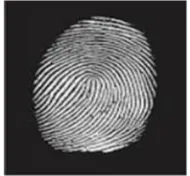
fingerprints are the patterns of valleys and ridges on the surface of the finger. Like everything in the human body, these ridges form through a combination of genetic and environmental factors. The genetic code in the dna that gives general orders on the way skin should form, but the specific way it forms is a result of random events.
B. Fingerprint Technology
[image:2.612.263.358.625.713.2]in the late 1800s, an anthropologist named alphonse bertillon sought to fix the problem of identifying convicted criminals and turned biometrics into a distinct field of study. He developed 'bertillon age', a method of bodily measurement which got a named after him. Bertillon realized that even if names changed, even if a person cut his hair or put on weight, certain elements of the body remained fixed, such as the size of the skull or the length of their fingers. His system was used by police authorities throughout the world, until it quickly faded when it was discovered that some people shared the same measurements and based on the measurements alone, two people could get treated as one.
Technology (IJRASET)
After this, the police used finger printing, which was developed by Dr. Richard Edward Henry of Scotland Yard, instead. In addition, the same methods used by the Chinese for years. There are many steps in the history of fingerprinting as a way to identify criminals in the world. The Argentine police was the first person to keep fingerprint files. He classified fingerprints according to a system established by Prof. Francis Galton, an anthropologist related to Charles Darwin. Galton later published one book that is, Fingerprints that contained a classification system. In this technology one’s finger is the key i.e., one’s fingerprints are used as the “PASSWORD” for identification. Finger print technology introduces by Fujitsu to help combat the increasing incidence of financial fraud and forgery. Among these available biometric traits, fingerprint proves to be one of the best traits providing good mismatch ratio, high accurate in terms of security and also reliable. To provide perfect security and to make the work easier we are taking the help of two different technologies viz. embedded systems and fingerprint biometrics in our project.
C. Block Diagram
he block diagram mainly consists of 89c52 MCU, Finger Print Module, Keypad, 16x2LCD, Buzzer, Relays, and Switch 9v battery, locking mechanism. Fingerprint Based Locks System Using Microcontroller Proceedings of IRF International Conference, 05th April-2014, Pondicherry, India.
Fig.3 Block Diagram.
The block diagram consists of various blocks as shown in Figure 3. The fingerprint module is interfaced to the microcontroller, it will be in user mode. In this mode, stored images will be verified with the scanned images. When coming to our application the images of the person’s fingerprint that are authorized to open the locks will be stored in the module with a unique id. To prove that
the persons are authorized to open the locks they need to scan their fingerprint images. The Finger Print scanner is interfaced to
89c52 microcontrollers; this controller will be controlling theFinger Printscanning process. Immediately the locker will be opened.
Technology (IJRASET)
D. Circuit Diagram
The circuit explanation includes the detailed pin connections of every device with the microcontroller. Power is available from the 9-volt battery, because microcontroller operates at 5V so, 7805 constant 5V, 1A positive voltage regulator that provides output of 5V is used.
Fig.4 Circuit Diagram.
Crystal is connected to 18th and 19th pins of microcontroller. The microcontroller 10th and 11th pins are connected to 11th and 12th pins of MAX232 to initialize fingerprint module and to enable serial communication. The fingerprint module’s pins 2 and 3 are connected to DB9 connector which is in turn connected to 13th and 14th pins of MAX232 through the pins 2 and 3. LCD module consists of 8 data lines D0 – D7, out of which four pins are connected to port1 (P1). Additionally, this module is having 3 control lines namely RS, R/W and EN, where RS and EN are connected to P1.0 and P1.1 respectively and R/W is grounded. Keypad connections are given to Port0 entirely because it is a 4x4 matrix keypad. DC motor is connected to microcontroller’s P2.0 and P2.1 through ULN2003 driver circuit.
E. Flowchart
The Flowchart is shown in the Figure 5. It shows how the working of the project goes according to the program. First, when system is switched on, welcome note will be displayed on LCD. User scans his finger, if his/her finger does not match with stored database it is indicated by the buzzer. If finger matches then two options will be displayed on LCD like, first one is open lock option, and next is modify user option, if user selects option 1 it asks for the 4-digit password if it matches with previously stored password then lock opens otherwise buzzer will be ON. After using the locker user should press key 3 through keypad to close the lock. Else if option 2 is selected again it asks fingerprint and if fingerprint is wrong buzzer will be ON if password is correct, again four options will be displayed on LCD. Like, first is new registration option for registration of new user, second is delete option to delete the old user's fingerprint image, third is change password option to change the current password, and fourth one is the cancel option to get back to main note. If option one is selected it scans new finger and stores it and goes back to main note, else if option two is selected it asks the id to be deleted after deletion is successful it goes back to the main note, else if option three is selected it asks for old password then for new password after entering passwords it goes back to main note, else last option is cancel if it is selected it directly goes to main note.
Technology (IJRASET)
IV.FUTURESCOPE
Fingerprint based locks are revolutionary locking systems that open with just the touch of authorised user’s finger; their increased use in various locking applications can actuate what would be known as ‘Keyless World’.
A. A fingerprint mismatch can be conveniently regarded as an attempt of illegal access in the wake of such unratified event, an
adjunct siren alarm may be initiated to reveal possible theft.
B. For systems demanding more security, such as expensive jewellery items or museum articles, scanning of multiple fingerprints
may be employed.
V. CONCLUSION
A. The Main Advantages of using this Lock are:
1) It is a simple lock which can be easily used and handled without any special training.
2) For every human being finger print is a unique trait and it cannot be imitated or fabricated
3) High accuracy in terms of security.
4) No false intrusions.
5) Hassle free access without keys or combination codes.
A methodical approach in designing the microcontroller based system for biometric smart security locks and even more for user verification using a finger print scanner has been followed. The result obtained in providing the security is quite reliable and accurate in all the circumstances. The system has successfully overcome some of the aspects existing with the present technologies, by the use of finger print Biometric as the authentication Technology.
VI. ACKNOWLEDGMENT
We would like to thank IETE for giving us opportunity to represent our technical paper. We would like to show deep and sincere gratitude to our HOD Dr. Milind Uttam Nemade & our guide Prof. Sandhya Deshpande for providing guidance and helping us to complete this paper.
REFERENCES
[1] Signals, Systems and Computers, 2004 Conference Record of the Thirty-Eighth Asilomar Conference on Publication 7-Nov-2004 Volume: one, on page(s): 577-581 Vol.1.
[2] International Journal of Advanced Research in Computer Science and Software Engineering, Volume 2, Issue 10, October 2012 [3] International Journals of Biometric and Bioinformatics, Volume (3): Issue (1)
[4] R. A. Fisher Biometrics, Vol. 20, No. 2, In Memoriam: Ronald Aylmer Fisher, 1890-1962 (Jun., 1964), pp. 261-264