Comparative Study on Implementation of Digital
Arithmetic Circuit
Lavanya B K1, Sumiksha2, Jose Alex Mathew3, Praveen Kumar Konda4, Savidhan Shetty5, Praveen Kumar M6
1,2
M.Tech in VLSI Design & Embedded Systems, 3HOD, 4,5,6 Assistant Professor
3,4,5,6
Dept. Electronics & Communication Engineering ,Sahyadri college of Engineering & Management, India
Abstract: Multiplier and adders play’s an important role in many applications, basically we need to reduce the delay, power, area in any VLSI design implementation, so we need consider suitable algorithm of multipliers and adders. In this paper we have compared different multiplier and adder algorithms such as vedic, KOM and parellel prifix adder.
Keywords – KOM, vedic multiplier, parallel prefix adder
I. INTRODUCTION
In today’s digital era, multipliers and adders play an very important role, where in many researchers have tried to design these multipliers and adders which satisfy the following criteria such as speed, low power consumption, area for implementation. They perform convolution, fast Fourier transforms. Depending on the components basis multipliers and adders divided into various class. one of the basic factor which is been considered during the designing of the multipliers and adders are its delay, speed, area.
II. MULTIPLIERS
Multiplier plays an important role in all digital circuit design .Multiplier is one of the fast and reliable component used for any operations. Depending on requirement of applications multiplier architecture is been selected .Different types of multiplier architecture are available.
A. Vedic Multiplier
Vedic mathematics is mainly based on 16 aphorism (sutras). Ancient system of Indian mathematics was given by a name called Vedic mathematics, the word veda means store-house of all knowledge. The word vedic is derived from the word veda. Aapplications introduces by Vedic Mathematics for Arithmetical computations, theory of numbers, compound multiplications, algebraic operations, factorizations, simple quadratic and higher order equations, simultaneous quadratic equations, partial fractions, calculus, squaring, cubing, square root, cube root, coordinate geometry and wonderful Vedic Numerical code. Multiplier designed by making use of Vedic Mathematics is one of the fast and low power multiplier. We can reduce the complexity, execution time and power, by using this technique in the computation algorithms. Sr Bharati Krushna Tirthaji Maharaj rediscovered an ancient system of calculation which was from Vedas known as “Vedic Mathematics”. The Vedic Mathematics is popular because of its simplicity and flexibility in carrying out the calculations mentally.
Two main Sutras for multiplication are Urdhva- Tiryagbhyham
Nikhilam Navatashcaramam Dashatah.
1) Nikhilam Navatashcaramam Dashatah: Nikhilam algorithm is a sutra or method coming from Vedic mathematics. It is used
www.ijraset.com Volume 4 Issue VI, June 2016 IC Value: 13.98 ISSN: 2321-9653
International Journal for Research in Applied Science & Engineering
Technology (IJRASET)
©IJRASET: All Rights are Reserved
830
The final result is obtained by concatenating RHS and LHS which is 8928. 96*93
Nearest base = 100 96 (100-96) 93 (100-93) Column 1 Column 2 96 4
89 7 89 28 Result = 8928
Multiplication using Nikhilam Sutra.
2) Urdhva-Tiryagbyham Sutra(UT): Among the 16 suthra UT is among it, which is an efficient multiplication operation which
is used for all kind of multiplication. This type of sutra are applied for binary multiplication. UT sutra work on the principle of vertical and crosswise multiplication. During the multiplication operation suppose if any carry is been generated then this carry will added with next operation obtained result, during the initial state the carry is considered to be 0.
The following are the steps used to show the UT sutra.
In order to find the unit place we need to multiply the unit place of the given number which is been known as vertical multiplication.
We need to cross multiply the given number and then we need to add the product. The obtained product, if it contains two digits then the place digit is considered as an carry then this carry is used for next operation of multiplication.
Vertical multiplication is done, and then carry of the previous step is added to the obtained product.
B. Karastubha-Ofman Multiplier
KOM which is known as karastuba ofman multiplier. This algorithm was been discovered by the “AnatoliiAlexeevitchKaratsuba “. KOM performs the multiplication operation faster. This algorithm will reduces the number of bits during the multiplication process, when we compare KOM algorithm with classic algorithm it is considered to be faster. recursive operation is been performed in KOM algorithm. Recursion is occurred until the number become very small and computation can be performed clearly.
KOM is given in equation by
PKOM = PLQL + ( PLQH + PH QL)Sn/2 + (PHQH)Sn ...(1) Where S=2 for an binary systems
P and Q operands are the size of the n-bits which is been considered during the multiplication process. Example
22*33
1) 2 2
3 3 2*3=6
2 ) 2 2
3 3 2*3=6 2*3=6
6+6=12, 1: carry
3) 2 2
3 3
2*3=6+1=7
KOM architecture shown in below figure
Figure1. KOM architecture
In the above architecture we make use of an barrel shifter, barrel shifter is used in order to shift the bits by 2 place towards the left. Zero extension is been used in order to make the 2 bit obtained as 4 bit. KOM architecture performs the operation with comparatively less delay in any system which in turn reduces the delay and hence increases the performance.
III. ADDERS
Adders are used to perform the addition of two operand, among the different adders like ripple-carry adders Carry-skip adder, n bit P(z) n bit Q(z)
n/2 KOM n/2 KOM n/2 KOM n/2 KOM
n bit full
n bit full adder n bit full adder
Zero extension
Product (2n) n/2 barrel shifter
n n n n
n
n n
n n
n n/2 n
n n
C
C1 P = 0011(2)
Q= 1001(2)
S=2 for binary numbers n=4 bits PL = 11(2) and PH = 00(2)
QL = 01(2) and QH = 10(2) PLQL= 11(2) x 01(2) = 0011(2).
(PLQH + PHQL) Sn/2= (11(2) x 10(2) + 00(2) x 01(2) ) S2 = (0110(2) + 0000(2)) S2= 011000(2); Shifted left by 2 bits.
(PHQH) Sn= (00(2) x 10(2)) S4 = 00000000(2) (PLQH + PHQL) Sn/2= 011000(2) Above obtained product is been decomposed into 01(2) and 1000(2)
www.ijraset.com Volume 4 Issue VI, June 2016 IC Value: 13.98 ISSN: 2321-9653
International Journal for Research in Applied Science & Engineering
Technology (IJRASET)
©IJRASET: All Rights are Reserved
[image:5.612.224.387.85.201.2]832
Figure 2 Parallel-Prefix adder mechanism
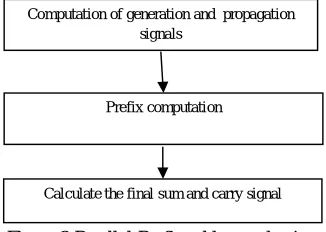
The block diagram have been explained as follows :
Intial we need to calculate propagate and genarate signal from the given inputs.propagation signal have been obtained by making an XOR operation for an given inputs. Generate signal have been obtained by making an AND operation for an given inputs.
Which is given in below equcation:
Gi = Xi . Yi ...(2) Pi = Xi ⨁ Yi ...(3)
In the second step we cosider two cells ,Gray cell and Black cell.Gray cell computes only a carry genarate signals and the Black cell computes both the carry generate and propagate signals by using an expression given below:
Gi:j = Gi:k +Pi:k . Gk-1:j ...(4) Pi:j = Pi:k . Pk-1:j ...(5)
In the 3rd step the carry which is been genarated in the secong stage XOR rd with the intial propagate signal,which can be writtin by using equcation:
Si = Pi ⨁ Ci-1 ...(6)
B. Kogge-Stone Adder
Kogge stone adder is one type of parallel prefix adder whose operation similar to that of carry look a head adder .Here black cell is connected in vertical which produces both carry propagate and generate signal. The carry generate signal are produced in last stage of second step using grey cells. To produce the sum, the carry which is been genarated in the secong step XORed with the intial propagate signal.
Carry Stages: log2 n The number of cells: nlog2 n Maximum:fan-out:2
Figure 3 16-bit Kogge-Stone Adder
C. Brent Kung Adders
By making use this adder we can reduce the area and also avoid the burst of wires. Here we perform odd and even Computation of generation and propagation
signals
Prefix computation
Calculate the final sum and carry signal
[image:5.612.187.427.517.691.2]computations where odd computation performed first and later even. First we need to calculate the prefix for 2-bits which in turn is used calculate prefix for 4 bit and so on. In order to find the carries to each bit computed prefix is been fed-back. To calculate the sum the carry generated will be XORed with initial propagate signal
Carry Stages: 2log2 n-1;
The number of cells: 2(n-1)-log2 n; Maximum fan-out: 2.
Figure 4 16-bit Brent-Kung Adder
D. Han-Carlson Adder
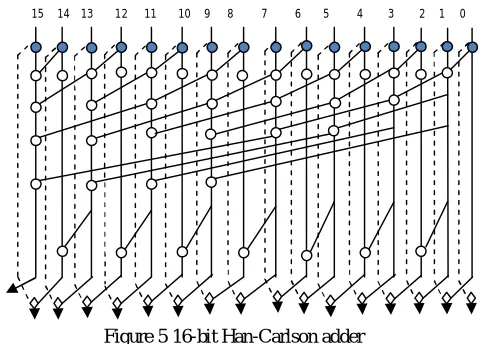
This adder is an network between 2 different types of parallel prefix adder which is KSA and BKA .it have been viewed as an dense version of KSA. Here carry merging operation have been performed on even bits and carry generate and propagate operations on or bits . To produces the true carry bits both odd and even bits recombined, then these carry bits are XORed with initial propagate signal to calculate the sum.
Carry Stages: log2 n
[image:6.612.194.428.148.307.2]The number of cells: (n/2).log2n Maximum fan-out: n/2
Figure 5 16-bit Han-Carlson adder
[image:6.612.189.429.432.604.2]www.ijraset.com Volume 4 Issue VI, June 2016 IC Value: 13.98 ISSN: 2321-9653
International Journal for Research in Applied Science & Engineering
Technology (IJRASET)
©IJRASET: All Rights are Reserved
834
Name of adder Inputs ( Bits)
Delay ( ns)
Area (um2)
Power (mW)
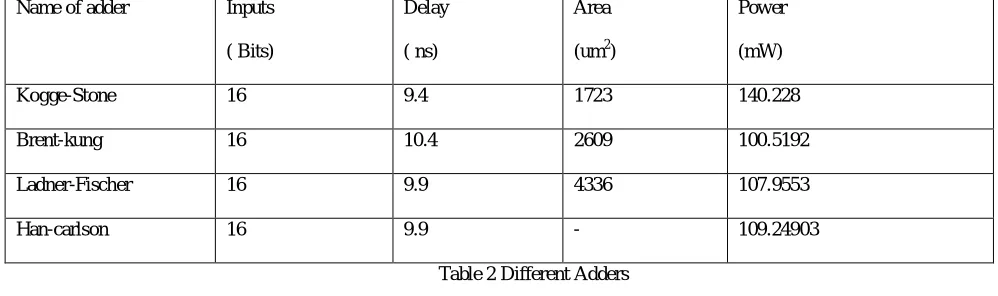
Kogge-Stone 16 9.4 1723 140.228
Brent-kung 16 10.4 2609 100.5192
Ladner-Fischer 16 9.9 4336 107.9553
[image:7.612.56.555.74.222.2]Han-carlson 16 9.9 - 109.24903
Table 2 Different Adders
V. CONCLUSION
From the observation of different algorithms we can conclude that kom multiplier gives more delay and less power consumption when it is compared to the vedic multiplier. By comparing different adder we can conclude that Kogge-Stone has least logic levels but hard to Propagate and generate. Han-Carlson has more logic levels but fewer cells Kogge-Stone adder is the best among the others, because it has less delay and area compared with other adders.
REFERENCES
[1] Murugesan G. and Lavanya S,” Design And Implementation Of High Speed Multiplier Using Vedic Mathematics,” ARPN Journal of Engineering and Applied Sciences , VOL. 10, NO. 16, SEPTEMBER 2015
[2] Nagarjun B and Poonam Sharma, “Design and FPGA Implementation of a simple time efficient KOM Multiplier,” IOSR Journal of Electronics and Communication Engineering (IOSR-JECE) e-ISSN: 2278-2834,p- ISSN: 2278-8735.Volume 9, Issue 5, Ver. V (Sep - Oct. 2014), PP 35-3
[3] Marco Bodrato,” Notes on Low Degree Toom-Cook Multiplication with Small Characteristic,”
[4] Piyush S. Kasat, Devendra S. Bilaye, Harish V.Dixit, Rahul Balwaik, and Amutha Jeyakumar, “ Multiplication Algorithms for VLSI – A Review,”International Journal on Computer Science and Engineering (IJCSE), Vol. 4 No. 11 Nov 2012
[5] D J McLaren, “Improved Mitchell-based Logarithmic Multiplier for low-power DSP applications,” Proceedings of IEEE International System On Chip Conference, pp. 53-56, September 2003.
[6] GeetaRani and Sachin Kumar, “Delay Analysis of Parallel-Prefix Adders,” International Journal of Science and Research (IJSR) Volume 3 Issue 6, June 2014
[7] Bharti B. Tiple and RupaliSuraskar, “Design of Improved High Performance of High Valency Ling Adder,” International Journal of Innovative Research in Computer and Communication Engineering (An ISO 3297: 2007 Certified Organization) Vol. 4, Issue 2, February 2016
[8] Srinivasasamanoj.R,, M. Sri Hari and B. RatnaRaju, “ High speed VLSI implementation of 256-bit Parallel Prefix Adders International Journal of Wireless Communications and Networking Technologies,” Volume 1, No.1, August- September 2012