Technology (IJRASET)
Extemporize The Legitimate In E-Commerce Using
Recommender Systems
A. Subha1, Mr.R.Purushothaman2 1
PG Student, ME CSE , 2Assistant Professor , Department of CSE, GKM College of Engineering and Technology, India.
Abstract--This paper focuses on the authenticity in Recommender Systems which may lead to various repercussions in critical ecommerce systems. Genuineness in recommender systems will increase the confidence level of prospective buyers to a greater extent thereby optimizing maximum benefit for the seller. The existing analysis in recommender systems mostly process ratings data in a networked relational data model. Here ratings are not independent of each other. Independent ratings analysis will improve the authenticity of recommender systems to a greater extent and this paper focuses on this aspect. A review monitor manager is attached with the recommender manager to vigilant member of a community when documents they are monitoring have changed. The managers provide an automatic evaluation of the temperament of the revolutionize. Users, but, afford the individual valuation and single user’s attempt be frequently enough to inform the whole community. Based on these subjective evaluations, the recommender mediator can decide which changed URLs to report to each user based on their preferences. By blending the manager and the recommender mediator, the work of monitoring URLs can be shared among many people in the civilization, confidently to assistance of all.
Keywords:- Recommendation system, Recommendation Algorithm, Hybrid Recommender system, RMSE
I. DOMAIN INTRODUCTION
The major Data Mining technique used in the circumstance of Recommender Systems. In toting up to introduce these technique, at this juncture it surveyed the uses in Recommender Systems and current device where they have been successfully applied. Recommender Systems (RS) characteristically be valid techniques and methodologies from supplementary adjacent area – such as Human Computer Interaction (HCI) or Information Retrieval (IR).The abundance of Internet technologies and e-commerce has made the web space an exciting and interactive business platform for producers, marketers and consumers. On the identical occasion, network itself has become multifaceted and complicated to steer, vast users with innumerable choices of products, services, and/or information. But, help is at hand with recommender systems which can overcome the information overload quandary by means to recover suitable in sequence based on a user’s precedent purchase, experience and preference and those of similar users. Recommender Systems in e-Commerce deal in the midst of recommendation systems.
Recommender systems enhance E-commerce sales in three ways:
Browsers into buyers Cross-sell
Loyalty
A. “Customize services around standardized products and services”: Recommender systems provide a customized service that enables E-commerce sites to sell their largely commodity products more efficiently.
B. “Create customizable products and services”: Recommender systems are a customizable product of the E-commerce site.
C. “Provide point of delivery customization”: The recommender system directly customizes the point of delivery for the E-commerce site.
D. “Provide quick response throughout the value chain”: We predict that recommender systems will be used in the future to predict demand for products, enabling earlier communication back the supply chain.
Technology (IJRASET)
the client as well as the site – but not always. Imperative decent challenges will crop up in paired the assessment of recommendation to the site and to the client. Headed for simplify the procedure, we begin by concerning ourselves only with the data flowing into and out of these systems. Each system takes in a collection of inputs that may include consumer preference data, attribute data, and other correlates. Since this covers a large space of data, we additionally divide these inputs to indicate their origin – inputs about the targeted customer (i.e., about the customer for whom we are making recommendations) vs. general inputs regarding the community of other customers. Recommender applications use these inputs to produce output recommendations for other items
Collaborative filtering recommender composition is pedestal on apex of the type of commendation performance to transpire within on daily basis communal connections: public distribute their opinion with reference to their like and it make a decision whether otherwise not on the way to proceed on top of them. Collaborative filtering (CF) encompass the improvement with the intention of such exchanges container be scale to group of thousands or still millions, extreme supplementary than might perhaps evocatively contribute to opinion within practically some additional structure. Conversely, on a daily basis societal commendation have a lead with the intention of collaborative system be deficient in, which be the contributor of recommendations, have a recognized firm uniqueness on which receiver of recommendations can rely. Over time, it could move toward to markdown, the recommendation of a friend whose tastes have been shown to be irreconcilable. Unidentified or pseudonymous user of an on-line organization, planned the added to give, and can increase their profile plus identity virtually forever. Drawing out procedure and technique within feature.
Fig 1 Main Steps and methods in data mining
II. RELATED WORK
A. Principle For Recommendation
The method is in improvement for the expansion of proposal. Collaborative filtering becomes solitary of the largest part research technique of recommender system. The inspiration of collaborative filtering is in verdict user in a neighborhood that contribute to appreciations. If two users have same or approximately similar rate items in frequent, then they comprise parallel experience. Such users fabricate a cluster or a consequently called neighborhood. A user gets recommendations to folk’s substance that he/she hasn’t rate before, apart from with the aim of be by now optimistically rated by users in his/her neighborhood. Thus, in sort to utilize this method we must in broad:
Get a representative neighborhood.
Find the additional suitable put of weights to consign to each neighbor, while predicting unobserved ratings.
Using a user-based k-NN as:-
rui = ΣvЄN(u) wuvrvi
Using an item-based k-NN as:-
rui = ΣvЄN(u) wuvrvi
Technology (IJRASET)
handle efficiently in the short amount of time allowed to complete the processIII. PROPOSED APPROACHES
A. Hybrid Recommender System
A hybrid approach is a arrangement of joint filter and content-based filter. It is occasionally additional valuable in various stage. Hybrid approach is competent of be implement within numerous way: by assembly content-based and collaborative-based prediction separately plus follow by combining them; through accumulation content-based capability towards collaborative-based; or by unify the approach keen on single replica. An empirically revision resolve evaluate the presentation of the hybrid by resources of the untainted collaborative and content-based methods and exhibit to facilitate the hybrid method know how to endow with more perfect recommendations than untainted approaches. These method containers too subsist second-hand to conquer a quantity of of the frequent harms in recommender systems such like arctic begin and the meager quandary.
B. Evaluation Of Recommendation Algorithm Using RMSE
The RMSE is a quadratic score imperative which actions the normal amount of the miscalculation. The equation intended for the RMSE is prearranged in together of the reference. Express the procedure in terminology, the variation flanked by predict and consequent experiential standards are every square and followed by averaged more than the example. In conclusion, the quadrangle origin of the standard is taken. From the time when the error are square previous to they be averaged, the RMSE give a comparatively elevated credence to outsized error. This means the RMSE is the majority constructive while large errors are predominantly detrimental. The MAE (Mean Absolute Error) and the RMSE can be worn mutually to identify the disparity in the errors in a position of forecasts. If the RMSE=MAE, then each and every one the error be of the same scale. The RMSE of a replica forecast with esteem to the probable patchy Ymodel is defined as the square root of the denote squared error:
2 n Y Y RMSE m
p obs i mo del p
1 2 , , ) (Where Yobs is observed values and Ymodel is modelled values at time/place i.
IV. CONCLUSION
Recommender Systems are emerging as efficient tool in ecommerce. A novel approach has been implemented for best outcome in Recommender system. Using Collaborative Filtering, with nearest neighborhood algorithm, it has been estimated with the justification. A Reviewer, rank the product, after purchasing. In Data Mining, purchased products aims to increase the ranking, rating with customers. It leads to dataset evaluations. Collaborative filtering method is used for personalized product recommendations; Preferences can be mined from the reviewer ratings. Collaborative Topic Regression (CTR), which extends CTR by seamlessly integrating the user-item rating information, item content information, and network structure among items into the same model. Experiments on real-world datasets show that our model can achieve better prediction accuracy than the state-of-the-art methods with lower empirical training time. Moreover, RCTR can learn good interpretable latent structures which are useful for recommendation.
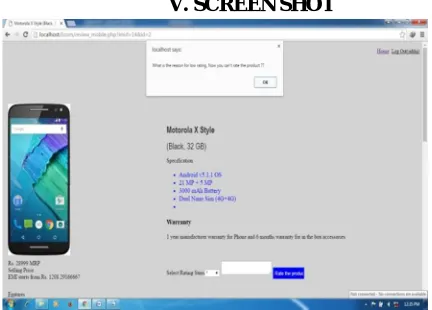
[image:4.612.198.414.551.706.2]V. SCREEN SHOT
Technology (IJRASET)
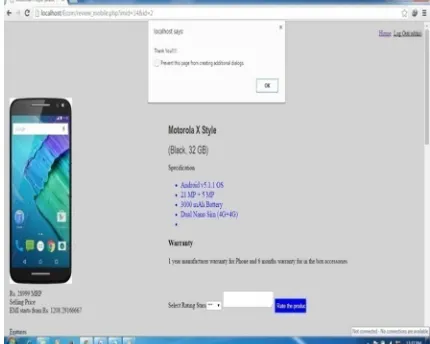
Fig 5.2 Rate a product as 3 to 5 Welcome alert dialog box will appear.
REFERENCES
[1] Hao Wang and Wu-Jun Li, “Relational Collaborative Topic Regression for “Recommender Systems,” IEEE, Vol.27, No 25 (2015).
[2] Shuhui Jiang, Xueming Qian, Jialie Shen, Yun Fu, Senior Member, and Tao Mei, Senior Member, “Author Topic Model-Based Collaborative Filtering for Personalized POI Recommendations,” IEEE, Vol.17, No.6, (2015).
[3] Negar Hariri, Carlos Castro-Herrera, Member,Mehdi Mirakhorli, Student Member, Jane Cleland-Huang, Member, and Bamshad Mobasher, “Supporting Domain Analysis through Mining and Recommending Features from Online Product Listings,” IEEE, Vol.39, No.12 (2013).
[4] Magdalini Eirinaki, Suju Abraham, Neoklis Polyzotis, and Naushin Shaikh, “QueRIE: Collaborative Database Exploration,” IEEE, Vol.26, No.7 (2014). [5] A.C.M. Fong, Baoyao Zhou, Siu C. Hui, Jie Tang, and Guan Y. Hong, “Generation of Personalized Ontology Based on Consumer Emotion and Behavior
Analysis,” IEEE, Vol.3, No.2 (2012).
[6] Mark F. Hornick, and Pablo Tamayo,” Extending Recommender Systems for Disjoint User/Item Sets: The Conference Recommendation Problem,” IEEE Computer Society, Vol.24, No.8 (2012).
[7] Wu Sen , Zhang Xiaonan, and Du Yannan, “ A Collaborative Filtering Recommender System Integrated with Interest Drift based on Forgetting Function,” International Journal of u- and e- Service, Science and Technology, Vol.8, No.4 (2015).
[8] Niloofar Rastin and Mansoor Zolghadri Jahromi, “Using Content Features to Enhance The Performance of User-Based Collaborative Filtering,” International Journal of Artificial Intelligence & Applications, Vol.5, No.1 (2014).
[9] Yi Cai, Ho-fung Leung, Qing Li, Senior Member, IEEE, Huaqing Min, Jie Tang, and Juanzi Li, “Typicality-Based Collaborative Filtering Recommendation,” IEEE, Vol.26. No.X (2014)
[10] Soanpet .Sree Lakshmi, Dr.T.Adi Lakshmi, “Recommendation Systems:Issues and challenges,” International Journal of Computer Science and Information Technologies, Vol. 5 (4) , 2014, 5771-5772(2014)
[11] Xavier Amatriain, Alejandro Jaimes, Nuria Oliver, and Josep M. Pujol, “Data Mining Methods for Recommender Systems,” Springer, (2011).
[12] Huizhi Liang, Yue Xu, Yuefeng Li, Richi Nayak, “Collaborative Filtering Recommender Systems Using Tag Information,” IEEE/WIC/ACM, 978-0-7695-3496-1/08(2008).