5
X
October 2017
Maceral Analysis and Chemical Composition of
Makum Coals, Upper Assam: Implication to
Depositional Environment.
Kakoli gogoi1, M. N. Dutta2
1
School of Sciences, Indira Gandhi National Open University, New Delhi-110068.
2
Department of Applied Geology, Dibrugarh University, Assam-786004
Abstract: Makum Coalfield, largest of all the coalfields of North Eastern Region of India, is a part of the outermost fringe of the Patkai range, abutting the alluvium of Burhi Dihing and Tirap river around Margherita and Ledo town of Tinsukia district of Assam. There are five regionally persistent coal seams and are confined to the basal 200m section of the Tikak Parbat Formation. The coal seams are thick (max. 60ft) and are bright and non-banding in nature. The coal contains comparatively low moisture (1.05-3.28%) and ash (5.01-10.01%) and relatively high volatile matter (28.06-44.07%), mineral matter (5.53-11.01%) and fixed carbon content (45.9-62.9%) as determined on air dried basis which is indicative of thermally less metamorphosed. The ultimate analysis exhibites that the coal contains 64.4-75.76% carbon, 3.95-4.64% hydrogen, 5.89-16.86% oxygen, 0.9-1.7% nitrogen, 2.1-6.17% sulphur on unit coal basis. High calorific value (6115.96-7248.64 cal/gm) and volatile matter with low ash content is an indicative of better heating capacity.Atomic H/C and Atomic O/C reflects that the coals are rich in Vitrinite and are of Type III, it indicates that the coals of Makum Coalfield are either immature or in a very early stage of maturation.The dominant maceral group in the Makum Coal Field is vitrinite and is found to be within 74-83% and the remaining is composed of inertinite (8.69-18.83%) and exinite group (1.17-4.32%) of macerals with mineral inclusions. Dominance of collinite suggests that the coal has been formed in a reducing environment. Presence of considerable amount of exinite group of macerals with high hydrogen content is also suggestive of a reducing condition of deposition. High volatile matter and presence of sclerotinites, fragmentary nature of fusinites and semi fusinites and compressed nature of plant tissues suggest a considerable pressure effect with less thermal influence.
Keywords: Makum Coalfield, Macerals, Proximate and Ultimate analysis, Tikak Parbat Formation.
I. INTRODUCTION
A. GEOLOGY
Tectonically, the coalfield areas of Upper Assam and its adjoining region occurs in the Belt of Schuppen (Mathur and Evans, 1964). The Belt of Schuppen with eight complex thrust faults are arranged imbricately along the Naga Hills and moved North West relative to the foreland ridges (Mathur and Evans, 1964). The Oligocene coal deposits on the northern flank of the Naga-Patkai range occurs in a belt that is >300km long broadly trending ENE-WSW. They extend over the states of Nagaland, Assam and Arunachal Pradesh. The structuralset up of Makum coalfield is represented by a EW striking syncline about 30km long and 2 to 4 km wide located between two main thrust- Margherita thrust on the north and Halflong-Disang thrust towards south (Fig. 1). The tertiary deposits are highly folded and faulted (Mathur and Evans, 1964; Raju, 1968; Ranga Rao, 1983), consequently the coal become friable and powdery due to geo-tectonic movements related to Himalayan orogeny.
[image:3.612.87.526.277.403.2]Makum coalfield, which is important from the point of view of the Tertiary coal resources of India, has five persistent coal seams housed in the Tikak Parbat Formation, the uppermost member of Barail Group. The seams are confined to the basal 200m section of the Tikak Parbat Formation (GSI,2009). The Tikak Parbat Formation is underlain by the Baragolai and Naogaon Formations. The lithologic characteristics of these formations are summarized in Table 1.
Table 1: Subdivisions of the Oligocene Barail Group.
Formation Thickness(m) Description
Tikak Parbat 300-600 Well bedded and massive, fine-grained sandstones,
sandy shales, shales and clays with thickcoal bedsin the basal part.
Baragolai 300 Well bedded and massive micaceous or ferruginous
sandstones alternating with clays, sandy clays and carbonaceous shales and a number of thin coal beds.
Naogaon 1100-1700 Thin-bedded, fine-grained quartzitic sandstones with
thin partings of splintery shales and sandy shales.
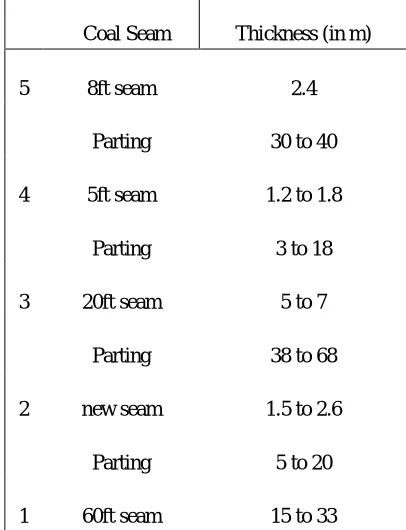
[image:3.612.203.406.461.726.2]The coal seams are thick (max. 60ft) and are bright and non-banding in nature. The generalised sequence of the coal bearing deposits are as follows (Table 2):
Table 2: Generalised sequence of coal bearing deposits (GSI, 2009) of Makum Coalfield.
Coal Seam Thickness (in m)
5 8ft seam 2.4
Parting 30 to 40
4 5ft seam 1.2 to 1.8
Parting 3 to 18
3 20ft seam 5 to 7
Parting 38 to 68
2 new seam 1.5 to 2.6
Parting 5 to 20
Fig.1: Geological map of the Makum Coalfield (modified after Goswami, 1987).
II. MATERIALS AND METHODS
Channel and pillar samples were collected both from open cast and underground mines namely Tipong, Tirap, Boragolai, Tikak, Ledo and Namdang.The collected channel samples were air dried for coning and quartering and the selected portion were crushed and allowed to pass through 72 mesh B.S test sieves (211micron). Finally the samples were stored in airtight glass bottles for chemical analysis.The proximate analysiswascarried out by adoptingthe procedures as recommended in Indian Standard Methods of Test for Coal and Cokes [IS: 1350 (Part I and Part III)-1969;IS:1970] to determine the percentage of moisture, volatile matter and ash. The ultimate analysis was carried out by adopting the procedures as recommended in Indian Standard Methods of Test for Coal and Cokes [IS: 1350 (Part IV/Sec I)-1974]. In this analysis, the weight percentage of carbon, hydrogen and nitrogen were determined and the calorific value was measured. The coal samples were crushed to -1mm size and coal pellets were prepared with cannabau wax for maceral analysis. These samples were studied under reflected light with a Leica DMLP photomicroscope with oil immersion lense following standard procedures (ICCP 1971,1998). Macerals were identified following ICCP classification of macerals (ICCP 1963, 1971,1975,1998).
III. RESULTS
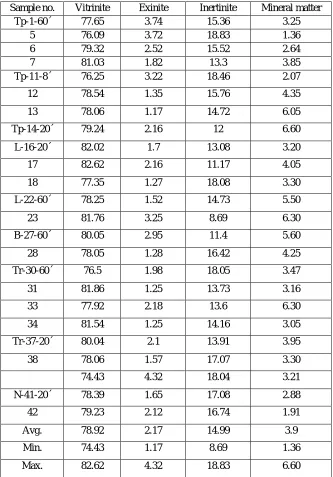
Table 3: Maceral analysis of coal samples of Makum coalfield.
Sample no. Vitrinite Exinite Inertinite Mineral matter
Tp-1-60´ 77.65 3.74 15.36 3.25
5 76.09 3.72 18.83 1.36
6 79.32 2.52 15.52 2.64
7 81.03 1.82 13.3 3.85
Tp-11-8´ 76.25 3.22 18.46 2.07
12 78.54 1.35 15.76 4.35
13 78.06 1.17 14.72 6.05
Tp-14-20´ 79.24 2.16 12 6.60
L-16-20´ 82.02 1.7 13.08 3.20
17 82.62 2.16 11.17 4.05
18 77.35 1.27 18.08 3.30
L-22-60´ 78.25 1.52 14.73 5.50
23 81.76 3.25 8.69 6.30
B-27-60´ 80.05 2.95 11.4 5.60
28 78.05 1.28 16.42 4.25
Tr-30-60´ 76.5 1.98 18.05 3.47
31 81.86 1.25 13.73 3.16
33 77.92 2.18 13.6 6.30
34 81.54 1.25 14.16 3.05
Tr-37-20´ 80.04 2.1 13.91 3.95
38 78.06 1.57 17.07 3.30
74.43 4.32 18.04 3.21
N-41-20´ 78.39 1.65 17.08 2.88
42 79.23 2.12 16.74 1.91
Avg. 78.92 2.17 14.99 3.9
Min. 74.43 1.17 8.69 1.36
Max. 82.62 4.32 18.83 6.60
Table 4: Proximate composition and calorific value of coal samples from different collieries of Makum coalfield on air dried basis.
Sample no. Moisture % Volatile
matter %
Ash % Fixed carbon
%
Mineral matter %
Calorific value (cal/gm)
Tp-1-60´ 2.88 42.08 5.34 49.7 5.87 6726.44
5 1.9 44.07 8.16 45.9 8.98 6187.65
6 2.2 39.12 7.26 51.42 7.99 7033.08
7 2.2 38.09 8.1 51.61 8.91 7088.77
Tp-11-8´ 3.28 38.9 5.26 52.56 5.79 7227.42
12 2.88 42.2 6.16 48.76 6.78 6614.72
13 2.96 38.68 5.34 53.02 5.87 7248.64
[image:5.612.93.519.595.727.2]L-16-20´ 1.08 30.04 6.01 62.87 6.61 6186.58
17 2.05 38.01 8.01 51.93 8.81 6854.68
18 3.07 31.01 10.01 55.91 11.01 6887.04
L-22-60´ 1.06 30.03 6.01 62.9 6.61 6188.73
23 2.05 37.01 5.03 55.91 5.53 6139.04
B-27-60´ 1.05 31.05 8.06 59.84 8.87 6124.68
28 2.06 40.02 6.02 51.9 6.62 6176.76
Tr-30-60´ 2.04 36.06 7.05 54.85 7.76 6148.28
31 3.02 38.05 5.06 53.87 5.57 6191.54
33 1.05 44.01 8.08 46.86 8.89 6527.13
34 2.01 37.05 6.05 54.89 6.66 6194.13
Tr-37-20´ 1.05 31.05 8.06 59.84 8.87 6124.68
38 1.08 43.02 5.6 50.3 6.16 6318.62
2.2 39.12 7.26 51.42 7.99 6115.96
N-41-20´ 2.2 38.09 8.1 51.61 8.91 6984.16
42 2.05 38.22 6.82 52.91 7.51 6562.84
Avg. 2.01 36.2 6.62 51.13 7.29 6250.84
Min. 1.05 30.03 5.03 45.9 5.53 6115.96
[image:6.612.142.471.362.729.2]Max. 3.28 44.07 10.01 62.9 11.01 7248.64
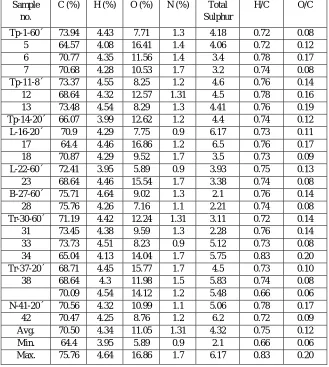
Table 5: Ultimate composition of coal samples of Makum coalfield on unit coal basis. Sample
no.
C (%) H (%) O (%) N (%) Total
Sulphur
H/C O/C
Tp-1-60´ 73.94 4.43 7.71 1.3 4.18 0.72 0.08
5 64.57 4.08 16.41 1.4 4.06 0.72 0.12
6 70.77 4.35 11.56 1.4 3.4 0.78 0.17
7 70.68 4.28 10.53 1.7 3.2 0.74 0.08
Tp-11-8´ 73.37 4.55 8.25 1.2 4.6 0.76 0.14
12 68.64 4.32 12.57 1.31 4.5 0.78 0.16
13 73.48 4.54 8.29 1.3 4.41 0.76 0.19
Tp-14-20´ 66.07 3.99 12.62 1.2 4.4 0.74 0.12
L-16-20´ 70.9 4.29 7.75 0.9 6.17 0.73 0.11
17 64.4 4.46 16.86 1.2 6.5 0.76 0.17
18 70.87 4.29 9.52 1.7 3.5 0.73 0.09
L-22-60´ 72.41 3.95 5.89 0.9 3.93 0.75 0.13
23 68.64 4.46 15.54 1.7 3.38 0.74 0.08
B-27-60´ 75.71 4.64 9.02 1.3 2.1 0.76 0.14
28 75.76 4.26 7.16 1.1 2.21 0.74 0.08
Tr-30-60´ 71.19 4.42 12.24 1.31 3.11 0.72 0.14
31 73.45 4.38 9.59 1.3 2.28 0.76 0.14
33 73.73 4.51 8.23 0.9 5.12 0.73 0.08
34 65.04 4.13 14.04 1.7 5.75 0.83 0.20
Tr-37-20´ 68.71 4.45 15.77 1.7 4.5 0.73 0.10
38 68.64 4.3 11.98 1.5 5.83 0.74 0.08
70.09 4.54 14.12 1.2 5.48 0.66 0.06
N-41-20´ 70.56 4.32 10.99 1.1 5.06 0.78 0.17
42 70.47 4.25 8.76 1.2 6.2 0.72 0.09
Avg. 70.50 4.34 11.05 1.31 4.32 0.75 0.12
Min. 64.4 3.95 5.89 0.9 2.1 0.66 0.06
IV. DISCUSSION
The maceral analysis of the Makum coal reveals that the vitrinite group (74.43% to 82.62%) of macerals is dominant (Goswami, 1985,1987; Ahmed, 1996) where collinite constitute more than 80% (Table-3). Collinites are identified as structureless constituents that act as the groundmass for other macerals. Dominance of collinite type of vitrinite indicates that they are formed by complete breakdown of the plant materials to form a gelified mass under anaerobic condition. The dominance of collinite suggests that the coal has been formed in a reducing environment (Sappal, 1989) and the water table in the depositional basin was considerably high that prevented the oxidation to a great extent. The proportion of tellinite in vitrinite is very less and exhibit well defined vegetal structures represented by bark and woody tissues. Tellinites occur as inclusions with the cell structures in the collinites. Besides some cracks were found to be developed in the collinite filled with mineral matter (Fig. 2a). Moreover high percentage of vitrinite indicates that the bark and woody tissues were the dominant contributors to the precursor peat (Ahmed, 1996). The inertinite group of macerals (8.69% to 18.83%) in the Makum coal is represented by Fusinite, Semifusinite and Sclerotinite (Table-3). Moreover in a few samples very less number of Inertodetrinite particles has been identified. Sclerotinite bodies are oval to elliptical shaped and both unicellular and multicellular (Fig.2b) bodies are found. In the present samples the sclerotinite bodies are mostly fungal spores. Fusinites found as thin bands and lense shaped bodies shows ring (Fig. 2c) and bogen structure (Fig. 2d). In Makum coalfield, the percentage of exinite (1.17% to 4.32%) group of macerals is less, compared to vitrinite and inertinite (Table-3). Presence of considerable amount of exinite group of macerals with high hydrogen content is also suggestive of a reducing condition of deposition. Microsporinite is found in the coal as compressed and stretched structures with dark grey to brownish in colour under reflected light within vitrinite. Sporinite is distributed sparsely with occasional densely packed patches in the samples. Sporinite includes spores and pollen grains with high relief. Bands of crassicutinite and tenuicutinite (Fig. 2e) are observed within the vitrinites formed by layers of cuticles. Resinites mostly occur as inclusions in vitrinite and are almost opaque in reflected light. The fragmentary nature of the inertinites, particularly the fusinites and semi fusinites and compressed nature of plant tissues suggest a considerable pressure effect with less thermal influence.The most abundant mineral inclusions occur in the coals of the study area are epigenetic pyrites which are sulphide minerals found usually as framboides. It occurs as disseminated grains and specks inside vitrinite. The framboidal pyrites (Fig. 2f) sometimes has replaced the maceral as large masses in vitrinite. Some other organic mineral matters are also observed scattered in vitrinite in the samples.
a. b.
e.
f.
Fig.2 :Microphotograph showing (a) cracks in the collinite filled with mineral matter, (b) multicelled sclerotinite body, (c) ring structure of fusinite, (d) fusinite showing bogen structure, (e) tenuicutinite band in vitrinite and (f) frameboidal pyrite in vitrinite.
On the basis of proximate analysis, themoisture content(1.05%-3.28%) reveals that the coal is a matured one while volatile matter content (28.06%-44.07%) shows that the coal is thermally less metamorphosed (Table-4). The carbon and volatile matter contents indicate that the coal is non-caking to weakly caking variety of high-volatile bituminous type. High calorific value (6115.96-7248.64 cal/gm) and low moisture also support this interference (Table-4). The calorific value of the coal is indicative of better heating capacity which is suggestive of generation of thermal power. Moreover, this high calorific value and volatile matter with low ash content (5.01%-10.01%; Table-4) suggest that the coal can be used in hydrogenation for production of a considerably wide range of petroleum products (Mukherjee and Samuel, 1987).
The ultimate analysis shows that the sulphur content of the Makum coal varies from 2.10 to 6.17% (Table-5) and acts as a catalyst in hydrogenation to produce syncrude and 80-90% of the coal can be liquefied (Mishra and Ghosh, 1996). The atomic H/C and O/C ratio (Table-5) of Makum Coal indicates that the coal is derived essentially from continental plants whose microbial degradation in the basin of deposition was limited due to sedimentation and rapid burial (Tissot and Welte, 1984). Geological information (Baruah et.al., 1987; Handique et.al., 1992) shows that the Barail sediments were deposited in fluviatile condition that hosts the coal seams containing high amount of sulphur which indicates that there may be some marine influence during the deposition of the coal seams. In this situation only possibility is that, during Oligocene the sea regressed which facilitated the formation of prograding delta complex represented by isolated basins, backwater swamps and lagoons that can serve as the sites for development of peat swamps (Misra,1992). As such it can be concluded that the coal seams were formed in a prograding delta complex with marine influence.
Fig.3: Cross plot of Atomic H/C vs Atomic O/C of coals of Makum Coalfield (modified after Tissot et. al. 1977).
As indicated by plot of atomic H/C vs. O/C (Fig.3), the organic matter present in the Makum Coal is of Type –III kerogen (Vitrain) and is gas prone. As the dominant maceral group of Makum Coal is vitrinite followed by the inertinite and exinite group of macerals and from these maceral compositions Makum Coal can be classified as gas-prone (Snowdon, 1984; Tissot & Welte, 1984).
V. CONCLUSION
The study on the chemical, petrographical characteristics of the coals of Makum Coalfield following conclusions have been
cutinite) varies between 1.17% and 4.32%. The presence of collinite in the coals indicates reducing condition of deposition (Sappal, 1989) with complete breakdown of organic matter.
B. The low ash content of the coal indicates that there was low clastic supply from outside during the deposition and formation of the coal. High volatile matter and presence of sclerotinites in sufficient numbers also indicates a lower thermal influence. The coals are deposited in a prograding delta complex formed due to regression of the Oligocene sea probably with a marine influence (Baruah et. al., 1987; Handique et. al., 1992) under reducing condition.
C. Presence of framboidal pyrite in vitrinite also indicates a marine influenced brackish water environment of deposition (Mishra,1992).
D. Relation between Atomic H/C and Atomic O/C reflects that the coals are rich in Vitrinite and are of Type III, it indicates that the coals of Makum Coalfield are either immature or in a very early stage of maturation.
REFERENCES
[1] AHMED, M., (1996): Petrology of Oligocene coal, Makum coalfield, Assam, northeast India, Int. Jour. Of Coal Geology, v-30, pp.319-325.
[2] BARUAH R.M, SINGH N.P AND RAO D.C, (1987): Foraminiferal Biostratigraphy of Disang and Barail Groups of a part of Nagaland. Proc. Nat. Sem.Tert. Orogeny, pp.305-327.
[3] ESPITALIE, J., MADEC, M., TISSOT, B., MENNING, J.J. AND LEPLAT, P. (1977): source rock characterization method for petroleum exploration. In proceedings 1977, Offshore technology Conference, Vol.3, pp. 439-442.
[4] GOSWAMI, D.N.D.(1987): Microlithotypes of the Tertiary coals of Makum Coalfield, Assam. ’Proceedings of National Seminar on Coal Resources of India. P-324-328.
[5] GSI (2009): Geology and Mineral Resources of Assam. No. 30 Part IV Vol. 2 (1) Assam.
[6] HANDIQUE, G. K., DUTTA, S. K. AND NEOG A., (1992): Stratigraphy, depositional environment and hydrocarbon prospects in Moran Oilfield, Upper Assam. Proc. Birbal Sahni Birth Centenary Palaeobotanical Conference, Geophytology, v- 22, pp.217-228
[7] IS: 1350 (Part-I)-1969: Methods of Test for Coal and Cokes- Part-I, Proximate analysis, Indian Standard Institute, New Delhi. [8] IS: 1350 (Part-III)-1969: Methods of Test for Coal and Cokes- Part-III, Determination of sulphur, Indian Standard Institute, New Delhi. [9] IS: 1350 (Part-II)-1970: Methods of Test for Coal and Cokes- Part-II, Determination of calorific value, Indian Standard Institute, New Delhi.
[10] IS: 1350 (Part-IV/Sec I)-1974: Methods of Test for Coal and Cokes. Part-IV, Ultimate analysis. Section-I, Determination of Carbon and Hydrogen, Indian Standard Institute, New Delhi
[11] ICCP (1963): International Hand book of Coal Petrology: 2nd Edition, International Committee of Petrology, C.N.R.S., Paris.
[12] ICCP(1971): International Hand book of Coal Petrology:Suppliment to 2nd Edition, International Committee of Petrology, C.N.R.S., Paris. [13] ICCP (1975): International Hand book of Coal Petrology: 2nd Supplement to 2nd Edition, International Committee of Petrology, C.N.R.S., Paris [14] ICCP (1998). The new Vitrinite Classification (ICCP System, 1994). Fuel, 77, pp349-358
[15] MATHUR, L. P. AND EVAN, P (1964): Oil in India, International Geological Congress 22nd Session India, 1964, pp. 4-53.
[16] MC CARTNEY. J.T. AND TEICHMULLER. M. (1972): Classification of coals according to degree of coalification by reflectance of the vitrinite component. Fuel, v-51, pp.64-68.
[17] MUKHERJEE, D.K AND SAMUEL, P. (1987): Hydrogenation of Coal in India. Proceedings of National Seminar on Coal Resources of India. Pp.588-604. [18] MISRA, B.K., (1992): Optical properties of some Tertiary coals from northeastern India: Their depositional environments and hydrocarbons potential. Inter.
Jour. Coal. Geol. v-20, pp.115-144.
[19] MISHRA, H.K. AND GHOSH, R.K., (1996): Geology, petrology and utilization potential of some Tertiary coals of the northeastern region of India. Inter. Jour. Coal. Geol. v-30, pp.65-100
[20] PAREEK, H.S., (2004): Progress of Coal Petrology in India, Geological Society of India, Bangalore, pp. 23-91.
[21] RAJU, A.T.R. (1968):Geological evolution of Tertiary basins of Assam and Cambay, India. Bull. Am. Assoc. Petrol. Geologists. Dec.68, Vol. 52, No. 12, pp. 2422 - 2436.
[22] RANGA RAO, A. (1983): Geology and hydrocarbon potentials of a part of Assam-Arakan basin and its adjoining region. Symp. Petroliferous basins of India. Pp 127-158.