5
VIII
August 2017
Challenges of 5G Network and Technologies used
to tackle the problems
Neha Bhakoriya, Jaya Dipti Lal, S. V. Charhate
Department of Electronics and Telecommunication Shri Govindram Seksaria Institute of Technology, Indore (M.P.)s
Abstract: In the future generation of network, data traffic in cellular network increasing rapidly. With the explosive growth of mobile internet application, mobile users are also increased. The prime objective or demands that need to be addressed are increased capacity, improved data rate, decreased latency, and better quality of service then 4G. This paper presents some key technologies used in 5th generation (5G) network which are helpful to meet the demands of users. In this we focus on the
Millimeter-wave and Massive multiple-input multiple-output (M-MIMO) technology which helps to increase the data rate (in Gbps). Along with this device-to-device (D2D) communication, densification of network, machine-to-machine communication are the technologies which are very useful to deal with the challenges like spectral efficiency, end-to-end latency and number of connected devices. At last we will see the development of 5G around the world.
KEYWORD: Massive multiple input multiple output [MIMO], small cells, milimeter wave [mmwave], ultra-densification, machine-to-machine.
I. INTRODUCTION
With the popularization of wireless multimedia communication, the wireless traffic is predicted to be increased more than 100 times in the next decade. So this explosive demand of mobile data results in several challenges which shifted the research directions to the fifth generation networks[1]. 5G networks are intended to provide significantly high data rate access and guaranteed quality-of-service (QoS). Some new technologies e.g. massive multi-input multi-output antennas [MIMO], millimeter wave, device-to-device communication (D2D), energy efficient communications and small cell networks are developed to support high speed wireless transmission in future fifth generation (5G) mobile communication system[2]. Heterogeneous network (HetNet) is an evolutionary path to the fifth generation communications[3]. HetNet uses the multiple radio access technologies. It support much more efficient resource utilization and meet the quality of service requirement. The objective of 5G network is to increased capacity, improved data rate, decreased latency and better quality of services with respect to 4G.
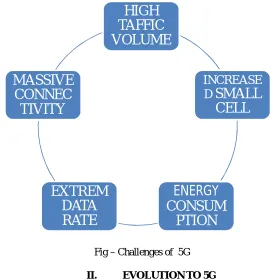
The various challenges occur in 5G network is high traffic volume, intercell interference, increased small cell, improved energy consumption and massive connectivity.
A. High traffic volume
The future requirement is to increase 1000x data traffic for 2020 and beyond.
B. Increased small cell
The majority of mobile traffic volume is make by small cell or hotspot.
C. Intercell interference
Ultra-dense network is responsible for intercell interference.
D. Massive connectivity
Higher number of connected devices (50 billion connected device by 2020) are supported by internet of things (IoT) and machine to machine (M2M) communication
E. Energy consumption
5G Green network is used to improved energy consumption.
F. Increased data rate
Fig – Challenges of 5G
II. EVOLUTION TO 5G
The evolution of wireless means evolving generations of wireless technologies in terms of data rate, mobility, coverage and spectral efficiency. As the wireless technologies are growing, the data rate, mobility, coverage and spectral efficiency increases[4].
Fig – The cellular evolution to 5G
A. The 1st generation (1G) was announced in initial 1980’s with 2.4 kbps data rate. Major subscribers were Advanced Mobile
Phone System (AMPS) and Total Access Communication System (TACS).
B. The 2nd generation (2G) was introduced in the late 1990’s. Global System for Mobile Communication (GSM) and Code
division Multiple Access (CDMA) was chiefly used for voice communication with 64kbps data rate. It also provides Short Message Service (SMS) and e-mail.
C. The 2.5G is the merger of 2nd generation cellular system with General Packet Radio Services (GPRS). It can assist data rate
upto 144kbps.
HIGH
TAFFIC
VOLUME
INCREASE
D
SMALL
CELL
ENERGY
CONSUM
PTION
EXTREM
DATA
RATE
MASSIVE
[image:3.612.89.516.412.599.2]D. The 3rd generation was established in late 2000 with the transmition rate up to 2mbps. 3G involves the WCDMA
(wideband code division multiple access), UMTS (universal mobile telecommunication system) and CDMA 2000. The evolving technologies for 3.5G uses High speed Uplink/Downlink packet access (HSUPA/HSDPA) with improved data rate of 5-30mbps.
E. In 4th generation Long term evolution (LTE) advanced as forthcoming 4G standard along with WIMAX (Worldwide
Interoperability for Microwave Access. It provides the data rate of upto 100-200mbps. Multimedia Messaging Service (MMS), Digital Video Broadcasting (DVB), video chat are the basic application use in 5G network.
F. In 5th generation we are using Massive MIMO, Beam Division Multiple Access, Smart antenna and Milimeter wave
technology to increase the capacity and data rate with respect to 4G. The expected speed with 5G is multi-gigabits per second.
III. TECHNOLOGIES OF 5G
High speed data and low latency demands will be the theme for future 5G environment. Five research areas will have the large impact on progressing 5G: Dense-small cell deployment, Massive MIMO, D2D, M2M and millimeter-wave (mm-wave) communications.
MASSIVE MIMO : Massive MIMO uses arrays of antenna containing few hundred antennas which are at the same time in one frequency slot serving many tens of user terminals. Massive MIMO depends on spatial multiplexing, which further depends on the base station to have channel state information, both on the uplink as well as downlink. So massive MIMO can significantly improve the signal strength, which could result in much higher cell throughput and better cell-edge performance than traditional 4G system.
A. Advantage of Massive-MIMO
1) Massive MIMO has the capability that it can improve the radiated energy efficiency by 100 times and at the same time, increases the capacity of the order of 10 or more.
2) Massive MIMO systems can be put together with the help of low power and less costly components.
3) Massive MIMO permits a substantial decrease in latency on the air interface.
4) Massive MIMO makes the multiple access layer simple.
5) Massive MIMO increase the strength equally against unintended man made interference and intended jamming.
B. Ultra-Dense Network
With the increasing no. of user the traffic is also increased therefore densification of the network is very important. For achieving ultra dense, heterogeneous network will play an important role. But Ultra-dense deployment and dynamic heterogeneous of small cells is a major factor of interference and mobility. The more irregular and denser deployment of small cells produces the higher gains in interference mitigation[5].
Ultra dense are more complex due to scalability and intrinsic densification. Scalability is hard to decide in specific hotspots. Various small cells are existing in a macrocell, therefore strategic decision-making among different small cell is also a complex target. So there exists interference mitigation techniques like enhanced inter-cell interference coordination and autonomous component carrier selection.
C. Millimeter-wave
CHALLENGES TECHNOLOGIES
Extreme data rate (gbps) Millimeter-wave band
Massive MIMO
No. of connected devices Dense small cells
Device-to-device (D2D)
Machine-to-machine communication
Energy efficiency M-MIMO in conjunction with millimeter-wave band
Millimeter- wave multihop relay stations.
Mobility Advanced heterogeneous networks
IV. 5G WORLDWIDE DEVELOPMENTS
The U.S. Federal Communications Commission (FCC) approved the spectrum of 5G above the 24 GHz July 14, 2016. The licensed bands at 28 GHz, 37 GHz and 39 GHz and unlicensed band at 64-71 GHz.
5G TRIALS- Samsung Electronics and NTT DOCOMO announced that they have successfully achieved a data speed of more then 2.5Gb/s in a 5G trials with a mobile device that was in a vehicle travelling 150 km/h using the 28-Ghz high-frequency band. In this trial, beam forming, beam tracking and massive MIMO technologies are used to overcome the problem occur by the fast moving device due to the large path loss of high frequency radio signal[8].
Qualcomm Technologies announced its Snapdragon X50 5G modem. It initially support operation in mm-wave spectrum in the 28-GHz. It will employ MIMO antenna technology with adaptive beam forming and beam tracking techniques. With 800-MHz bandwidth, it supports the speed of upto 5 GB/s.
REFERENCES
[1] J. G. Andrews et al., “What will 5G be?” IEEE J. Sel. Areas Commun.,vol. 32, no. 6, pp. 1065–1082, Jun. 2014.
[2] R.Baldemair et al., “Evoluation wireless communication: addressing the challenges and expectation of the future” IEEE veh. Tech. mag. Vol8, no.1 pp 24-30 mar 2013.
[3] Akhil Gupta and Rakesh kumar jha “A survey of 5G Network: Architecture and Emerging Technologies” vol 3, pp 1206-1232, aug 2015. [4] Sumei sun, koichi adachi, peng hui tan, yuan zhou, “Heterogeneous Network: An evolutionary path to 5G.
[5] Shijie cai, Yueling che, ‘‘Green 5G Heterogeneous Networks through dynamic small cell operation’’ IEEE J. Sel. Areas Communications, vol,34, no.5, pp 1103-1115, may 2016.
[6] Chungang Yang “Interference- Aware Energy Efficiency Maximization in 5G ultra-dence Network” IEEE J. Sel. Areas Communications. Vol.65.no.2, Feb 2017.
[7] Yong Niu, Chuhan li “energy-efficient Scheduling for mmwave Bachauling of small cells in Heterogeneous Cellular Networks” IEEE veh. Tech. mag. vol 66 no. 3 pp 2674-2687 march 2017