5
VIII
August 2017
823
©IJRASET (UGC Approved Journal): All Rights are Reserved
Performance Analysis of Random Access Protocol
in Crowded LTE Network over Nakagami Fading
Channel
Harjinder Singh1, Harpreet Kaur2
1,2Electronics and Communication Engineering Department, Punjabi UniversityPatiala
Abstract: The Massive Multiple input multiple output (MIMO) technology has a boundless potential to accomplish the fast-growing data traffic in wireless network. Massive MIMO attains excellent spectral efficiency by spatial multiplexing of many tens of User equipment (UE). These gains are only realized by practicing if several UE’s can connect effectively to the wireless network than today. As the no. of UE’s continuously intensifying, while each & every UE irregularly accesses the network, there by random access protocol plays vital role in sharing the restricted no. of pilots among the connected UE’s. In this paper, traditional techniques for pilot allocation in MIMO based network and random access protocol techniques used for pilot allocation inovercrowded Long term evolution (LTE) network and resolved as well as unresolved collisions while assigning pilot. Keywords: MIMO, Random Access Protocol, Pilot Allocation, LTE, Wireless Network, 4G, Massive MIMO.
I. INTRODUCTION
Future of mobile network is facing immense numbers of linked user equipment’s or UE’s that mutually request for immense data volumes [1]. As the allotted cellular frequency resources are limited, hence, magnifying improvements are required in the spectral efficiency. The Massive MIMO i.e. multiple-input multiple-output network, projected in [2], can fetch such astonishing enhancements [3]. The elementary idea is to arrange base stations abbreviated as Base station (BS) with hundreds of antennas and use them for multiplexing tens of UE’s with equal time-frequency resource crowded MIMO is principally for time-division duplexing i.e. Time division duplex (TDD) systems, where channel mutuality can be subjugated for accessible pilot-based channel assessment. The attainable Uplink (UL) and Downlink (DL) data outputs have been examined broadly in recent years; for example, in[4]. On contrary, the network access functionality has acknowledged little devotion in crowded MIMO [5], in spite of the circumstance that the enormous numbers of UE’s with intermittent action need scalable and efficient solutions. Random access has a vital role in crowded MIMO network. In the unique crowded MIMO perception [6], all UE’s inside a cell use devoted orthogonal pilot arrangements, while the essential re-use of pilot’s crossways cells leads to contamination of pilot lying under inter-cell[7]. In future, massive situations, the no. of UE’s exists in a cell is also much higher than the no. of pilot sequences, pilots cannot be pre-related with UE’s but need to be resourcefully deallocated and allocated to follow according to their recurrent activity. [6] and [7] papers examine situations where the UE’s transmit data packages arbitrarily designated pilot sequences, with the menace for intra cell pilot contamination/collisions. The paper [8]by E. Bjornson proposed a novel random access protocol which resolves pilot contamination & collisions in crowded MIMO network before the data transmission initiates. A Random-Access Protocol in LTE network is to put our protocol into framework, in this paper.Before this protocol used was the Physical Random Access Channel (PRACH) is in LTE network which is concise in Fig. 2.1. In the unique crowded MIMO perception[9], all UE’s inside a cell use devoted orthogonal pilot arrangements, while the essential re-use of pilot’s crossways cells leads to contamination of pilot lying under inter-cell[6].[10]and [11] papers examine situations where the UE’s transmit data package arbitrarily designated pilot sequences, with the menace for intra cell pilot contamination/collisions.
II. IMPLEMENTATION
A. Protocol for Pilot Provisioning In LTE/MIMO Network
824
©IJRASET (UGC Approved Journal): All Rights are Reserved
techniques are reviewed, over traditional techniques for pilot allocation in MIMO based network and random-access protocol techniques used for pilot allocation in over- crowded Long term evolution (LTE) network[8], [9].Future of mobile network is facing immense numbers of linked user equipment’s or UE’s that mutually request for immense data volumes [12]. As the allotted cellular frequency resources are limited, hence, magnifying improvements are required in the spectral efficiency[13]. The Massive MIMO i.e. multiple-input multiple-output network, projected in [10],[14], &[15] can fetch such astonishing enhancements. The elementary idea is to arrange base stations abbreviated as Base station (BS) with hundreds of antennas and use them for multiplexing tens of UE’s with equal time-frequency resource crowded MIMO is principally for time-division duplexing i.e. Time division duplex (TDD) systems, where channel mutuality can be subjugated for accessible pilot-based channel assessment. The attainable Uplink (UL) and Downlink (DL) data outputshave been examined broadly in recent years; for example, in [4].On contrary, the network access functionality has acknowledged little devotion in crowded MIMO [16], in spite of the circumstance that the enormous numbers of UE’s with intermittent action need scalable and efficient solutions[8]. Random access has a vital role in crowded MIMO network[8], [9].
B. PRACH Protocol
1) Step 1: The retrieving UE picks arbitrarily a preamble from a set of pre-defined preambles. This preamble permits the BS to gain synchronization. It does not transfer a specific reserved data or information and hence has a role as a pilot sequence[8]. As multiple UE’s pick preambles in an awkward way, a collision may happen if two or more UE’s choose the same preamble. Though, at this stage the base station only senses if a particular preamble is live or not.
2) Step 2: The base station transmits a random-access reply to each activated preamble correspondingly, which helps to know various physical parameters likewise timing advance and assign a resource to the UE or UE’s that triggered the preamble. In Step 3, each UE that has acknowledged a reply to its transmitted preamble, sends a Radio Resource Control (RRC) Connection request in order to gain resources for succeeding data transmission. If more than one UE triggered with that preamble, then all UE’s use the same resources to direct their RRC connection invitation[8].
3) Step 3: This collision is noticed by the base station[8].
[image:3.612.193.397.485.690.2]4) Step 4: Termed by contention resolution and comprises of one or multiple steps that are envisioned to avoid collision[8], [9].
Fig. 2.1: The PRACH Protocol of the LTE System[8].
UE BS
1. Random Preamble
2. Random Access Response
3. RRC Connection Request
825
©IJRASET (UGC Approved Journal): All Rights are Reserved C. SUCR Protocol
This is complex process that can root significant delays. In paper presented by E. Bjornson [8] proposed Strongest user collision resolution (SUCR), which re-defined random access for beyond LTE systems (5G) in other words crowded LTE networks by manipulating the channel hardening parameter according to crowded MIMO channels. The SUCR protocol comprises of four main steps, as demonstrated in Fig. 2.2. There is also an initial Step 0, in which the base station transmits a synchronization signal broadly from which each UE can assess its average channel gain to the base station.
[image:4.612.195.401.277.477.2]1) Step 1: A UE arbitrarily chooses a pilot order from a pre-defined set of pilots. This looks alike the selection of preambles in LTE network, as the collision of two or more UE’s that choses the same pilot sequence that cannot be detected in Step 1. The base station notices which pilot sequences that were used and evaluates the channel that each pilot has broadcasted over. If a collision has happened this turn out to be an evaluation of the super position of the several UE channels.
Fig 2.2: SUCR random access protocol Proposed for Massive MIMO[8].
2) Step 2: The base station transmits downlink pilot signals that are pre-coded using the channel evalations. These permits each UE to approximate the summation of gains of respective channels of the UE’s that have chosen the same pilot and equate it with its own channel gain attained in Step 0. Each UE can hence perceive if there’s been a collision in Step 1 in a scattered way. This proceeds from the traditional method in which collisions are perceived in a central way at the base station and aired to the UE’s. Depending upon the detection in Step 2, the UE’s can solve out contentions already[8]
3) Step 3: By implying the local conclusion rule that only the UE having strongest channel gain is permitted to re-transmit its pilot[9].
4) Step 4: Allowances these resources or initializes a contention resolution, if a collision is noticed in Step 3. The new SUCR protocol implemented on uncorrelated Rayleigh fading channels.The main benefit over physical random access channel (PRACH) in LTE network, where all UE’s re-send their preambles in Step 3. Hence forth, in the SUCR procedure the possibility of effective transmission in Step 3 have been increased. Step 3 in our protocol be similar to the Radio resource control (RRC) connection request, the UE notifies about[8].
D. NAKAGAMI Channel
The Nakagami distribution is associated to the gamma distribution. It has two constraints a controlling spread Ω and shape parameter . By a simple scaling transformation on a Chi-distributed random variable ~ (2 ), Nakagami random variable is generated as below[17]:
UE BS
1. Random Pilot Sequence
2. Precoded Random Access Response
3. Distributed Contention Resolution & Pilot Retransmission
826
©IJRASET (UGC Approved Journal): All Rights are Reserved
= (Ω/2 )
III.SIMULATEDRESULTS
In this Section, performance of SUCR protocol in cellular networks is illustrated numerically using simulations. During simulations the main cell is taken as the middle cell in the hexagonal network while monitoring the activities in the six neighbouring cells. Each hexagon is considered to be 250 in radius. The UEs are distributed uniformly in each cell at 25 distance from the BS. The estimator , of is used in simulations[8].
A. Estimators of
For any UE ∈ , is given by sum of the signal and interference gains received at base station during transmission of the UL pilot[9].
=
∈
+
The first approximation to estimate is given by[8],
, = max
( ) − ,
The received signal can be expressed as = + , where both and are independent. is chi-distribution with degrees of freedom [9].
= 1
2 + , ~
~ (0, ( +Υ + −
+ ))
,ℝ| = ,ℝ|
Γ( )
2 −1
×
⎝ ⎜ ⎜
⎛Γ + ( , ) ,
,
, +
⎠ ⎟ ⎟ ⎞
To estimate from above equations, the exact statistics to obtain the maximum likelihood estimate can be used. If (. , . ) is the lower incomplete gamma function, then[8],
,ℑ| =
1 ,ℑ|
( ) = (−1) ≥1
−1 < 0
The ML estimate of with , , , ∈ ℝ and = , + , is,
, = arg max ( ,ℝ| ) ( ,ℑ| )
The dependence of the coefficients and on can be given by,
= +
= +Υ + −
827
©IJRASET (UGC Approved Journal): All Rights are Reserved
ℝ( )≈ { } =
+
Γ( + )
Γ( )
Here, is large. By solving the equation ℝ( ) = { } for we get,
, = max
Γ +
Γ( ) ℝ( ) − ,
The function (. ; . ) gives the maximum of values as for UE ≥ . As → ∞ the above estimators become asymptotically equivalent. Also the above estimators are asymptotically error free[8], [9].
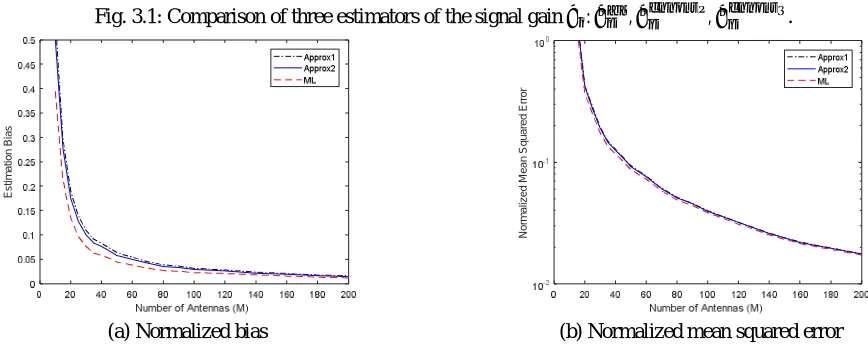
The performance of the three estimators of : , , is compared in Fig. 3.1. The value of = 20, and the pilot SNR at UE is 10 . The UE estimates using = = = 1 and = 10. Thus, SNR becomes 0 , and the effective pilot SNR 10 . Fig. 3.1(a) depicts normalized bias , − / and Fig. 3.1(b) illustrates normalized mean-squared
error (NMSE) , − / .For < 25 the estimators perform badly. As becomes greater than 25, all three estimators
[image:6.612.70.504.322.496.2]become asymptotically unbiased and NMSEs less than 10 is obtained for ≥50. All estimators can overestimate , because of positive bias. gives lowest values of NMSEs. is considerably better than , thus, we use in our simulations[8].
Fig. 3.1: Comparison of three estimators of the signal gain : , , .
(a) Normalized bias (b) Normalized mean squared error
B. Pilot Repetition Probability
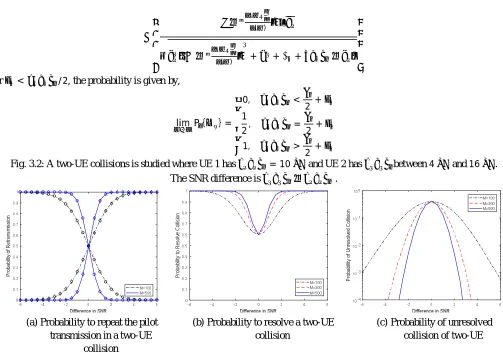
In the SUCR protocol’s Step 3, only one UE transmits pilot . Pilot repetition probability is the probability that a particular UE will repeat its pilot transmission. If UE estimates as as described in previous section and decision rule < /2 is applied, then probability of repeat the pilot is[8]
P {ℛ } = 1−P ℜ(z )≤ ς + P ℜ(z )≤ − ς
where,
= Γ +
Γ( ) + 2( − )
P {ℜ(z )≤b} = √2 −
Γ( + 1) ×
2 Γ + ( ) ,
( )
+
For large , the CCDF P {ℜ(z ) > } converges to,
E
s
ti
m
a
ti
o
n
B
ia
s
N
o
rm
a
liz
e
d
M
e
a
n
S
q
u
a
re
d
E
rr
o
828
©IJRASET (UGC Approved Journal): All Rights are Reserved
⎝ ⎜ ⎜
⎛ −
( )
− ( ) + +Υ + −
⎠ ⎟ ⎟ ⎞
For < /2, the probability is given by,
lim
→ P {ℛ } =
⎩ ⎪ ⎨ ⎪
⎧0, < 2 +
1
2, = 2 +
1, >
[image:7.612.52.555.87.444.2]2 +
Fig. 3.2: A two-UE collisions is studied where UE 1 has = 10 and UE 2 has between 4 and 16 .
The SNR difference is − .
(a)Probability to repeat the pilot transmission in a two-UE
collision
(b)Probability to resolve a two-UE collision
(c)Probability of unresolved collision of two-UE
This shows confirms that if a single UE has a signal gain greater than is sum of rest of the signal gains, then this particular UE will repeat its pilot in Step 3. Parameter is used for tuning. If > 0 for all then only one UE will transmit the pilot in Step 3. Let us take an example to resolve collision between two UE’s, where 02 UE’s collide = {1,2}. The first UE has the constant pilot SNR which is = = = 10 , while the equivalent of the second UE is varying from 4 dB and 16 dB having normalized noise variance i.e. = 1. Fig.3.2 (a) demonstrates the probability that the UEs replicate their pilot retransmissions in Step 3, let us assume = 0 and taking = 100 or = 500 Base Station antenna’s.
The horizontal x-axis displays the difference between the SNR of two UEs i.e. − , which varies from -6 dB to +6 dB. The curves were engendered by Monte Carlo simulations whereas the markers are calculated by using the closed form expression in Theorem 2. The minute differences are because of finite no. of Monte-Carlo realizations. The UE having largest SNR is expected the onlyone to recurred the pilot, If SNR difference is of atleast 3 dB. On the other side if both UEs recurred the pilot with same probabilities i.e. when having same SNR value. The changeover in such cases is sharper with increase in no. of antennas, which mark in Corollary 1. The resolving probability of collision between two UE i.e. , , is revealed in Fig. 3.2(b) with ∈
{100, 300, 500} at = 0. The planned SUCR protocol resolves nearly all collisions when and are adequately different
e.g. when SNR difference is a 3 dB, more than 90% of the two UE collisions have been resolved. The resolving probability of collisions upsurges with addition in more no. of antennas excluding case where = where it is steady at about 60%. If the choice would be independent between the UE’s then resolved collisions would be only 50% in this case. Henceforth, the errors in , , estimates are correlated, when one UE acknowledges a small scale realization of channel considerably stronger than the avg. it will underrate , while the other UE is likely to overrates as it will have faith that the other UE has a stronger avg. channel gain than it really has.
829
©IJRASET (UGC Approved Journal): All Rights are Reserved C. Channel Propagation Models
In this section four different channel models will be compared, viz. uncorrelated Rayleigh fading, correlated Rayleigh fading, pure line-of-sight (LoS) propagation and Nakagami fading. In uncorrelated Rayleigh fading, ℎ is distributed as circularly-symmetric complex Gaussian distribution given by ℎ ~ (0, , ),for = 1, … … , . In correlated Rayleigh fading, ℎ ~ (0, ), with [ ], = | | ( ), where is the angle between UE and zeroth BS and (= 0.7) is the correlation between the adjacent antennas. The LoS propagation model is equipped with the BS that uses ULA with antenna spacing of half wavelength and
ℎ = 1 ( )… ( ) ( ) .
In Nakagami fading, ℎ is distributed as complex Gamma distribution given by ℎ ~ Γ(0, , ),for = 1, … … , [8]. Both Rayleigh and Nakagami fading models have log-normal distributed shadow fading with path loss exponent equal to 3.8 and standard deviation of 10 . The LoS model has log-normal variations with path loss exponent of 2.5 and standard deviation 4 . When a UE’s at edges of the cell transmits at extreme power then the median of the SNR i.e. , / =0 dB which is for the case of non LoS and in the LoS case it is 33 dB.
The UEs and BS transmits at same power = hence in both directions giving the same SNR. We will both deliberate cases when the adjacent cells are quiet through the RA protocol and when they do consistent data transmission. In the concluding case, it is supposed that each neighbouring cells have 10 active UEs and the propagation channels are demonstrated as uncorrelated Rayleigh
fading having same powers with path loss models as above. The avg. UL interference[8] = ∗
‖ ‖ / , where the
assumptions are evaluated considering locations of user and realizations of shadow fading which is presumed to be acknowledged at the UE which is same for each UE and is deducted from , with = − /2.[8]
1) Probability to Resolve Collisions: It is illustrated that even in the overloaded system, the SUCR protocol is accomplished of collision resolving. A scenario is being considered with = 5000 in-active UE’s in the cell and = 10, where with a 0:5% probability, each UE admittances the network in an assumed RA block. The no. of UE’s, | |, is dispersed as exemplified in below Fig., which is attained from the binomial distribution in (1) by acclimatizing on that | | ≥1 . In BelowFig. 3.4(a) when nakagami channel omega is set to be at 2 then probability to resolve collisions is still far, when compared with other 03 channel models. But it close to outcomes of SUCR LoS.
The resolve collision probability continues to upsurge for ≥50, but at very slow pace. Uncorrelated Rayleigh fading gives healthier response than correlated Rayleigh fading but for larger values of the difference is small. Nakagami channel too follows same pattern but at M = 120 it slips down but again accelerates for higher M > 120.In case of LoS model, it has slightly worse performance as the pathloss variances are lower which makes it tougher to assign a strongest UE. Even though, SNR at the cell edge is higher in case of LoS SNR differences can be afforded to create by randomizing the UL pilot powers. In Fig. 3.3, 4.4, 4.5,4.6 also displays the case of LoS when each UE decreases its pilot power with a random no. from 0 to −30 consistently distributed over dB scale. This case gives the best performance among all other cases.
[image:8.612.98.265.617.704.2]Henceforth, the SUCR protocol is well suitable for both non-LoS and LoS channels. But in contrasts it fails badly when performance of SUCR protocol to resolve collisions is applied on nakagami fading channel.In Fig. 3.3, 4.4, 4.5,4.6 baseline displays a conventional protocol in which pilot collisions are only tackled by re-transmitting it in later RA blocks. As shown and used in Fig. 2.1[8], all UE’s replicates the pilot in Step 3 of access protocol and ensues to the method of centralized contention resolution.
Fig. 3.3 Probability of Resolved collisions over Nakagami fading channel with OmegaΩ = 1
830
©IJRASET (UGC Approved Journal): All Rights are Reserved
[image:9.612.115.523.202.344.2]In Fig. 3.3, 4.4, 4.5, 4.6 displays the resolve collisions probability and it is noticed that the SUCR protocol is capable to acknowledge approx. 04 times as many UE’s / RA pilot than the baseline i.e. conventional scheme. But it falls in below in only one case of nakagami channel when value of omega is set to be at 1. But when omega = 2 it is very well above that baseline.We also observed a minor degradation in performance when inter cell interference is being considered, except in case of LoS where performance is nearly unaffected. In the case of full power LoS achieves likewise other channel models.
Fig. 3.4 Probability of Resolved collisions over Nakagami fading channel with OmegaΩ = 2
[image:9.612.356.522.403.524.2](a)With adjacent channel interference (b)without interference
Fig. 3.5 Probability of Resolved collisions over Nakagami fading channel with OmegaΩ = 3
[image:9.612.365.533.589.697.2](a)With adjacent channel interference (b)without interference
Fig. 3.6 Probability of Resolved collisions over Nakagami fading channel with OmegaΩ = 4
(a) With adjacent channel interference (b) without interference
P
ro
b
a
b
il
it
y
t
o
R
e
s
o
lv
e
C
o
ll
is
io
n
P
ro
b
a
b
il
it
y
t
o
R
e
s
o
lv
e
C
o
ll
is
io
831
©IJRASET (UGC Approved Journal): All Rights are Reserved D. Avg. No. of RA Attempts in Crowded Case
Earlier it is proved that the RA collisions can be resolved by SUCR protocol, but the chief motive of a RA protocol is that each & every UE should be acknowledged to the data blocks after as few as possible RA attempts. This performance pointed in a situation with = 10 = 100, and by changing no. of in-active UE’s i.e. ranging from [100; 12000]. Each UE with probability of chooses to access the network. If it is not acknowledged instantly, then in the next blocks the UE links the SUCR procedure with probability 0.5 that runs in that very block. If in a total of 10 SUCR procedures which includes first one, the UE has not succeeded after transmitting RA pilots, then it is on top of the transmission; i.e., it deliberates that access has been starved of by the network. Memo the process of joining the 9 supplementary SUCR procedures can be enhanced acc. to the principles of splitting tree protocols [18], [19]. Uncorrelated Rayleigh fading is being considered, taking cases without inter cell interference and with inter cell
interference, and by using the bias term =
√ − . The SUCR protocol is again being compared with the same baseline protocol
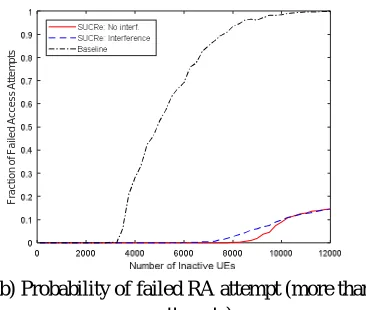
as before which only tackles collisions by re-transmission by adding the UE’s make 10 RA attempts at random instances in the similar way as that in SUCR protocol. Fig. 3.12(a) displays the avg. no. of RA attempts that each UEmakes as a func. of whereas Fig. 3.12(b) displays the section of UE’s that fails in accessing the network within made 10 failed attempts.
Fig. 3.12: RA performance in a cellular network, where each UE accesses the network with 0.1% probability and sends 10 RA pilots before giving up. The SUCR protocol can handle substantially higher user loads, , than
conventional methods.
(a) Average number of RA attempts (b) Probability of failed RA attempt (more than 10 attempts)
The SUCR protocol can effectively tackle up to = 6000 under inter cell interference and = 8000 when the adjacent cells interference is being not considered i.e. when adjacent RA blocks are silent. For higher values of nearby 0−15% of the UE’s will fail to be acknowledged. It is observed that at = 10000 there will on avg. be . 0.001/ = 1 UE that chooses each RA pilot, i.e. that the network is basically over-loaded. Yet, surprisingly 90% of the UE’s can even successfully access the network, with the 90% resolving collision probability as observed in Fig. 3.3. This behaviour relics also for > 10000. In distinction,the baseline protocol necessitates more re-transmissions at < 3000 and as upsurges with range of > 3000 the RA functionality slowly breakdowns down, at = 10000 only 1:5% of the UE’s have effectively succeeded with their RA attempts.
IV.CONCLUSIONS
In Massive MIMO the pilot sequences are valuable resources as they permit the BS in the spatial domain to distinct the UE’s [20]. In most real-world cases,[21], [22] the no. of UE’s that exist in a cell is much higher than the no. of avail. pilots, therefore the pilots required to be temporally assigned only to the UE’s that have data to retrieve transmitter. The projected SUCR random access protocol delivers an effective way for UE’s to allocate pilots for data transmission in Massive crowded LTE MIMO network. The protocol achieves the favourable propagation assets to allow dispersed collision detection and resolving at the UE’s, where the competitor with the strongest signal gain is the one being acknowledged. The simulated results validate that around 90% of all collisions have been resolved with the SUCR protocol on rayleigh channel[8] but it slips to 75% for nakagami channel and even though it is healthy towards channel distribution and inter cell interference. The protocol even not breakdowns in crowded i.e.
[image:10.612.346.529.325.480.2]832
©IJRASET (UGC Approved Journal): All Rights are Reserved
massive overloaded conditions, where more no. of UE’s requested for pilot allocation than no. of RA resources, but endures to acknowledge a subgroup of the accessing UE’s.
REFERENCES
[1] A. B. Ericsson, “Ericsson mobility report: On the pulse of the Networked Society,” Ericsson, Sweden, Tech. Rep. EAB-14, vol. 61078, 2015. [2] M. Fallgren, B. Timus and others, “Scenarios, requirements and KPIs for 5G mobile and wireless system,” METIS deliverable D, vol. 1, p. 1, 2013.
[3] F. Boccardi, R. W. Heath, A. Lozano, T. L. Marzetta and P. Popovski, “Five disruptive technology directions for 5G,” IEEE Communications Magazine, vol. 52, pp. 74-80, 2014.
[4] J. Hoydis, S. Ten Brink and M. Debbah, “Massive MIMO in the UL/DL of cellular networks: How many antennas do we need?,” IEEE Journal on selected Areas in Communications, vol. 31, pp. 160-171, 2013.
[5] E. Björnson, E. G. Larsson and M. Debbah, “Massive MIMO for maximal spectral efficiency: How many users and pilots should be allocated?,” IEEE Transactions on Wireless Communications, vol. 15, pp. 1293-1308, 2016.
[6] A. Ashikhmin and T. Marzetta, “Pilot contamination precoding in multi-cell large scale antenna systems,” in Information Theory Proceedings (ISIT), 2012 IEEE International Symposium on, 2012.
[7] J. Jose, A. Ashikhmin, T. L. Marzetta and S. Vishwanath, “Pilot contamination and precoding in multi-cell TDD systems,” IEEE Transactions on Wireless Communications, vol. 10, pp. 2640-2651, 2011.
[8] E. Björnson, E. De Carvalho, E. G. Larsson and P. Popovski, “Random access protocol for massive MIMO: Strongest-user collision resolution (SUCR),” in Communications (ICC), 2016 IEEE International Conference on, 2016.
[9] E. Björnson, E. De Carvalho, J. H. Sørensen, E. G. Larsson and P. Popovski, “A random access protocol for pilot allocation in crowded massive MIMO systems,” IEEE Transactions on Wireless Communications, vol. 16, pp. 2220-2234, 2017.
[10] E. Björnson, J. Hoydis, M. Kountouris and M. Debbah, “Massive MIMO systems with non-ideal hardware: Energy efficiency, estimation, and capacity limits,” IEEE Transactions on Information Theory, vol. 60, pp. 7112-7139, 2014.
[11] E. De Carvalho, E. Björnson, E. G. Larsson and P. Popovski, “Random access for massive MIMO systems with intra-cell pilot contamination,” in Acoustics, Speech and Signal Processing (ICASSP), 2016 IEEE International Conference on, 2016.
[12] E. Björnson, E. G. Larsson and T. L. Marzetta, “Massive MIMO: Ten myths and one critical question,” IEEE Communications Magazine, vol. 54, pp. 114-123, 2016.
[13] H. Huh, G. Caire, H. C. Papadopoulos and S. A. Ramprashad, “Achieving" massive MIMO" spectral efficiency with a not-so-large number of antennas,” IEEE Transactions on Wireless Communications, vol. 11, pp. 3226-3239, 2012.
[14] H. Q. Ngo, E. G. Larsson and T. L. Marzetta, “Energy and spectral efficiency of very large multiuser MIMO systems,” IEEE Transactions on Communications, vol. 61, pp. 1436-1449, 2013.
[15] T. L. Marzetta, “Noncooperative cellular wireless with unlimited numbers of base station antennas,” IEEE Transactions on Wireless Communications, vol. 9, pp. 3590-3600, 2010.
[16] L. Lu, G. Y. Li, A. L. Swindlehurst, A. Ashikhmin and R. Zhang, “An overview of massive MIMO: Benefits and challenges,” IEEE journal of selected topics in signal processing, vol. 8, pp. 742-758, 2014.
[17] S. A. Abbas and A. U. Sheikh, “A geometric theory of Nakagami fading multipath mobile radio channel with physical interpretations,” in Vehicular Technology Conference, 1996. Mobile Technology for the Human Race., IEEE 46th, 1996.
[18] J. Capetanakis, “Tree algorithms for packet broadcast channels,” IEEE transactions on information theory, vol. 25, pp. 505-515, 1979.
[19] J. H. Sørensen, Č. Stefanović and P. Popovski, “Coded splitting tree protocols,” in Information Theory Proceedings (ISIT), 2013 IEEE International Symposium on, 2013.
[20] Kaur, Sandeep, Charanjit Singh and Amandeep Singh Sappal. "Effects and estimation techniques of symbol time offset and carrier frequency offset in OFDM system: Simulation and analysis." International journal of Electronics and Computer Science Engineering (2012): 1188-1196.
[21] Kaur, Sandeep, Harjinder Singh and Amandeep Singh Sappal. "Carrier Frequency Offset Estimation for OFDM system using Time/Frequency-Domain Techniques. “International journal of Advance Research in Computer Science and Electronics Engineering (IJARCSEE) 1.2 (2012): pp- 154.
![Fig. 2.1: The PRACH Protocol of the LTE System[8].](https://thumb-us.123doks.com/thumbv2/123dok_us/8307184.856586/3.612.193.397.485.690/fig-prach-protocol-lte.webp)
![Fig 2.2: SUCR random access protocol Proposed for Massive MIMO[8].](https://thumb-us.123doks.com/thumbv2/123dok_us/8307184.856586/4.612.195.401.277.477/fig-sucr-random-access-protocol-proposed-massive-mimo.webp)