IMPROVING THE ACCURACY OF TEXT DOCUMENT CLUSTERING BASED ON SYNGRAM ALGORITHM
ABDUL HALIM BIN OMAR
A thesis submitted in
fulfillment of the requirement for the award of the Degree of Master of Information Technology
Faculty of Computer Science and Information Technology Universiti Tun Hussein Onn Malaysia
ABSTRACT
ABSTRAK
Sorotan kajian terdahulu telah banyak menyatakan penggunaan Vector Space Model (VSM) sebagai satu kaedah bagi mewakilkan teks dokumen. Perwakilan itu dilakukan dengan mengambil kira kekerapan istilah-istilah yang telah wujud di dalam teks dokumen. Secara umumnya, Istilah-istilah tersebut telah diabaikan hubungan diantara mereka dan VSM menukarkan istilah-istilah tersebut kepada suatu entiti yang tunggal. Oleh kerana itu, VSM telah mengakibatkan dua permasalahan utama yang berpunca daripada pengabaian tersebut. Kedua-dua permasalahan ini merupakan Polysemy dan Synonymy konsep. Bagi mengatasinya, kajian ini telah mencadangkan pengabungan dua kaedah iaitu WordNet dan N-grams yang dinamakan sebagai algorithma Syngram. WordNet telah dipilih kerana ia merupakan sebuah pangkalan data yang dapat memberikan konsep-konsep sinonim yang mana dapat digabungkan supaya menjadi urutan set sinonim. Kaedah kedua ialah N-grams, ia merupakan suatu kaedah kebarangkalian yang telah digunakan dalam pemodelan bahasa dan ia cukup bermanfaat bagi menghasilkan urutan-urutan istilah. Oleh yang demikian, kajian ini telah mengeksploitasikan N-grams dalam menyelesaikan masalah Polysemy dengan mengubah istilah-istilah ke dalam bentuk ketulan urutan istilah. Dengan mengubah istilah teks dokumen dari kekerapan tunggal kepada kekerapan berkonsep, ia terbukti telah meningkatkan prestasi (ketepatan) text document clustering. Satu eksperimen telah dijalankan ke atas reuters50_50 dataset dengan 10 kelas nama pengarang dan hasil eksperimen telah dibandingkan antara text document clustering (k-means) dengan VSM, N-grams, WordNet dan algoritma yang telah dicadangkan. Keputusan telah menunjukkan algorithma cadangan (65.6%) telah mengatasi VSM (55.4%), N-gram (53.2%) dan WordNet (59%).
TABLE OF CONTENTS
DECLARATION ii
DEDICATION iii
ACKNOWLEDGEMENT iv
ABSTRACT v
ABSTRAK vi
TABLE OF CONTENTS vii
LIST OF TABLES x
LIST OF FIGURES xi
LIST OF SYMBOLS AND ABBREVIATIONS xii
LIST OF APPENDICES xv
LIST OF PUBLICATIONS xvi
CHAPTER 1 INTRODUCTION 1
1.1 An Overview 1
1.2 Problem Statements 5
1.3 Objectives of the Study 6
1.4 Scope of Study 6
1.5 Aim of the Study 7
1.6 Significance of the Study 7
CHAPTER 2 LITERATURE REVIEW 9
2.1 Introduction 9
2.2 Text Document Clustering 10
2.3 Text Document Preprocessing 12
2.3.1 Text Document Weighting 13
2.3.2 Text Document Conversion With VSM 14 2.4 Vector Space Model (VSM) Limitation 17
2.4.1 Synonymy Concept 17
2.4.2 Polysemy Concept 18
2.5 Text Document Clustering Based on Frequent Concept (WordNet)
19
2.6 Text Document Clustering Based on N-grams 23 2.7 The Integration of WordNet and N-grams 26
2.8 Research Gap Discussion 27
2.9 Summary of Chapter 30
CHAPTER 3 RESEARCH METHODOLOGY 31
3.1 Methodology Overview 31
3.2 Methodology Process 32
3.3 Dataset Selection 33
3.4 Text Documents Preprocessing 33
3.5 Proposed Algorithm (Syngram) 34
3.5.1 Step 1 Modelling Terms with Synsets 36 3.5.2 Step 2 Modelling Terms (Synsets and
N-grams
36
3.5.3 Step 3 Syngram Based Weighting Scheme
3.6 Deploying Text Document Clustering (K-means) 39
3.7 Performance Evaluation Measure 43
3.8 Summary of Chapter 45
CHAPTER 4 EXPERIMENTAL RESULT AND DISCUSSION 46
4.1 Experiment Overview 46
4.2 Programming Setup
4.2.1 RapidMiner 5.3 (JAVA Based)
47 47
4.3 Text Document Clustering 47
4.3.1 Partitioning the Dataset 48
4.3.2 Text Documents Similarity Distances 48
4.4 The Quality of Clustering 52
4.5 Discussion 57
4.6 Summary 58
CHAPTER 5 CONCLUSION AND FUTURE WORKS 59
5.1 Summary of Study 59
5.2 Contribution of the Study 61
5.3 Recommendations for Future Works 62
REFERENCES 64
APPENDIX A 69
LIST OF TABLES
2.1 Partitioning and Hierarchical Clustering 11
2.2 The Implementation of VSM 15
2.3 Synonymy Effects in Text Documents 18
2.4 Polysemy Effects in Text Documents 19
2.5 Generated N-grams Term 23
2.6 Research Chronology of clustering with WordNet and N-grams
29
3.1 Standard Preprocessing for Text Document Clustering
33
3.2 Data Table 40
3.3 Centroid Calculation 40
3.4 Distance Calculations of Cluster to D1 40
3.5 Distance Calculations of Cluster to D2 41
3.6 First Recalculation of Centroid 41
3.7 Calculated Distance between Documents 41
3.8 Second Recalculation of Centroid 42
3.9 First Recalculation Distances between Documents 42 3.10 Second Recalculation of Distances between
Documents
42
3.11 Third Recalculation Distances between Documents 43 3.12 Relevance and Retrieval Contingency Table 43 4.1 Score of Accuracy (VSM, Synsets, N-grams and
Syngram)
54
LIST OF FIGURES
1.1 Group of Clustered object 2
1.2 Term Concept of Polysemy 4
2.1 Basic Steps in Text Document Clustering 11
2.2 Five Stages of Data Preprocessing Text Documents 13
2.3 The Implementation of BOW 16
2.4 Semantic Relations in WordNet 20
3.1 Research Methodology Framework 32 16
3.2 Syngram versus VSM 34
3.3 Conceptual Diagram of Syngram Approach 35
3.4 Syngram Algorithm 36
3.5 The intersection between Terms and Synsets 37
3.6 Sub Process of Syngram Algorithm 37
3.7 K-means Algorithm 39
4.1 Graph Similarity between Text Documents 49
4.2 Term Changes by Syngram Algorithm 51
4.3 F-Measure between VSM, Synsets, N-grams and Syngram
52
4.4 Graph Distribution of different Adaptive Methods 54
4.5 Precision and Recall 56
LIST OF SYMBOLS AND ABBREVIATIONS
𝑤𝑖 Weighting of text document 𝑡𝑓𝑖 Term Frequency
𝑖𝑑𝑓𝑖 Inverse Document Frequency
𝑑𝑓𝑖 Document Frequency 𝐷, d Document
log() Log Formulation for Normalization Synsetsi Set of synonym
Cn Concept of term 𝑠𝑓𝑖 Syngram Frequency
Dictionary WordNet Dictionary Synsetsn Set of synonym Syn Synonym term Term1 Term
Termi|Syni; Concatenation between terms 𝑃(𝑐1𝑛) Probability of concept
𝑥1 Variable 𝑥1
∩ Interception
𝑟𝑒𝑐𝑎𝑙𝑙 Subject in F-Measure
𝐹 F-Measure
P Precision tn True negative fn False negative tp True Positive fp False Positive
R Recall
cos(𝑑𝑖, 𝑑𝑗) Cosine angle between documents
TF-IDF Term Frequency Inverse Document Frequency VSM Vector Space Model
BOW Bag of Word
WordNet Electronically lexical Dictionary N-grams Probability of Chain Rules Synonymy Concept of Synonym
Polysemy Concept of Polysemy (Same term but has multiple meaning)
F- Measure Measurement Formulation for Clustering HTML Hyper Text Markup Language
XML Extensible Markup Language DOM Document Object Model
K-means Partitioning algorithm for clustering Syngram Proposed algorithm (Synsets + N-grams) Reuters50_50 Text documents dataset from UCIMLR NLP Natural Language Processing
Apriori Apriori Algorithm
TF-IDF Term Frequency Inverse Document Frequency CCAT Class Criteria Cognitive Aptitude Test
Synset Set of Synonym from WordNet Euclidean Method to Calculate Distance JAVA Programming Language
UCIMLR University California Irvine Machine Learning Repository
Hierarchical Hierarchical Clustering Algorithm Spiral Spiral Clustering Algorithm DBSCAN DBSCAN Clustering Algorithm Synonyms Same Meaning of terms
Hypernyms Hierarchical of Categorize Terms Hyponyms Anatomy of Term
Meronyms Explaining Hyponyms
KUSZA Sultan Zainal Abidin Religious College UTHM University Tun Hussein Onn Malaysia
LIST OF APPENDICES
APPENDIX TITLE PAGES
A Table A.1: VSM Contingency Table 69
CHAPTER 1
INTRODUCTION
1.1 An Overview
Internet is known as a participative medium has been designed for the whole world. Via the internet, user would be able to broadcast any ideas or running any services over the internet by utilizing website as a primary platform. Basically website is a regular medium for public to carry out their network activities such as social networking, doing business transaction, as a learning occasion and many more. Those mentioned activities requiring data and the data processed into information that might be considered either useful or harmful to everyone. Toby, Collind & Jammy (2009) have defined some collective of data might be presented in many forms, either it is unstructured, semi-structured and structured. Initially, data presented in a free form or arbitrary sizes and types. However, several frameworks such as Hyper Text Markup Language (HTML) and Extensible Markup Language (XML) invented to encapsulate data in semi structured form known as Document Object Model (DOM). The finest form is structured data which is stated in the specific location in database. The database stores the data in precise and complete formatted. This formatted scheme has ensured the data to become more significant and efficient to be managed. On the other hand, the data lies inside document and processed into the nature of information that kindly being used nowadays.
internet are stored in the form of text (Yu Xiao, 2010). It is consistent with rapidly growing of the internet user within this information age, the information spread from side to side through the websites and it turns out to be overloaded which brought a lot of choices of information. These choices of information have made text document become a good sources of references.
Despite of all the positive outcomes of having it as a good source of information, text document still remains unstructured and needs to be clustered into a significant and more meaningful collection. Moreover, a lot of researches have been done with regards to cluster the text document, which refers to structure unstructured text document in a huge set of corpus and concentrating on text clustering algorithm. As a result, there are many text clustering algorithms existed over industry and some of well-known algorithms are K-means, Hierarchical, Spiral Model and many more. The purpose of the listed clustering algorithm is to solve the issues related to the unstructured text document.
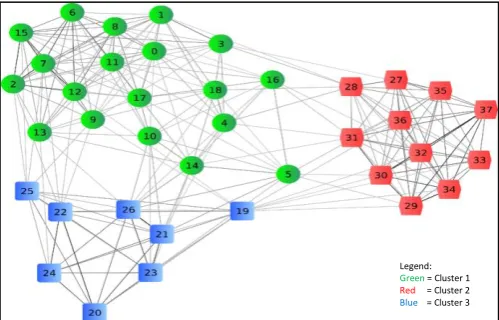
[image:14.595.194.444.547.707.2]Text document clustering algorithm can be defined as a task of separating text documents into homogeneous classes or clusters into their own related groups. In the process of separating text documents, the text documents in mutual classes must be same as possible while text documents in the contradicting classes must be dissimilar as possible. In Figure 1.1 shows clustered text documents as objects represented by blue, green and red color. That conceptual figuration is a collection of object grouped together based on similar color. Those objects have been connected by edges in order to show the distances between every object that being clustered.
Figure 1.1: Group of Clustered object
Legend:
Green = Cluster 1
There are many types of text clustering algorithm existed, but the most popular are hierarchical and partitioning. Nevertheless, both algorithms have shared a mutual objective which is to cluster the text documents. Before clustering any text documents, one important thing to be considered as a step before clustering process is text document conversion. It is become crucial since the text document clustering is working on numerical data and requires an outstanding method to convert text documents into numerical values.
The conversion of the text documents into numerical values is unavoidable routine before deploying any text document clustering. It has been started in early 1975, a professor of Computer Science at Cornell University has founded the Vector Space Model (VSM). This technique was successfully applied in information retrieval (Salton, Wong & Yang, 1975). It is very useful and widely being used in text document conversion.
Basically, text document conversion based on VSM similarly works as Bag of Words (BOW). It treats all term occurred in all text documents by independently, which mean term will be separated into single terms (Baghel & Dhir, 2010). With this approach it has suffered a limitation regarding term relationship which is very important in measuring text document similarity. To further justify, the reason of the VSM limitation is due to the existence of relationships occurred inside the text documents. Furthermore, VSM only emphasizes on single term instead of hidden term concepts that important to be digested.
VSM, as example of “drives me crazy” and “driving a car”. They may look simple to be understood due to different forms and contexts, but in VSM, “drive me crazy” and “driving a car” are the same.
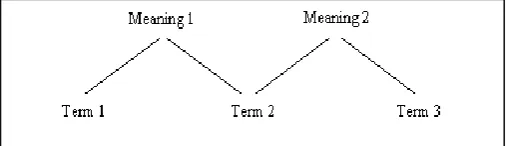
[image:16.595.211.465.300.373.2]In contrast, the concept of Synonymy is about terms that have the same meaning but appear in different forms like “big house” and “huge house”. Both term concepts are so important and it is compulsory to take them into account before applying text clustering algorithm in order to increase the quality of text clustering result. Figure 1.2 is a simple version of the Polysemy concept by Vaquero, Saenz & Barco (2000) and Vaquero et al., 2000 mentioned that Term 2 has two meanings and it's important in determination of meaning 1 and meaning 2.
Figure 1.2: Term Concept of Polysemy
Moreover, Terms 3 and Term 1 are different to each other but in the meaning determination, they shared the same connector, which is Term 2. This connector is more likely to have multiple meanings yet reflect same form. Also, the connection between terms will be constructed into phrase that has a longer meaning rather than the one with single term.
1.2 Problem Statements
between conceptual or semantic similarity of text fragments in text documents by utilizing N-grams as method to detect term frequencies. Both researchers combine WordNet and gram based on their own preferences. In this study WordNet and N-grams being utilized is to increase the text document clustering accuracy. The challenge of this research is to prove the combination of WordNet and N-grams have the significant effects after changing the text features from frequent term into frequent concept in improving text document clustering algorithm (K-Means).
1.3 Objectives of the Study
The objectives of this research:
i. To propose Syngram algorithm based on a frequent concept of Polysemy and Synonymy.
ii. To improve text document clustering by deploying the proposed algorithm iii. To evaluate the performance of the proposed algorithm based on accuracy of
text document clustering result by using F-Measure.
1.4 Scope of the Study
1.5 Aim of the Study
The aim of the study is to improve the result of text document clustering (K-means) base on VSM (frequent single term). The improvement was made by deploying Syngram algorithm (frequent concept).
1.6 Significance of the Study
This study investigated the performances of text document clustering with frequent term and frequent concept. It was discovered in this study that text document clustering with frequent concept improved further accuracy compared to frequent term. The frequent concept was originally constructed from the combination of WordNet lexical dictionary and N-gram chain rule. This combination has improved the performance of text document clustering instead of frequent term approach that was implemented by previous researchers.
1.7 Outline of the Thesis
This thesis consisted of five chapters, including Chapter one. Following is the summarization of each chapter.
(i) Chapter 1: Introduction. Apart from providing an outline of the thesis,
this chapter contains an overview of the research background, problem statement, objectives, scope, aim, and significance of the study.
(ii) Chapter 2: Literature Review. This chapter included a review on VSM
new method in improving the text document clustering accuracy by proposing the algorithm as described in Chapter 3.
(iii) Chapter 3: Research Methodology. This chapter discusses the research methodology used to carry out the study systematically. Initially started with dataset selection, pre-processing, propose algorithm, applying clustering algorithm and cluster evaluation. The main subject in this chapter is regarding a new algorithm called as Syngram has been proposed. The Syngram will further explained on how it worked in order to improve the accuracy of text document clustering.
(iv) Chapter 4: Result and discussion. The proposed algorithm in Chapter 3 is
further validated for its accuracy improvement in this chapter. The performances of the proposed algorithm were tested for comparison against the conventional VSM, WordNet and N-grams. The performance evaluation was carried out based on the document clustering quality of mapping cluster label and with precision and recall.
(v) Chapter 5: Conclusions and Future Works. The contributions of the
CHAPTER 2
LITERATURE REVIEW
2.1 Introduction
2.2 Text Document Clustering
Text document clustering is one of the methods used in many data mining application. It manage to group text documents based on their similarity criterion. In a text document clustering the group of similar documents must be more similar between intra documents and less similarity between intra documents of two clusters (Elahi & Rostami, 2012). As a result the similarity of text document can be measured by the formulation of the distance.
Table 2.1 shows several types of the partitioning clustering algorithms and hierarchical clustering algorithm. Both types of algorithms are categorized based on the respective characteristics or traits when the text document is clustered.
Table 2.1: Partitioning and Hierarchical Clustering
Partitioning Clustering Algorithm Hierarchical Clustering Algorithm
K-means Single Linkage
X-Means Average Linkage
Bisecting K-means Complete Linkage
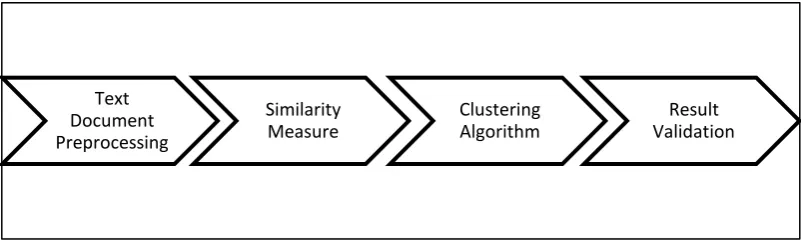
[image:23.595.114.515.348.468.2]There are four basic steps to be implemented in deploying any text document clustering as shown in in Figure 2.1.
Figure 2.1: Basic Steps in Text Document Clustering (Ravichandra, 2003)
The first step is referred as text document preprocessing, where it considered as a basic and an essential process to take place before applying text document clustering. The second step is similarity measure. This step responsible to consider the similarity between text documents and it has come in assortment of methods, one of the most frequently being used in text document clustering is cosine similarity (Kalaivendhan & Sumaithi, 2014). The cosine method is used to determine the text documents similarity.
The third step in text document clustering is selecting a clustering algorithm. This step uses a particular similarity measure as a subroutine process. This step choose the best algorithm to cluster the text document because by selecting the right clustering algorithm, more or less would be able to get the performance increased
Text Document Preprocessing
Similarity Measure
Clustering Algorithm
(Ravichandra, 2003). Furthermore inside clustering algorithm subroutines, the distance of text documents must be calculated in order to distinguish the text documents to the centroid point. This centroid point is calculated by determining the mean values of every text documents vector. Based on the calculated centroid point, clustering algorithm will determined the document cluster by grouping them into mutual clusters regarding the distances of text documents to the closest centroid point.
Most of clustering algorithms quantify the distance between a point and the cluster centroid for separating them into relevant groups. It is a vital process in order to create a mutual cluster among the text documents (Ravichandra, 2003). After mutual clusters have been setup, the final process in text document clustering procedure is result validation which is generating the output in statistical figure with the number of clustered text document. It is the last step in validating the clustering result and this last step is the process of iteration in clustering at the prior stage, which is having some methods depend on the clustering task of validation.
Ravichandra (2003) mentioned that the steps in a text document clustering involve calculating the similarity between text documents before selecting the clustering algorithm. In order to calculate the similarity, it is compulsory to convert text documents into sequences of numerical values to make sure text documents would be compared. This conversion is known as a weighting process, which also can be classified as a preprocessing stage of text document and it is important for the smoothness and accuracy of the clustering algorithm.
2.3 Text Document Preprocessing
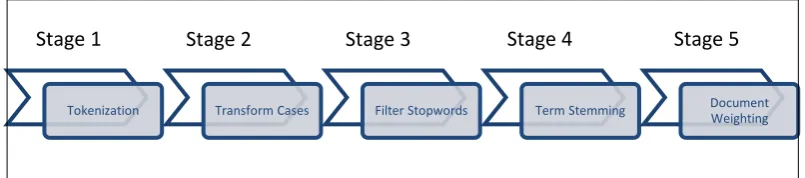
Figure 2.2: Five Stages of Data Preprocessing Text Documents
This study only emphasizing on Document Weighting since VSM worked in this stage. In Document Weighting process, VSM works to convert the text document into sequences of numerical values and every term inside text document will be separated independently. Based on the separation of terms into singleton it cause the ignorant of term relationship (Polysemy and Synonymy concept) which is really important to text document clustering. The ignorant of term relationship will caused a major mistake in distinguishing the text documents. This chapter will explained more detail regarding text document weighting and the limitations of Polysemy and Synonymy concepts.
2.3.1 Text Document Weighting
Text document weighting is a conversion process of text documents into vectors that are represented in numerical (Srividhya & Anitha, 2011). This conversion will allows text documents to be measured by changing the text document features into sequences of numerical values. This conversion method is very significant for text document clustering in order to determine the object distances while clustering the text document.
Most of text clustering algorithm used VSM as basic conversion of text document into numerical vector values (Beil, Ester & Xu, 2002). The vector values will be assigned by length of vector and applying length normalization in order to be compared among text documents. After the conversion process has been done, the next process is to compare the similarity between text documents. In this process, require some methods such as cosine, jaccard, dice, manhattan and many more. Once
Tokenization Transform Cases Filter Stopwords Term Stemming Document
Weighting
the similarity method has been chosen, the distances between text documents could be calculated and compared successfully.
2.3.2 Text Document Conversion with VSM
Vector Space Model (VSM) is basically inspired from an algebraic model in representation of text document and generally it can be practiced on any object to count the frequencies (Salton et al., 1975). It is been widely used in many appliance such in information retrieval, information filtering, information indexing and so on. VSM is also often used in text clustering in utilizing Natural Language Processing (NLP) since text document was an object that represents human in expressing something.
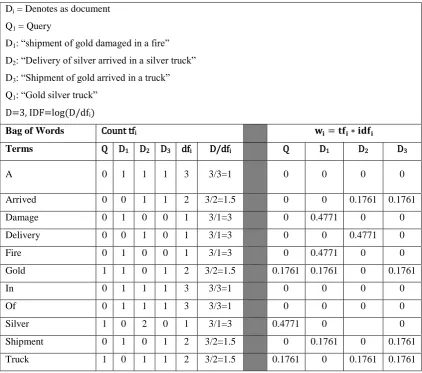
Table 2.2: The Implementation of VSM (Abual-Rub et al, 2007)
Di = Denotes as document
Q1 = Query
D1: “shipment of gold damaged in a fire”
D2: “Delivery of silver arrived in a silver truck”
D3: “Shipment of gold arrived in a truck”
Q1: “Gold silver truck”
D=3, IDF=log(D/dfi)
Bag of Words Count tfi 𝐰𝐢= 𝐭𝐟𝐢∗ 𝐢𝐝𝐟𝐢
Terms Q D1 D2 D3 dfi D/dfi Q D1 D2 D3
A 0 1 1 1 3 3/3=1 0 0 0 0
Arrived 0 0 1 1 2 3/2=1.5 0 0 0.1761 0.1761
Damage 0 1 0 0 1 3/1=3 0 0.4771 0 0
Delivery 0 0 1 0 1 3/1=3 0 0 0.4771 0
Fire 0 1 0 0 1 3/1=3 0 0.4771 0 0
Gold 1 1 0 1 2 3/2=1.5 0.1761 0.1761 0 0.1761
In 0 1 1 1 3 3/3=1 0 0 0 0
Of 0 1 1 1 3 3/3=1 0 0 0 0
Silver 1 0 2 0 1 3/1=3 0.4771 0 0
Shipment 0 1 0 1 2 3/2=1.5 0 0.1761 0 0.1761
Truck 1 0 1 1 2 3/2=1.5 0.1761 0 0.1761 0.1761
In mathematical way VSM is represented with this Equation 2.1:
𝑤𝑖 = 𝑡𝑓𝑖 ∗ log (𝑑𝑓𝐷
𝑖) (2.1)
Equation 2.1 shows the fundamental of weighting scheme when 𝑤𝑖 denotes as total weight in numerical and 𝑡𝑓𝑖 is term frequency in a document. The method log (𝑑𝑓𝐷
𝑖) is used in order to normalize the value from 𝑑𝑓𝐷
𝑖 which is 𝐷 is documents and 𝑑𝑓𝑖 is the document frequency that containing term 𝑖. With 𝑑𝑓𝐷
𝑖 is the global probability due to its capability of choosing document contained terms related in other text documents.
Based on Table 2.2, it shows how the term frequencies are calculated. Assume that 3 documents (𝐷1, 𝐷2, 𝐷3) consisting terms is weighted based on 𝑤𝑖 = 𝑡𝑓𝑖 ∗ 𝑖𝑑𝑓𝑖 and well converted into numerical values as per Table 2.2. All terms
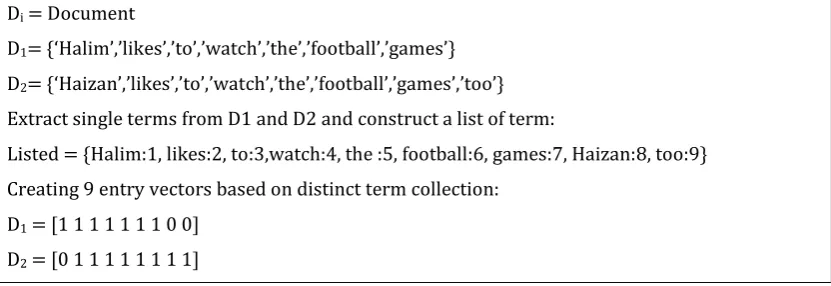
occurrences inside documents has been calculated their frequencies of occurred by using VSM formulation. All text documents will be generated vector values and these vector values determined how frequent of term appeared in text document based on the uppermost values. Figure 2.3 shows the example of BOW implementation, similar with VSM, which computes all terms occurrences in all text documents. With the samples of documents given in Documents D1 and D2 were
extracted into several term occurrences with an elimination of repetitive terms into the list of terms. Nine entry vectors created from the distinct term collection. As a result D1 and D2 become a vector with numerical values of term occurrence and ignored the term relationship.
Di = Document
D1= {‘Halim’,’likes’,’to’,’watch’,’the’,’football’,’games’}
D2= {‘Haizan’,’likes’,’to’,’watch’,’the’,’football’,’games’,’too’}
Extract single terms from D1 and D2 and construct a list of term:
Listed = {Halim:1, likes:2, to:3,watch:4, the :5, football:6, games:7, Haizan:8, too:9} Creating 9 entry vectors based on distinct term collection:
D1 = [1 1 1 1 1 1 1 0 0]
[image:28.595.110.526.587.730.2]D2 = [0 1 1 1 1 1 1 1 1]
2.4 The Vector Space Model (VSM) Limitation
Fundamentally, VSM treats the terms independently and may cause a major constraint by demolishing the relation between the terms, where terms can be comprehended as the conceptual representations, namely Polysemy and Synonymy. The first limitation, Polysemy, can be described as a term to express different things in different contexts, for example, “collecting a card” and “collecting a result”. Due to this, some unrelated documents might have high similarities because they tend to share some terms. As a result, this circumstance can affect the precision in the measurement issue. The second limitation, Synonymy, refer to a term used to express the same thing, such as “truck driver” and “lorry driver”. However, the number of similarities among some relevant documents might be low, as they do not share the same terms. This condition will effect on recall, in which these two limitations can be the detrimental causes to the vector created.
These limitations are exactly occurred when the process of converting text document is conducted by utilizing VSM formulation and along the process will discovered the limitations of VSM. From Table 2.2, the terms are separated and their relationship is ignored. This particular event shows a major limitation of VSM, where it works by making terms turned into form of single operation. Furthermore, these independencies will cause the ignorance of the relationship among terms which is important to create a possibility to represent the expression or meaning from text documents contents. For instance, the wrong interpretation of the contents can cause text document clustering less accurate while performing text clustering. The two major boundaries, Polysemy and Synonymy will be explained in further detail in the subtopics of Synonymy and Polysemy concepts respectively.
2.4.1 Synonymy Concept
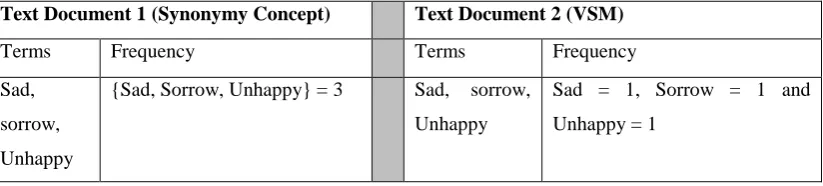
independently and without term relationship to be counted. Table 2.3 illustrates how Synonymy changes the text document content.
Table 2.3: Synonymy Effects in Text Documents
Text Document 1 (Synonymy Concept) Text Document 2 (VSM)
Terms Frequency Terms Frequency
Sad,
sorrow,
Unhappy
{Sad, Sorrow, Unhappy} = 3 Sad, sorrow,
Unhappy
Sad = 1, Sorrow = 1 and
Unhappy = 1
The separation of terms in Text Document 2 in Table 2.3 has shown how synonym terms are treated by VSM as singleton and different to each other. This approach will cause the misinterpretation of text document content.
2.4.2 Polysemy Concept
Table 2.4: Polysemy Effects in Text Documents
Text Document 1 (Polysemy Concept) Text Document 2 (VSM)
Terms Frequency Terms Frequency
My name
is Gabriel
{My name is Gabriel} = 1 My name is
Gabriel
My = 1, Name = 1 is = 1
Gabriel = 1
The Polysemy concept will keep term contact in default position and it protects the originality of the meaning. Such as in Table 2.4 the Polysemy concept is still a phrase of “My name is Gabriel”.
2.5 Text Document Clustering Based on Frequent Concept (WordNet)
Terms are important in representing passage and passage is important to represents document. In this research term frequent detection method is used in order to investigate the document relationship existed inside text documents. In order to consider the term concept, it is necessary to have an electronic lexical dictionary as term concept database. Since WordNet is choose in this study, a further research on WordNet dictionary is conducted.
WordNet has been used widely in many text documents’ clustering research due to its capacity of Synsets word groups. Furthermore, WordNet is also well known as a large lexical database with the combination of a dictionary and a thesaurus of English language (Miller, 1995). Furthermore, Miller (1995), defines the vocabulary of a language as a set W of pairs (f, s), where a form f is a string over a finite alphabet, and a sense s is an element from a given set of meanings. For instance, forms can either be utterances composed of a string of phonemes or inscriptions composed of a string of characters. Due to this, each form with a sense in a language is called a term in that language. Other than that, a dictionary is referred as an alphabetical list of words, in which a word that has more than one sense is polysemous while two terms that share at least one sense in common are said to be synonymous (Miller, 1995).
an ordinary dictionary is normally the solution but it is not machine interpreted or machine readable. A dictionary is suitable for human only and to initiate machine learning requires a specific version in computer readable. However, instead of the ordinary dictionary, WordNet was invented. WordNet is an online lexical database designed for the use under program control. English nouns, verbs, adjectives, and adverbs are organized into sets of synonyms, in which each represents a lexicalized concept and a semantic relation link the synonym sets. In conjunction with this research, both concepts of Polysemy and Synonymy are the main keys to investigate how both concepts are able to mend the limitations of VSM as mentioned previously by defining the similarity between text documents with the help of Synsets. Synsets is a group of synonymous words and collocations and it corresponds to a concept (Baghel & Dhir, 2010). Synsets came along with WordNet which is contains 155 287 words organized in 117 659 Synsets for a total of 206 941 word sense with pair (Baghel & Dhir, 2010).
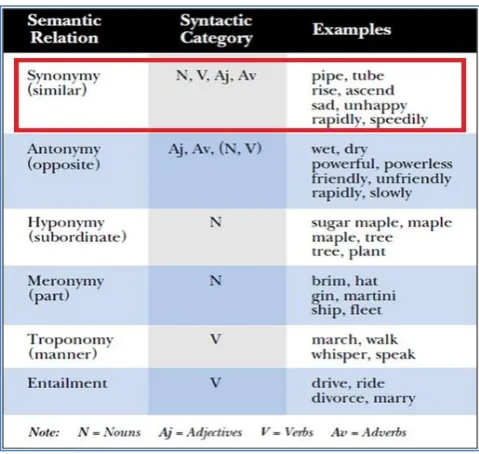
[image:32.595.199.439.483.710.2]In WordNet, there are semantic relations among terms and these relations are divided into six categories (Miller, 1995). As shown in Figure 2.4 is a concept of relationships that consists of useful tools such as Synonymy, Antonymy, Hyponymy, Meronymy, Troponymy and Entailment. However, this research only focuses on Synonymy concept to counter VSM limitation.
Many researchers (Huang et al., 2008; Hamou et al., 2010; Ray & Singh, 2010; Thanh & Yamada, 2011; Bouras & Tsogkas, 2012; Celik & Gungor, 2013) have used WordNet as a platform to extract word ontology and the text extraction feature to apply on their datasets in finding Synonymy concept. Baghel & Dhir (2010), has proposed Frequent Concept Document Clustering (FCDC), which is contained WordNet as references for concept of Synonymy to cluster text document. In this approach, Baghel & Dhir (2010) has stated the solution by searching for the concepts in documents and then finding for the frequent concepts. Baghel & Dhir (2010) applied the concepts by using apriori paradigm that utilizes frequent item set. Next, the paradigm forms the initial clusters of documents with each cluster representing a single frequent concept. Then, the proposed algorithm processes these initial clusters to create disjoint clusters and finally represents the results by using the hierarchical tree like structure.
Furthermore, Abdelmalek, Elberrichi & Simonet (2010) have deployed WordNet as a research platform in order to extract the term concept before applying clustering algorithm. In experimental process, WordNet was used as text document representation and the representation with WordNet is better because it make the similarity among text document increased. Moreover, the text clustering used an ascending hierarchical clustering method known as a Self-Organizing Maps (SOM) based clustering method and an ant-based clustering method. These algorithms were applied based on the Synsets of WordNet as terms for the representation of textual documents. As a result, the effects of these methods were examined in several experiments using three similar measurements, namely the Cosine distance, the Euclidean distance and the Manhattan distance. Other than that, the experiments indicated that using the SOM based clustering method and using the cosine distance provided the best results. Abdelmalek et al. (2010) has mentioned in a publication that many document clustering tasks use Synsets of WordNet as a featured selection in order to gain accuracy of the clustering results.
of more general words. The term concept (hypernyms) was used in the preprocessing step and applied on several text clustering algorithms.
The research was proposed W-K means (K-means WordNet based) algorithm and compared it with K-means. The comparison between both clustering algorithms have resulted the proposed one better than K-means, where it was improved by the enhancement of standard K-means algorithm using the external knowledge from WordNet. Moreover, the experimental process used the approach of WordNet hypernyms in a two folded manner, enriching the ‘‘bag of words’’ prior to the clustering process and assisting the label generation procedure. In addition, both processes were implemented in text preprocessing phase. Thus, the research shown how WordNet becomes very useful to increase or improve the clustering algorithms.
On the other hand, the additional WordNet dictionary before the clustering process also can be used as a feature selection. It is conjunction with huge increased in the number of text documents on the Internet nowadays and the fast speed material publication such as news article, digital libraries, publications and many more, this consequence has yielded a major problem of high dimensionality of data that which is very high volume of data.
Patil & Atique (2013) have investigated how feature selection improves the text classification in order to deal with the major problem as mentioned. The research were started with the used of feature selection method from the preprocessing steps on text documents by selecting the important feature with the information gained based on entropy. Based on WordNet as a lexical database, the global unique word has been extracted and found the frequent word sets and further key terms from all documents by using feature selection methods. From the results, the important terms were selected based on the information gained from using WordNet was reduced the text document dimensionality.
2.6 Text Document Clustering Based on N-grams
[image:35.595.107.532.609.685.2]N-grams is another method of text document representation besides Vector Space Model (VSM) which has several advantages (“N-grams” is a sequence of n consecutive characters or term) (Amine et al., 2008). The whole set of N-grams (n generally varies from 2 to 5) generated for a given document is mainly the result of the displacement of a window of n equal to characters along the text (Millar et al., 2006). Furthermore, the window is moved by a character at a time and the position. This method creates term N-grams of tokens in a document as based on Markov Model (Brown et al., 1992). Other than that, n can be assigned in view of term or character (linguistic area of study), where n = term or n = character. These connotations define term N-grams as a series of consecutive tokens of length n. The term N-grams is generated by consisting of all series of consecutive tokens of length n. In an experiment by Shannon et al. (1949) n was located with probability when language modeling and independence assumptions are made so that each word depends only on the last n-1 words. This N-grams method can be used in many areas of study widely such as Protein Sequencing, DNA Sequencing, Computational Linguistics (character) and Computational Linguistics (term). For instance, this study only focuses on the use of Computational Linguistic (term) and works with text document clustering. Table 2.5 shows in general how N-grams method converts sequence of term into consecutive relative term, merging the same properties together. With this N-grams ability, it helps to solve VSM problems on the Polysemy limitation by concatenating terms inside text documents.
Table 2.5: Generated N-grams Term
Domain Unit Sample 1-gram 2-gram 3-gram
Computational
linguistics term
me or me not
to me
me, or, me,
not, to, me,
me or, or me, me
not, not to, to me,
me or me, or
me not, me not
to, not to me,
the face of grammatical and typographical errors in the documents. Secondly, N-grams representations require no linguistic preparations such as word-stemming or stopwords removal. Thus the N-grams are ideal in situation requiring multi language operations. Vector processing retrieval models also have some unique advantages for information retrieval tasks. In particular, based on N-grams, Cavnar (1995) has provided a simple and uniform representation for documents queries, and an intuitively appealing document similarity measure. Besides that, the technique of modern vector space model has good retrieval performance by characteristics. In addition Cavnar (1995) worked on the combination of these two ideas by using a vector processing model for documents and queries based on N-grams frequencies as the basis for the vector element values instead of more traditional term frequencies. The resulting system provides good retrieval performance on the TREC-1 and TREC-2 tests dataset without the need for any kind of word stemming or stopwords removal. Furthermore Cavnar (1995) also had begun testing the system on other language documents (Spanish language) rather than English.
Miao, keselj & Milios (2005) had motivated by some recent positive results in using character N-grams in building author profiles and used it in automated authorship attribution. Furthermore Miao et al. (2005) explored the idea of using frequent character grams as vector features in document clustering. Based on N-grams, a vector space has been built for the documents and found that the results are better than using terms, especially for low dimensionality. Miao et al. (2005) also had done an experiment with multi word terms as the vectors features. Based on the hypothesis is on the assumption that a multi-word term representation is a more compact representation of meaning in a domain than words, and therefore has the potential of providing better clustering performance at lower dimensionality. They perform automatic term extraction based on a combination of linguistic and statistical criteria. The clustering algorithm been used in the experimental process is K-Means with cosine distance measure.
REFERENCES
Abdelmalek Amine., Zakaria Elberrichi., Michel Simonet, (2010) Evaluation of Text Clustering Methods Using WordNet, The International Arab Journal of Information Technology, Vol. 7, No. 4, pp. 349-355.
Abual-Rub, M. S., Abdullah, R., & Rashid, A. (2007). A Modified Vector Space Model for Protein Retrieval. International Journal of Computer Science and Network Security (IJCSNS), 7(9), 85-89.
Alneyadi, S., Sithirasenan, E., &Muthukkumarasamy, V. (2013). Word N-grams Based Classification for Data Leakage Prevention. In Trust, Security and Privacy in Computing and Communications (TrustCom), 2013 12th IEEE International Conference, pp. 578-585.
Amine, A., Elberrichi, Z., Simonet, M., & Malki, M. (2008). Wordnet-based and N-grams-based document clustering: A comparative study. InBroadband Communications, Information Technology & Biomedical Applications, 2008 Third International Conference, pp. 394-401.
Baghel, R., & Dhir, R. (2010). Text document clustering based on frequent concepts. In Parallel Distributed and Grid Computing (PDGC), 2010 1st International Conference, pp. 366-371.
Beil, F., Ester, M., & Xu, X. (2002). Frequent term-based text clustering. InProceedings of the eighth ACM SIGKDD international conference on Knowledge discovery and data mining, pp. 436-442.
Bengio, Y., Ducharmea R., Vincent P., & Jauvin C. (2006). Neural probabilistic language models. Innovations in Machine Learning, pp. 137-186.
Bouras, C., & Tsogkas, V. (2012). A clustering technique for news articles using WordNet. Knowledge-Based Systems, pp. 115-128.
Brown, Desouza, Mercer, Della Pietra, Jenifer C Lai (1992). Class-based n-gram models of natural language.Computational linguistics, pp.467-479.
Buscaldi, D., Tournier, R., Aussenac-Gilles, N., & Mothe, J. (2012). Irit: Textual similarity combining conceptual similarity with an N-grams comparison method. In Proceedings of the First Joint Conference on Lexical and Computational Semantics-Volume 1: Proceedings of the main conference and the shared task, and Volume 2: Proceedings of the Sixth International Workshop on Semantic Evaluation Association for Computational Linguistics, pp. 552-556.
Callison Burch, Chris, and Raymond S. Flournoy. (2001) A program for automatically selecting the best output from multiple machine translation engines. Proc. of MT Summit VIII. pp 3-5.
Celik, K., & Gungor, T. (2013). A comprehensive analysis of using semantic information in text categorization. In Innovations in Intelligent Systems and Applications (INISTA), 2013 IEEE International Symposium, pp. 1-5.
Carlone, D. (1989). Sentiment Mining in a Location-Based Social Networking Space. University of Aalborg: Master. Thesis.
Cavnar, W. (1995). Using an N-grams-based document representation with a vector processing retrieval model. NIST SPECIAL PUBLICATION SP, pp. 269-269.
E. Statmatatos (2011). Plagiarism Detection Using Stopword n-grams. Journal of American Society for Information Science and. International Journal of Computer Science Issues, Vol. 62, Issue 12, pp 2512-2527.
Elahi, A., & Rostami, A. S. (2012). Concept-based vector space model for improving text clustering. Journal of Advanced Computer Science & Technology Research. pp 2-3.
Elberrichi, Z., Rahmoun, A., & Bentaallah, M. A. (2008). Using WordNet for Text Categorization. Int. Arab J. Inf. Technol., 5(1), pp. 16-24.
Go, K., & See, S. (2008). Incorporation of WordNet Features to N-grams Features in a Language Modeler. In PACLIC, pp. 179-188.
Hamou, R. M., Lehireche, A., Lokbani, A. C., & Rahmani, M. (2010). Representation of textual documents by the approach wordnet and n-grams for the unsupervised classification (clustering) with 2D cellular automata: a comparative study. Computer and Information Science, 3(3), pp. 240-255. Huang, A. (2008). Similarity measures for text document clustering.In Proceedings
of the sixth New Zealand computer science research student conference (NZCSRSC2008), Christchurch, New Zealand, pp. 49-56.
Huang, A., Milne, D., Frank, E., & Witten, I. H. (2009). Clustering documents using a Wikipedia-based concept representation. In Advances in Knowledge Discovery and Data Mining Springer Berlin Heidelberg, pp. 628-636.
Kalaivendhan, K., & Sumathi. (2014) M. P. International Journal of Innovative Research in Engineering Science and Technology http://journal. selvamtech.com. pp 257-266.
Kim, S., Sundaram, S., Georgiou, P., & Narayanan, S. (2010). An N-grams model for unstructured audio signals toward information retrieval. InMultimedia Signal Processing (MMSP), 2010 IEEE International Workshop,pp. 477-480.
Liu, C., Wang, D., & Tejedor, J. (2012). N-grams FST Indexing for Spoken Term Detection. In interspeech.
MacQueen, James. (1967.) Some methods for classification and analysis of multivariate observations." Proceedings of the fifth Berkeley symposium on mathematical statistics and probability. Vol. 1, pp. 281-297.
Miao, Y., Kešelj, V., & Milios, E. (2005). Document clustering using character N-grams: a comparative evaluation with term-based and word-based clustering. In Proceedings of the 14th ACM international conference on Information and knowledge management ACM, pp. 357-358.
Millar, E., Shen, D., Liu, J., & Nicholas, C. (2006). Performance and scalability of a large- scale n-gram based information retrieval system. Journal of digital information, 1(5).
N. C. Thanh. & K. Yamada (2011). Document Representation and Clustering with WordNet Based Similarity Rough Set Model." International Journal of Computer Science Issues, Vol. 8, Issue 5, No 3.
Patil, L., & Atique, M. (2013). A novel feature selection based on information gain using WordNet. In Science and Information Conference (SAI), pp. 625-629). Ravichandra Rao, I. K. (2003). Data mining and clustering techniques.DRTC
Workshop on Semantic Web 8th – 10th December DRTC, Bangalore. Pp. 325-330.
Ray, S. K., & Singh, S. (2010). Blog content based recommendation framework using WordNet and multiple ontologies. In Computer Information Systems and Industrial Management Applications (CISIM), 2010 International Conference, pp. 432-437.
Salton, G., Wong, A., & Yang, C. S. (1975). A vector space model for automatic indexing. Communications of the ACM, 18(11), pp. 613-620.
Shannon, Claude Elwood, Warren Weaver, and Richard E. Blahut (1949). The mathematical theory of communication. Vol. 117. Urbana: University of Illinois press.
Srividhya, V., & Anitha, R. (2011). Evaluating preprocessing techniques in text categorization. International Journal of Computer Science and Application,47(11).
Steinbach, M., Karypis, G., & Kumar, V. (2000). A comparison of document clustering techniques. In KDD workshop on text mining Vol. 400, No. 1, pp. 525-526.
Suyal, H., Panwar, A., & Singh Negi, A. (2014). Text Clustering Algorithms: A Review. International Journal of Computer Applications, 96(24), pp. 36-40. Toby S,Collin E and jammy T (2009) in :Data Integration Across the Web.
Programmming the Semantic Web. O’Reilly Media, Inc.1005 Gravenstein Highway North Sebastopol, CA 95472 800-998-9938 (in the United States or Canada).
Yu Xiao, (2010) A Survey of Document Clustering Techniques & Comparison of LDA and moVMF Comparison of LDA and moVMF ACM SIGKDD International Conference on Knowledge Discovery and Data Mining, pp. 1-4. Zhao, Y., Karypis, G., & Fayyad, U. (2005). Hierarchical clustering algorithms for
document datasets. Data Mining and Knowledge Discovery, 10(2), 141-168. ZhiLiu (2011). Uci Machine Learning Repository: Retrieved from
http://archive.ics.uci.edu/ml.