Journal of Chemical and Pharmaceutical Research, 2019, 11(9):45-54
Research Article
CODEN(USA): JCPRC5
ISSN: 0975-7384
45
Effect of Addition of Organic Ligands on Complexation of Trace Nickel
Ions in its Aqueous Solutions onto Chelating-azo-Hydroxyl Functionalized
Polystyrene Adsorbents
Ali Saad Alwesabi
1*and Badr Ismail Alabsi
21Pharmaceutical Science Department, Faculty of Pharmacy, University of Science and Technology, Sana'a, Yemen
2Chemistry Department, Faculty of Science, Hodeida University, Hodeida, Yemen
_________________________________________________________________
ABSTRACT
In this work, developed, selective, sensitive and reliable method for preconcentration and spectrophotometric
determination of trace nickel ions in its aqueous solutions based on formation of mixed-ligand complex in the
(complexing absorbent-Ni(II) ions-p-bromo and nitroanilines) system.
The effect of addition of p-nitroaniline and p-bromoaniline ligands on complexation of nickel (II) with adsorbents of
polystyrene-azo-phenol derivatives from aqueous solutions was investigated. The parameters including optimum
acidity (pH opt),the half-adsorption pH value (pH50), time(t) and temperature(T), the adsorption capacity (qm), the
stability constant of the complexation (logβ) in the presence of a ligand as a third component were extensively
investigated under batch (static) conditions. The adsorption selectivity of nickel (II) and the possibility of desorption
in this system studied. The structure of the mixed ligand complex was suggested.
Keywords: Nickel ions; Polystyrene-azo-phenol; p-Nitroaniline; Chelating group; Quantitative adsorption; Efficiency and selectivity; Desorption and adsorption
_____________________________________________________________________________
INTRODUCTION
46
with the chelating polymer adsorbents for separation and preconcentration of harmful trace elements from their solutions at levels from 10-5 to 10-8% [3-5]. The ternary complex adsorbents in which metal ion attached to two different ligands like (ligand1-M+n-ligand2) are important in analytical processes and metallic-catalyzed reactions.
The use of this system has received wide acceptance because these complex polymer adsorbents present enhanced strength and high color intensity with colored complexes; these complexes formed at lower acidic values, they are better extractable, act [6]. In these systems, the coordination capacity of a multi-charged cation is highest or complete to exclude the occurrence of masking, hydrolysis and solvolysis reactions, which result in a partial weakening of bonds in the complex and in a decrease in its stability [7,8]. Heretofore, we previously was studied the complexation of nickel(II) with a group of synthesized sorbents based on aminopolystyrene and substituted phenols having structurally different substituents of various electronic natures in the para position with respect to phenolic hydroxyl like Br,Cl,NH2,SO3H,COOH,CH3 and NO2.
Since the coordination number of the Ni (II) cation is 4, this property is incompletely realized in a complex with the given structure (Figure 1). Therefore, we studied the interaction of a third component with a group capable of forming a valence bond with Ni (II) cation. This choice of a third component allowed us to monitor the effect of the nature of this component on the pH of complexation and the adsorption of Ni (II) ions at the chelating groups of the adsorbent.
Therefore, the aim of this work to study the formation reactions of the ternary systems of (adsorbent-Ni (II) ions - p -bromo and p-nitro anilines) and the most important parameters of nickel (II) chemisorption with a third component with different electronic structures.
EXPERIMENTAL SECTION
Materials and Methods
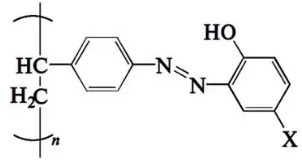
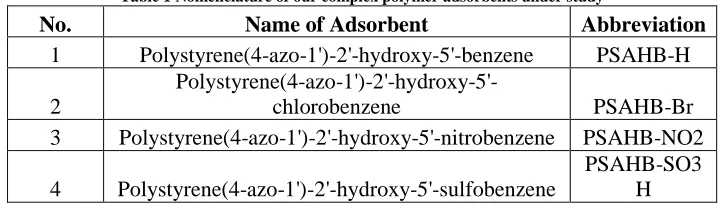
[image:2.612.229.380.524.604.2]We were applied polystyrene-azo-phenol derivatives to adsorb the trace amount of elements in the model aqueous solutions. The structure and the nomenclatures of these adsorbents presented in Table 1 and Figure 1. This class of adsorbents purchased from Central Chemical Laboratory of IGEM, Russian Academy of Sciences. The adsorbents synthesized according to procedures [9]. The absorbents were ground in an agate mortar and bolted through a sieve of 200 mesh (0.074 nm)[10].
Figure 1. The structure of the adsorbents (PSAHB-X) where X: H, Br NO2, or SO3H
47
[image:3.612.125.487.113.217.2]balance TOPLAB India, a781 pH/Ion meter with accuracy ±0.05 pH, China 78-1 magnetic stirrer with hotplate, UV VIS Spectrophotometer S-927 Systonic India were used in the present study.
Table 1 Nomenclature of our complex polymer adsorbents under study
No.
Name of Adsorbent
Abbreviation
1
Polystyrene(4-azo-1')-2'-hydroxy-5'-benzene
PSAHB-H
2
Polystyrene(4-azo-1')-2'-hydroxy-5'-chlorobenzene
PSAHB-Br
3
Polystyrene(4-azo-1')-2'-hydroxy-5'-nitrobenzene
PSAHB-NO2
4
Polystyrene(4-azo-1')-2'-hydroxy-5'-sulfobenzene
PSAHB-SO3
H
Calibration curve of standard nickel solutions was constructed with 15 standards in the range 1-15 µg/ml. The required amount of a third component for quantitative adsorption was studied by preparing a series of solutions with the constant concentration of nickel ions (i.e. 25 µg) and 25 mg of adsorbent in 25 mL of aqueous solution, and variable multiple amounts of a third component ranging from 0 to100 µg/ml. Optimal pH values of nickel (II) adsorption (pH opt) were determined experimentally from the plots of degree of adsorption (R %) versus the
solution's pH ranged from 1 to10. For this purpose, 20 stoppered bottles with 40 mL volume each one contained 25 mg of adsorbent under study, 25 µg of Ni(II) (C0) and 30 mg/mlof a third component was added. Then, the required
volume of aqueous buffer solution was added to adjust the pH in the range from 1 to 10, the total volume was brought to 25 mL and the mixture stirred by a magnetic stirrer for 2 hours at 25 ± 2°C. Then, the adsorbent was collected on a blue ribbon filter paper with pore size 0.45 µm. The absorbance (A) of Ni (II) in the filtrate determined by using a UV-vis spectrophotometer (LI-295 UV-VIS) with H2Dm reagent at λ=445, then the amount
of nickel in the filtrate Ce was calculated from a straight-line equation of calibration curve of standard nickel
solutions. The amount of adsorbed Ni (II) ions (qe) calculated using eqn. (1):
0 (1)
e e
q C C
The adsorption degree of nickel (R, %) at the created pH value was calculated using Equation (2):
0 0
, % C Ce 100 (2)
R
C
These data used to create the graphs of R(%)versus pH. From these graphs, the (pH opt) corresponded to the highest
R% and the values of pH50 at R=50% were determined graphically.
Effect of Contact Time and Solution Temperature
The effect of contact time and solution temperature on nickel adsorption (R %) were investigated. For this purpose, we prepared three sets of solutions each contains 25 µg of Ni(II), 25 mg of a adsorbent and 30 µg/ml of a third component. The pH was adjusted with the optimal acidity previously determined. The solutions of the first set were stirred at fixed 25°С over different time intervals (10-180 min). In the other two sets, the solutions were stirred at 40 and 60°С respectively with the previous conditions. The degree of adsorption (R %) were determined using
48
The adsorption capacity of nickel by the adsorbent (qm) was calculated as the number of moles of adsorbed Ni (II)
per gram of the adsorbent[11]. The adsorption capacities of the adsorbents were determined experimentally under optimal conditions as: a series of solutions were prepared with the same amount of the adsorbent (25 mg), a third component (30 mg/ml) and increasing concentrations of the Ni(II)ions from 1 to 30 µg/ml. The systems were stirred with a magnetic stirrer (with 300 rpm) at the optimal conditions predetermined. Then, the amount of the adsorbed element in each experiment was determined, and the dependence of the (R%) on the mass of the introduced element was constructed. The mass of the element - that is limiting in capacity for 25 mg of the specified adsorbent-determined by the inflection point of the curve. The equilibrium adsorption capacity (qm) (mg/g), was calculated by
Equation (3) [12]:
0
( )
(3)
e m
C C V
q
w
Where C0 and Ceare initial and equilibrium concentrations of Ni(II) in the solution mg/L, respectively; V is the
solution volume (L) and w is the adsorbent mass (g).
Selectivity Test
The effect of various foreign ions was carried out under the preselected optimal conditions using the above - described protocol. A series of solutions were prepared with a fixed concentration of the element to be determined, fixed adsorbent and ligand masses. Different multiple mass amount of foreign ions with respect to Ni(II) amount added individually to the above solutions as (1:0.1, 1:1, 1:10, 1:100, 1:500, 1:1000, 1:5000 and 1:10000). The procedures for the determination of Ni(II) followed. We carried out series of experiments to improving the selectivity of Ni(II) adsorption with masking agents for foreign macro elements that exceed the possible ratios.
Desorption and Recycle Test
Study of desorption for regeneration of the adsorbent is necessary to make the adsorption process more economical. Therefore, desorption of adsorbate from the adsorbent was carried out by washing it to a beaker with 10 mL of 1 to 4 M concentrations of HCl and HNO3 desorbing agents. Then, the system mixed using a magnetic stirrer for 1 hour.
Degree of desorption of ions (D, %) from the adsorbent was determined with eqn. (4).
, % d 100 (4)
i C D
C
where Ci, Cd are concentrations of adsorbed and desorbed Ni(II) ions respectively.
All measurements of adsorption as well as desorption experiments were repeated three times. The shown values are averaged.
RESULTS AND DISCUSSION
Calibration Graph and Analytical Characteristics
The Ni (II) adsorbs obeyed Beer's law over the range 1-15 µg/ml with a correlation coefficient of 0.999. The LOD [13] was calculated based on 3Sb/m; where Sb is the standard deviation of the blank signal and m is the slope of the
calibration curve after preconcentration, which was obtained to be 0.032 µg/ml. The straight-line equation was A=0.0996 C Ni(II)+ 0.018 and ε=5.57 × 10
4
49
The Third Component Dose
Figure 2 shows that the effectiveness of adsorption of Ni (II) ions ontp PSAHB-SO3H adsorbent increases rapidly
[image:5.612.115.501.200.439.2]with increasing amount of the p-nitroaniline (as third component) in adsorption system.The significant increasing in adsorption was observed when the amount of p-nitroaniline ligand was reached to 30 µg/ml. Any further addition of the p-nitroaniline did not cause any significant change in the adsorption. From the results, it was shown that each 25 µg of element with 25 mg of adsorbent requires 30 µg/ml of the third component for quantitative sorption (R,%=100%).
Table 2. Chemisorption of Ni(II)ions in mixed-ligand complex adsorbents with the p-nitroaniline ligand (T=298 K; μ=1)
No. Adsorbents pH opt R, % PH50 t, min log β
1 PSAHB-H 5.5-6.5 100 3.4 25 4.25 2 PSAHB-Br 05-Jun 100 3 20 7.46 3 PSAHB-NO2 4.5-6 100 2.7 20 6.4
4
PSAHB-SO3H 4-5.5 100 2.1 15 8
Figure 2. Effect of amount of p-nitroaniline as third component on R,% of 25 µg Ni(II) ions [mass adorb..=25 mg, sample vol.=25 ml, PH=6, t=100 min., T=298 K].
[image:5.612.208.405.547.672.2]Effect of pH
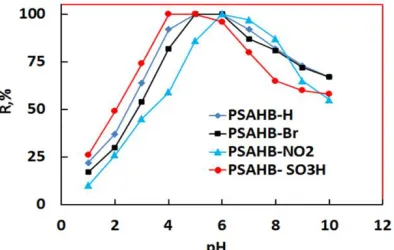
Figure 3 show the effect of the solution acidity on the adsorption of Ni(II) ions by adsorbents 1-4 in the presence of p-nitroaniline. The values of pH50 for nickel adsorption (Table 2) were determined graphically at R=50% and T=25
± 2°C.
Figure 3. Effect of pH on Ni(II) adsorption by 1,2,3 and 4 adsorbents [25 mg of adsorbent, 25 μg of Ni(II), 30 µg/ml p-nitroaniline; V sample=25 ml, T=298 K; with H2Dm method at λ max
50
Comparison of Efficiency of p-Bromoaniline And P-Nitroaniline Ligands
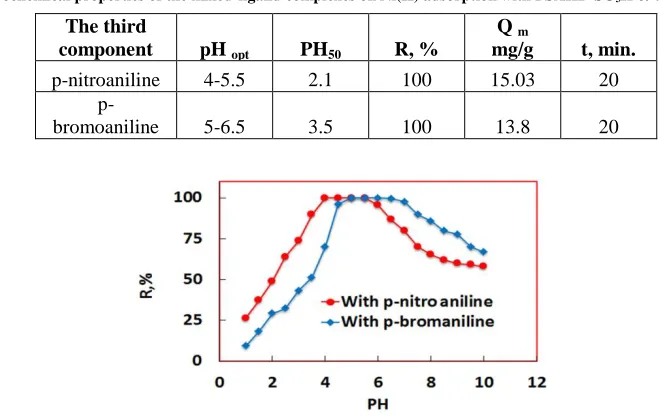
Based on the experimental data in Table 2, we concluded that the polystyrene-(4-azo-1')-2'-hydroxyl-5'-sulfobenzene adsorbent (PSAHB-SO3H) interacted with Ni(II) ions in a more acidic region at pH 2.1. Therefore, we
used this an adsorbent to compare the effect of introduce of third components: p-bromoaniline and p-nitroaniline. Thus, Figure 4 and Table 3 were showed the results of adsorption process of Ni (II) with p-bromoaniline; the value of pH50 was 3.5 and pH opt falls in the range of 5-6.5, whereas with p-nitroaniline, the values of pH50was 2.1 and pH
opt were 4-5.5. The experimental data suggest that the adsorption of nickel (II) in a more acidic region occurred upon
the addition of the third component p-nitroaniline to the system. This was due to a pHshift to a more acidic region because of the electronic substituent effect of a nitro group - ) NO2) on the dissociation constant of the amino group
(-NH2).
The substituent nitro group (-NO2) in p-substituted aniline, in comparison with the bromine atom (Br) in the p
-position, sharply shifts pH50 of adsorption to a more acidic region. The introduction of electron-withdrawing
substituents into the adsorbent structure leads to shifting in pH50of the adsorption of the nickel element to a more
[image:6.612.133.463.338.546.2]acidic region. As a result, the strength of the bond in the complex "adsorbent-Ni (II)-p-substituted aniline" increases and the coordination number of the nickel was realized.
Table 3. Physicochemical properties of the mixed-ligand complexes on Ni(II) adsorption with PSAHB-SO3H & the third component
The third
component pH opt PH50 R, %
Q m
mg/g t, min.
p-nitroaniline 4-5.5 2.1 100 15.03 20
p-bromoaniline 5-6.5 3.5 100 13.8 20
Figure 4. The effect of addition of a third component on the pH shift of Ni(II) adsorption with PSAHB-SO3H adsorbent
Effect of Time and Temperature
The effect of time and temperature on the adsorption degree of Ni (II) (R,%) in the ternary system with presence of the p-nitroaniline ligand shown in Figure 5. All of the tested adsorbents quantitatively adsorbed nickel (II) (R=100%) at 293 K. The best kinetic characteristics at T=288 K was with PSAHB-SO3H adsorbent, because
51
Figure 5. Effect of contact time on Ni (II) adsorption by the adsorbents with p-nitroaniline at 298& 333 K.
Adsorption Capacity of Adsorbents (qm)
The adsorption capacity of the adsorbents (qm) of each Ni(II) ions - a third component - an adsorbent system was
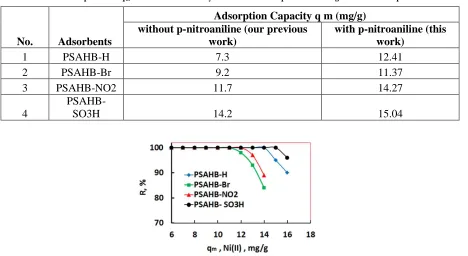
determined experimentally as the amount of adsorbed Ni(II) mg per gram of the adsorbent at optimal adsorption conditions. The (qm) values presented in Table 4 and Figure 6 show that sulfo-substituted adsorbent is more selective
and provides quantitative adsorption. The found adsorption capacity of this adsorbent for the Ni (II) ions was 15.04 mg of Ni (II) per gram of the adsorbent. The values of (qm) used in calculating the required mass of adsorbent,
[image:7.612.76.544.377.633.2]applied in the analysis of Ni (II) in artificial and natural objects. Table 4 shows comparison of adsorption capacity of chelating adsorbents with and without p-nitroaniline ligand. The data presented in Table 4 reveals that, generally, the chelating adsorbents with the added ligand have a good efficiency in metal ion adsorption more than the same adsorbents without this ligand.
Table 4 Comparison of q m adsorbents under study with & without the p-nitroaniline ligand as third component
No.
Adsorbents
Adsorption Capacity q m (mg/g)
without p-nitroaniline (our previous
work)
with p-nitroaniline (this
work)
1
PSAHB-H
7.3
12.41
2
PSAHB-Br
9.2
11.37
3
PSAHB-NO2
11.7
14.27
4
PSAHB-SO3H
14.2
15.04
Figure 6. Determination of the sorption capacity of Ni(II) ions of 1-4 adsorbents in presence p-nitroaniline ligand.
Selectivity Study
52
possible ratios of the foreign cations do not interfere with the determination. The high selectivity of this mixed-ligand complex has allowed us to develop rapid procedures for determining of Ni (II) in artificial and environmental solutions.
We studied the possibility of increasing the selectivity of Ni (II) adsorption with masking agents for foreign macro elements in amounts higher than permissible ones. Masking agents chosen with large amounts of Fe3+, Al3+ (5 mg), Cr3+, Са2+ and Mg2+ (6 mg). We found out that addition of 0.5 g of sulfosalicylic acid agent individually to Fe3+, Al3+ and 0.5 g of sodium dihydrogen phosphate agent to Cr3+, Са2+ and Mg2 solutions made it possible for quantitatively preconcentrate the trace amounts of Ni (II) ions in the presence of these foreign ions.
Table 5. Permissible ratios of interfering ions in determination of Ni(II)with mixed-ligand complexes
Cations Possible ratio
N+, К+ 5 × 10⁴
Са2+, Mg2+, Ва2+, Сu2+, Zn2+, Cr3+ 4 × 10³
Fe3+, Fe2+, Al3+, Pb2+, Mn2+, Sr2+, Cd2+ 2 × 10³
Desorption and Regeneration Studies
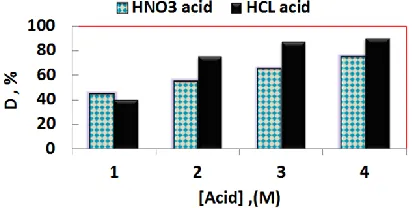
As shown in Figure 7 and Table 6, theHNO3 is a weak desorbing agent. This is evidence of a strong bond between
the Ni ions and adsorbent. Only when HCl was used; a significant increase in the degree of desorption was realized.
[image:8.612.202.408.434.538.2]It was found that the degree of desorption increased with increasing the HCl concentration. The desorption mechanism is based on the exchange of hydrogen ions H+ with the Ni (II) ions. On the other hand, the cyclic adsorption-desorption studeis were performed to estimate the ability of regeneration with results presented in Figure 8. The degree of adsorption was shown consistently at a level ˃90% for each cycle after desorption with 12 cycles. The results provedthehigh regeneration ability of the adsorbent.
Figure 7. Desorption test of Ni ion on PSAHB-SO3H adsorbent with p-nitroaniline.
Table 6. Desorption of nickel (II) ions from adsorbents & p-nitroaniline ligand
Acid [Acid]
R,(%) of Ni (ll)
PSAHB-H
PSAHB-Br
PSAHB-NO2
PSAHB-SO3H
HCI 2 M 81 80 78 81
3 M 94 91 90 95
4 M 100 100 100 100
HNO3 1 M 59 55 52 59
53
Figure 8. Adsorption-desorption cycles of adsorption of Ni on PSAHB-SO3H adsorbent with p-nitroaniline
Predicted Structure of the Formed Complex
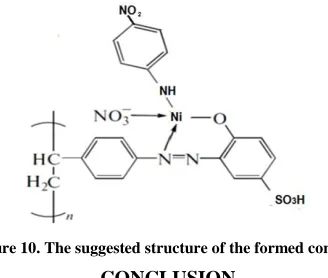
The number of liberated protons (n) during the adsorption of Ni (II) with presence of p-nitroaniline was determined
by the Astakhov method [14]. The number of liberated protons was calculated from the slope of the log
(100 )
R pH
R
curve (Figure 9); was found out one proton to be displaced for a Ni (II) ion in this system, where the slope of the curve=0.782; therefore, the liberated protons (n) equal to 1H+. The mechanism of nickel adsorption in this system defined in Equation 4.
2 +
2
2 2
2 ... (4)
NiR
HR Ni H NiHR
NiHR H
where HR refers to the chelating groups in the adsorbent and the added ligand and NiR2 refers to the complex
adsorbent formed.
Figure 9. Number of proton (n) substituted in Ni(II) adsorption of the ternary complex
[image:9.612.204.409.428.545.2]54
Figure 10. The suggested structure of the formed complex
CONCLUSION
We have found that a new and low-cost and eco-friendly polystyrene (4-azo-1')-2'-hydroxy-5'-sulfobenzene adsorbent in presence of p-nitroaniline ligand are most promising for preconcentration and separation of Ni (II) from artificial and natural solutions. Optimum pH of adsorption was located in the range of 4-5.5. The adsorption capacity of Ni ions on adsorbent was increased with the increasing of the value of pH, amount of nickel and temperature of the solution. They have a higher adsorption capacity (15.04 mg/g) and the best kinetic parameters; at 298 K, 100% recovery achieved in 15 min with high selectivity. The obtained results showed that the high regeneration efficiency demonstrated that this chelating adsorbent with p-nitroaniline ligand is a promising adsorbent for the removal and determination of Ni ions in real industrial, geological and industrial materials.
ACKNOWLEDGEMENT
This research financed within the Research Project Unit of the pharmaceutical science Research Center at University of Science and Technology, Sana'a, Yemen according to decision no. DEC-2013/09/N/ST8/00319.
REFERENCES
1) RC Bansal; M Goyal, CRC Press, New York. 2005, 346.
2) HD Doan; J Wu; R Mitzakov. J Chem Technol. Biotechnol. 2006, 81, 1398. 3) QI Tsizing; YA Zolotov. J Analytical chemistry. 2002, 57, 678.
4) NN Basargin; SV Chepelev; GY Rozovskii. J Ino Chem.2010, 55, 541.
5) M Fayazi; M Ghanei; MA Taher; R Ghanei; MR Salavati. J Hazar Mate. 2016, 309, 27. 6) Gyula; Z Kovács; A Dean; PCTA compl, Inorg Chem. 45(2006) 9269.
7) Thiazines and their Benzo Derivatives. Mole Scien & Chem Engin 8 (2008) 513. 8) C Xiong; C Yao. Chem Eng J.2009, 155, 844.
9) Shuangming; Buqin; Yueqin; Y Yong. J Anal Chem. 2011, 66, 31.
10) ER Oskotskaya; EN Gribanov; Markov; YV Khripunov. J Phys Chem. 2011, 85, 1804. 11) NV Lakiza; OI Tissen; LK Neudachina; MA Ezhikova. J Appl Chem Russ.2013, 86, 1383. 12) M Ajmal; RAK Rao; R Ahmad; J Ahmad. J Hazard Mat.2000, 79, 117.