Journal of Chemical and Pharmaceutical Research, 2014, 6(6):1515-1520
Research Article
CODEN(USA) : JCPRC5
ISSN : 0975-7384
Dynamic multi-objective location-routing problem in
post-earthquake logistics system
Shuanglin Li
1, ZuJun Ma
2and Bin Zheng
31School of Traffic and Logistics, Southwest Jiaotong University, Chengdu, China
2Institute for Logistics and Emergency Management, School of Economics and Management, Southwest Jiaotong
University, Chengdu, China
3Emei Campus, Southwest Jiaotong University, Emeishan, China
____________________________________________________________________________________________
ABSTRACT
This study has developed a dynamic multi-objective mathematics model for location-routing problem (DMLRP) to minimize the total time and cost. A multi-objective hybrid genetic algorithm has presented, and a test has designed to demonstrate reliability and effectively for the model and the algorithm. The test result showed that the proposed meta-heuristic can solve DMLRP effectively and also can avoid the limitation of traditional multi-objective optimization methods. Finally, the result of the numerical example has analyzed to help the decision maker making decision effectively and quickly.
Keywords: emergency logistics, location-routing problem, dynamic multi-objective.
____________________________________________________________________________________________
INTRODUCTION
Recently, earthquakes and natural disasters occurred frequently, and often coursing great destructive, especially in the larger population density where thousands of people suffered injury or even death. Though the government has established some emergency rescue plans, the key to cut the losses down is to transfer emergency commodities to affected areas as soon as possible.
EXPERIMENTAL SECTION
Problem Description and Model
In the event of earthquake, it is very crucial and realistic to address three integrate problems mentioned in the previous section. Therefore, a dynamic multi-objective location routing problem model (DMLRP) is formulated to describe the considered in this section. In order to facilitate formulating the model, some reasonable assumptions are made as follows: (1) Locations of facility and affected areas are known for beginning at each period; (2) The vehicles should have been return to belongs relief facility; (3) All vehicles have the same capacity and beyond the affected area forecasted demand; (4) For each period, one affected area can only serve by one candidate facility; (5) All emergency commodities are un-consumable resource.
DMLRP: ( ) = 1 1 ( ) ( ) ( ) ( )
Z min
( )
( )
( )
( )
M t i
ij ij ijk ij j i i
j i S t j S t k K i N t j M t
c d x
t
F
z t D t O
y t
=
∈ ∈ ∈ ∈ ∈
+
+
∑
∑ ∑ ∑
∑ ∑
(1)2
( ) ( )
min
ij ijk( )
i S t j S t k K
Z
t x
t
∈ ∈ ∈
=
∑ ∑ ∑
(2)( )
( ) 1
ijk k K i S t
x
t
∈ ∈
=
∑ ∑
,∀ ∈
j
M t
( )
(3)( )
( )
1
ij i N t
z t
∈
=
∑
,∀ ∈
j
M t
( )
(4)( )
( )
( )
0
ijk i k K j M t
x
t
y t
∈ ∈
−
≥
∑ ∑
,∀ ∈
i
N t
( )
(5)( )
( )
( )
0
ijk i j M t
x
t
y t
∈
−
≤
∑
,∀ ∈
i
N t
( )
,∀ ∈
k
K
(6)( ) ( )
( ) 1
ijk i N t j M t
x
t
∈ ∈
≤
∑ ∑
,∀ ∈
k
K
(7)( )
( )
( )
2
ijk i j
k K
x
t
y t
y t
∈
+
+
≤
∑
,i
∈
N t
( )
,j
∈
N t
( )
(8)( ) ( )
( )
( )
0
ijk jik j S t j S t
x
t
x
t
∈ ∈
−
=
∑
∑
,∀ ∈
i
S t
( )
,∀ ∈
k
K
(9)( ) ( )
( )
( )
j ijk i S t j M t
D t x
t
Q
∈ ∈
≤
∑ ∑
,∀ ∈
k
K
(10)( )
( )
( )
( )
j ij i i
j M t
D t z t
y t CAP
∈
≤
∑
,∀ ∈
i
N t
( )
(11)( )
( )
( )
( )
( )
1
ik jk ijk
U
t
−
U
t
+
M t x
t
≤
M t
−
,∀ ∈
i j
,
M t
( )
,∀ ∈
k
K
(12)( ) {0,1}
ijk
x
t
∈
,∀ ∈
i j
,
S t
( )
(13)( ) {0,1}
i
y t
∈
,z t
ij( )
∈
{ }
0,1
,∀ ∈
i
N t
( )
,∀ ∈
j
M t
( )
(14)Where
T
denotes period plan;N t
( )
denotes the set of candidate facility foe periodt
,N t
( )
denotes the number of candidate facility for periodt
;M t
( )
denotes the set of affected areas for periodt
,M t
( )
denotes the number of affected areas for periodt
;S t
( )
denotes the set of candidate facility and affected areas for periodt
,( )
( )
( )
S t
=
N t
∪
M t
;P t
j( )
denotes the number of changed for injured people at affected areaj
at periodt
;C
denotes the set of emergency commodities,c
as the index;P
mc denotes the volume of emergency commoditiesc
for each person, unit ism
3;D t
j( )
denotes the number of emergency commodities needed for affected areaj
atthe index;
Q
denotes the capacity of relief vehicle;U
jk( )
t
denotes the sorts for affected areaj
served by relief vehicle , ifU
jk( )
t
=
0
denotes affected areaj
didn’t served by relief vehicle;d
ij denotes the distance from nodei
t node
j
, wherei j
,
∈
S t
( )
,d
ij=
1.4
⋅
(
x
i−
x
j)
2+
(
y
i−
y
j)
2 ;v
denotes the average speed for reliefvehicle;
t
ij denotes the time needed from nodei
t nodej
, wherei j
,
∈
S t
( )
,t
ij=
d
ijv
;c
ij denotes the cost from nodei
t nodej
, wherei j
,
∈
S t
( )
;x
ijk( )
t
denotes if the relief vehiclek
passed from nodei
t nodej
, wherei j
,
∈
S t
( )
, thenx
ijk( )=1
t
;y t
i( )
denotes if facilityi
provide service, theny t
i( )=1
;z t
ij( )
denotes ifaffected area
j
accessed by facilityi
, thenz t
ij( )=1
.Where objective function (1) is to minimizing the total cost for each period and objective function (2) is to minimizing the total travel time for each period. Constraints set (3) denote one affected area can only accessed by one relief vehicle for each period. Constraints set (4) denote one affected area can only serve by one facility for each period. Constraints set (5) denote there are have more than one relief vehicle for opened facility. Constraints set (6) denote not opened facility have no relief vehicles. Constraints set (7) denote one relief vehicle only belongs to one facility. Constraints set (8) denote there are no paths between two facilities. Constraints set (9) denote the relief vehicle entered into affected area must be leaved. Constraints set (10) denote the capacity of relief vehicle is limited. Constraints set (11) denote the capacity of facility is limited. Constraints set (12) denote each relief vehicle routing only one facility and no loop. Constraints set (13)-(14) are binary variables constraint.
RESULTS AND DISCUSSION
Comparison of Models
With the rescue time lapse and rescue continued, the weight of travel time and cost would be changed. The main purpose of “golden” 72 hours is to rescue more people’s life and the weight of travel time would higher than the weight of travel cost. But, when time over 72 hours, the people lived property would become very low, and then the weight of travel cost would be higher than the weight of travel time [11]. In this paper, we employed a function to process dynamic multi-objective, which showed as follows and where
w t
1( )
+
w t
2( )
=
1
,w t
1( )
,w t
2( )
≥
0
.1
2
( )
0.08
0.84
( )
0.08
0.16
w t
t
w t
t
= −
+
=
+
(15)Multi-objective Hybrid Genetic Algorithm
In this paper, we improved simple genetic algorithm, employed hybrid coding method with the parameters cascade. We divided one chromosome into 3 substrings, where substring 1 adapted binary code, occupied
N t
( )
gen, and substring 2 adapted integer code, the value of gen range is(Tex translation failed)
, which length determined by the number of encode which gen value equals 1 in substring 1, and substring 3 adapted nature number code, occupiedM t
( )
. For clearly, we assumed that there are 7 facilities, meansN t
( )
=
7
, 10 affected areas, meansM t
( )
=
10
, at periodt
, and the index of 1, 4, 6 serve in this period, then a chromosome can encoding which shown in Fig. 1.Fig. 1 A representative chromosomes graphic
Initial Chromosome and Fitness Function
Generate chromosome by rand, and
chrom p
( )
denotes one population in populations,p
=
1, 2,...,
Popsize
, wherePopsize
denotes populations’ size.Step 1: calculated the population’s each objective, and marked by
f
pi, wherei
denotes thei
-th objective,p
denotes thep
-th population;Step 2: marked the maximum and minimum of objective
i
bymaxi
f
andmini
f
;Step 3: sorted objectives by ascend, we assumed
R p
i( )
denotes the order of objectivei
for populationp
; Step 4: calculated each population’s fitness by formulate (16), which showed as follows.( )
(
( ))
i i max p i
i i i
max min
f
f
f
p
Popsize
R p
f
f
−
=
−
[image:4.595.132.476.225.355.2]−
(16)Table 1. Candidate facility information
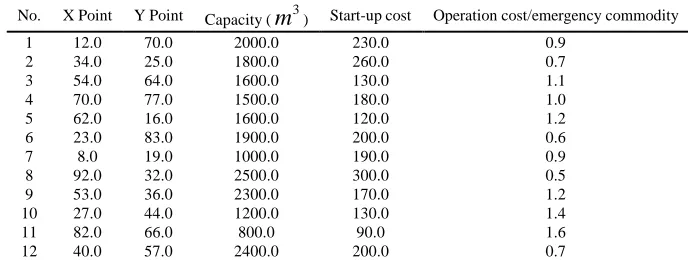
No. X Point Y Point Capacity (
m
3) Start-up cost Operation cost/emergency commodity1 12.0 70.0 2000.0 230.0 0.9
2 34.0 25.0 1800.0 260.0 0.7
3 54.0 64.0 1600.0 130.0 1.1
4 70.0 77.0 1500.0 180.0 1.0
5 62.0 16.0 1600.0 120.0 1.2
6 23.0 83.0 1900.0 200.0 0.6
7 8.0 19.0 1000.0 190.0 0.9
8 92.0 32.0 2500.0 300.0 0.5
9 53.0 36.0 2300.0 170.0 1.2
10 27.0 44.0 1200.0 130.0 1.4
11 82.0 66.0 800.0 90.0 1.6
12 40.0 57.0 2400.0 200.0 0.7
Table 2. Affected areas information
NO. Poin
t Injured People
Assistance
Ability(
µ
,δ
2) NO. Point Injured PeopleAssistance Ability(
µ
,δ
2)X Y X Y
1 31 8 340 (44,10) 31 87 72 420 (50,8)
2 37 48 280 (36,8) 32 3 23 510 (62,11)
3 3 98 450 (57,12) 33 82 61 630 (76,13)
4 18 5 600 (83,23) 34 10 81 740 (88,14)
5 98 87 400 (51,11) 35 49 39 830 (99,16)
6 66 22 520 (70,18) 36 32 41 980 (116,18)
7 57 99 380 (47,9) 37 60 90 880 (103,15)
8 49 99 430 (55,12) 38 80 1 760 (90,14)
9 7 71 420 (54,12) 39 14 67 320 (38,6)
10 66 44 600 (81,21) 40 98 99 410 (53,12)
11 90 54 1200 (163,43) 41 16 72 450 (58,13)
12 92 12 900 (123,33) 42 37 22 470 (58,9)
13 49 65 800 (116,36) 43 34 61 570 (71,14)
14 55 66 700 (98,28) 44 78 31 600 (75,15)
15 5 1 560 (78,22) 45 64 62 430 (55,12)
16 56 98 640 (88,24) 46 53 51 340 (42,8)
17 79 82 610 (87,26) 47 26 33 320 (41,9)
18 4 83 740 (103,29) 48 47 73 340 (44,10)
19 51 5 820 (113,31) 49 5 24 130 (15,2)
20 91 94 910 (124,33) 50 17 25 240 (27,3)
21 96 16 340 (42,8) 51 4 17 180 (22,4)
22 73 28 230 (29,6) 52 75 33 190 (24,5)
23 83 55 760 (103,27) 53 2 54 510 (68,17)
24 44 66 840 (113,29) 54 21 88 360 (45,9)
25 51 59 730 (99,26) 55 29 64 520 (69,17)
26 18 52 600 (75,15) 56 81 12 430 (55,12)
27 49 32 460 (58,12) 57 68 34 360 (45,9)
28 34 22 730 (99,26) 58 27 13 640 (82,18)
29 23 25 800 (110,30) 59 70 68 270 (36,9)
30 12 79 920 (123,31) 60 95 37 430 (55,12)
We adopted take lonely operation for crossover and mutation. In substring 1, single point crossover and mutation operation was adopted. We adopted uniform crossover and mutation in substring 2. In substring 3, we adopted two-pointed crossover operation and reserved transcription variations.
Numerical Example
In this section, we generated a numerical example by rand. We assumed that there are 12 candidate facilities (showed in Table 1), 60 affected areas (showed in Table 2). Where they are point are generated by range from 0 to
100 100m
×
2The proposed meta-heuristic has been programed in Matlab language, the configurations of the laptop for the experiment were as follows: 2.27GHz CPU and 4G RAM. The parameters of the genetic algorithm were as follows:
700
Maxgen
=
,Popsize
=
100
,p
c=
0.9
,p
m=
0.1
,v
=
40Km/h
,c
ij=
1.4
,T
=
10
,Q
=
1500m
3,3
2.61m
mc
[image:5.595.97.510.281.725.2]P
=
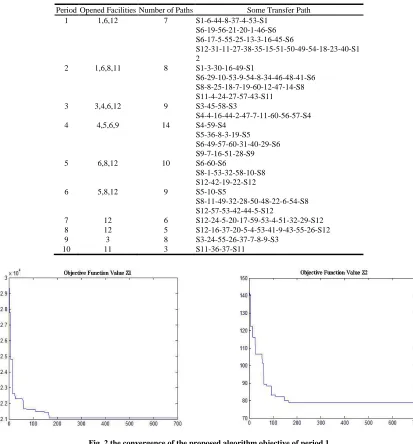
. The average computation time of ten optimization runs was 903.21s. And the convergence of the proposed algorithm objectives of period 1 and 9 are demonstrated by Fig. 2 and Fig. 3. And the statistics showed in Table 3.Table 3. Each period strategy
Period Opened Facilities Number of Paths Some Transfer Path 1 1,6,12 7 S1-6-44-8-37-4-53-S1
S6-19-56-21-20-1-46-S6 S6-17-5-55-25-13-3-16-45-S6
S12-31-11-27-38-35-15-51-50-49-54-18-23-40-S1 2
2 1,6,8,11 8 S1-3-30-16-49-S1
S6-29-10-53-9-54-8-34-46-48-41-S6 S8-8-25-18-7-19-60-12-47-14-S8 S11-4-24-27-57-43-S11 3 3,4,6,12 9 S3-45-58-S3
S4-4-16-44-2-47-7-11-60-56-57-S4
4 4,5,6,9 14 S4-59-S4
S5-36-8-3-19-S5 S6-49-57-60-31-40-29-S6 S9-7-16-51-28-S9
5 6,8,12 10 S6-60-S6
S8-1-53-32-58-10-S8 S12-42-19-22-S12
6 5,8,12 9 S5-10-S5
S8-11-49-32-28-50-48-22-6-54-S8 S12-57-53-42-44-5-S12
7 12 6 S12-24-5-20-17-59-53-4-51-32-29-S12 8 12 5 S12-16-37-20-5-4-53-41-9-43-55-26-S12
9 3 8 S3-24-55-26-37-7-8-9-S3
10 11 3 S11-36-37-S11
[image:5.595.95.518.293.714.2]Fig. 3 the convergence of the proposed algorithm objective of period 9
CONCLUSION
The contributions of this paper include: (1) Developed a multi-objective (to minimize the total travel time and to minimize the total travel cost for each period) facility Location-routing problem. (2) Employed Delphi method to transform the weight of multi-objective to single objective and changed by dynamic. (3) A meta-heuristic that incorporates hybrid multi-objective genetic algorithm is proposed to solve the proposed programming model, finally, the proposed optimization model and meta-heuristic are demonstrated via a numerical example. The results indicate that the proposed meta-heuristic is computationally affordable to solve the model.
REFERENCES
[1]F. Fiedrich, Gehbauer F., Rickers U. Safety Science, 2000, 35(1-3):41-57.
[2]Jotshi A, Gong Q, Batta R. Socio-Economic Planning Sciences, 2009, 43(1):1-24. [3]C. Toregas, Swain R., ReVelle C. et al. Operations research, 1971, 19(6):1363-1373. [4]B. Liu. Theory and Practice of Uncertain Programming, 2009:157-165.
[5]Li S.L., Ma Z.J., Zheng B., Dai Y. Chinese Journal of Management Scinece, 2013, 21(2):144-151. (in chinese) [6]Afshar A M, Haghani A. Socio-Economic Planning Sciences, 2012. Doi: http://10.1016/j.seps.2011.12.003 [7]Zheng B., Ma Z. J, Fang T. System engineering, 2009, 27, 188(8):21-25. (in chinese)
[8]Dai Y. Ma Z. J, Zheng, B. Management review, 2010, 22(1):121-128. (in chinese) [9]W. Yi, Özdamar L. European Journal of Operational Research, 2007, 179(3):1177-1193. [10]Ma, Y. H., Xie, L. L. Earthquake engineering and engineering vibration, 2000, (4):140-147.