P r e d i c tiv e m o d e lli n g of h u m a n
w a l ki n g ov e r a c o m pl e t e g a i t
c y cl e
R e n , L, Jo n e s , RK a n d H o w a r d , D
h t t p :// dx. d oi.o r g / 1 0 . 1 0 1 6 /j.j bio m e c h . 2 0 0 6 . 0 7 . 0 1 7
T i t l e P r e d i c tiv e m o d e lli n g of h u m a n w al ki n g ov e r a c o m p l e t e g ai t cy cl e
A u t h o r s R e n , L, Jo n e s , RK a n d H o w a r d , D
Typ e Ar ticl e
U RL T hi s v e r si o n is a v ail a bl e a t :
h t t p :// u sir. s alfo r d . a c . u k /i d/ e p ri n t/ 2 1 0 / P u b l i s h e d D a t e 2 0 0 7
U S IR is a d i gi t al c oll e c ti o n of t h e r e s e a r c h o u t p u t of t h e U n iv e r si ty of S alfo r d . W h e r e c o p y ri g h t p e r m i t s , f ull t e x t m a t e r i al h el d i n t h e r e p o si t o r y is m a d e f r e ely a v ail a bl e o nli n e a n d c a n b e r e a d , d o w nl o a d e d a n d c o pi e d fo r n o
n-c o m m e r n-ci al p r iv a t e s t u d y o r r e s e a r n-c h p u r p o s e s . Pl e a s e n-c h e n-c k t h e m a n u s n-c ri p t fo r a n y f u r t h e r c o p y ri g h t r e s t r i c ti o n s .
Predictive Modelling of Human Walking Over a Complete Gait Cycle
Lei Ren1,2, Richard K Jones1,3 and David Howard1,2
1
Centre for Rehabilitation and Human Performance Research
2
School of Computing, Science and Engineering & 3School of Healthcare Professions
University of Salford
Corresponding Author:
Prof. David Howard
School of Computing, Science and Engineering University of Salford
Salford M5 4WT
United Kingdom Tel. 0161 295 3584 Fax. 0161 295 5575
Email [email protected]
Keywords: gait prediction, inverse dynamics, optimisation, optimal motor task
Word count (introduction through discussion): 3000
Submitted as an Original Article
Abstract
An inverse dynamics multi-segment model of the body was combined with
optimisation techniques to simulate normal walking in the sagittal plane on level
ground. Walking is formulated as an optimal motor task subject to multiple
constraints with minimisation of mechanical energy expenditure over a complete gait
cycle being the performance criterion. All segmental motions and ground reactions
were predicted from only three simple gait descriptors (inputs): walking velocity,
cycle period and double stance duration. Quantitative comparisons of the model
predictions with gait measurements show that the model reproduced the significant
characteristics of normal gait in the sagittal plane. The simulation results suggest that
minimising energy expenditure is a primary control objective in normal walking.
However, there is also some evidence for the existence of multiple concurrent
performance objectives.
Nomenclature
an
x , y an coordinates of ankle joint centre in global reference frame
an
x&
& , &y&an linear accelerations of ankle joint centre in global reference frame
an
x
∆ relative displacement of ankle joint along x-axis in stance phase
) ( hs an
x x coordinate of ankle joint at heel strike
ft
i
x , yi coordinates of the i
th
joint centre in global reference frame
i
x& & ,
i
y&
& linear accelerations of the ith joint centre in global reference frame
j
l length of jth body segment
j
θ , ωj, αj angular displacement, velocity and acceleration ofbody segment
i
m mass of ith segment
i
av translational acceleration vector for the ith segment’s mass centre
ji F
v
jth resultant joint force acting on the ith segment
ei
F
v
resultant external force acting on the ith segment
gv
gravitational vector
i
I moment of inertia of the ith segment
i
θ
,α
i angular displacement and acceleration of body segmentji
M net muscle moment acting on the ith segment at the jth joint
ei
M resultant external moment acting on the ith segment
ki
M moment of the resultant joint force at the kth joint acting on the ith
segment
gi F
v
, Mgi ground reaction force and moment acting on left or right foot
i
T net muscle torque acting at ith joint
) ( 0 i
a , ak(i), ) (i k
b coefficients in Fourier series representing ith segment angle trajectory
ω
walking frequencyc
T walking cycle period
) (i p
ω
,ω
d(i) angular velocity of proximal and distal segment at ith jointm
a
V average walking velocity over a walking cycle
L ankle joint displacement over a walking cycle
x
µ
friction coefficient between the foot and the ground surfaceIntroduction
Although the biomechanics of walking is well understood (McMahon, 1984; Zajac et
al., 2003a, 2003b), little is known about the neural control strategies involved. Much
of the research has been empirical, and few have focused on gait simulation (Chow
and Jacobson, 1971, Davy and Audu, 1987; Marshall et al., 1989; Yamaguchi, 1990;
Koopman, 1995; Anderson and Pandy, 2001). In predictive gait simulation,
optimisation techniques have often been employed, where muscle forces and
movements are determined by minimising a cost function.
The most popular approach to gait prediction has been to combine optimisation with
forward dynamics, probably because this coincides with the natural sequence of
neuromuscular control (Zajac and Winters, 1990; Yamaguchi, 1990, Pandy, 2001).
However, since the system differential equations must be numerically integrated, the
forward dynamics method leads to very long simulation times. In addition, realistic
initial guesses for all control inputs (e.g. muscle activations) and initial values for all
state variables (e.g. joint angular positions and velocities) are required to ensure that
reasonable gait patterns can be obtained (Pandy, 2001). This depends on the
availability of measurement data (Marshall et al., 1989; Anderson and Pandy, 2001)
In contrast, the inverse dynamics method is very efficient computationally as it does
not require numerical integration of the system differential equations. In addition,
initial values for optimisation parameters can be set without the need for measurement
data and initial values for the state variables are unnecessary. When inverse dynamics
is applied in gait prediction, simple mathematical functions are used to represent the
trajectories of the generalized coordinates (Yen and Nagurka, 1987; Koopman, 1995),
where the function coefficients are the optimisation variables.
Only a few gait predication studies have employed inverse dynamics and optimisation
(Yen and Nagurka, 1987; Channon, 1992; Koopman, 1995; Chevallereau and
Aoustin, 2001). Most of these have considered only the single support phase or
assume an instantaneous double support phase (zero duration). In addition, the foot
segment was often neglected or assumed to be flat on the floor during stance.
Moreover, additional trajectory constraints were often imposed on the segmental
motions to simplify the optimisation problem. For example, Yen and Nagurka (1987)
modelled the human skeletal system as a five-segment linkage. However, the
trajectories of the body segments were only predicted for the single stance phase, the
trunk was assumed to be upright throughout the cycle, and the model was forced to
move at a constant forward speed. Koopman (1995) employed an eight-segment
three-dimensional model to simulate normal walking over the whole gait cycle.
However, all of the motions at the hip, knee and ankle were constrained to follow
measured data or set to zero, the aim being to predict the unmeasured trunk and pelvic
In this paper, we present a combined inverse dynamics and optimisation method to
predict normal human walking. In contrast to previous studies, the model predicts a
complete gait cycle, including a normal double support phase. The foot segment is
allowed to rotate freely during stance, rather than remaining flat on the floor. In
addition, no predefined or measured trajectory constraints are imposed on segmental
motions. The gait motions and joint torques are predicted from only three simple gait
descriptors, average walking speed, cycle period and double stance duration, which
minimizes the requirements for experimental data.
Methods
The multi-segment model
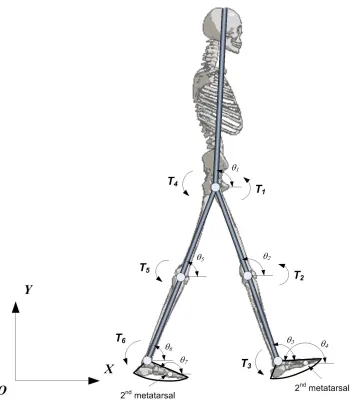
The human body was modelled as a planar (sagittal plane) seven-segment system
(Figure 1). The interaction between the foot and the floor was modelled as a rigid
contact, where the contact point is determined by the shape of the foot’s plantar
surface and the foot orientation.
Referring to Figure 1, the segmental angles
θ
1,θ
2, …,θ
7 were used to describe theorientation of each body segment with respect to the global reference frame. In the
double support phase, these segmental angles are not all independent because the
model becomes a closed loop mechanism. The torques T1, T2, …, T6 are the net
Anthropometric data, including segment masses, centre of mass positions and
moments of inertia, are based on the data of de Leva (1996), which were modified for
the HAT segment.
Kinematics
In this study, the stance foot was modelled as a rigid body with a curved surface
rolling on the ground without slipping (Figure 2), such that the foot kinematics during
the stance phase are described by
= = ∆
) (
) (
ft an
ft an
g y
f x
θ
θ
(1)
where ∆xan =xan −xan( hs), where x is the current x coordinate of the ankle joint, and an
) ( hs an
x is the x coordinate of the ankle joint at heel strike.
Equations (1) were determined using kinematic data captured in the gait laboratory
using a six camera Qualisys motion analysis system, where the ankle joint was
considered to be the mid-point between lateral and medial malleolus (Ren et al, 2005).
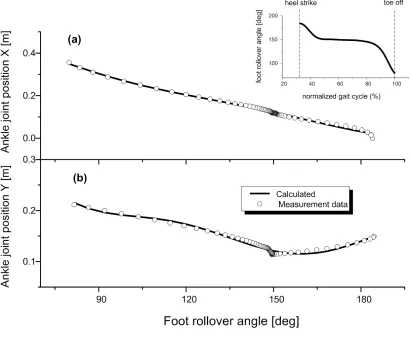
Figure 3 shows the output of the foot model when the roll over shape is described by a
best fit third order Fourier series. The relative timings of heel-strike and toe-off were
also based on measurement data.
⋅ + ⋅ = ⋅ + ⋅ = ft ft ft ft an ft ft ft ft an d dg d g d y d df d f d x
α
θ
ω
θ
α
θ
ω
θ
2 2 2 2 2 2 & & & & (2)During walking there is at least one foot in contact with the ground throughout the
gait cycle. Thus, the positions of the other joint centres in the multi-segment model
were derived from the location of the stance ankle joint.
⋅ ⋅ + = ⋅ ⋅ + =
∑
∑
= = m j j j an i m j j j an i l j I y y l j I x x 1 1 ) sin ) ( ( ) cos ) ( (θ
θ
(3)where m is the number of segments in the chain connecting the stance ankle joint to
the ith joint and I( j) is a sign function, which is equal to 1 when the segment
belongs to the stance limb, or equal to -1 if the segment is in the contralateral limb.
Differentiating Equation (3) twice, the accelerations of the joint centres are,
⋅ − ⋅ ⋅ ⋅ − = ⋅ + ⋅ ⋅ ⋅ − =
∑
∑
= = m j j j j j j an i m j j j j j j an i l j I y y l j I x x 1 2 1 2 )) cos sin ( ) ( ( )) cos sin ( ) ( (θ
α
θ
ω
θ
ω
θ
α
& & & & & & & & (4)Thus, given the segment angles, Equations (1) to (4) were used to calculate the
accelerations of each body segment mass centre were derived using anthropometric
data.
Kinetics
The inverse dynamics method was employed to calculate joint kinetics and
mechanical energy expenditure during walking. Since, in predictive modelling, the
ground reactions are initially unknown, the inverse dynamics method must be based
only on segmental motions. This differs from the conventional implementation of
inverse dynamics used in gait laboratory studies (Winter, 1990; Siegler and Liu, 1997),
where the calculations start from the measured ground reactions.
The equations of motion of the ith body segment can be written as follows,
+ + = ⋅ ⋅ + + = ⋅
∑
∑
∑
= = = i i i n k ki ei n j ji i i i ei n j ji i i M M M I g m F F a m 1 1 1α
v v v v(5a & b)
where the segment has n joints connecting it to other segments. i
By combining the equations of motion of all body segments, the sums of the external
forces and moments can be derived. Since, during walking, the only external forces
and moments acting on the human body, other than gravity, are the ground reactions,
these expressions can be written as,
− ⋅ = − ⋅ =
∑∑
∑
∑
∑
∑
= = = = n i n k ki n i i i gi n i i i gi i M I M g a m F 1 1 1 1 ) (α
v v vwhere n is the number of body segments in the model.
Therefore, during the swing phase, the ground reaction force acting on the single
supporting foot can be obtained directly from Equation (6a). However, in double
support phase, the ground reaction forces and moment (COP) are indeterminate. In
order to solve this problem, the linear transfer assumptions shown in Figure 4, and
introduced in Ren et al, 2005, have been used to model the transfer of the ground
reactions from one foot to the other during the double support phase. As Figure 4
shows, these linear transfer assumptions are in good agreement with published ground
reaction measurements (Winter, 1990).
During gait simulation, firstly, the ground reaction forces on each foot are calculated
from Equation (6a) and the linear transfer relationships. Starting from the supporting
feet and working up, segment by segment, the resultant force at each joint is
calculated using Equation (5a). Then, the ground reaction moments on each foot are
obtained from Equation (6b) and the linear transfer relationship for the centres of
pressure. Starting from the feet and working up segment by segment again, the net
muscle moments at each joint are calculated using Equation (5b). A detailed
description of this inverse dynamics calculation process has been given elsewhere
(Ren et al, 2005).
Optimisation and the constraints associated with gait
It has been observed in experimental studies that people’s self-selected walking speed
Cavagna and Kaneko, 1977). Therefore, in this study, the optimisation problem was
described as: find segment trajectories that achieve the specified gait parameters,
whilst minimizing energy cost, and satisfying the constraints associated with a
walking gait.
The segment trajectories were represented by a set of Fourier series,
∑
=
⋅ ⋅ + ⋅ ⋅ +
= n
k
i k i
k i
i a a k t b k t
1
) ( )
( )
(
0 ( cos( ω ) sin( ω ))
θ (7)
where n is the order of the Fourier series and
ω
=2π Tc is the walking frequency,where T is the period of the gait cycle. One of the advantages of using a set of c
Fourier series is that they provide a representation of the gait motions that is implicitly
cyclic, avoiding the need to introduce explicit constraints.
Power spectrum analysis of reflective marker data, during normal walking, has shown
that most of the signal power (99.7%) is contained in frequencies below 6Hz (Winter,
1990). Therefore, a set of 5th order Fourier series were employed to represent the
segmental rotations, resulting in a total of 11 Fourier coefficients for each segment,
which were used as the optimisation parameters.
In normal walking, bilateral symmetry can be assumed, that is, movements of the left
limb mirror movements of the right limb with a half cycle phase difference. Thus, the
number of DOF representing the 7-segment model is reduced to 4, resulting in 44
noted that doing this does not impose any symmetry constraint on trunk motion. In
fact, the optimiser can choose whichever pattern of trunk motion is most energy
efficient.
As suggested by experimental observations of walking energetics (Ralston, 1976;
Cavagna and Kaneke, 1977; Inman et al, 1994), a minimal energy criterion was
employed as the objective function. In particular, the total joint work over the gait
cycle was minimised.
Task constraints, biomechanical constraints and environmental constraints were
implemented in the optimisation scheme. The task constraints (input gait descriptors)
were average walking velocity V , cycle period a T , and double stance duration. The c
biomechanical constraints prevent joint hyperextensions or other unrealistic
movements. The environmental constraints represent the rules of ground interaction
during walking.
All of the above leads to the following mathematical definition of the optimisation
problem. Minimise mechanical energy expenditure over a complete gait cycle, which
is defined as follows,
∫ ∑
=− ⋅ = Tc n
i
i d i p i
m T dt
E Minimise
0 1
) ( ) (
)
(ω ω
where T is the net muscle moment at the ii th joint,
ω
(ip) and ωd(i) are the angularvelocities of the proximal and distal segments respectively. The optimisation
5th order Fourier series representing the rotations of trunk, thigh, shank and foot.
Furthermore, the optimisation is subject to the following constraints:
(1) Segment motion constraints:
] , 0 [ , ) (
0≤θi t ≤π t∈ Tc (i=1,2,3,4)
(2) Joint motion constraints:
] , 0 [ , ) ( ) ( , ) ( )
( 3 max(1) min(2) 4 3 max(2)
2 ) 1 (
min ≤θ t −θ t ≤θ θ ≤θ t −θ t ≤θ t∈ Tc
θ
(3) Kinematic constraints:
0 ) (t >
ytip for a swing foot and ytip(t)=0 for a stance foot, where y is the vertical tip
position of the foot’s lowest point.
(4) Kinetic constraints:
0 ) (t >
Fy and x
y x x t F t F
µ
µ
< <−
) (
) (
for a stance foot, where µx is the friction coefficient
between the foot and the ground surface
(5) Stride length constraint:
c a an
c
an T x V T
x ( )− (0)= ⋅
For the purposes of calculating the energy cost from the inverse dynamics calculations,
200 discrete calculation points were used over the gait cycle. The constraints defined
above, and the representation of the segmental rotations by a set of finite Fourier
series, ensure that solutions for this optimisation problem are valid cyclic walking
gaits. However, this does not guarantee that they will be realistic.
The optimisation scheme was implemented in MATLAB using a Sequential Quadratic
Programming (SQP) algorithm (Gill et al., 1981) from the optimisation toolbox. The
c
T = 1.0 s and double stance duration = 0.18 s) were obtained from the gait
measurement data of one male subject (age: 38years, weight: 101.7kg, height: 178cm).
A detailed description of the experimental procedures has been given elsewhere (Ren
et al, 2005). The initial values of the optimisation parameters (Fourier coefficients)
were set such that the model stands upright and stationary. In other words, except for
the constant offset terms (a ), all of the Fourier coefficients were set to zero. In 0(i)
order to avoid finding a single local minimum, different initial values were randomly
selected. These all represented stationary postures close to the upright position, as
these were found to have a very good chance of converging to a solution. Due to the
highly non-linear nature of the gait model, there appeared to be many local minima.
Results
Although many optimisation solutions were found, based on the major features of the
gait patterns, they appeared to fall into 4 distinct families of solutions, with only small
differences between members of the same family. We believe that these four families
represent just four local minima and that the small differences are related to the
precision of the optimisation process and the sensitivity of the objective function close
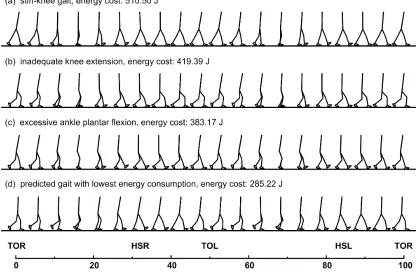
to the true minima. The four gait patterns (families) are illustrated in Figure 5. Each
family of gait patterns is represented by the member with the lowest energy cost. The
gait patterns in Figures 5(a), 5(b) and 5(c) differ from normal walking in certain
respects, which results in higher mechanical energy expenditure. The solution with
the lowest energy consumption (Figure 5(d)) also yields the most realistic gait pattern.
which provides further evidence that minimisation of energy consumption is a feature
of normal walking.
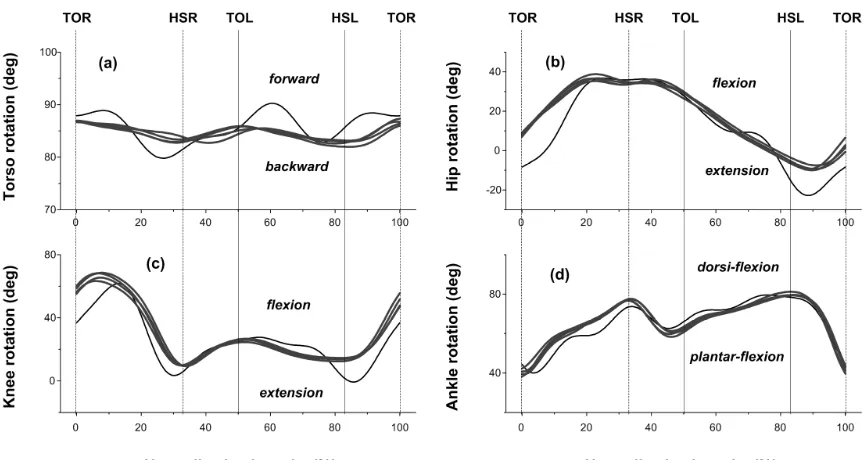
The predicted torso and lower limb joint rotations for the minimum energy solution
are depicted in Figure 6 and compared with gait measurement data. Over most of the
gait cycle, the majority of the predicted motions are in good agreement with the
measurement data. The largest differences occur in the trunk segment. Although the
overall trend agrees with the gait measurements and the reported data in the literature
(Inman et al., 1994), the amplitude of fluctuation is noticeably larger. This difference
could be due to the arms and pelvis not being considered, which probably moderate
the trunk’s angular fluctuations during normal walking. Another notable discrepancy
is thigh rotation, which is much lower than the measured data shortly after opposite
heel strike, thereby resulting in an increased range of thigh rotation. This is probably
because the model does not include pelvic transverse rotation, which increases stride
length, and the model compensates by increasing the thigh’s angular displacement to
achieve the specified stride length.
In Figure 7, the predicted ground reaction forces are compared with force plate data.
Although agreement is reasonable where trends are concerned, there are unexpected
fluctuations in the predicted forces. This probably arises from model simplifications,
for example, because rotations of the pelvis are neglected.
In this study, all segmental motions and ground reactions were predicted from only
three simple gait descriptors: average forward velocity, gait cycle period and double
stance duration, which minimizes the requirements for measurement data. No
prescribed motion patterns or measured trajectories were imposed on the model. This
is in contrast to previous work using a forward dynamics approach to gait prediction,
where the initial and final kinematic states where taken to be as measured and
imposed as optimisation constraints (Anderson and Pandy, 2001).
The predicted motions agree well with the measurement data over most of the gait
cycle. The agreement with measured ground reaction forces is reasonable, but there
are unexpected fluctuations. Moreover, among the local minima found, the solutions
with the lowest energy consumption produced the most realistic gait patterns. This
implies that minimizing energy cost is a primary motor control objective in normal
walking. This seems a reasonable inference for the lower limbs, since it has been
found that the cyclic movement of the legs accounts for the majority of the energy
cost of walking (Pierrynowski et al, 1980). This is supported by the fact that the
predicted motions of the lower limbs showed better agreement with the measured data
than those of the trunk segment.
The large predicted trunk motions are partly explained by the fact that the arms and
pelvis are not modelled. However, it has been shown in experimental studies that
head motion is smoother than that of the pelvis and the shoulder (Cappozzo et al.,
1978; Cappozzo, 1981), which may be due to the requirement to protect the visual and
vestibular systems from excessive mechanical disturbance. If so, minimisation of head
motions. This suggests that multiple performance objectives are employed in human
walking (Marshall et al, 1989).
The differences between the model predictions and experimental data are probably a
result of the limitations of the seven-segment model. Many of the discrepancies may
be due to the model being limited to the sagittal plane and the fact that the pelvis and
arms have been omitted. Pelvic transverse rotation increases stride length and
decreases the angular thigh excursion. Moreover, pelvic tilt can help to decrease and
smooth the trajectory of the body mass centre (Inman et al, 1994).
The use of inverse dynamics, instead of forward dynamics, has several advantages
including its computational efficiency, which is very important for predictive models
that are based on optimisation techniques. Since no numerical integration of the
differential equations is involved, the execution time for each optimisation iteration is
greatly reduced. For example, the prediction model proposed in this paper required
only 20 minutes of CPU time to converge to a minimal energy solution (Intel Pentium
4, 3.2 GHz). Another advantage of inverse dynamics is simpler implementation of the
kinematic and kinetic constraints associated with walking.
The authors plan to extend this work by creating a full three dimensional gait
prediction model. In addition, some of the variables that are currently fixed (gait cycle
duration, stride length etc) could be free to vary during optimisation, allowing further
Acknowledgements
Funding for this work has been provided by the UK Ministry of Defence. The
References
Anderson, F.C. and Pandy, M.G. (2001). Dynamic optimisation of human walking.
ASME Journal of Biomechanical Engineering 123, 381–390.
Cappozzo, A. (1981). Analysis of the linear displacement of the head and trunk during
walking at different speed. Journal of Biomechanics 14, 411–426.
Cappozzo, A., Figura, A., Leo, T. and Marchetti, M. (1978). Movements and
mechanical energy changes in the upper part of the human body during walking. In:
Asmussen, E. and Jorgensen, K. (eds.), Biomechanics VI-A. Baltimore, MD:
University Park Press.
Cavagna, G.A. and Kaneko, M. (1977). Mechanical work and efficiency in level
walking and running. Journal of Physiology 268, 467–481.
Channon, P.H., Hopkins, S.H. and Pham, D.T. (1992). Derivation of optimal walking
motions for a bipedal walking robot. Robotica 10, 165–172.
Chevallereau, C. and Aoustin, Y. (2001). Optimal reference trajectories for walking
and running of a biped robot. Robotica 19, 557–569.
Chow, C.K. and Jacobson, D.H. (1971). An optimal programming study of human gait. Mathematical Biosciences 10, 239–306.
Davy, D.T. and Audu, M.L. (1987). A dynamic optimisation technique for predicting
muscle forces in the swing phase of gait. Journal of Biomechanics 20, 187–201.
de Leva, P. (1996) Adjustments to Zatsiorsky-Seluyanov’s segment inertia parameters.
Journal of Biomechanics 29, 1223–1230.
Gill, P.E., Murray, W. and Wright M.H. (1981). Practical Optimization, Academic
Press, London.
Inman, V.T., Ralston, H.J. and Todd, F. (1994). Human locomotion. In: Rose, J. and
Koopman, B., Grootenboer, H.J. and de Jongh, H.J. (1995). An inverse dynamics
model for the analysis, reconstruction and prediction of bipedal walking. Journal of
Biomechanics 28, 1369–1376.
Marshall, R.N., Wood, G.A. and Jennings, L.S. (1989). Performance objectives in
human movement: A review and application to the stance phase of normal walking.
Human Movement Science 8, 571–594.
McMahon, T.A. (1984). Muscles, Reflexes, and Locomotion. Princeton University
Press, Princeton, NJ.
Pandy, M. G. (2001). Computer modeling and simulation of human movement.
Annual Review of Biomedical Engineering 3, 245–273.
Pierrynowski, M.R., Winter D.A. and Norman R.W. (1980). Transfer of mechanical
energy within the total body and mechanical efficiency during treadmill walking.
Ergonomics 23, 147–156.
Ralston, H.J. (1976). Energetics of human walking. In: R.M. Herman et al., (Eds.).
Neural Control of Locomotion. Plenum Press, New York.
Ren L., Jones R. and Howard D. (2005). Dynamic analysis of load carriage
biomechanics during human level walking. Journal of Biomechanics 38(4), 853–863.
Siegler, S. and Liu, W. (1997). Inverse dynamics in human locomotion. In: Allard P.
et al. (Eds.), Three-dimensional Analysis of Human Locomotion. John Wiley and
Sons Ltd, Wiley, New York.
Winter, D. A. (1990). The Biomechanics and Motor Control of Human Movement
(2nd Edition). John Wiley and Sons Ltd, Wiley, New York.
Yamaguchi, G.T. (1990). Performing whole-body simulations of gait with 3-D,
Muscle Systems. Biomechanics and Movement Organization. Spring-Verlag, New
York.
Yen, V. and Nagurka, M.L. (1987). Suboptimal trajectory planning of a five-link
human locomotion model. In ASME Winter Annual Meeting, Biomechanics of
Normal and Prosthetic Gait, Boston, MA, USA.
Zajac, F.E. and Winters, J.M. (1990). Modeling musculoskeletal movement systems:
joint and body-segment dynamics, musculoskeletal actuation, and neuromuscular
control. In: Winters, J.M. and Woo, S.L-Y. (Eds.), Multiple Muscle Systems.
Biomechanics and Movement Organization. Spring-Verlag, New York.
Zajac, F.E., Neptune R.R. and Kautz, S.A. (2003a). Biomechanics and muscle
coordination of human walking. Part I: Introduction to concepts, power transfer,
dynamics and simulations. Gait and Posture 16, 215–232.
Zajac, F.E., Neptune R.R. and Kautz, S.A. (2003b). Biomechanics and muscle
coordination of human walking. Part II: Lessons from dynamical simulations and
Figures and Captions
Figure 1 The seven-segment model including 6 joints and the following segments:
the right and left thighs, shanks, and feet together with a HAT segment (head, arms
and trunk). Segmental angles
θ
1,θ
2, …, θ7 are defined with respect to the X-axis ofthe global reference frame, counter-clockwise being positive. T1, T2, …, T are the 6
Figure 2 The ankle-foot kinematic relationships during foot rollover in the stance
phase. The foot angular displacement is defined by the line connecting the ankle joint
centre and the 2nd metatarsal, and the x-axis. The displacement of the ankle joint along
Figure 3 Mathematical representation of ankle-foot kinematics during stance phase,
(a) x coordinate of ankle joint and (b) y coordinate of ankle joint, using 3rd order
Fourier series (black lines) compared with measurement data (circles). The subject
(age: 38years, weight: 101.7kg, height: 178cm) walked at 1.52 m/s, and the cycle
period was 0.98 s. Inset is the time trajectory of stance foot rotation angle in the
0.0 0.5 1.0
linear transfer linear transfer linear transfer
CoPr + CoPl
CoPr
Fyr Fxr Fyl
Fxl Fyr + Fyl
Fyr
0.0 0.5
HCL TOR HCR TOL
TOR
Measurement Data
0.0 0.2 0.4 0.6 0.8 1.0
0.0 0.5 1.0
Walking Time ( s )
Figure 4 Calculated transfer ratios (solid line), based on linear assumptions,
compared with measurement data from Winter (1990). F , xr F , yr F and xl F are the yl
horizontal and vertical ground forces at the right and left foot. CoPr and CoP are l
centres of pressure for right and left foot. CoP is defined as ground reaction moment
about the ankle joint divided by vertical ground force Mz Fy. In the double support
phase from right heel contact (HCR) to left toe off (TOL), the vertical force transfer
ratio rt_fy increases from 0 to 1, the horizontal force transfer ratio rt_fx increases from
) (
_ HC
fx t
r to (_ ) TO
fx t
Figure 5 Some typical gait patterns (local minima) found during the random
optimisation runs. The model (weight 101.7 kg) walked at 1.50 m/s, with a cycle
period of 1.0 s. The right limb swing phase is from 0 to 32%, and the stance phase is
from 32% to 100%. The double support phase is from 32 to 50% and from 82 to
100%. (a) stiff-knee gait with limited knee flexion during swing phase, mechanical
energy expenditure 510.50J. (b) inadequate knee extension in stance phase, energy
cost 419.39J. (c) excessive ankle plantar flexion and consequently inadequate knee
extension at opposite heel strike, energy cost 383.17J. (d) gait pattern which best
Figure 6 Predicted rotations of the trunk (a), right hip (b), right knee (c) and right
ankle (d) in the sagittal plane (black lines), compared with measured data (grey lines)
from 4 repeated trials for one subject (age: 38years, weight: 101.7kg, height: 178cm).
The average walking speed was 1.50 m/s, and the average cycle period was 1.0 s. The
swing phase for the right limb is from 0 to 32%, and the stance phase is from 32% to
Figure 7 Predicted anterior-posterior ground reaction force (a) and vertical ground
reaction force (b) (black lines), compared with recorded force plate data (grey lines)
from 4 repeated trials for one subject (age: 38years, weight: 101.7kg, height: 178cm).
The average walking speed was 1.50 m/s, and the average cycle period was 1.0 s. The
swing phase for the right limb is from 0 to 32%, and the stance phase is from 32% to