International Journal of Emerging Technology and Advanced Engineering
Website: www.ijetae.com (ISSN 2250-2459, Volume 2, Issue 11, November 2012)
454
Native-IP and Technical Cornerstone of Fifth Generation
Network
1
Dr. Oludele Awodele,
2Enem Theophilus Aniemeka
1,2Babcock University, Ilisan Remo, Ogun State, NigeriaAbstract-This paper describes technologies in Native-IP (4G) evolution and technical cornerstones of 5G. The current Native-IP broadband wireless services surpassed the previous generations of cellular networks paving way to true wide area mobility and multimedia services. The new technology eliminates the needs for the user to know anything about network operator, topology, radios and it employed all internet protocol (IP) based integrated network system. The technical cornerstones of 5G describe the components that will play prominent role in the 5G evolution. These are radio technologies, self-organizing network, air interface and optical fibers.
Keywords: Native-IP, Latency, Technical Cornerstone, IP Backbone, seamless.
I. INTRODUCTION
Over the years, there have been consistent improvements in the design of cellular wireless networks. The advancement is necessary in order to cope with increasing number of users, increasing level of traffic, and increasing level of sophisticated but useful applications on mobile devices. The quest for higher bandwidth, faster connection times, and seamless handoffs, a scalable solution prompted engineers to seek better solutions. [1] The transformation is occurring in the context of an overall enterprise shift toward all-IP communications. Internet Protocol, describes both the format and the switching technology that drives the core of the Internet. Originally, IP seems to be for general-purpose data transport, but it has now expanded to support voice and video communications over an integrated IP backbone.[2] In a Native-IP wireless system, interactions among networks are not limited to horizontal (intra network) or vertical (inter network) handoffs for service continuity, but encompass complex functions of billing, security, privacy, Quality of Service (QoS), network resilience, fault location and recovery to provide a “seamless” experience to the user.
The components of 5G will significantly be more heterogeneous in terms of antenna configurations (number, height, pattern of antenna), transmit power, frequency band, transmission bandwidth, and duplex arrangements. The radio network will move from stand-alone base station to different degree of centralized processing, depending on the availability of front-haul and backhaul.
Prediction from the current growth tends to indicate that networks need to be prepared to support up to a thousand-fold increase in total mobile broadband traffic by decade. This figure assumes a ten-fold increase in broadband mobile subscribers and up to 100 times higher traffic per user, with smart phones and super-phones experiencing the fastest growth. [3]
This paper is organized as follows: section 2 describes generations of mobile wireless network services (an overview), section 3 states the standard components in Native-IP technologies, section 4 highlight potential for 5G radio evolution, section 5 describes technical cornerstones of 5G, and finally section 6 as the conclusions.
II. GENERATIONS OF MOBILE NETWORK SERVICES: AN OVERVIEW
International Journal of Emerging Technology and Advanced Engineering
Website: www.ijetae.com (ISSN 2250-2459, Volume 2, Issue 11, November 2012)
455
Essentially, MIMO creates multiple channels to carry user information, leading to higher capacity. It is similar to Wave Division Multiplexing (WDM) used in fiber optic networks. The 3.5G and 3.75G technology advancement techniques ushered in more improvement on mobile technology. While 3G was still waxing high, fourth generation also known as “Native-IP” arrived. The deployment of Native-IP networks enabled another leap in wireless data rate and spectral efficiency.[7] [8] The International Telecommunication
Union (ITU) has specified International Mobile
Telecommunications – Advanced (IMT-Advanced) for Native-IP standard. It is all about convergence; convergence of wired and wireless networks, wireless technologies including Global System for Mobile Communications (GSM), wireless LAN, and Bluetooth as well as computers, consumer electronics, communication technology and several others. The figure below depicts the major transitional changes in the history of wireless technology and points towards 5G generation. Figure i: Generations of Mobile
[image:2.612.53.299.364.588.2]Wireless Technology.
Figure i: Generations of Mobile Wireless Technology
III. STANDARD COMPONENTS IN NATIVE-IP TECHNOLOGIES
A. Maximum Input Maximum Output (MIMO)–OFDM
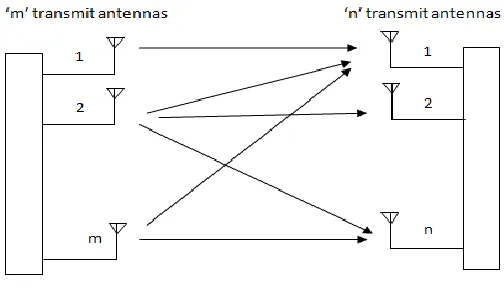
Multiple Input Multiple Output (MIMO) systems use spatial multiplexing, wherein multiple transmitting antennas and multiple receiving antennas are used.
It permits parallel streams to be transmitted simultaneously by those antennas. Because MIMO transmits multiple signals across the communications channel, data rate in MIMO systems gets multiplied by the number of antennas used. [9] MIMO, in contrast to traditional communication systems, takes advantage of multipath propagation to increase
throughput, range/coverage, reliability, and boost
transmission performance.
In Orthogonal Frequency Division Multiplexing (OFDM), digital signal itself is split into different narrowband frequencies, modulated by data and then re-multiplexed to create the OFDM carrier. The main benefit of OFDM is high spectral efficiency, high immunity to Radio Frequency (RF) interference, and lower multi-path distortion. It also dramatically reduces equalization complexity by enabling equalization in the frequency domain. Srinivasan (2012) noted that orthogonal frequency division multiplexing can be implemented efficiently by using Fast Fourier Transforms (FFT) at the transmitter and receiver. FFT provides the channel response for each frequency. With MIMO, the channel response becomes a matrix and hence, MIMO-OFDM signals can be processed using relatively straightforward matrix algebra. Since complexity involved with space-time equalizers for MIMO-OFDM systems is less, they are preferred. Also, MIMO uses multipath propagation to its advantage. See figure ii: MIMO antenna structure.
Figure ii: MIMO Antenna Structure
B. Smart Antennas
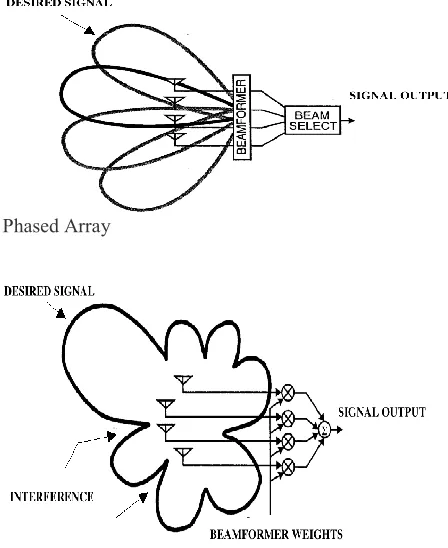
Smart antennas are a multi-antenna concept which allows the radio beam to follow the user. This is done through beam forming which temporarily improve gain and offer higher capacity. Properties of a beam are “tuned” or customized for a subscriber to achieve this capacity for a limited duration.
0G- MTS
5G ?
4G NATIVE-IP
2G- CDMA
1G- AMTS
3G- UMTS
2.5G- GPRS/ EDGEE
3.75G- HSUPA
3.5G- HSDPA
1980 s
1990 s
2000 2010 2015 2020
100kbp
s
3Mbps
500Mbps
56kbps
100Mbps
[image:2.612.319.571.460.604.2]International Journal of Emerging Technology and Advanced Engineering
Website: www.ijetae.com (ISSN 2250-2459, Volume 2, Issue 11, November 2012)
456
They are also used to provide transmit and/or receive diversity. There are two types, phased and adaptive array antennas. [10] Figure 3.2 depict smart antennas.
Phased Array
[image:3.612.47.271.183.457.2]Adaptive Array
Figure iii: Smart Antennas
C. Ad hoc Networks
Ad hoc networks refer to spontaneous self organization of network (SON) of devices, not necessarily connected to internet. [11] Native-IP creates hybrid wireless networks using ad hoc networks. Intelligent routing to determine shortest path with least powers are used, i.e., data packets are sent through paths with minimal power requirements.
D. Adaptive Modulation and Coding (AMC)
Adaptive modulation and coding mechanism reacts to instantaneous variations in channel conditions and accordingly modify the modulation & coding formats. Based on feedback from the receiver, response of the channel is estimated and depending upon the channel conditions, AMC allows different data rates to be assigned to different users. Channel statistics aid the transmitter and receiver to optimize system parameters such as modulation, coding, bandwidth, channel estimation filters, and automatic gain control.
E. Adaptive Hybrid ARQ
Efficient and reliable Medium Access Control (MAC) layer performance is extremely important for reliable link performance over the lossy wireless channel. To achieve this, an automatic retransmission and fragmentation mechanism called Automatic Repeat Request (ARQ) is used, wherein the transmitter breaks up packets received from higher layers into smaller sub packets, which are transmitted sequentially. If a sub packet is received incorrectly, the transmitter is requested to retransmit it. This mechanism introduces time diversity into the system due to its capability to recover from noise, interference, and fades. [12]
F. Improved Modulation
Previous standards used Phase-shift keying, more spectrally efficient modulation schemes such as 64-QAM (Quadrature Amplitude Modulation) is being used for Native-IP systems.
G. Software Defined Radio (SDR)
Software Defined Radio allows some of the functional modules of radio equipment like modulation/demodulation, signal generation, coding and link-layer protocols, that used to be traditionally implemented in special purpose hardware to be implemented in modifiable software or firmware operating on programmable processing technologies. [13] Since Native-IP is all about convergence of diverse wireless standards, this can be efficiently realized using SDR technology.
H. LTE (Long Term Evolution) Advanced
International Mobile Telecommunication–Advanced
International Journal of Emerging Technology and Advanced Engineering
Website: www.ijetae.com (ISSN 2250-2459, Volume 2, Issue 11, November 2012)
457
I. Discussion and Expectations
According to Saeed (2010) one of the main ways in which Native-IP differed technologically from 3G was in its elimination of circuit switching, instead employing an all IP-based integrated Network system. Native-IP is capable of providing 100 Mbps for high mobility and 1 Gbps for low mobility, with end-to-end Quality of Services (QoS) and high security, and it is offering various services at any time as per user requirements, anywhere with seamless interoperability, at affordable cost. The user services include IP telephony, ultra-broadband Internet access, gaming services and High Definition Television (HDTV) streamed multimedia. [14] In Native-IP technology, IPv6 has evolved to support a large number of devices. IPv4 uses 32 bits and hence it is able to address 4294967269 possible addressable devices, whereas IPv6 uses 128 bits and is able to address 3.4 X 1038 possible
addressable devices. [15] An important IPv6 feature is the introduction of flow labels to enable the labeling of packets belonging to particular traffic flows for which the sender requests special handling, such as non-default quality of service or real-time service.[16] With IPv6, each device will have its own IP, even if access point is changed, IP will remain same. IP based backbone or IP Core will allow everything to talk to each other, provided they follow the same protocol. [17]
IV. POTENTIALS FOR 5G RADIO EVOLUTIONS This current radio evolution will not stop with LTE-Advanced; on the contrary, some underlying technologies will continue improving. Moore’s law which originated in 1970 stated that processor speeds or overall processing power for computers will double every two years. [18] This law is still very active as processing powers of most devices are increasing, and will continue even as we look forward to 5G evolution. The law might probably be obsolete once transistors can be created as small as atomic particles, then, there will be no more room for growth in the CPU market. The higher processing power the higher data rate signal processing in the digital baseband.
There will be development in radio frequency (RF) technologies. An implementation of wider bandwidth will create a radio frequency bandwidth which is also a factor for increase data rate transmission. Optical fiber availability will enable faster connections to base stations, either as backhaul or front-haul up to the antenna. The technology advancements will enable the deployment of higher data rates and higher capacity as well as driving down the cost per bit. Radio evolution will require increase in spectrum; this will cause a greater demand in available mobile broadband spectrum.
Mobile broadband data in many countries is carried today by the UMTS 2100 MHz band with a total of 2 x 60 MHz of spectrum.
V. TECHNICAL CORNERSTONES OF 5G
A. Ubiquitous Heterogeneous Networks
According to Andrew (2011), future networks will be deployed more densely than today’s networks. Due to economic constraints and site availability, networks will become significantly more heterogeneous in terms of transmit power, antenna configurations (number, height and pattern of antennas), supported frequency bands, transmission bandwidths and duplex arrangements.[19], [20] Radio network nodes will vary from stand-alone base stations to systems with different degrees of centralized processing, depending on the availability of front-haul and backhaul. There will be the need to integrate diverse radio access technologies with any combination of long term evolution (LTE), high speed packet access plus (HSPA+), wireless fidelity (Wi-Fi) and other radio access technologies. There is high tendency that allocated spectrum will be more fragmented and may even be shared among Communications Subscriber Providers (CSPs) according to new license models.
5G wireless network connectivity will also be designed to take energy efficiency into account. Networks will intelligently distribute radio resources to achieve the lowest energy consumption possible. Hence, instead of offering a uniform radio access with varying delivery capabilities, services could be delivered intelligently to take advantage of the operational environment. Context sensitive variables could be the existence of other access networks, the availability of radio bandwidth, radio propagation environment and user mobility patterns. In addition, the quality of connections could be set according to available network and air interface resources.
B. Self-organization and Cognitive Radio
International Journal of Emerging Technology and Advanced Engineering
Website: www.ijetae.com (ISSN 2250-2459, Volume 2, Issue 11, November 2012)
458
Moreover, a much greater variety of devices, machine to machine, notebooks and smart phones will demand network flexibility. A vital 5G technology is Cognitive Radio Networks (CRN), and Self-Organizing Networks (SON). The CRN will enable flexible spectrum management, device-to-device networking and wideband software-defined radio. [21]
C. The Air Interface
The air interface is the foundation of all wireless
communication infrastructures. The properties and
interoperability of different air-interfaces, physical layer, protocol layer, retransmission, critically affect the QoS, spectral efficiency, energy efficiency, robustness and flexibility of the entire radio system. The evolution of the air interface will be driven by small cell dominated architectures.
VI. CONCLUSION
The general acceptability and usage of Native-IP technologies are in full motion. Service providers are already offering the services. End users are acquiring these Native-IP phones and the associated services. The move to Native-IP represents a major step forward in wireless communications. With state-of-the art radio technology, Native-IP moves wireless performance to a new level while offering speed, reliability and security on par with wired network connections. As 4G is built on an all-IP core network, it brings the mobile network into step with the overall directions in enterprise networking. The future advancement of wireless network, will witness increasing number of small cells with fiber backhaul that will drive the need for locally centralized small cell clusters capable of global optimization. 5G technology will basically focus more on radio spectrum, optical fiber, higher processing power and base stations. The most important design targets are expected to be the cost per delivered bit and system scalability. In addition, future heterogeneous network deployments will offer ubiquitous connectivity with solid-rock quality where necessary. Cloud technologies, virtualization, and increased degrees of coordination are the key technologies to reduce the cost of transmission sites for antenna clusters. Today’s wireless systems fall short of expected demands and interested researchers should focus on cloud technologies, and virtualization.
REFERENCES
[1] Toh, C. K. 2011. 4G LTE technologies. System concepts. Chief technology advisor, ALICO systems Inc., Torrance, CA, US.
[2] Tiwari, B. P. 2010. Mobile WiMAX. The 4g revolution has begun. Retrieved from: http://www.wimax.com/features/mobile-wimax-the-4g-revolution-has-begun
[3] Alex, W. 2011. 2020: Beyond 4g radio evolution for the gigabit experience. Retrieved from http://www.nokiasiemensnetworks.com
[4] Brookes, T. 2012. A brief history of mobile phones. Retrieved from http://www.makeuseof.com/tag/history-mobile-phones/
[5] Gupta, A. 2012. Introduction and types of wireless technologies. Retrieved from
http://www.bukisa.com/articles/743302_introduction-and-types-of-wireless-technologies
[6] Badoi, C. I. 2011. Tellabs Operations, 4G. The what, why and when. Retrieved from www.tellabs.com/4g/whatwhywhen.pdf
[7] Srinivasan, R. T. 2012. 4G-technology. On the go. Retrieved from https://sites.google.com/site/4gtechnology82/references-annotations
[8] Aravantinos, E., & Fallah, M. H. 2008. Potential scenarios and drivers of the 4g evolution. Wesley J. Howe school of technology management, Stevens institute of technology, Hoboken.
[9] Kim, I. H., Chun, J., & Lee, K. 2007. AMIMO antenna structurethat combines transmit beamforming and spatial multiplexing, Bibliometrics data Bibliometrics ... IEEE transaction on wireless communication 6(3), March 2007.
[10] Winters, J. H. 2003. Smart antennas for wireless systems. Retrieved from http://www.wtec.org/loyola/wireless/graphics/fh06_02.gif
[11] Toh, C.K. 2002. Ad hoc mobile wireless network, Pretence hall publishers.
[12] Liu, Q., Zhou, S., & Giannakis, G. B. 2004. Cross-layer combining of adaptive modulation and coding with truncated ARQ over wireless links.
[13] Dillinger, M., Madani, K., & Alonistioti, N. 2003. Software defined radio. Architectures, systems and functions.
[14] 4G technology. Retrieved from
http://www.engineersgarage.com/articles/4G-technology. September 23, 2010.
[15] David, G. 2012. The internet now has 340 trillion, trillion, trillion addresses. Retrieved from
http://money.com/2012/06/technology/ipv6/index.htm
[16] Havinga, P.J., & Wu, G. 2001. Wireless internet on heterogeneous networks.
[17] Frost, D. 2011. IPv6 traffic volume going backward, itwire.
[18] Moore’s law. Retrieved from: www.mooreslaw.org.
[19] Andrew, R. 2011. 2020: Ubiquitous heterogeneous network, beyond 4g.Managing director, nokia/Siemens network SA. ITU Kaleidoscope 2011 Cape Town South Africa.
[20] Stuckmann, P., & Zimmermann, R. 2007. Towards ubiquitous and unlimited-capacity communication network – European research in framework programme 7.
International Journal of Emerging Technology and Advanced Engineering
Website: www.ijetae.com (ISSN 2250-2459, Volume 2, Issue 11, November 2012)