Journal of Chemical and Pharmaceutical Research, 2014, 6(7):1241-1245
Research Article
CODEN(USA) : JCPRC5
ISSN : 0975-7384
The profit pattern analysis of the telecom value-added service supply chain
with advertising elements
Xu Jian and Yang Tian-jian
School of Economics and Management, Beijing University of Posts and Telecommunications, Beijing, China
_____________________________________________________________________________________________
ABSTRACT
Based on the fusion of telecom value-added service and the Internet, we study the telecom value-added service chain with one telecom operator and one service provider. Advertisement which is provided by Advertisers is implanted into value-added products as profit elements, and the service provider's income makes up of two parts: information fees share and advertising revenue. First, the model is established by using game theory, then, the optimal strategies are obtained through strict theoretical proof. Finally, we get the optimal decision when telecom operator and service provider have different profit share, and discuss the change of product price, profits when Advertisement is implanted into value-added products as profit elements. The paper proposes some suggestion to improve the telecom value-added business revenue model, and provides a good idea for operations and management of the enterprise.
Key words: Telecom value-added service; Internet; stackelberg model; numerical analysis
_____________________________________________________________________________________________
INTRODUCTION
Telecom value-added service refers to the additional value-added services with Communication Network developed, it can make the function of the original network, value improved. There are many main kinds of value-added services, such as
WAP
,MMS
,IVP
etc [1]. With the restructuring of the telecommunications industry, three major telecom operators launched fierce competition, meanwhile, value-added services as competition farmar increasingly brought to the attention of the operator. In order to win in the fierce competition, service provider changes the method of profit model through value-added services and Internet integration [2]. Such as: telecommunications enterprises ringtone is prepared for business users of fixed phone ringtone. Companies can set the promotion advertising, product introduction and other voice into fixed phone back tone [3]. The diversity of the Internet and value-added services integration makes value-added services industry chain further extended. Profit element from the Internet and traditional media, advertising and other industries will be injected into the value-added services in the design of new products [4, 5].Internet gradually generalization, and the single profit pattern is gradually replaced in the competition. Based on this, we study the telecom value-added service chain with one mobile operator and one service provider. Advertisement which is provided by Advertisers is implanted into value-added products as profit elements, and the model is established by using game theory. Finally, numerical examples are given to support the models.
1. NOTATION
We use the following notation throughout this paper.
0
p
: Communication fee1
p
: Information fee1 0
p
p
+
: Price selling to the customers0
c
: SP's fixed costs1
c
: SP's variable cost per unitm0
c
: MP's fixed costm1
c
: MP's variable cost per unitα
: Cooperation parameter, i.e., share of revenue per unitSP
∏
: SP’s profit functionMP
∏
: MP’s profit functionW
: Communication costTake an example of China telecom supply chain,
MP
charges the communication feep
0D
and shares theinformation fee
α
p
D
1 with
SP
. WhileSP
shares(
1
-
α
)
p
1D
from the information fee with the agreed contractsigned with
MP
. Communication costW
means the concomitant cost when one telecom service is introduced to mobile customer throughMP
's network resource[10].2. ASSUMPTION
To make the problem more clear and avoid unrealistic and trivial cases, we make the following assumptions. (1) A telecom service chain in this paper consists of one
MP
and oneSP
.MP
is the leader of the telecom supply chain.(2) SP provides one single value-added service in one specified period to customer.
(3) The demand[11] follows
D
=
a
-
b
(
p
1+
p
0)
+
θ
g
;a
stands for capacity of the market;b
stands for themarket price influence coefficient;
θ
g
Stands for the increased demand for propaganda role.(4) A part of
SP
's income is advertising revenue related to the download of users, and assume that advertising revenue is a simple linear relationship with users, that isG =
K
D
,K
is constant.(5)The fixed cost and variable cost of
MP
arec
m0andc
m1respectively, in a specified sales season. The fixed costand variable cost of
SP
arec
s0andc
s1respectively in a specified sales season4. MODEL FRAME WORK
With the above on hand, we can get the profit functions of
SP
,MP
andSC
.W -D c -c -KD D p )
α
-1
( 1 s0 s1
SP = +
∏ (1)
g -W D c -c -D p D p α
1 m 0 m 0 1
MP = + +
∏ (2)
g -D c -c -D c -c -KD D ) p p
( 1 0 m0 m1 s0 s1
SC = + +
∏ (3)
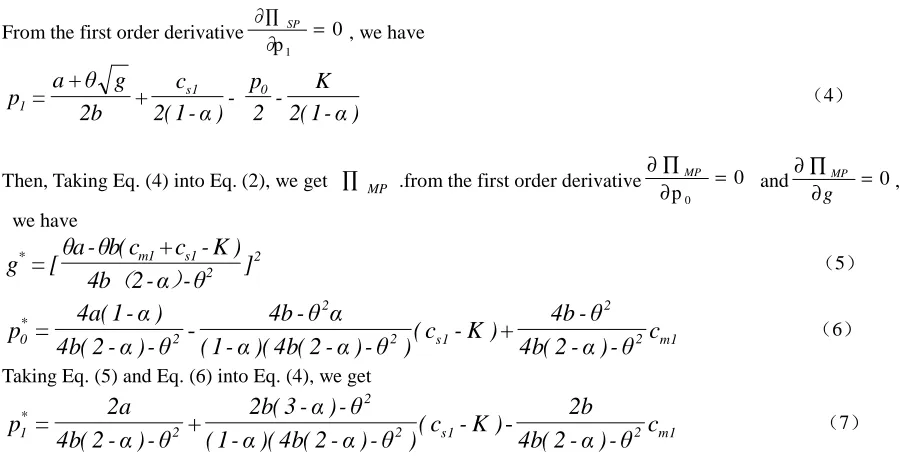
From the first order derivative 0 p ∂ ∏ ∂ 1 = SP
, we have
)
α
-1
(
2
K
-2
p
-)
α
-1
(
2
c
b
2
g
θ
a
p
1+
s1 0+
=
(4)Then, Taking Eq. (4) into Eq. (2), we get
∏
MP .from the first order derivative 0 p0 =∂ ∏ ∂ MP
and =0
∂ ∏ ∂ g MP , we have 2 2 1 s 1 m *
]
θ
-α
-2
b
4
)
K
-c
c
(
b
θ
-a
θ
[
g
)
(
+
=
(5)1 m 2 2 1 s 2 2 2 *
0
θ
c
-)
α
-2
(
b
4
θ
-4b
)
K
-c
(
)
θ
-)
α
-2
(
b
4
)(
α
-1
(
α
θ
-4b
θ
-)
α
-2
(
b
4
)
α
-1
(
4a
p
=
-
+
(6)Taking Eq. (5) and Eq. (6) into Eq. (4), we get
1 m 2 1 s 2 2 2 *
1
θ
c
-)
α
-2
(
b
4
2b
)
K
-c
(
)
θ
-)
α
-2
(
b
4
)(
α
-1
(
θ
-)
α
-3
(
2b
θ
-)
α
-2
(
b
4
2a
p
=
+
-
(7)With Eq. (5-7), the profit functions of
MP
,SP
, andSC
can be rewritten respectively.In the next section, we study the impact of allocation rate
α
on the profits ofMP
,SP
, and telecom supply chain, and conduct an example with data from aMP
and aSP
in China telecom industry.5. NUMERICAL EXAMPLE
5.1 Different Profit Allocation Model between
MP
andSP
After some reasonable data processing and standardization, we use the system parameters given in the following:
SP’s fixed cost :
c
s0=
10000
; SP's variable cost per unit:c
s1=
1
.
1
;MP's fixed cost:
c
m0=
24000
; MP's variable cost per unit:c
m1=
0
.
01
; Communication cost fromSP
toMP
:W =
1000
;The demand follows
D
=
250000
-
5000
(
p
1+
p
0)
+
31
g
.Table 1: Numerical Results for An Example
0 . 0
=
α α=0.1 α=0.2 α=0.3 α=0.4 α=0.5 α=0.6 α=0.7 α=0.8 α=0.9
* 1 * 0 p
p + 38.45 37.82 37.13 36.35 35.47 34.47 33.32 31.99 30.43 28.57
D 63898 67348 71192 75502 80367 85902 92256 99625 108273 118566 SP
∏ 805582 805434 799930 787071 764056 726911 669888 584503 457921 270156
MP ∏ ) ( 6 10 ×
1.571 1.657 1.753 1.861 1.982 2.119 2.278 2.462 2.678 2.935
SC
∏ ( ) 6 10
× 2.377 2.462 2.552 2.647 2.746 2.847 2.948 3.047 3.136 3.205
[image:3.595.71.525.70.303.2]Numerical results are obtained by taking the above system parameters into the model in Section 4, which is given in Table 1. It demonstrates the impact of allocation rate
α
on theMP
,SP
, and telecom supply chain's profit functions, respectively. We take values of allocation rateα
from 0.0 to 0.9 with an increment of 0.1. From Table 1, all of the profits ofMP
,SP
and supply chain are clearly presented. The profits ofMP
andSC
gradually increase, however, the profit ofSP
gradually reduce, and the falling speed is faster and faster. The experiments in Table 1 propose a basis for the profit allocation. Clearly,MP
andSP
can select a more proper allocation rate for their cooperation.5.2 Compared with the Literature
Profit model of service provider in[8] is single, and income only Contains information fees share,however, in this paper advertisement which is provided by advertisers is implanted into value-added products as profit elements, and the service provider's income makes up of two parts: information fees share and advertising revenue.
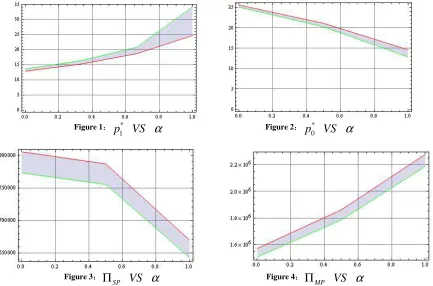
through the simulation,as shown in figure 1-4,where The red line represents the numerical results in this paper, the green line represents the numerical results of the literature [8].
[image:4.595.91.524.114.400.2]
Figure 1: *
1
p
VS
α
Figure 2: *0
p
VS
α
Figure 3:
SP
VS
α
Π
Figure 4:MP
VS
α
Π
Figures 1-4 show: (1) compared with the literature [8], information fee
p
1in this paper is lower, and communicationfee
p
0 in this paper have improved. Appearing this situation is reasonable, the reason is that service provider'sincome Contains advertising revenue.
SP
Will decrease information fee to attract more users, whileMP
will take the opportunity to improve communication fee to maximize their own profits. (2) In the literature [8] and this paper model,MP
's profits are far outweighSP
's profits among all kinds of cooperation mode. That isMP
Squeezes profits in the supply chain as much as possible, which fully shows the nature of the capital market that is pursuing profit maximization. (3) Compared with the literature [8], all of the profits ofMP
,SP
and supply chain are improved obviously In this paper. So, under the trend of telcom and the Internet integrated,SP
Can increase their income by implanting advertisement into value-added products. Simulation results provide the theoretical basis, and has the certain reference value.CONCLUSION
In this paper, we have studied the telecom value-added service chain with one telecom operator and one service provider. We have formulated the model by using game theory and derived the profit functions of
SP
,MP
, and the telecom supply chain. Finally, we have presented a numerical example based on some real data derived from oneSP
and oneMP
in China telecom industry. Simulation results provide the theoretical basis, and has the certain reference value.REFERENCES
[1] Wu Chuanbao, Sun Xiaoqi. Communications Management and Technology, 2006,(2):10-12.
[2] Gao Liang. High value-added telecom business will bring new opportunities in the era of 3G [J]. Journal of
office automation,2009.
[3] Lu Ying. The future development trend of the telecom value-added service [J]. Friend of Science Amateurs, 2011, 10:150-151.
[5] Li Yiming, Su Dan. the development of Mobile Internet value-added business. Telecommunications Science, 2009, 2:60-61.
[6] Li Wei. a study on revenue shafing contract of value added services of Telecommunication [D].Bei Jing, Beijing University of Posts and Telecommunications , 2008.
[7] Bai Xiuguang, Yang Hongbin, Shu Huaying. Research on the Application of Multi-followers Stackelberg Model to the Telecom Value-addedService Supply Chain[J]. China Communications, 2010,4.
[8] Wu Jun,Tian Tian. Modeling of a telecom service chain with mobile value-added service [J]. System Science and
Mathematics, 2011, 31(11):1578-1584.
[9] Wu Jun, Tian Tian, Ou Haiying, Liu Lihan. Research on Telecom Value-added Service Chain with Cooperative Advertising. Management Review, 2012, 24(11):81-86.
[10] China Mobile Communications Corporation. Measures for the