
Journal of Chemical and Pharmaceutical Research, 2017, 9(4):180-184
Research Article
CODEN(USA) : JCPRC5
ISSN : 0975-7384
180
Synthesis, Characterisation and Antimicrobial Activity of Some Schiff Base
Metal Chelates
Ekata Kumari
1*and Shashi Kumari Singh
21
Uttaranchal College of Science and Technology, Dehradun,Uttarakhand, India
2
B.R.A.Bihar University Muzaffarpur, Bihar, India
_____________________________________________________________________________
ABSTRACT
The aim of the present work is to synthesize some Schiff base complexes of metal ion and to evaluate their antimicrobial activities. A New Schiff base has been derived From 1,2-diacetyl benzene and 4,5-dimethyl -O- Phenylenediamine and their Complexes with Cu(II), Co(II), Ni(II) have been synthesized and evaluated for their antibacterial activities by disc diffusion method. The complexes have been characterized by conductance, magnetic, IR and electronic spectroscopic techniques.
Keywords: Coordination; Schiff base ligands; Infrared; UV/Vis; Antibacterial activity
_____________________________________________________________________________
INTRODUCTION
Multidentate ligands and their metal complexes have played an important role in the development of co-ordination chemistry. Schiff bases are compounds containing a carbon-nitrogen double bond (azomethine group), (C=N-) with the nitrogen atom connected to an aryl or alkyl group but not hydrogen. Schiff bases are of the general formula R1R2C=N-R3, where R3 is an aryl or alkyl group that makes the Schiff base a stable imine [1-10]. Schiff bases, named after Hugo Schiff and their transition metal complexes continue to be of interest even after over a hundred years of study. Schiff bases have a chelating structure and are in demand because they are easy to prepare and are moderate electron donors. Schiff base metal complexes are still widely used in catalysis but increasingly with a slightly modified concept. The chemistry of the carbon-nitrogen double bond plays a vital role in the progress of chemical sciences. Schiff-base compounds have been used as fine chemicals and medical substrates. Much attention has been devoted by bioinorganic as well as by medicinal chemists to the relationship between the metal ions and their complexes as antitumour and antibacterial agents. Interaction of various metal ions with antibiotics may enhance or suppress their antimicrobial activity but usually in many cases the pharmacological activity of antibiotics after complexation with metals is enhanced as compared to that of free ligands. Some novel transition metal [Co(II), Ni(II) and Cu(II)] complexes of substituted pyridine bases have been prepared and characterized by physical, spectral and analytical data. The synthesized Schiff-bases act as deprotonated tetradentate for the complexation reaction with Co(II), Ni(II) and Cu(II) ions [11-14]. Various transition and inner-transition metal complexes with bi-, tri- and tetra-dentate Schiff bases containing nitrogen and oxygen donor atoms, play an important role in biological systems.
181
EXPERIMENTAL SECTION
Materials and Methods
Most of the special chemicals used were of BDH, and Aldrich AnalR grade and were used without further purification. They are: 4,5-dimethyl O-phenylenediamine and 1,2-diacetylbenzene and metal(II) chlorides. Methanol was used as the medium in all preparations. The bacterial strains used are four Gram-negative bacterials: Escherichia coli. Pseudomonas aeruginosa, Salmonella typhi and Shigella flexneri and two Gram-positive bacterials Bacillus subtilis and Staphylococcus aureus.
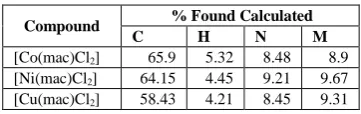
Some representative preparation of macrocyclic complexes are descriibed here. Analytical data for the complexes are given in Table 1.
Preparation of Macrocyclic Coordination Compound
[3,4:11,12dibenzo7,8:15,16di(3’4’dimethylebenzo)Dichlorido2,5,10,13tetramethyl1,6,9,14tetraazacycl ohexadeca1,5,9,13,tetraenatocohalt(II)represented by [Co (Mac)Cl2]:
[image:2.595.207.388.310.367.2]Cobalt (II) chloride hexahydrate (2.3 g, 0.01 mol), 1,2-diacetylbenzene (2.3 g, 0.02 mol) and 4,5- dimethyl orthophenylenediamine (2.7, 0.02 mol) were refluxed together in the molar ratio 1:2:2 in ethanolic solution medium for 6 hours. The reaction mixture was cooled to room temperature and brown coloured solution was first formed, was concentrated by evaporation gradually. The brown product was filtered and washed with ethanol and dried over anhydrous CaCl2 in a dessicator.
Table 1: Microanalytical data of the ligands and their Metal (II) complexes
Compound % Found Calculated C H N M
[Co(mac)Cl2] 65.9 5.32 8.48 8.9 [Ni(mac)Cl2] 64.15 4.45 9.21 9.67 [Cu(mac)Cl2] 58.43 4.21 8.45 9.31
[3,4:11,12-dibenzo-7,8:15,16-di(3’4’-dimethylebenzo)]Dichloro-2,5,10,13-tetramethyl-1,6,9,14-tetraazacyclohexa deca 1,5,9,13,tetraenatoNickel(II) represented by [Ni(Mac)Cl2]:
Nickel(II) chloride hexahydrate (2.3 g, 0.01 mol), 1,2-diacetylbenzene (2.3 g, 0.02 mol) and 4,5-dimethylorthophenylenediamine (2.7 g, 0.02 mol) were refluxed together in the molar ratio 1:2:2 in ethanolic solution medium for 6 hours. The reaction mixture was cooled to room temperature and green coloured solution was first formed, was concentrated by evaporation gradually. The green product was filtered and washed with ethanol and dried over anhydrous CaCl2 in a dessicator.
[3,4:11,12-dibenzo-7,8:15,16-di(3’4’-dimethylbenzo)]Dichlorido-2,5,10,13-tetramethyl-1,6,9,14 tetraazacyclo hexadeca-1,5,9,13-tetraenatocopper(II)represented by [Cu(Mac)Cl2]:
Copper (II) chloride hexahydrate (2.3 g, 0.01 mol), 1,2-diacetylbenzene (2.3 g, 0.02 mol) and 4,5-dimethyleorthophenylenediamine (2.7 g, 0.02 mol) were refluxed together in the molar ratio 1:2:2 in ethanolic solution medium for 6 hours. The reaction mixture was cooled to room temperature and blue coloured solution was first formed, was concentrated by evaporation gradually. The blue product was filtered and washed with ethanol and dried over anhydrous CaCl2 in a dessicator.
Physical Measurements
The Elemental analysis for C, H, and N were determined using a Perkin Elmer model 2400 series 11 CHNS/O elemental analyzer. The percentage metals were determined by EDTA complexometric [15] titration. The molar conductivity measurements were done using a Conductivity Meter model 160 Orion with a cell constant of 0.82
at a concentration of dimethylformamide(DMF) 10-3 M at room temperature were measured using direct reading
conductivity meter, Systronics conductivity bridge type 305. Infrared spectra were recorded on FTIR-84005 Model Spectrophotometer using Nujol mull techniques in the range 200-4000cm-1. Spectra were recorded for both the ligands and the complexes. Electronic spectra of the ligands and complexes were recorded using UV/Vis 2500 Series Spectrophotometer in the range 200-1100 nm using chloroform and DMF as the solvent. Magnetic susceptibility data were recorded using Guoy method at room temperature using Hg
[Co(NCS)4] as Calibrate.
Antimicrobial Activity of Complexes
182
RESULTS AND DISCUSSION
The prepared ligands and their metal (II) complexes gave (%) yield ranging from 63 - 94. The complexes gave various shades of colours ranging from dark brown to dark green. This indicates that the ligands or complexes are probably pure. The conductivity values (Tables 2-6) of the ligands and the complexes in DMF at the concentration 10-3 mol. dm-3 are in the range 16-17 S cm2 mol-1. This indicates that they are non-electrolytes. The microanalysis data of the ligands and the metal (II) complexes are presented in Table 1. In general, the complexes analyzed as [MCl2 (Mac)], where M = Co(II), Ni(II) or Cu(II). This shows that the complexes are anhydrous.
Table 2: Band positions of electronic transitions (cm-1) of the Co(II) complexes [Co(Mac)X2]
Compounds Ʋ1 Ʋ2 Ʋ3 C.T. Band
[Co(Mac)Cl2] 8760 17600 22300 34600 [Ni(Mac)Cl2] 9400 18000 24900 34700 [Cu(Mac)Cl2] 17600 - - 26500
Table 3: Infrared spectral bands (cm-1) of cobalt (II), nickel (II) and copper (II), Complexes [M(Mac)X2]
Complex ν(C=N) ν(M−N) ν(M−X)
[Co(Mac)Cl2] 1604 453 508 [Ni(Mac)Cl2] 1609 457 577 [Cu(Mac)Cl2] 1606 458 574
Table 4: Data of electrical conductance for the Co(II) complexes [Co(Mac)X2]
Compounds S cm2 mole-1 solvent
[Co(Mac)Cl2] 16 DMF
[Ni(Mac)Cl2] 17 DMF [Cu(Mac)Cl2] 16 DMF
Table 5: Data of magnetic moment of the Co(ll) complexes [Co(Mac)X2]
Complexes Colour μeff (B.M.) Magnetic nature
[Co(Mac)Cl2] Brown 4.7 Paramagnetic [Ni(Mac)Cl2] Green 2.5 Paramagnetic [Cu(Mac)Cl2] Blue 2.1 Paramagnetic
Table 6: Antimicrobial properties (primary screening) of Schiff bases and Metal(II) complexes
Inhibition zone diameter(mm)
Gram-negative Gram-positive
Compound Escherichia
coli
Pseudomonas aeruginosa
Salmonella typhi
Shigella flexneri
Bacillus subtilis
Staphylococcus aureus
[Cu(Mac)Cl2 22 16 21 14 21 16
[Co(Mac)Cl2] 20 18 19 19 16 18
[Ni(Mac)Cl2] 21 20 22 21 19 18
The IR spectra (Table 3) of the Schiff base ligand, showed bands resulting from the bands corresponding to
(C=N), (M-N) and (M-X) stretchings were observed in the 1604-1616, 453-478 and 508-577 cm-1 regions
respectively in both the ligands. The comparison of the IR spectra of the ligand and their metal (II) complexes indicated that the ligand is coordinated to the metal ions in different ways. The band appearing at(C=O)
1714-1725 cm-1(N-H) 3430 due to 1,2-diacetyl benzene and dimethyl 0-phenylenediamine in the ligand is shifted to
lower frequency by 2-10 cm-1 in the complexes, indicating the participation of the azomethine nitrogen in coordination with the metal ion. Further evidence of the coordination of this Schiff-base ligand with the metal ions was shown by the appearance of weak frequency new bands at 453-478 and 508-577 cm-1. These were assigned [17-24] to the metal-nitrogen (M-N) and metal-chlorine (M-Cl) vibrations, respectively.
The electronic spectra of the ligands and the metal complexes were determined in DMF in the range 200–700 nm. On the basis of previous assignments of related complexes [13,25-28] band I, II and III represent transitions
around 8760–17600, 16500 – 18000 and 22100–24900 cm-1 respectively. The broad band at 22100–24900 cm-1
is assigned to d-d transition of the metal ions. The positions of these bands in the spectra of the metal complexes are consistent with the expected octahedral or tetrahedral geometry.
183
[image:4.595.227.370.96.242.2]exhibited varying degrees of inhibitory effects (low to moderate) on the growth of different tested strains (Table 5 and Figure 1).
Figure 1: Structure of ligand (Mac)
The Schiff base, L1 showed no inhibitory action against the Gram-negative species, Salmollella typhi and
Shigella flexneri, and the Gram-positive species, Bacillus subtilis. In contrast, the growth of all the Gram-negative and Gram-positive species was inhibited by all the metal complexes under investigation. These results
are similar to other reports in the literature [27,29],which stated that biologically inactive compounds become
active and less biologically active compounds become more active upon coordination. In comparison, the uncomplexed ligand in present work has been shown to be less active than the metal complexes.
The preliminary screening showed that the compounds NiCl2 (Mac) and CuCl2 (Mac), are the most active against both Gram-negative and Gram-positive organisms. The MIC of all the three active compounds varies
from 10-100 µg/ml. The compound [CuCl2 (Mac)] proved to be the most active one. It inhibited the growth of
Salmonella typhi, Shigella flexneri and Bacillus subtilis at 10 µg/ml concentration. This study may serve as a basis for the chemical modifications directed towards the development of a new class of antibacterial agents. The complexes are multi-coloured, the ratio of metal to ligand are 1:2 in all the metal complexes as confirmed by their microanalysis. The complexes are non-electrolytes as confirmed from their conductivity measurements. The electronic spectral data suggest a plausible octahedral or tetrahedral geometry around the metal ions as shown in the proposed structures (Figure 2).
Figure 2: Structure of the macrocyclic complex [Co(Mac)Cl2]
CONCLUSION
The Stereochemical environment of the metal ions in each case is octahedral. The 16 membered ligand behaves in a tetradentate manner utilizing all of its nitrogen donor atoms. The anions are also coordinated to the metal ions in a unidentate manner. The broad nature of electronic spectral bands suggests tetragonal distortion in the complexes. The proposed structures of the ligand and metal (II) complexes (taking Coas representative metal) are shown in Figures 1 and 2. The in vitro antimicrobial screening of the complexes confirmed their potency against most of the microorganisms used in this study
REFFERENCES
[1] M Raisanen. Ph.D. Thesis, University of Helsinki, Finland, 2007, 9.
[2] AD Garnovskii; EV Sennikova; BI Kharisov. Open J Inorg Chem.2009, 3, 1.
[3] PG Cozzi. Chem Soc Rev, 2004, 33, 410.
[image:4.595.211.384.422.560.2]184
[5] D Boghaei; M Gharagozlou. Spectro Chimica Acta.2007, A67, 944.
[6] LA Saghatforoush; A Aminkhani; F Khabari; S Ghammamy. Asian J Chem. 2008, 20, 2809.
[7] JY Hai; HS Wen; LL Zi; M Zhi. Chinese Chem Lett. 2002, 13(1), 3.
[8] HC Zahid; M Asifa; TS Claudi. Metal Base Drugs. 2001, 8(3), 137.
[9] MS Iqbal; MS Ahmad; A Asad. J Pharm Phamacol.1999, 5, 1371.
[10] SMM Sony; K Saraboji; MN Ponnuswamy; J Manonmanbi; M Kandasamy; HK Fun. Cryst Res
Technol.2004, 39, 185.
[11] SS Ayed. J Spectrochim Acta.2004, 60, 1189.
[12] EET Naser. Ph.D Thesis, Universiti Sains Malaysia, 2009, 1.
[13] AS Lotf; A Ali; E Sohrab; K Ghasem; G Shahriar; K Roya. J Molecules.2008; 13, 804.
[14] FM Morad; MM EL-ajaily; SB Gweirif. J Appl Sci.2007, 1(1), 72.
[15] AI Vogel. A Text book of Quantitative Chemical Analysis, 5th edition, Longmans Ltd. London, 1982,
591.
[16] KJ Bakhtiar; M Khan; F Rubina; R Rehana; R Wajid; M Qaisar; AF Khan; AK Khan; M Danish; N
Awais; ZA Bhatti; M Rizwan; A Naveed; M Hussani; A Pervez. Afr J Pure Appl Chem. 2009, 3(4), 066.
[17] PA Cox, Inorganic Chemistry, 2nd edition, Garland Science/BIOS Scientific Publishers, New York, USA, 2004, 21-45, 125.
[18] GA Kolawole; NP Ndahi. Synth React Inorg Met Org Chem.2004, 34(9), 1563.
[19] MM El-ajaily; FA Abdulseed; S Ben-Gweirif. Eur J Chem.2007, 4(4), 461.
[20] WJ Geary. Coord Chem Rev.1971, 7, 81.
[21] FA Adekunle; JAO Wood; IO Adeoye; OOE Onawumi; OA Odunola. Res J Pharm Bio Chem Sci.
2010, 1(2), 425.
[22] HC Zahid; KAS Syed. Met Drugs. 1997, 4(2), 65.
[23] K Nakamoto. Infrared and Raman spectra of Inorganic and coordination compounds, John Wiley and
Sons Inc., New York. 1978.
[24] RD Marcelo; CDA Antonio. J Electrocatal.2010, 1, 95.
[25] RK Agarwal; DS Suryanarayana; CS Vallabhaneu. Indian J Chem.1981, 20(4), 473.
[26] H Hamrit; S Djebbar-sid; O Benli-Baitichy; MA Khan; GM Bouet. Synth React Inorg Met Org Chem.
2000, 30(10), 1835.
[27] HC Zahid; CT Supuran; A Scozzafava. J Enzyme Inhib Med Chem. 2004, 19, 79.
[28] A Majumdar; GM Rosair; A Mallick; N Chattopadhyay; S Mitra. Polyhedron. 2006, 25, 1753.
![Figure 2: Structure of the macrocyclic complex [Co(Mac)Cl2]](https://thumb-us.123doks.com/thumbv2/123dok_us/8736878.888858/4.595.227.370.96.242/figure-structure-macrocyclic-complex-mac-cl.webp)
