Improving Mechanical Engineering Students'
Achievement in Calculus through
Problem-based Learning
Nizaruddin*, Muhtarom, Muhammad Saifuddin Zuhri
Department of Mathematics Education, Universitas PGRI Semarang, Indonesia
Received October 7, 2019; Revised October 30, 2019; Accepted November 8, 2019
Copyright©2019 by authors, all rights reserved. Authors agree that this article remains permanently open access under the terms of the Creative Commons Attribution License 4.0 International License
Abstract
This research aims to evaluate the effectiveness of problem-based learning (PBL) approach to improve mechanical engineering students' learning achievements. As for the research sample, it consisted of 56 engineering students selected by cluster random sampling which were grouped into the experimental class and the control class. The instrument used is in the form of a description test which is used to measure students' learning achievements. T-test and N-Gain test were used to analyze research data, while students' mastery learning was presented in quantitative description. The results of this research concluded that PBL is effectively applied in the learning process for mechanical engineering students, because the learning achievements of students who get PBL learning are better than the learning achievements of students who get conventional learning. The majority of students complete their mastery learning and there is an increase in students' achievements of high categories.Keywords
Problem-based Learning, Conventional Learning, Learning Achievements1. Introduction
Mathematical problems Calculus is one of the main courses in the curriculum in Indonesia, both for mathematics and engineering. The fact shows that many engineering students are no exception to mechanical engineering students who do not like calculus, because it is difficult and less useful in the field of engineering [1] [2]. Engineering students often have difficulty understanding concepts because of their lack of ability to do deductive reasoning. This happens because students still face conventional approaches in the learning process
[3] [4]. Conventional approaches are closely related to the use of lecture methods, where teachers are more active in providing guidance while students only accept material passively. Textbooks are used as the only source of information for classroom teaching, which emphasize the computing side rather than understanding concepts [3] [5] [6].
Although the conventional approach can be done, but this approach is criticized for producing students who are passive and do not take into account the various needs and abilities of students [7]. Many students are unable to associate the concept of calculus with its application in real life. Thus, lecturers need to emphasize the importance of realizing the interactions between students, students and lecturers, and students with learning resources are necessary in calculus learning in engineering [8]. Therefore, it needs a learning approach that provides more interaction and learning opportunities for students so they can produce graduates who are relevant to the needs of the industry. Problem-based learning (PBL) is an approach that is used in overcoming real life problems as a context for students to learn, as well as to acquire essential knowledge and concepts from lecture material [9-11]. PBL emphasizes that the learning process moves from the transfer of information to the construction process of knowledge socially and individually. This is in line with the constructivism understanding that every student can understand teaching material through everything according to his own construction.
finding sources in the library, database, internet, and observation. 4) Students returning to the group to exchange ideas, peer learning, and working together in solving problems, 5) students presenting solutions found, and 6) students assisted by lecturers evaluating all learning activities. PBL is able to improve students’ learning skills, and this approach also helps students explore real problems that will be encountered after graduation [10] [11] [13]. Through PBL, each student interacts and helps each other in the learning process so that they can overcome the different levels of student’s learning abilities. Students who do not understand the course material will get help from students who understand the course material and at the same time students who understand lecture material can better consolidate their mastery of knowledge and skills. Based on the description above, the objectives of this research are: 1) Are there differences between learning achievements of mechanical engineering students with PBL and conventional learning?, 2) How is the mastery learning of students with PBL and conventional learning ?, and 3) How is the improvement in learning achievements of mechanical engineering students with PBL and conventional learning?
2. Methods
2.1. Research Sample
This research was conducted in September 2018 until January 2019, middle semester 2018/2019 academic year. To ensure the objectivity of researchers and avoid bias in research, the sample in this research was selected using cluster random sampling technique so that it can provide equal opportunities to a group of students gathered in the class to become a research sample. The research sample
consisted of 56 mechanical engineering students at the Universitas PGRI Semarang, Central Java Province, Indonesia. The sample is divided into two classes, namely the experimental class (PBL learning) and the control class (conventional learning), with each class consisting of 28 students. Before doing the research, test the normality with the Lilliefors method, the homogeneity test with the Bartlett test, and the t-test is done first. The results showed that samples from conventional learning classes and PBL classes came from populations that were normally distributed, the variance between the two groups was homogeneous, and the two samples had the same initial ability.
2.2. Instrument and Procedures
At this stage the researcher determines methods, teaching materials, learning strategies and learning media. The learning method used in each lesson plan is a cooperative learning method. Teaching materials used by researchers are printed books, and the learning strategies chosen are active learning. Before being used, the device was validated by two validators and concluded that the device was suitable for use, with an expert rating of 84.4% (good), and 86.6% (very good) to be used.
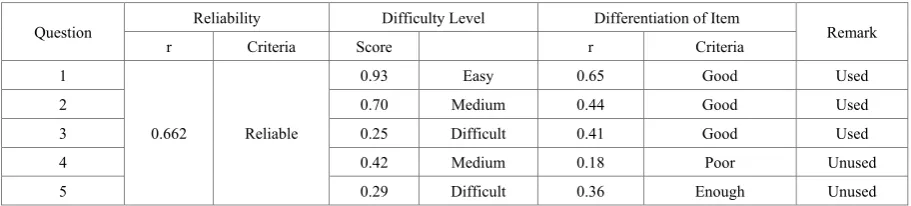
[image:2.595.70.526.547.650.2]The test questions are arranged in reference to the syllabus used in the mechanical engineering research program at the Universitas PGRI Semarang. The test questions were first validated by two experts, then tested to find out the reliability, the level of difficulty and the differentiation of items. Test questions are used to measure the ability of students' learning achievements in the experimental class and the control class. The results of the test analysis of the test instruments are presented in Table 1, which clearly shows that there are three items used as a matter of pre-test and post-test in this research.
Table 1. Analysis of Essay Test Instrument
Question Reliability Difficulty Level Differentiation of Item Remark
r Criteria Score r Criteria
1
0.662 Reliable
0.93 Easy 0.65 Good Used
2 0.70 Medium 0.44 Good Used
3 0.25 Difficult 0.41 Good Used
4 0.42 Medium 0.18 Poor Unused
2.3. Data Analysis 2.3.1. Test T-Test
The t-test is used to find out whether there is a difference of mean of student’s achievement between PBL class and conventional class. The data tested is the post-test result, in the following way:
(The mean of student’s achievement of PBL class is less than the average of conventional class).
(The mean of student’s achievement of PBL class is better than the average of conventional class). 2.3.2. Students’ Learning Mastery
Mastery learning is a minimum level of mastery over the substance of calculus teaching material. Students are said to master learning if they get a minimum value of 70, and mastery learning is classically met if at least 85% of all students complete the learning material. Value of 70 is the minimum criteria of mastery learning (KKM) established by mechanical engineering program in Universitas PGRI Semarang. The percentage of classical learning completeness is calculated using the formula: P = (Number of students who have completed (> 70): Number of students who took the test) x 100%
2.3.3. Test Improvement of Students' Achievements To calculate the improvement of mechanical
engineering students’ achievements in calculus before and after learning, it is calculated by the normalized gain formula [14], namely:
N-Gain (g) = (posttest score – pretest score): (maximum ideal score – pretest score)
The result of N-Gain calculation was then interpreted on Table 2.
Table 2. Interpretasi N-Gain (g)
Amount of N-Gain (g) Interpretation
g ≥ 0.7 High
0.3 ≤ g < 0.7 Medium
g < 0.3 Low
3. Results
3.1. Test of Prerequisites
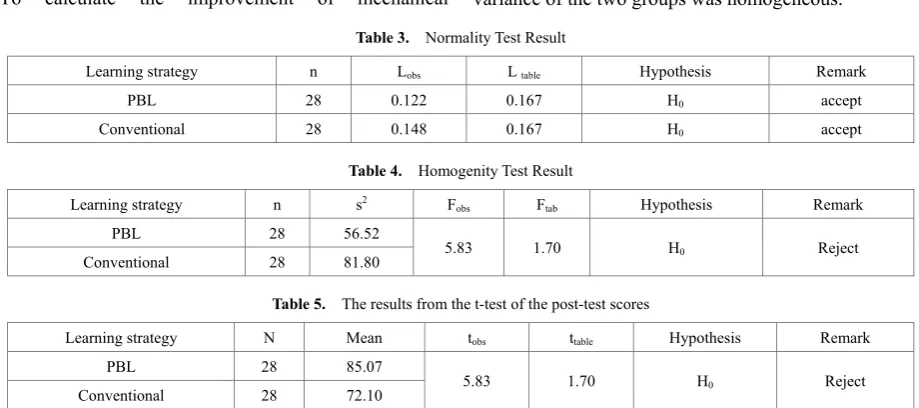
Table 3 provides data that Lobs< Ltable, with p = 5% and n = 28, thus it was concluded that the samples from conventional learning classes and PBL classes came from populations that were normally distributed.
[image:3.595.67.527.403.607.2]Presented in Table 4 that Fobs = 0.691, Ftable = 1.904, p = 5%, and H0 accepted.. thus it was concluded that the variance of the two groups was homogeneous.
Table 3. Normality Test Result
Learning strategy n Lobs L table Hypothesis Remark
PBL 28 0.122 0.167 H0 accept
Conventional 28 0.148 0.167 H0 accept
Table 4. Homogenity Test Result
Learning strategy n s2 F
obs Ftab Hypothesis Remark
PBL 28 56.52
5.83 1.70 H0 Reject
Conventional 28 81.80
Table 5. The results from the t-test of the post-test scores
Learning strategy N Mean tobs ttable Hypothesis Remark
PBL 28 85.07
5.83 1.70 H0 Reject
Conventional 28 72.10
2 1 0:
H µ ≤µ
2 1 a:
3.2. Test of Research Data
Based on the results of the statistical test and prerequisite test, then the test was carried out to determine the differences in learning achievement of mechanical engineering students from the application of each learning approach. Presented in Table 5 that sp = 8.316, tobs = 5.83, with the score of v = 28 + 28 – 2 = 54 and p = 0.05, obtained t(0.05,54) = 1.70. Therefore H0 is rejected. It can be concluded that the learning achievements of mechanical engineering students who get PBL learning are better than the learning achievements of mechanical engineering students who get conventional learning.
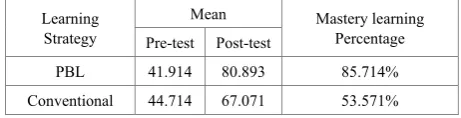
[image:4.595.58.289.363.422.2]Table 6 shows the pre-test and post-test score of the two research classes, where the pre-test scores were taken before PBL learning, while the post-test scores were taken after PBL learning. Related to the achievement of student learning completeness, in the PBL class the percentage of learning completeness was 85.714%. Whereas in the conventional class, completeness was only 53.571%, which means that almost half of the students had not yet completed the KKM.
Table 6. Mean of Pre-Test, Post-Test, and Mastery Learning Percentage
Learning Strategy
Mean Mastery learning
Percentage Pre-test Post-test
PBL 41.914 80.893 85.714%
Conventional 44.714 67.071 53.571%
[image:4.595.59.288.581.626.2]The N-Gain test is used to see the improvement in learning achievement of mechanical engineering students from the application of each learning approach. The data used are the pre-test and post-test value data. Obviously it is presented in Table 7 that the increase in learning outcomes of mechanical engineering students who get PBL learning is 0.70. While the increase in learning outcomes of mechanical engineering students who get conventional learning is 0.40. This shows that PBL is better for improving learning achievement than conventional learning.
Table 7. Improved Students’ Achievements
Learning strategy N-Gain Interpretation
PBL 0.70 High
Conventional 0.40 Medium
4. Discussion
The results of the research showed that the learning achievements of students who received PBL were better than the learning achievements of students who received conventional learning. This shows that the PBL approach has been able to foster interaction between students, students with lecturers, students with learning resources in calculus learning, and students are able to associate the
concept of calculus with its application in real life. Through giving problems, students are challenged and motivated to solve them so that students are increasingly active in learning [8] [15-17]. This result is supported by the majority of mechanical engineering students (85.714%) who have learned PBL to have achieved KKM as determined by the school, which is 70; which is different from the completeness of students with conventional learning which is only 53.571%. Furthermore, this fact is also reinforced by the increase in student achievement of students who get PBL of 0.7 in the high category and only an increase of 0.4 with the moderate category in conventional learning. Thus, the application of PBL to calculus material has taken into account the needs and abilities of students in learning [7].
PBL learning process as described by Barret [9] and Arends & Kilcher [12] has been able to improve student learning skills, and this approach also helps students explore real problems that will be encountered after graduation. This is in line with the opinion that PBL uses real-world problems as a context for students to learn, and to acquire essential knowledge and concepts from lecture material [9-11] [13]. During the learning process, students actively construct knowledge socially and individually as well as constructively. Whereas in conventional learning it can be seen that students passively receive the knowledge explained by the lecturer, which emphasizes more on computing than understanding the concept [3] [5] [6].
5. Conclusions
This research shows that the PBL approach is effective for improving students’ learning achievements compared to conventional learning. Lecturers need to often apply PBL in lectures so that students will increasingly be accustomed to linking teaching material to daily life, and improving their learning achievement. Lecturers need to pay attention to student collaboration to develop ideas for solving problems. Furthermore, the application of PBL needs to be developed in other subjects and other technical fields.
Acknowledgements
We would like to thank Universitas PGRI Semarang for supporting this research.
REFERENCES
C. H. Huang, Engineering students’ generating counter [1]
K. M. Yusof, A. N. Sadikin, F. A. Phang, & A. A. Aziz, [2]
Instilling professional skills and sustainable development through problem-based learning (PBL) among first year engineering students, International J. of Engng. Educ., 32 (1), 333-347, 2016.
E. T. Agustin, & D. J. Tindowen, Improving engineering [3]
students’ achievement in solid mensuration by using an obedized work text, Global J. of Engng. Educ., 21(1), 75-79, 2019.
A. Morgan, A study of the difficulties experienced with [4]
mathematics by engineering students in higher education, International J. of Math. Educ. in Science and Technology, 21(6), 975-988, 1990.
M. Muhtarom, D. Juniati, & T. Y. E. Siswono, Exploring [5]
prospective teachers' beliefs about nature of mathematics, Journal of Engng. and Applied Sciences, 13(10), 3547-3554, 2018.
M. Muhtarom, D. Juniati, & T. Y. E. Siswono, Examining [6]
prospective teacher beliefs and pedagogical content knowledge towards teaching practice in mathematics class: a case study, Journal on Math. Educ., 10(2), 185-202, 2019. L. K. Chan, S. M. Bridges, I., Ng, M. L. Doherty, N. Sharma, [7]
N. K. Chan, & H. Y. Y. Lai, A qualitative study on how health professional students and their PBL facilitators perceive the use of mobile devices during PBL, Interdisciplinary Journal of Problem-based Learning, 9(1), 83-95, 2015.
S. L. Thomas, A social network approach to understanding [8]
students’ integration persistence, The J. of High. Educ., 71(5), 46-52, 2000.
T. Barret, Understanding Problem-based Learning, New [9]
York, Merill, 2005.
J. E. Mills, & D. F. Treagust, Engineering education-Is [10]
problem-based or project-based learning the answer, Australasian J. of Engng. Education, 3(2), 2-16, 2003. H. Othman, U. Ewon, M. Salleh, N. H. Omar, A. Baser, M. E. [11]
Ismail, & A. Sulaiman, Engineering students: Enhancing employability skills through PBL, In IOP Conference Series: Materials Science and Engineering, 2017.
R., I. Arends, & A. Kilcher, Teaching for student learning. [12]
New York, Routledge, 2010.
A. L. deChambeau, & S. E. Ramlo, STEM high school [13]
teachers’ views of implementing PBL: An investigation using anecdote circles, Interdisciplinary J. of Problem-based Learning, 11(1), 2017.
D. E. Meltzer, The relationship between mathematics [14]
preparation and conceptual learning gains in physics: A possible “hidden variable” in diagnostic pretest scores, American J. of Physics, 70(12), 1259-1268, 2002.
M. Muhtarom., Y. H. Murtianto, & S. Sutrisno, Thinking [15]
process of students with high-mathematics ability (A study on QSR NVivo 11-assisted data analysis), International J. of Applied Engng. Research, 12(17), 6934-6940, 2017. M. Muhtarom., S. Sugiyanti., R. E. Utami & K. Indriana, [16]
Metacognitive ability of male students: difference impulsive-reflective cognitive style. Journal of Physics: Conf. Series 983, 012118 doi:10.1088/1742-6596/983/1/01
2118, 2018.
N. Nizaruddin, M. Muhtarom, Y. H. Murtianto, Exploring of [17]