6
II
February 2018
A Comparative Study of ICA Arnold Catmap with
Hybridization of ICA based Arnold Catmap using
Reversible Cellular Automata
Sanjeev Sharma1, Navleen kaur21, 2
Department of Computer Science & Engineering, ACET, Amritsar, Punjab
Abstract: Image encryption has important role to assure all transmission of image over internet. Security of the multimedia data including image and video is one of the basic requirements for the telecommunications and computer networks. Cellular autoats is based on modifying the mixing matrix in Independent Component Analysis (ICA) using the chaotic Arnold’s Cat Map (ACM) for encryption. This research implies that hybridized ICA and ACM has the better results but it can be improved further by utilizing optimistic decision making. This paper put a light on The research of image cryptography based on independent component analysis based arnold cat cryptography still has many problems, but independent component analysis based arnold cat cryptography have many advantages as compared to other encryption algorithms because of the vast parallelism, exceptional energy efficiency, and extra information density inherent in independent component analysis based arnold cat map. We have improved the performance of independent component analysis based Arnold cat based image cryptography technique using reversible cellular automata. The primary objective is to improve the computational speed. To propose hybrid (ICA) based on Arnold cat-map with reversible cellular automata based image encryption technique, to improve the encryption speed further. Keywords: Arnold cat map, cellular automata, independent component analysis (ICA)
I. INTRODUCTION
Images contribute a lot now a days many organization send their confidential data or images over internet but to get image at receiver end security was the main problem was that how one can transfer important images on internet without any attack of intruder or hacker so to solve this problem [1]. We are having many encryption techniques given by various scientist and researchers to provide security to various organization and individuals so that they can transfer any confidential data over internet without with ease [2].
Fig.1 An illumination of Image Encryption and Decryption
image encryption algorithm or various techniques to perform an efficient image encryption but only some have concentrated over the security of the important documents such as many of documents of it companies having lots of confidential data to be transmitted over the internet but due to confidentiality issue we need a securer way to communicate or we can say we need a reliable technique [5]. We can transfer our important documents without any tension. So in this paper we have discussed some techniques below [6]
II. ARNOLD’SCATMAP(ACM)
Arnold's change infers that a picture is hit with the change that will clearly randomizes the first association of its pixels. if iterated enough no of times, eventually the first picture reappears.[7] The quantity of considered cycles is known as the Arnold's time frame. The period relies upon the picture measure; i.e., for various size pictures, Arnold's period is unique.
Where size of image is denoted by N, p,q are positive integer and det(A)=1, (Xn,Yn) is the positions of the sample in N data such that And (xn+1, yn+1) is the transformed position after cat map, Cat map has two typical factors, which bring chaotic movement:
tension(multiply matrix in order to enlarge x, y) and fold (taking mod in order to bring x, y in unit matrix).[9]
+
+ = ( ) + ( )… (1)
Equation.1 changes all the positions of the pixels, when all the pixels are shuffled. The image we get is scrambled image .the no of iteration depends upon the size of the image i.e. no of iterations= Arnold period secret key [10]
A. Arnold’s Cat Map (ACM) algorithm 1) Input any arbitrary image
2) Use num as variable which is represented the No. of
3) Determine the No. of rows and columns. Which are represented by the variables row and col respectively.
4) for inc=1 to num
for row1= 1 to row for col1= 1 to col nrowp=row1 ncolp=col1 forite =1 to inc
5) Shuffle the positions of the pixels of the image using Eq. (1) end
Result the new encryption image end
end end
III.INDEPENDENTCOMPONENTANALYSIS(ICA)
ICA describes a generative model for viewed multivariate data, which ordinarily is capable of finding the underlying factors In this model, data variable are believed to be immediate or nonlinear.ICA always looks for component that are statistically independent and non guassian [11].ICA always find principal component which is dissimilar from other components present
. ..( ) . ( ) = ( )→→ ( )→ → ( ) = . ..( ) . ( )
( )…. (2)
( ) = ( )……. (2)
Where ( ) = [ ( ), … . , ( )] is a × 1 column vectr Collecting the source images, similarly vector ( ) collects then observed
signals, A is a × matrix of unknown mixing Coefficients, ≥ and is the time index.
Fig. 2 shows the principal component from independent components
A. Applications Of Ica
1) Speech enhancement
2) Image process in
3) BSS (blind source separation
4) Biomedical signal processing
IV.REVERSIBLECELLULARAUTOMATA
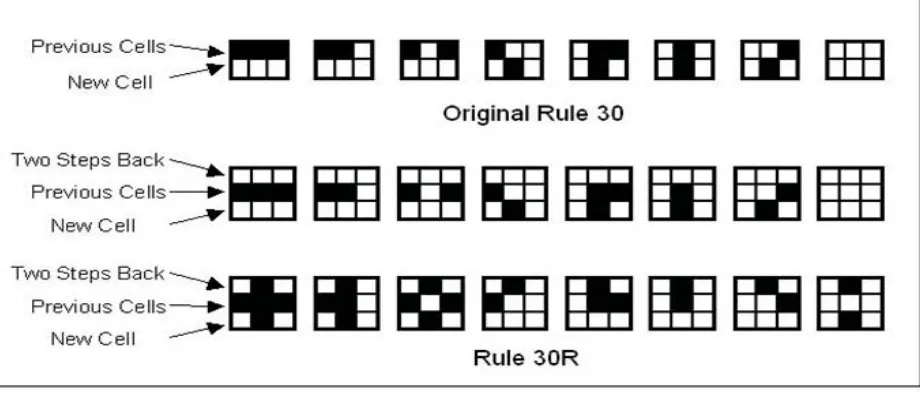
Reversible cellular automata are automata in which each arrangement has a novel ancestor. It is a normal lattice having cells, each having a state drawn from a limited arrangement of states, with administer for changing all cells at the same time in view of the neighbor.[12] To such an extent that the past condition of any cell before a refresh can be resolved interestingly from the adjusted conditions of the considerable number of cells. Numerous strategies are known for characterizing cell automata decides that are reversible; these contain the square cell automata strategy, in which each refresh isolates the cells .. Furthermore, the second request cell automata technique.[13] In which the refresh administer contains states from two past strides of the automata.
Fig. 3 shows the Reversible Cellular Automata
[image:4.612.84.544.449.646.2]V. METHODOLOGY
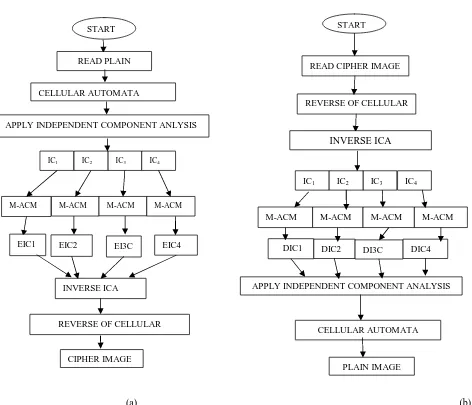
The flow chart of Image encryption and decryption as shown below:
[image:5.612.57.529.107.512.2](a) (b)
Fig. 4 shows the flowchart of image encryption and decryption.
VI.RESULTANALYSISANDDISCUSSION
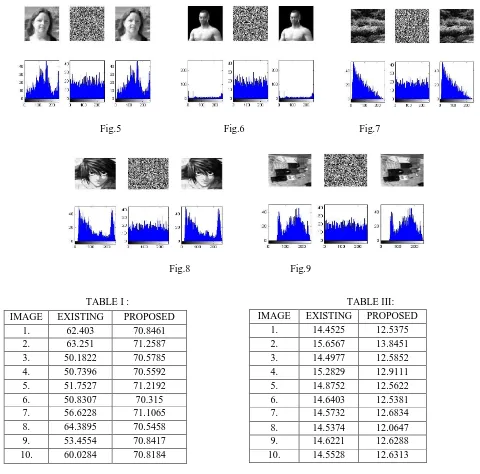
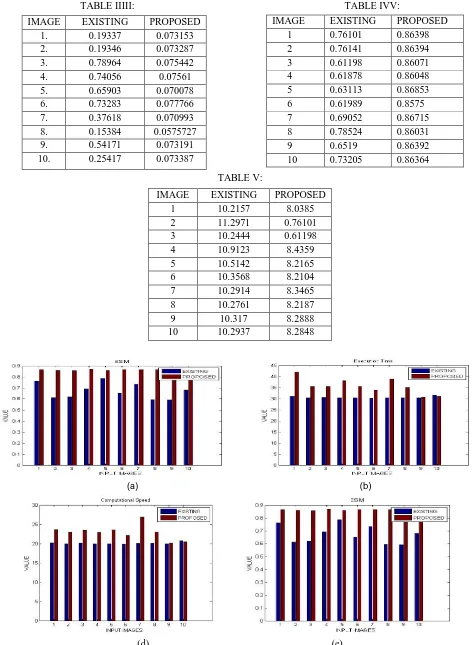
For experimentation and implementation the proposed technique is evaluated using MATLAB tool. The evaluation of proposed technique is done on the origin of following parameters such as SDR, PSNR, Execution Time, Computational Speed based on different images. Fig (a)-(f) is indicating the quantized research into the SDR, PSNR, SSIM, Execution time, Computational Speed. As SDR value is less which implies proposed algorithm is indicating the superior results when compared to access methods as the noise is less in each case. As PSNR ought to be higher which implies proposed algorithm is indicating the superior results when compared to access methods as the PSNR is higher in each case. As SSIM ought to be higher which implies proposed algorithm is indicating the superior results when compared to access methods as the SSIM is higher in each case. As Execution time ought to be lower which implies proposed algorithm is indicating the superior results when compared to access methods as the Execution time is lower in each case.
As Computational Speed ought to be higher which implies proposed algorithm is indicating the superior results when compared to access methods as the Computational Speed is higher in each case.Also, quantitatively evaluations of proposed method with different images for image encryption are below. Fig 5-9 shoes the source images
START
READ CIPHER IMAGE
REVERSE OF CELLULAR AUTOMATA
APPLY INDEPENDENT COMPONENT ANALYSIS IC1
M-ACM
CELLULAR AUTOMATA
PLAIN IMAGE
DIC1 DIC2 DI3C DIC4
IC3
IC2 IC4
M-ACM M-ACM M-ACM
INVERSE ICA
START
READ PLAIN IMAGE
CELLULAR AUTOMATA
APPLY INDEPENDENT COMPONENT ANLYSIS
IC1
M-ACM
INVERSE ICA
REVERSE OF CELLULAR AUTOMATA
CIPHER IMAGE
EIC1 EIC2 EI3C EIC4
IC3
IC2 IC4
A. Parameters
1) SSIM: Structural similarity index is a novel method for measuring the similarity between the two images. It is quality measure of one of the image compared, provided the other image is regarded as of perfect quality. SSIM gives much indication of image quality.
2) Computational Speed- This parameter is use to compare the speed of cryptography performed by existing technique compared to our purposed technique showing the difference between the speeds between both the techniques .it give results with respect to time. Lesser the time more will be the computational spee
3) Execution Time-It is performance measure parameter it calculates the time taken by the machine to perform a particular task for e.g. here execution time will measure the time taken by CPU in cryptography. So lesser the time taken by CPU better is the performance
[image:6.612.66.546.262.736.2]4) PSNR- PSNR is commonly used to measure the quality of reconstruction of image compression codecs. The signal here is original image or data and the error is noise introduced by the compression. When comparing compression PSNR is approximation to human perception of reconstruction quality . generally higher the PSNR value higher is the quality
Fig.5 Fig.6 Fig.7
Fig.8 Fig.9
TABLE I : TABLE III:
IMAGE EXISTING PROPOSED
1. 62.403 70.8461
2. 63.251 71.2587
3. 50.1822 70.5785
4. 50.7396 70.5592
5. 51.7527 71.2192
6. 50.8307 70.315
7. 56.6228 71.1065
8. 64.3895 70.5458
9. 53.4554 70.8417
10. 60.0284 70.8184
IMAGE EXISTING PROPOSED
1. 14.4525 12.5375
2. 15.6567 13.8451
3. 14.4977 12.5852
4. 15.2829 12.9111
5. 14.8752 12.5622
6. 14.6403 12.5381
7. 14.5732 12.6834
8. 14.5374 12.0647
9. 14.6221 12.6288
TABLE IIIII: TABLE IVV:
TABLE V:
(a) (b)
(d) (e)
IMAGE EXISTING PROPOSED
1 0.76101 0.86398
2 0.76141 0.86394
3 0.61198 0.86071
4 0.61878 0.86048
5 0.63113 0.86853
6 0.61989 0.8575
7 0.69052 0.86715
8 0.78524 0.86031
9 0.6519 0.86392
10 0.73205 0.86364
IMAGE EXISTING PROPOSED
1. 0.19337 0.073153
2. 0.19346 0.073287
3. 0.78964 0.075442
4. 0.74056 0.07561
5. 0.65903 0.070078
6. 0.73283 0.077766
7. 0.37618 0.070993
8. 0.15384 0.0575727
9. 0.54171 0.073191
10. 0.25417 0.073387
IMAGE EXISTING PROPOSED
1 10.2157 8.0385
2 11.2971 0.76101
3 10.2444 0.61198
4 10.9123 8.4359
5 10.5142 8.2165
6 10.3568 8.2104
7 10.2914 8.3465
8 10.2761 8.2187
9 10.317 8.2888
(f)
VII. CONCLUSIONS
In this research paper, we have analysed existing ‘Image encryption based on Independent Component Analysis and Arnold’s Cat Map’. The proposed ‘hybrid independent component analysis based on arnold cat-map and with reversible cellular automata based image encryption technique gives better results as the speed is increased This paper has shown comparison existing image encryption technique on the basis of parameters like SDR,PSNR, execution time and computational speed. This proposed image encryption technique shows better results as compared to existing technique. However, in this paper we have not considered the DNA based image encryption techniques to improve the results further. Therefore, in near future we will modify the proposed technique by using the DNA based image encryption techniques.
REFERENCES
[1] Ravishankar KC, Venkateshmurthy MG. Region based selective image encryption. In: International conference on computing & informatics, ICOCI ’06; 2006. [2] GaoHaojiang, Zhang Yisheng, Liang Shuyun, Li Dequn. A newchaotic image encryption algorithm. Chaos SolitFract2006;29:393–9.
[3] Yu Hai, Zhu Zhiliang, Chen Guanrong. An efficient encryption algorithm based on image reconstruction. In: International workshop on chaos fractals theories and applications; 2009
[4] Kamali SH, Shakerian R, Hedayati M, Rahmani M. A new modified version of advanced encryption standard based algorithm for image encryption. In: 2010 International conference on electronics and information engineering (ICEIE 2010
[5] Paul AJ, Mythili P, Paulose Jacob K. Matrix based crypto-graphic procedure for efficient image encryption. In: Recent advances in intelligent computational systems conference (RAICS); 2011
[6] Gautam A, Panwar M, Gupta PR. A new image encryptionapproach using block based transformation algorithm. IJAEST2011;8(1):90–6
[7] Fei Xiang, Xiao-congGuo. An image encryption algorithm based on scrambling and substitution using hybrid chaotic systems. In: Seventh international conference on computational intelligence and security; 2011. p. 882–5.
[8] Ye Ruisong, Zhao Haiying. An efficient chaos-based imageencryption scheme using affine modular maps. Int J ComputNetwork Inform Security (IJCNIS) 2012;4(7):41–50.
[9] Liu Rui, Tian Xiaoping. New algorithm for color image encryp-tion using chaotic map and spatial bit level permutation. J TheorAppl Inform Technol 2012;43(1):89–93
[10]PradhanChittaranjan, SaxenaVilakshan, Bisoi Ajay Kumar.Imperceptible watermarking technique using Arnold’s transformand cross chaos map in DCT domain. Int J ComputAppl 2012;55(15)
[11]Ashtiyani M, MoradiBirgani P, KarimiMadahi SS. Speech signalencryption using chaotic symmetric cryptography. J BasiApplSci Res 2012;2(2):1678–84 [12]Hyvarinen A, Oja E. Independent component analysis: algorithmsand applications. Neural Networks 2000;13:411–30
[13]Comon P, Jutten C. Handbook of blind source separationindependent component analysis and applications. AcademicPress is an imprint of Elsevier; 2010. [14]Cardoso JF. Blind signal separation: statistical principles. ProcIEEE 1998;86(10):2009–25
[15]Cardoso JF, Souloumiac A. Blind beamforming for non Gaussiansignals. IEEE Proc F 1993;140(6):362–70
[16]Dong Tianbao, Lei Yingke, Yang Jingshu. An algorithm forunderdetermined mixing matrix estimation. Neurocomputing2012:1–9 (Elsevier)
[17]Virtanen Tuomas, GemmekeJort F, Raj Bhiksha. Active-setnewton algorithm for overcomplete non-negative representationsof audio. IEEE Trans Audio Speech Lang Process 2013;21(11):2277–89