Implementation of Student Monitoring System
using Machine Learning Algorithms
Sandeep Kumar Hegde 1, Jensil Elvise Dsouza2, Ashrith Kumar V3, Ananthakrishna Acharya 4 1
Assistant Professor, Computer Science and Engineering, NMAM Institute of Technology 2
Student, Computer Science and Engineering, NMAM Institute of Technology 3
Student, Computer Science and Engineering, NMAM Institute of Technology 43
Student, Computer Science and Engineering, NMAM Institute of Technology
Abstract: The ability to predict a student’s performance on a given concept is an important tool for the Education industry; it allows for understanding what types of students there are and what are key concepts that help shape the understanding of another. These are important factors for educators to know in order to constantly modify and improve educating tools. In this paper, a model is proposed to predict the performance of students in an academic organization. This paper aims to build an easier and automated system to get the students mark details, by fetching the student’s marks from a centralized database that is accessible to all the class coordinators as well the SPMC staff members. This system will ensure an easier and less time consuming process of generating the students’ list and for faster scheduling of the classes. The system discussed in this paper will make use of a webpage that will be accessible to the SPMC coordinators as well as the concerned class advisors and faculty members who can access it through the college Intranet Network.
Keywords: Centralized Student Database, Monitoring, Performance, Student, Neural Networks, Performance Predictions.
I. INTRODUCTION
This Student Performance Monitoring Cell (SPMC) is a system which will be used to monitor and analyze students’ academic performance and marks details in an easier and quicker manner. This concept is not new in the world as various educational institutions have tried and implemented this system. Lot of research has been done in this field and many systems have been prototyped and also implemented. This technology is going to work on our educational institution through the college Intranet Network. In this system the SPMC coordinators can access the students’ marks details through the database that contains the students’ marks details. The proposed research, mainly concentrates on Data Mining as a means to monitor and analyze the academic performance of students. Here the SPMC coordinators get a privilege to login to the SPMC webpage that has a username and password for authentication. By logging in to this webpage the coordinator can get the details of the students with lower marks. The advantage of using this system is the list generation and the classes scheduling can be done more quickly than the current manual system. The faster list generation adds up in sooner class scheduling and efficient time table generation which helps in better scheduling of faculty members to the concerned subject. These results in simplification of services which would enable a wider adoption rate to the existing technology and make existing system more efficient in terms of effort and time.
II. BACKGROUNDANDRELATEDWORK
Most commonly studied problems by the concepts of machine learning and data mining researchers are Classification. It involves predicting the values of an attribute which is based on the values of some other attributes. There are various types of classification methods. Bayesian classification is one such method which is based on Bayes rule of conditional probability. Bayes rule is a technique to estimate the likelihood of a property given the set of data as evidence or input. Other different methods that can be used are K-Nearest Neighbor, Support Vector Machine (SVM), Decision Tree, and Neural Networks.
III.LITERATURESURVEY
In [1] “Evaluation of Students Performance based on Formative Assessment using Data Mining” a system was developed and implemented by Mohak Hasmukh Gogri, Shahla Ashraf Shaikh and Vibha Venugopal Iyengar to assess the performance of students and get instant feedback.
In [3] “Student Performance Analysis System (SPAS)” Chew Li Sa et.al have proposed a framework named Student Performance Analysis System (SPAS) which is able to predict the students’ performance in course “TMC1013 System Analysis and Design”, which in turns assists the lecturers from Information System department to identify students that are predicted to have bad performance in course “TMC1013 System Analysis and Design”. The proposed system offers student performance prediction through the rules generated via data mining technique. The data mining technique used in this project is classification, which classifies the students based on students’ grade.
In [4] “Extraction and Analysis of Faculty Performance of Management Discipline from Student Feedback Using Clustering and Association Rule Mining Techniques” Chandrani Singh, Dr. Arpita Gopal ,Santosh Mishra have proposed a system that deals with the extraction and analysis of faculty performance of management discipline from student feedback using clustering and association rule mining techniques. The idea proposed in this paper is to perform extraction and analysis of faculty performance using techniques of Data Mining.
In [5] “A Review on Predicting Student’s Performance using Data Mining Techniques” Amirah Mohamed Shahiria, Wahidah Husaina, Nur’aini Abdul Rashida from Malaysia developed a automated system to predict students performance because of the lack of features in the existing manual system in order to analyze and monitor the student’s performance. The concept used for this system was Data Mining.
In [6] “In Student’s Performance Prediction using Machine Learning” Havan Agrawal, Harshil Mavani from K. J. Somaiya College of Engineering, Mumbai developed a student performance application using Neural Networks. This application was designed and implemented to predict the future performance of students.
IV.METHODOLOGY
The Student Performance Monitoring Cell (SPMC) is a system that will be integrated within the college Intranet website. This system will implement the following functionality with the student database. This system provides the SPMC coordinators with following functionalities
A. Students’ list generation who score below 10 marks in Mid Semester Examination
B. Track student attendance percentage
C. Assign remedial class timetable for the concerned subject
D. Allocate classroom and concerned faculty member to the subjects on the day of class
V. ESSENTIALFACTORSINVOLVEDINPREDICTINGSTUDENT’SPERFORMANCE
This section is involved in discussion of the various factors that are involved in predicting students performance. Normally there are two major factors that are helpful in predicting the performance of the students. The main focus is concerned on the attributes that can be considered to predict the student performance and as time progresses by the focus is shifted on to the prediction methods.
A. Essential Attributes Involved In Predicting Student’s Performance
The writing examination is utilized to recognize and the imperative traits in anticipating understudies execution. The traits that have been much of the time utilized is the interior evaluation. Ten of thirty papers have utilized CGPA and Internal Marks as their primary credits to foresee understudies execution The principle thought of why the vast majority of the scientists are utilizing CGPA is on account of it has an unmistakable incentive for future instructive and vocation versatility. It can likewise be considered as a sign of acknowledged scholarly potential In numerous examinations CGPA is the most impact traits in deciding the execution of understudies in their investigation, regardless of whether they can finish their examination or not. All characteristics will be assembled in one property called inside appraisal. These details are mostly used among the researchers to predict the students performance.
B. Neural Network
Network model to foresee understudies execution. The characteristics examined by Neural Network are affirmation information, understudies demeanor towards self-directed learning and scholarly execution.
C. Naive Bayes Method
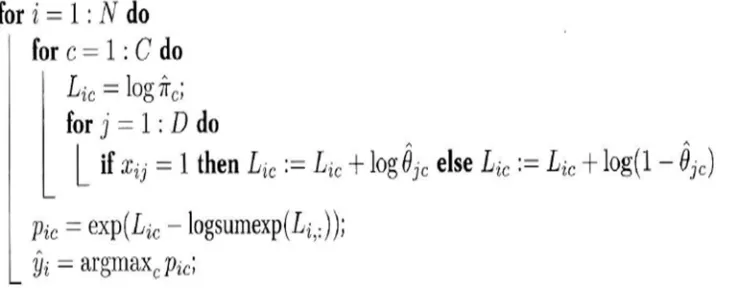
[image:4.612.128.496.203.348.2]Innocent Bayes calculation is likewise a possibility for scientists to make an expectation. In each thirty papers, there are four papers that have utilized Naive Bayes calculations to appraise understudies execution. The goal of every one of these papers is to locate the best forecast procedure in anticipating understudies execution by making correlations . Their exploration demonstrated that Naive Bayes has utilized all of properties contained in the information. At that point, it examined every last one of them to demonstrate the significance and independency of every trait.
Fig 1: Naive Bayes Classifier Algorithm
D. Support Vector Method
Another method used for prediction and classification is the Support Vector Machine method. There are many papers that have used the SVM (Support Vector Machine) method to predict the performance of students. Support Vector Machine can be used for small datasets. The advantage of SVM method is that it has a good ability of generalization. Back in the year 2014 a study conducted by Gray Et Al showed that the SVM method had the highest accuracy prediction concerned with risks identifying on which particular students can fail.
E. K-Nearest Neighbor
The papers referred for this project and in writing this paper show that the good accuracy and best performance was given by the K-Nearest Neighbor method. This method takes very low time in identifying whether the student is a excellent learner, or a good learner, a slow learner or an average learner. This method is useful in estimation of pattern in tertiary education.
F. Decision Tree
Another popular prediction technique is Decision Tree. Decision Tree is used by many researchers because it is comprehensive and simple. It can be used to analyze large data structure and as well as small data and get the prediction. Decision Tree models are easily understandable because of the simple reasoning process and can be converted into IF-THEN rules. More than 10 papers have used Decision Tree method to predict students academic performance. Decision Tree method can predict students performance and get the data from web based education system. Kapalnadevi and Mayilvaganan have compared various classification techniques to predict the students performance conducted in their study. The accuracy of various classification methods to predict student performance was investigated by Gray et al (2014).
VI.SCOPEANDBOUNDARYOFTHISSYSTEM
The proposed system will meet the needs of the SPMC coordinators by providing the following features:
A. SPMC coordinators will be able to generate the list of students who score below 10 marks in Mid Semester Examination
VII. PROPOSEDSYSTEM
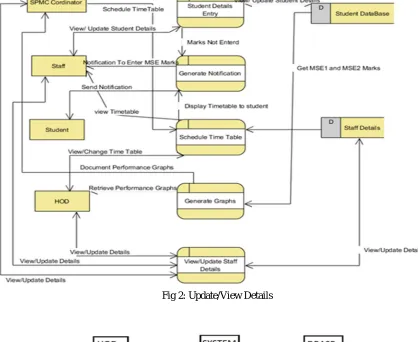
[image:5.612.89.507.142.484.2]The figures attached below show the current system that is being developed along with the interaction between different components of the proposed system.
Fig 2: Update/View Details
Fig 4: Particular Faculty Interaction
[image:6.612.171.397.398.706.2]Fig 6: SPMC Coordinators Interaction
[image:7.612.183.403.406.685.2]Fig 8: Chart Showing the Percentage of Accuracy Prediction of Different Methods
Figure 2 shows the relationship between all the entities in the system. Here the SPMC coordinator has the permission to view student details and schedule timetable. Staff members receive notifications to enter students’ internal details. All the entered details are saved in the student database. Student can login and check the timetable for the respective subject. The Head of the Department has the option to login and check the students list and their internal details. In addition SPMC coordinators assign a particular faculty for a subject and that faculty can login and check the subject assigned and retrieve the students list in that particular subject. Student performance graphs are also generated based on the mark details from the database.
Figure 3 shows the interaction between the Head of the Department and the SPMC system. HOD logs in and if the details are incorrect an error is shown. If the credentials are perfect then the HOD gets logged in and can have access to the students list, their internal details and the reports. There is a provision to give feedback and update if there are any changes. Once all the updating is done HOD can log out and the session gets terminated.
Figure 4 shows the interaction between the staff member who is assigned to a particular subject and the SPMC system. The lecturer logs in and if the details are incorrect an error is displayed. If the credentials are perfect then the lecturer gets logged in and can access the schedule, the students in that particular subject, update the attendance details and store it in the database. Once all the details are updated the faculty member can log out and the session gets terminated.
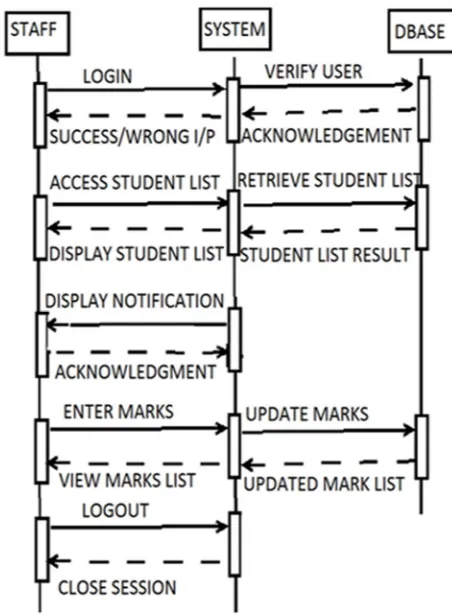
Figure 5 shows the interaction between the staff and SPMC system and the particular subject. If the details are incorrect an error is shown. If the credentials are perfect then the login is successful and can have access to the students list and this page will contain notifications informing the staff member to update the mark details. Once all the updating is done staff checks the marks and then log out and the session gets terminated.
Figure 6 shows the interaction between the SPMC users and the SPMC system. SPMC Admin users can grant access to different users based on the type of designation of the member .SPMC admin user can control the access to the database, crosscheck and maintain a record of various activities performed on the system and the database. Also the schedules can be updated or viewed and the reports can be managed. The SPMC users can send notifications, create timetables manage reports and notification activities. Once all the activities are performed the SPMC user can log out and the session gets terminated.
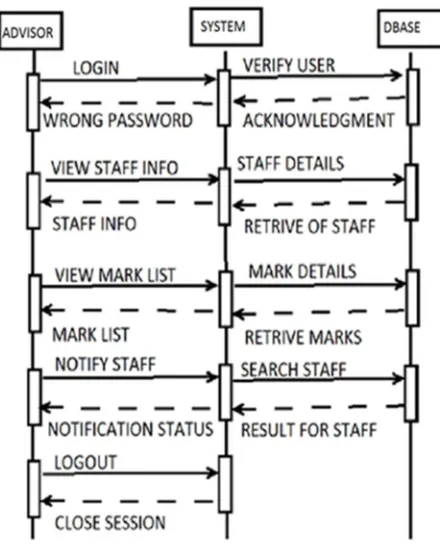
Figure 7 shows the interaction between the Class Advisor and the SPMC system. Class Advisor logs in and if the details are incorrect an error is shown. If the credentials are perfect then the Class Advisor gets logged in and can have details of which faculty member is allotted for remedial class. The Class Advisor can also check students list and send notification to remedial staff to enter the details. The Class Advisor can also check staff details. Once all the work is done HOD can log out and the session gets terminated.
VIII. DISCUSSIONANDRESULT
83%. Naive Bayes Prediction Method gave the lowest Accuracy percentage of 76%. The result on prediction accuracy is depending on the attributes or features that were used during the prediction process. Neural Network method gave the highest prediction accuracy because of the influence from main attributes. The final outcome of this project is a more automated way of generation of student list who score below 10 marks in the internal exams. This list is generated by the system which has access to the database which contains all the marks and the attendance details of the subjects. The system will automatically generate the list of students who score below 10. The entries to the database will be made by the lecturer concerned with the particular subject. This system will have a separate link in the college intranet network. The login will be available to the Head of the SPMC Coordinators, the concerned lecturer and the Head of the Department. The system will be useful in quicker scheduling of classes and allocation of classrooms and the faculty for the subjects concerned. The system will also send the list to the concerned Head of the Department and this system will also generate graphs depending on the student performance. The final outcome of this system is to almost reduce the manual works that are currently involved in the student list generation who score below 10 in the internal assessments.
IX.CONCLUSIONS
Students performance prediction is the most part valuable to help the teachers and students enhancing their learning and instructing process. This paper has surveyed past examinations on foreseeing understudies execution with various investigative systems. The different examinations demonstrate that scholastic executions of understudies are principally reliant on their past exhibitions. Our investigation affirms that past understudy exhibitions have to be sure got a huge impact over students performance. It can likewise be discovered that the execution of neural systems increments with increment in dataset measure. Machine taking in has come a long way from its early stages, and can end up being an effective device in the scholarly community. Later on, applications like the one created, and additionally any changes thereof may turn into an incorporated piece of each scholarly establishment.
X. SCOPEFORFUTUREDEVELOPMENT
This paper has looked into different past examinations on foreseeing understudies execution with different diagnostic strategies. The vast majority of the analysts have utilized CGPA and inward evaluation as datasets. While for expectation systems, the order technique is as often as possible utilized as a part of instructive information mining zone. Under the grouping procedures, Neural Network and Decision Tree are the two strategies exceptionally utilized by the scientists for foreseeing understudies execution. All in all, the meta-investigation on foreseeing understudies execution has roused us to do additionally research to be connected in our condition. It will help the instructive framework to screen the performance of the students.
XI.ACKNOWLEDGMENT
We owe our deepest gratitude to Professor Sandeep Kumar Hegde. Without his important guidance and direction, this paper would never have been accomplished.
REFERENCES
[1] Mohak Hasmukh Gogri, Shahla Ashraf Shaikh and Vibha Venugopal Iyengar -- Evaluation of Students Performance based on Formative Assessment using Data Mining. International Journal of Computer Applications (0975 – 8887) Volume 67– No.2, April 2013.
[2] Snehal Kekane, Dipika Khairnar, Rohini Patil, Prof. S. R. Vispute, Prof. N. Gawande -- Automatic Student Performance Analysis and Monitoring. International Journal of Innovative Research in Computer and Communication Engineering. (An ISO 3297: 2007 Certified Organization) Vol. 4, Issue 1, January 2016.
[3] Chew Li Sa et.al -- Student performance Analysis System (SPAS). Information and Communication Technology for The Muslim World (ICT4M), 2014 The 5th International Conference 26 January 2015.
[4] Chandrani Singh, Dr. Arpita Gopal ,Santosh Mishra -- Extraction and Analysis of Faculty Performance of Management Discipline from Student Feedback Using Clustering and Association Rule Mining Techniques. 3rd International Conference on Electronics Computer Technology Issue 5, 2011.
[5] Amirah Mohamed Shahiria, Wahidah Husaina, Nur’aini Abdul Rashida -- A Review on Predicting Student’s Performance using Data Mining Techniques. "School of Computer Sciences Universiti Sains Malayisa 11800 USM, Penang, Malaysia". The Third Information Systems International Conference, Procedia Computer Science, Volume 72, 2015, Pages 414-422.