Development of a TaqMan Array Card for Pneumococcal Serotyping
on Isolates and Nasopharyngeal Samples
Suporn Pholwat,aFuminori Sakai,bPaul Turner,c,dJorge E. Vidal,bEric R. Houpta
Division of Infectious Diseases and International Health, Department of Medicine, University of Virginia, Charlottesville, Virginia, USAa; Hubert Department of Global Health, Rollins School of Public Health, Emory University, Atlanta, Georgia, USAb; Cambodia Oxford Medical Research Unit, Angkor Hospital for Children, Siem Reap, Cambodiac; Centre for Tropical Medicine and Global Health, Nuffield Department of Medicine, University of Oxford, Oxford, United Kingdomd
Streptococcus pneumoniae
is both a commensal and a major pathogen that causes invasive disease in people of all ages. The
in-troduction of serotype-specific pneumococcal vaccines has reduced the burden of disease but has also led to replacement with
new strains; thus, serotyping remains important for vaccine-related disease surveillance. Conventional serotyping methods are
laborious and expensive. We developed an easy-to-perform genotypic TaqMan array card (TAC) to identify
S. pneumoniae
strains, including
lytA-based sequences, and 53 sequence-specific PCRs to identify 74 serotypes/serogroups covering all current
vaccine types as well as prevalent nonvaccine types. The TAC method was evaluated on 146 clinical
S. pneumoniae
isolates and
13 nonpneumococcal species that naturally inhabit the upper respiratory tract and yielded 97% (142/146) sensitivity and 100%
(13/13) specificity versus results of standard Quellung serotyping. The calculated limit of detection was 20 to 200 fg (
⬃
8 to 84
genome equivalents) per reaction. On 23 blinded nasopharyngeal specimens that were pneumococcus culture positive, the TAC
pan-pneumococcus
lytA
assay was positive in 21 (91% sensitivity versus culture). On TAC
lytA-positive specimens, a serotype
result was obtained on 86%, and the result was 95% accurate versus the subsequent culture’s Quellung result. TAC also detected
mixed serotypes in two specimens where Quellung detected only the predominant serotype. This TAC method yields fast and
comprehensive serotyping compared to the standard method and may be useful on direct specimens.
S
treptococcus pneumoniae
(the pneumococcus) is a leading
in-vasive pathogen of children and older adults, principally
caus-ing pneumonia, otitis media, and mencaus-ingitis. The precursor to
invasive disease is upper airway colonization (
1
). Existing vaccines
are based upon capsular polysaccharide and are highly effective
only against vaccine types (
2–5
). Serotype replacement occurs
with increased colonization and disease caused by nonvaccine
strains (
6
,
7
). With over 90 different capsular serotypes, there is a
constant race to add more capsular types to further expand
cov-erage to reduce disease burden amid a headwind of changing
strain replacement.
In this context it is important to epidemiologically follow
pneumococcal serotypes, both in invasive strains to detect
emer-gence of virulent serotypes and also in the upper airway to
moni-tor strain replacement (
1
,
8
). However, serotyping of
pneumo-cocci with the Quellung method is technically difficult, requires
expensive panels of polyclonal antisera and precise inocula (
9
),
and may yield visually ambiguous reactions (
10
). Furthermore, a
limited number of subcultured colonies are typed, limiting the
ability to detect mixed infections, particularly from
nasopharyn-geal specimens (
11
,
12
).
Molecular serotyping methods are therefore emerging. After
elucidation of the capsular biosynthetic locus (
13
), PCR assays for
the capsular polysaccharide synthesis gene clusters have been
de-vised. Sequencing-based assays of the
cps
and
wzh
genes (
14
,
15
)
have been published, as have real-time PCR assays to detect 21
serotypes/serogroups (
16
,
17
). Nanofluidic, microarray, and
Lu-minex-based systems have also been developed (
18–21
). Recently,
we optimized 53 singleplex reactions to discern most serotypes/
serogroups, including all vaccine types (
22
). However, performing
that many reactions per specimen is onerous and difficult to
im-plement in field settings; therefore, in this work we further
opti-mized and configured the reactions to a single TaqMan array card
(TAC).
MATERIALS AND METHODS
Bacterial strains.All bacterial strains utilized in this study were cultured at Emory University on blood agar plates and incubated at 37°C with 5% CO2overnight (⬃16 h) prior to DNA extraction. Strains from 70S.
pneu-moniaeincluded serotypes 1, 2, 3, 4, 5, 6A, 6B, 6C, 7A, 7B, 7F, 8, 9L, 9N, 9V, 10A, 10B, 10F, 11A, 11B, 11C, 11F, 12B, 12F, 13, 14, 15A, 15B, 16A, 16F, 17A, 17F, 18C, 19A, 19B, 19C, 19F, 19“F” (atypical), 20, 21, 22A, 22F, 23A, 23B, 23F, 24A, 24B, 25A, 27, 28A, 28F, 29, 31, 33A, 33B, 33D, 33F, 34, 35A, 35B, 35F, 36, 38, 39, 41A, 41F, 43, 45, 46, and 47A, as described previously (22). For specificity testing, we included 20 streptococci natu-rally found in the nasopharynx, includingS. infantis,S. oralis,S. anginosus, S. intermedius,S. sobrinus,S. pseudopneumoniae,S. mitis,S. parasanguinis, S. australis,S. mutans,S. peroris,S. oligofermentans,S. intestinalis,S. ves-tibularis,S. cristatus,S. salivarius,S. gordonii,S. sanguinis,S. sinensis, Do-losigranulum pigrum, and three other bacterial speciesNeisseria meningi-tidis,Haemophilus influenzae, andStaphylococcus aureus.
Received22 March 2016Returned for modification15 April 2016 Accepted30 April 2016
Accepted manuscript posted online11 May 2016
CitationPholwat S, Sakai F, Turner P, Vidal JE, Houpt ER. 2016. Development of a TaqMan array card for pneumococcal serotyping on isolates and nasopharyngeal samples. J Clin Microbiol 54:1842–1850.doi:10.1128/JCM.00613-16.
Editor:S. S. Richter, Cleveland Clinic
Address correspondence to Eric R. Houpt, [email protected].
S.P., F.S., J.E.V., and E.R.H. contributed equally to this article.
Supplemental material for this article may be found athttp://dx.doi.org/10.1128 /JCM.00613-16.
Copyright © 2016 Pholwat et al. This is an open-access article distributed under the terms of theCreative Commons Attribution 4.0 International license.
on May 16, 2020 by guest
http://jcm.asm.org/
Nasopharyngeal samples from children.Nasopharyngeal (NP) sam-ples (n⫽28) belonged to our laboratory collection, and pneumococcal carriage had been analyzed in our previous studies (10,23). NP samples were stored at⫺80°C in skim milk-tryptone-glucose-glycerin (STGG) transport medium prior to DNA extraction.
Quellung standard serotyping.Quellung results were determined as described previously (22). Briefly, a fresh overnight bacterial culture in a blood agar plate was suspended in 1⫻phosphate-buffered saline (PBS) and then mixed with antiserum on a glass slide and read microscopically at a magnification of⫻100. Pneumococcus Neufeld antiserum was ob-tained from the Statens Serum Institute (Copenhagen, Denmark).
DNA extraction from bacterial cultures and nasopharyngeal speci-mens.A bacterial colony was suspended in 200l of lysis buffer (Tris-EDTA [TE] buffer containing 0.04g/ml lysozyme and 75 U/ml mutanoly-sin), or 200l of nasopharyngeal specimens (in STGG medium) was mixed with 100l of lysis buffer. Samples were incubated for 1 h at 37°C. DNA was then purified using a QIAamp DNA minikit (Qiagen, Valencia, CA, USA) according to the manufacturer’s instructions and eluted in 100
l. The quality and quantification of DNA preps obtained from bacterial cultures were further evaluated using a NanoDrop system (NanoDrop Technologies, Wilmington, DE).
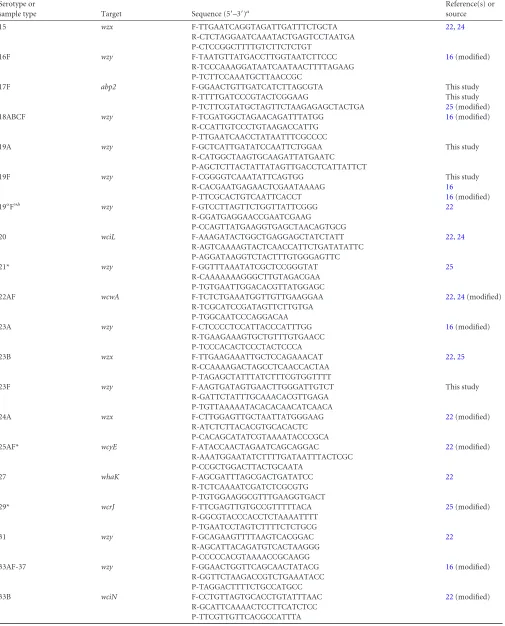
Assay development on 384-well plates.We adopted 53 serotype/se-rogroup-specific primers and probes from published sources (16,22,24– 26) (Table 1) and, if needed, made modifications to accommodate the common cycling condition of the TaqMan array card (TAC) using Primer Express, version 3 (Applied Biosystems, Life Technologies Corp., Carls-bad, CA, USA). We also included one pan-pneumococcus assay (lytA) (26) and an assay for an internal control (27). Optimization of conditions and probe specificity testing were performed using the 384-well format of the ViiA7 platform (Applied Biosystems, Life Technologies Corp., Carls-bad, CA, USA). Each primer/probe set (0.09l of each forward and re-verse primer, 0.025l of probe of a 50M stock) was amplified in single-plex in a total of 5l of PCR mixture containing 2.5l of 2⫻TaqMan universal master mix II with uracil-Nglycosylase (UNG) (Applied Biosys-tems, Life Technologies Corp., Carlsbad, CA, USA), 1.295l of nuclease-free water, and 100 pg of genomic DNA. Cycling conditions included UNG activation at 50°C for 2 min and initial denaturation at 95°C for 10 min, followed by 40 cycles of denaturation at 95°C for 10 s and annealing/ extension at 60°C for 1 min. We included 54 previously characterized serotypes in each run for specificity testing, and nuclease-free water was used for a nontemplate control.
Evaluation of the TaqMan array card.Primer and probe oligonucle-otides were synthesized and spotted onto the TaqMan array card by Ap-plied Biosystems (Life Technologies Corp., Carlsbad, CA, USA) as laid out inFig. 1. Twenty microliters of input DNA (1 ng/l for isolates) was mixed with 50l of 2⫻TaqMan universal master mix II with UNG (Applied Biosystems, Life Technologies Corp., Carlsbad, CA, USA) and 30l of nuclease-free water to a 100-l final volume. This was loaded into each port of the card, whereby each card included seven clinical samples and one synthetic positive-control plasmid (Genewiz, Inc., South Plain-field, NJ, USA) that we designed to contain the primer and probe region of all 55 assays (53 serotype-specific assays pluslytAand phocine herpesvirus [PhHV]). The loaded card was centrifuged twice at 1,200 rpm for 1 min and then sealed; the loading ports were excised, and the card was inserted into a ViiA7 instrument (Life Technologies Corp., Carlsbad, CA, USA) and run under the same cycling conditions as described above for 40 cycles.
Statistical analysis.Means or medians were compared using Stu-dent’sttest or a Mann-Whitney test. Data are shown as means⫾ standard deviations unless otherwise stated. A standard curve oflytA was generated with known DNA concentrations and plotted against the threshold cycle (CT) to yield the copy number, calculated as
10(CT⫺33.701)/⫺3.4262.
RESULTS
Analytical assay performance.
The 53
serotype/serogroup-spe-cific singleplex PCR assays as well as the
S. pneumoniae lytA
assay
were tested against 54 serotyped pneumococcal isolates as well as
several nonpneumococcal species, and 100% specificity with no
cross-reactivity was observed (see
Fig. 1
in the supplemental
ma-terial). The PCR performance of each primer/probe assay was
de-termined on both 384-well plates and the TaqMan array card
for-mats. DNA from both individual and pooled serotypes was tested in
serial dilution. The overall linearity of the 53 serotype assay
tar-gets including
lytA
was 0.997
⫾
0.01 and 0.986
⫾
0.02, and the
PCR efficiencies were 93%
⫾
4.9% and 97%
⫾
9.7% using the
384-well plates and TaqMan array card formats, respectively.
The limit of detection on 384-well plates was 10 to 100 fg/
reaction while that of TAC was 20 to 200 fg/reaction (
Table 2
).
Evaluation of TaqMan array card serotyping on clinical
iso-lates.
The performance of the TaqMan array card was evaluated
on 54
S. pneumoniae
serotypes (previously serotyped by Quellung
reactions) and then on 92 blinded isolates, which included
sero-types 1, 2, 3, 4, 5, 6A, 6B, 7F, 8, 9N, 9V, 10A, 10F, 11A, 11B, 11C,
12F, 14, 15B, 16A, 17A, 17F, 18C, 19A, 19B, 19C, 19F, 20, 22A, 22F,
23F, 24B, 28A, 28F, 33F, and 13 non-
S. pneumoniae
strains. TAC
yielded 97% (155/159) agreement compared with the Quellung
serotype result (
Table 3
). There was 100% specificity, and all four
discordant samples were indicated as serotype 22F by Quellung
(performed twice) but negative with the TAC 22AF assay. This was
not due to 22AF assay failure since it was positive for three
sero-type 22A strains.
TaqMan array card serotyping on direct specimens.
Twenty-eight nasopharyngeal specimens underwent DNA extraction and
TAC testing, and the results were compared with the culture and
Quellung results (
22
). In 23 of these nasopharyngeal specimens an
S. pneumoniae
strain had been isolated whereas five were culture
negative. The TAC yielded a
lytA
-positive result in 21/23
culture-positive specimens and was culture-positive in 1/5 culture-negative
spec-imens (
C
Tof 34), corresponding to a TAC
lytA
sensitivity of 91%
and specificity of 80% versus culture (
Table 4
). The serotype
as-says were exclusively positive in
lytA
-positive specimens (TAC
serotype assays, 100% specificity versus
lytA
). In the 22
lytA
-pos-itive specimens, a serotype result was obtained for 19 specimens
(TAC serotype assays, 86% sensitivity versus
lytA
). The TAC
se-rotype result matched the Quellung result in 18 specimens (95%
accuracy), the exception being one pneumococcus specimen
non-typeable by Quellung that was serotype 4 by TAC (with a
some-what late
C
Tof 30 compared with the other serotype 4 strains).
There were two culture-positive specimens undetectable by
lytA
on the TAC, one of which was
lytA
-positive when larger volumes
of DNA were used (1
l;
C
Tof 37) in a plate format and one of
which remained negative. Likewise, we retested the three
lytA
-positive/serotype-negative samples with the serotype assays with
larger volumes of DNA, and one became positive (1
l;
C
Tof 36).
We used the TAC
lytA C
Tto extrapolate the pneumococcal
con-centration in the nasopharyngeal specimens, and the two
discrep-ant results (e.g.,
lytA
positive/serotype negative) were both at the
lowest concentration of 3
⫻
10
3to 4
⫻
10
3CFU/ml.
DISCUSSION
In this work we describe the development of a TaqMan array card
that compartmentalizes 53 reactions to detect 74 pneumococcal
serotypes and that can be used on isolates or nasopharyngeal
on May 16, 2020 by guest
http://jcm.asm.org/
TABLE 1Primer and probe sequences of the 53 PCRs corresponding to 74 serotypes
Serotype or
sample type Target Sequence (5=–3=)a
Reference(s) or source
1 wchD F-CGTGCGGTAATTGAAGCTATGA 24
R-TGTGGCCCCAGCAACTCT P-TGCTTGCCCTTGTATAGGGT
2 wzy F-TTATGGACTGGCTGATGGTTCTC 25
R-AAATCCTGACCCAATAATAGCCTTT
P-AGGTCAACGTATTGGAACTCTTAGAAATTGGGAAA
3 tnp F-GGTCAGCAGAAAGTATGCATTGG 22,24
R-TCGTTTATCCAGGGTCTGATGA P-TATTGGATGTGGTTTATCGTGAAGA
4 wzy F-GCATCAGCGACGGTTGTTAT This study
R-CACCACCATAGTAACCAAAGTTCC 16
P-TTACCTGTAGGCTCTTCTTTTG 16(modified)
5 wzy F-CATGATTTATGCCCTCTTGCAA 16(modified)
R-GACAGTATAAGAAAAAGCAAGGGCTAA P-CTTCTTCTCATCGTTTCCGCAT
6ABCD wciP F-AAGTTTGCRCTAGAGTATGGGAAGGT 22,24(modified)
R-ACATTATGTCCATGTCTTCGATACAAG P-TGTTCTGCCCTGAGCAACTGG
6CD wciNbeta F-CAATCAGGCAGTTCTTTTCTCG 22
R-ACCTGACTCACCATCAATAACC P-AAATGGGAGGGCTTTGGATTGGC
7AF wcwH F-ATGAAGGCTTTGGTTTGACAGG 16(modified)
R-ATTCTCGCCATCAATTGCATATTC P-TGAGACTAACGCACAGCCA
7BC-40 wcxU F-TCCAGATATAGTCATTCCCAATCAG 22(modified)
R-AAAGAAGGTAAATCCCATGATGAATT P-TCCCTCATTATCGATTACTGACCCACCA
8 wzx F-CCACTCATCAGTTTCCCATATGTTT 22,24
R-TCAATAATTGAAGAAGCGAACGTT P-TGATGGCAGATGGGTTGGGACGAG
9AV wzx F-AGGTATCCTATATACTGCTTTAGG 16(modified)
R-CGAATCTGCCAATATCTGAAAG P-ACACATTGACAACCGCTACA
9LN wzx F-CGTGGAATTTTCTATACTGCAATAGG 22(modified)
R-CTACTGCTACGATACCATATTCTACAG P-CAATTCTTAGCCGGATTCTCTC
10A wcrD F-AGAGGCCCTAAGAAAAGATTCG 22(modified)
R-CCCAGTCATCCCCATCAATAAC P-AGGTCATGGCTCAACAATT
10B wcrD F-AAATATGAGATTGGTAAGGAATATTCTGG 22
R-GTCTTTTCACTTAAACGAATTCCATTC P-AACGGATTCCAATGCACTCGGTAACT
11AD wchK F-CGGCCCAGCTACATTTATGG This study
R-TGATCATTCACATGCTCACCAA
P-AAATACCAATAGTTGTTCCGAGATTAAAGAAGT
11F* wchK F-TGGTCCAGCTACTTTTATGGC 22
R-TGATCATTCACATGCTCCCC
P-ACTCCAATAGTTGTTCCGAGGCAAAAGA
12ABF-44-46 mnaB F-GCACCCACGGGTAAATATTCTAC 16(modified)
R-CAACTAAGAACCAAGGATCCACAG P-ATACAATGCCCACCAACACC
12B wzx F-GGTTGCTGATCAAAAGGTCTATG This study
R-AGGTTCAAAGTAAGATTTTTAGCAA This study
P-AGATAAAAATCTTTCCAAATCATCAAAGTGA 22(modified)
13 wzy F-AGACTACCATTTTTTGATCAGTTAGATT 22
R-CAGAAAACATATTTTGTTCATAAATCCATC P-AAGCAGCACTTCCAAGTCGTAATCTACC
14 wchL F-CGACTGAAATGTCACTAGGAGAAGAT 22,24(modified)
R-AATACAGTCCATCAATTACTGCAATACTC P-TCATTCGTTTGCCAATACTTGATGGTCTC
(Continued on following page)
on May 16, 2020 by guest
http://jcm.asm.org/
TABLE 1(Continued)
Serotype or
sample type Target Sequence (5=–3=)a
Reference(s) or source
15 wzx F-TTGAATCAGGTAGATTGATTTCTGCTA 22,24
R-CTCTAGGAATCAAATACTGAGTCCTAATGA P-CTCCGGCTTTTGTCTTCTCTGT
16F wzy F-TAATGTTATGACCTTGGTAATCTTCCC 16(modified)
R-TCCCAAAGGATAATCAATAACTTTTAGAAG P-TCTTCCAAATGCTTAACCGC
17F abp2 F-GGAACTGTTGATCATCTTAGCGTA This study
R-TTTTGATCCCGTACTCGGAAG This study
P-TCTTCGTATGCTAGTTCTAAGAGAGCTACTGA 25(modified)
18ABCF wzy F-TCGATGGCTAGAACAGATTTATGG 16(modified)
R-CCATTGTCCCTGTAAGACCATTG P-TTGAATCAACCTATAATTTCGCCCC
19A wzy F-GCTCATTGATATCCAATTCTGGAA This study
R-CATGGCTAAGTGCAAGATTATGAATC P-AGCTCTTACTATTATAGTTGACCTCATTATTCT
19F wzy F-CGGGGTCAAATATTCAGTGG This study
R-CACGAATGAGAACTCGAATAAAAG 16
P-TTCGCACTGTCAATTCACCT 16(modified)
19“F”b wzy F-GTCCTTAGTTCTGGTTATTCGGG 22
R-GGATGAGGAACCGAATCGAAG
P-CCAGTTATGAAGGTGAGCTAACAGTGCG
20 wciL F-AAAGATACTGGCTGAGGAGCTATCTATT 22,24
R-AGTCAAAAGTACTCAACCATTCTGATATATTC P-AGGATAAGGTCTACTTTGTGGGAGTTC
21* wzy F-GGTTTAAATATCGCTCCGGGTAT 25
R-CAAAAAAAGGGCTTGTAGACGAA P-TGTGAATTGGACACGTTATGGAGC
22AF wcwA F-TCTCTGAAATGGTTGTTGAAGGAA 22,24(modified)
R-TCGCATCCGATAGTTCTTGTGA P-TGGCAATCCCAGGACAA
23A wzy F-CTCCCCTCCATTACCCATTTGG 16(modified)
R-TGAAGAAAGTGCTGTTTGTGAACC P-TCCCACACTCCCTACTCCCA
23B wzx F-TTGAAGAAATTGCTCCAGAAACAT 22,25
R-CCAAAAGACTAGCCTCAACCACTAA P-TAGAGCTATTTATCTTTCGTGGTTTT
23F wzy F-AAGTGATAGTGAACTTGGGATTGTCT This study
R-GATTCTATTTGCAAACACGTTGAGA P-TGTTAAAAATACACACAACATCAACA
24A wzx F-CTTGGAGTTGCTAATTATGGGAAG 22(modified)
R-ATCTCTTACACGTGCACACTC P-CACAGCATATCGTAAAATACCCGCA
25AF* wcyE F-ATACCAACTAGAATCAGCAGGAC 22(modified)
R-AAATGGAATATCTTTTGATAATTTACTCGC P-CCGCTGGACTTACTGCAATA
27 whaK F-AGCGATTTAGCGACTGATATCC 22
R-TCTCAAAATCGATCTCGCGTG P-TGTGGAAGGCGTTTGAAGGTGACT
29* wcrJ F-TTCGAGTTGTGCCGTTTTTACA 25(modified)
R-GGCGTACCCACCTCTAAAATTTT P-TGAATCCTAGTCTTTTCTCTGCG
31 wzy F-GCAGAAGTTTTAAGTCACGGAC 22
R-AGCATTACAGATGTCACTAAGGG P-CCCCCACGTAAAACCGCAAGG
33AF-37 wzy F-GGAACTGGTTCAGCAACTATACG 16(modified)
R-GGTTCTAAGACCGTCTGAAATACC P-TAGGACTTTTCTGCCATGCC
33B wciN F-CCTGTTAGTGCACCTGTATTTAAC 22(modified)
R-GCATTCAAAACTCCTTCATCTCC P-TTCGTTGTTCACGCCATTTA
(Continued on following page)
on May 16, 2020 by guest
http://jcm.asm.org/
imens. Once developed, the TAC assay is as simple to perform as a
single PCR. The TAC assays exhibited excellent linearity and
lim-its of detection, albeit they were slightly less sensitive than the
assays in a plate format, where more DNA template can be added.
This slight sensitivity loss may not be clinically deleterious, and
certainly the procedural advantage of the TAC versus setting up 54
singleplex PCRs is enormous.
For isolates where abundant DNA is available, performance
remained excellent, with 97% accuracy versus the Quellung result.
Indeed, the card had 100% accuracy on blinded isolates from a
wide variety of 24 serotypes, including all of the PCV13 strains.
Discrepancies were observed only with 22F strains. Curiously,
wcwA
sequences, according to GenBank accession numbers
CR931681.1
and
CR931682.1
, are identical between 22A and 22F
in the primer region, yet the 22F strains did not amplify, while 22A
did, suggesting that there is a disconnect between the available 22F
GenBank sequence and these four strains (see Fig. 2 in the
supple-mental material). Future iterations of the assays can attempt to
understand and improve this. This caveat aside, the assay is clearly
robust for use on cultured isolates from invasive sites and should
provide an important tool to document whether serotype
[image:5.585.44.545.77.557.2]replace-ment is occurring in invasive strains (
28
).
TABLE 1(Continued)
Serotype or
sample type Target Sequence (5=–3=)a
Reference(s) or source
33D* wciN F-CGTATAGTCTTGCGACATTTCA 22(modified)
R-TTCCACATGCGTTACCTCAC
P-CACAACTAGTTTTTTATCAAAAAGACCTTGGC
34 wzy F-CGGTGGAGTAGGTCAAGATG 22
R-GTCTGTTCTCCCCAATATACTGAG P-ACGGAGCGCCAATGTACTTGAATAGTT
35AC-42 wcrK F-TGTTTCAAGCTTCCCCTTTAGA This study
R-AAATGAAATCAAAGTATCACGTATCG 22(modified)
P-TTCAAAATACCCAGGACACCCGTTCA 22
35B wcrJ F-GCATGGAGGTGGAGCATACA 22,24(modified)
R-TGTAAAGACTGCACAACTCGATATAAAA P-AACAATATTAGTAAAGCGCAGGTC
35F-47F wzy F-GTGGTCGTATATACTTGATGAATAAATCG 22(modified)
R-ACATACAAATTATCAACATACAGATAGGTC P-TTCAACTGGTCGTCCGAATA
36* wzy F-CTTGTCTATTCAGCCCTTCTGG 22(modified)
R-CGCGATTATATTGTAAATTGGGAACT P-AGAATGCCCGCTACAATGAG
38-25AF wciI F-GTCTTACGTAGAACCTCTCTGGATGA 22,24
R-TGGTCCTACAAGCGACATGTG
P-TTGCCACAGATTTGGAATATTTTGGTCGG
39* wcrG F-CAAAAAAATGAACTAACTCAAATAGTAACG 22
R-ATACTGTAATTTTCTTGTTTATTTGCGG P-AAGTCAGGCGTATTCTTCACAAGGGAAA
41A wciB F-GCAAATAGATGTATCCCAGTTAACAC 22(modified)
R-GGTAGCTCTTTTGGTTTAATGTCC P-CGACCGAATAGTCTAGCTTCAAAGG
41F wzx F-TTTTTGGGAGGAAGTGCTTTT 22
R-AACCGCTTTCTCATGATTCATAACT This study
P-CTTCTGTGCTAACAGTGGAGAT 22(modified)
43 wzx F-AGAGGCTACATCAAATAGTTGGC 22
R-GAATCACACCGTAACTTCCAAAG P-TCCAATAGTACTCACCCCTACCGAGC
45* wzy F-TCTAGCTACTTGACTAAAATATTTGAACTG 22(modified)
R-GACGAGTCGATTTCGCTGTAT P-CTTTTAGTGACCTCGCTCCC
47AF* whaI F-AGGAATTGGTAGAGAGTTTGTGG 22
R-GAAAGTTGAACCATCATCCGTC P-CACTTGATGGAATGCCTGCTGCC
lytA lytA F-TCGTGCGTTTTAATTCCAGCT 26(modified)
R-ACGCAATCTAGCAGATGAAGCA P-CTCCCTGTATCAAGCGTTTTCGGCA
PhHV gB F-GGGCGAATCACAGATTGAATC 27
R-GCGGTTCCAAACGTACCAA P-TATGTGTCCGCCACCATCT
aF, forward primer; R, reverse primer; P, probe labeled with FAM (6-carboxyfluorescein) except for the probes for the serotypes marked with asterisks, which are labeled with VIC
at the 5=end. All are 3=minor groove binder probes. bAtypical 19F.
on May 16, 2020 by guest
http://jcm.asm.org/
The assay also worked well on direct nasopharyngeal
speci-mens, with a 91% sensitivity versus culture and an 86% accuracy
of the serotype result versus the Quellung reaction on
lytA
-posi-tive specimens. A few samples had low levels of DNA at the
lytA
or
serotype level that could be rescued with larger amounts of DNA.
Thus, the serotype result was 100% accurate for any
lytA
result of
a
C
Tof 34 or below (corresponding to a nasopharyngeal density of
8
⫻
10
3CFU/ml), which is how we would propose using the assay.
This assay is suitable for monitoring pneumococcus density and
mixed infections in nasopharyngeal specimens, which is of great
interest in the effort to better document the phenomenon of
se-rotype replacement in the nasopharynx after vaccination (
6
).
Re-garding mixed infections, there was one discrepant nasopharyngeal
specimen which was nontypeable by Quellung but serotype 4 by
TAC, which we hypothesize was mixed. It is also plausible that this
[image:6.585.48.516.67.587.2]FIG 1Streptococcus pneumoniaeserotyping TaqMan array card layout. The TaqMan array card includes eight sample ports, whereby each sample is ali-quoted into 48 PCRs. Serotypes in the form AB or A-B indicate a common assay that detects multiple serotypes/serogroups. Serotypes in the form A/B* indicate a duplex assay.
TABLE 2PCR performance of each serotype/serogroup-specific assay
Serotype or sample
384-well plate TaqMan array card
Linearity (R2)a LOD (fg)b Linearity (R2) LOD (fg)
1 0.953 (87.2) 10 (4.2) 0.994 (85.7) 20 (8.4)
2 0.998 (85.9) 10 (4.2) 0.940 (87.3) 20 (8.4)
3 0.999 (97.7) 10 (4.2) 0.998 (98.8) 20 (8.4)
4 0.998 (90.0) 100 (42) 0.998 (95.6) 200 (84)
5 0.997 (89.9) 10 (4.2) 1.000 (92.8) 20 (8.4)
6ABCD 0.999 (92.4) 10 (4.2) 0.995 (98.9) 20 (8.4)
6CD 0.999 (91) 10 (4.2) 0.998 (98.6) 20 (8.4)
7AF 1.000 (92.9) 10 (4.2) 0.998 (89.5) 20 (8.4)
7BC-40 0.999 (91.1) 10 (4.2) 0.968 (80.4) 20 (8.4)
8 0.999 (100) 10 (4.2) 0.996 (99.0) 20 (8.4)
9AV 0.992 (95.7) 10 (4.2) 0.993 (109.1) 20 (8.4)
9LN 0.993 (90.6) 10 (4.2) 0.957 (87.4) 20 (8.4)
10A 1.000 (97.0) 10 (4.2) 0.983 (102.6) 20 (8.4)
10B 1.000 (94.4) 10 (4.2) 0.996 (108.1) 20 (8.4)
11AD 1.000 (92.4) 10 (4.2) 0.965 (86.5) 20 (8.4)
11F 0.994 (84.8) 10 (4.2) 0.943 (120.2) 20 (8.4)
12ABF-44-46 0.999 (99.2) 10 (4.2) 0.997 (102.3) 20 (8.4)
12B 1.000 (91.5) 100 (42) 0.961 (76.1) 200 (84)
13 0.999 (90.9) 100 (42) 0.861 (94.8) 200 (84)
14 0.999 (95.7 10 (4.2) 0.994 (95.7) 20 (8.4)
15 1.000 (93.7) 10 (4.2) 0.994 (102.6) 20 (8.4)
16F 0.998 (86.9) 100 (42) 0.979 (92.5) 200 (84)
17F 0.998 (88.5) 10 (4.2) 0.996 (103.3) 20 (8.4)
18ABCF 0.999 (91.0) 10 (4.2) 0.998 (78.4) 20 (8.4)
19A 1.000 (92.8) 10 (4.2) 0.994 (99.5) 20 (8.4)
19F 0.999 (99.3) 10 (4.2) 0.998 (95.0) 20 (8.4)
19“F” 1.000 (94.4) 10 (4.2) 0.993 (94.4) 20 (8.4)
20 0.998 (95.3) 10 (4.2) 0.996 (90.6) 20 (8.4)
21 0.999 (93.4) 10 (4.2) 0.993 (98.2) 20 (8.4)
22AF 0.998 (100) 10 (4.2) 0.999 (103.5) 20 (8.4)
23A 0.999 (89.3) 10 (4.2) 0.995 (92.8) 20 (8.4)
23B 0.998 (103) 10 (4.2) 0.992 (103.7) 20 (8.4)
23F 0.996 (88.5) 10 (4.2) 0.998 (93.6) 20 (8.4)
24A 0.998 (100) 10 (4.2) 0.973 (82.8) 20 (8.4)
25AF 0.997 (88.5) 10 (4.2) 0.997 (103.6) 20 (8.4)
27 0.998 (89.9) 10 (4.2) 0.996 (106.7) 20 (8.4)
29 0.992 (85.5) 10 (4.2) 0.997 (70.0) 20 (8.4)
31 0.999 (93.1) 10 (4.2) 0.996 (89.7) 20 (8.4)
33AF-37 1.000 (90.7) 10 (4.2) 0.998 (101.3) 20 (8.4)
33B 0.993 (97.8) 10 (4.2) 0.996 (98.9) 20 (8.4)
33D 1.000 (96.5) 10 (4.2) 0.985 (95.1) 20 (8.4)
34 0.996 (92.6) 100 (42) 1.000 (103.4) 200 (84)
35AC-42 0.997 (105) 10 (4.2) 0.996 (103.8) 20 (8.4)
35B 0.998 (94.0) 10 (4.2) 0.979 (100.2) 20 (8.4)
35F-47F 0.997 (90.1) 10 (4.2) 0.996 (94.3) 20 (8.4)
36 0.999 (88.7) 10 (4.2) 0.997 (103.1) 20 (8.4)
38-25AF 0.999 (96.8) 10 (4.2) 1.000 (94.3) 20 (8.4)
39 0.999 (96.4) 10 (4.2) 0.986 (108.8) 20 (8.4)
41A 1.000 (91.7) 10 (4.2) 0.994 (97.9) 20 (8.4)
41F 1.000 (79.0) 100 (42) 0.997 (105.7) 200 (84)
43 0.998 (95.4) 10 (4.2) 0.929 (96.8) 20 (8.4)
45 1.000 (94.7) 10 (4.2) 0.998 (95.0) 20 (8.4)
47AF 1.000 (93.4) 100 (42) 0.995 (104.3) 200 (84)
lytA 0.998 (94.8) 10 (4.2) 0.999 (97.9) 20 (8.4)
PhHV 0.994 (94.7) 0.986 (114.9)
aValues in parentheses represent PCR efficiency (%).
b
LOD, limit of detection. Values in parentheses are the numbers of copies per reaction. The genome size ofS. pneumoniaeserotype 4 TIGR4 (2,160,842 bp) was used for calculations.
on May 16, 2020 by guest
http://jcm.asm.org/
[image:6.585.289.537.74.655.2]specimen represents a weakly expressing strain. We think that
apply-ing TAC to nasopharyngeal colonization will be particularly useful to
monitor vaccine effectiveness in communities over time, ensuring
that vaccine types are being eliminated as expected. Nasopharyngeal
materials are much easier to obtain than invasive isolates, particularly
in children and in resource-limited settings where the burden is
high-est. It has been proposed that the absence of a vaccine type in
naso-pharyngeal specimens in children with pneumonia could be used as a
surrogate for vaccine effectiveness (
11
).
Limitations of our study are that the number of direct
speci-mens with culture- and serotype-confirmed results was small;
thus, the sensitivity and specificity estimates of the TAC assay are
approximate, and additional evaluation will be beneficial. Other
investigators have found that nonpneumococcal streptococcal
species can interfere with serotyping assays (
29
), so more direct
specimen testing is needed. Although the limit of detection by
TAC was within the range of other reported assays (
26
), it was
2-fold higher than that of the regular real-time PCR format (
22
).
Some serotypes could not be identified individually by single assay
sets. For example, to infer serotype 6AB we must detect serotypes
6ABCD in the absence of serotypes 6CD (
Fig. 1
). We certainly
suspect that the serotype reactions may need to be modified over
time to include alternate types.
We embarked on this project because we have demonstrated
excellent performance and reproducibility of the TAC platform in
multisite field studies in Africa and Asia (
30
), areas of high
pneu-mococcal carriage, coinfection, and variable serotype
distribu-tions. While the real-time PCR instrument is costly (
⬃
$75,000), it
also performs routine real-time PCR. To our knowledge, the TAC
platform exists in at least 13 countries across sub-Saharan Africa
and South Asia. The TAC cards are stable at 4°C for at least 2 years
and cost about $50 per specimen, or approximately $1 per
reac-tion, which compares favorably with conventional Quellung
test-ing, which can cost up to $100 per colony (
12
). In conclusion, the
TABLE 3Performance of TaqMan array card serotyping on isolates versus the Quellung standard
Isolate condition and Quellung serotype or sample type No. of isolates tested No. of concordant results No. of discordant results % Accuracy Unblinded
All serotypes fromTable 2 54 54 0 100
Blindeda
1 4 4 0 100
2 2 2 0 100
3 3 3 0 100
4 4 4 0 100
5 2 2 0 100
6A 3 3 0 100
6B 5 5 0 100
7F 4 4 0 100
8 3 3 0 100
9N 4 4 0 100
9V 4 4 0 100
10A 3 3 0 100
11A 3 3 0 100
12F 1 1 0 100
14 4 4 0 100
15B 2 2 0 100
17F 3 3 0 100
18C 4 4 0 100
19A 3 3 0 100
19F 5 5 0 100
20 3 3 0 100
22A 2 2 0 100
22F 4 0 4b 0
23F 4 4 0 100
33F 3 3 0 100
Serotypes not included in Table 2
10 10b 0 100
Nonpneumococcal bacteria 13 13c 0 100
Total 159 155 4 97
a
Serotypes in bold are those included in PCV13.
bPositive withlytAbut negative with any serotype-specific probe on the TAC.
c
[image:7.585.296.542.90.499.2]Negative with any probe on the TAC, includinglytA.
TABLE 4Performance of TaqMan array card serotyping method on nasopharyngeal specimens
Quellung serotype or culture resulta
TaqMan array card
lytA CT
Serotype result(s) (CT)
DNA (copies/ reaction)
Predicted bacterial load from lytA CT
(CFU/ml)
4 27 4 (29), 23B (30) 9.33E1 9.33E5
4 28 4 (28) 4.70E1 4.70E5
6A 27 6ABCD (29) 6.77E1 6.77E5
6A Negative Negative NAb NA
10A 31 10A (33) 6.49E0 6.49E4
11A 23 11AD (23) 4.96E2 4.96E6
11A 28 11AD (28) 5.94E1 5.94E5
11A 32 11AD (35) 4.16E0 4.16E4
11A 34 11AD (34) 8.59E⫺1 8.59E3
17F 30 17F (30) 1.32E1 1.32E5
17F 33 17F (36) 1.66E0 1.66E4
19A 29 19A (31), 6CD
(33)
1.79E1 1.79E5
19A 28 19A (30) 3.71E1 3.71E5
19F 29 19F (29) 2.85E1 2.85E5
19F 28 19“F” (30) 4.20E1 4.20E5
19F 30 19F (30) 1.41E1 1.41E5
19F 28 19F (28) 5.04E1 5.04E5
19F 35 Negative 3.86E⫺1 3.86E3
23F 28 23F (31) 3.63E1 3.63E5
23F 27 23F (28) 7.45E1 7.45E5
23F Negative Negative NA NA
35F 35 Negative 3.16E⫺1 3.16E3
NT 27 4 (30) 3.08E1 3.08E5
Pneumococcal culture negative With positive
TAC result (n⫽1)
34 Negative 9.62E⫺1 9.62E3
With negative TAC result (n⫽4)
Negative Negative NA NA
a
The Quellung reaction was performed with pure culture colonies from the same nasopharyngeal samples. NT, not typeable.
b
NA, not applicable.
on May 16, 2020 by guest
http://jcm.asm.org/
TaqMan array card is a fast, high-throughput, serotyping method
for pneumococci that is suitable to field studies.
ACKNOWLEDGMENTS
This work was supported by NIH grant K24 AI102972 (to E.R.H.) and by the Murdoch Children’s Research Institute (to J.V.) which received funds from the Bill and Melinda Gates Foundation (grant 52099). P.T. is funded by the Wellcome Trust as part of the Wellcome Trust-Mahidol Universi-ty-Oxford Tropical Medicine Research Programme.
We thank Catherine Satzke for helpful discussions and Yiming Lin from Emory University for his assistance in some laboratory procedures. We also thank Lesley McGee and Bernard Beall from the CDC for provid-ing most nonpneumococcal streptococci utilized in this study.
FUNDING INFORMATION
This work, including the efforts of Eric Houpt, was funded by HHS | National Institutes of Health (NIH) (K24 AI102972). This work, includ-ing the efforts of Paul Turner, was funded by Wellcome Trust. This work, including the efforts of Jorge Eugenio Vidal, was funded by Bill and Me-linda Gates Foundation (52099).
REFERENCES
1.Bogaert D, De Groot R, Hermans PW.2004.Streptococcus pneumoniae colonisation: the key to pneumococcal disease. Lancet Infect Dis4:144 – 154.http://dx.doi.org/10.1016/S1473-3099(04)00938-7.
2.Klugman KP, Madhi SA, Huebner RE, Kohberger R, Mbelle N, Pierce N, Vaccine Trialists Group.2003. A trial of a 9-valent pneumococcal conjugate vaccine in children with and those without HIV infection. N Engl J Med349:1341–1348.http://dx.doi.org/10.1056/NEJMoa035060. 3.Black SB, Shinefield HR, Ling S, Hansen J, Fireman B, Spring D, Noyes
J, Lewis E, Ray P, Lee J, Hackell J.2002. Effectiveness of heptavalent pneumococcal conjugate vaccine in children younger than five years of age for prevention of pneumonia. Pediatr Infect Dis J21:810 – 815.http://dx .doi.org/10.1097/00006454-200209000-00005.
4.Cutts FT, Zaman SM, Enwere G, Jaffar S, Levine OS, Okoko JB, Oluwalana C, Vaughan A, Obaro SK, Leach A, McAdam KP, Biney E, Saaka M, Onwuchekwa U, Yallop F, Pierce NF, Greenwood BM, Ad-egbola RA, Gambian Pneumococcal Vaccine Trial Group.2005. Efficacy of nine-valent pneumococcal conjugate vaccine against pneumonia and invasive pneumococcal disease in The Gambia: randomised, double-blind, placebo-controlled trial. Lancet365:1139 –1146.http://dx.doi.org /10.1016/S0140-6736(05)71876-6.
5.Olarte L, Barson WJ, Barson RM, Lin PL, Romero JR, Tan TQ, Givner LB, Bradley JS, Hoffman JA, Hulten KG, Mason EO, Kaplan SL.2015. Impact of the 13-valent pneumococcal conjugate vaccine on pneumococ-cal meningitis in US children. Clin Infect Dis61:767–775.http://dx.doi .org/10.1093/cid/civ368.
6.Weinberger DM, Malley R, Lipsitch M.2011. Serotype replacement in disease after pneumococcal vaccination. Lancet378:1962–1973.http://dx .doi.org/10.1016/S0140-6736(10)62225-8.
7.Gaviria-Agudelo CL, Jordan-Villegas A, Garcia C, McCracken GH, Jr. 22 February 2016. The effect of 13-valent pneumococcal conjugate vac-cine on the serotype distribution and antibiotic resistance profiles in chil-dren with invasive pneumococcal disease. J Pediatr Infect Dis Sochttp: //dx.doi.org/10.1093/jpids/piw005.
8.Weinberger DM, Bruden DT, Grant LR, Lipsitch M, O’Brien KL, Pelton SI, Sanders EA, Feikin DR.2013. Using pneumococcal carriage data to monitor postvaccination changes in invasive disease. Am J Epide-miol178:1488 –1495.http://dx.doi.org/10.1093/aje/kwt156.
9.Habib M, Porter BD, Satzke C.2014. Capsular serotyping of Streptococ-cus pneumoniaeusing the Quellung reaction. J Vis Exp84:e51208.http: //dx.doi.org/10.3791/51208.
10. Hanke CR, Grijalva CG, Chochua S, Pletz MW, Hornberg C, Edwards KM, Griffin MR, Verastegui H, Gil AI, Lanata CF, Klugman KP, Vidal JE.2016. Bacterial density, serotype distribution and antibiotic resistance of pneumococcal strains from the nasopharynx of Peruvian children be-fore and after pneumococcal conjugate vaccine 7. Pediatr Infect Dis J 35:432– 439.http://dx.doi.org/10.1097/INF.0000000000001030. 11. Turner P, Hinds J, Turner C, Jankhot A, Gould K, Bentley SD, Nosten
F, Goldblatt D.2011. Improved detection of nasopharyngeal
cocoloniza-tion by multiple pneumococcal serotypes by use of latex agglutinacocoloniza-tion or molecular serotyping by microarray. J Clin Microbiol49:1784 –1789.http: //dx.doi.org/10.1128/JCM.00157-11.
12. Huebner RE, Dagan R, Porath N, Wasas AD, Klugman KP.2000. Lack of utility of serotyping multiple colonies for detection of simultaneous nasopharyngeal carriage of different pneumococcal serotypes. Pediatr In-fect Dis J19:1017–1020.http://dx.doi.org/10.1097/00006454-200010000 -00019.
13. Bentley SD, Aanensen DM, Mavroidi A, Saunders D, Rabbinowitsch E, Collins M, Donohoe K, Harris D, Murphy L, Quail MA, Samuel G, Skovsted IC, Kaltoft MS, Barrell B, Reeves PR, Parkhill J, Spratt BG. 2006. Genetic analysis of the capsular biosynthetic locus from all 90 pneu-mococcal serotypes. PLoS Genet2:e31.http://dx.doi.org/10.1371/journal .pgen.0020031.
14. Elberse KE, van de Pol I, Witteveen S, van der Heide HG, Schot CS, van Dijk A, van der Ende A, Schouls LM. 2011. Population structure of invasiveStreptococcus pneumoniae in The Netherlands in the pre-vaccination era assessed by MLVA and capsular sequence typing. PLoS One6:e20390.http://dx.doi.org/10.1371/journal.pone.0020390. 15. Leung MH, Bryson K, Freystatter K, Pichon B, Edwards G,
Charalam-bous BM, Gillespie SH. 2012. Sequetyping: serotyping Streptococcus pneumoniaeby a single PCR sequencing strategy. J Clin Microbiol50: 2419 –2427.http://dx.doi.org/10.1128/JCM.06384-11.
16. Pimenta FC, Roundtree A, Soysal A, Bakir M, du Plessis M, Wolter N, von Gottberg A, McGee L, Carvalho MDG, Beall B.2013. Sequential triplex real-time PCR assay for detecting 21 pneumococcal capsular sero-types that account for a high global disease burden. J Clin Microbiol51: 647– 652.http://dx.doi.org/10.1128/JCM.02927-12.
17. Dube FS, van Mens SP, Robberts L, Wolter N, Nicol P, Mafofo J, Africa S, Zar HJ, Nicol MP.2015. Comparison of a real-time multiplex PCR and sequetyping assay for pneumococcal serotyping. PLoS One10:e0137349. http://dx.doi.org/10.1371/journal.pone.0137349.
18. Tomita, Y., Okamoto, A., Yamada, K., Yagi, T., Hasegawa, Y., Ohta, M. 2011. A new microarray system to detectStreptococcus pneumoniae sero-types. J Biomed Biotechnol2011:352736.http://dx.doi.org/10.1155/2011 /352736.
19. Satzke C, Dunne EM, Porter BD, Klugman KP, Mulholland EK, Pneu-Carriage Project Group.2015. The PneuCarriage Project: a multi-centre comparative study to identify the best serotyping methods for examining pneumococcal carriage in vaccine evaluation studies. PLoS Med12: e1001903.http://dx.doi.org/10.1371/journal.pmed.1001903.
20. Dhoubhadel BG, Yasunami M, Yoshida LM, Thi HA, Thi TH, Thi TA, Watanabe K, Suzuki M, Morimoto K, Dang DA, Ariyoshi K.2014. A novel high-throughput method for molecular serotyping and serotype-specific quantification of Streptococcus pneumoniae using a nanofluidic real-time PCR system. J Med Microbiol63:528 –539.http://dx.doi.org/10 .1099/jmm.0.071464-0.
21. Yu J, Lin J, Kim KH, Benjamin WH, Jr, Nahm MH.2011. Development of an automated and multiplexed serotyping assay forStreptococcus pneu-moniae. Clin Vaccine Immunol18:1900 –1907.http://dx.doi.org/10.1128 /CVI.05312-11.
22. Sakai F, Chochua S, Satzke C, Dunne EM, Mulholland K, Klugman KP, Vidal JE.2015. Single-plex quantitative assays for the detection and quan-tification of most pneumococcal serotypes. PLoS One10:e0121064.http: //dx.doi.org/10.1371/journal.pone.0121064.
23. Sakai F, Talekar SJ, Klugman KP, Vidal JE, for the Investigators G. 2013. Expression of virulence-related genes in the nasopharynx of healthy Children. PLoS One8:e67147.http://dx.doi.org/10.1371/journal.pone .0067147.
24. Azzari C, Moriondo M, Indolfi G, Cortimiglia M, Canessa C, Becciolini L, Lippi F, de Martino M, Resti M.2010. Realtime PCR is more sensitive than multiplex PCR for diagnosis and serotyping in children with culture negative pneumococcal invasive disease. PLoS One5:e9282.http://dx.doi .org/10.1371/journal.pone.0009282.
25. Azzari C, Moriondo M, Cortimiglia M, Valleriani C, Canessa C, Indolfi G, Ricci S, Nieddu F, de Martino M, Resti M.2012. Potential serotype coverage of three pneumococcal conjugate vaccines against invasive pneu-mococcal infection in Italian children. Vaccine30:2701–2705.http://dx .doi.org/10.1016/j.vaccine.2011.12.008.
26. Carvalho Mda G, Tondella ML, McCaustland K, Weidlich L, McGee L, Mayer LW, Steigerwalt A, Whaley M, Facklam RR, Fields B, Carlone G, Ades EW, Dagan R, Sampson JS.2007. Evaluation and improvement of real-time PCR assays targetinglytA,ply, andpsaAgenes for detection of
on May 16, 2020 by guest
http://jcm.asm.org/
mococcal DNA. J Clin Microbiol45:2460 –2466.http://dx.doi.org/10.1128 /JCM.02498-06.
27. Liu J, Gratz J, Amour C, Kibiki G, Becker S, Janaki L, Verweij JJ, Taniuchi M, Sobuz SU, Haque R, Haverstick DM, Houpt ER.2013. A laboratory-developed TaqMan Array Card for simultaneous detection of 19 entero-pathogens. J Clin Microbiol 51:472– 480. http://dx.doi.org/10.1128/JCM .02658-12.
28. Feikin DR, Kagucia EW, Loo JD, Link-Gelles R, Puhan MA, Cherian T, Levine OS, Whitney CG, O’Brien KL, Moore MR.2013. Serotype-specific changes in invasive pneumococcal disease after pneumococcal conjugate vaccine introduction: a pooled analysis of multiple surveil-lance sites. PLoS Med10:e1001517.http://dx.doi.org/10.1371/journal .pmed.1001517.
29. Carvalho Mda G, Pimenta FC, Moura I, Roundtree A, Gertz RE, Jr,
Li Z, Jagero G, Bigogo G, Junghae M, Conklin L, Feikin DR, Breiman RF, Whitney CG, Beall BW.2013. Non-pneumococcal mitis-group streptococci confound detection of pneumococcal capsular serotype-specific loci in upper respiratory tract. PeerJ1:e97.http://dx.doi.org /10.7717/peerj.97.
30. Liu J, Kabir F, Manneh J, Lertsethtakarn P, Begum S, Gratz J, Becker SM, Operario DJ, Taniuchi M, Janaki L, Platts-Mills JA, Haverstick DM, Kabir M, Sobuz SU, Nakjarung K, Sakpaisal P, Silapong S, Bod-hidatta L, Qureshi S, Kalam A, Saidi Q, Swai N, Mujaga B, Maro A, Kwambana B, Dione M, Antonio M, Kibiki G, Mason CJ, Haque R, Iqbal N, Zaidi AK, Houpt ER.2014. Development and assessment of molecular diagnostic tests for 15 enteropathogens causing childhood di-arrhoea: a multicentre study. Lancet Infect Dis14:716 –724.http://dx.doi .org/10.1016/S1473-3099(14)70808-4.