R E S E A R C H A R T I C L E
Open Access
The images of psychiatry scale: development,
factor structure, and reliability
Heather Stuart
1*, Norman Sartorius
2, Tiina Liinamaa
3and The Images Study Group
Abstract
Background:This analysis is based on a survey questionnaire designed to describe medical educators’views of psychiatry and psychiatrists. Our goals in this paper were to assess the psychometric properties of the survey questions by (a) using exploratory factor analysis to identify the basic factor structure underlying 37 survey items; (b) testing the resulting factor structure using confirmatory factor analysis; and (c) assessing the internal reliability of each identified factor. To our knowledge, this is the first attempt to use these techniques to psychometrically assess a scale measuring the strength of stigma that medical educators attached to psychiatry.
Methods:Survey data were collected from a random sample of 1,059 teaching faculty in 23 academic teaching sites in 15 countries. We conducted exploratory and confirmatory factor analysis to identify the scale structure and Cronbach’s alpha to assess internal consistency of the resulting scales.
Results:Results showed that a two-factor solution was the best fit for the data. Following exploratory factor analysis, we conducted confirmatory factor analysis on a split half of the sample. Results highlighted several items with low loadings. Excluding factors with low correlations and allowing for several correlated variances resulted in a good fitting model explaining 95% of the variance in the data.
Conclusions:We identified two unidimensional scales. The Images Scale contained 11 items measuring stereotypic content concerning psychiatry and psychiatrists. The Efficacy of Psychiatry Scale contained 5 items addressing perceptions of the challenges and effectiveness of psychiatry as a discipline.
Keywords:Stigma, Medical educators, Images of psychiatry scale, Efficacy of psychiatry scale
Background
Psychiatry has a problem with its image such that diffi-culty recruiting medical students into psychiatry has emerged as an important problem [1], being referred to by some as a“Sisyphean task”[2]. Studies carried out in dif-ferent parts of the world—both developing and developed countries—indicate that medical students do not consider psychiatry as a desirable career choice [3-10]. In a survey of 655 students from 6 Australian medical schools, for example, psychiatry was identified as the least respected specialty and the least likely to be identified as a career choice [3]. In the Kingdom of Bahrain, only four of 140 (2.9%) medical students who completed the survey questionnaire from the Arabian Gulf University selected psychiatry as their first choice—the lowest of any specialty
[9]. Similar proportions have been identified in the United States and the United Kingdom [11,12]. In a large 20-country study, 4.5% of the medical students surveyed indicated they were likely to choose psychiatry as a career [10].
Most countries have a shortage of psychiatrists and many rely heavily on international graduates [1,13]. In New Zealand, for example, the ratio of psychiatrists to population is 1 to 14,880; considerably lower than the often-cited benchmark of 1:10,000 [14]. In 53% of countries reporting to the World Health Organization, covering 69% of the world’s population, there is less than one psychiatrist per 100,000 population. This includes all countries in the South-East Asia Region and 96% of those in the African Region in which there is often no more than one psychiatrist per million population [15].
* Correspondence:[email protected]
1
Department of Public Health Sciences, Queen’s University, Kingston, Ontario, Canada
Full list of author information is available at the end of the article
The bulk of research in this area has focused on the attitudes of medical students. Criticisms made by med-ical students are that psychiatry is too narrow in scope; it does not draw on all aspects of medical training; it is ineffective, unscientific and too emotionally demanding; and psychiatrists are unattractive role models. These negative attitudes persist even after contact with psychi-atric educators and clinical rotations [7,16-18].
Research has demonstrated that a proportion of medical students will change their career choices due to negative comments (“badmouthing”) from mentors and peers. In a survey of 1,114 senior students, three quarters had heard some badmouthing about their career choice and 17% indicated that they had decided against their initial career choice because of negative comments that they heard about it. In over half of the cases, badmouthing was iden-tified as coming from teaching faculty [19]. This research suggests that the attitudes of medical educators may be an important and understudied source of stigma against psychiatry as a career choice.
A review of the literature indicated that there were no psychometrically validated scales to measure med-ical educators attitudes. Therefore, we developed a pool of 37 Likert-type survey questionnaire items to describe medical educators’views of psychiatry and psychiatrists. (We originally had 39 items but two items pertaining to psychiatric rotations were eliminated, as rotations were not offered in all of the countries participating in the study.) Given the lack of psychometrically tested instru-ments measuring attitudes of teaching faculty, and the importance of understanding medical educators views as a potential barrier to recruitment of psychiatrists, our goals in this paper were to: (a) identify the basic factor structure underlying the 37 items using an exploratory factor ana-lysis; (b) test the resulting factor structure using a con-firmatory factor analysis; and (c) assess the internal reliability of each identified scale. To our knowledge, this is the first attempt to psychometrically assess a scale to assess medical educators’attitudes toward psychiatry and psychiatrists.
Methods Study setting
This study was conducted as part of the scientific activities of the World Psychiatric Association’s Stigma and Mental Health Scientific Section. It was developed with the partici-pants attending an international course on leadership skills for young psychiatrists in Asian/Pacific countries organized by the Association for the Improvement of Mental Health Programs, a not-for-profit organization in Geneva. Individ-uals attending the course agreed to participate in a re-search study in order to develop and improve their research skills. Subsequently several young psychiatrists from Europe petitioned to join the research group. Each
participant functioned as the lead site investigator and was responsible for obtaining appropriate institutional approvals, conducting or coordinating the translation and back translation of the survey, and coordinating data collection.
Sampling plan
Data were collected from 23 academic teaching sites in 15 countries: Belarus, China, Croatia, India, Indonesia, Iran, Japan, Portugal, Romania, Russia, Scotland, Singapore, Thailand, Turkey, and the Ukraine. The average response rate was 65% (1060 of 1629), with site-specific response rates ranging from 42% to 100% and sample sizes ranging from 25 to 169.
In each participating site, all non-psychiatric medical educators were enumerated from staff directories and their career stage (early, middle, or late) was determined. Individuals were considered to be in the early stage of their career if they were Lecturers, Assistant Professors, under ten years in practice, or under 40 years old. They were defined as in mid career if they were Associate Professors, had been in practice 11-25 years, or were 41-55 years old. Individuals were considered to be in late career if they were Full Professors, Emeritus Professors, in practice more than 25 years, or over the age of 56 years. A stratified random sample of 10 faculty members from each career stage (representing approximately 20% of teaching faculty overall) was then drawn from each site. Some sites over-sampled to support more detailed country-specific analyses. More detailed information on the methods and descriptive results can be found elsewhere [20].
Item development
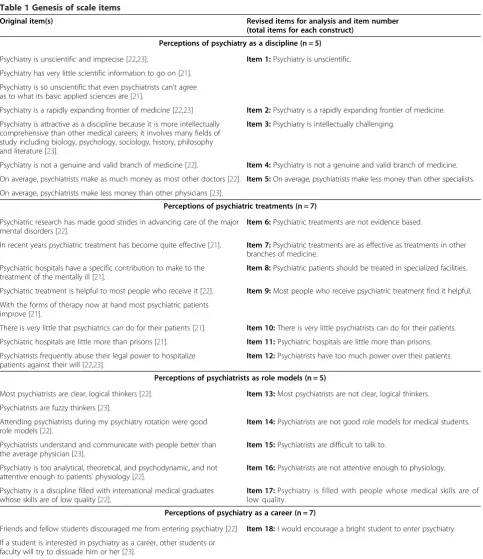
Our work was informed by three survey instruments, all of which measured attitudes of medical students: The ATP 30 scale developed by Burra and colleagues in 1982 [21], the 39-item questionnaire developed by Balon and colleagues in 1999 [22], and its predecessor, a 22-item questionnaire originally developed by Nielsen and Eaton in 1981 [23]. Only the ATP 30 had been psychometric-ally tested. Split-half reliability was high (0.9) and the six-week test-retest reliability in a control sample of first year medical students was 0.87.
Table 1 Genesis of scale items
Original item(s) Revised items for analysis and item number
(total items for each construct)
Perceptions of psychiatry as a discipline (n = 5)
Psychiatry is unscientific and imprecise [22,23]. Item 1:Psychiatry is unscientific.
Psychiatry has very little scientific information to go on [21].
Psychiatry is so unscientific that even psychiatrists can’t agree as to what its basic applied sciences are [21].
Psychiatry is a rapidly expanding frontier of medicine [22,23] Item 2:Psychiatry is a rapidly expanding frontier of medicine.
Psychiatry is attractive as a discipline because it is more intellectually comprehensive than other medical careers; it involves many fields of study including biology, psychology, sociology, history, philosophy and literature [23].
Item 3:Psychiatry is intellectually challenging.
Psychiatry is not a genuine and valid branch of medicine [22]. Item 4:Psychiatry is not a genuine and valid branch of medicine.
On average, psychiatrists make as much money as most other doctors [22]. Item 5:On average, psychiatrists make less money than other specialists.
On average, psychiatrists make less money than other physicians [23].
Perceptions of psychiatric treatments (n = 7)
Psychiatric research has made good strides in advancing care of the major mental disorders [22].
Item 6:Psychiatric treatments are not evidence based.
In recent years psychiatric treatment has become quite effective [21]. Item 7:Psychiatric treatments are as effective as treatments in other branches of medicine.
Psychiatric hospitals have a specific contribution to make to the treatment of the mentally ill [21].
Item 8:Psychiatric patients should be treated in specialized facilities.
Psychiatric treatment is helpful to most people who receive it [22]. Item 9:Most people who receive psychiatric treatment find it helpful.
With the forms of therapy now at hand most psychiatric patients improve [21].
There is very little that psychiatrics can do for their patients [21]. Item 10:There is very little psychiatrists can do for their patients.
Psychiatric hospitals are little more than prisons [21]. Item 11:Psychiatric hospitals are little more than prisons.
Psychiatrists frequently abuse their legal power to hospitalize patients against their will [22,23].
Item 12:Psychiatrists have too much power over their patients.
Perceptions of psychiatrists as role models (n = 5)
Most psychiatrists are clear, logical thinkers [22]. Item 13:Most psychiatrists are not clear, logical thinkers.
Psychiatrists are fuzzy thinkers [23].
Attending psychiatrists during my psychiatry rotation were good role models [22].
Item 14:Psychiatrists are not good role models for medical students.
Psychiatrists understand and communicate with people better than the average physician [23].
Item 15:Psychiatrists are difficult to talk to.
Psychiatry is too analytical, theoretical, and psychodynamic, and not attentive enough to patients’physiology [22].
Item 16:Psychiatrists are not attentive enough to physiology.
Psychiatry is a discipline filled with international medical graduates whose skills are of low quality [22].
Item 17:Psychiatry is filled with people whose medical skills are of low quality.
Perceptions of psychiatry as a career (n = 7)
Friends and fellow students discouraged me from entering psychiatry [22] Item 18:I would encourage a bright student to enter psychiatry.
If a student is interested in psychiatry as a career, other students or faculty will try to dissuade him or her [23].
Psychiatry has a low prestige among the general public [22]. Item 19:Psychiatry has low prestige among other medical disciplines.
Psychiatry has high status among other medical disciplines [22].
Psychiatry is a respected branch of medicine [21].
At times it is hard to think of psychiatrists as equal to other doctors [21].
items were reviewed by two of the authors (HS and NS). Items pertained to perceptions of psychiatry as a discipline (5); perceptions of the effectiveness of psychiatric treat-ments (7); perceptions of psychiatrists as role models (5); perceptions of psychiatry as a career (7); perceptions of psychiatric patients (7); and perceptions about the quality of psychiatric training (6).
Following the scoring approach recommended by Ballon et al. to avoid non-committal response sets [22], items were rated on a 4-point Likert type agreement scale ranging from strongly agree to strongly disagree, with no neutral option. Several items were reversed to avoid response patterns. To minimize social desirability bias, respondents were asked what they thought others in their medical school would endorse. This approach, originally
recommended by Link and Cullen [24], has been used extensively in population studies of stigma to minimize social responsibility biases that can emerge when asking people to make declarations of personal prejudices.
Items were translated and back translated by bilingual investigators in each setting. In some sites this was done by a single individual, and in others, by a small group. Two authors (HS and NS) independently reviewed the back translations for comparability to the original scale.
Data management and analysis
Completed surveys were returned via email (scanned .pdf files) or by courier to Queen’s University, Canada, where they were entered and analyzed. Queen’s University Health Sciences and Affiliated Teaching Hospitals
Table 1 Genesis of scale items(Continued)
Item 20:Many students at this medical school are interested in pursuing psychiatry as a career.
Many people who could not obtain a residency position in other specialties eventually enter psychiatry [22].
Item 21:Students who could not obtain a residence position in other specialties eventually end up in psychiatry.
On the whole, people taking up psychiatric training are running away from participation in real medicine [21].
Psychiatrists tend to be at least as stable as the average doctor [21]. Item 22:Students are generally attracted to psychiatry because of their own personal problems.
Most nonpsychiatric faculty and house staff at my medical school are critical of psychiatry [23].
Item 23:My colleagues generally speak well of psychiatry.
Psychiatry is unappealing because it makes so little use of medical training [21,23].
Item 24:Entering psychiatry is a waste of medical education.
Perceptions of psychiatric patients (n = 7)
Psychiatrists get less satisfaction from their work than other specialists [21]. Item 25:Working with psychiatric patients is rewarding.
I feel uncomfortable with mentally ill patients [22]. Item 26:Psychiatric patients are emotionally draining.
Item 27:Psychiatric patients tend to be violent and unpredictable.
Item 28:Psychiatric patients are highly appreciative of the care they receive.
Item 29:Psychiatric patients should be treated in specialized facilities away from general hospitals.
Psychiatric patients are often more interesting to work with than other patients [21].
Item30:Psychiatric patients are often more interesting to work with than other patients.
Psychiatric illness deserves at least as much attention as physical illness [21]. Item 31:Psychiatric illnesses deserve at least as much attention as physical illnesses.
Perceptions of Psychiatric Training (n = 6)
Teaching of psychiatry at my medical school is interesting and of good quality [22].
Item 32:Psychiatric teaching at this medical school is of the highest quality.
The majority of students report that their psychiatric undergraduate training has been valuable [21].
Item 33:Students at this medical school think that their psychiatric training has been valuable.
Item 34:Less time should be spent in the medical curriculum teaching psychiatry to medical students.
Item 35:Psychiatric rotations are well structured and informative.
Psychiatry is so amorphous that it cannot really be taught effectively [21]. Item 36:Psychiatry is so vague and imprecise it cannot really be taught effectively.
These days psychiatry is the most important part of the curriculum in medical schools [21].
Research Ethics Board granted ethics clearance. In addition, some study sites also obtained local ethics reviews and clearances.
We first conducted an exploratory factor analysis. Because the results of exploratory factor analysis may not be replicable in a new sample (there is a tendency for models to over-fit the data), we randomly split the sample. Exploratory factor analysis was conducted on the first half of the sample and confirmatory factor analysis was con-ducted on the second half. Osborne and Fitzpatrick [25] refer to this as internal replication and recommend that researchers examine their exploratory factor analysis solu-tions using replication samples to determine the extent to which their solutions are likely to be robust. Items with strong loadings in the exploratory analysis may not load strongly in the confirmatory analysis and so may need to be dropped once the confirmatory factor analysis is completed.
Because the survey items were ordinal, we performed principal components factor analysis using the polychoric correlation matrix and varimax rotation. We examined eigenvalues (1.0 or greater), scree plots, and factor load-ings to select two potential factors. Once the factors were selected we conducted two confirmatory factor analyses on the remaining half of the sample with structural equa-tion modeling using Stata 13 [26] following the proce-dures described by Acock [27]. In the confirmatory factor analysis, we allowed for correlation between the factors as this occurs frequently even when varimax rotation has been used in the exploratory analysis to identify uncorre-lated factors [28]. We examined a variety of goodness of fit statistics to assess the appropriateness of the model to the data. We eliminated items with poor factor correla-tions (under 0.4) and respecified the model based on model indices statistics. To obtain a better fitting model, we conducted a second confirmatory factor analysis allow-ing for correlated error variances between items within a scale whenever the modification indices were 10 or higher on the assumption that highly correlated items may also have correlated errors. We examined the wording of all correlated items to ensure that they made conceptual sense. We used Cronbach’s alpha to assess internal reliability of the resulting scales.
Results
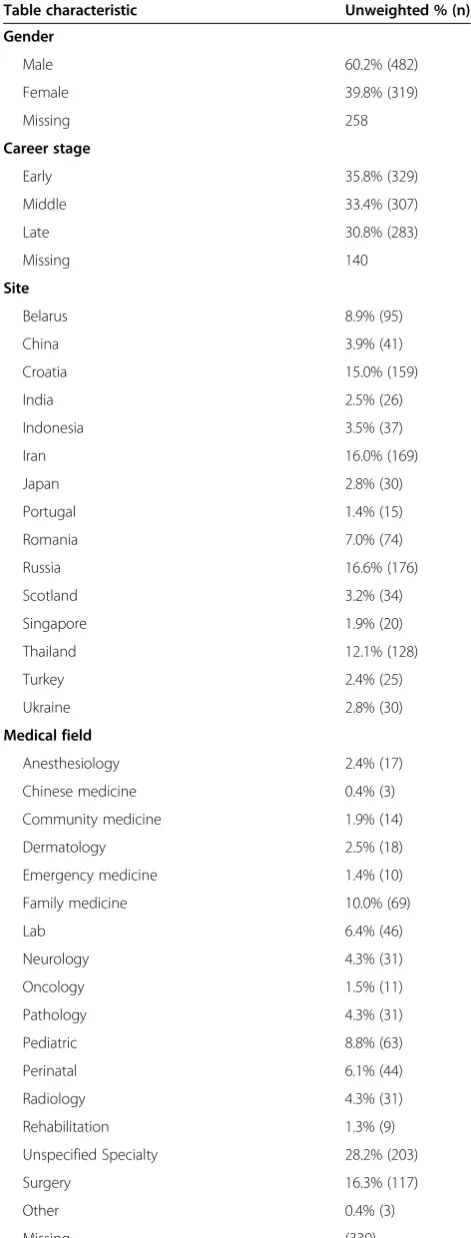
Table 2 describes the composition of the full sample. The majority of respondents were male (60.2%). Career stage was evenly distributed by design. Study sites were predominantly from Asia-Pacific and Eastern European countries, though a site in Scotland also provided data. In two instances (Russia and Thailand) more than one study site contributed data. We could determine the med-ical field for all but 32% (n = 339) of the sample, however the largest group (19%) was from an undisclosed specialty.
[image:5.595.303.539.102.722.2]Table 2 Sample composition
Table characteristic Unweighted % (n)
Gender
Male 60.2% (482)
Female 39.8% (319)
Missing 258
Career stage
Early 35.8% (329)
Middle 33.4% (307)
Late 30.8% (283)
Missing 140
Site
Belarus 8.9% (95)
China 3.9% (41)
Croatia 15.0% (159)
India 2.5% (26)
Indonesia 3.5% (37)
Iran 16.0% (169)
Japan 2.8% (30)
Portugal 1.4% (15)
Romania 7.0% (74)
Russia 16.6% (176)
Scotland 3.2% (34)
Singapore 1.9% (20)
Thailand 12.1% (128)
Turkey 2.4% (25)
Ukraine 2.8% (30)
Medical field
Anesthesiology 2.4% (17)
Chinese medicine 0.4% (3)
Community medicine 1.9% (14)
Dermatology 2.5% (18)
Emergency medicine 1.4% (10)
Family medicine 10.0% (69)
Lab 6.4% (46)
Neurology 4.3% (31)
Oncology 1.5% (11)
Pathology 4.3% (31)
Pediatric 8.8% (63)
Perinatal 6.1% (44)
Radiology 4.3% (31)
Rehabilitation 1.3% (9)
Unspecified Specialty 28.2% (203)
Surgery 16.3% (117)
Other 0.4% (3)
Otherwise, the most frequently occurring fields were family medicine and surgery.
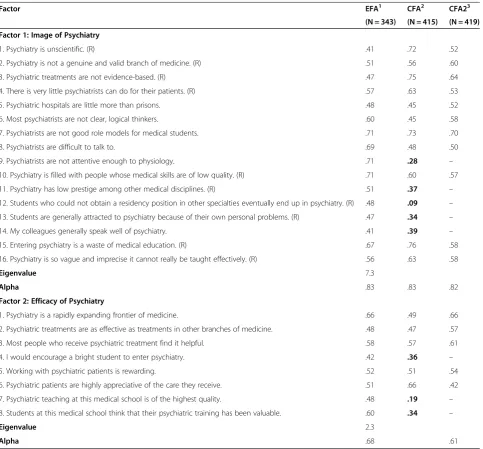
The Kaiser-Meyer-Olkin measure of sampling adequacy of .73 indicated that the survey items were sufficiently correlated to warrant conducting a factor analysis. Table 3 shows these results. Column 2 of Table 3 describes the factor loadings associated with the exploratory factor ana-lysis, excluding any items with loadings less than 0.4. Two factors emerged with strong eigenvalues over 1.0 account-ing for 54% of the overall variance. Factor one had an
eigenvalue of 7.3 and factor 2 had an eigenvalue of 2.3. Three additional factors had eigenvalues exceeding 1.0 (1.8, 1.3, and 1.1 respectively); however the item loadings on these factors were sparse, conceptually inconsistent, and the alpha values were disappointing. Therefore, we chose a two-factor solution as the best fit for this dataset. Thirteen items were eliminated at this stage.
[image:6.595.58.542.242.691.2]Items loading on the first factor were those reflecting negative stereotypic images of psychiatry, psychiatrists, and psychiatric residents such as psychiatry is unscientific;
Table 3 Factor loadings from the exploratory factor analysis (EFA), the confirmatory factor analysis (CFA) and the confirmatory model respecified (CFA2)
Factor EFA1 CFA2 CFA23
(N = 343) (N = 415) (N = 419)
Factor 1: Image of Psychiatry
1. Psychiatry is unscientific. (R) .41 .72 .52
2. Psychiatry is not a genuine and valid branch of medicine. (R) .51 .56 .60
3. Psychiatric treatments are not evidence-based. (R) .47 .75 .64
4. There is very little psychiatrists can do for their patients. (R) .57 .63 .53
5. Psychiatric hospitals are little more than prisons. .48 .45 .52
6. Most psychiatrists are not clear, logical thinkers. .60 .45 .58
7. Psychiatrists are not good role models for medical students. .71 .73 .70
8. Psychiatrists are difficult to talk to. .69 .48 .50
9. Psychiatrists are not attentive enough to physiology. .71 .28 –
10. Psychiatry is filled with people whose medical skills are of low quality. (R) .71 .60 .57
11. Psychiatry has low prestige among other medical disciplines. (R) .51 .37 –
12. Students who could not obtain a residency position in other specialties eventually end up in psychiatry. (R) .48 .09 –
13. Students are generally attracted to psychiatry because of their own personal problems. (R) .47 .34 –
14. My colleagues generally speak well of psychiatry. .41 .39 –
15. Entering psychiatry is a waste of medical education. (R) .67 .76 .58
16. Psychiatry is so vague and imprecise it cannot really be taught effectively. (R) .56 .63 .58
Eigenvalue 7.3
Alpha .83 .83 .82
Factor 2: Efficacy of Psychiatry
1. Psychiatry is a rapidly expanding frontier of medicine. .66 .49 .66
2. Psychiatric treatments are as effective as treatments in other branches of medicine. .48 .47 .57
3. Most people who receive psychiatric treatment find it helpful. .58 .57 .61
4. I would encourage a bright student to enter psychiatry. .42 .36 –
5. Working with psychiatric patients is rewarding. .52 .51 .54
6. Psychiatric patients are highly appreciative of the care they receive. .51 .66 .42
7. Psychiatric teaching at this medical school is of the highest quality. .48 .19 –
8. Students at this medical school think that their psychiatric training has been valuable. .60 .34 –
Eigenvalue 2.3
Alpha .68 .61
1
Rotated loadings (> .4) using varimax rotation. (R) = Reverse coding. Kaiser-Meyer-Olkin measure of sampling adequacy = .73. 2
Chi square model vs saturated 1215, df = 448, p < .001; Root mean square error of approximation = .10; Comparative fit index = .54 Standardized root mean squared residual = .40; Coefficient of determination = .96.
3
students are attracted to psychiatry because of their own problems; or entering psychiatry is a waste of a good edu-cation. We designated this scale theImages of Psychiatry Scale. Cronbach’s alpha for the items composing this 16-item scale showed high internal reliability in this sample (.83). The eight items that loaded on the second factor portrayed psychiatry as a rewarding and efficacious branch of medicine, such as psychiatry is a rapidly emerging fron-tier of medicine; most people who receive psychiatric treatment find it helpful; or working with psychiatric pa-tients is rewarding. We designated this scale theEfficacy of Psychiatry Scaleand noted it had acceptable reliability in this sample (alpha = .68). Because we used varimax ro-tation, the factors were uncorrelated.
Colum 3 of Table 3 summarizes the results of the first confirmatory factor analysis (CFA1) testing a model with two scales with uncorrelated error variances between items. Several of the key goodness of fit statistics indicated that the model was a poor fit for the data. The Chi-square statistic was significant (which often happens in samples over 200), the root mean square error of approximation (RMSEA) was well above the .05 threshold at .10, the comparative fit index of .54 was considerably less that the desired .90 threshold, the standardized root mean squared residual was greater than .05. In addition, 5 items on the Images scale and 3 items on the Efficacy scale had correla-tions of less than .40. This model explained 96% of the variation in the data.
Column 4 of Table 3 summarizes the results of the second confirmatory factor analysis (CFA2) using the same second half of the sample with a respecified model allowing for correlated errors within scales. The fit of
this model was considerably improved. Though the Chi square statistics remained significant (as expected), the Root mean square error of approximation was reduced to .055, the comparative fit index rose to .80, and the standardized root mean squared residual dropped to .13. This model also explained 95% of the variation in the data. Internal consistency was high for the resulting 11-item Images Scale (.82) and acceptable but lower than desirable on the 5-item Efficacy Scale (.61), likely due to the smaller number of items. The final two scales were modestly correlated (.50).
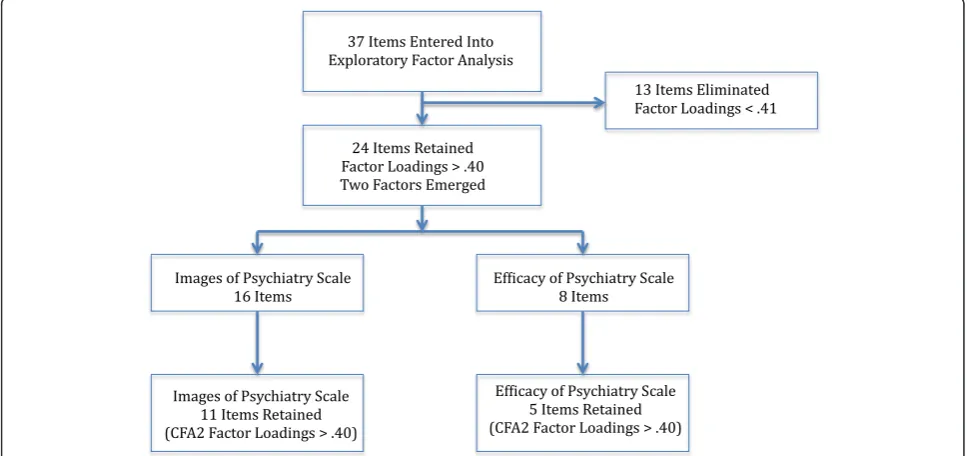
Figure 1 summarizes the results of the exploratory and the confirmatory factor analyses in terms of the items retained at each step. It shows the results of the second and best fitting confirmatory factor analysis. Thirty-seven items were entered into the exploratory factor analysis. Thirteen were eliminated with factor loadings of .40 or less. The remaining 24 items loaded on two factors: 16 items on the Images of Psychiatry Scale, and 8 items on the Efficacy of Psychiatry Scale. On the basis of the second confirmatory analysis, 11 items were retained on the Images of Psychiatry Scale and 5 were retained on the Psychiatric Efficacy Scale. The specific items that were retained appear in Colum 4 of Table 3. Items that were eliminated appear in bold in Column 3 of Table 3.
Discussion
[image:7.595.56.540.485.713.2]There is growing concern over the shortage of psychiatrists worldwide and many organizations, such as the World Psychiatric Association, the American Psychiatric As-sociation, and the European Psychiatric AsAs-sociation, have attempted to understand the reasons behind low
recruitment levels among medical students [13]. For example, Farooq and colleagues recently studied the career plans of 2198 final year medical students in 46 medical schools from 40 countries. Across all countries, 4.5% of students definitely considered psychiatry as a car-eer choice. Women, prior experience with a mental or physical illness, media portrayal of doctors, and positive attitudes to psychiatry were associated with a career choice of psychiatry. In order for the survey to be suffi-ciently brief to improve response rates, a number of fac-tors, including potentially stigmatizing attitudes towards psychiatry and psychiatrists, were not addressed [10].
The scales developed in this research can be used to examine the attitudes of medical educators and their effects on psychiatry career choices of medical students, which is an important gap in our knowledge. Prior to this study, a psychometrically tested scale using both exploratory and confirmatory factor analysis did not exist. We identified two unidimensional scales. The first
measures stereotypic Images of Psychiatryand
psychia-trists. The second measures positive aspects ofEfficacy of Psychiatry. The Images Scale was the longer and stronger of the two. As alpha values are influenced by the number of scale items, it is likely that theEfficacy of Psychiatry Scale could be improved in future research with the addition of a broader range of items.
A persistent question faced by those measuring attitudes has been the extent to which responses reflect socially cor-rect responses, as opposed to the more deeply held atti-tudes that are embedded in our cultural views and more likely to govern behaviours. Link and Cullen have opera-tionalized these deeper attitudes by asking respondents to
indicate how they think“most people”would respond to
someone with a mental illness. They found that, when asked directly, respondents tended to report idealized responses reflecting cultural norms for politically correct responses. When deeper attitudes were measured, scores were higher, reflecting greater stigma [24]. Based on this research, an important strength of our measurement approach was to ask medical educators to indicate the view that they thought best reflected the attitudes of their colleagues in their medical schools. Similarly, as recom-mended by Balon and colleagues [22] we deliberately excluded a neutral category in the agreement scale to avoid non-committal response sets.
A second strength of our approach was that we based our results on a large heterogeneous sample of medical educators drawn randomly from 23 academic settings in 15 countries. Survey items were translated and back translated following a systematic process with final approval from the principal investigators. This means we can have some confidence that these scales will behave well in a wide assortment of samples and educational settings. However, the test sites in this research did not
include centres from countries such as Canada, the United States, or Western Europe, where the bulk of this research tends to occur. Also, there were a high number of missing values pertaining to socio-demographic characteristics and medical field, as these were not always obvious from the staff directories. Therefore, future research is needed to assess the usefulness of these instruments in a wider sample of North American and European countries.
Conclusions
Using exploratory and confirmatory factor analyses, we identified two unidimensional scales to measure attitudes of medical educators toward psychiatry and psychiatrists: theImages of Psychiatry Scale(11 items) and theEfficacy of Psychiatry Scale (5 items). These constitute the first psychometrically tested scales to measure attitudes of medical educators—knowledge that is important if we are to better understand the determinants of low recruitment into psychiatry.
Competing interests
The authors declare that they have no competing interests.
Authors’contributions
HS participated in the design of this study and took the lead on data management, analysis and reporting. NS participated in the design of this study, the recruitment of members for the Images study group, and reviewed and commented on all drafts of this paper. TL took the lead on data entry and quality assurance. In addition she reviewed and commented on a draft of this paper. Members of the images study group were responsible for executing the study, including obtaining local ethics reviews where appropriate. All members of the Images Study group reviewed and commented on a draft of this paper. All authors read and approved the final manuscript.
Acknowledgements
This study was funded, in part, by the Association for the Improvement of Mental Health Services, Geneva, Switzerland. The authors would like to acknowledge the support provided by Yakov Kochetkov, Valeriy Krasnov. The Images Study Group: Valentin Artounian, Daniel M. Bennett, Monica Boer, Cristina Bredicean, Maria Denisenko, Joanna Franz, Catalina Giurgi-Oncu, Ravi Gupta, Tanja Grahovac, Hitoshi Iida, Nikolina Jovanovic, Fransiska Kaligis, Ozge Kilic, Kentaro Kira, Nina Kruk, Ketsiri Liamwanich, João Gama Marques, Chen Min, Eduard Motoescu, Ali-Akbar Nejatisafa, Maria Orlova, Maria Parpara, Alexey Romanov, Costin Emilian Roventa, Daria Smirnova, Kanida Tassniyom, Dan Teodorescu, Dina Tukhvatullina,Phern-Chern Tor, Naoki Uchida, Lidia Nica Udangiu, Emilian Valcu.
Author details
1Department of Public Health Sciences, Queen’s University, Kingston, Ontario, Canada.2Association for the Improvement of Mental Health Programs, Geneva, Switzerland.3Centre for Health Services and Policy Research, Queen’s University, Kingston, Ontario, Canada.
Received: 20 February 2014 Accepted: 13 November 2014
References
1. Stampfer H:The recruitment problem in psychiatry: a critical commentary.Educ Res Perspect2011,38(2):1–19.
2. Brown N, Vassilas C, Oakley C:Recruiting psychiatrists–a sisyphean task?
Psychiatr Bull2009,33:390–392.
4. Syed E, Siddiqi M, Doqar I, Hamrani M, Yousafzai A, Zuberi S:Attitudes of Pakistani medical students towards psychiatry as a prospective career: a survey.Acad Psychiatr2008,32:160–164.
5. Soufi H, Raoof A:Attitude of medical students toward psychiatry.Med Education1992,26:38–48.
6. Rajagopal S, Rehill K, Godfrey E:Psychiatry as a career choice compared with other specialties. A survey of medical students.Psychiatr Bull2004, 28:444–446.
7. Pan P, Lee P, Lei-Mak F:Psychiatry as compared to other career choices: a survey of medical students in Hong Kong.Med Education1990,24:251–257. 8. Dmeteo D, Khasakhala L, Ongecha-Owuor F, Kuria M, Mutiso V, Syanda J,
Kokonya D:Attitudes toward psychiatry: a survey of medical students at the University of Nairobi, Kenya.Acad Psychiatr2008,32:154–159. 9. Al-Ansari A, Alsadadi A:Attitude of Arabian gulf university medical
students towards psychiatry.Education for Health2002,15(2):180–188. 10. Farooq K, Lydall G, Malik A, Ndetei D, Group I, Bhugra D:Why medical
students choose psychiatry - a 20 country cross-sectional survey.
BMC Medical Education2014,14(12):1–13.
11. Sierles F, Yager J, Weissman S:Recruitment of U.S. medical graduates into psychiatry: reasons for optimism, sources of concern.Acad Psychiatr2003, 27:252–259.
12. Halder N, Hadjidemetriou C, Pearson R, Farooq K, Lydall G, Malik A, Bhugra D:Student career choice in psychiatry: findings from 18 UK medical schools.Int Rev Psychiatr2013,25(4):438–444.
13. Fiorillo A, Del Vecchio V, Luciano M, Sampogna G, Beezhold J:This is why there is hope for psychiatry.World Psychiatry2014,13(1):98–99. 14. Burvill P:Looking beyond the 1:10,000 ratio of psychiatrists to
population.Aust NZ J Psychiat1992,26(2):265–269.
15. The World Health Organization:Atlas: Country Profiles on Mental Health Resources 2001.Geneva, Switzerland: World Health Organization; 2001. 16. Paihez G, Bulbena A, Coll J, Ros S, Balon R:Attitudes and views on
psychiatry: a comparison bewteen Spanish and US medical students.
Acad Psychiatr2005,29:82–91.
17. Feifel D, Moutier C, Swerdlow N:Attitudes toward psychiatry as a prospective career among students entering medical school.
Am J Psychiat1999,156:1397–1402.
18. Abramowitz M, Bentov-Gofrit D:The attitudes of Israeli medical students toward residency in psychiatry.Medical Psychiatry2005,107:424–429. 19. Hunt D, Scott C, Zhong S, Goldstein E:Frequency and effect of negative
comments (“badmouthing”) on medical students’career choices.Acad Med1996,71:665–669.
20. Stuart H, Sartorius H, Liinamaa T, Images Study Group:Images of Psychiatry and Psychiatrists.Acta Psychiatr Scand. in press
21. Burra P, Kalin R, Leichner P, Waldron J, Handforth J, Jarrett F, Amara I:The ATP 30 - a scale for measuring medical students’attitudes to psychiatry.
Med Education1982,16:31–38.
22. Balon R, Franchini G, Freeman P, Hassenfeld I, Keshavan M, Yoder E:Medical students’attitudes and views of psychaitry: 15 years later.Acad Psychiatr
1999,23:30–36.
23. Nielsen AEJ:Medical students’attitudes and views of psychiatry.
Acad Psychiatr1981,38:1144–1154.
24. Link B, Cullen F:Reconsidering the social rejection of ex-mental patients: levels of attitudinal response.Am J Commun Psychol1983,11(3):261–273. 25. Osborne J, Fitzpatrick D:Replication analysis in exploratory factor analysis:
what it is and why it makes your analysis better.Practical Assessment Research & Evaluation2012,17(15):1–8.
26. StataCorp:Stata Statistical Software: Release 13.College Station (Texas): StataCorp LP; 2013.
27. Acock A:Discovering Structural Equation Modeling Using Stata Revised Edition.
StataCorp LP: College Station (Texas); 2013.
28. Gerbing D, Anderson J:An updated paradigm for scale development incorporating unidimensionality and its assessment.J Marketing Res1988, 25(2):186–192.
doi:10.1186/s12888-014-0337-1
Cite this article as:Stuartet al.:The images of psychiatry scale: development, factor structure, and reliability.BMC Psychiatry201414:337.
Submit your next manuscript to BioMed Central and take full advantage of:
• Convenient online submission
• Thorough peer review
• No space constraints or color figure charges
• Immediate publication on acceptance
• Inclusion in PubMed, CAS, Scopus and Google Scholar
• Research which is freely available for redistribution