R E S E A R C H A R T I C L E
Open Access
Use of a formal consensus development
technique to produce recommendations for
improving the effectiveness of adult mental
health multidisciplinary team meetings
Rosalind Raine
1*, Caoimhe Nic a
’
Bháird
1, Penny Xanthopoulou
1, Isla Wallace
1, David Ardron
2, Miriam Harris
3,
Julie Barber
4, Archie Prentice
5, Simon Gibbs
6,7, Michael King
8, Jane M. Blazeby
9, Susan Michie
10, Anne Lanceley
11,
Alex Clarke
12and Gill Livingston
13Abstract
Background:Multidisciplinary team (MDT) meetings are the core mechanism for delivering mental health care but it is unclear which models improve care quality. The aim of the study was to agree recommendations for improving the effectiveness of adult mental health MDT meetings, based on national guidance, research evidence and experiential insights from mental health and other medical specialties.
Methods:We established an expert panel of 16 health care professionals, policy-makers and patient representatives. Five panellists had experience in a range of adult mental health services, five in heart failure services and six in cancer services. Panellists privately rated 68 potential recommendations on a scale of one to nine, and re-rated them after panel discussion using the RAND/UCLA Appropriateness Method to determine consensus.
Results:We obtained agreement (median≥7) and low variation in extent of agreement (Mean Absolute Deviation from Median of≤1.11) for 21 recommendations. These included the explicit agreement and auditing of MDT meeting objectives, and the documentation and monitoring of treatment plan implementation.
Conclusions:Formal consensus development methods that involved learning across specialities led to feasible recommendations for improved MDT meeting effectiveness in a wide range of settings. Our findings may be used by adult mental health teams to reflect on their practice and facilitate improvement. In some other contexts, the recommendations will require modification. For example, in Child and Adolescent Mental Health Services, context-specific issues such as the role of carers should be taken into account. A limitation of the comparative approach adopted was that only five members of the panel of 16 experts were mental health specialists.
Keywords:Multidisciplinary team, Recommendations, Chronic diseases, Consensus development method, Adult mental health
Background
Multidisciplinary team (MDT) meetings for chronic dis-eases are well established in the NHS [1–4] and have been the core model for delivering mental health care for decades [5]. However, they are resource intensive, commonly occupying teams of more than a dozen pro-fessionals for several hours each week. Moreover, there
is substantial diversity in their perceived purpose and their organisation, both between mental health teams and across other chronic disease MDTs [6–9]. This can partly be explained by variations in guidance provided for different conditions. Thus, cancer teams follow na-tional guidance which sets out prescribed features of MDT meetings with respect to structure, attendance, documentation of decisions and administrative support. Cancer MDTs are nationally audited against a detailed list of indicators relating to these features [1, 10, 11]. In con-trast, in mental health relatively little national guidance is * Correspondence:[email protected]
1
Department of Applied Health Research, University College London, London WC1E 7HB, UK
Full list of author information is available at the end of the article
available and locally determined arrangements are often advocated [3, 12]. Where recommendations are made, they tend to lack specificity. For example, guidance for Memory Clinics simply states that care plans for patients should be developed in consultation with a number of dif-ferent (but unspecified) disciplines [13]. It is telling that in comparison with teams in other specialities, adult mental health teams are often idiosyncratic and produce and im-plement fewer MDT decisions [8].
Variations in team practice may reflect appropriate re-sponsiveness to local needs, but may also indicate uncer-tainty or a lack of evidence regarding the most effective ways to conduct MDT meetings. Policy makers are now focusing on the need to improve the quality of mental health service provision through the establishment of a Mental Health Intelligence Network, based on the can-cer model, to better monitor variations in provision [14]. In addition, the Care Quality Commission recently com-mitted to developing definitions of ‘what good looks like’ in mental health services [15]. Enhancing the effectiveness of the MDT meeting, the key management decision-making body, is central to improving care overall and re-ducing unwarranted variations in care.
Uncertainty about determinants of MDT effectiveness is, in part, secondary to insufficient or inconclusive empir-ical evidence. One approach to address a lack of research or research ambiguities is to use formal consensus methods [16, 17]. These are structured facilitation tech-niques that measure levels of consensus among experts by synthesising their opinions [18]. In contrast to informal decision-making groups such as committees, they follow explicit steps that can be replicated. They have been used to formulate clinical practice guidelines and to inform ser-vice development in mental health [19, 20]. The three consensus methods most often used in health care re-search are the Delphi Method, the Nominal Group Tech-nique, and the RAND/UCLA Appropriateness Method [16, 21, 22]. In practice, formal consensus studies often adapt components from each of these approaches to achieve their aims [17].
We applied the RAND/UCLA Appropriateness Method (RAM) to examine the extent to which it is possible to de-rive feasible recommendations for improving the effective-ness of mental health MDT meetings. This was part of a larger study aiming to derive recommendations which are generalisable across MDTs for patients with a range of common diseases [8]. In addition to adult mental health, we therefore also examined other disease specialties, en-suring that we included those for which comprehensive guidance exists (cancer) and others where it does not (heart failure). This allowed us to identify areas where spe-cialities could ‘learn from one another’ and areas where condition specific recommendations were likely to be re-quired. In this paper we present recommendations that
can be implemented by adult mental health MDTs to im-prove their quality. Our focus is on generic recommenda-tions for the weekly adult mental health meeting typically attended by the whole multidisciplinary team, rather than Care Plan Assessments (CPAs) and Mental Health Act as-sessments, which have specific requirements and formats.
Methods
We convened a panel of experts, which included five mental health panellists with expertise in adult mental health care settings. Panellists first rated a series of rec-ommendations on the basis of the research evidence which we provided within the context of their experi-ence of MDT meetings and their expertise and know-ledge. These ratings were done privately using a postal questionnaire. This was followed by a meeting during which panellists revised their ratings in the light of quantitative feedback on the panel’s initial ratings, a dis-cussion of the rationale for their judgements, again within the context of their own experiences [23]. Each component of this process is described in more detail below and summarised in Fig. 1.
Generating recommendations for the expert panel to rate
We used the following sources of evidence to generate recommendations for rating by the expert panel:
Research evidence
We used the results from a large mixed-methods obser-vational study of 12 MDTs (in adult mental health, memory, cancer, and heart failure services) which we had recently undertaken [9]. In this research we exam-ined the determinants of effective MDT decision-making and explored areas of diversity in MDT meetings. We collected data from three sources: non-participant obser-vation of MDT meetings, semi-structured interviews with MDT professionals and patients, and clinical data from medical records. The mental health data in this study came from observations of the meetings of six Adult Community Mental Health, Early Intervention in Psychosis and Memory Clinic teams (all from the North Thames area of England, held between December 2010 and December 2012), and from semi-structured interviews with 35 mental health professionals and patients. We gen-erated recommendations from our quantitative analysis which identified determinants of implementation of MDT decisions. We also drew on our qualitative data which ex-plored specific practices considered effective by some teams but not used in others, appropriate issues for MDT discussions, team structure and other MDT features, and ways to improve MDT meetings and to incorporate pa-tient preferences into MDT discussions.
on key aspects of MDT meetings, including their pur-pose, structure, meeting processes, content of discus-sions, and the role of the patient.
National guidance
We identified key national policies and guidance for men-tal health [3, 24] and memory clinic [13, 25–28] MDTs, in addition to guidance for cancer [1, 10, 11, 29–32] and heart failure MDTs [33–35].
Developing recommendations
Using these data sources, we developed an initial list of recommendations of potential ways to improve the ef-fectiveness of MDT meetings. These recommendations were refined in analytic conferences with all members of the research team to ensure that they were supported by the data. We also ensured that each recommendation was clear and precise and included only one issue for consideration.
In total we generated 68 recommendations for the ex-pert panel to rate. These recommendations were grouped into a 16 section questionnaire, based on categories gener-ated by a thematic analysis of the data. The final categories related to MDT purpose, structure, meeting processes, content of discussions, and the role of the patient (see Additional file 1).
The questionnaire
[image:3.595.57.541.89.293.2]Each of the 16 sections in the questionnaire summarised the policy, guidance and research evidence relating to each group of recommendations in that section. The full questionnaire pack is provided in Additional file 2. We instructed panellists to rate their level of support for each recommendation, according to its desirability and feasibility, by drawing on the information provided and on their own knowledge and experience of MDT meet-ings in their specialty [36]. Ratmeet-ings were on a nine-point Likert Scale, where a rating of 1 indicated that the panel-list strongly disagreed with the recommendation, a rat-ing of 5 indicated neither agreement nor disagreement (i.e. depends on circumstances), a rating of 9 indicated strong agreement, and‘don’t know’indicated that partic-ipants did not think they were informed enough to re-spond. An example of a recommendation is provided in Fig. 2.
Identification and establishment of the consensus development panel
We purposively sampled 22 health care professionals, policy-makers and patient representatives from different Trusts and regions of England, and with MDT experience of adult mental health, heart failure and cancer. Potential participants were identified by consulting the project’s Steering Group and relevant professional organisations.
Fig. 1Overview of the consensus development method used
Implementation of MDT decisions should be audited annually
Strongly ………Strongly Disagree Agree
Don’t know
1 2 3 4 5 6 7 8 9
[image:3.595.54.541.654.718.2]This approach helped to ensure that participants had credibility as experts in their field and were representative of their profession [17]. Three patient representatives (in-cluding a carer for a mental health patient) identified and recruited by our patient co-applicants, were included to bring their perspective to the discussion. Sixteen of the in-dividuals invited agreed to participate, including five men-tal health experts (one psychiatrist, two psychiatric nurses, one occupational therapist and one patient representa-tive). These panellists had expertise in an extensive range of adult mental health care settings, including adult com-munity mental health teams, inpatient wards, day hospi-tals, learning disability teams, rehabilitation and recovery services, and specialist teams for substance misuse, home-lessness, and forensic populations. The professional back-grounds of the other panellists are shown in Additional file 1.
Expert panel Round One–consensus development questionnaire
Ten weeks before the consensus development meeting, panellists were sent the first round questionnaire for completion in private.
Expert panel Round Two–consensus development meeting The ratings from Round One were used to develop a personalised version of the questionnaire for each panel member (Fig. 3). These showed the participant’s own re-sponses (in red) and the distribution of rere-sponses for all panellists for each item (in italics above the Likert scale). This information was distributed to the panellists at the consensus meeting, which was chaired by the Chief Investigator who is experienced in facilitating formal consensus panels. The purpose of this meeting was to discuss those recommendations where there was a lack of consensus, to explore causes of divergent responses, and to identify where the lack of consensus was second-ary to different interpretations of the recommendations. Panellists were encouraged to discuss reasons for differ-ences in ratings before re-rating each item privately. The facilitator ensured that all participants had an opportun-ity to contribute during the meeting, and made clear that participants did not need to conform to the group
view [16]. Where it transpired that disagreement was the result of differing interpretations, the recommendation was discussed and new wording agreed to clarify any ambiguities prior to re-rating. Where there had been consensus (defined below) in the first round ratings, rec-ommendations were not discussed individually, although the broader discussion usually touched on the issues ad-dressed in these recommendations and panellists were given the opportunity to comment on all recommenda-tions before re-rating them.
With the consent of all the panellists, the meeting was audiotaped and field notes taken to ensure that we could correctly identify the profession and disease specialty as-sociated with each discussion point made.
Data entry and analysis
Data entry
Ratings were entered into a database using SPSS version 21 for Windows. There were no missing data. At each round, we double-checked 25 % of the data entered against the original paper questionnaires to ensure accur-acy. No errors were detected.
Analysis of Round One ratings
We measured the spread of responses to each recom-mendation using RAND guidelines [23]. ‘Consensus’for a panel of 16 members is defined as four or fewer panel-lists rating outside the 3-point region containing the me-dian (1–3.5, 4–6.5, 7–9;i.e.where at least three-quarters of respondents rate in the same third of the scale). This allowed us to prioritise recommendations for discussion at the consensus meeting. 21 recommendations met this criterion and these were not discussed individually at the meeting. The remaining 47 recommendations were dis-cussed individually.
Analysis of Round Two ratings: quantitative analysis For each item, we examined the strength of agreement with each recommendation, and the variation in extent of agreement among panellists.
The strength of the group’s agreement with each rec-ommendation was indicated by the median [37]. Me-dians between 7 and 9 indicated agreement with the
Implementation of MDT decisions should be audited annually
Strongly ……… Strongly Disagree Agree
1 2 2 1 3 5
Don’t know
1 2 3 4 5 6 7 8 9
[image:4.595.58.539.623.705.2]recommendation, medians between 4 and 6.5 indicated uncertainty, and medians between 1 and 3.5 indicated disagreement. These ranges cover all possible medians for a 16 member panel and are based on the defini-tions provided in the RAM User’s Manual [23].
The group’svariation in extent of agreement was indi-cated by the mean absolute deviation from the median (MADM) [37]. This was categorised into low, moderate and high variation according to thirds of the observed MADM scores (low <1.11, moderate 1.11-1.75, and high variation >1.75).
We defined a recommendation as a final recommenda-tion for improving the effectiveness of MDT meetings if both agreement (median between 7–9) and low variation in extent of agreement (MADM <1.11) were present.
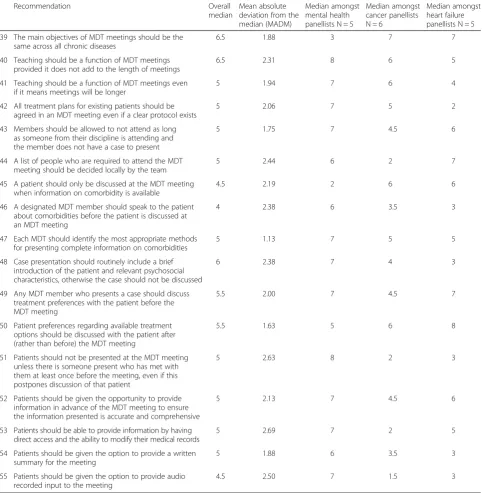
Where recommendations were rated ‘uncertain’ (me-dians 4–6.5) or ‘disagree’ (medians 1–3.5), we cate-gorised the panellists into mental health, cancer, and heart failure groups and calculated the median score for each group. This allowed us to provisionally investigate whether uncertainty or disagreement might be secondary to disease specific considerations.
Analysis of Round Two ratings: qualitative analysis
We transcribed the meeting in full. We conducted a the-matic analysis of the meeting transcript, coding the panellists’comments regarding each recommendation to highlight the range of views about each item discussed and to identify possible explanations for differences in ratings. We used the qualitative data to identify whether there were differences of opinion between the mental health experts and the experts from the other conditions.
Ethical approval
The study was approved by East London Research Ethics Committee (10/H0704/68) and the National Information Governance Board for Health and Social Care (ECC 6– 05 (h)/2010).
Results
Results from the second (i.e.final) round of ratings are summarised and presented in Tables 1, 2, 3, 4 and 5 below. Of the 68 potential recommendations, only one needed to be re-worded for clarity before re-rating.
Recommendations where there was agreement andlow
variation in extent of agreement
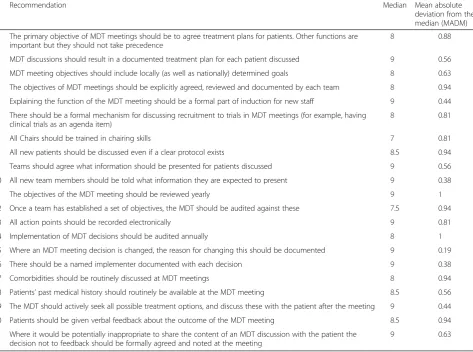
We identified 21 recommendations for which there was both agreement (median≥7) and low variation in the ex-tent of agreement (MADM score <1.11; Table 1). This included six recommendations relating to the purpose of the meetings (Table 1, Recommendations 1–6), ten relat-ing to meetrelat-ing processes (Table 1, Recommendations 7– 16), two relating to content of the discussion, and three
relating to the role of the patient. Panellists from all spe-cialties agreed that these recommendations were desirable and feasible. A printable list of these final recommenda-tions is also provided in Box 3 of Additional file 1.
Recommendations where there was agreement buthigh
or moderatevariation in the extent of agreement
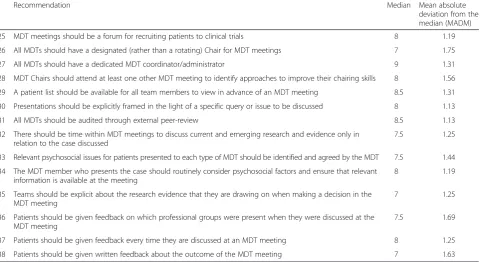
There were a further 17 recommendations where there was agreement (medians between 7 and 9) but high or moderate variation in the extent of that agreement be-tween panellists (Tables 2 and 3).
Where there were differences in opinion, the qualita-tive data highlighted that the main concern amongst panellists was feasibility. For example, some panellists raised concerns about the feasibility of having a desig-nated person at each MDT meeting to identify suitable patients for clinical trials (Recommendation 22), and of giving patients feedback on all treatment options, even those rejected by the MDT (Recommendation 23):‘I just thought it was impractical…you would be entering into a very, very, very long conversation, creating a lot of con-flict, instead of it [the feedback] being [about] the treat-ment you think is practical and will hopefully work’ (doctor, mental health). Similarly, some panellists thought that allowing patients to choose the mode of MDT feedback was impractical: ‘I disagree …we can’t actu-ally commit to sending everyone written feedback…be-cause of time constraints’ (team manager, mental health: Recommendation 24).
Furthermore, mental health panellists did not always agree with each other. For example there were differ-ences of opinion about whether all MDTs should have a dedicated MDT coordinator or administrator (Recom-mendation 27). While a mental health nurse supported this recommendation: ‘clinicians end up doing a lot of work which could easily be done by someone else… [it would] free up their time’,a mental health doctor argued: ‘I’m not sure that we need them [a dedicated administra-tor]…the person who’s seen them needs to be able to pull all that together succinctly and report back to the team, why do you need someone to coordinate that?’
dysfunctional for three months whilst someone is thrown into the position of Chair who doesn’t really want to be doing it, and doesn’t necessarily have the skills to do it’ (doctor, cancer: Recommendation 26).
Recommendations rated as‘uncertain’
There were 17 recommendations where the strength of agreement was ‘uncertain’ (median rating was ≥4 and ≤6.5). However, calculating the median score for panel-lists from each discipline separately, showed that mental health panellists had rated ‘agree’ or ‘disagree’for 13 of these (Table 4). Five of these 13 recommendations re-lated to providing patient-centred care, for example,
[image:6.595.63.537.102.454.2]how information on patients’psychosocial issues should be managed and the best ways of facilitating patient in-put into discussions. In contrast to cancer and heart fail-ure panellists, mental health panellists agreed with the recommendation that patients should not be presented at an MDT meeting unless someone who has met them is present (Recommendation 51):‘it’s different [in mental health], you can’t say anything before you’ve met the pa-tient’(doctor, mental health). They also agreed that pa-tients should only be discussed when their psychosocial characteristics could be presented (Recommendation 48): ‘patients are people and I think it’s relevant as to whether their treatment is likely to impact on their social
Table 2Recommendations where strength of agreement wasagree(median≥7) but variation in extent of agreement washigh (MADM score >1.75)
Recommendation Median Mean absolute
deviation from the median (MADM)
22 All teams should have a designated person at each MDT meeting to help identify suitable patients for clinical trials 7 1.88
23 Patients should be given feedback on all treatment options, even those rejected by the MDT 7 2.25
[image:6.595.56.542.660.734.2]24 Patients should be able to choose the mode of MDT meeting feedback (e.g.written, phone call, in clinic) 7.5 2.19 Table 1The 21 recommendations for improving the effectiveness of mental health multidisciplinary team meetings
Recommendation Median Mean absolute
deviation from the median (MADM)
1 The primary objective of MDT meetings should be to agree treatment plans for patients. Other functions are important but they should not take precedence
8 0.88
2 MDT discussions should result in a documented treatment plan for each patient discussed 9 0.56
3 MDT meeting objectives should include locally (as well as nationally) determined goals 8 0.63
4 The objectives of MDT meetings should be explicitly agreed, reviewed and documented by each team 8 0.94
5 Explaining the function of the MDT meeting should be a formal part of induction for new staff 9 0.44
6 There should be a formal mechanism for discussing recruitment to trials in MDT meetings (for example, having clinical trials as an agenda item)
8 0.81
7 All Chairs should be trained in chairing skills 7 0.81
8 All new patients should be discussed even if a clear protocol exists 8.5 0.94
9 Teams should agree what information should be presented for patients discussed 9 0.56
10 All new team members should be told what information they are expected to present 9 0.38
11 The objectives of the MDT meeting should be reviewed yearly 9 1
12 Once a team has established a set of objectives, the MDT should be audited against these 7.5 0.94
13 All action points should be recorded electronically 9 0.81
14 Implementation of MDT decisions should be audited annually 8 1
15 Where an MDT meeting decision is changed, the reason for changing this should be documented 9 0.19
16 There should be a named implementer documented with each decision 9 0.38
17 Comorbidities should be routinely discussed at MDT meetings 8 0.94
18 Patients’past medical history should routinely be available at the MDT meeting 8.5 0.56
19 The MDT should actively seek all possible treatment options, and discuss these with the patient after the meeting 9 0.44
20 Patients should be given verbal feedback about the outcome of the MDT meeting 8.5 0.94
21 Where it would be potentially inappropriate to share the content of an MDT discussion with the patient the decision not to feedback should be formally agreed and noted at the meeting
life, their quality of life, and in the other direction whether or not their context is having an impact on their treatment’(doctor, mental health).
Similarly, mental health panellists were the only group who agreed with Recommendations 53, 54 and 55 about patients being able to provide information to the MDT by modifying their medical records and providing audio recorded input: ‘allowing them to present their view-points…will be further evidence of their state of mind at the time’(patient representative, mental health).
On the other hand mental health panellists disagreed that the objectives of team meetings should be the same across all chronic diseases (Recommendation 39); ‘in a mental health MDT…people need some emotional sup-port in managing a patient who’s quite risky. That might be very different to a more clinical orientated team who are really checking that an algorithm has been followed’ (doctor, mental health). Cancer and heart failure panel-lists disagreed with this, despite MDTs in different con-ditions being ‘very, very different animals’(policy maker, cancer).
Recommendations where there was disagreement
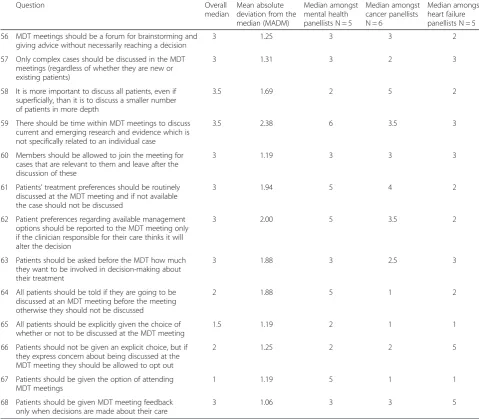
There were 13 recommendations which the panellists disagreed with (median <4; Table 5). A number of these centred on the role of the patient in MDT decision-making. For example panellists from all disease special-ities pointed to practical and cognitive barriers to asking patients before the MDT about how much they wish to
be involved in decision-making (Recommendation 63):‘a lot of service users have difficulties making decisions’ (team manager, mental health); ‘I’m not sure it’s a ques-tion that many patients might be able to deal with…es-pecially…if [they] are presenting with something that [they] don’t suspect, [they’ve] got so many things to think about’ (patient representative, cancer). Similarly, the panel disagreed with Recommendations 65 and 66 that patients should be allowed to opt out of the meeting, particularly those at risk of harm: ‘we couldn’t do our jobs if patients could opt out. It’s not uncommon for people with mental health problems to not want to have anything to do with us!’(doctor, mental health).
For five of the 13 potential recommendations rated as ‘disagree’overall, the median for mental health panellists fell into the‘uncertain’range (Recommendations 59, 61, 62, 64, and 67).
For example, although the panel as a whole did not think that all patients should be told if they are going to be discussed in an MDT meeting (Recommendation 64) the mental health panellists were uncertain about this recommendation. In common with cancer panellists, the mental health experts were also uncertain as to whether patients should only be discussed if their treatment pref-erences were known (Recommendation 61):‘people with mental health problems don’t always have a strong pref-erence’(doctor, mental health).
[image:7.595.59.540.113.375.2]Finally, mental health panellists were the only group who were uncertain as to whether patients should be Table 3Recommendations where strength of agreement wasagree(median≥7) but variation in extent of agreement wasmoderate (MADM score 1.11-1.75)
Recommendation Median Mean absolute
deviation from the median (MADM)
25 MDT meetings should be a forum for recruiting patients to clinical trials 8 1.19
26 All MDTs should have a designated (rather than a rotating) Chair for MDT meetings 7 1.75
27 All MDTs should have a dedicated MDT coordinator/administrator 9 1.31
28 MDT Chairs should attend at least one other MDT meeting to identify approaches to improve their chairing skills 8 1.56
29 A patient list should be available for all team members to view in advance of an MDT meeting 8.5 1.31
30 Presentations should be explicitly framed in the light of a specific query or issue to be discussed 8 1.13
31 All MDTs should be audited through external peer-review 8.5 1.13
32 There should be time within MDT meetings to discuss current and emerging research and evidence only in relation to the case discussed
7.5 1.25
33 Relevant psychosocial issues for patients presented to each type of MDT should be identified and agreed by the MDT 7.5 1.44
34 The MDT member who presents the case should routinely consider psychosocial factors and ensure that relevant information is available at the meeting
8 1.19
35 Teams should be explicit about the research evidence that they are drawing on when making a decision in the MDT meeting
7 1.25
36 Patients should be given feedback on which professional groups were present when they were discussed at the MDT meeting
7.5 1.69
37 Patients should be given feedback every time they are discussed at an MDT meeting 8 1.25
given the option of attending MDT meetings (Recom-mendation 67).
Discussion
We demonstrate that it is possible to use formal consen-sus development methods to produce feasible recom-mendations for improving the effectiveness of MDT meetings in adult mental health services. Expert panel-lists from mental and physical health backgrounds agreed with 21 (31 %) of the 68 recommendations
[image:8.595.57.540.101.595.2]proposed and demonstrated low variation in the extent of agreement with these 21 recommendations. While previous research in this area has focused on individual conditions, our findings illustrate the value of shared learning across mental and physical health care to agree core factors for effective MDT functioning [10, 38–40]. Nonetheless, the recommendations would require modi-fication in some contexts. For example, in Child and Adolescent services, context-specific issues such as the role of carers would need to be taken into account. Table 4Medians for each disease group: recommendations rated as“uncertain”overalla
Recommendation Overall
median
Mean absolute deviation from the median (MADM)
Median amongst mental health panellists N = 5
Median amongst cancer panellists N = 6
Median amongst heart failure panellists N = 5
39 The main objectives of MDT meetings should be the same across all chronic diseases
6.5 1.88 3 7 7
40 Teaching should be a function of MDT meetings provided it does not add to the length of meetings
6.5 2.31 8 6 5
41 Teaching should be a function of MDT meetings even if it means meetings will be longer
5 1.94 7 6 4
42 All treatment plans for existing patients should be agreed in an MDT meeting even if a clear protocol exists
5 2.06 7 5 2
43 Members should be allowed to not attend as long as someone from their discipline is attending and the member does not have a case to present
5 1.75 7 4.5 6
44 A list of people who are required to attend the MDT meeting should be decided locally by the team
5 2.44 6 2 7
45 A patient should only be discussed at the MDT meeting when information on comorbidity is available
4.5 2.19 2 6 6
46 A designated MDT member should speak to the patient about comorbidities before the patient is discussed at an MDT meeting
4 2.38 6 3.5 3
47 Each MDT should identify the most appropriate methods for presenting complete information on comorbidities
5 1.13 7 5 5
48 Case presentation should routinely include a brief introduction of the patient and relevant psychosocial characteristics, otherwise the case should not be discussed
6 2.38 7 4 3
49 Any MDT member who presents a case should discuss treatment preferences with the patient before the MDT meeting
5.5 2.00 7 4.5 7
50 Patient preferences regarding available treatment options should be discussed with the patient after (rather than before) the MDT meeting
5.5 1.63 5 6 8
51 Patients should not be presented at the MDT meeting unless there is someone present who has met with them at least once before the meeting, even if this postpones discussion of that patient
5 2.63 8 2 3
52 Patients should be given the opportunity to provide information in advance of the MDT meeting to ensure the information presented is accurate and comprehensive
5 2.13 7 4.5 6
53 Patients should be able to provide information by having direct access and the ability to modify their medical records
5 2.69 7 2 5
54 Patients should be given the option to provide a written summary for the meeting
5 1.88 6 3.5 3
55 Patients should be given the option to provide audio recorded input to the meeting
4.5 2.50 7 1.5 3
a
The largest category of recommendations where there was cross-specialty agreement related to MDT processes (10 of the 21 recommendations). Our findings concur with other research demonstrating the importance of clear documentation of meeting outcomes [32, 38] and regular review of meeting objectives [39]. While cancer MDTs already follow, and are audited against, national guidelines that explicitly address these issues, [7, 11] mental health MDTs do not. Our findings demonstrate agreement among experts that it would be feasible and desirable for adult mental health MDTs to also adhere to a number of these processes. Many of these recommen-dations require minimal additional financial resources, indicating that improvement is possible even in resource-stretched teams.
Clarity of purpose has previously been identified as a key feature of effective team working [39, 40]. However, it has been reported that mental health staff are some-times unclear about the purpose of MDT meetings [8, 40]. We obtained consensus regarding their principal objective (i.e.the agreement of treatment plans) and agreement for the inclusion of both locally and nationally determined goals.
[image:9.595.56.536.102.521.2]Previous research has emphasised the importance of considering patient preferences and noted the associ-ation with better MDT decision implementassoci-ation rates [41–43]. However a recent survey of mental health ser-vice users by the Care Quality Commission found that only 57 % agreed that they were ‘definitely’ involved as much as they wanted to be in agreeing what care they Table 5Medians for each disease group: recommendations rated“disagree”overalla
Question Overall
median
Mean absolute deviation from the median (MADM)
Median amongst mental health panellists N = 5
Median amongst cancer panellists N = 6
Median amongst heart failure panellists N = 5
56 MDT meetings should be a forum for brainstorming and giving advice without necessarily reaching a decision
3 1.25 3 3 2
57 Only complex cases should be discussed in the MDT meetings (regardless of whether they are new or existing patients)
3 1.31 3 2 3
58 It is more important to discuss all patients, even if superficially, than it is to discuss a smaller number of patients in more depth
3.5 1.69 2 5 2
59 There should be time within MDT meetings to discuss current and emerging research and evidence which is not specifically related to an individual case
3.5 2.38 6 3.5 3
60 Members should be allowed to join the meeting for cases that are relevant to them and leave after the discussion of these
3 1.19 3 3 3
61 Patients’treatment preferences should be routinely discussed at the MDT meeting and if not available the case should not be discussed
3 1.94 5 4 2
62 Patient preferences regarding available management options should be reported to the MDT meeting only if the clinician responsible for their care thinks it will alter the decision
3 2.00 5 3.5 2
63 Patients should be asked before the MDT how much they want to be involved in decision-making about their treatment
3 1.88 3 2.5 3
64 All patients should be told if they are going to be discussed at an MDT meeting before the meeting otherwise they should not be discussed
2 1.88 5 1 2
65 All patients should be explicitly given the choice of whether or not to be discussed at the MDT meeting
1.5 1.19 2 1 1
66 Patients should not be given an explicit choice, but if they express concern about being discussed at the MDT meeting they should be allowed to opt out
2 1.25 2 2 5
67 Patients should be given the option of attending MDT meetings
1 1.19 5 1 1
68 Patients should be given MDT meeting feedback only when decisions are made about their care
3 1.06 3 3 5
a
will receive [44]. The expert panel discussed the import-ance of knowing patient preferences in advimport-ance of MDT meetings and of shared decision-making. Much of the discussion highlighted the complexity of these issues in terms of the most appropriate way to involve patients, and practical constraints such as the need to use invol-untary treatment. The panel therefore recommended that when making a decision, the MDT should actively seek to identify all possible treatment options and dis-cuss these with the patientafterthe meeting.
Adult mental health MDTs have certain distinctive fea-tures which explain why there was disagreement with some proposed recommendations. For example, panel-lists disagreed that patients should be allowed to opt out of being discussed at MDT meetings, citing concerns about the impact of this on patients at risk of harm. This may be particularly problematic if patients are unable to fully discern the adverse implications of their condition. In addition, panellists did not think that the MDT meet-ing should be a forum for the discussion of complex cases only.
We also identified areas where it is likely that mental health specific recommendations are required. For ex-ample, mental health panellists considered it to be im-perative for someone with personal knowledge of a patient to be present when that patient is discussed by the MDT, whereas this was thought to be unnecessary in cancer and heart failure MDT meetings.
Strengths and limitations
The novel inclusion of research evidence, policy and clinical expertise from across mental and physical health care was a key strength in this study. Highlighting the evidence and guidance available from other specialities, and bringing together diverse experts to share their dif-ferent experiences, encouraged new perspectives on taken-for-granted practices and challenged assumptions regarding what can feasibly be achieved in MDT meet-ings. This approach allowed us to apply learning from different disease specialities to agree recommendations which might be applied generically across conditions. Our recommendations do not displace specific consider-ations which must be applied during CPA and Mental Health Act Assessments, e.g. to ensure safeguarding or to assess risk of harm to self and others. Our study de-sign also allowed us to distinguish those issues which might be more appropriately dealt with on a condition-specific basis. A limitation of this comparative approach was that the panel of 16 experts included just five men-tal health specialists. The size of the panel was deter-mined by the evidence that whilst having more group members increases the reliability of group judgement, large groups reduce the ability to elicit sufficient contri-butions from every member of the panel [17]. Whilst we
acknowledge that five mental health panellists cannot encompass the variety of MDT meetings in mental health services, this limitation is likely to impact upon our provisional results referring to recommendations that may be better made on a condition specific basis. We therefore suggest that further examination by homo-geneous (mental health) consensus development panels is needed to explicitly define those purposes and pro-cesses which are specific to mental health MDTs.
Another important strength of our study was our cal-culation of both the strength and extent of agreement for each recommendation. The extent (or spread) of the distribution of ratings tends to attract relatively little at-tention but its measurement was particularly relevant in this study because it depends on group composition [37]. Low variation in the spread of ratings was achieved in 21 recommendations which the panel agreed with. This suggests that experts from different clinical back-grounds took account of other’s opinions [45].
We chose to use the RAND/UCLA Appropriateness Method (RAM) rather than the more commonly used Delphi consensus development survey. Whilst the Delphi approach enables large sample sizes, the RAM allowed us to explore the rationale behind panellists’ratings by quali-tatively analysing the panel discussion. The level of detail provided in this face-to-face discussion enabled the pro-duction of far more informative results than would have been possible with a Delphi survey. Furthermore, to miti-gate the possibility that the presentation and framing of the research evidence might influence judgements [46] we used the meeting to identify any differing interpretations of the information provided. This resulted in the reword-ing of just one recommendation to clarify its meanreword-ing (Recommendation 19). Finally, the panel discussion en-sures that the final recommendations are concise and clear.
Delphi survey of a wider range of relevant‘stakeholders’, including patients and carers [47].
Finally, audit of implemented recommendations is re-quired to ascertain their effectiveness in practice.
Conclusions
The availability of explicit guidance for ensuring the ef-fectiveness of MDT meetings varies widely across mental and physical health conditions. In adult mental health care, the purpose and format of MDT meetings is largely locally formulated, while cancer teams are required to adhere to explicit, nationally determined guidance. It is tempting to justify this difference as an inevitable conse-quence of different disease trajectories, funding systems, patient and research contexts. Whilst it is to be expected that some disease specific guidance is necessary, our use of a formal consensus development technique enabled us to identify 21 feasible recommendations for improv-ing the effectiveness of MDT meetimprov-ings in a range of set-tings, including adult mental health. Comparing MDT meetings in different specialties allowed alternative ‘ pat-terns of thinking’to be revealed and scrutinised, prompt-ing critical reflection on established and taken-for-granted beliefs and practices. Enhancing the effectiveness and productivity of the MDT meeting is particularly salient given the centrality of this decision-making model in the NHS and the escalating mental health burden as a propor-tion of all NHS activity. Thus, the applicapropor-tion of these rec-ommendations is important because MDT meetings are extremely resource intensive and their value to the NHS and individual patients should be maximised.
Additional files
Additional file 1:Questionnaire sections, panel composition and printable version of the final 21 recommendations.
Additional file 2:Round 1 Questionnaire Pack.
Competing interests
The authors declare that they have no competing interests.
Authors’contributions
RR, AL, AP, JMB & MK conceived the idea for this study. RR led the funding application and all components of the study. RR, CN, IW and PX prepared the first and subsequent drafts of the paper. All other authors contributed to the drafts and approved the final draft. CN, IW and PX contributed to review of the literature, and recruitment of participants, data collection, analysis and interpretation. JB collaborated in the funding application and was responsible for statistical aspects of the study. JMB, AC, SG, MK, AL, GL, SM, and AP collaborated in developing the idea for the research and in the funding application. They contributed to study design and provided clinical expertise throughout the project. DA, MH, AC, AL, GL, and AP contributed to participant recruitment. AL and AC contributed to the qualitative analysis and interpretation of the findings. DA and MH contributed to study design and provided guidance from a patient perspective throughout the project. As the Chief Investigator and guarantor, RR managed the study overall and had final responsibility for the analysis and manuscript content. All authors read and approved the final manuscript.
Acknowledgments
We are indebted to all the panellists who participated in the Consensus Development meeting. We are also grateful to all those who contributed to the mixed methods research which provided data for this consensus development study,i.e.to: participating North Thames MDT teams, patients and NHS staff; Dr William O’Driscoll, Dr Manonmani Manoharan, Rowan Calloway, Natalie Austin-Parsons, Dr Sophie Bostock, Dr Khadija Rantell, Dr Mike Galsworthy and Professor Ewan Ferlie.
This report presents independent research commissioned by the National Institute for Health Research (NIHR). The views and opinions expressed by authors in this publication are those of the authors and do not necessarily reflect those of the NHS, the NIHR, MRC, CCF, NETSCC, the Health Services and Delivery Research programme or the Department of Health.
Author details
1
Department of Applied Health Research, University College London, London WC1E 7HB, UK.2Patient and Public Involvement Representative, North Trent Cancer Research Network, Consumer Research Panel, ICOSS, The University of Sheffield, Western Bank, Sheffield S10 2TN, UK.3Patient and Public Involvement Representative, London, UK.4Department of Statistical Science, University College London, Gower Street, London WC1E 6BT, UK.5Royal College of Pathologists, 2 Carlton House Terrace, London SW1Y 5AF, UK. 6National Heart and Lung Institute, Imperial College London, Du Cane Road,
London W12 0HS, UK.7Department of Cardiology, Hammersmith Hospital, Du Cane Road, London W12 0HS, UK.8Division of Psychiatry, University College London, Charles Bell House, 67-73 Riding House St, London W1W 7EH, UK.9School of Social and Community Medicine, University of Bristol, Bristol BS8 2PS, UK.10UCL Centre for Behaviour Change, University College London, 1-19 Torrington Place, London WC1E 7HB, UK.11Department of Women’s Cancer, UCL Elizabeth Garrett Anderson Institute for Women’s Health, University College London, Medical School Building, 74 Huntley Street, London WC1E 6AU, UK.12Department of Plastic and Reconstructive Surgery, The Royal Free Hospital, Pond Street, Hampstead, London NW3 2QG, UK.13Mental Health of Older People, Division of Psychiatry, University College London, Charles Bell House, 67-73 Riding House Street, London W1W 7EH, UK.
Received: 22 December 2014 Accepted: 16 June 2015
References
1. National Cancer Action Team. National Cancer Peer Review Programme Manual for Cancer Services: Haemato-oncology Cancer Measures. London: National Cancer Action Team; 2013.
2. Department of Health. Improving Chronic Disease Management. 2004. 3. Department of Health. Mental Health Policy Implementation Guide:
Community Mental Health Teams. London: Department of Health; 2001. 4. National Institute for Health and Clinical Excellence. Management of stable
angina [NICE clinical guideline 126]. London: National Institute for Health and Clinical Excellence; 2012.
5. Huxley P, Evans S, Baker C, White J, Philpin S, Onyett S, Gould N. Integration of social care staff within community mental health teams. Final Report. NIHR Service Delivery and Organisation Programme: Southampton; 2011. 6. Taylor C, Atkins L, Richardson A, Tarrant R, Ramirez A. Measuring the quality
of MDT working: an observational approach. BMC Cancer. 2012;12(1):1–10. 7. National Peer Review Programme. National Peer Review Report: Cancer
Services 2012/2013: An overview of the findings from the 2012/2013 National Peer Review of Cancer Services in England. London: NHS Improving Quality; 2013.
8. Raine R, Wallace I, Nic a Bháird C, Xanthopoulou P, Barber J, Lanceley A, Clarke C, Livingston G, Prentice A, Ardron D, et al. Improving the effectiveness of multidisciplinary team meetings for patients with chronic diseases: a prospective observational study. Health Services and Delivery Research 2014, 2(37).
9. Raine R, Xanthopoulou P, Wallace I, Nic a’Bháird C, Lanceley A, Clarke A, Livingston G, Prentice A, Ardron D, Harris M, et al. Determinants of treatment plan implementation in multidisciplinary team meetings for patients with chronic diseases: a mixed-methods study. BMJ Quality & Safety 2014. 10. National Cancer Action Team. National Cancer Peer Review Programme
11. National Cancer Action Team. National Cancer Peer Review Programme Manual for Cancer Services: Gynaecology Measures. London: National Cancer Action Team; 2013.
12. Department of Health. New Horizons: A Shared Vision for Mental Health. London: Department of Health; 2009.
13. Department of Health. Dementia Commissioning Pack: Service specification for dementia: memory service for early diagnosis and intervention. London: Department of Health; 2011.
14. Department of Health. Closing the Gap: Priorities for Essential Change in Mental Health. London: Department of Health; 2014.
15. Care Quality Commission. A fresh start for the regulation and inspection of mental health services. Newcastle Upon Tyne: Care Quality Commission; 2013. 16. Jones J, Hunter D. Consensus methods for medical and health services
research. BMJ. 1995;311(7001):376–80.
17. Murphy M, Black N, Lamping D, McKee C, Sanderson C, Askham J, Marteau T. Consensus development methods, and their use in clinical guideline development. Health Technol Assess. 1998;2(3):i.
18. Campbell S, Braspenning J, Hutchinson A, Marshall M. Research methods used in developing and applying quality indicators in primary care. BMJ. 2003;326(7393):816–9.
19. Bisson JI, Tavakoly B, Witteveen AB, Ajdukovic D, Jehel L, Johansen VJ, Nordanger D, Garcia FO, Punamaki R-L, Schnyder U, et al. TENTS guidelines: development of post-disaster psychosocial care guidelines through a Delphi process. Br J Psychiatry. 2010;196(1):69–74.
20. Crawford MJ, Price K, Rutter D, Moran P, Tyrer P, Bateman A, Fonagy P, Gibson S, Weaver T. Dedicated community-based services for adults with personality disorder: Delphi study. Br J Psychiatry. 2008;193(4):342–3. 21. Hutchings A, Raine R. A systematic review of factors affecting the
judgments produced by formal consensus development methods in health care. J Health Serv Res Policy. 2006;11(3):172–179H.
22. Black N, Murphy M, Lamping D, McKee M, Sanderson C, Askham J, Marteau T. Consensus development methods: a review of best practice in creating clinical guidelines. J Health Serv Res Policy. 1999;4(4):236–48.
23. Fitch K, Bernstein SJ, Aguilar MD, Burnand B, LaCalle JR. The RAND/UCLA appropriateness method user’s manual. Santa Monica: RAND Corporation; 2001.
24. Department of Health. Choosing Health: supporting the physical needs of people with severe mental illness - commissioning framework. London: Department of Health; 2006.
25. Royal College of Psychiatrists. Memory Services National Accreditation Programme: standards for memory services. London: Royal College of Psychiatrists; 2012.
26. Department of Health. Living well with dementia: a national dementia strategy. London: Department of Health; 2009.
27. National Collaborating Centre for Mental Health. A NICE-SCIE Guideline on supporting people with dementia and their carers in health and social care. Guideline no 42. London: National Collaborating Centre for Mental Health; 2007. 28. National Institute for Health and Clinical Excellence. Dementia: Supporting
people with dementia and their carers in health and social care. NICE Clinical Guideline 42. London: National Institute for Health and Clinical Excellence; 2006.
29. The Royal College of Radiologists. Cancer Multidisciplinary Team Meetings -Standards for Clinical Radiologists. London: Royal College of Radiologists; 2005.
30. National Institute for Health and Clinical Excellence. Guidance on Cancer Services: Improving Outcomes in Haematological Cancers: The Manual. London: National Institute for Clinical Excellence; 2003.
31. Academy of Medical Royal Colleges. Intercollegiate Cancer Committee: Educational Initiatives to Improve the Effectiveness of Cancer
Multidisciplinary Teams. London: Academy of Medical Royal Colleges; 2009. 32. National Cancer Action Team. The Characteristics of an Effective
Multidisciplinary Team. London: NHS National Cancer Action Team; 2010. 33. NHS Improvement. A guide for review and improvement of hospital based
heart failure services. NHS Improvement: Leicester; 2011.
34. National Institute for Health and Clinical Excellence. Chronic heart failure: Management of chronic heart failure in adults in primary and secondary care. NICE Clinical Guideline no 108, vol. GC108. London: National Institute for Health and Clinical Excellence; 2010.
35. National Institute for Health and Clinical Excellence. Services for people with chronic heart failure. London: National Institute for Health and Clinical Excellence; 2011.
36. Fink A, Kosecoff J, Chassin M, Brook RH. Consensus methods: characteristics and guidelines for use. Am J Public Health. 1984;74(9):979–83.
37. Hutchings A, Raine R, Sanderson C, Black N. An experimental study of determinants of the extent of disagreement within clinical guideline development groups. Qual Saf Health Care. 2005;14(4):240–5. 38. Field KM, Rosenthal MA, Dimou J, Fleet M, Gibbs P, Drummond K.
Communication in and clinician satisfaction with multidisciplinary team meetings in neuro-oncology. J Clin Neurosci. 2010;17(9):1130–5. 39. Fay D, Borrill C, Amir Z, Haward R, West MA. Getting the most out of
multidisciplinary teams: A multi-sample study of team innovation in health care. J Occup Organ Psychol. 2006;79(4):553–67.
40. West M, Alimo-Metcalfe B, Dawson J, El Ansari W, Glasby J, Hardy G, Hartley G, Lyubovnikova J, Middleton H, Naylor P. Effectiveness of Multi-Professional Team Working (MPTW) in Mental Health Care. NIHR Service Delivery and Organisation Programme: Final Report; 2011.
41. Blazeby J, Wilson L, Metcalfe C, Nicklin J, English R, Donovan J. Analysis of clinical decision-making in multi-disciplinary cancer teams. Ann Oncol. 2006;17(3):457–60.
42. English R, Metcalfe C, Day J, Rayter Z, Blazeby J. A Prospective Analysis of Implementation of Multi-Disciplinary Team Decisions in Breast Cancer. Breast J. 2012;18(5):459–63.
43. Kidger J, Murdoch J, Donovan J, Blazeby J. Clinical decision-making in a multidisciplinary gynaecological cancer team: a qualitative study. BJOG. 2009;116(4):511–7.
44. Care Quality Commission. National Summary of the Results for the 2014 Community Mental Health Survey. Newcastle upon Tyne: Care Quality Commission; 2014.
45. Raine R, Sanderson C, Hutchings A, Carter S, Larkin K, Black N. An experimental study of determinants of group judgments in clinical guideline development. Lancet. 2004;364(9432):429–37.
46. Loblaw DA, Prestrud AA, Somerfield MR, Oliver TK, Brouwers MC, Nam RK, Lyman GH, Basch E. American Society of Clinical Oncology Clinical Practice Guidelines: Formal Systematic Review–Based Consensus Methodology. J Clin Oncol. 2012;30(25):3136–40.
47. Raine R, Sanderson C, Black N. Developing clinical guidelines: a challenge to current methods. BMJ. 2005;331(7517):631–3.
Submit your next manuscript to BioMed Central and take full advantage of:
• Convenient online submission
• Thorough peer review
• No space constraints or color figure charges
• Immediate publication on acceptance
• Inclusion in PubMed, CAS, Scopus and Google Scholar
• Research which is freely available for redistribution