University of Huddersfield Repository
Oluwajobi, Akinjide O. and Chen, Xun
MultiPass Nanometric Machining Simulation using the Molecular Dynamics (MD)’
Original Citation
Oluwajobi, Akinjide O. and Chen, Xun (2011) MultiPass Nanometric Machining Simulation using the Molecular Dynamics (MD)’. In: ICPM 2011 The 6th International Congress on Precision Machining, 13 15 September 2011, Liverpool, UK.
This version is available at http://eprints.hud.ac.uk/id/eprint/11572/
The University Repository is a digital collection of the research output of the University, available on Open Access. Copyright and Moral Rights for the items on this site are retained by the individual author and/or other copyright owners. Users may access full items free of charge; copies of full text items generally can be reproduced, displayed or performed and given to third parties in any format or medium for personal research or study, educational or notforprofit purposes without prior permission or charge, provided:
• The authors, title and full bibliographic details is credited in any copy;
• A hyperlink and/or URL is included for the original metadata page; and
• The content is not changed in any way.
For more information, including our policy and submission procedure, please contact the Repository Team at: [email protected].
Multi-Pass Nanometric Machining Simulation using the Molecular
Dynamics (MD)
Akinjide Oluwajobi
1,a, Xun Chen
2,b1,2
Centre for Precision Technologies University of Huddersfield Queensgate, Huddersfield HD1 3DH
UK
Email: [email protected], [email protected]
Keywords: Multi-pass, Nanometric machining, MD simulation
Abstract
The multi-pass nanometric machining of copper with diamond tool was carried out using the Molecular Dynamics (MD) simulation. The copper-copper interactions were modelled by the EAM potential and the copper-diamond interactions were modelled by the Morse potential. The diamond tool was modelled as a deformable body and the Tersoff potential was applied for the carbon-carbon interactions. It was observed that the average tangential and the normal components of the cutting forces reduced in the consecutive cutting passes. Also, the lateral force components are affected by atomic vibrations and the cross sectional area during the cutting process.
Introduction
The trend towards miniaturization of devices is pervasive in the electronics, medical and the energy industries and there is a great demand for these devices to have very high form and surface finish.
At the nanoscale, machining phenomena take place in a small limited region of tool – workpiece
interface, which often contains a few atoms or layers of atoms. Currently, it is very difficult to observe the diverse microscopic physical phenomena occurring at that length scale through experiments and dimension problems limit the use of analytical and empirical models [1]. The interface at this nanometre level may not be considered as a continuous media or homogeneous as assumed by continuum mechanics, so the analysis should be based on discrete atoms whose interactions are governed by appropriate interatomic potentials. The use of Molecular Dynamics (MD) simulation has proved to be an effective tool for the investigation of machining processes at the nanometre scale. The method gives higher resolution of the cutting process than what is possible by continuum mechanics on that length scale.
The MD method was initiated in the late 1950s at Lawrence Radiation Laboratory in the US by Alder and Wainwright in the study of statistical mechanics [2]. Since then, the use of the simulation method has extended from Physics to Materials Science and now to Mechanical Engineering. Rentsch and Inasaki [3] modelled a copper workpiece and a diamond tool using the Lennard-Jones potential for the copper atom interactions. They observed a build-up phenomenon after 25000 time steps, while keeping the tool rigid. Komanduri et al [4] used copper workpiece and an infinitely hard tungsten tool for their simulation. They used Morse potentials and a cutting speed of 500m/s. Many existing MD simulation studies on nanometric cutting have been limited to single pass tool or simple line-type groove. As an extension of the single pass studies, Zhang et al [5] modelled folder- line grooves for AFM-based nanometric cutting process of copper with diamond tool. They used the EAM potential for the copper-copper interactions and the Morse potential for the copper-diamond interactions. They treated the diamond tool as rigid and concluded that the normal, lateral and the
investigated the multi-groove simulation of single-point tuning of copper with diamond tool. They used a two-groove cutting procedure and modelled the copper-copper and the copper-diamond interactions by using the Morse potential. They also treated the tool as a rigid body and observed that the tool forces increase with increase in feed rate and depth of cut. In practice, most machining processes involve the use of multiple passes to create new surface patterns and the diamond tool is deformable. To address this problem, a multi-pass cutting was employed in this study to simulate the surface creation in single point diamond turning.
The MD Simulation Methodology
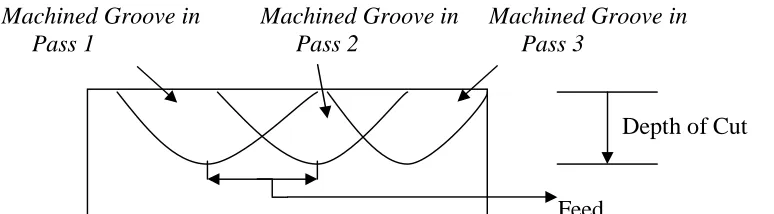
[image:3.595.79.310.268.401.2]The configuration has a total of 54232 atoms. The workpiece consists of 43240 copper atoms with the FCC lattice. It includes 3 kinds of atoms namely; boundary atoms, thermostat atoms and Newtonian atoms (See Fig. 1). The cutting tool consists of 10992 carbon atoms with diamond lattice structure. Fig. 2 shows a diagram of the machined grooves with passes 1, 2 and 3.
Figure 1: The MD Simulation Model
The simulation conditions applied in this study are the following, viz; Bulk temperature is 293K, the cutting direction is along the x-axis, the cutting speed is 150m/s, the cutting depth is 1.5nm, feed is 1.5nm, the time step is 0.3fs and the simulation run is 150000 steps.
Machined Groove in Machined Groove in Machined Groove in
Pass 1 Pass 2 Pass 3
Depth of Cut
Feed
Figure 2: Cross Section of the Machined Grooves with Passes 1-3 (direction of cut is perpendicular to the paper face)
The cutting tool is fairly pointed shaped. The boundary atoms are kept fixed to reduce edge effects. The thermostat atoms conduct the heat generated during the cutting process out of the cutting region. This is achieved by the velocity scaling of the thermostat atoms, (with the conversion between the kinetic energy (KE) and temperature via Eq. 1 [7, 8]);
i B i
i i
T Nk v
m
2 3 2
1 2
[image:3.595.83.470.495.602.2]Where miis the mass of the ith atom, viis the resultant velocity of the ith atom, Nis the number of
the thermostat atoms, Tiis the temperature of the ith atom and kBis the Boltzmann constant
(1.3806504 x10⁻²³ JK-1)
Whenever the temperature of the thermostat atoms exceeds the preset bulk temperature of 293K, their velocities are scaled by using Eq. 2 [9, 10];
current desired i
new i
T T v
v, . (2)
Where Tcurrent is the current temperature that is calculated from the KE and the Tdesired is the desired temperature. The Newtonian atoms obey the Newton’s equation of motion. The LAMMPS MD software [11] was used for the simulations and the VMD software [12] was used for the visualization of the results.
The modelling parameters for potentials
Many researchers sometimes use different interatomic potentials for nanometric machining simulation without justifications. In previous studies, it has been established that the EAM potential is very suitable for the Cu-Cu interactions [13, 14] and for the Cu-C interactions, the Morse potential is a good choice [15].
Embedded-Atom Method Potential (EAM) (Eq. 3) [16] (For the Cu-Cu interactions)
j i
ij ij i
i h i
tot G V r
E
,
, ( )
2 1 )
( . (3)
Where h,i is the total electron density at atom i due to the rest of the atoms in the system.
i
G is the embedding energy for placing an atom into the electron density, Vi,j is the short range pair
interaction representing the core-core repulsion, rij is the separation of atoms i and j
Morse Potential (Eq. 4) [17] (For the Cu-C interactions)
]} (
exp[ 2 )] ( 2
{exp[ ij e ij e
ij D r r r r
V . (4)
Where rijand re are instantaneous and equilibrium distances between atoms i and j respectively
and D are constants determined on the basis of the physical properties of the material
The parameters used in the simulations are below, [18];
The cut-off distance chosen was 6.4 Angstroms (that is, the interactions between atoms separated by more than this distance are neglected).
Tersoff Potential (Eq. 5) [19] (For the C-C interactions)
i i i j
ij
i V
E E
2 1
. (5) nm
r nm eV
and, )] ( ) ( )[
( ij ij R ij ij A ij C
ij f r a f r b f r
V
2 2
2 2 2 ) , ( 3 3 3 3 3 3 ) , ( 2 / 1 2 / 1 2 1 ) cos ( 1 ) ( , ) ( exp ) ( ) ( ) ( exp ) ( , , 0 , / ) ( 2 sin 2 1 2 1 , 1 ) ( ) 1 ( , ) 1 ( ), exp( ) ( ), exp( ) (
h q p q p g r r g r f r r r f D R r D R r D R D R r D R r r f b a r B r f r A r f where j i k ik ij ijk ik C ij ik ij ik j i k C ij C n n ij n ij n n ij n ij A RWhere R and D are cutoff parameters; A,B,1,2,3,,,n,p,q,h are fitting parameters of the Tersoff potential.
The simulation parameters used for carbon, are given as [19, 20, 21];
A(eV) =1.3936103; B(eV) =3.467102; 1(nm1)= 34.879; 2(nm1)= 22.119; = 0.0;
=1.5724107; n =7.2751101; p =3.8049104; q = 4.384; h = 5.7058101;
) ( 1
3
nm
= 22.119; R (nm) = 0.18; D(nm) = 0.02.
C utting Forces for Pass 1
-8.00E+ 01 -6.00E+ 01 -4.00E+ 01 -2.00E+ 01 0.00E+ 00 2.00E+ 01 4.00E+ 01 6.00E+ 01 8.00E+ 01 1.00E+ 02
0 20000 40000 60000 80000 100000 120000 140000 160000
No of Steps
C u tt in g F o rc e s ( e V /A ) Fx Fy Fz
[image:5.595.64.532.378.554.2](a) (b)
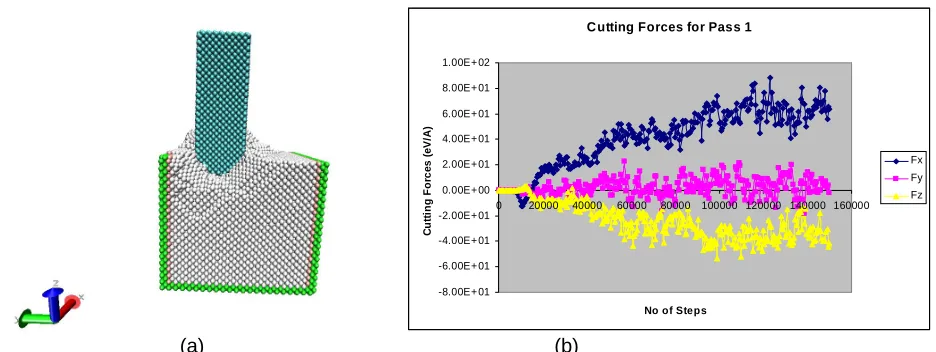
Figure 3a: Simulation of Pass 1 Cutting; 3b: Cutting Forces for Pass 1
Simulation Results and Discussion
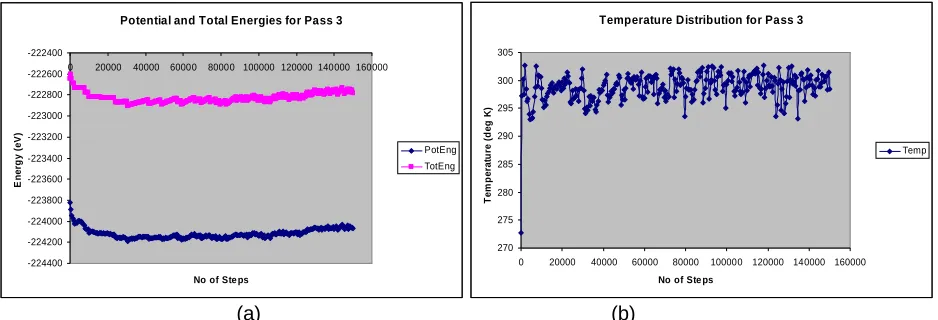
Figs. 3a, 3b, 4a and 4b show the simulation results for the pass 1 groove cutting. Figs 5a, 5b, 6a and 6b show the results for the pass 3 groove cutting. Fx, Fy and Fz are the tangential, lateral and normal
components of the cutting forces respectively. The average Fx decreases with the consecutive passes
in the simulation, i.e. from 41.5063 eV/A in pass 1, to 30.98684 eV/A in pass 2, and then to
29.57385 eV/A, in pass 3. (1eV/A = 1.602nN). The average Fz also decreases in a similar way. This
is so because there are less material to be removed during the passes 2 and 3 compared to pass 1. Fy
should be zero theoretically, but it varies around zero for the pass 1 simulation. This shows the atomic vibration effects during the cutting process. However, for passes 2 and 3, Fy is biased
distribution is fairly stable as the time step increases. This is because at the start of the pass 1 cut, the interface between the tool edge and the workpiece generates an initial high temperature, which is later conducted away and stabilizes. For pass 2 and 3, there is less material to be removed, so there is no much initial temperature built-up. Also, for passes 2 and 3, the potential and the total energies decrease initially and then stabilize. This may be because the tool initially engaged the asymmetrical atomic structure left after the previous pass.
P otential and Total Energies for Pass 1
-225500 -225000 -224500 -224000 -223500 -223000 -222500
0 20000 40000 60000 80000 100000 120000 140000 160000
No of Steps
E n e rg y ( e V ) PotEng TotEng
Temperature Distribution for Pass 1
270 275 280 285 290 295 300 305
0 20000 40000 60000 80000 100000 120000 140000 160000 No of Ste ps
T e m p e ra tu re ( d e g K ) Temp
[image:6.595.56.539.168.325.2](a) (b)
Figure 4a: Potential and Total Energies for Pass 1; 4b: Temperature Distribution for Pass 1
Cutting Forces for Pass 3
-6.00E+01 -4.00E+01 -2.00E+01 0.00E+00 2.00E+01 4.00E+01 6.00E+01 8.00E+01 1.00E+02
0 20000 40000 60000 80000 100000 120000 140000 160000
No of Steps
C u tt in g F o rc e ( e V /A ) Fx Fy Fz
[image:6.595.72.525.363.530.2](a) (b)
Figure 5a: Simulation of Pass 3 Cutting; 5b: Cutting Forces for Pass 3
Potential and Total Energies for Pass 3
-224400 -224200 -224000 -223800 -223600 -223400 -223200 -223000 -222800 -222600 -222400
0 20000 40000 60000 80000 100000 120000 140000 160000
No of Ste ps
E n e rg y ( e V ) PotEng TotEng
Temperature Distribution for Pass 3
270 275 280 285 290 295 300 305
0 20000 40000 60000 80000 100000 120000 140000 160000 No of Ste ps
T e m p e ra tu re ( d e g K ) Temp
(a) (b)
[image:6.595.58.527.573.733.2]Summary
The MD simulation of multi-pass nanometric machining procedure has been clearly demonstrated. It was observed that the average tangential and the normal components of the cutting forces decrease with the consecutive passes. The ratio of the tangential to the normal force component is in the range 1.77 to 2.69 for the three passes. Also, the lateral force components are affected by the atomic vibrations and the cutting cross sectional area.
References
[1] R. Rentsch, in: Nano and Micromachining, Wiley-ISTE, edited by Davim, J.P. and Jackson, M.J. (2008), p. 1–24
[2] B.J.Alder.and T.E. Wainwright: Journal of Chemical Physics, Vol. 31, (1959), p. 459-466 [3] Rentsch R. and I. Inasaki: Annals of the CIRP Vol. 43, No 1, (1994), p. 327-330
[4] R.N. Komanduri, Chandrasekaran and L.M. Raff: Philosophical Magazine Part B, Vol. 79, No 7, (1999), p. 955-968
[5] J.T. Zhang, T. Sun, Y. Yan, Y. Liang and S. Dong: Appl. Phys A (Materials Science and Processing), Vol. 94, (2009) p.593-600
[6] J. Shi, Y. Shi and C.R. Liu: Int. J Adv. Manuf. Tech., Vol. 54, (2011), p. 161-171 [7] M. Cai, X. Li and M. Rahma:, International Journal of Computer Applications in
Technology, Vol. 28, No. 1, (2007), p. 2-8
[8] Y.Y. Guo, Liang, M. Chen, Q. Bai and L. Lu: Science China Technological Sciences, Vol. 53, No.3, (2010), p. 870-874
[9] W.C.D. Cheong, L. Zhang and H. Tanaka: Key Engineering Materials, Vol. 196, (2001), p. 31-42
[10] Z. Lin, Z. Chen and J. Huang: International Journal of Advanced Manufacturing Technology, Vol. 33, (2007), p. 425-435
[11] S.J. Plimpton: J Comp Phys, Vol. 117, (1995), pp. 1-19 and www.lammps.sandia.gov [12] Visual Molecular Dynamics (VMD), http://www.ks.uiuc.edu/Research/vmd/
(Accessed in 2010)
[13] A.O. Oluwajobi and X. Chen: Proceedings of the 16th Int. Conf. on Automation and Comp.
edited by X.Chen and J.Wang (2010), p.130-135
[14] A.O. Oluwajobi and X. Chen: International Journal of Abrasive Technology, Vol.3, No.4 (2010), p. 354-381
[15] Q.X. Pei, C. Lu, F.Z. Fang and H. Wu: Comp. Mat. Sci., Vol 37, No 4, (2006), p. 434-441 [16] S.M. Foiles: Physical Review B, Vol. 32, No 6, (1985), p. 3409-3415
[17] P.M. Morse: Physical Review, Vol. 34, No1, (1929), p. 57-64
[18] H.J. Hwang, O-K Kwon and J. W. Kang: Solid St. Comm. 129, (2004), p. 687-690 [19] J. Tersoff : Physical Review B, Vol. 38 No 14, (1988), p. 9902-9905
[20] H. Rafii-Tabar and G.A. Mansoori in: Encyclopedia of Nanoscience and Nanotechnology, edited by H.S.Nalwa, American Scientific Publishers Vol. X, (2003), p 1-17