2017 3rd International Conference on Computer Science and Mechanical Automation (CSMA 2017) ISBN: 978-1-60595-506-3
Locating the Source of Message Diffusion in the Anonymous Network
Ying-Shou ZHONG
1, Nan-Fang LI
2, Li-Li YANG
3and Xu WANG
4,*1
No. 8, No. 54 West Road, Chengxi District, Xining City, Qinghai Province, China 2
No. 8, No. 54 West Road, Chengxi District, Xining City, Qinghai Province, China 3No. 2 Jianyan Road, Xingtong Company, Xining City, Qinghai Province, China
4
No. 89 Shengli Road, Xining City, Qinghai Province
Email: [email protected], [email protected], [email protected], [email protected].
Keywords: Anonymous network, Network management, Message propagation model.
Abstract. Locating the source of message diffusion in the anonymous network is vital for the network management and security. Existing works primarily focus on finding the disease propagation source in a normal network, few works have focused on tracing back the messages in an anonymous network. In this paper, we propose a method to enable us to identify the propagation source of the anonymous message. We are the first to use the message propagation model for the Crowds anonymous network. Based on the simulation study, we demonstrate that the effectiveness of our proposed method.
Introduction
Anonymous message helps people communicate privately with each other without disclosing their identities. In practice, several anonymous networks have been proposed, such as Crowds [1], Tor [2] and I2P [3] etc. Locating the message sender in the anonymous network is critical for network management and security. Researchers has demonstrated that through flow correlation [4,5] or website fingerprinting [6,7] attacks, the attacker can discover the message sender or the receiver in the anonymous network. However, previous attacks assume the attacker can gain control of the vantage point, such as the entry or the exit node in the network. Unlike previous attacks, our methods do not have to control these vantage point. On the other hand, other works [8,9] utilized the message propagation model to determine the potential disease propagation source. Inspired by previous studies, we employed the message propagation model to help us identify the possible location of the message sender in an anonymous network.
In this paper, we propose a new approach to help us locate the possible senders of a particular message in an anonymous network. To the best of our knowledge, we are the first to use the message propagation model from complex network theory to trace the message sender in the anonymous network. Our simulation result has also shown, our proposed method could effectively trace back the potential message sender of an anonymous message.
The remainder of the paper is organized as follows. In section 2, we enumerate current works on locating the sender of the anonymous messages. Section 3, we show our method in detail. The simulation results are shown in section 4. And finally, the conclusions are drawn in section 5.
Related Works
To locate the source of the anonymous message, existing works could be classified into following categories. As shown in Fig.1, the listed attack methods could be used to broke user’s privacy.
fingerprinting attack. Also, Pries et al. [10] showed to replay Tor cell could result in the failure of the Tor circuit thus revealing the receiver of the message.
[image:2.612.176.441.178.316.2]As for identifying the message sender, Abbott [11] et al. showed a method to insert a JavaScript or a Shockwave Flash at the Tor exit node. To render target clients to connect to a malicious webserver, thus revealing their IP addresses. Jansen et al. [12] found an implementation error in current Tor clients. The proposed sniper attack could also find the sender in an anonymous network by exhausting the target’s memory.
Figure 1. The existing methods for revealing the sender or the receiver in the Anonymous network.
Moreover, some existing methods could find the sender and the receiver at the same time. Wang et al. [13,14] came up with a flow water marking techniques to find the communication two parties. And Wang et al. [4,5] showed they could link two traffic flows by doing flow correlation attack. However, all these methods assume the attacker could control the vantage points i.e. the entry and the exit node. Unlike previous approaches, we did not require the attacker to take control of these vantage points. Thus, our approach is more general than existing ones.
Message Propagation Model in Anonymous Network
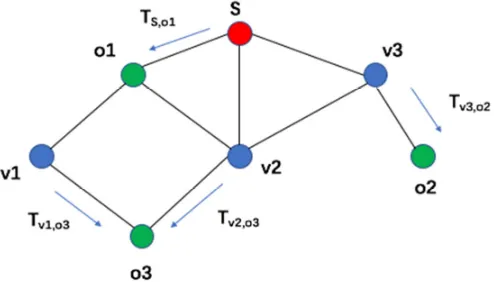
In essence, the anonymous network is an overlay network which could be expressed as a graph G=<V,E>, where V is the vertex set has N nodes and E is the edge sets has L edges (see Fig. 2).
Figure 2.An example graph G of message diffusion.
In Fig. 2, o1, o2 and o3 are observers setup by the attacker In this example, there are three observers, which measure from which neighbours and at what time they received the information. The. S is the message propagation source. The goal is to estimate, from above observations, which node in G is the possible information source. Let O ∈ ⊂ denote the set of K observers,
[image:2.612.183.430.506.647.2]neighbour and the time it received the information. Specifically, if Tv,o denotes the time observer o
receives the message from its neighbour v. Thus the location probability P is a maximum likelihood estimator [8]. Given that the propagation delay associated with the edges of G are independent identically distributed random variables with Gaussian distributionNµ, , where the mean µ and variance are known. Like [8] in this paper we assume the distribution of propagation delay in the anonymous network satisfies the Gaussian distribution.
For a general propagation graph G, the optimal estimator for most likely information source is given by equation s argmax μΛ 0.5 ∗ %, whered is the observed delay,μ is the
deterministic delay, and Λ is the delay covariance, given by &d( )* ). And &μ(
%|,-, *| |,-, |, in which |P(u,v)| denoting the number of edges (length) of the path
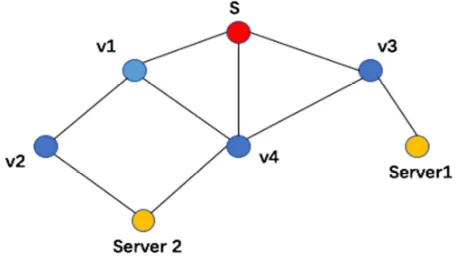
[image:3.612.192.424.408.536.2]connecting vertices u and v. By calculating the maximum likelihood estimator for s, we could get potential senders with the highest probability. For more detail please refer to [8]. As a proof of concept work, we use the above propagation method in Crowds [1] anonymous network. The node in Crowds for transmitting messages is called a jondo. When the jondo is started, it connects to a server called blender to request admittance to the Crowds network. Once the user joins the Crowds network, the user could send web browsing requests through the jondos. The user selects this jondo as her web proxy by specifying its host name and port number in her web browser as the proxy for all services. Upon receiving the first user request from the browser, the jondo establish a random path of jondos that carries its users’ traffic to and from their intended web servers. More specifically, the jondo selects a jondo from the crowd (including itself) at random and forwards the request to it. When this jondo receives the request, it flips a biased coin to determine whether to forward the request to another jondo: the coin has a probability pf to forward the message, and a probability 1-pf to send it directly to the target node or web server. A possible set of such paths is shown in Fig. 3, the possible paths are S→V3→Server1; S→ V4→ V3→ Server1 and so on. Where S and v1~v5 are called the jondos.
Figure 3. An example of the Crowds anonymous network.
Simulation Results and Analyses
and from which neighbor it received the message. After each Peersim simulation, we generated a list of observer nodes and their corresponding time to receive the message. Then we input the result as one of the parameters into the maximum likelihood estimator described in section 3. And the output of the estimator would generate a list of potential senders in the network, and in our experiment, we only considered the top ranked results as the output.
[image:4.612.153.460.221.424.2]As could be seen in Fig. 4, we used different number of nodes and different number of observers in the network, and for each simulation we ran 1000 times. The accuracy is defined as the number of correct identified sender divided by the total number of simulation times. When the number of the observers increased, we could have a higher accuracy to identify the true sender of the message. This is reasonable, because the attacker can gain more confidence when he had more available information.
Figure 4.Simulation results on different number of nodes. Pf=0.8.
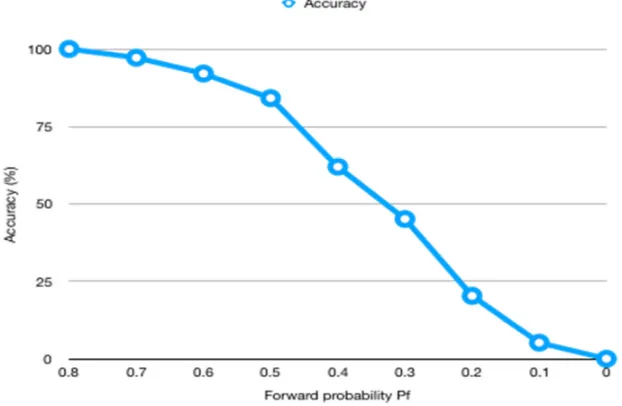
Figure 5. Using 100 nodes, accuracy under different forward probability pf.
[image:4.612.151.462.456.659.2]more likely to send the message directly to the server, thus the attacker (observer) can just gain less information to infer the source of message, simply because they did not receive the message.
Conclusion
In this paper, we innovatively proposed a message trace back method in an anonymous network based on message diffusion model [8]. We implemented the Crowds [1] anonymous network protocol based on the Peersim [15] P2P network simulator. Using the randomly selected observers in the anonymous network, the attacker could infer the potential sender of the message by utilizing our proposed method, without the necessities to control the vantage points. The simulation results suggest our method could effectively identify the anonymous sender in the network with a high accuracy.
References
[1]M. K. Reiter and A. D. Rubin. Crowds: anonymity for web transactions. ACM Trans. Inf. Syst. Secur., 1:66–92, November 1998.
[2]Dingledine R, Mathewson N, Syverson P. Tor: The second-generation onion router[R]. Naval Research Lab Washington DC, 2004.
[3]I2P Anonymous Network. http://www.i2p2.de.
[4]Wang X, Chen S, Jajodia S. Network flow watermarking attack on low-latency anonymous communication systems[C]//Security and Privacy, 2007. SP'07. IEEE Symposium on. IEEE, 2007: 116-130.
[5]Wang X, Reeves D. Robust correlation of encrypted attack traffic through stepping stones by flow watermarking[J]. IEEE Transactions on Dependable and Secure Computing, 2011, 8(3): 434-449.
[6]Panchenko A, Lanze F, Pennekamp J, et al. Website Fingerprinting at Internet Scale[C]//NDSS. 2016.
[7]Wang T, Cai X, Nithyanand R, et al. Effective Attacks and Provable Defenses for Website Fingerprinting[C]//USENIX Security Symposium. 2014: 143-157.
[8]Pinto P C, Thiran P, Vetterli M. Locating the source of diffusion in large-scale networks[J]. Physical review letters, 2012, 109(6): 068702.
[9]Jiang J, Wen S, Yu S, et al. Identifying propagation sources in networks: State-of-the-art and comparative studies[J]. IEEE Communications Surveys & Tutorials, 2017, 19(1): 465-481.
[10]Pries R, Yu W, Fu X, et al. A new replay attack against anonymous communication networks[C]//Communications, 2008. ICC'08. IEEE International Conference on. IEEE, 2008: 1578-1582.
[11]Abbott T G, Lai K J, Lieberman M R, et al. Browser-based attacks on Tor[C]//International Workshop on Privacy Enhancing Technologies. Springer Berlin Heidelberg, 2007: 184-199.
[12]Jansen R, Tschorsch F, Johnson A, et al. The sniper attack: Anonymously deanonymizing and disabling the Tor network[R]. Office of Naval Research Arlington VA, 2014.
[14]Wang X, Reeves D. Robust correlation of encrypted attack traffic through stepping stones by flow watermarking[J]. IEEE Transactions on Dependable and Secure Computing, 2011, 8(3): 434-449.