2017 International Conference on Computer, Electronics and Communication Engineering (CECE 2017) ISBN: 978-1-60595-476-9
Pseudo Multi-hop Distributed Consensus Algorithm with Time Delay
Huan-xin PENG
*, Wen-kai WANG and Bin LIU
Department of Mechanical Engineering, Nanjing Institute of Industry Technology, 1, Yang Shan North Road, Nanjing, China.
*Corresponding author
Keywords: Distributed consensus, Time-delay, Convergence performance, Pseudo multi-hop algorithm.
Abstract. In this paper, we analyze the pseudo multi-hop distributed consensus algorithm with time-delay. If there is time-delay among agents, the convergence performance of distributed consensus algorithms degrades. Supposing that the time-delay in every link is identical and invariant in time and spatial, we analyze the convergence performance of the pseudo multi-hop distributed consensus algorithm with time-delay, and calculate the maximum time-delay that the pseudo multi-hop algorithm remains stable. Finally, simulation results are provided to verify these analytical results.
Introduction
In the past few years, distributed consensus problems have attracted much attention from many fields. The distributed consensus algorithm is applied in many fields. Distributed average consensus means that each node can reach an agreement based on the information of local nodes. In [1, 2], a continuous first-order distributed consensus algorithm is proposed, and the theoretical framework for the analysis of consensus based on first order algorithms. Recently, many distributed consensus algorithms are proposed [3-7].
In order to accelerate the convergence rate of distributed consensus, in [7], the pseudo multi-hop distributed consensus algorithm under undirected graph is proposed. In [8], the pseudo multi-hop distributed consensus algorithm under directed topology is analyzed. The pseudo multi-hop distributed consensus algorithm accelerates dramatically the convergence rate by utilizing the previous information of non-adjacency nodes based on single-hop communication. The convergence rate of the pseudo multi-hop algorithm is much bigger than those of the other algorithms.
In real systems, time delays always exist due to finite communication speed. More works have recently been done on consensus algorithms with time-delays. A consensus algorithm with uniform constant commensurate delay is analyzed under undirected topology in [1]. A multi-hop relay consensus algorithm with time-delay is analyzed in [7]. Reference [9] further extends these results to multiple time-varying delays with switching topologies. Reference [6] considers constant non-uniform, non-commensurate delay on a fixed topology. Reference [10] analyzes second-order consensus algorithm with time-delay. Reference [11] analyzes the discrete-time consensus with diverse input and communication time-delays.
In the paper, we analyze the pseudo multi-hop algorithm with communication time-delay under directed topology and undirected topology. We analyze the stability of the pseudo multi-hop distributed consensus algorithm with communication delay, and calculate the maximum time-delay ensuring the pseudo multi-hop algorithm stable. For simplicity’s sake, we suppose that the communication time-delay in every links is identical and invariant in time and spatial.
Pseudo Multi-hop Distributed Consensus Algorithm with Time-delay
We introduce some notations and concepts that will be used through this paper. A graph )
,
( 1 1
1 V E
wherei,jV1. A directed graph is denoted by(i,j)(j,i). An adjacency matrix for directed graph G1
is denoted asA1{aij}N*N, where
1 1 ) , ( 0 ) , ( 0 E j i E j i
aij . A setNiis denoted as the set of vertices that can
send directly information to vertexi. In-degree of nodei is
N
j ji in i a
1 ) (
deg , and out-degree of nodei
is
N
j ij out i a
1
) (
deg .A path is a set of vertices, in which the edge formed by adjacent vertices is an
element of the setE1. A path is an m-hop path if it has m non-intersected edges. A graph )
,
( m m
m V E
G is defined as m-hop topology graph, where all elements of the edge set Em are m-hop
paths of the graph G1, and V1Vm . An adjacency matrix ofGm is denoted as Am {il}N*N ,
where otherwise E s t and and i j a a m st ij il 0 ) , ( ) , ( * * *
. A single-hop Laplacian matrix is denoted
as L1{lij}1A1 , where { ... .}
1 1
1
1
N j Nj N j j a a
diag . An m-hop Laplacian matrix is denoted
asLm{lij}mAm, where { ... .}
1 1 1
N j Nj N j jm diag . A directed graph is strong connected while
there is a directed path between any two nodes, and a directed graph is balanced while the in-degree of every node is equal to itself out-degree, i.e. degin(i)degout(i),iV.
The pseudo multi-hop distributed consensus algorithm under directed graph or undirected graph in [7, 8] can be written as:
i N j j j i ij ii k x k a k x k x k y k
x( 1) ( ) ( ){( ( ) ( )) { ( )
) 1 ( { )) 1 ) 1 ){ (
k y k x k x ka j l
N l i jl j ( ( (
l N p l ilp k x k x k
a ( ){( ( 2) ( 2)
) 1 ( )( ( ) 2 ( {
m k x k a m k y i N t st s s }}}}} )} 1 ( xs k m (1)
)) ( ) ( ( ) ( ) 1
(k a k x k x k
y i j
N j ij i i
(2)where xi(k) is the state of node iin step k, yi(k)is the state derivative of node iin step k, is a
constant step size.
For simplicity’s sake, we suppose that the communication time-delay in every links is identical and invariant in time and spatial, and the communication time-delay is .
The pseudo multi-hop algorithm with communication time-delay can be written by:
i N j j i ij ii k x k a k x k x k
x( 1) ( ) ( ){( ( ) ( ))
))}} 2 1 ( ) 2 1 ( ){( ( ) ( {
k x k x k a k y j N l i jl j j ) 1 ( ( ) ) 1 ( 2 ({y k m m a xi k m m
N w sw s s
} ))} 1(k m m
xw
)) ( ) ( ( ) ( )
1
(
k x k x k a k
y i j
N j
ij i
i
(4)
Dynamic Analyses for Pseudo Multi-hop Consensus Algorithm with Communication Time-delay
From (3) and (4), the collective dynamics of the group of nodes can be written as:
) 1 ( )
( ) ( ) 1
(k x k L1x k L x k m m
x m . (5) Form (5), we can get:
) ( )
( )
( ) 1
( ( 1)
1z x k L z x k
L k x k
zx m mm (6) We can infer from (6):
0 ) ( ) 1
( ( 1)
1
z L L z xk
z m m m . . (7) The characteristic equation of system in (7) is given by:
0 ) 1
det(
) 1 (
1
z z L z
L I
m m m
(8) Obviously, if the roots of (8) have modulus less than unity except for a root at z1, then system in (3) and (4) with a connected undirected or directed balanced graph containing a globally reachable node achieves a consensus asymptotically.
But the calculation about the roots in (8) is very difficult. For simplicity, we calculate approximately the maximum time-delay in (5) by a simply way.
If the pseudo multi-hop algorithm with time-delay can reach a consensus, i.e.
) 0 ( 1 ) ( lim ) 1 (
lim x
n k x k
x T
k
k 11 , (9)
where 1 is a vector, 1[1,1,,1]T . Obviously, we can get limx(k m) limx(k m m)
k
k . We can get from (5):
) ( )
( ) ( lim ) 1 (
limx k x k L1x k Lmx k m
k
k
(10) Obviously, equation (10) is the expression of the multi-hop algorithm, so the maximum time-delay in the pseudo multi-hop algorithm is equal to the maximum time-delay in the multi-hop algorithm.
We have the following important result.
Theorem1. For the pseudo multi-hop distributed consensus algorithm with communication time-delay in (5), when communication time-time-delay *, the pseudo multi-hop distributed consensus
algorithm with time-delay can reach an average consensus, where *is the maximum time-delay in
multi-hop algorithm.
Proof. Based on the above mentioned analysis, we can get the results.
Simulation Results
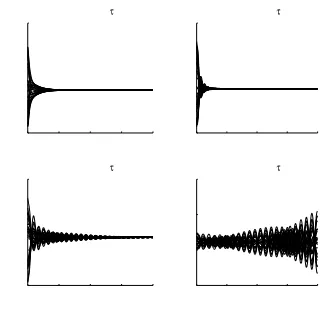
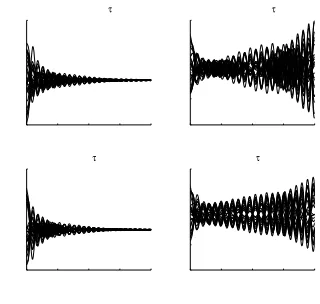
In order to verify the results of the pseudo four-hop distributed consensus algorithm with time-delay, we test it on two different networks listed in figure 1, figure 2, denoted asG1andG2. TopologyG1 is an undirected regular graph, andG2 is a directed random network with 25 nodes. For the sake of
Figure 1. Undirected regular topology graph.
Figure 2. Undirected random topology graph.
[image:4.612.223.383.404.562.2]
Figure4. The convergence performance about the pseudo four-hop distributed consensus algorithm with time-delay under graph G2.
[image:5.612.224.384.66.217.2]
Figure 5 Comparison of the maximum time-delays in the pseudo four-hop algorithm and in four-hop algorithm under graph G1.
Figure 6. Comparison of the maximum time-delays in the pseudo four-hop algorithm and in four-hop algorithm under graph G2.
From figure 3 to figure 6 show the simulation results of the mean-square error of the pseudo four-hop distributed consensus algorithm underG1andG2 with the random initial state from 0 to 50, and
[image:5.612.224.384.273.425.2]Conclusions
In this paper, we analyze the convergence performance of the pseudo multi-hop distributed consensus algorithm with communication time-delay. When there is communication time-delay among agents, the performance of distributed consensus algorithm degrades. We analyze the convergence performance of the pseudo multi-hop distributed consensus algorithm with time-delay, and calculate the maximum time-delay. By calculating, the maximum time-delay in the pseudo multi-hop algorithm is equal to the maximum time-delay in the multi-hop algorithm.
Acknowledgment
Supported by the open foundation on intelligent sensor network engineering and technology research of Jiangsu development center ZK16-02-06.
Supported by Qing Lan Project rsc16-01-01.
Supports by the open foundation on Precision manufacturing engineering and technology research of Jiangsu development center (ZK16-01-06).
Supported by Nanjing Institute of Industry Technology foundation (YK16-01-03).
References
[1] R. Olfati-Saber, R.M. Murray, “Consensus problems in networks of agents with switching topology and time-delays,” IEEE Trans. Automat. Contr., vol. 49, no. 9, pp. 1520-1533, 2004.
[2] R. Olfati-Saber, J.A. Fax, and R.M. Murray, “Consensus and cooperation in networked
multi-agent systems,” Proc. IEEE, vol. 95, no. 1, pp. 215-233, 2007.
[3] L. Xiao, S. Boyd, “Fast linear iterations for distributed averaging,” Systems and Control Letters, vol. 53, pp. 65-74, 2004.
[4] L. Xiao, S. Boyd, and S.J. Kim, “Distributed average consensus with least mean square deviation,” Journal of Parallel and Distributed Computing, vol. 67, no. 1, pp. 33-46, 2007.
[5] T.C. Aysal, B.N. Oreshkin, and M.J. Coates, “Accelerated distributed average consensus via localized node state prediction,” IEEE Transactions on signal processing, vol. 57, no. 4, pp. 1563-1576, 2009.
[6] Gang Xiong, S. Kishore, “Discrete-time second-order distributed consensus time
synchronization algorithm for wireless sensor networks,” Eurasip Journal on Wireless Communications & Networking, vol. 1, pp. 1-12, 2009.
[7] H.X. Peng, G.Q. Qi, A.D. Sheng, “Pseudo multi-hop relay distributed consensus, ”Control Theory and Application. vol. 29, no. 5, pp. 628-633, 2012.
[8] H.X. Peng, W.K. Wang, “Pseudo multi-hop distributed consensus algorithm under directed topologies,” Proceeding of 12th Internation Conference on Control, Automation, Robotics and Vision, Guangzhou, China, pp. 1227-1231, 2012.
[9] W. Ren, E.M. Atkins, “Distributed multi-vehicle coordinated control via local information exchange,” International Journal of Robust Nonlinear Control, vol. 17, no. 10, pp.1002-1033, 2007. [10]Y.G. Sun, L. Wang and G.M. Xie, “Average consensus in networks of dynamic agents with switching topologies and multiple time-varying delays,” Systems and Control Letters, vol. 57, no. 2, pp. 175-183, 2008.
[11]Y.P. Tian, C.L. Liu, “Consensus of multi-agent systems with diverse input and communication