2017 International Conference on Computer, Electronics and Communication Engineering (CECE 2017) ISBN: 978-1-60595-476-9
Research of the Shielding Effectiveness for Double Layer
Metallic Enclosures Based on HFSS
Tao-rong WANG and Xue-gong HUANG
*School of Mechanical Engineering, Nanjing University of Science and Technology, Nanjing of Jiangsu Province, China
*Corresponding author
Keywords: Shielding effectiveness, FEM, Double layer metallic enclosures, Penetrative wire.
Abstract. The effects of electromagnetic interference are getting worse with the wide application of electronic devices. For better understanding that the strong electromagnetic environment affected the metallic enclosure, it used double layer metallic enclosures in a mechatronics system as the research object to set up models. And it used HFSS software on FEM to simulat and analyze the effect on shell shielding effectiveness. The results show that: built-in circuit board can improve the electromagnetic shielding, different typical metallic material has less impact on the shielding effectiveness, and penetrative wire can reduce the shielding effectiveness of inner enclosure, but the wire coated copper sheath on surface can improve that. The research can guide the design of the electromechanical system’s structure, strengthen the anti electromagnetic interference to achieve the better shielding effectiveness.
Introduction
The extensive application of electronic devices brings the troubles of electromagnetic sensitivity and vulnerability, and it attracts the attention of various countries to electromagnetic shielding. When the electronic devices is in strong electromagnetic environment, electromagnetic energy coupling to the devices will produce induced current in the electronic circuit, interfere the nonlinear components (e.g. transistor, SCR etc.) existing in electronic circuit, affect the normal operation of electronic devices, and cause the circle engendering the malfunction, even burn electronic devices. The actual condition, electromagnetic waves can penetrate the metal shell coupling into the devices, some devices need to open apertures for the cables to ensure the power supply, signal transmission and other necessary operations, so the electromagnetic wave can also couple through apertures and conductors. There are many researches on the coupling characteristic of the apertures [1-3], this paper
makes the models of the double layer metallic enclosures based on a certain type of mechatronics system, considers the effects of penetration and penetrative wire in strong electromagnetic field, and studies the coupling process by numerical simulation.
Calculation Method of Shielding Effectiveness
When the electromagnetic wave passes through the shielding material such as metal, the incident electromagnetic wave must pass through by reflection, absorption and reflection again, and the field strength will be attenuated to a certain extent. This decay process can be divided into three parts, including the reflection of the incident interface, the absorption inside the metal, and the reflection inside the metal. So the total shielding effectiveness of metal SE consists of three parameters, including the surface reflection loss R (the sum of the two interface losses), absorption loss of A and metal internal reflection loss of B. So it is as shown in formula (1):
effect of material, and the definition of SE is ratio of the field strength about a point before shielding and after, and it’s used in engineering calculation for dB [4]. In this paper, the SE formula of electric
field is used to express the attenuation of electromagnetic field, as shown in formula (2):
E
SE = 20lg ES E0
. (2) In the formula (2), E0 indicates the electric field intensity of a point before shielding, and ES
indicates the electric field intensity of the point after shielding.
The finite element method (FEM) has wide application range, and is suitable for the analysis of various complex mechanisms. It can be also easily obtained more accurate results with modern high-speed and large reserves of computers. HFSS is the software for 3D electromagnetic field simulation and analysis based on FEM for electromagnetic field. In this paper, HFSS is used to simulat the shielding effectiveness of metal enclosure.
Modeling and Results
The Influence of PCB Board on Shielding Effectiveness
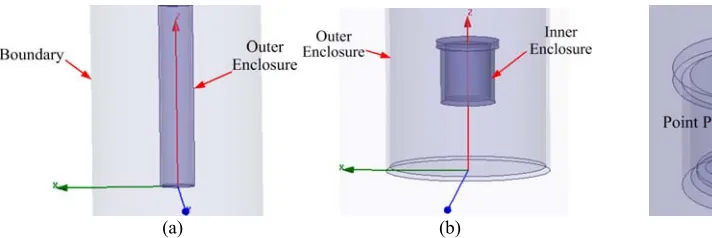
Model 1 is an empty outer enclosure without inner enclosure, as shown in figure 1(a). The material is steel, and the center of the enclosure bottom coincides with the origin of the coordinate system. The maximum diameter is Φ120mm, the total height is 972mm, and the thickness is 3mm. Model 2 is an outer enclosure with an inner enclosure, as shown in figure 1(b). The material of the inner enclosure is aluminum, the maximum diameter is Φ46mm, the total height is 46mm, the wall thickness is 3mm, and the distance between the bottom and the coordinate origin is 50mm. Model 3 is a PCB board added to the model 2, as shown in figure 1(c). The PCB board is based on FR4, with thickness of 1.6mm and diameter of Φ30mm. The surface consists with an annular microstrip line and a rectangular microstrip line. The line material is copper, with thickness of 35μm. The point P (0,0,70) in inner enclosure is as the observation point.
The incident wave is set as a plane wave and the plane wave is vertically incident along the positive direction of the X axis. The electric field intensity of the plane wave is 900V/m and positively polarized along the Z axis. The simulation results are shown in figure 2. This paper sets the radiation condition on the cylinder boundary out of model to express the electromagnetic field extended to the infinity space, what’s known as Sommerfeld [5] radiation condition.
[image:2.612.97.453.503.622.2]
(a) (b) (c) Figure 1. Building three different models.
experiment frequency the curve of P-point’s SE does not oscillate with the frequency. Leading the circuit board, shielding effectiveness increases about 5dB.
Figure 2. SE curve of point P in different situations.
The Influence of Inner Enclosure Material on Shielding Effectiveness
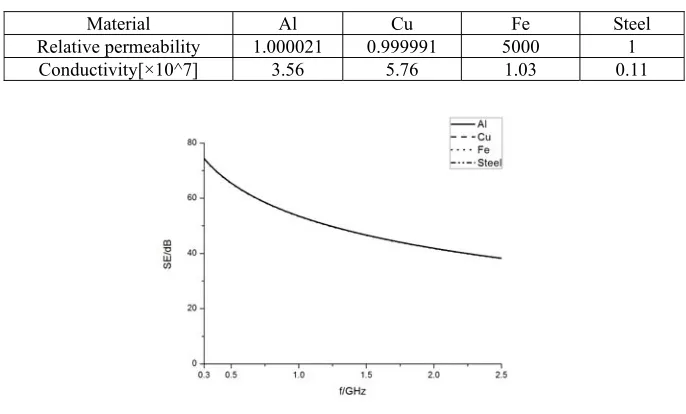
This paper uses several typical metallic materials with loss, including aluminum, copper, iron and steel, as shown in table 1. The simulation results are shown in figure 3.
[image:3.612.134.477.369.576.2]The simulation results show that the change of common metallic materials’ parameters has little influence on shielding effectiveness. Therefore, different metallic material is not the main factor affecting the shielding effectiveness of the enclosure in general.
Table 1. Electrical parameters of typical metals.
Material Al Cu Fe Steel
Relative permeability 1.000021 0.999991 5000 1
Conductivity[×10^7] 3.56 5.76 1.03 0.11
Figure 3. SE curves of different inner enclosure materials.
The Influence of Penetrative Wire in Inner Enclosure on the Shielding Effectiveness
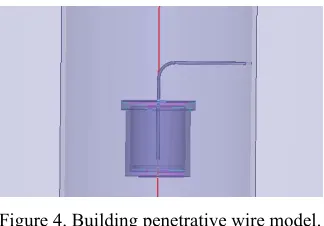
Figure 4. Building penetrative wire model.
In the figure 5, empty refers to the situation that there is no inner enclosure or line, NO line refers to the situation that there is inner enclosure and PCB but no penetrative wire, and line refers to the situation that there is penetrative wire between outer and inner enclosure. As shown in figure 5: when the frequency is about 0.45GHz, SE curve of line appears minimum, at this frequency SE is even less than the situation of empty. When the frequency is after 1.5GHz, the SE curve obviously oscillates with frequency in the case of line. And when the SE curve appears the minimum, the shielding effectiveness is negative, which means that the electromagnetic field of the inner air cavity is enhanced, and the electric field strength is enhanced. At this point, the inner enclosure has almost no shielding to the electromagnetic field as the metal cavity. Figure 5 shows that the penetrative wire between the outer and inner enclosure can obviously reduce the shielding effectiveness of the metal cavity and enhance the electric field intensity in the inner cavity.
[image:4.612.100.506.340.482.2]
Figure 5. SE curves of penetrative wire. Figure 6. SE curve of copper wrapped wire.
The part of wire inside the inner enclosure is constructed with copper sheath of 0.5mm thickness, and the simulation is carried out. The simulation results are shown in figure 6.
In figure 6, line-Cu refers to the situation of the part wire inside the inner enclosure wrapped with copper sheath. As shown in figure 6: the situation of line-Cu has higher shielding effectiveness than the situation of line.When frequency is after 1.5GHz, the SE curve oscillates with frequency in the case of line-Cu, but the value of the minimum point is larger than that of the original situation, and the shielding effectiveness is almost not negative. Figure 6 expresses the shielding effectiveness of copper covered wire is better than that of the primary wire.
The Analysis of Simulation Results
Because the inner enclosure can be regarded as a shield made of metal, it forms the two electromagnetic shielding, so the shielding effectiveness is improved compared to the situation without an inner enclosure. Moreover, the inner enclosure forms a new size air cavity, which improves the oscillation of the electric field because of the outer air cavity. In addition, because the PCB board is a king of lossy material, compared with the case without PCB, the PCB board consumes the partial electromagnetic energy of the coupling into the enclosure, so the shielding effect is improved.
The conductivity of typical metallic materials is relatively high, which can produce large current, so metallic materials can consume larger incident electromagnetic energy. Therefore, different metallic material is not the main factor affecting the shielding effectiveness of metallic enclosure in general.
When the conductor is connected with double layer enclosures, the wire runs through the inner enclosure, and it destroys the continuity of the inner enclosure surface, and affects the distribution of the induced current. In addition, the introduction of wires leads to new radiation in the inner enclosure. Although the wire is through the slot into the enclosure, but because the size of the aperture is much smaller than the wavelength of the incident wave, it is not the main reason for the reduction of electromagnetic shielding effectiveness. When the wire is wrapped with copper, the copper sheath shields certain radiation of wire, so the shielding effectiveness of the inner enclosure is improved.
Summary
In this paper, the shielding effectiveness of double layer metallic enclosures in an electromechanical system is numerically simulated by the electromagnetic simulation software HFSS based on FEM. And the impact for shielding effectiveness is mainly studied about the lead-in of PCB, the material of inner enclosure and the penetrative wire through inner enclosure. The results show that the outer enclosure’s shielding effectiveness is poor at the resonant frequency, but the existence of inner enclosure is equivalent second times shielding and improves the shielding effectiveness, improve the resonant condition. In addition, adding PCB board in the inner enclosure can also improve the shielding effectiveness. The typical metallic materials have little influence on shielding effectiveness. When there is penetrative wire connected the outer and inner enclosure, the shielding effectiveness decreases significantly and a new cavity resonance is produced. The wire wrapped with copper sheath can improve shielding effectiveness and cavity resonance to a certain extent. The research can guide the design of the structure of the electromechanical system, optimize the layout and strengthen the anti electromagnetic interference to achieve the best shielding effectiveness.
References
[1] H. Azizi, F. Tahar Belkacem, D. Moussaoui, H. Moulai, A. Bendaoud and M. Bensetti. Electromagnetic interference from shielding effectiveness of a rectangular enclosure with apertures – circuital approach, FDTD and FIT modelling. Journal of Electromagnetic Waves and Applications, 2014, 28 (4): 494-514.
[2] Jing An, Jun-feng Wu and Yi-hui Wu. Influence of slot on shielding effectiveness of shell built-in circuit board. Journal of Microwaves, 2011.4, 27(2): 34-37.
[3] Kai Li, Guang-hui Wei and Xiao-dong Pan. Study on shielding effectiveness of rectangular metal enclosure with slots. Journal of Microwaves, 2013.8, 29(4): 48-52.
[4] Joseph Shapira. Electromagnetic Compatibility for System Engineers. IETE Technical Review, 2011, 28 (1), 70-77.