2017 2nd International Conference on Wireless Communication and Network Engineering (WCNE 2017) ISBN: 978-1-60595-531-5
Intelligent Selection Recommendation Algorithm in the
"Double" Mechanism
Chun-hua TANG
1,*, Jin-jun TANG
2and En-xian CHI
31
Shandong Vocational College of Foreign Affairs Translation, Shandong Jinan, 250100, China 2
China Academy of Armed Forces Ningbo Branch, Zhejiang Ningbo, 315103, China 3
Shandong University, Shandong Jinan, 250100, China
*Corresponding author
Keywords: Credit system, Course selection, Comprehensive evaluation of curriculum.
Abstract. Aiming at the phenomenon of blind selection during the course selection of college students under the credit system, the paper puts forward the most preferred course selection recommendation algorithm and the recommended course selection algorithm based on comprehensive evaluation of curriculum. The most preferred course selection recommendation algorithm uses 0-1 integer programming model to give the minimal courses and the maximum credits; the comprehensive evaluation of curriculum based on considering the students' learning ability and learning interest gives he curriculum evaluation coefficient, students according to the curriculum evaluation coefficient can objectively and accurately select elective courses for their own development ability. These two elective courses conform to the actual situation of students' elective courses, and can effectively guide students to select courses.
Introduction
With the vigorous development of campus informatization and the extensive implementation of credit system education, and the diversification of social demand for talents, these have promoted the reform and optimization of curriculum structure in Colleges and Universities. At present, many colleges and universities have established a "compulsory + elective" double curriculum mechanism in order to cultivate diversified innovative talents, and established elective course selection system, students can independently choose the number and type of elective courses.
The Most Preferred Course Selection Recommendation Algorithm
Students in the learning course often encounter problems of Course selection, Elective courses should not only take into account the interests of their own courses, but also consider the minimum course to achieve the best results, the most important thing is to meet the requirements of the school elective courses, complete graduation.
In the course of course selection, some courses must be chosen under the premise of related subject study. There are always contradictions in the course selection under the influence of these factors. Therefore, only a careful consideration of various factors, can it ultimately get the best course selection results.
Minimum Course Recommendation Algorithm
Table 1. Alternative courses in the university.
Course number
1 2 3 4 5 6 7 8 9
Course name Mathe matics Calc ulus Principles of Statistics Financ ial Accou nting Basic accounti ng practice Accounti ng computeri zation Computer programmi ng language Fundamental s of computer application Databa se manage ment Course credits
4 2 2 4 3 2 2 4 3
Suppose that Xi represents the choice of the I course in the course table, Xi=1 means elective, and Xi=0 means not elective, The range of I is 1 to 9, MinZ means the minimum course in course selection, Max w means the most credits you get in the course selection.
The goal of elective course is the least number of elective course. That is
Eq. 1 minz=Σj=19x(j). (1)
That is
Eq. 2 minz=x1+x2+x3+x4+x5+x6+x7+x8+x9 (2) Constraint condition: For example, if you want to choose No.4 classes, you must first choose No.5 classes, which means that the x4=1 contains x5=1, this condition can be expressed as X4 ≤x5; If you want to choose No. 3 course, you must choose No.1 and No.2 courses, This condition can be expressed as x3≤x1; and x3≤x2, The combination of these two forms is an inequality, 2x3≤x1+x2.
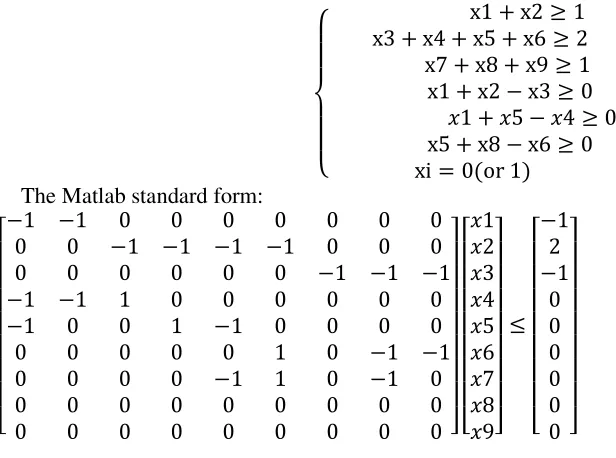
Therefore, the constraints can be expressed as
x3 + x4 + x5 + x6 ≥ 2 x1 + x2 ≥ 1 x7 + x8 + x9 ≥ 1 x1 + x2 − x3 ≥ 0 1 + 5 − 4 ≥ 0
x5 + x8 − x6 ≥ 0 xi = 0(or 1) The Matlab standard form:
−1 −10 0 −1 −1 −1 −10 0 0 0 00 00 00
0 0 0 0 0 0 −1 −1 −1
−1 −1 1 0 0 0 0 0 0
−1 0 0 1 −1 0 0 0 0
0 0 0 0 0 1 0 −1 −1
0 0 0 0 −1 1 0 −1 0
0 0 0 0 0 0 0 0 0
0 0 0 0 0 0 0 0 0
12 3 4 5 6 7 8 9 ≤ −12 −1 0 0 0 0 0 0
The Matlab program and results: z=[4,2,2,4,3,2,2,4,3];f=[1;1;1;1;1;1;1;1;1];
a=[1,1,0,0,0,0,0,0;0,0,1,1,1,1,0,0,0;0,0,0,0,0,0,1,1,1;1,1,-1,0,0,0,0,0;1,0,0,-1,1,0,0,0, 0;0,0,0,0,0,-1,0,1,1;0,0,0,0,1, -1,0,1,0;0,0,0,0,0,0,0,0,0;0,0,0,0,0,0,0,0,0];
b=[1;2;1;0;0;0;0;0;0]; aeq=[1,1,1,1,1,1,1,1,1];beq=[4]; [x,y]=bintprog(f,-a,-b, aeq, beq); x,y=-y
Optimization terminated.
Get credits: c=4x1+2x3+2x6+4x8=12
That is, when students choose mathematics, statistics, accounting computerization, computer application foundation, the number of elective courses is the least.
The Recommended Algorithm with the Least Courses and the Most Elective Courses
On the basis of question one, whether there is a better algorithm in the least elective course, which makes the total credits of elective courses maximized.
Set total credit function:
Eq. 3 maxw=4x1+2x2+2x3+4x4+3x5+2x6+2x7+4x8+3x9 (3) The matlab standard model
10 −10 −1 −1 −1 −10 0 0 0 00 00 00
0 0 0 0 0 0 −1 −1 −1
−1 −1 1 0 0 0 0 0 0
−1 0 0 1 −1 0 0 0 0
0 0 0 0 0 1 0 −1 1
0 0 0 0 −1 1 0 −1 0
0 0 0 0 0 0 0 0 0
0 0 0 0 0 0 0 0 0
12 3 4 5 6 7 8 9 ≤ −1−2 −1 0 0 0 0 0 0
(1 1 1 1 1 1 1 1 1)
12 3 4 5 6 7 8 9 =4
The Matlab program and results:
z=[4,2,2,4,3,2,2,4,3];f=[1;1;1;1;1;1;1;1;1];
a=[1,1,0,0,0,0,0,0;0,0,1,1,1,1,0,0,0;0,0,0,0,0,0,1,1,1;1,1,-1,0,0,0,0,0;1,0,0,-1,1,0,0,0, 0;0,0,0,0,0,-1,0,1,1;0,0,0,0,1, -1, 0, 1, 0;0,0,0,0,0,0,0,0,0;0,0,0,0,0,0,0,0,0];
b=[1;2;1;0;0;0;0;0;0]; aeq=[1,1,1,1,1,1,1,1,1];beq=[4]; [x,y]=bintprog(f,-a,-b, aeq, beq); x,y=-y
Optimization terminated. x={ x={1, 0, 0, 1, 0, 1, 0, 1, 0}
That is:x1=x4=x6=x8=1,x2=x3=x5=x7=x9=0
maxw=4x1+2x2+2x3+4x4+3x5+2x6+2x7+4x8+3x9=14
Similarly, in the choice of 4 elective courses, elective credits can get the maximum credit, which is 14 credits. Therefore, elective courses should be selected according to this algorithm. Comparing the above two algorithms, the 14 credit course selection algorithm is to use elective course for financial accounting instead of statistical principle of 12 credits, these two courses belong to the specialized course elective course, in line with the constraints.
The Recommended Elective course Algorithm Based on Comprehensive Evaluation
students' individual ability, but also is not conducive to the cultivation of talents. How can college students choose their own courses that they like and have ability to learn well according to their own needs in the course of choosing courses? This paper presents a comprehensive evaluation recommended course selection algorithm based on the combination of curriculum difficulty evaluation and individual willingness evaluation.
The Recommended Selection Algorithm Based on the Difficulty of the Course Evaluation
The recommended course selection algorithm based on the evaluation of curriculum difficulty is calculated according to the curriculum difficulty coefficient and the related curriculum influence coefficient.
Algorithm of Curriculum Difficulty Coefficient
The coefficient of difficulty of the course is set to dif, Its algorithm is course credits divided by 10. The Course credit is set to cc, thus
Eq. 4 dif=cc/10. (4)
Influence Coefficient of Related Courses
The degree of correlation between the related courses and the academic achievements of the related courses have great influence on the elective courses. First of all, it is to determine the related course of elective courses.
The establishment of the related courses
The correlation coefficient of an elective course and other courses is T. The value of T is calculated according to the amount of knowledge used in other courses, which is the proportion of the knowledge points in the elective course.
Thus:
Eq. 5 Ti="#" (5)
Qi represents the number of knowledge points used by other courses in this elective course, and Q represents the total number of knowledge points in the elective course. When Ti is less than 0.1, other courses influence is ignored, and we think other courses are irrelevant to this course.
Relevance of academic achievement of related courses and curriculum
Because other courses are related to an elective course, the academic achievement of other courses have an impact on the academic achievement of the elective course. The influence coefficient of the relevant courses is Ci.thus
Eq. 6 Ci=$%(&''()%)&'' (6) (fi represents the achievements of students in other related courses with 100 points.)
The determination of influence coefficient of related courses
Because one elective course may be related to other courses, the cademic achievement of other courses and the degree of association will have some influence on students' learning of this course, the influence coefficient of other courses on this course is R.
Eq. 7 R=*&∑*#.&,-=&*∑*#.&/#(&''(0#)&'' (7) (N represents the number of courses related)
Calculation of Evaluation Coefficient of Curriculum Difficulty
Eq. 8 Cd=dif+R (8) (The evaluation index of curriculum difficulty is Cd)
Algorithms for Evaluating Individual Wish
A student's interest in the course has a crucial impact on students to learn the course well. The more students like a course, the stronger the motivation for students to learn it. Here, the degree of willingness (W) is used to express the students' interest in the course. The range of will degree coefficient is 0∽1, w is to take 0 unwillingly, w is to take 1 very willingly, w is to take 0.5 usually willingly. The gradual increase of 0-1 value indicates that the will of elective course is more and more intense.
An Algorithm for Comprehensive Evaluation of an Elective Cours
Whether a student can learn an elective course well and feel that it is worth learning comes mainly from the individual's prediction of the learning ability of the course and the degree of personal interest. The comprehensive evaluation coefficient of elective courses is CE, The comprehensive evaluation coefficient of elective courses is CE, and the calculation method of CE is the coefficient of individual will minus the evaluation index of curriculum difficulty.
Eq. 9 ce=w-cd=w-dif-&1∑1%.&$%(&''()%)&'' (9) When the CE of an elective course is more than 0, it is recommended to choose an elective course; When CE is equal to 0, it is not recommended or objected to choose an elective course; When CE is less than 0, it is against selecting an elective course. According to the value of CE, students can objectively and accurately select suitable courses for their personal ability development. The number of elective courses offered by the university will reach a relative balance, which is conducive to the management of the elective courses. Through the questionnaire survey of 40 students in the last semester of 15 computer applications, we found that students who have a strong desire to take part in an elective course (w>0.5), the calculation value of CE is greater than 0; The calculated values of CE for students who are not willing to take an elective course or do not want to take an elective course (w<0.5), the calculation value of CE is less than or equal to 0. Therefore, the recommended algorithm of the elective course is in line with the actual situation of students.
Summary
References
[1] Leyuan Yu, Huabo Liao. Optimization scheme of College Students' elective courses [J]. Journal of Jining University, 2016, 37(3):40-42.
[2] Kepeng Feng. Personalized recommendation algorithm for college course selection based on Data Mining [J]. Data technology and Application. 2012:
[3] Hairong Bai, Yefei Tan, Minyu Xu. Problems and Countermeasures of students' course selection management under the credit system in Colleges and Universities—Taking Guilin University of Technology as an example [J]. Higher Education Forum. 2017:
[4] Liang, Na Zhao. Improved collaborative filtering recommendation algorithm [J]. Application of computer system. 2016, 25(7):147-150.
[5] Rui Zhao. Design of weighted course selection algorithm based on probability dynamic distribution [J]. Journal of Xi'an University of Posts and Telecommunications. 2013, 18(5):121-124.
[6] Liyuan Chai. Mathematical model of course selection based on complete credit system [J]. Mathematics learning and research. 2017, 8.
[7] Lijiang Wang. Research and application of course selection recommendation algorithm for practice teaching system [D]. North China University of Technology. 2016.
[8] Jian Hu, Lijiang Wang. Research on data mining in course selection recommendation [J]. Software. 2016, 37(4):119-121.
[9] Yi Ren; Zhao-xia Dai; Xiao-huan Zhao; Ming-ming Fei. Wen-tian Gan; Exploring an on-line course applicability assessment to assist learners in course selection and learning effectiveness improving in e-learning[J]. Learning and Individual Differences. 2017.
[10] Qang Shi, Hongjie Guan. Optimization Practice of course selection system based on cloud dynamic resource expansion [J]. Software Guide. 2016.