2016 International Conference on Artificial Intelligence: Techniques and Applications (AITA 2016) ISBN: 978-1-60595-389-2
Towards a Fixed Parameter Tractability of Geometric Hitting Set Problem
for Axis-Parallel Squares Intersecting a Given Straight Line
Daniel KHACHAY
1,2,*, Michael KHACHAY
1,2,3and Maria POBERIY
11Krasovsky Institute of Mathematics and Mechanics, 16 S. Kovalevskoy str., Ekaterinburg 620990,
Russia
2Ural Federal University, 19 Mira str., Ekaterinburg 620002, Russia
3Omsk State Technical University, 11 Mira ave., Omsk 644050, Russia
*Corresponding author
Keywords: Hitting set problem, Fixed parameter tractability, Dynamic programming.
Abstract. The Hitting Set Problem (HSP) is the well-known extremal problem adopting interest of researchers in the fields of statistical learning theory, combinatorial optimization, and computational geometry for decades. It is known, that the problem is NP-hard in its general case and remains intractable even in very specific geometric settings, e.g., for axis-parallel rectangles intersecting a given straight line. Recently, for the special case, where all the rectangles are unit squares, a polynomial but very time-consuming exact algorithm was proposed. We improve this algorithm to decrease its complexity bound more than 100 degrees of magnitude. Also, we extend it on the more general case and prove that the geometric HSP for axis-parallel (not necessarily unit) squares intersected by a line is polynomially solvable for any fixed range of the squares to hit. Hence, this geometric setting of the HSP belongs to the class of Fixed Parameter Tractable (FPT) problems.
Introduction and Related Work
We consider a geometric setting of the well-known Hitting Set Problem (HSP), which is actively investigated by researchers in machine learning, combinatorial optimization, and computational geometry.
On the one hand, to the best of our knowledge, the HSP appears to be the first intractable combinatorial problem, whose approximability was substantially improved (see, e.g. [11]) based on statistical learning techniques, especially the well-known Vapnik and Chervonenkis theory [15]. Studying the randomized approximation algorithms for the HSP and related problems sourcing from seminal papers [1] and [6] stems to the new drastically developing field in computational geometry. On the other hand, concepts of the hitting set and the ensemble classifier taking its decisions by some kind of voting are very close. In particular, the HSP and its dual Set Cover problem are closely related to well-known boosting learning procedures [14], especially to the Minimum Committee problem that of finding the ensemble majority voting classifier of the minimum VC-dimension (see, e.g. [9] and [8, 10]).
Finally, investigation of the efficient polynomial time exact and approximate algorithms for the Hitting Set and Set Cover problems seems to be very relevant in modern engineering, for instance in development of highly reliable wireless networks (see, e.g. [13]).
The geometric HSP for axis-parallel rectangles is the well-studied problem. It is known [5] that the problem is NP-hard even in the case of unit squares. In papers [7] and [2] first polynomial time approximation schemes were proposed for unit and arbitrary axis-parallel squares, respectively. Chepoi and Felsner [3] proposed 6-approximation polynomial time algorithm for the case of axis-parallel rectangles intersected by an axis-monotone Lagrangian curve. Recently, Correa et al. [4] showed that this problem is NP-hard even in the case of a straight line and proposed a 4-approximation algorithm for this particular case.
unit squares intersected by a straight line. That result seems to be very promising since the most settings of the HSP (even very special) are proven to be NP-hard. Unfortunately, their algorithm has a very high (but polynomial) bound of time consumption. In Section 3, we improve the algorithm for this setting of the HSP to decrease its complexity bound more than 100 degrees of magnitude. Further, in Section 4, we extend the algorithm to the case of square collections of varying side lengths and show that this setting belongs to a class of Fixed Parameter Tractable (FPT) problems.
Problem Statement
We consider the Hitting Set Problem in the following geometric setting. In the Euclidean plane, the finite collection 𝑆 = {𝑄1, … , 𝑄𝑛} of axis-parallel (closed) squares intersecting the given straight line
𝑑 is given. For the collection 𝑆, it is required to find a hitting set 𝑃 of a minimum size, i.e.
arg min{|P|: P ⊂ R2, P ∩ Q
[image:2.595.180.437.247.389.2]j ≠ ∅, j = 1, . . . , n }.
Figure 1. Value 𝐾 does not exceed the number of rectangular cells induced by the lines defining borders of 𝑄1, . . . , 𝑄𝑛.
Without loss of generality we assume that the line 𝑑 is defined by the equation 𝑘𝑥 + 𝑦 = 0 for some 𝑘 ≥ 1.
The collection 𝑆 induces a partition of the plane onto mutually disjunctive regions 𝜃1, … , 𝜃𝐾 such
that, any points 𝑝1 and 𝑝2 belong to the same 𝜃𝑘 if and only if
(∀ Qj ∈ S) ((p1 ∈ Qj) ⟺ (p2 ∈ Qj)).
Since each optimal hitting set contains at most one point pk from any region 𝜃𝑘, the initial continuous problem is polynomially equivalent to the corresponding combinatorial one of finding a minimal hitting set among subsets of the finite set 𝒫 = {𝑝1, . . . , 𝑝𝐾}, 𝑝𝑘∈ 𝜃𝑘\∪𝑙≠𝑘𝜃𝑙. Indeed, for any collection of 𝑛 axis-parallel squares (and even rectangles), the corresponding set 𝒫 contains at most 𝑂(𝑛2) elements (see Fig. 1) and can be constructed in polynomial time.
Improved Algorithm for Unit Squares
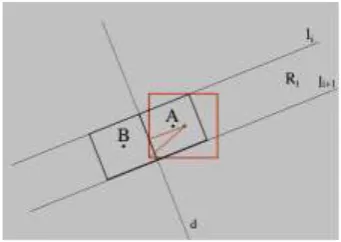
We start with the similar (but not the same) notation to that was introduced in [12]. First, we partition the plane by straight lines 𝑙0, . . . , 𝑙𝑟+2 orthogonal to 𝑑 with distance of√2/2 between each neighboring lines such that for each square 𝑄𝑗 ∈ 𝑆 its center 𝑐𝑗 is located between 𝑙1 and 𝑙𝑟+1
Figure 2. Any unit square Qj∈ Siin is hitted by one of the centers A and B of √2/2 –squares.
As in [12], we find an optimal hitting set recursively, by the dynamic programming procedure presented in Algorithm 1. Indeed, for any 𝑖 ∈ 1, . . . , 𝑟, denote 𝒫𝑖 = 𝒫 ∩ 𝑅𝑖. Let, for 𝑈 ⊂ 𝒫𝑖−1 and
𝑉 ⊂ 𝒫𝑖, 𝑇(𝑖, 𝑈, 𝑉) be the size of a smallest hitting set 𝑃 for ∪𝑙≥𝑖 𝑆𝑙 such that 𝑃 ∩ 𝒫𝑖−1 = 𝑈 and
𝑃 ∩ 𝒫𝑖 = 𝑉. Similarly to [12], we express 𝑇(𝑖, 𝑈, 𝑉) in terms of 𝑇(𝑖 + 1, 𝑈′, 𝑉′) but for a substantially smaller subsets 𝑈′ and 𝑉’.
The following Theorem summarizes the properties of Algorithm 1.
Theorem 1. For 𝑞 = 6, Algorithm 1 finds an optimal hitting set for the collection 𝑆 in time of 𝑂(𝑛37).
Proof. We start with the following simple fact. By construction, for any 𝑖 ∈ {1, . . . , 𝑟} and any
𝑗 ∈ 𝑆𝑖𝑖𝑛 , 𝑄𝑗∩ {𝐴, 𝐵} ≠ ∅ (see Fig. 2 for details). As a consequence, for any optimal hitting set 𝑃
and any 𝑖 ∈ {1, . . . , 𝑟}, |𝑃𝑖| ≤ 6, where 𝑃𝑖 = 𝑃 ∩ 𝑅𝑖. Indeed, assume by contradiction that, for some
𝑖, |𝑃𝑖| > 6. Since 𝑆𝑖 ⊂ 𝑆𝑖−1𝑖𝑛 ∪ 𝑆𝑖𝑖𝑛 ∪ 𝑆𝑖+1𝑖𝑛 and 𝑃𝑖 ∩ 𝑄𝑗 = ∅ for any 𝑄𝑗 ∉ 𝑆𝑖, we can substitute 𝑃𝑖 by an appropriate 6-point subset 𝑃𝑖′ such that 𝑃 ∪ 𝑃𝑖′\𝑃𝑖 remains a hitting set for 𝑆 and |𝑃’| < |𝑃|. The
contradiction obtained with optimality of 𝑃 finalizes our argument. Hence, Algorithm 1 finds an optimal hitting set for the given collection 𝑆.
Let us obtain an upper bound for its running time. Obviously, the loop 5-9 having 𝑟 − 1 = 𝑂(𝑛)
iterations is the most time consuming part of Algorithm 1. In each iteration, 𝑂(|𝒫𝑖−1|6) ×
𝑂(|𝒫𝑖|6) = 𝑂(𝑛24) subproblems each having time complexity of 𝑂(𝑛12) should be solved.
Hitting Squares Whose Sizes Differ
Obviously, due to the scaling, the result of Section 3 remains valid in the case of equal squares of any side-length. In this section we extend this result to the more general case. Let 𝑎 and 𝑏 be the minimum and the maximum values of side-lengths of the given squares. W.o.l.g, assume that 𝑎 = 1.
Case of 𝐤 = 𝟏
We proceed with the following observation. For 𝑘 = 1, as in Section 3, any square 𝑄 of size at least 1, whose center belongs to some stripe 𝑅’ of width √2/2 orthogonal to the line 𝑑, is hitted by the points 𝐴 and 𝐵 (like in Fig. 2). Therefore, in this case, we can adapt Algorithm 1 to take into account the squares whose side-lengths are greater than 1. Indeed, as above, consider stripes 𝑅𝑖 of width
𝑏√2/2 consisting all the squares. Then, partition each of them onto ⌈𝑏⌉ substripes of width √2/2
(see Fig. 3) and use all other notation introduced in Section 3 as is. The following assertion is valid.
Theorem 2. Let the given collection 𝑆 consists of squares with side-lengths from [1, 𝑏]. Algorithm 1 with 𝑞 = 6⌈𝑏⌉ finds an optimal hitting set for this collection in time of 𝑂(𝑛6𝑞+1). For the sake of brevity, we skip the proof of Theorem 2. As a corollary, we obtain that the hitting set problem in this case is a Fixed Parameter Tractable (FPT) problem with parameter 𝑏.
[image:4.595.62.508.335.494.2]
Figure 3. Partition of the plane for 𝑏 = 4. Figure 4. Hitting of large squares by the centers of neighboring squares.
What if 𝐤 > 𝟏
Unfortunately, in this case, situation like presented in Fig. 2 takes place only for unit squares. Indeed, consider a stripe of width √2/2; to any 𝑘 > 1 assign the largest 𝑏 = 𝑏(𝑘), for which any square 𝑄
with center 𝑐 in this stripe and intersecting the line 𝑑 is hitted by the set {𝐴, 𝐵} (as in Fig. 2). It can be proven that
inf{b(k): k ≥ 1} = 1.
But, to proceed with our extension, for squares of a larger size we can adopt the centers of the neighboring √2/2 squares. In particular, we proved that, for any 𝑘 ≥ 1, the set {𝐴, 𝐵, 𝐴’, 𝐵’} (see Fig. 4) hits any square 𝑄 intersecting the line 𝑑 with the center in a stripe of width √2/2 with side-length at most ≈ 4.43 As a corollary, we obtain
Theorem 3. For any 𝑘 ≥ 1, for 𝑞 = 8, Algorithm 1 finds a minimal hitting set of any given square collection 𝑆 with side-lengths of [1,4] in time 𝑂(𝑛49).
Conclusion
modification has better upper time complexity bound by 100 orders of magnitude. In addition, we propose an extension of this algorithm to the case of non-unit squares and proved that this problem is fixed parameter tractable with respect to the maximum of their side-length. As for the future work, it would be interesting to establish the complexity status of the considered problem in the case, where this parameter is unbounded.
Acknowledgement
This research was supported by Russian Foundation for Basic Research, grant no. 16-07-00266 and Russian Science Foundation, grant no. 14-11-00085.
References
[1] H. Brönnimann and M. T. Goodrich. Almost optimal set covers in finite vc-dimension. Discrete & Computational Geometry, 14(4):463-479, 1995. Reference to a book.
[2] T. M. Chan. Polynomial-time approximation schemes for packing and piercing fat objects. Journal of Algorithms, 46(2):178 - 189, 2003.
[3] V. Chepoi and S. Felsner. Approximating hitting sets of axis-parallel rectangles intersecting a monotone curve. Computational Geometry, 46(9):1036 - 1041, 2013.
[4] J. Correa, L. Feuilloley, P. Pérez-Lantero, and J. A. Soto. Independent and hitting sets of rectangles intersecting a diagonal line: Algorithms and complexity. Discrete & Computational Geometry, 53(2):344-365, 2015.
[5] R.J. Fowler, M.S. Paterson, and S.L. Tanimoto. Optimal packing and covering in the plane are np-complete. Information Processing Letters, 12(3):133 - 137, 1981.
[6] D. Haussler and E. Welzl. Epsilon-nets and simplex range queries. Discrete & Computational Geometry, 2(2):127-151, 1987.
[7] D. Hochbaumand W. Maass. Approximation schemes for covering and packing problems in image processing and vlsi. J. ACM, 32(1):130-136, 1985.
[8] M. Khachay. Committee polyhedral separability: complexity and polynomial approximation. Machine Learning, 101(1):231-251, 2015.
[9] M. Khachay and M. Poberii. Complexity and approximability of committee polyhedral separability of sets in general position. Informatica, 20(2):217-234, 2009.
[10] M. Khachay, M. Pobery, and D. Khachay. Integer partition problem: Theoretical approach to improving accuracy of classifier ensembles. International Journal of Artificial Intelligence, 13(1):135-146, 1 2015.
[11] J. Matoušek. Lectures on Discrete Geometry. Springer New York, 2002.
[12] A. Mudgal and S. Pandit. Covering, hitting, piercing and packing rectangles intersecting an inclined line. In Zaixin Lu, Donghyun Kim, Weili Wu, Wei Li, and Ding-Zhu Du, editors, Combinatorial Optimization and Applications: 9th International Conference, COCOA 2015, Houston, TX, USA, December 18-20, 2015, Proceedings, LNCS 9486, pages 126-137. Springer International Publishing, Cham, 2015.
[13] S. Ramakrishnan and I.M.M. El Emary. Wireless sensor networks: from theory to applications. CRCPress, Taylor & Francis, 2014.
[14] R. Schapire and Y. Freund. Boosting: Foundations and algorithms. MIT Press, 2012.