2017 2nd International Conference on Computer Science and Technology (CST 2017) ISBN: 978-1-60595-461-5
Predicating Influential Microblog in Micro-blogging Services
Yi GAO
1,a, Ting WANG
1,*Sha-sha LI
1, Cheng-sen RU
1and Jin-tao TANG
11College of Computer, National University of Defense Technology, ChangSha, Hunan,
China 410073
*Corresponding author
Keywords: Social influence analysis, learning to rank, Text content.
Abstract. This paper focuses on the problem of predicating influential message
(microblog) of micro-blogging services in China. Sina Weibo is one of China’s most notable online social networks. Inferring influential microblog has been playing a crucial part in many applications such as branding management and online advertising. However, many previous social network analysis schemes rely mainly on link structures between users to find influencers in micro-blogging services, ignoring the important text content created by the users with the assuming that text content is the cause of links. As the text content has rich features such as word count of a single microblog, the sentiment of the microblog text and so on, we propose a novel model
based on Learning to Rank, which integrates both features of the text content and the
links of the Sina Weibo users to predicate the influential microblog. Experimental results show that our model outperforms many other related algorithms, including
TunkRank and TwitterRank.
Introduction
Sina Weibo (weibo.com), one of the most notable online social network services in China, has gained tremendous popularity in recent years. A user can publish a short message via this micro-blogging service, called a microblog, and follow other users to keep up with their latest updates. Common practices of a user responding to a microblog he/she has read include reposting, commenting, and liking towards it. Responses towards a microblog reflect its social influence on other users. The more reposts, comments or likes a microblog gets, the larger influence it generates. Having a better understanding of what kinds of microblogs can make larger social influence will have practical value, such as helping advertisers or marketers design more effective marketing campaigns in micro-blogging services. However, it has been difficult for social influence analysis, because this study is pretty tough to rapidly quantized, and more importantly some related components like human behaviors cannot be reproduced when we define social influence.
Recent works have paid much attention on how to measure the influence of a microblog or a user based on information propagation among users, which is based on the following assumptions [3,8,12]:
• The social influence of a microblog can be measured by responses towards it.
• The social influence of a user is generated by the aggregation of the microblogs’
influence he/she has published.
However, these works are not enough to understand what kinds of microblogs will gain popularity in the micro-blogging services. The popularity or social influence of a microblog is not only related to that of its user’s popularity; it is also related to the topic of this microblog discussed, linguistic characteristics, emotion tendency, publication timing and etc. For example, nobody could deny that YaoChen, a famous actress in China who has over 80 million followers in Sina Weibo, is an important influencer in general. Although her influence is mainly reflected in the entertainment industry, in other fields like choosing smart phones, she is not likely to be influential. Therefore, the social influence analyzing should be under a specific topic. Many research fields are benefiting from social influence analysis, such as marketing, social sciences, etc. Identifying the key messages and users are crucial to these research fields. However, these internal characteristics of influential microblogs have not been fully studied. In this paper, we focus on exploring microblog features impacting on the social influence and develop a method to predict the influence of a microblog on a specific topic using these features.
In order to predict the social influence of microblog in micro-blogging services, this
paper propose a new model based on Learning to Rank, which utilizes both the
characteristics of the publisher and the rich text features of the microblog itself. Using the dataset gathered from Sina Weibo, we rank microblogs utilizing our new method and then validate our predicating results with actual number of repost, comment, and like of these microblogs. Comparative experiments show that the proposed method is promising. The main contributions in this paper include:
• Firstly, this paper mainly focuses on predicting the social influence of a
microblog ahead of time instead of indicating influential microblogs after the end of the event propagation in micro-blogging services.
• Secondly, we investigate a set of rich text features coming from microblog itself
which impact on the popularity of a microblog.
• Thirdly, we propose a ranking method based on Learning to Rank combining
users’ in-degree and rich features of text content to predict the social influence of microblogs.
Related Work
In early work, a user’s social influence in online social network services is generally measured by the number of followers he/she has. The more followers a user has, the more impact he/she may make in micro-blogging services. The underlying assumption here is that every microblog published by a user is read by all his/her followers [1]. However, some followers of a user seldom response to the user’s microblogs, which means that they do little with the generation of the user’s social influence. Hodas et al. [2] propose a method to cut down the interferences from those kinds of followers, which used the ratio between the number of one’s followers and the number of his/her friends as a measurement to identify influential users. Another method proposed by the
Web Ecology Project [3] measures the social influence based on the ratio of attention a
user received to the microblogs he/she published. All of the above methods have not considered the global link structures among micro-blogging users.
Many attempts have taken account of the global link structures when measuring the
social influence in the Twitter context, such as TunkRank [4], and TwitterRank [1].
difference in the social influence in different of topics. TwitterRank proposes a random walk based algorithms beyond the following relationships. A random surfer model computes TwitterRank as follows: the random surfer visits each user with certain probability by following the appropriate edge. These methods mainly use the link structures among the users to indicate users’ social influence, ignoring the rich features provided by micro-blogging services. To address these limitations of previous
approaches, a model named Followship-LDA is proposed in [5]. This model integrates
both content topic discovery and social influence analysis in the same generative process. Despite that some of these prior works begin to distinguish the topic’s impact on the users’ social influence; we can briefly conclude that the nature of all these prior works is that a user’s social influence mainly reflects in the probability that microblogs he/she published can be read. Therefore, a single microblog’s social influence is certainly an important manifestation of a user’s influence in micro-blogging services.
Embar et al. [6] define various functional and usability criteria that social influence scores should satisfy, and propose a multi-dimensional definition of social influence that satisfy these criteria. They consider many different dimensions of social influence: follower strength, activity, response rate or timeliness, etc. This work highlights the need to identify all-time influencers, which is a vivid instance of using the feature of time provided by micro-blogging services. We must note that social influence is a complex concept, which has various definitions and different evaluation metrics. Andrew McNeill and Pam Briggs [7] claim that social psychological theory can be used to in the qualitative analysis of Twitter data. They also point that when it comes to analysis the intensive social influence of tweets we should think about the how tweets can be influential by virtue of their content; the content includes emotion, themes, content category, and rhetorical strategy. Cha et al. [8] clearly present an in-depth description of two measures of a microblog’s social influence: repost and comment. These works are increasingly aware of the importance of a single microblog’s social influence.
All these prior works give us some clues about whether a user’s influence is exactly same with his/her microblog’s influence, how to measure a microblog’s social influence accurately, and which features provided by micro-blogging services can be used to analyze and predicate a microblog’s social influence better. We will carry out the following work with these questions. In this paper, we proposed a new model, for predicating the topic-based social influence of microblogs. Also compared with the existing works, our new model can analyze microblogs’ social influence ahead of time.
Overview of Proposed Model
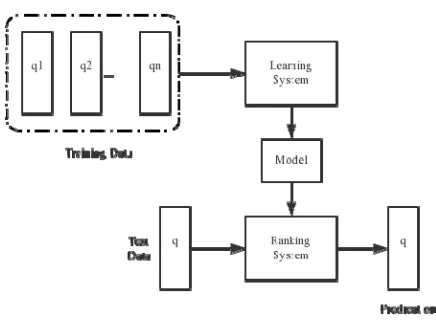
We proposed a model based on learning to Rank which has been proven to have an excellent performance in addressing a variety of ranking problems. The overview of the flowchart is shown in Fig. 1.
Figure 1. The flowchart of Learning to Rank for microblogs ranking.
As shown in Fig. 1, at first the training and test data are collected. Then the required features are extracted from the training data, which include both features from microblog’s publisher and that from microblog itself. We use ListNet algorithm to train our ranking model from the training data. At last, the trained model is used for ranking the testing microblogs according to their influence prediction.
As discussed above, there are rich features provided by micro-blogging services to predict a microblog’s influence, such as word count of a single microblog, emotional tendencies of the microblog text, and whether there are URLs shared in a microblog. Thus choosing the appropriate features for our proposed model is one of our most important tasks. The features we explored are as follows:
The Total Word Count. Sina Weibo implements many features from Twitter. A
user may post with a 140-character limit. However, in January 2016, Sina Weibo decided to remove the 140-character limit for any original post, and the users were thereby allowed to post with up to 2000 characters, while the 140-character was still applicable to reposts and comments. Intuitively, a long sentence tends to have more information than a short one. The word count is a metric of the information richness of a single microblog. We will investigate later whether the word count has a certain impact on a microblog’s propagation process.
URLs. In Sina Weibo, URLs are automatically shortened using the domain name
t.cn. Bakshy et al. investigated the attributes and relative influence of the Twitter users by tracking the tweet that contained a URL over a certain interval in 2009 and found that the tweet contained a URL were more likely to spread [12]. URL is a binary feature. It is assigned 1 when a microblog contains at least one URL, otherwise 0. This piece of work gives us a direct revelation that whether a single microblog contains a URL or not has a significant impact on the influence of a microblog.
Emotion Tendency.The emotional content of message is likely to have an impact
on the reader [7]. Thus, reader’s behavior in micro-blogging services may be different even in face of the same event described with different text sentiment. We use a simple but efficient way to get the emotional tendency of microblog text. Firstly, we utilize the
NLPIR [13] as our word segmentation tool. Then we use Chinese Emotion Word
Score= EPi*EIi i
n
. (1)In this equation, the number of emotional words is n in a sentence; EP and EI are the abbreviations of emotional polarity and emotional intensity. The Chinese Emotion Word Ontology provides a convenient and reliable aid for the Chinese text sentiment analysis and opinion analysis. There are three emotional polarities: 0 represents neutral, 1 represents commendatory, -1 represents derogatory. Each word’s emotional intensity is represented by 1,3,5,7,9; and 9 is the maximum intensity, 1 is the minimum intensity. We get each microblog’s emotional score by calculating the emotional polarity of each word multiplied by the value of the emotional intensity.
The Number of Followers. Although a user with a lot of followers may be a general
influencer in micro-blogging services, this kind of influence cannot cover all the topics. Besides, a user with a lot of followers does not always bring influential microblogs; in some specific topics, grassroots users will bring a microblog with much attention. Therefore, we cannot regard a user as an influencer just because the number of her
followers is bigger, let alone some of the followers might be zombie fans. Zombie fans
are artificial followers that can be bought and sold online.
Because our research goal is to predicate influential microblogs ahead of time, the above features provided by micro-blogging services are what we known before the microblog propagation. Assuming that when a micro-blogging user post a microblog, what we know are the number of her followers, word count of this microblog, emotional tendencies of this microblog, and whether this microblog contains URL or not. Next this microblog may draw a lot of attention, which results in a certain amount of repost, comment, and like. We expect that our proposed model can make full use of features that we already know at the same time of a user posting his/her microblog. Thus, the features repost count, comment count, and like count, can be used as natural evaluation index, which we will describe in detail in the following section.
Evaluation Metric and Experiment Results
In this section, we introduce the dataset, evaluation metric and experiment results of our proposed model in detail.
Dataset
For the purpose of this study, a set of Sina Weibo data about SAMSUNG note7
explosion in November 2016was collected as follows:
1) Keywords of the topic: We chose “note7 explosion” as our topic’s keywords.
Then we crawled microblogs that contained the keyword. Therefore, we make sure that all the microblogs gathered talks about the same topic.
2) Timing of our topics: We queried the keywords’ trends in Baidu Index
(index.baidu.com). Then used the peak time of keywords’ trends in Baidu Index for the intermediate point, and crawled the microblog for a month.
3) Users’ profile: After we collected all the microblogs, we collected the users’
profiles of all the microblogs we got.
4) Link structures: We then crawled following relationships among users who
14,519 microblogs have been collected for the topic of SAMSUNG note7 explosion;
and there are 4,784 users who post those microblogs that talked about the topic during
the appointed time. For topic SAMSUNG note7 explosion, there are in total 65535
following relationships among users. Our proposed model utilizes the rich text features and the in-degree of the users to predicate microblog’s social influence; and the link structures we gathered in this paper are used by the two-prior works, that are TunkRank and TwitterRank which are the benchmarks in our research. In our experiments, we randomly choose 10,000 microblogs as the training data, and the rest of microblogs are test data. We conduct ten queries and each query uses 1000 microblogs out of the training data.
Benchmarks and Evaluation Metric
As mentioned above, TunkRank and TwitterRank are used as benchmarks in our research. These two models are originally used to calculate the users’ social influence. However, in this paper, we make these two-prior works adapt to our research by using the following relationships among users who published related microblogs.
In this paper, we utilize Spearman’s Rank Correlation Coefficient as a measure of
the strength of the association between two different rank sets, as in Eq. 2
ρ=1−6
(
xi−yi)
2
N3−N .
(2)
xi and yi are two different ranks of microblog i based on two different social influence
measurements. The calculation of Spearman’s Rank Correlation Coefficient is a
nonparametric test. The coefficient assesses how well an arbitrary monotonic function could describe the relationship between two variables. N is the total number of
microblogs the calculation of Spearman’s Rank Correlation Coefficient assesses how
well an arbitrary monotonic function could describe the relationship between two variables, which is a fairly appropriate evaluation metric for our research. The closer ρ is to +1, the more likely two ranking is related. For example, a perfect positive
correlation is +1 and a perfect negative correlation is -1. A Spearman’s Rank
Correlation Coefficient of zero indicates that there is no relation between the two
different ranking sets.
This paper takes repost count, comment count, and like count of a microblog as its influence measures. These measures are the intuitive expression of a microblog’s social influence. The repost mechanism empowers users to spread information of their choice beyond the reach of the original microblog’s followers. Thus, repost indicates a gap in influence inferred from the number of followers and that from the popularity of one’s microblog [15]. Similarly, with the repost, when a user sees a microblog, there are the other two behaviors that this user can do, that are comment, and like. The comment mechanism indicates the ability of a user to engage others in a conversation, while the like mechanism directly reaction of users towards a microblog. The more like count of a single microblog means that this microblog gets more positive sentiment without a doubt.
Because all these three features, repost count, comment count, and like count, are the representations of a microblog’s social influence, we now address the problem of computing an aggregate influence measure for a microblog. First, we get the ranks of
these three features respectively. Then we calculate Average Top-k rank which is the
evaluation metric that is denoted as Rank_Algo. The proposed method introduced in Section III has been used to predict each microblog’s influence. All the microblogs has been ranked according to their prediction influence and compared with the rank of the above four influence measures.
Experiment Results
We train a ranking model by utilized an algorithm named ListNet based on features we
explored in Section Ⅲ; and this model is denoted as ListNet All. Two prior works
named TunkRank and Twitter Rank are implemented to compare with our proposed
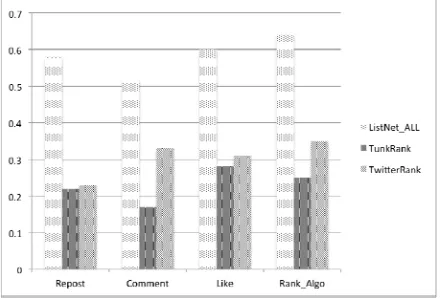
model. Fig. 2shows the comparison between our proposed model and these two-prior
works. We measure a microblog’s influence based on the repost count, comment count,
like count, and the Average Top-k rank, which are denoted as Repost, Comment, Like,
[image:7.612.197.417.251.400.2]and Rank_Algo, respectively.
Figure 2. The correlation of predication results and four influence measures.
The experiments illustrate that our proposed model has the strongest correlation in repost influence, comment influence, like influence, and the aggregate influence compared with two prior works, which the correlations are above 0.50 across all pairs.
The prior approaches of TunkRank and TwitterRank have similar performance with the
correlations below 0.40 in predicting a microblog’s social influence, because these two approaches mainly utilize the link structures of micro-blogging users. All these three approaches almost have a strongest correlation in aggregate influence, which can prove
that the Average Top-k rank works best in this reasearch.
Although the ListNet_All outperforms against the two-prior works, TunkRank and
TwitterRank, we’d like to find which feature makes the biggest contribution to
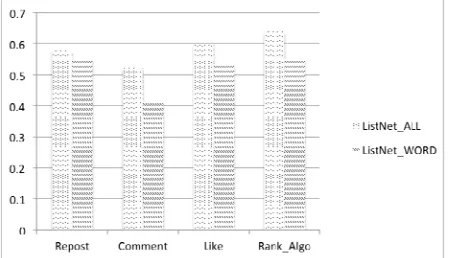
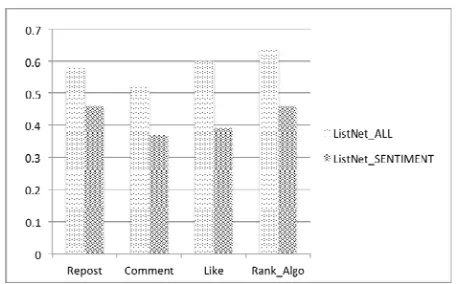
predicting a microblog’s social influence. Then we evaluate the importance of each feature by the decrement of correlation when removing each feature from ListNet_All. We remove the features of user’s in-degree, word count, microblog’s sentiment, and URL condition from ListNet_All, respectively. They are denoted as ListNet_INDEGREE, ListNet_WORD, ListNet_URL, and ListNet_SENTIMENT. Fig. 3 - Fig. 6 show the comparison between these models and ListNet_ALL.
Another significant feature is the URL of the microblog contained; the correlations fall from above 0.5 to below 0.4. We suppose the reason is that URL shared in a
[image:8.612.194.420.263.394.2]Figure 3. The comparison of ListNet_ALL and ListNet_INDEGREE.
Figure 4. The comparison of ListNet_ALL and ListNet_WORD.
[image:8.612.195.420.424.553.2]Figure 6. The comparison of ListNet_ALL and ListNet_SENTIMENT.
microblog can provide more detailed information. The other two features used in our proposed model do not display significant contribution for microblogs’ ranking compared with the features of users’ in-degree and whether contains URL; the correlations have a relatively small decline after removing them from ListNet_All. However, these two less important features still show a positive correlation. Although the Sina Weibo removed the 140-character limit last year, a single microblog trends to contain less information. Therefor the URL shared in microblog is a useful information supplement, which certainly leads to a better spread in cyberspace. Meanwhile the features of word count in a single microblog seem least important for the spread of a microblog in terms of the microblog’s four influence measures. The feature of microblog’s emotional sentiment is less important for model’s predication. It seems to be that when a micro-blogging user see a microblog, his/her endorsement towards this microblog is not depended on the sentiment of this microblog’s content. That is, People's inherent awareness is more important. Similar to the Fig. 2, new experiment results also show that there is a stronger correlation in our Average Top-k Rank. The aggregate influence measure does reduce the randomness of these three influence measures of repost count, comment count, and like count.
Conclusions
In this paper, we fully explore the features provided by micro-blogging services and
propose a model for microblogs ranking by utilizing Learning to Rank algorithm. We
reveal an effective feature set to predicate microblog’s social influence, instead of user’s social influence, which performs much better than prior works.
Future works will be conducted in the following aspects. As we all know, every micro-blogging service has a problem of zombie fans and spam messages, not just Sina Weibo, so identifying the zombie fans and spam messages is an important issue for social influence analysis which has not been taken into account yet. We should investigate the zombie and spam problems in the next research. Furthermore, social influence analysis is a complex concept, which is also related to social psychology theory; we should combine social influence analysis with the psychology theory more closely.
Acknowledgement
References
[1] J. Weng, E.P. Lim, J. Jiang, et al. Twitterrank: finding topic-sensitive influential twitterers[C], Proceedings of the third ACM international conference on Web search and data mining, ACM, 2010, pp. 261-270.
[2] N.O. Hodas, F. Kooti, K. Lerman. Friendship paradox redux: Your friends are more interesting than you, arXiv preprint arXiv:1304.3480. (2013).
[3] A. Leavitt, E. Burchard, D. Fisher, et al. submitted to Journal of Web Ecology Project (2009)
[4] D. Tunkelang. submitted to Journal of the Noisy Channel (2009)
[5] B. Bi, Y. Tian, Y. Sismanis, et al. Scalable topic-specific influence analysis on microblogs[C], Proceedings of the 7th ACM international conference on Web search and data mining, ACM, 2014, pp. 513-522.
[6] V.R. Embar, et al. Online Topic-based Social Influence Analysis for the Wimbledon Championships, KDD. (2015)
[7] A.R. McNeill, P. Briggs. Understanding Twitter influence in the health domain: a social-psychological contribution[C], Proceedings of the 23rd International Conference on World Wide Web, ACM, 2014, pp. 673-678.
[8] M. Cha, H. Haddadi, F. Benevenuto, et al. Measuring user influence in twitter: The million-follower fallacy, Icwsm, 2010, 10(10-17): 30.
[9] N. Fuhr. Probabilistic models in information retrieval, The Computer Journal 35.3 (1992): 243-255.
[10] T.Y. Liu. Learning to rank for information retrieval, Foundations and Trends® in Information Retrieval, 2009, 3(3): 225-331.
[11] Z. Cao, T. Qin, T.Y. Liu, M.F. Tsai, and H. Li. Learning to rank: from pairwise approach to listwise approach, ICML ’07: Proceedings of the 24th international conference on Machine learning, 2007, pp.129–136.
[12] E. Bakshy, J.M. Hofman, W.A. Mason, et al. Everyone's an influencer: quantifying influence on twitter[C], Proceedings of the fourth ACM international conference on Web search and data mining, ACM, 2011, pp. 65-74.
[13] K. Zhang. NLPIR: Natural language processing and information retrieval sharing platform. (2014)
[14] J. Chen. The Construction and Application of Chinese Emotion Word Ontology, Master’s Thesis, Dalian University of Technology, China, 2009.