University of Huddersfield Repository
Chilmon, Barbara and Tipi, Nicoleta S.
Modelling an End to End Supply Chain system Using Simulation
Original Citation
Chilmon, Barbara and Tipi, Nicoleta S. (2014) Modelling an End to End Supply Chain system
Using Simulation. In: LRN Annual Conference and PhD Workshop 2014, 3rd5th September 2015,
University of Huddersfield, Huddersfield, United Kingdom.
This version is available at http://eprints.hud.ac.uk/id/eprint/24664/
The University Repository is a digital collection of the research output of the
University, available on Open Access. Copyright and Moral Rights for the items
on this site are retained by the individual author and/or other copyright owners.
Users may access full items free of charge; copies of full text items generally
can be reproduced, displayed or performed and given to third parties in any
format or medium for personal research or study, educational or notforprofit
purposes without prior permission or charge, provided:
•
The authors, title and full bibliographic details is credited in any copy;
•
A hyperlink and/or URL is included for the original metadata page; and
•
The content is not changed in any way.
For more information, including our policy and submission procedure, please
contact the Repository Team at: [email protected].
Modelling an End to End Supply Chain system Using Simulation
Barbara Chilmon, Nicoleta S. Tipi
Business Operations, Supply Chain and Transport Research Group (BOSCAT), The Business
School, The University of Huddersfield, Queensgate, HD1 3DH
Email:
[email protected]
;
[email protected]
Introduction
This paper attempts to analyse trends in the field of supply chain modelling using simulation and to provide directions for future research by reviewing existing Operations Management/ Operations Research literature focusing on Supply Chain Management (SCM), which has been identified as one of the most frequently studied themes. Structural and operational complexities as well as different business processes within various industries are often limiting factors during modelling efforts. Successively, this calls for an end to end SC (E2E-SC) modelling framework where generic processes, related policies and techniques could be captured and supported by the powerful capabilities of simulation.
Literature review
In order to dichotomise the existing research on modelling an E2E supply chain, this research applies the concept of a systematic literature review (SLR), which is a literature synthesis strategy that provides rigour by building upon the existing work within the area. This approach does not, however lack criticism, therefore, its applicability and the importance is presented henceforth.
Systematic Literature Review (SLR) strategy
The systematic approach is a methodology that has been successfully applied in the simulation studies within the healthcare or medical science, where the quality of the literature review process and the synthesis of the research require transparency and attention to detail to further build the evidence base (Tranfield et al., 2003). The challenge with applying this methodology to management research is mainly related to the nature of the field. Management Studies often focus on various aspects, thus its heterogeneity may be treated as an obstacle to the synthesis of the research.
Management research requires similarities in research ideologies, values and quality judgement in order to become more rigorous thus contribute to the evidence-based knowledge (Rousseau et al.2008). This is particularly important for the research within SC that uses simulation as a methodology to address matters within operations management (OM) by applying operations research and management science (OR/MS) approach. Those studies often span across various disciplines like general management (GM), industrial engineering (IE) or management information systems (MIS) hence pertinence of SLR, which brings clarity to the research questions and enhances credibility of the review summary. It further helps to replicate the research and extend its findings. This research focuses on the SC modelling and aims to identify the most commonly studied themes that adopted simulation methodology within the E2E-SC. Therefore the study focuses on two distinct aspects of an E2E-SC definition which are strongly based upon the supply chain management concept and refers to:
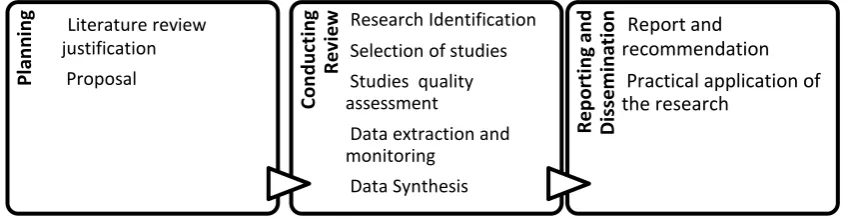
2 Figure 1 SLR process; further developed from Khan (2001) and Kitchenham (2004)
The entire chain of processes/ activities undertaken in order to deliver the product/ service to the final user/ customer (Handfield, 2011).
SLR is important and necessary for the development of an E2E-SC simulation model due to the clarity that the approach brings. It can further comprehend the existing conceptual framework developed by Pundoor and Herrmann (2006) that has been adopted as a background for this research and allows for the identification of E2E model. Likewise, it permits to construct a high quality research essential in practise as from the practitioners / industry point of view, the implementation of the developed models can have adverse financial consequences and implication to the business.
Limited work has been done to identify and analyse the existing studies where various theories and methods within the modelling of an E2E-SC from product and/or process view are summarised in a systematic manner. Consequently, this paper aims to fulfil this gap by reviewing selected studies within SCM.
The systematic approach to literature review involves the evaluation and interpretation of all available research within a particular research question, area of interest or phenomena under investigation (Kitchenham, 2004). The author further points out that the literature review is of little scientific value unless is through and with accordance to a predefined strategy. This implies that the research needs to explicitly specify the inclusion and exclusion of the studies that fall in the scope of the SLR. Khan (2001) and Kichenham (2004) stress that this is one of the necessary steps that need to be taken in order to conduct SLR in an informed manner (Figure 1).
This research considers the SLR approach proposed by Khan (2001) and recommendation from Kitchenham (2004) where after careful planning process researcher identifies the scoping studies based on appropriate quality assessments. The research henceforth focuses on conducting a literature review and explains the strategy used to search for primary studies as well as inclusion and exclusion criteria. Moreover, it summarises the methods used to conduct the SLR under a protocol which include: resources to be used, journal selection, synthesis of the extracted data from primary studies and the timeframe for the review (Kitchenham 2004).
Study selection- a protocol
SC can be described as an integrated system that coordinates various intra-organisational processes and synchronises them amongst cooperating businesses and their customers (Min and Zhou 2002). Therefore a success of an organisation depends largely on their managers’ ability to address various operational challenges. A review of existing literature related to SCM and SC modelling reveals that this demands companies to incessantly examine their strategies with the overall aim of simplifying their business processes and procedures (Caridi et al., 2013).
Pl ann ing
Literature review
justification Proposal C o nd uct ing R e vi ew Research Identification Selection of studies Studies quality assessmentData extraction and monitoring Data Synthesis R e po rti ng and D isse m ina ti o
n Report and
3 The SLR seeks to address this gap and is guided by the following primary question:
Which are the main elements, processes and characteristics of an E2E-SC?
A set of journals was chosen as a base for the literature survey following previous study conducted by Shafer and Smunt (2004). The search was managed with the help of the ‘Scopus’, which is the largest online abstract and citation database within peer reviewed literature (www.elsevier.com). Likewise ‘Scopus’ is a product of large journal and book publisher Elsevier, which provides access to a wide range of materials.
A first step within the literature review process was to conduct scoping studies to identify all peer reviewed articles within selected journals and published within specified timeframe related to supply chain. Secondly, using wildcard characters to search for variations of a word an investigation into simulation studies within supply chain was conducted (Scopus 2013). Articles were only selected based on the appearance of the search strings in title, abstract, and key words of a particular paper.
Journal articles selected during scoping studies were subject to further review. Based on the breadth of the field, it was decided to not apply any further search strings, but to review the title, abstract and key words for relevance. The selection criteria were as follows:
Articles that focus on the following aspects were chosen for further synthesis and analysis: extended SC, entire SC, complex SC, complex networks, SC systems, multi-echelons, whole SC, multi-product
The selected articles were classified into thematically similar groups and categories considering such aspects as: simulation model elements and scope, type of the industry, nature of data used for analysis as well as the type of the simulation tool used. This process facilitated a clear understanding of the trends and themes developed by academics and practitioners over the past fourteen years in relation to simulation modelling within the SCs. Nevertheless, the review highlights the need for the generic modelling framework that will provide clarity and enable global SC operators to control and holistically view the business.
Review Findings
Computer simulation is one of the most frequently used techniques in modelling SCs. It provides a robust tool to help decision makers and capability to address complex issues caused by uncertainty in supply and demand, conflicting objectives, ambiguity of information, coupled with the numerous variables and constraints at different levels (Abo-Hamad and Arisha 2011). Simulation can be defined as “a broad collection of methods and applications to mimic the behaviour of a real system” (Kelton 2004 p.3) usually performed with the help of computer assisted tools; General Software, Specialist Packages or Simulation Languages.
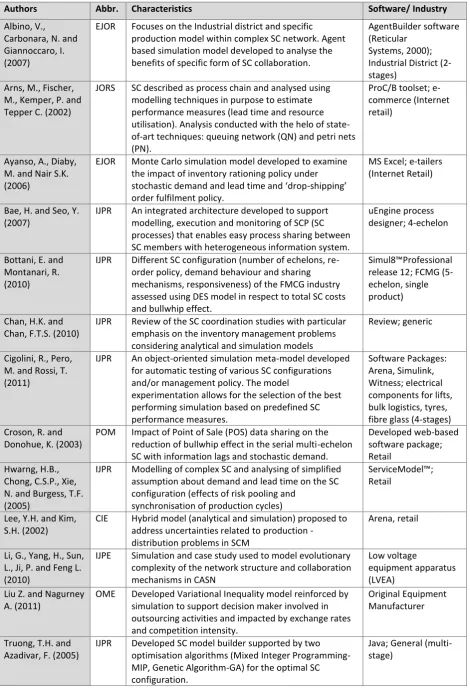
The review of selected literature on SC modelling and simulation highlights that the majority of work where simulation methodology was applied has been published in the International Journal of Production Research (IJPR), International Journal of Production Economics (IJPE) and European Journal of Operational Research (EJOR). This indicates that the most often discussed aspects are production and manufacturing research as per journals’ aims and scope (Taylor and Francis 2013, Elsevier 2014). The findings are also applied to SCM studies reviewed in table 1.
4
Authors Abbr. Characteristics Software/ Industry
Albino, V., Carbonara, N. and Giannoccaro, I. (2007)
EJOR Focuses on the Industrial district and specific production model within complex SC network. Agent based simulation model developed to analyse the benefits of specific form of SC collaboration.
AgentBuilder software (Reticular
Systems, 2000); Industrial District (2-stages)
Arns, M., Fischer, M., Kemper, P. and Tepper C. (2002)
JORS SC described as process chain and analysed using modelling techniques in purpose to estimate performance measures (lead time and resource utilisation). Analysis conducted with the helo of state-of-art techniques: queuing network (QN) and petri nets (PN).
ProC/B toolset; e-commerce (Internet retail)
Ayanso, A., Diaby, M. and Nair S.K. (2006)
EJOR Monte Carlo simulation model developed to examine the impact of inventory rationing policy under stochastic demand and lead time and ‘drop-shipping’ order fulfilment policy.
MS Excel; e-tailers (Internet Retail)
Bae, H. and Seo, Y. (2007)
IJPR An integrated architecture developed to support modelling, execution and monitoring of SCP (SC processes) that enables easy process sharing between SC members with heterogeneous information system.
uEngine process designer; 4-echelon
Bottani, E. and Montanari, R. (2010)
IJPR Different SC configuration (number of echelons, re-order policy, demand behaviour and sharing mechanisms, responsiveness) of the FMCG industry assessed using DES model in respect to total SC costs and bullwhip effect.
Simul8™Professional release 12; FCMG (5-echelon, single product)
Chan, H.K. and Chan, F.T.S. (2010)
IJPR Review of the SC coordination studies with particular emphasis on the inventory management problems considering analytical and simulation models
Review; generic
Cigolini, R., Pero, M. and Rossi, T. (2011)
IJPR An object-oriented simulation meta-model developed for automatic testing of various SC configurations and/or management policy. The model
experimentation allows for the selection of the best performing simulation based on predefined SC performance measures.
Software Packages: Arena, Simulink, Witness; electrical components for lifts, bulk logistics, tyres, fibre glass (4-stages) Croson, R. and
Donohue, K. (2003)
POM Impact of Point of Sale (POS) data sharing on the reduction of bullwhip effect in the serial multi-echelon SC with information lags and stochastic demand.
Developed web-based software package; Retail
Hwarng, H.B., Chong, C.S.P., Xie, N. and Burgess, T.F. (2005)
IJPR Modelling of complex SC and analysing of simplified assumption about demand and lead time on the SC configuration (effects of risk pooling and
synchronisation of production cycles)
ServiceModel™; Retail
Lee, Y.H. and Kim, S.H. (2002)
CIE Hybrid model (analytical and simulation) proposed to address uncertainties related to production -
distribution problems in SCM
Arena, retail
Li, G., Yang, H., Sun, L., Ji, P. and Feng L. (2010)
IJPE Simulation and case study used to model evolutionary complexity of the network structure and collaboration mechanisms in CASN
Low voltage
equipment apparatus (LVEA)
Liu Z. and Nagurney A. (2011)
OME Developed Variational Inequality model reinforced by simulation to support decision maker involved in outsourcing activities and impacted by exchange rates and competition intensity.
Original Equipment Manufacturer
Truong, T.H. and Azadivar, F. (2005)
IJPR Developed SC model builder supported by two optimisation algorithms (Mixed Integer Programming- MIP, Genetic Algorithm-GA) for the optimal SC configuration.
[image:5.595.67.538.68.760.2]Java; General (multi-stage)
5 SCM is associated with management of materials and information flows at three levels within the SC (Cigolini et al. 2011) through efficient and effective SC design, planning and control (Bottani and Montanari, 2010).
Heterogeneous nature of Business Process Management (BPM) within organisations can create some issues in regards to setting and controlling the access level to each company’s process information. This has been addressed by Bae and Seo (2007) who developed a role-based SC process monitoring (RSCPM) model. This reflects the advancements in Information technology where integrated architecture has been proposed to support SC Process monitoring, control and execution trough Web services integration.
Advancements in SCM often necessitate the entire SC design to be configured and designed alongside product/ process requiring sophisticated techniques to align often conflicting objectives of various SC components (echelons) alongside dynamism of the surrounding environment (Truong and Azadivar, 2005).
Operational research issues and practical decision are supported by various complex computational techniques and methods often spanning across multiple dimension and disciplines such as mathematics, computer engineering, software design, biology, education and many others. Simulation has been purposely used in the research on topics that threat the interface between various cross-disciplinary areas related to complex SC systems. Structural complexity in the SC however, is not the only reason favouring simulation methods.
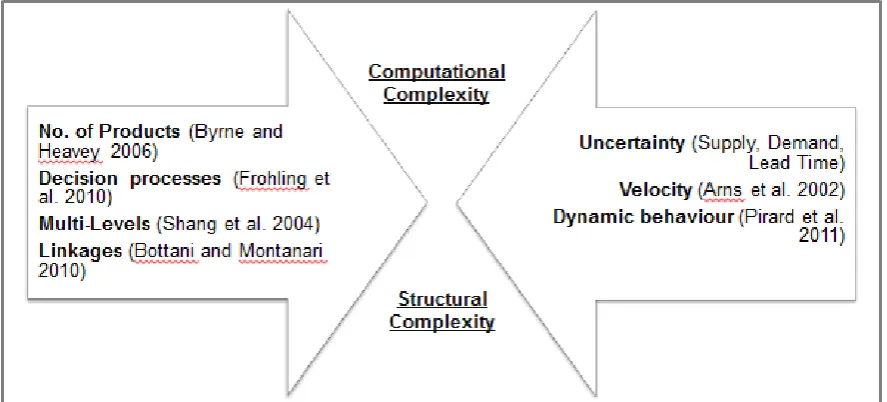
[image:6.595.79.523.499.700.2]Byrne and Heavey (2006) studied the effects of utilising information sharing and forecasting in the capacitated SC simulating various scenarios, which considered demand profiling as a way to differentiate processes that were applicable to a certain group of products. SC studies that adopt simulation as a methodology often cross multiple levels as observed in Shang et al. (2004) where multi-dimensional issues within SC operations such as cooperation, information, sharing and capacity were enhanced by computational complexities in a form of multiple operational techniques such as Taguchi method, response surface and simulation (figure 2).
6 Complexity in modelling SC is also enhanced by the existence of structural differences between industries that affect computational results and require a specific operational environment to suit business and model requirements.
Arns et al. (2002) provided an analytical evaluation of the modelling techniques for investigating velocity of service and product delivery in the SC and proposes a hybrid model. The authors devised hierarchical modelling approach to reduce computational complexity and allowed aggregation of various sub-models designed with different approaches (Queuing Network or Petri Nets).
Pirard et al. (2011) designed a model that mimics dynamic behaviour of the SC system caused by uncertainties (supply, demand or lead time). Focusing on various SC design scenarios, an evaluation of control policies applied to inventory management, scheduling and production activities was undertaken.
Decision maker was involved in the optimisation of selected elements in the model (rules) as a way to improve SC system performance. Simulation capabilities have been employed in detailed process modelling to support decision making processes as in Frohling et al. (2010), where consideration was given to integrate the planning of complex SC processes. Frohling et al (2010) presents an innovative application of OR to closed loop SC through designing a recycling process model that allocates residues from different sources to recycling sites.
Shafer and Smunt (2004) summarised empirical simulation studies in OM filed concluding that scheduling was the most frequent research topics with capacity planning and cellular manufacturing closely following. This research extends their work by deliberating categories that were selected by the authors and identifies new categories within E2E-SC simulation studies. Based on the review of the sixty randomly selected studies, it appears that SCM is one of the most frequently investigated areas. It spans across multiple disciplines incorporating elements of complexity and adopting simulation as a modelling technique. Various multi-level decisions related to planning, sourcing, producing, distributing and transportation are analysed with the help of quantitative modelling techniques, where sophisticated algorithms taken on from other disciplines like physics or biology are employed (Surana et al, 2005).
Supply Chain Operations Reference (SCOR) model has often been used within the studies as a standard framework to describe and/or map SC processes. Herrmann et al. (2003) proposed a SC simulation model based on Discrete Event Simulation (DES) and SCOR model to study dynamic nature of the SC incorporating multiple level of detail that permit for inclusion of as many features as required.
More attention has been brought to study aspects of SC collaboration and examination of benefits achieved through linking simulation modelling with operational processes, for instance Collaborative Forecasting, Planning and Replenishment (CFPR) (Caridi et al. 2005). In the SC system, organisations work together to deliver the right quantity of products timely and cost efficient to satisfy the end customer needs and desires. Notwithstanding a common goal to achieve high SC performance, each of the chain participants decides about the level of information sharing with other participants in order to maintain its competitive position in the market and manage uncertainty effectively (Datta and Christopher 2011).
7 A range of studies looked into modelling complex SC systems, but limited work has been done on modelling an E2E-SC from the system thinking perspective where the system is viewed holistically and inclusive of all elements of the system rather than selected sets of individual elements.
Source: E2E SC Taxonomy based on the SLR
The most frequently used simulation techniques within reviewed studies were Agent Based Simulation which belongs to the Artificial Intelligence and addresses various aspects of SC system behaviour alongside discrete event simulation (DES). Studies that consider simulation methodology appreciate the computational constraints that analytical methods provide thus often combine / mix modelling methods. This is particularly important in modelling complex SC systems and has been reflected in various studies combining optimisation with heuristics and simulation or analytical models with simulation (Bae and Seo 2007).
Findings and Originality
8
Research Impact
A systematic review of the supply chain and simulation literature takes an integrated and holistic assessment of an E2E SC, from market-demand scenarios through order management and planning processes, and on to manufacturing and physical distribution. Thus, by providing significant advances in understanding of the theory, methods used and applicability of supply chain simulation, this paper will further develop a body of knowledge within this subject area.
Practical Impact
The paper will empower practitioners’ knowledge and understanding of the supply chain process characteristics that can be modelled using simulation. Moreover, it will facilitate a selection of specific data required for the simulation in accordance with the individual needs of the industry.
Keywords: supply chain, modelling, simulation
References
Abo-Hamad, W., and Arisha, A. (2011), ‘Simulation-Optimisation Methods in Supply Chain Applications: A Review’, Irish Journal of Management, 30(2), 95-124.
Arns, M., Fischer, M., Kemper, P. and Tepper, C. (2002), ‘Supply Chain Modelling and Its Analytical Evaluation’, Journal of Operational Research Society, 53(8), 885-894.
Bae, H. and Seo, Y. (2007), ‘BPM-based integration of supply chain process modeling, executing and monitoring’, International Journal of Production Research, 45(11), 2545-2566.
Bottani, E. and Montanari, R. (2010), ‘Supply chain design and cost analysis through simulation’,
International Journal of Production Research, 48(10), 2859-2886.
Byrne, P.J. and Heavey, C. (2006), ‘The impact of information sharing and forecasting in capacitated industrial supply chains: A case study’, International Journal of Production Economics, 103, 420-437.
Caridi, M., Perego, A. and Tumino, A. (2013), ‘Measuring supply chain visibility in the apparel industry’,
Benchmarking: An International Journal, 20(1), 25-44.
Chan, H.K. and Chan, F.T.S. (2010), ‘A review of coordination studies in the context of supply chain dynamics’, International Journal of Production Research, 48(10), 2793–2819.
Cigolini, R., Pero, M. and Rossi, T. (2011), ‘An object-oriented simulation meta-model to analyse supply chain performance’, International Journal of Production Research, 49(19), 5917-5941.
Handfield, R. (2011), What is Supply Chain Management? Retrieved from http://scm.ncsu.edu/scm-articles/article/what-is-supply-chain-management.
Kitchenham, B. (2004), ‘Procedures for performing systematic reviews’, Keele University Technical Report
Lambert, D. M. (2008), ‘Supply chain management: processes, partnerships, performance’, Third Edition, Sarasota: Supply Chain Management Institute
Pundoor, G., & Herrmann, J. W. (2006), ‘A hierarchical approach to supply chain simulation modelling using the Supply Chain Operations Reference model’, International Journal of Simulation and Process Modelling, 2(3), 124-132.
Rousseau, D. M., Manning, J., & Denyer, D. (2008), ‘11 Evidence in Management and Organizational Science: Assembling the Field’s Full Weight of Scientific Knowledge Through Syntheses’, The academy of
management annals, 2(1), 475-515.
Scopus. (2013), Help and Contacts. Retrieved from http://help.scopus.com.libaccess.hud.ac.uk
Shafer, S. M., & Smunt, T. L. (2004), ‘Empirical simulation studies in operations management: context, trends, and research opportunities’, Journal of Operations Management, 22(4), 345-354.
Tranfield, D., Denyer, D., & Smart, P. (2003), ‘Towards a methodology for developing evidence‐informed management knowledge by means of systematic review’, British journal of management, 14(3), 207-222.
Van Der Zee, D. J., and Van Der Vorst, J. G. (2005), ‘A modeling framework for supply chain simulation: Opportunities for improved decision making’, Decision Sciences, 36(1), 65-95..