University of Huddersfield Repository
Bernier, NicolasFive objectbased sound compositions
Original Citation
Bernier, Nicolas (2013) Five objectbased sound compositions. Doctoral thesis, University of Huddersfield.
This version is available at http://eprints.hud.ac.uk/id/eprint/23294/
The University Repository is a digital collection of the research output of the University, available on Open Access. Copyright and Moral Rights for the items on this site are retained by the individual author and/or other copyright owners. Users may access full items free of charge; copies of full text items generally can be reproduced, displayed or performed and given to third parties in any format or medium for personal research or study, educational or notforprofit purposes without prior permission or charge, provided:
• The authors, title and full bibliographic details is credited in any copy; • A hyperlink and/or URL is included for the original metadata page; and • The content is not changed in any way.
For more information, including our policy and submission procedure, please contact the Repository Team at: [email protected].
!
FIVE OBJECT-BASED SOUND COMPOSITIONS
Nicolas Bernier
Thesis submitted in partial fulfillment of the
requirements for the degree of Doctor of Philosophy School of Music, Humanities and Media
University of Huddersfield
!
!
!
!
!
!
!
“the measure of a work of art is whether one can sense in it the presence of the artist’s body. If so, then it is a success, and if not, it’s a failure.”— Pierre Hébert
TABLE OF CONTENT
Abstract v
Acknowledgement vi
Introduction 1
PART I 4
OBJECT, PERFORMANCE, VISION 4
1. Objects and works 5
1.1. On the relationship to the object 5
1.2. The recorded object: Dans le ventre de la machine 8
1.3. The amplified object: frequencies (a) 13
1.4. The mechanized object: L’usure du clocher 15
1.5. The silent object: Music for a book 17
1.6. The absent object: frequencies (synthetic variations) 19
2. Objects and performances 23
2.1. Materialization 23
2.2. Manipulation 27
3. Objects and vision 32
3.1. Hybridity 32
3.2. Materiality 35
3.3. Luminosity 39
3.4. Synchronicity 44
Word count: 25 654
PART II 51
IDEAS, MATTER, AESTHETIC 51
5. Conceptuality 53
5.1. Socio-political concept 56
5.2. Community concept 59
5.3. Historical concept 62
5.4. Material concept 64
5.5. Absent concept 66
6. Artificiality 70
6.1. Authenticity 70
6.2. (Dis)organization 72
7. Physicality 75
7.1. Friction 75
7.2. Humanity 76
8. Impurity 78
8.1. Noise 78
8.2. Rupture 81
8.3. Post-Glitch 84
9. Summary of Part Two 87
Conclusion 88
References 93
Art works cited 98
Submitted works 101
Annexed works 102
ABSTRACT
This text is a commentary on the nature of my principle artistic preoccupations over a period of research-creation spanning 2011 and 2013. The works discussed cover, each in their own way, various approaches to sound composition linked to physical objects. In effect, the object proves to be a fundamental element at the heart of discourse, which, though anchored in sound, is often multi-disciplinary. The object here is thus taken apart in its affective, conceptual, performative, visual, as well as sonic properties. The first part of this text illustrates the nature of the relationship between the physical object and the works submitted for this doctoral thesis. It focuses on the journey of the works: from their genesis in the artist’s collections of objects to their life on stage where the objects are used as visual elements in a performative context.
The second part is dedicated to the conceptual and aesthetic content of the works, from which flow the principal elements of their discourse. Here, the relationships between the work, the concept and the sonic material are established, which together make up their aesthetic.
ACKNOWLEDGEMENT
I express my great and sincere gratitude to Pierre Alexandre Tremblay who supervised my doctoral thesis. His generosity and the acuity of his comments, often leading to passionate debates allowed me to reflect further on my artistic practice. I would like to thank Monty Adkins, second supervisor, who has always provided interesting food for thought during the making of this work.
I gratefully acknowledge the financial support of the Fonds de recherche sur la société et la culture (FQRSC) and of the University of Huddersfield during the duration of my Ph.D. studies.
Thanks to my family who has always supported me in this singular artist/parent/ student/worker journey, especially to my wife Isabelle Gardner, my son Louis Bernier and my father Serge Bernier.
Thanks to close colleagues and collaborators, rich and perpetual sources of inspiration and reflection : Olivier Girouard, Martin Messier, Dominic Thibault, and to the stimulating artists at Perte de signal, artist-run media centre who have been supporting my work for many years.
INTRODUCTION
About this text
This commentary addresses the main concerns that emerged during my doctoral research at the University of Huddersfield. It acts as a complement to a portfolio of five sound works that are intrinsically linked to physical objects. These works take different forms: fixed media, installation, performance and soundtrack.
multidisciplinary thought led to the works discussed. This multiplicity of references reflects the multidisciplinary aesthetic research that led to the works discussed, pointing towards a better understanding of the ideas that fueled this artistic work. It is important to note that there is but a limited discussion of the musical form per se, in favour of an analysis of the work in a broader sense, within in a multidisciplinary perspective. The form of the work is addressed rather it in its relationship to the physical object, the choice of materials, its integration of scenic elements, its staging, as well as its lighting. These concerns were also the subject of an article published in the journal Circuit, published by the Université de Montreal (Bernier, 2013a), which, within a more condensed framework, laid the foundations for this dissertation.
The main theme—the relationship between the physical object and the works—is explored at its elementary level, that is to say, as an object in itself and not in reference to the theory of sound objects elaborated by Pierre Schaeffer (1966). The lack of references to Schaeffer’s ideas might indeed seem unusual for the discerning reader, but it is a conscious omission which, in my opinion, avoids confusing the reader in a series of definitions that might weigh the simple object down with Schaeffer’s phenomenological considerations.
This document was written in a spirit of openness providing a series of aesthetic and formal analytic elements leading to a better understanding of the works that forges this research.
!
Content
!
PART I
!
1. Objects and works
This section establishes the dominant relationship between objects and each work covered in this text.
The discussion revolves around the primary motivations leading to work based on objects: an attachment to physical matter; the narrative and symbolic properties of objects; the desire to materialize an invisible art form. This relationship is initially taken up in a general discussion on the subject and then further examined relative to every work submitted. These projects each cover the relationship to the object in their own way: the object is recorded, amplified, mechanized, silent, or even absent.
1.1. On the relationship to the object
First and foremost, even before the sound material, it is the physical material that is the center of my compositional approach: the material that I can touch, feel, look at; that can scratch me, scald me, engulf me, injure me, stroke me, that I can interact with, throw, knock, caress, manipulate. According to ethnomusicologist Lucie Rault, we can trace instruments made from found objects back to primitive civilizations (Rault, 1
des objets2 (The System of Objects), sociologist Jean Baudrillard puts forward that “man is bound to the objects around him by the same visceral intimacy that binds him to the organs of his own body” (1968, p. 20). Thus, even if the goal is is to compose 3
sound, it is important to me to cultivate that intimacy with the physical world and the objects that surround us, because they give meaning to my life and my worldview. The foundations of the works discussed here flow directly from this relationship to the object.
Therefore, the trigger for one of my art projects is only very rarely the music itself, since to imagine a project, I need to connect to the visible world and the objects themselves. Musicologist and philosopher Theodor W. Adorno wrote: “music is antithetical to the definiteness of material things” (Adorno & Eisler, 2005, p. 21). Contrary to this statement, my work on the sound is intrinsically linked to physical material, weaving together, in its use of the object, hearing, thinking and seeing.
My interest in this close relationship with the object probably originates in my past as a drummer, in which the sense of touch is crucial. When the computer became my main tool as a composer, this sensual need quickly resurfaced. Bill Brown, an American researcher dedicated to the cultural history of the object, points to what I miss when working on the computer: “Something warm, then, that relieves us from the chill of dogged ideation, something concrete that relieves us from unnecessary abstraction” (Brown, 2004a, p. 1). This feeling is obviously not uniquely the result of
! This essay by Jean Baudrillard is one of the texts that was of greatest interest to me because it is a text dealing 2
directly – although within a non-musical perspective – with the subject of my research on the relationship with the object.
! “l’homme est lié alors aux objets ambiants par la même intimité viscérale (toutes proportions gardées) qu’aux 3
the advent of digital technologies, as the composer Frederic Rzewski testifies in a comment issued in 1969, long before digital proliferation:
Now that machines have become such a dominant part of our environment, we are beginning to become aware of the need for rediscovering our bodies, which have become atrophied by dependence on machines and from which machines have alienated us. Our music has to be a demonstration of something simple, physical, universal, and liberating. Machines, electronics, and fancy technology get in the way of this demonstration. (Rzewski, Frederic in Cox, 2002, p. 43)
The object allows me to thwart the primacy of the computer in my work. Indeed, the computer as an object seems uninteresting to me, being a functional object with little of the evocative power that I find in other objects. Indeed, in its reference to the material world around us, the object is involved in the creation of meaning, which weaves a multiplicity of narrative threads into the heart of the compositions. For example, the story linking the object to the artist is metaphorically embedded in the object. The past story of the object that the artist enjoys imagining as well as the future story in the work being created also reside within it. This work—and this object—is then perceived by audience members who, in turn, can reinvent the path that led to them. The multidisciplinary artist Susan Hiller explains the multi-layered signification told by the object:
For example, in the sound performance frequencies (a) (2012a), I use the tuning fork for its power to evoke a musician’s moment of tuning an instrument, a spiritual person’s meditation practice, or even an acoustician’s scientific experimentation. The object might also not bring anything up for viewers, but the work nonetheless unfolds before them to create a new narrative thread.
In this text, we will thus consider how my work is rooted in the relationship to an object that is used for its power to evoke the world that surrounds us as well as to trigger the basic need to play, touch, to see and feel. The following sections show how each of the works are related, each in their own way, to the object.
1.2. The recorded object: Dans le ventre de la machine
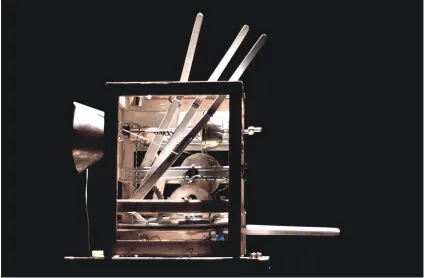
Dans le ventre de la machine (In the belly of the machine)(2011a) addresses the object in its invisibility since it deals with a work that is fixed on a medium, without a visual or physical component when presented to the public. However, even in this approach within fixed media, the material object remains the catalyst of the whole process of composition.
The object considered here is an invented machine, custom-made by the carpenter Alexandre Landry in 2008. The instrument that originally served for the performance “boîte.” (box.) (2008) was subsequently reused in the show La chambre des machines
(The engine room), (2010) created in collaboration with artist Martin Messier.
felt a need to rediscover it in a different way, to enter its sonic intimacy. Within the performance practice, the relationship with the machine is situated in the body and gesture rather than in listening. The recording and methodical relistening of the audible mechanisms produced by the machine lead to a very different work from the one done in real time. Editing techniques and mixing give access to gestures impossible to achieve by bodily actions. Unlike the “boîte.” and La chambre des machines
performances, this fixed media work offers us a kind of writing that is far more precise in its articulation. Through repeated listening to recorded sounds, the material was rediscovered and reworked from a new angle.
Although it is not the aim of this text to discuss Pierre Schaeffer’s theory of the sound object , it would be remiss not to mention the founder of 4 musique concrète, since Dans le ventre de la machine rests, as we have just seen, on the principle of reduced listening. This quotation from Schaeffer offers a description of reduced listening while clarifying the distinction between the Schaefferian sound object and the physical object––or sounding body when this physical object is used as a sound source:
The sound object must be distinguished from sounding body or the device that produces it, just as the musical object differs from the written symbol that designates it: both are objects of perception, more exactly objects of listening, of a “reduced” listening, that is, detached from references to the sound’s source (the sound as indicator/cue) or its meaning (the sound as sign). (Schaeffer, 1973, p. 36)
Thus, a machine formerly used as a musical instrument in performance later found itself arranged in a series of sound objects utilized as compositional material for the
work Dans le ventre de la machine. The sound of the physical object is extracted to be introduced, in a second phase, in a software sequencer where it is organized on a timeline, launching the physical object into the invisible world of pure sound phenomenon.
Fig. 1.2 Recorded object: a machine made by the carpenter Alexandre Landry in 2008, which helped create the sound material of the work Dans le ventre de la machine. Photo: Meriol Lehmann © 2008
!
Fig. 1.3 Amplified object: frequencies (a). Photo : Nicolas Bernier © 2013.
!!
Fig. 1.4 Mechanized object: the sound sculpture L’usure du clocher. Photo : Nicolas Bernier © 2011.
!
1.3. The amplified object: frequencies (a)
Unlike Dans le ventre de la machine where the object is recorded, the objects highlighted in frequencies (a) are acoustically sounding bodies, that are heard and amplified in real time. In their further use as props, they satisfy a desire to materialize electroacoustic music.
The beginnings of explorations of sounding bodies on stage is usually associated with the instruments invented by the Italian Futurists and Luigi Russolo’s manifesto L’arte dei rumori (1913). Further examples include John Cage’s Water Walk (1959), instruments invented by the composer Harry Partch (Chromelodeon, 1965, Quadrangularis Reversum, 1941), mechanized instruments manufactured by musician Pierre Bastien (Mécanologie, 1997) or even the scrap metal percussions of industrial German group Einstürzende Neubauten (Kollaps, 1981). In 1977, the composer Pierre Henry proposed precisely such an “musique d’objets” (music of objects):
But there is one area which we have not developed: what I call “music of objects”, which is what tempts me for the future. It would imply people working with sounding bodies, more or less amplified, electrified and transformed –– or perhaps not at all –– and thus inventing new kinds of instruments –– not in the "Dada" style of the futurists and their noisemakers, but with sounding bodies we can manipulate, modulate and play, with all the subtleties arising from a very serious musical education and instrumental gesture. (Henry, 5
1977, p. 104)
!
! “Mais il y a un domaine où on n'a rien fait : celui que j'appelle la « musique d'objets », et c'est ça qui me tente dans 5
The piece frequencies (a), an audio-visual performance work, fits into this historical continuum. The object explored in this work is the tuning fork: eight in number, each with different frequencies, these acoustic bodies are amplified using piezoelectric microphones onto which they are directly placed. The forks are electrified in a certain way through solenoids that provide the necessary impulsions for their resonances. In a second step, the sounding bodies are also manipulated, played and modulated with subtlety by the artist, as proposed by Henry. Everything is placed on a visual apparatus that is also integral to the work’s intention––a chapter is dedicated to the discussion of these visual elements.
The choice to work with the fork is not accidental: it is closely related to my practice, creating a bridge between the acoustic and electronic. In fact, I use the tuning fork not only as the source of sound, but of symbolism. First of all, it is a symbol of centuries of acoustic instrumental music, but at the same time a symbol of the beginnings of acoustical research and, therefore, an ancestor of electronic music. But it is the timbral characteristics of the tuning fork that fascinate me, since the sound it produces is similar to that of the sine wave synthesis, and can thus be used to compose music that might be perceived as electronic though it is produced by acoustic means.
Therefore, the use of the tuning fork as the main object in the frequencies (a)
performance flows from the proposition to materialize electroacoustic music. Moreover, the object succeeds in functioning as a sounding body and a visual prop, all the while evoking a strong symbolism. A similar symbolic aspect is incidentally particularly in the foreground in the discussion that follows of the work,
1.4. The mechanized object: L’usure du clocher
So far, we have discussed the object as a sound element at the core of a fixed media work—Dans le ventre de la machine, and as a sounding, amplified body in a performance context—frequencies (a). The mechanized sculpture L’usure du clocher
depends on an object with a highly symbolic power to create a connection between a sound work and a small municipal community. Sound installation works have long been of interest to me, since they are a form where the object’s place is firmly anchored. Among others, I would cite influences from the works by Zimoun (50 prepared dc-motors, 2009), [The Users] (Symphony for Dot Matrix Printers, 1998), Jean Tinguely (Homage to New York, 1960), and by Janet Cardiff and George Bures Miller (Opera for a Small Room, 2005).
Unlike frequencies (a) that uses small objects, L’usure du clocher is a more imposing structure, six feet tall. Its sculptural form draws inspiration from the church tower, creating a symbolic link to Western culture and values. As grand a structure as it is, the belfry carries the function of “personifying human relations, populating the space it shares, and having a soul” while generating “an affective quality that is called 6
‘presence’” (Baudrillard, 1968, p. 20). These ideas about the personification and soul 7
of the environment permeate the sound installation project of L’usure du clocher. During the design phase of L’usure du clocher, I needed to take into account a number of elements that were foreign to me: it was an outdoor project for the general public, in
honor of the 150-year anniversary of Victoriaville, a small town in Québec. The choice of object here converged on the church belfry, one of these urban orchestras, “permanent members of a very particular orchestra” as Daniel Lanois put it so 8
eloquently (2011, p. 142).
The basic idea took shape in the construction of a low-fi tower consisting of three conical speakers pointing towards the ground, mechanized to move in the same way as 9
a church belfry. I was thus exploring the dual nature of the object as described by the art historian Dominique Allard, for whom the object is “anthropological, when defined as an artifact, and poetic when posited as a metaphor, symbol, or allegory” (Allard, 2012, p. 5). Like Baudrillard, Allard also alludes to the soul of objects, but in an animistic perspective where people attribute a soul to the object by the projection of their fantasies and desires (Allard, 2012, p. 5). This animism is particularly strong in the case of kinetic objects, where the inanimate animates, as is the case of L’usure du clocher. The decision to animate the tower stems precisely from a desire to invest it with a force that would somehow humanize it, or at least create a link with the people observing it. In this regard Baudrillard tells us that “because the automated object ‘works on its own’, it exudes a similarity to the autonomous human individual, and this fascination carries it” (Baudrillard, 1968, p. 134). 10
This is thus how the use of a mechanized kinetic object with strong evocative power make
L’usure du clocher a work whose symbolic character speaks to the citizens of a community.
! “membres permanents d’un orchestre bien particulier” (Translation: T. Hron) 8
Broadcasting a looped soundtrack from an mp3 player hidden within the structure.
9
! “parce que l'objet automatisé ‘marche tout seul’, il impose une ressemblance avec l'individu humain autonome, et
10
1.5. The silent object: Music for a book
The works presented so far are all based on objects that emit sound. This is not the case for Music for a book (2012b), which is as soundtrack to the third novel by Québec author Marc-André Moutquin, entitled Entre l’aurore et la nuit (Between dawn and the night) (2012). The music itself, that consists essentially of field recordings11, has no relationship with the object. However, although the music is not based on the sound of physical objects, it remains intrinsically linked to an object: the book.
book edition of their opera The Carbon Copy Building (2006), in which the cartoon images from the show are presented in book form. But in my opinion, one of the most interesting and poetic objects is Mount Eerie’s Dawn (2008). Here we find a real link between the text and the music, since it is a kind of travelogue written by Elverum that is accompanied by musical works he composed during the same trip.
The relationship between sound and the reading of the inanimate object of the book can can take on a particular salience. In formal terms, we can draw a relationship between sound creation and literature. This description of the book, offered by philosophers Gilles Deleuze and Félix Guattari, is such an example:
In a book, as in all things, there are lines of articulation or segmentarity, strata and territories; but also lines of flight, movements of deterritorialization and destratification. Comparative rates of flow on these lines produce phenomena of relative slowness and viscosity, or, on the contrary, of acceleration and rupture. (Deleuze & 12
Guattari, 1980, p. 9)
Isn’t music constructed in just the same manner, with lines of articulation—the editing, territories—the spaces and soundscapes, and different speeds—the rhythm? I took these literary elements into account in Music for a book, trying to give the work a slower kind of pacing/rhythm, and using a long pedal that supports the reading, which is in itself more articulated. In the use of field recordings, the soundtrack also connects with the landscape, an important concept of Northern narrative. On the one hand, the slow and droning nature of the work allows readers the freedom to let themselves be carried without paying attention to particular sonic details and on the other hand, the
! “Dans un livre comme dans toute chose, il y a des lignes d'articulation ou de segmentarité, des strates, des 12
soundscape helps anchor the unfolding of the narrative in the space described by the author.
Here, the book as physical object does not act as the source of the sounds themselves, but its intrinsic link is in its literary content, which permeated the composition through a feedback loop of the editing of audio and the reading of its pages. The soundscape been composed by reading the book, integrating a few snippets of actual spaces— like rain and footsteps, but especially through the imagination of a sustained space that allows the reader the freedom of mind necessary for the rather heavy nature of the novel.
1.6. The absent object: frequencies (synthetic variations)
Up until now, the connection between sound work and object was relatively easy to make since it was directly involved in each of the works discussed. But the issues are different in the case of frequencies (synthetic variations) (2013c), which is constructed using synthesized sounds. Indeed, there is no direct correlation between this type of sound and a physical object––except perhaps in the common object that serves as generator, that is to say the computer.
manipulation of physical objects, forcing me to face a process to which I have objected since starting in the world of sound creation. This “complex but mostly prepared in advance” (Salter, 2010a, p. 177) type of performance puzzled me, prompting me to question seriously the issues discussed by Chris Salter:
Did it live in waiting fastidiously prepped in the machine and ready to take its place on the screen with the human operator’s tasks reduced to the push of a laptop’s spacebar or the press of the play button on the DVD player? What signified “live,” now that the stage was reduced to the pixel and the stretched canvas, to lights, speakers, and projectors; devoid of human presence, yet still generating the excitement and pulse of a performance happening in the here and now? (Salter, 2010a, p. 177)
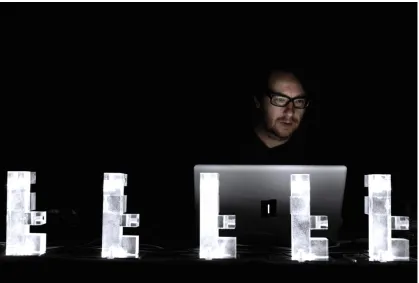
work right from the beginning of the creative process. In contrast, I had to invent the system of visual representation of frequencies (synthetic variations) in a second phase. Since the work’s sound was based in synthesis, it therefore seemed consequent also to use an object made of a synthetic material for the display: acrylic. In an analogue manner to the organization of audio sequences, the acrylic blocks themselves are assembled differently for each performance. This opens a new course of action for working with the object, as in this case, we are not dealing with an everyday or existing object. With acrylic, it is possible to create abstract shapes while disconnecting from the manipulated object—the visual aspects of performances are discussed in further detail in a section dedicated to the topic.
This is therefore the solution I found to deal with the challenge of finding a relationship to an object within the context of a work created from synthetic sounds. Indeed, the plastic material is proposed so as to provide a conceptual and aesthetic correlation among the various aspects of the audiovisual composition.
This section thus summarizes the context of the objects that lie at the heart of my creative concerns. I began this chapter by suggesting that focusing on the object is a way of working with sound with the aim of materializing it; and then I continued by highlighting a few of the lines of communication between my sound works and physical objects. For example, we have covered how these objects can be recorded in
Fig. 1.6.1 Absent object: a first version of the modular visual interface for the work, frequencies (synthetic variations). Photo : DAÏMÕN © 2013.
Fig. 1.6.2 Absent object: second version of the modular visual interface for the work frequencies (synthetic variations). Photo : Isabelle Gardner © 2013.
2. Objects and performances
The use of the physical object on stage brings is own set of issues. Now that I’ve presented the objects used in the works discussed in this text, this present chapter addresses certain topics related to their integration on the stage, the final phase of the relationship with the object in the process of creation. By presenting performance in its historical context, I will first discuss a few issues raised by such work materializing an invisible sound art. I continue with the more specific questions related to the coexistence between humans and mechanized objects, as well as the manipulation of sounding bodies in real time.
2.1. Materialization
An important part of my interest in the object springs from the need to materialize electronic music onstage, leading inevitably to the issue of the relationship between sound created live and that fixed on a medium. In 2002, Bob Ostertag believed this to be one of the major challenges in the presentation of this type of sound creation:
I think most musicians working with electronics are probably not very satisfied with the state of electronic music today, and the crucial missing element is the body. Many of us have been trying to solve this problem for years but we have been notoriously unsuccessful at it. How to get one’s body into art that is as technologically mediated as electronic music, with so much technology between your physical body and the final outcome, is a thorny problem. (Ostertag, 2002)
involved into the world of technological arts and electroacoustic music. At the beginning of the twenty-first century when many artistic proposals involving technology were based on abstract content free of physical materials—video, net art, virtual reality, laptop performance—, my interest pointed elsewhere: to the stage, the presence of the human body and sound materials coming from a visible source. But today, we notice that this feeling fits quite naturally in our history, as Chris Salter proposes in his book Entangled:
Performance as practice, method, and worldview is becoming one of the major paradigms of the twenty-first century, not only in the arts but also the sciences. As euphoria for the simulated and the virtual that marked the end of the twentieth century subsides, suddenly everyone from new media artists to architects, physicists, ethnographers, archaeologists, and interaction designers are speaking of embodiment, situatedness, presence, and materiality. In short, everything has become performative. (Salter, 2010a, p. xxi)
The founder of Thing Theory13, Bill Brown, suggests a “return to the real”:
If, more recently, some delight has been taken in historicism’s “desire to make contact with the ‘real,’” in the emergence of material culture studies and the vitality of material history, in accounts of everyday life and the material habitus, as in the “return of the real” in contemporary art, this is inseparable, surely, from the very pleasure taken in “objects of the external world” [...] (Brown, 2004b, p. 2)
My interest in performance seems to be part of the zeitgeist and my past as a rock musician certainly facilitates the move from fixed media to performance works. Since I composed many of my sound works by using and manipulating physical objects, it felt only natural to continue this research onstage.
To this end, it is interesting to note the tensions that exist between recording and live performance. Joe Milutis suggests there was a time where performance lost its noble
value in favour of recording: “materialized on tape, vinyl or Edison cylinder, no longer would the spiritual event of live performance be the fetishized endpoint and privileged locus of audition” (Milutis, 2008). Paradoxically, if physical performance returns to the focal point of interest in the technological arts at the turn of the twenty-first century, it is somewhat in response to the ubiquity of recording, as Nicolas Collins points out:
Recording, we all know, has changed the way people listen to music, perform music and compose music. It has also, ironically, made the act of creating music, live and in person, a signally “special” event. (Collins, 2008)
The work frequencies (a) draws as much attention to our performance heritage as its does to sound fixed on a medium. Alongside a series of electro-mechanically controlled —through the use of computer-controlled solenoids—tuning forks, the human presence onstage brought with it a whole series of questions about the relationship between the acoustic sounds of objects, synthetic sounds and pre-recorded sounds. For example, when presented with the amplified sound of actual physical objects, is it still pertinent to use sounds generated through synthesis or recording? Indeed, faced with a live sound source produced by a sounding body, the use of computer processing and pre-recorded sound inevitably adds a layer of opacity for the audience’s reading. On the other hand, the interest of a work is created through such a multiplicity of possible readings of the artistic content, hence the decision not to eliminate pre-recorded sound.
!
!
Besides, the musician Adam Linson believes it an exaggeration to adhere only to mechanically-generated sound:
Since music performance is a meaningful human activity, it makes little sense to consider music-making solely in terms of the physical production of sound. The context for the intention to make a sound in a musical performance is a human situation, while the mechanics of the sound production are part of a physical system. (Linson, 2011, p. 421)
It would indeed be curious nowadays to abolish the use of fixed or synthetic sounds in favour of only acoustic sound, setting aside all the advances brought by research in the electroacoustic field. However, in the context of physical performance, it remains crucial to find a balance between invisible sound inscribed in media and mechanically generated sound coming from the stage. In fact, what really matters is providing coherent audiovisual content for the audience members without losing their attention should they begin to question the origin of the sounds. Michel Chion discusses these issues related to fixed media in his book L’audio-vision:
Faced with sound passing through a loudspeaker that does not come with a visual calling card, the listener must ask the question "what is it" (as in “what caused this sound”) twice as often, watching out for the smallest clues to identify its source, which, moreover, are often interpreted against the grain. (Chion, 1990, p. 31) 14
However, the following is important to keep in mind: a mechanically produced sound does not necessarily lead to a coherence of sounding result. The acoustic sounds that are mechanically triggered in frequencies (a) remain just as invisible a phenomenon as synthetic or pre-recorded sounds. In fact, the mechanical action of the solenoids is so
! “Face à un son qui passe par un haut-parleur et qui ne se présente pas avec sa carte de visite visuelle, l’auditeur 14
small that the only person able to see the mechanics is the artist right next to the device. In line with Linson, William Brent also questions this requirement of connecting gesture and sound:
One common assumption is particularly relevant: that there should be a perceivable correlation between the movements of a performing musician and the resulting sound. [...] Thus, we must ask: are desires for clear action-sound relationships merely historical remnants linked to a perverse obsession with technical prowess ? (Brent, 2011, p. 430)
Mitigating the problem of invisible mechanical triggers is one of the main purposes of the lighting system, which adds visual feedback to the triggered tuning forks in
frequencies (a), strengthening the connection between sound and vision for the audience.
The central importance in my work of finding that fragile balance between live and pre-recorded sound is clear. frequencies (a) is built on a frugal balance of synthetic sound, visual feedback, as well as sound that is mechanically triggered live, which all guide the audience’s listening. The next section deals more specifically with the importance of physical manipulation and performance.
2.2. Manipulation
the games I play in manipulating them must also be specially designed. For example, I conceived of the playing techniques when writing the performance of frequencies (a)
because, although the tuning fork is quite a common cultural artifact, there is very little repertoire that uses it as a musical instrument. Indeed, the device on the one hand becomes a new interface, but on the other remains a familiar artifact. Adam Linson explains this dichotomy by suggesting that
Though new interfaces are in principle open to radical innovations, they are generally designed to take advantage of established human skills. In some cases, this comes down to the intuitions of ordinary physical interaction discussed above. In other cases, interaction with cultural artifacts is similarly familiar (e.g., a typewriter or a piano). (Linson, 2011, p. 423)
Nevertheless, the fact remains that even in using familiar objects, the musical performance itself must be conceived in such a way as to fit into the concept of the sound work. Furthermore, in the case of frequencies (a), the tuning forks are played in counterpoint with an electro-mechanical interface controlled by a computer. It is in this double game of human/machine/object interaction that the subject of the performance lies. Indeed, it was important to merge the electro-mechanical performance of the newly-created interface with the physical performance of the human. To do so, I added a second set of tuning forks. Rather than being controlled by the computer, this set is manually manipulated by the artist. These additional manipulations emphasize the gesture/sound relationship since the automated actions of the electro-mechanical interface remain practically invisible. Indeed, the action of the solenoids, too small and rapid, is difficult to perceive clearly.
The most important contribution brought by human manipulation is certainly the dose of imperfection––a section of the text is therefore dedicated to this theme––of the sound generated by the artist versus the rapid and complete synchronicity of what is triggered by computer. These two antipodal playing techniques create a counterpoint that helps the audience distinguish between human and electro-mechanical action. Although human performance is not perfect , it is nevertheless true that many hours of practice are necessary to find appropriate playing techniques. In fact, a bespoke interface requires just as much practice as a musical instrument, as Linson reminds us: “Though it is an object, a DMI [Digital Music Instrument] is also a tool, and as such, it must be possible to learn how to use it and, with continued learning, to improve over time.” (Linson, 2011, p. 423)
To be sure, the playing techniques I used were found during the rehearsal process. A few examples: striking two tuning forks together brings out their percussive vibrations more than their pitches; playing them as percussion instruments directly on the amplified table, using their mechanical vibrations directly on the microphones and wires, which creates a series very short percussions that create the impression of a distortion. As a result of this instrumental performance research, a kind of agility, a virtuosity specific to the interface emerged. However virtuosity remains somewhat elusive on a singular interface, without any history of interpretation, since there is no comparison available.
In his article, Human Bodies, Computer Music, Bob Ostertag notes, nevertheless, that virtuosity is a necessary element in performance:
Virtuosity has been out of fashion for years now, ever since the advent of punk rock, conceptual art and other movements that emphasize the idea rather than its execution. Nevertheless, virtuosity of some sort is a necessary element of almost any performance. (Ostertag, 2002)
For this purpose, although virtuosity on a custom-built interface remains an ambiguous concept, I feel that virtuosity is necessary in order to bring the magic that will stimulate the spectator imagination. For a work to function, there must inevitably be a particular skill that somehow defines the principle of virtuosity. The importance of virtuosity goes back to the fundamental character of instrumental practice in all forms of sound performance. Michailidis and Berweck convey this idea while voicing certain reservations about new electronic instruments:
Through instrumental practice, the performer is able to learn and internalize the responses inherent in the mechanical production of sound. The instrument reacts to the energy it receives from the performer by producing both audible and tactile feedback. However, current electronic musical input devices, instruments and interfaces lack the ability to provide similar haptic feedback to the performer. The missing feedback information introduces practical problems in performances and compositions of live electronic music. (Michailidis & Berweck, 2011, p. 661)
approximate virtuosity of human manipulation. The human and the machine rub together in a choreography where both complement each other, playing together either in counterpoint or in opposition. As Salter writes, it is a performance where “[...] real-time actions played out in front of a spectator alongside the agency of machines try[ing] to equally effect changes in the material conditions of the world” (Salter, 2010a, p. xxxii). There is a good example of this man/machine dialogue at the very end of the frequencies (a) performance, where the computer generates a sequence of rapid changes while the artist somehow tries to follow the sequence at the same speed, creating a dramatic tension leading the public to question whether the machine or human controls the situation. The tension, however, remains unresolved during the composition leaving the question open. To this end, the philosopher Gerald Raunig proposed that this tension is unwarranted:
It is no longer a matter of confronting man and machine to estimate possible or impossible correspondences, extensions and substitutions of the one or the other, of ever new relationships of similarity and metaphorical relations between humans and machines, but rather of concatenations, of how man becomes a piece with the machine or with other things in order to constitute a machine. (Raunig, 2010, p. 32)
3. Objects and vision
The link to the object and its use in the context of performance inevitably lead to a discussion of issues related to the visual composition this type of project requires. This section addresses how working with the object necessarily bring disciplinary hybridization. We also analyze the practice of working with physical and light materials, to conclude with the synchronicity between audio and video as the primary multidisciplinary composition technique.
3.1. Hybridity
In developing such an object-based project, I feel it is important to contemplate the multiplicity of artistic aspects since the proposition does not only entail sound composition. Indeed, when a project is presented on stage, it seems impossible to consider that what is presented depends only on the sound component. The visual component, modest as it may be, should not be obscured. Some believe that sound “has become the show for which the music is nothing more than support” (Chion, 2009, p. 15
79), but it seems natural to me to design a stage performance that takes all the artistic parameters perceived by the audience into account.
Obviously, once onstage, the artist is no longer facing a listener but a spectator. Dealing with gesture, movement, light, object, architecture, scenography, and body language are
all extremely important elements that should thus not be relegated to the background. Moreover, the art historian Simon Shaw-Miller writes the following in his article
Separation and Conjunction: Music and Art: “Performance is multimedia, and
therefore we cannot simply speak of art and music as we do in the context of formal modernism; instead, we need to think in the gaps and across the frame” (Shaw-Miller, 2010, p. 34).
This multidisciplinary approach inevitably brings to mind Richard Wagner’s
Gesamtkunstwerk, described as early as 1850 in his essay Das Kunstwerk der Zukunft
(1850). Gesamtkunstwerk, or “total work of art”, proposes the simultaneous superposition of several artistic disciplines, as illustrated by art historian Barbara John: “The term Gesamtkunstwerk refers to the utopian aspirations beginning in the early nineteenth century toward the union of all the arts into a single work of art” (John, 2009). Since witnessing the explosion of disciplines, we’ve also seen the emergence of a multiplicity of terms specifying the types of relationships between the arts: multidisciplinary, interdisciplinary or even transdisciplinary.
Chris Salter for his part, put forward the term Entangled to evoke the fact that not only are our senses linked, but we are also closely connected with the technology we use:
the term entangled from its anthropological connotations suggests that human and technical beings and processes are so intimately bound up in a conglomeration of relations that it makes it difficult, if not impossible to tease out separate essences for each. (2010a, p. xxxii)
The frequencies (a) performance is a case in point of this hybrid approach. There are elements of theatre in the bodily actions onstage that are carried by a certain kind of dramatic buildup: at the beginning of the performance, the artist does not interact with the interface while at the end of the performance, the more interaction there is, the more difficult it seems, and the more the performance seems to require an exhausting amount of energy.
In frequencies (a), there are also elements that we could link to dance since the interaction with the interface requests gestures that were not developed in a purely utilitarian, but also aesthetic perspective. I designed the speed of the movements, the placement of the body in space, and the motions themselves travel to imprint the presence of the body consistently with all the elements of the work. The performance also carries references to science—the tuning fork as a scientific instrument, set design —a laboratory setting, as well as visual and lighting elements, which will be discussed in the next chapter.
In sum, when presented onstage, my work goes beyond the scope of sound composition to encompass concerns that touch on several artistic disciplines. Working with the object requires a reflection on the visual aspects that involve numerous elements borrowed from theater, gesture and the visual arts. Moreover, the next chapter is devoted to the visual aspects involved in working on physical matter itself.
3.2. Materiality
Exploring the object inevitably entails working with physical matter, which requires different skills from those needed for sound work. My interest in the object is directly related to my attraction to the visual arts. Before I entered the world of composition, while employed as a graphic designer, my interests focused on photography and the visual arts as much as on music. My first works—between 2001 and 2005—were based mainly on video, flowing smoothly from my interest in the visual. Although I cannot think of myself as a visual artist, this dimension is a major part of my creative approach.
work, it was impossible for me to start again at square one.
Another aspect of working with physical matter is the physical space it requires. My modest composition studio turned into an even smaller creative workshop when it was invaded by the great aluminum belfry. It was impossible for me to keep this sculpture that occupied too much of my workspace. So I presented it once and then destroyed it. This experience has been very useful to me, as I learned so much about visual practice and physical matter, not to mention how to deal with electricity, motors and welding, which I was tackling for the first time, and this laid a foundation for the techniques employed in my next works, frequencies (a) and frequencies (synthetic variations). When starting frequencies (synthetic variations), I imagined composing a pure sound work, but it quickly became clear to me that a rich visual component would be very worthwhile. Unlike frequencies (a) where the sound and visuals interpretation were created simultaneously, here I wanted to compose the elements in two stages, focusing on the sound first. Since the piece is composed of short sequences played in a random order, I also used this model for the visual aspect. MIDI sequences were generated in 16
relation to the sound work, knowing that they would be reused to control the custom lighting. These sequences could eventually be synchronized to a standard theater lighting system, rotary motors or even solenoids, or robots or automatons. For now, they are used to synchronize light projected inside acrylic structures. The clear acrylic serves here to make a link between the synthetic material present as much in the sound as the visual matter. Acrylic also points towards the work of visual artists from the
MIDI, or Musical Instrument Digital Interface, a communication protocol used for the interaction of different
16
Light and space movement. Emerging on West Coast of the USA in the 1960s, artists such as James Turrell , Larry Bell and Doug Wheeler used light and plastic materials “[...] directing the flow of natural light, embedding artificial light within objects or architecture, or playing with light through the use of reflective, translucent, or transparent materials [...]” (Clark, 2011, p. 20).
Paradoxically, using the tuning fork creates a strong referent, which stands against minimalist ideals, which usually “refer neither metaphorically nor symbolically to anything beyond themselves” (Marzona, 2004b, p. 11). Since the tuning fork has a strong symbolic value, I wanted to find a balance between the referential content that emanates from the object in order to integrate it into a sober and formal visual aesthetic. The refusal of the sublime, adhered to by the minimalists, is another source of contention. In leaning into the musical and its performance, with its all its related characteristics, the sublimation of reality is part of my task. I am charged with building a magical moment for the audience, with areas of half lighted clair-obscurs and inexplicable elements. The minimalists were searching for rather the opposite:
The minimalists wanted their work to be about real space as opposed to the space of illusion, but this distinction is less easily made with work that illuminate and colour themselves and the space they occupy than it is with sculpture. It is true that when we look at a Flavin we are seeing something and that it is real; but the perception that an object is being dissolved by and into the light it is itself does not comfortably fit any definition of the real except in an extremely metaphorical sense. Flavin and the minimalists didn’t want to be metaphorical, however; they wanted to be empirical. (Gilbert-Rolfe, J. in Weiss, 2006, p. 88)
While pointing out the various links to the visual arts that help feed my work, a number of challenges emerged during my dealings with the physical matter in the works
3.3. Luminosity
From the most distant past to the present day, light has always fascinated the human spirit. It has always held a strong grip on human emotion and thought, on how they view the world, whether they are religious, philosophers, poets, artists and scholars. Well before the light became the subject of scientific studies, it was considered to be of a transcendental nature. (Xuan, 2008, p. 29) 17
I became interested in light around 2005, when I was looking for an alternative to video in audiovisual composition. In fact, I had lost interest in video because the exponential proliferation of screens that now took up such a prominent place in the art world. Its format, which trapped images most often in a rectangular frame, no longer suited my purposes. The screen was now so present that it stole the content’s show; it became the new stage, one where there were no humans any more, only images:
Through the increased interest in simulation, virtual reality, and the development of interfaces to set such simulations into interactive dialogue with their users, the screen and the computer became a new kind of stage [...].
(Quoting Brenda Laurel in Salter, 2010a, p. 321)
I knew that a visual alternative to the screen had to exist, and I was looking for it. Light without a screen –– since video is in fact, also light –– thus offered an interesting avenue. As a medium, it is closer to sound, since it is not framed, and is thus a more fluid entity, freer to project in space. On the other hand, the light is always used to illuminate something, which brings us to back the object, since there needs to be something to shed light upon, to put onstage. This thing could ironically be a screen, but that is obviously not what interests me in light.
! “Des temps les plus reculés jusqu'à nos jours, la lumière a toujours fasciné l'esprit humain. Elle a toujours exercé 17
My particular interest in the works of minimalist artists, especially Dan Flavin’s, influences my own approach to light: “Just like colour, light continues to fascinate composers and musicians alike” (Kienscherf, 2009). Dan Flavin is a visual artist especially known for his work with light, more specifically with fluorescent tubes. 18
Flavin himself described these fluorescent tubes as “vibrant instruments” (Flavin, 1965). When used in combination with a light and sound interface onstage, we can certainly see the lights as an instrument, or at least as a component of the audiovisual instrument onto which they are grafted. Flavin’s fluorescent tubes are one of the major influences on the frequencies (a) interface.
The fact remains that this type of work has important analogies with the video, since it is similarly organized in time and space. Chris Salter describes different ways to use video in performance thus, and the proposal could largely also apply to light design:
Video could be used in performance setting to (1) invoke the cultural phenomenon of television or, more broadly, the media (video as a sign), (2) articulate the tension between the live and the recorded, (3) articulate the tension between lived stage and media time and fragment its expected continual passage, (4) challenge the line between the public and the private, (5) invoke the image and experience of surveillance, (6) occupy sculptural space (as a light source, for instance), (7) provide multiple perspectives and points of view, (8) demonstrate the tension between presence of the flesh and blood performer and absence of the body, (9) emphasize the utter artifice of the theatrical event, and (10) act as a microscope, closing in on and recording elements unbeknownst to the human eye (a system of repetition). (Salter, 2010a, p. 130)
!
! Various monographic books are dedicated to his work, including Dan Flavin: New Light(Fer, 2006).
In the case of frequencies (a) and frequencies (synthetic variations), I used light in accordance with Salter’s points 2, 6, 8, 9 and 10. Tensions between the "live" and the pre-recorded are articulated—point 2 in Salter’s enumeration—the light in
frequencies (a) reacts to a pre-recorded electrical signal that triggers a synchronicity between the tuning forks/solenoids and light, while the artist’s manipulations have no lighting correlation, thus creating a counterpoint. In the middle of the show, I also composed a moment when the light reacts to the pre-recorded sound and not the sound of the tuning forks, as is the case in most of the work, which helps articulate this tension.
In my two audio-light projects, light is used to fill a sculptural space—point 6 in Salter’s enumeration. In frequencies (a), a sculptural object, the table on which the device/interface is placed, appears in the space when the lighting is fully active. The light emitted by the table projects upwards, revealing certain elements of the concert hall—like rigging, furniture and walls, allowing each performance to bring out different shadows emerging from the sculptural space/architecture of the hall. In frequencies (synthetic variations), the light is less diffused into the hall as it is contained within acrylic structures. It is the positioning of the acrylic sculptural pieces themselves that interact with our perception of the architectural space. The light component of this project mainly resides in the use of transparent rectangular plates within which the light is projected, and reflects on the edges of the plates. This creates a strange luminous effect where the plates appear to be floating. In an article on the work Light and Space
solid object becomes an optical phenomenon” (Hanor, 2011, p. 134). The ten acrylic plates I use are arranged each time in an order that I determine in the performance space and in relation to the technical requirements like seating disposition, the size of the tables used for my setup, etc. The light produced by one plate reflects on the others, and always creates new designs, new light combinations, new perceptual effects, which mirrors the improvised aspect of the work.
In point 8 of Salter’s list, on the expression of the presence and absence of human body, light in frequencies (a) is sometimes so thin that the human disappears completely. Another technique I employ is a strobe that allows me to show only very short moments, where darkness creates discontinuity in the image revealed to the public. Chris Salter explains this phenomenon in his article The Question of Thresholds:
Immersion, Absorption and Dissolution in the Environments of Audio-Vision :
Like the transient, discontinuous attack of perceptual phenomena that upsets the brain’s sensory modality hierarchies, a sudden flash in the visual field jostles the eye into another way of looking, disturbing its routine and challenging the assumption that we continually "see" the whole visual field before us.
(Salter, 2010b, p. 209)
technological paraphernalia evokes the spirit of a scientific laboratory, a place that we often associate with research on synthetic and artificial substances.
Using light is a subtle way to create an immersive environment. Like sound, which cannot be framed, light reflects all over the room, on the walls, the body of the artist and the viewer. This brings us to another aspect of Flavin’s work:
The phenomenological experience of a room of fluorescent light is not to look at it but to be in it. The fluorescents may be ready-made objects, but they cease to be discrete objects as soon as they are arranged in a situation. They cast light and shadow all around, onto the walls and onto the spectators who are there. (Fer, B. in Weiss, 2006, p. 26)
In this section, I explained the origins of my interest in working with light as the main component of visual staging for the performances frequencies (a) and frequencies (synthetic variations). I showed that its use represented a search for a kind of audiovisual composition that did not use video, all the while addressing the main compositional strategies that are common in video, as developed by Chris Salter. Since these strategies are based on a rhythmic relationship between sound and light, the main compositional technique remains synchronization. This is fundamental and unavoidable issue, because even when there is no synchronization, the question of synchronicity and non-synchronicity remains central in any work that combines several heterogeneous elements.
!
3.4. Synchronicity
Indeed, the moment a discourse takes place in time and space, its various elements are necessarily linked and structured within a temporal relationship. Whether that is one of synchronicity, desynchronicity or counterpoint, the sonic and visual aspects are built around “points of contact between temporally organized processes and spatially organized artifacts” (Kwastek, 2010, p. 149). Omnipresent in the arts, the relationship between the visual and the sonic has been a fascination since the dawn of time, as explained by Birgit Schneider:
Artists were guided by the ideal that the dominant distinction between optical and acoustic perception in art could be fundamentally overcome. This fascination was based on an analogy that had dominated since antiquity: that sounds could be assigned to visual experiences, just as images had corresponding tones. (Schneider, 2010)
The example most often cited as precursor to works dealing with an audiovisual relationship is that of the Jesuit Louis Bertrand Castel, who, already in 1725, proposed the construction of a “Harpsichord for the eye”, a musical instrument that could paint colour (Castel, 1725). In Castel’s treatise L’optique des couleurs (The optics of colours) (Castel, 1740), the composer Georg Philipp Telemann, who composed for Castel’s ocular harpsichord, describes the instrument thus (original quote is in ancient French):
either in chords or in a harmonic progression. (Telemann in Castel, 19
1740, p. 482)
Early efforts to find synchronicity and aesthetic correlations between sound and image developed in various forms, such as "visual music" which translates images into sounds: here we should consider, among others, the work of filmmakers such as Norman McLaren (Synchromy, 1971), Walter Ruttmann (Lichtspiel Opus IV, 1925), Hans Richter (Rhythmus 21, 1921), Viking Eggeling (Symphonie Diagonale, 1924) and Oskar Fischinger (An Optical Poem, 1938). Artists also appropriated this relationship in the form of dialogues with light as in Robin Fox’s Laser Show (2007), electricity as in
POWEr byArtificiel (2009) or space like in Kurt Hentschlager’s Zee (2008). But what primarily interests me is the relationship between the sound and the object. In this context, it is important to mention works that make electroacoustic equipment itself the subject of audiovisual performances. I am thinking here of Steve Reich’s Pendulum Music (1968) or even more of Gordon Monahan’s Speaker Swinging (1982).
In my work L’usure du clocher, I use an invented object that borrows from a device in the electroacoustic chain, the speaker cone. As a dialogue, desynchronicity is the operative principle of the vertical writing of sound and image. In this project, the two elements were developed completely independently. This artistic decision was determined here by the project’s technical constraints, which did not allow for the detailed kind of composition that is geared towards precision work in the synchronicity of sound and image. The fact that the work that was presented outdoors, and might face
! “Comme la touche en pressant ou en tirant une targete, une pilore, ou un talon ouvre une foufpape pour opérer un 19
adverse weather conditions and vandalism, meant the device had to be as crude as possible in terms of materials, and very sturdy electronic equipment. This context made the use of a computer or micro-controller that could be damaged on site difficult, so I opted instead for playback of digital audio files. Without this constraint, I might have further developed the relationship between the music’s packing and that of the movement of the bells.
In works where I controlled light with the computer, frequencies (a) and
frequencies (synthetic variations), synchronicity is more or less at the root of the dialogue between the audio and visual elements. However, I see little interest in a systematic synchronicity. According to Schneider, such an objective correspondence is nonexistent in any case, suggesting that “the artists ultimately demonstrated that there are no universal correspondences between colours and sounds that can be determined physiologically and objectively” (Schneider, 2010, p. 177). I think it is important to keep the dialogue between sound and visuals vibrant, to keep surprises for the audience by avoiding unequivocal relationships on the audiovisual level. I am not, therefore, interested in showing an objective concordance or even demonstrating that a certain element is in a dependent relationship to another.