2017 International Conference on Mathematics, Modelling and Simulation Technologies and Applications (MMSTA 2017) ISBN: 978-1-60595-530-8
City Tour Route Planning Model Based on Improved Floyd Algorithm
Xiao ZHOU
1,*, Yun-fei YUAN
2, Meng-cheng MA
1, Hong-shuai LI
1,
Yang XU
1and Da-hai SONG
11Information Engineering University, No. 62 Kexue Avenue, High-tech Zone, Zhengzhou, China
2Army Academy of Border and Costal Defence, Ziwu town, Chang’an Zone, Xi’an, China
*Corresponding author
Keywords: Improved Floyd algorithm, City tour, Tour route, Route planning, Tourist motive.
Abstract. On the basis of analyzing current problems of city tour route planning, this paper brings
forward city tour route planning model based on improved Floyd algorithm. Firstly, interest sight spot coding and selecting model are set up to form sight spot classification code. Intelligent sight spot element selecting method is brought forward. And then city tour route planning algorithm model is set up according to selected sight spot element and optimal motive iteration output model of the shortest route is obtained. Take Zhengzhou for example, motive iteration values and sight spot guide maps of different tour routes are obtained. Meanwhile, optimal tour routes and several suboptimal routes are obtained, which meet the needs of tourists’ best motive benefit. Example testifies that the algorithm conforms to the reality and it is feasible and practical to intelligent tourism route planning.
Introduction
Before tourists going to visit an unfamiliar city, they should confirm specific sight spots according to interest and scheduling, on which basis tour route should be planned to meet tourist motive benefit. When planning tour route, selected sight spots are set as intermediate nodes. One-way tour route should be time-limited, and each sight spot can only be singly visited. Among many factors, traffic condition is the critical issue that tourists should consider most. City sight spots are relatively dispersive, different sight spots are connected by urban roads, which forms many paths. But not all the paths are optimal. The tour route planned by tourist after selecting sight spots should mostly meet tourist motive benefits, in which route distance, bus number, subway number, taxi fee and traffic light number, etc. are the factors influencing tourist motive benefits.
Currently, tour routes are planned mainly by tourists subjectively planning or through travel agency, which lacks considering tourists’ individual interests. The subjectivity of tour route planning can hardly meet the best motive benefits. Meanwhile, route planning algorithms of current tour GIS only consider shortest route and neglect tourists’ real needs and related dynamic factors of city tour, and the planned routes can hardly meet tourists’ motive benefits. Aim at the problems, this paper brings forward city tour route planning model based on improved Floyd algorithm based on individual interests. This model combines tourists’ interests, city tour characters and dynamic factors to plan optimal tour routes, which meets the tourists’ motive benefits most.
Interest Sight Spot Coding and Selecting Model
Tour city usually contains many sight spots of different kinds. Tourists have different interests, and they will select different sight spots. According to tourists’ interests, city sight spots can be classified as four groups.
Set sight spot set as
V
i,
+0, 4
Z
i
. SetV
1 is park and Greenland, setV
2is shopping mall,set
V
3 is venue and setV
4is entertainment. According to city specific sight spots, Sight spot setThus, sight classification set vectors containing sight spot elements are
1
1 1 1, 1 2,..., 1 j
V V U V U V U
,
V2 V U V U2 1, 2 2,...,V U2 j2
,
V3 V U V U3 1, 3 2,...,V U3 j3
and
4
4 4 1, 4 2, ..., 4 j
V V U V U V U
,
max
j j1, , ,2 j3 j4
max j.
If tourists are familiar with sight spots and have interests on some sight spots, they can select sight spots directly according to scheduling. If tourists are unfamiliar with sight spots or have difficulty on selecting, intelligent machine can help to randomly select sight spots. Tourists provide sight spot number and then intelligent machine select proper sight spots, or tourists firstly choose sight spot classification set according to interests and provide expected sight spot element number in each set, and then intelligent machine selects sight spots randomly.
Select uniform distribution function on
a b, as random number generator, as formula 1. Tourists selectn
kinds of sight spot classification sets,n
0, 4
Z
+, and then randomly selectn
1,n
2,n
3and n4 amount of sight spot elements in each set,
+0,
Z
i i
n
j
.
x aF x
b a
,x
a b, (1)As toVi, when ji 0 and ni 0, transfer uniform distribution function F x
once for eachsight spot set,
x
0,
j
i
Z
+, and randomly obtainn
i sight spot element codes. Total sight spotnumber
n
meets formula 2.4
1
i i
n
n
,
+
0, 4
Z
i
(2)
Tour Route Planning Algorithm Model
After tourists selecting
n
amount of sight spots, intelligent machine plans tour routes according to traffic condition and dynamic factors, which combines tourists’ interests and traffic characters and can mostly meet the satisfaction of tourists’ motive.Set sight spot element set selected from intelligent machine by tourists as
P
, in which element sight spot isp
k ,
+
0,
Z
k
n
. Sight spot element of sight spot classificationV
iis pki,
+0, Z
i i
k n .
There is space distance among sight spots. From the former sight spot to the next one, there are many factors influencing tourists’ motive such as route distance
1, bus number
2, subwaynumber
3, taxi fee
4 and traffic light number
5, etc. Table 1 shows the influence weight ontourists’ motive,
S
is route distance, N1is bus number, N2is subway number,R
is taxi fee and [image:2.612.179.431.656.706.2]K
is traffic light number.Table 1. Each influence weight on tourists’ motive.
Influence factor
1
2
3
4
5Weight
S
10.1
N
10.1
N
2R
1K
1Floyd route planning algorithm, combining tourists’ interests and needs, traffic condition and city tourism characters, the improved tour route planning algorithm model is set up as following steps.
Step-1 Ensure Starting and Terminal Sight Spot
1) whenn1, route planning algorithm is not transferred.
2) whenn2, ensure one route between the starting and terminal sight spot. 3) when
2,
Z+n , set
p
kandp
k
among
n
amount of sight spot elements of setP
as the starting and terminal sight spot. Then the number of node sight spots isn
2
.Step-2 Permutation and Combination of Tour Sequence
Tour route traverses all the selected
n
sight spots in the way of one-direction and single time.2
n
amount of node sight spots are the turning points on the tour route. Set node sight spot setQ
as the proper subset of
P
and its element isq
t ,Q
P
,
+
0,
2
Z
t
n
.When traversing all the
n
amount of sight spots in the way of one-direction and single time with the starting sight spot
p
kand terminal sight spotp
k
, 22
n n
A
kinds of tour routes will be formed. Each route motive iteration value can be calculated after the tour sequence being confirmed.Step-3 Route Searching and Motive Value Iterating
Take one tour route sequence for example, as Figure.1 shows. From the starting sight spot
p
k, theroute goes through
n
2
amount of node sight spots and finally ends with terminal sight spotp
k
.
Figure 1. Tour route sequence containing starting terminal and node sight spots.
The route distance from the starting sight spot
p
kto node sight spotq
1isS
g,1. The distance formnode sight spot
q
1to node sight spotq
2isS
g,2. Thus, the distance form node sight spotq
t1to nodesight spot
q
t isS
g t, . The distance from node sight spotq
n2to the terminal sight spotp
k
is
S
g n, 1. The total distance of theg
kind tour route is as follows.1 , 1
n g g w
w
s
S
(3) Calculate 22
n n
A
kinds of tour routes’ total distance and arrange the values in ascending order, andtour route vector
T
is obtained, as formula 4 shows.
1 2
min
,
a,
a,...,
maxT
s
s
s
s
(4)If tourists only consider shortest route, they can directly choose the optimal tour route from
vector
T
Step-4 Comprehensively Consider City Character and Influence Factors
If tourists contemporarily consider influence factors, algorithm continues. Set the initial motive iteration value from sight spot
p
k1to the next one isI
k1, and then the iteration value will beI
k, asformula 5 shows.
5
1 1, 1
k k k m
m
I
I
(5) Thus, the final motive iteration value from the starting sight spot to the terminal sight spot is shown as formula 6.
1 5
1 1, 1 1
n
k k m k m
I
I
(6) Calculate 22
n n
A
kinds of tour routes’ motive iteration values and arrange the values in descendingorder, and motive iteration vector
I
is obtained, as formula 7 shows.
1 2
max
,
b,
b,...,
minI
I
I
I
I
(7)When comprehensively consider city character and influence factors, the highest motive iteration value related to the optimal tour route.
Step-5 Select Other Starting and Terminal Sight Spot
There are totallyAn2kinds of selecting methods and 2 n
A kinds of tour routes. As to each method, restart the algorithm from step 1 and obtain the tour route distance vector
T
or motive iteration vectorI .Select the shortest route or the highest motive iteration value as the optimal tour route, tourists can obtain the best motive benefits.
Simulation Example
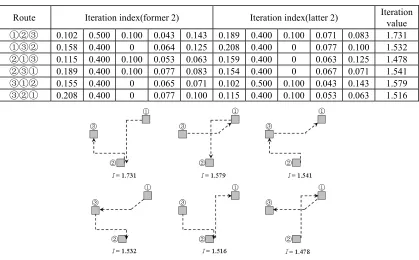
Take Zhengzhou city for example. Set Zhengzhou interest sight spot codes as table 2 shows. Some tourist makes a request of visiting one Park and Greenland (code①), one shopping mall (code②) and one venue(code③), meanwhile, the route should be short and convenient. Intelligent machine gets the request and randomly selects three sight spots from the sight spot code sets as table 2 shows. The selected sight spots are in bold and underlined.
Table2. Interest sight spot sets and codes.
Sight spot set V1 V2 V3 V4
Sight spot code
1
U Renmin Park
2
U Bishagang Park
3
U Zijingshan Park
4
U Forest Park
5
U Lvcheng Square
6
U Botanical garden
1
U Wangfujing
2
U Department store
3
U ②Erqi Uanda 4
U Zhongyuan Unada
5
U Dehua street
6
U CC mall
1 U HenanMuseum 2 U ErqiMuseum 3 U Gallery 4
U ③ZhengzhouMuseum
5
U Science museum
6 U Aquarium 1 U CenturyPark 2 U FountPark 3 U WaterPark 4 U ChildrenPark
Table 3. Selected sight spots and the calculated data.
Route Iteration index(former 2) Iteration index(latter 2) Iteration value
①②③ 0.102 0.500 0.100 0.043 0.143 0.189 0.400 0.100 0.071 0.083 1.731
①③② 0.158 0.400 0 0.064 0.125 0.208 0.400 0 0.077 0.100 1.532
②①③ 0.115 0.400 0.100 0.053 0.063 0.159 0.400 0 0.063 0.125 1.478
②③① 0.189 0.400 0.100 0.077 0.083 0.154 0.400 0 0.067 0.071 1.541
③①② 0.155 0.400 0 0.065 0.071 0.102 0.500 0.100 0.043 0.143 1.579
③②① 0.208 0.400 0 0.077 0.100 0.115 0.400 0.100 0.053 0.063 1.516
Figure 2. Tour route guide maps.
From the motive iteration values, it can be concluded that the tour route of Zijingshan Park, Erqi Uanda and Zhengzhou Museum can output the highest motive iteration value, which can confirm the shortest distance and obtain the best motive benefits in the optimal way. The tour route of Zhengzhou Museum, Zijingshan Park and Erqi Uanda is suboptimal. Intelligent machine pushes the optimal and some suboptimal tour routes to tourists and provides tour guide maps as well as tour guide information, which helps tourists to rapidly obtain related information.
Conclusions
On the basis of analyzing current problems of tour route planning, this paper brings forward city tour route planning model based on improved Floyd algorithm, which fully considers tourists’ interests and gets the shortest route. It calculates the motive iteration value of tour routes containing all interest sight spots and finally gets the optimal route as well as suboptimal ones. It helps tourists to get the best motive benefits. Simulation example shows that the algorithm conforms to the reality, and it is feasible and practical to intelligent tour route planning.
References
[1] Loo B.P.Y., Li L. Carbon dioxide emissions frompassenger transport in China since 1949:Implications for developing sustainable transport. Energy Policy, 2012, 50(6): 464-476. [2] Kwon T.H. Decomposition of factors determining the trend of CO2 emissions from car travel in Great Britain (1970–2000). Ecological Economics, 2005, 53(2): 261-275.
[3] Nicolau J.L., Ma’ s F.J. The influence of distance and prices on the choice of tourist destinations: the moderating role of motivations. Tourism Management, 2006, 27: 982-996.
[5] Wang C.Y., Qu H.L. Tourist motive, destination image and tourism expectation. Tourism Tribune, 2013, 28(6): 26-34.
[6] Li M., Cai L.A. The effects of personal values on travel motivation and behavioral intention. Journal of Travel Research, 2011, 51(4): 473-487.
[7] Zhao X., Guan H.Z., Wang H. An analysis on choice behavior of tourist destination based on tourist motivation. Journal of Transportation Systems Engineering and Information Technology, 2014, 14(5): 175-180.