2019 International Conference on Computational Modeling, Simulation and Optimization (CMSO 2019) ISBN: 978-1-60595-659-6
Using Modified Self-adaptive Differential Evolution for Estimation of
Chemical Reaction Kinetic Parameters
Li-yu-xin CHEN, Dong-xiang ZHANG
*, Li-hua WANG and Jian-feng SU
School of Chemistry and Chemical Engineering, Beijing Institute of Technology, Beijing, China *Corresponding author
Keywords: Differential evolution algorithm, Self-adaptive, Parameter estimation.
Abstract. In order to accurately estimate the reaction kinetic parameters, a novel modified self-adaptive differential evolution (MSaDE) algorithm is proposed in this paper, aiming at the problems of premature or local optimization of differential evolution (DE). MSaDE advances a mutation strategy candidate pool, a given interval of mutation factor (F) and crossover factor (CR). In the evolutionary process, mutation strategy, F and CR of the next generation are self-adaptively adjusted according to the previous state information of search process. Through five commonly used benchmark functions, it shows that MSaDE can effectively improve the global optimal searching capability, with higher search accuracy and faster convergence rate. In addition, MSaDE is applied to estimate the kinetic parameters of ammonium perchlorate (AP) thermal decomposition reaction models, satisfactory results are obtained.
Introduction
With the rapid development of economy, the supply of oil is more and more difficult to meet our growing needs. Therefore, it is of great significance to adopt oil production technology to alleviate the shortage of petroleum resources. The gas generator technology is the latest oil production-increasing technology. And ammonium perchlorate (AP) is a commonly used oxidizer in the formula of gas generator[1]. The thermal decomposition process of AP is quite complex and is greatly affected by the decomposition conditions. Therefore, it is particularly important to find reasonable kinetic parameters for mechanism analysis and in-depth study.
The problem of kinetic parameter estimation is usually more complex, and has larger dimensions, with a large number of local optimal solutions. If classical methods, such as Powell method and Gauss-Newton method[2], are used, they tend to fall into local optimum. With the rise of modern optimization algorithms in recent decades, many effective solutions are provided.
Differential evolution (DE) algorithm is one of them, which was proposed by Storn and Price[3]. DE is a new heuristic search algorithm. According to incomplete statistics, DE had made great achievements in various international contest from 2005 to 2013[4]. Although it has proved that DE is the simplest and most efficient evolutionary algorithm, DE still has many aspects to improve.
Hence, we proposed a modified self-adaptive differential evolution (MSaDE) algorithm. The effectiveness had been demonstrated in the benchmark experiments. Further, MSaDE was applied to estimate the kinetic parameters of AP thermal decomposition reaction.
Differential Evolution Algorithm
Differential evolution is based on genetic algorithm (GA) and designed differential operation for individuals.
Assuming that the continuous optimization problem could be described as:
minxf(x1,x2,…,xn),ai≤xi≤bi, i=1,2,…,n. (1)
(1) Initialization: Determine population size NP, mutation rate F, crossover rate CR, and maximum generation Gm. Generate initial population xi0(i=1,2,…,Np).
(2) Mutation: A mutant individual is generated as:
x̂iG+1=xrG1+F∙(xrG2 −xrG3). (2) with r1,r2,r3 ∈ {1,2, … , 𝑁𝑝} are mutually different integers, F is a gain constant.
(3) Crossover: Cross the mutant individual x̂iG+1 generated in step (2) with the current individual
xiG to generate a crossover individual x̅ i G+1
as:
x
̅kGi+1={
x
̅kGi, Pc>CR
x
̂kGi+1, otherwise , 𝑘𝑖 = 1,2, … , 𝑛. (3) with CR is a constant ∈ [0,1], Pc is a random number between [0,1].
(4) Selection: Standard DE adopts a one-to-one greedy selection as:
xiG+1={x̅iG+1, f(x̅iG+1)≤f(xiG)
xiG, otherwise
. (4)
(5) G=G+1.
(6) Repeat steps (2)-(6) until the optimal solution is obtained or G>Gmax.
Modified Self-adaptive Differential Evolution Algorithm
In view of the previous successful experience, MSaDE proposed in this paper introduces a mutation strategy candidate pool, a given interval of mutation factor (F) and crossover factor (CR). In the process of iterative calculation, the current mutation strategy, F and CR are adjusted self-adaptively.
Next, we will introduce these three aspects in detail.
Self-adaptive Mutation Strategy
Currently, researchers have proposed many different types of mutation strategies. The five most common mutation strategies[5] are DE/rand/1, DE/rand/2, DE/best/1, DE/best/2, and DE/current-to-best/1.
In order to balance the search ability of different periods of evolution, we choose four different types of mutation strategies, namely DE/rand/1, DE/rand/2, DE/current-to-best/1 and DE/best/2 to form a mutation strategy candidate pool. In the evolutionary process, MSaDE dynamically chooses the appropriate mutation strategy from the candidate pool SP for each individual. The self-adaptive operation is:
SiG+1={
randi(SP) ,if rand[0,1]<τ1
SiG ,otherwise
. (5)
where randi(∙) means to select an element from the mutation strategy candidate pool SP, τ1=0.1 represent probabilities to adjust mutation strategy.
Self-adaptive Control Parameters
On account of the empirical intervals of previous researchers, we select random values from the given continuous intervals.
For F, initialize Fi(0)=0.5, i=1,2,…,Np. When the probability τ2=0.1, the value is randomly selected from [0.1, 1.0], otherwise the original value is taken. The self-adaptive operation is:
FiG+1={0.1+0.9∗randi[0,1] ,if rand[0,1]<τ2
FiG, otherwise
. (6)
For CR, initialize CRi(0)=0.9, i=1,2,…,Np. When the probability τ2=0.1, the value is randomly selected from [0.0, 1.0], otherwise the original value is taken. The self-adaptive operation is:
CRiG+1={
0.0+1.0∗randi[0,1] ,if rand[0,1]<τ2
CRiG, othrerwise
. (7)
The above adjustment methods are based on jDE[6] and SaDE[7], but they are different. Firstly, MSaDE adopts mutation strategy candidate pool, while jDE adopts single mutation strategy. Secondly, MSaDE self-adaptively adjusts control parameters from a given interval, while SaDE self-adaptively adjusts control parameters through normal distribution.
Experimental Results
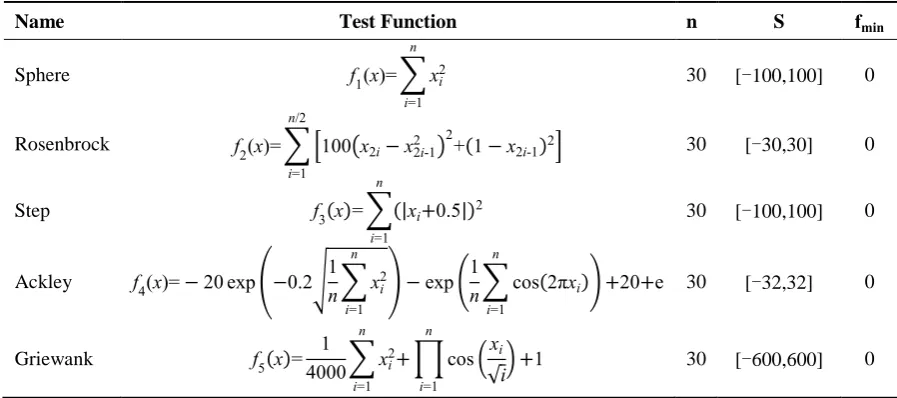
[image:3.595.72.521.316.515.2]In order to verify the validity of MSaDE, five commonly used benchmark functions are selected from [8] for experimental testing. Based on the functional features, they are representative. The benchmark functions are shown in Table 1. n denotes the dimension of the function, S represents the search range, and fmin is the global optimal value.
Table 1. Benchmark functions.
Name Test Function n S fmin
Sphere f1(x)=∑xi2
n
i=1
30 [-100,100] 0
Rosenbrock f2(x)=∑ [100(x2i−x22i-1) 2
+(1−x2i-1)2]
n/2
i=1
30 [-30,30] 0
Step f3(x)=∑(|xi+0.5|)2
n
i=1
30 [-100,100] 0
Ackley f4(x)=−20 exp(−0.2√1
n∑xi2 n
i=1
) −exp(1
n∑cos(2πxi)
n
i=1
) +20+e 30 [-32,32] 0
Griewank f5(x)= 1
4000∑xi2+ ∏cos(
xi
√i) +1
n
i=1
n
i=1
30 [-600,600] 0
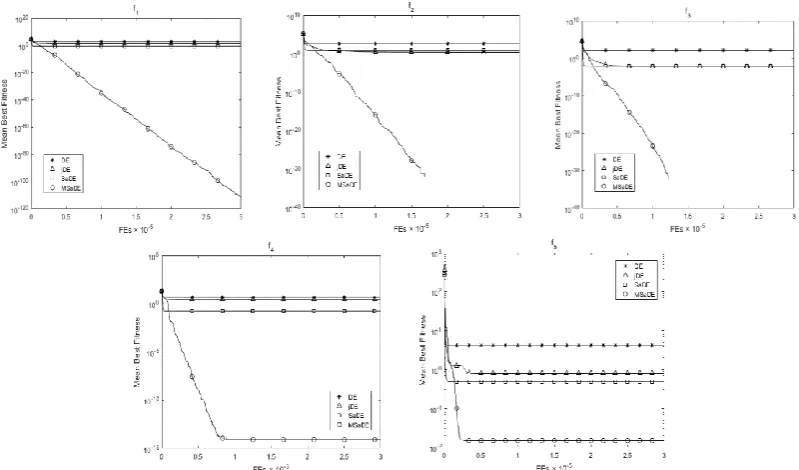
In order to facilitate comparison and analysis of results, we choose three other representative versions of DE to compare. Namely DE proposed by Storn and Price[3], jDE proposed by Brest et al.[6], and SaDE proposed by Qin et al.[7]; For DE, jDE and SaDE, the parameters are set based on the primary literature. In our experiments, the parameters are set as:NP=50, maximum number of function evaluations (FEs) is 3×10⁵.
Figure 1. Iterative process diagrams of four algorithms. Table 2. Computational results over 25 runs.
Test function
DE jDE SaDE MSaDE
Mean SD Mean SD Mean SD Mean SD
f1 6.05E+1 1.43E+0 2.29E+1 1.22E+0 1.34E-1 2.79E-1 1.01E-112 2.39E-112 f2 4.75E+0 9.27E-2 2.77E-1 1.79E-2 8.39E+0 2.40E-1 0 0
f3 1.40E+1 1.34E+1 7.52E-3 1.05E-4 8.12E-3 3.25E-4 0 0
f4 4.69E+0 1.62E+0 2.66E+0 3.58E-1 1.68E-1 3.45E-3 7.99E-15 5.63E-14 f5 4.16E+0 5.17E-1 7.87E-1 2.99E-2 4.83E-1 4.43E-3 1.48E-2 3.68E-3
Note: “Mean” stands for mean best fitness and “SD” stands for standard deviation
Application
Choose reduced graphene oxide/ cobalt ferrite (rGO/CoFe2O4) nanohybrids as the catalyst, conduct thermal decomposition of ammonium perchlorate (AP). When the decomposition is completed, the gas phase products include N2O, NO, NO2, HCl, H2O, Cl2, O2 and so on[9].
According to Arrhenius's law, AP thermal decomposition reaction kinetic equation can be expressed as[9]:
−r =−dω dt=A(ω
'- ω ∞
' )αexp(− E
RT). (8) where ω' and ω∞' are the sample quality at the time and residual weight at the end of the experiment. In (8), the determination of the three unknown parameters (E, A, α) is achieved by minimizing the sums of squared error between the model values and the experimental values. Set the optimization objective function as:
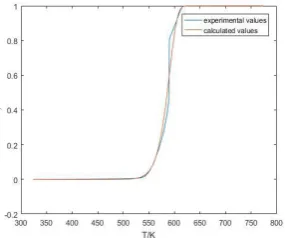
min S(γ)=∑mi=1(γcal.i-γexp.i)2. (9) where γcal. is model values; γexp. is experimental values.
Hence, MSaDE is an effective method to solve the problem of parameter estimation.
[image:5.595.226.369.91.210.2]Figure 2. Fitting results calculated values and experimental values. Table 3. Results comparison of DE and MSaDE.
Algorithm E A α S(γ)
DE 112.36 2451.08 1.932 86.715
MSaDE 97.58 1844.57 1.010 67.391
Conclusion
In view of the shortcomings of the conventional DE, such as prematurity and low efficiency of global optimization, this paper presents a modified self-adaptive DE algorithm, which self-adaptively selects and adjusts mutation strategy, mutation factor and crossover factor in the process of evolution. In the benchmark functions tests, the experimental results show that MSaDE has strong global optimization ability.The algorithm is also applied to the parameter estimation of AP thermal decomposition reaction kinetics model, and the results are good, which provides a new idea for the optimization of thermal decomposition kinetics parameters.
References
[1] Z.X. Yu, Study on the catalytic effect of transition metal oxides on the thermal decomposition of ammonium perchlorate, Nanjing University of Science & Technology (2009).
[2] M. Huang, X.F. Yan, The performance analysis of differential evolution algorithm and its application in parameter estimation of a dynamic model, Computers and Applied Chemistry, 24, 4, (2007) 445–447.
[3] R. Storn, K. Price, Differential evolution—a simple and efficient heuristic for global optimization over continuous spaces, International Computer Science Institute, USA, (1995).
[4] S.W. Wang, L.X. Ding, et al, Survey of differential evolution, Journal of Wuhan University (Natural Science Edition), 60, 4, (2014) 283–292.
[5] B. Liu, L. Wang, and Y.H. Jin, Advances in differential evolution, Control and Decision, 22, 7, (2007) 721–729.
[6] J. Brest, S. Greiner, B. Boskovic, et al, Self-adapting control parameters in differential evolution: a comparative study on numerical benchmark problems, IEEE Transactions on Evolutionary Computation, 10, 6, (2006) 646–657.
[7] A. K. Qin, V. L. Huang, and P. N. Suganthan, Differential evolution algorithm with strategy adaptation for global numerical optimization, IEEE Transactions on Evolutionary Computation, 13, 2, (2009) 398–417.