211
Chapter 29
Effect of Manure and Urea on Chemical Properties of Sandy Soil and
Physiological Properties of Aloe Vera L. Plant Cultivated in Coastal Sandy
Area
Maria Theresia Darini1,a, Zamroni1, Yacobus Sunaryo1
1Faculty of Agriculture, University of Sarjanawiyata Tamansiswa, Indonesia a[email protected]
Abstract. Study dealing with the application of cow-manure and urea in different doses in coastal sandy land
has aimed to determine the chemical properties dynamic of sandy soil and physiological properties of the aloe plant under nutrient stress condition. The research was conducted in coastal sandy area of Depok, Kretek District, Bantul Regency, Special Region of Yogyakarta, Indonesia. The Research was carried out from January until August 2015 using a factorial experiment arranged in Randomized Completely Block Design. The first factor was the doses of manure consisting of three levels, i.e 10; 20 and 30 ton ha-1. The second factor was doses of urea consisting of five levels i.e : 0; 150; 300; 450 and 600 kg.ha-1. The soil chemical properties parameters included organic C content, organic matters level, pH value, total N content, and Cation Exchange Capacity (CEC) were observed. The observation was also objected to physiological parameters of aloe plant such as leaf area, stomatal density, total chlorophyll content, plant photosynthetic rate, plant respiration rate, proline content, and aloetic acid (aloin) content. The results of the experiment indicated that there was an influence of the manure as well as urea on both the chemical properties of sandy soil and the physiological properties of aloe plant.
Keywords: Aloe vera, physiological properties, sandy soil.
I.
Introduction
The Aloe vera plant has been used not only as an ornamental plant but also as a health food ingredient materials for the cosmetic industry, and as a medicinal plant [36, 11]. This plant has multifunctional therefore it has known as a Miracle Plant [7].The leaves of this plant contain fat compounds, carbohydrates, proteins, and 18 essential amino acids, four kinds of vitamins, minerals and six kinds of enzymes. It also contains secondary metabolites: alkaloids, aloins, lectins, lignin, saponins, tannins, phenolic and glucomannan. It is the synergistic activity of all these active substances that contributes to the efficacy of aloe leaves. Aloe vera leaves can be used to improve hair growth, cell regeneration, immunity, and to heal wound, skin irritations, and as anti-inflammatory, antiseptic, antibiotic, antioxidant, anticancer, and anti-cholesterol, antidiabetic, so that Aloe vera leaf is currently used as an ingredient in phytotherapeutics [9, 25, 39, 27].
212
To improve the properties of sandy soil an innovative technique is required in the form of ameliorative materials such as manures. The application of manures can create better soil structure of sandy beach land [29]. Manures as the organic fertilizer not only can increase soil fertility, but also can create healthier ecosystem an environment [34]. To increase essential elements content and decrease the soil temperature of coastal sandy land can be used natural organic fertilizers [35]. Aggregation and productivity of sandy land can be increased by using properly fermented organic materials [37].Plants growing in coastal sandy land can not only suffer due to lack of nutrients but also suffer because of high temperature condition. In high temperature plants will have more thickness leaves, wide stomatal opening, increasing gas exchange, high biomass accumulation [28]. Under stress condition plants can have physiological properties change such as net assimilation rate, respiration rate, stomatal conducting, chlorophyll content, leaf thickness, leaf area, and yield [4]. Assimilate production of the plant depends on light condition, leaf position, air temperature, CO2 concentration, water, and nutrient elements [38]. Therefore, it is exciting to study the chemical properties of sandy soil and the physiological properties of the aloe plant cultivated in coastal sandy land treated with different doses of manure and urea.
II.
Materials and Methods
2.1. Description of the study
The field experiment had been conducted in the coastal sandy area of Depok, Kretek, Bantul Regency, Special Region of Yogyakarta. It has daily temperature of 31-40°C, 100% light intensity, 64-75% humidity, rainfall of 1672.5 mm.year-1. The laboratory observation had been carried out in the Crop Production Laboratory of the Faculty of Agriculture, University of Sarjanawiyata Tamansiswa, and in the Soil Science Laboratory, Plant Science Laboratory and Integrated Research and Testing Laboratory of Gadjah Mada University.
2.2. Experimental design
The research used factorial experiment arranged in a complete randomized block design with 3 replications. The first factor was the dosage of manure consisting of three levels, i.e 10 tons ha-1; 20 tons ha-1; and 30 tons ha-1. The second factor was the dosage of urea fertilizer consisting of five levels i.e: 0 kg. ha-1; 150 kg. ha-1; 300 kg. ha-1, 450 kg. ha-1; and 600 kg. ha-1. It resulted 15 combined treatments.
2.3. Experimental procedures
Experimental procedures consist of: Seedling preparations of aloe plants growth in polybag. Initial soil observation to chemical properties. Soil tillage using hoe, land plotting, and planting hole making. Application of manure as a basic fertilizer base on the treatment doses. Planting of the plant, meanwhile giving urea in one- third doses. Urea application for the second and third fertilization, each using one-third doses. Water irrigation was done every day in the afternoon using sprayer. Weeding was done manually. Final soil observation to chemical properties was done 6 months after planting.
2.4. Data collection and analysis
213
Treatment: manure+ urea dosages / ha (%)
10 t + 0.0 kg.ha-1 0.68 c 1.09 d
10 t + 150 kg.ha-1 0.82 b 1.32 bc
10 t + 300 kg.ha-1 0.78 b 1.15 d
10 t + 450 kg.ha-1 1.53 b 1.53 b
10 t + 600 kg.ha-1 0.82 b 1.42 b
20 t + 0.0 kg.ha-1 0.86 b 1.20 d
20 t + 150 kg.ha-1 0.78 b 1.13 bc
20 t + 300 kg.ha-1 0.76 b 1.26 c
20 t + 450 kg.ha-1 0.78 b 1.53 b
20 t + 600 kg.ha-1 1.13 a 2.46 a
30 t + 0.0 kg.ha-1 0.85 b 1.26 c
30 t + 150 kg.ha-1 0.82 b 1./42 b
30 t + 300 kg.ha-1 0.73 bc 1.26 c
30 t + 450 kg.ha-1 0.79 b 1.37 b
III.
Results and Discussions
3.1. Chemical Properties of Sandy Soil
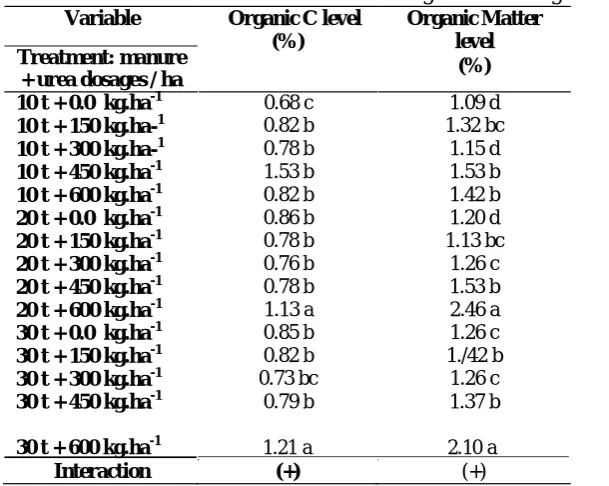
Results of the experiment indicate that it occur an interaction between manure and urea on both organic C content and organic matter level of the sandy soil (Table 1). The results indicate that application of manure 10 t.ha-1 can increase the organic C level when 150 to 450 kg.ha-1 urea are added. Based on the results of this research, to obtain the highest levels of organic C, 20 ton ha-1manure combined with 600 kg.ha-1urea must be added to the sandy soil. A low level of organic C was obtained on the provision of 10 ton ha-1manure and without the addition of urea. This is consistent with the opinion of Islam et al. [22] that manure can improve soil organic C. Rezig et al. [30] reported that organic fertilizer can increase organic carbon waste. Similarly, Singh et al. [32] stated that organic fertilizer and chemical fertilizer can increase the organic C of the soil.
[image:3.595.155.460.328.571.2]Based on the results of this study (Table 1.), in order to obtain a high organic matter content of sandy soil 20 tons ha-1of manure and an addition of 600 kg.ha-1 urea is needed. The lowest organic matter content is obtained when 10 ton ha-1 manure is added without the addition of urea. This is consistent with the report of Celik et al. [10] that the given of additional manure and compost can improve the organic matter content of the soil, and it is also in line with the report of Adeoye et al. [1] and Ibrahim et al. [21] reported that the provision of cow and chicken manures and compost can improve the organic matter content of the soil.
Table 1. The interaction between manure and urea on organic C and organic matter level Variable Organic C level
(%)
Organic Matter level
30 t + 600 kg.ha-1 1.21 a 2.10 a
Interaction (+) (+)
Note: Mean within a column followed by the same letter are not significantly different using Duncan’s Multiple Range Test at the 0.05 probability level.
In this research no interactions between the application of manure and urea occur on pH, total N content, and CEC (Table 2). Based on the results of the study, provision of 20 ton ha-1 of cow manure can slightly increase the pH of sandy soil, while the addition of urea up to a dosage of 600 kg.ha-1 do not affect the pH of sandy soil. This is in accordance with the reports of Gasparalos et al. [16] and Hasan and Mahmoud [18] that organic fertilizer, can increase the pH of the soil. In another hand, Singh et al. [32] reported also that vermicomposting is able to raise the pH of the soil. Results of this study are not consistent with Sridhar et al. [33] reported that the provision of urea fertilizer can increase the pH of the soil.
The results of this study indicate that the optimum dosage to produce the highest total N content is with provision of 30 ton ha-1manure (Table 2). The total N content of 0.05% is the highest, although this still belonged to the low category. Similarly, the provision of urea fertilizer, with the optimum dosage of 450
214
This is supported by Sridhar et al. [33] that high urea fertilizer can increase the levels of N total. Result of this study is not in accordance with Singh et al. [32] reported that the total N increases when an organic fertilizer is provided in combination with a chemical fertilizer..Table.2. pH value, N Total level and C E C of the sandy soil after application of manure and urea.
Application Dosage pH value (H2O) Total N (%) C E C (c mol +
.kg-1)
Cow Manure 10 7.01 b 0.03 b 2.95 b
(ton.ha-1) 20 7.21 a 0.03 b 3.11 a
30 7.01 b 0.05 a 3.29 a
Urea (kg.ha-1)
0 150
7.08 p 7.04 p
0.03 q 0.03 q
3.30 p 3.50 p
300 7.01 p 0.03 q 2.95 q
450 7.04 p 0.05 p 3.21 p
600 7.01 p 0.03 q 2.61 q
Interaction (-) (-) (-)
Note: Mean within a column followed by the same letter are not significantly different using Duncan’s Multiple Range Test at the 5% probability level.
Results of the research indicate that the optimum dosage to produce high CEC 3.11 was manure application of 20 tons ha-1 even this result still belonged to a very low category. Results of this study is in a line with the research of Gasparalos et al. [16]; Hornick [19]; Rezig et al. [30]; that applications of organic fertilizers can increase the CEC of the soil.
3.2. Physiological Properties
Results of the research (Table 3) indicate that provision of 30 tons manure ha-1 and the addition of 450 kg urea ha-1 produced a broader leaf blade than provision without urea, as well as with urea with of 150, 300 and 600 kg.ha-1. The addition of 600 kg urea ha-1 led to a decrease in leaf area, even lower than without urea. The results are consistent with reports by Adekiya and Agbede [2] that a combination of organic fertilizer and chemical fertilizer can improve tomato leaf area. Ayeni et al. [5] reported that the application of organic and inorganic fertilizers can increase corn leaf area. Likewise Derkota and Dha [13] reported that a combination of organic fertilizer and chemical fertilizer increases Centella asiatica L. leaf area. Amara and Mourad [3] reported that a combination of organic and inorganic fertilizers can increase the leaf area of potato plants.
Based on the research results (Table 3), the highest stomatal density is obtained on a treatment combination of 30 tons ha-1 manure and 300 kg ha-1 urea. Huishi et al. [2] reported that the stress conditions of soil can increase the density of stomata in darken colored mustard greens, and Selebasto et al. [31] reported that a stressful environment can increase the stomatal density of Arabidopsis thaliana leaves.
Results of this study indicate that treatment combinations of manure in a dosage of 20 tons and urea 450 kg ha-1 as well as manure 30 tons ha-1 and urea 600 kg.ha-1 can produce the highest total chlorophyll content (Table 3). The lowest total chlorophyll content was obtained on manure provision of 20 tons ha-1 without urea. This study indicate that like other plants, aloe plant need much amount of nitrogen to produce chlorophyll. This result is in accordance with the report of El-Sherif and Sarwat [14] that the provision of chicken manure increased the chlorophyll content of rosella leaves, and Karanatsitis and Bouva [26] that an organic fertilizer increased the pigment of chlorophyll concentration in pepper. The result is also consistent with the report of Hamid and Jawaid [17 that a combination of chicken manure and NPK fertilizer could increase pea chlorophyll, and Ibrahim et al. [21] reported that a combination of chicken manure and a chemical fertilizer could increase the chlorophyll content of Labisia pumila plant.
215
Table 3. Leaf Area, Stomatal Density, Chlorophyll Content and Photosynthetic Rate of Aloe LeavesVariable Leaf Area (cm2) Treatment: manure
Stomatal Density (Stomatal/mm2)
Total of Chlorophyll
Content
Photosynthetic Rate ( µmol/mm2/s)
+ urea dosages (mg/g)
10 t + 0.0 kg.ha-1 100.80 f 36.55 bc 0.16 c 23.03 b
10 t + 150 kg.ha-1 158.36 d 38.24 b 0.14 cd 21.26 c
10 t + 300 kg.ha-1 192.31 b 30.89 c 0.20 b 15.06 d
10 t + 450 kg.ha-1 185.58 c 39.64 b 0.17 b 20.51 c
10 t + 600 kg.ha-1 202.48 b 39.11 b 0.17 b 23.50 c
20 t + 0.0 kg.ha-1 112.25 f 31.48 c 0.14 d 28.84 b
20 t + 150 kg.ha-1 182.78 c 40.19 b 0.20 b 25.17 b
20 t + 300 kg.ha-1 194.01 c 35.60 b 0.17 b 18.94 cd
20 t + 450 kg.ha-1 184.55 c 38.48 b 0.20 a 21.01 c
20 t + 600 kg.ha-1 188.55 b 38.65 b 0.18 b 17.49 cd
30 t + 0.0 kg.ha-1 195.09 b 39.35 b 0.13 d 26.08 b
30 t + 150 kg.ha-1 192.36 b 35.82 bc 0.14 d 26.57 b
30 t + 300 kg.ha-1 197.78 b 46.09 a 0.20 b 23.03 c
30 t + 450 kg.ha-1 263.84 a 38.59 b 0.16 c 33.97 a
30 t + 600 kg.ha-1 171.18 d 39.36 b 0.26 a 25.77 b
Interaction (+) (+) (+) (+)
Note: Mean within a column followed by the same letter are not significantly different using Duncan’s Multiple Range Test at the 0.05 probability level.
[image:5.595.72.537.439.682.2]Based on this research (Table 4), the highest plant respiration rate can be obtained on a application combination of manure 30 tons ha-1 and urea 150 kg ha-1. Results of this study is in line with report of Boudh et al. [8] that a compost organic fertilizer can increase the rate of respiration in ashwaganda plants (Withania sonintera L.). In one hand, Jouyban [23] reported that when the plant grow in the soil in a strees condition will have lower the respiration rate. In another hand, Likewise Fahramand et al. ([15] reported that strees condition can increase the rate of respiration of the plant.
Table 4. The Respiration Rate, The Transpiration Rate and Proline Content of Aloe Leaves. Variable
Treatment: manure+urea dosages
Respiration Rate (mg/kg/hour)
Transpirion Rate (minute/cm2)
Proline Content (ppm)
Aloin content (ppm)
10 t + 0.0 kg.ha-1 126.42 d 30.66 b 6.75 a 645.67 d
10 t + 150 kg.ha-1 68.52 f 30.00 b 6.13 a 822.89 a
10 t + 300 kg.ha-1 76.92 ef 28.33 b 5.38 a 524.37 g
10 t + 450 kg.ha-1 124.65 d 38.00 b 5.12 a 811.29 a
10 t + 600 kg.ha-1 96.25 c 48.66 a 5.12 a 676.42 c
20 t + 0.0 kg.ha-1 180.23 b 18.66 d 4.49 b 492.42 g
20 t + 150 kg.ha-1 144.04 c 24.00 c 4.36 b 605.72 f
20 t + 300 kg.ha-1 141.33 c 31.33 b 4.12 b 637.99 d
20 t + 450 kg.ha-1 142.02 c 23.66 c 3.96 c 566.97 f
20 t + 600 kg.ha-1 84.82 ef 26.00 c 3.85 c 760.84 b
30 t + 0.0 kg.ha-1 73.04 ef 24.33 c 3.67 c 723.41 b
30 t + 150 kg.ha-1 225.98 a 26.00 c 2.66 d 627.53 d
30 t + 300 kg.ha-1 144.64 c 31.66 b 2.40 d 791.50 b
30 t + 450 kg.ha-1 54.69 g 33.33 b 2.28 d 567.47 f
30 t + 600 kg.ha-1 158.79 bc 32.66 b 2.00 d 648.82.d
Interaction (+) (+) (+)
Note: Mean within a column followed by the same letter are not significantly different using Duncan’s Multiple Range Test at the 0.05 probability level.
216
Based on the results (Table 4), the highest concentration of proline is obtained on a combination of manure 10 tons ha-1in combination with urea application in all doses . These results indicate that application of urea had no significantly effect on the levels of proline content of aloe leaves. Low levels of proline are obtained on treatment combination of manure 30 tons ha-1 in combination with urea of 150–600 kg.ha-1. These conditions indicate that higher dosage of manure can result better environment that appropriate for plant growth so it resulted lower proline content of aloe leaves. Results of the study is in accordance with Jouyban [23] reported that a strees condition increase the proline content, and Fahramand et al. [15] and Zamani et al. [41] reported that a plant in a strees condition increases in the proline content.The results of this study (Table 4) indicate that treatment combination of manure 10 tons ha-1 and urea all doses can result higher aloin average concentration than that of other combinations. These results indicate that the application of lower dosage of manure in coastal sandy soil can create inappropriate condition for plant growth of Aloe plant so it results in higher aloin concentration of the plant.
IV.
Conclusions
Good working relationship between buyer and food supplier can increasing long term partnerships, improve the operation and food safety implementation as a whole for mutual benefit of all parties involved. However suggested that the degree of good working relationship that develops between buyer and food suppliers are likely to be more improved by continuous improvement and commitment among them in implementing Food Safety Management System all pre-requisite and procedure were need to be applied in all process and every non conformance issue would be need to get corrective action to avoid re-occurrence.
Results of this research indicate that:
1. Manure application in doses of 20–30 tons ha-1 can create better chemical properties of coastal sandy sail, nevertheless urea applications in doses up to 600 kg ha-1 have no result better chemical properties of coastal sandy soil.
2. Manure application in doses of 20–30 tons ha-1 in combination with urea 300–400 kg ha-1 can result better physiological properties of aloe plant cultivated in coastal sandy land.
3. Manure application in doses of 10 tons ha-1 results proline and aloin concentration higher than that of manure application in higher doses.
Acknowledgement
The authors would like thankfull to Indonesia Research Technology and Higher Education Ministry for the Research Grant provided to implement the experiment.
References
[1]. Adeoye P.A., Adebayo S. E. and Musa J. J., 2011. Growth and yield response of cowpea (Vigna unguilata) to poultry and cattle manure as amendments on sandy loam soil plot. Agric. J. 6 (5): 218-221.
[2]. Adekiya A.O. and Agbede T.M., 2009. Growth and yield of tomato (Lycopersicum esculentu m Mill) as influenced by poultry manure and NPK fertilizer. Emir. J. Food Agric 21 (1): 10 -20. [3]. Amara D.G. and Mourad S. M., 2013. Influence of organic manure on vegetatif growth and tuber
production of potato (Solanum tuberosum L.) in a Sahara dessert regi on. Intern. J. Agric. Crop Sci. 5 (22): 2724-2731.
217
[5]. Ayeni L.S., Adeleye, E.O. and Adejuno, J.O. 2012. Comparative study of organic, organomineraland mineral fertilizer on soil properties, nutrient up take, growth and yield of mayze (Zea mays). Intern. Res..J. Agric. SoilSci. 2(10: 493-497.
[6]. Bahadur A., Chatterje A., Kumar R., Singh M., and Naik P. S., 2011. Physiological and biochemical basis of drought tolerance in vegetables. Veget. Sci. J. 38 (1): 1 -6.
[7]. Boudreau M. D. and Beland F. A., 2006. An evaluationon of the biological and toxicological pproperties of Aloe barbadensis Mill, Aloe vera Journal of Environmental Science and Health Part C 24 (1): 153-158.
[8]. Boudh G. K., Pandey R., Namdeo K. N., Pandey G., and Ahirwar K., 2013. Effect of organic and inorganic sources of nutrient on physiological, biochemical and productivi ty parameter of ashwaganda (Withthaniasominifera L. Dunall). Crop Res. J. 45 (3) : 223 -225.
[9]. Bunyapraphatsara N., Yongchaiyudha S., Rungpitarangsi V. , and Chokechayaranporn O., 2007. Antidiabetic activity of Aloe vera L. juice II clinical trial in New ca ses of diabetis mellitus. Journal of Phytomedicine 1(3): 245 –248.
[10]. Celik I., I. Ortas, and S. Kilic, 2009. Effect of compost mycorhiza, manure and fertilizer on some physical properties of chromoxeret soil. Soil and Tillage Res. 76 (1): 59 -67.
[11]. Christiningsih R. and Darini M. Th., 2013. Initial treatment on raw material processing product Aloe vera. Scientific Journal of Agriculture Science Agros. 15 (2): 369 -375.
[12]. Darini M. Th., 2011. Optimization plant growth regulator NAA and BAP on Aloe vera explant growth. Scientific Journal of Agriculture Science Agros. 13 (2): 230-237.
[13]. Derkota A. and Dha P. K., 2013. Effect of integrated manuring on growth and yield of Centella asiatica L. Urb. J. Tropical Ecology 54 (1): 89-95.
[14]. El-Sherif M. H. and Sarwat, M. I., 2007. Physiological and chemical variation in producing rosella plant (Hibiscus sabdariffa L.) by using some organic farmyard manure. World J. of Agric. Sci. 3 (5): 609-616.
[15]. Fahramand M., Mahmoody M., Keykha A., Moori M., and Regi K., 2014. Influence of abiotic stress on proline, photosynthetic enzym and growth. Intern. Res. J. App and Basic Sci. 8 (3): 257 -265.
[16]. Gasparalos D., Roussor P. A., Christofiloponiou E., and Haidouti C., 2011. Comparative effect of organic and conventional apple orchard management on soil chemical properties and plant mineral content under mediterranean climate conditins. J. Soil Sci. Plant Nutr. 11(4): 105 -117.
[17]. Hamid N. and Jawaid F., 2013. Effect of chicken manure and mineral fertilizer on some nutritive parameter and lead acumulation in two species grown in lead contaminated soil. Park. J. Chem. 3(4): 188-197.
[18]. Hassan A.Z.A. and Mahmoud A. M., 2013. Effect of different sources of calcium, organic and inorganic nitrogen on sandy soil penut yield and componen. Topless J. Agric. Res. 2 (1): 1-9. [19]. Hornick S.B. 2009. Nutritional quality of crop as affected by management practices. Agric Res.
Survive U.S. Departmen Agriculture, Beltsville, Maryland, USA, 8 pp.
[20]. Huishi H.W., Yang R., Li J., and Yu Y., 2012. Stomatal characteristic of greenin g plant species in response to different atmosfir enviroment in Xi’an China. J. of Food Agric. and Environ 10 (3;4): 1524-1539.
[21]. Ibrahim M. H., Jafar. H. Z. E, Karimi E., and Ghasemzadeh A., 2013. Impact of organic and anorganic application on the Kacip Fatimah (Labisia pumila Blume) Molecul 18: 10973-10988. [22]. Islam M.M., Karim A. J. M. S., Jahiruddin M., Majid N. M., Miah M. G., Ahmed M. M., and
Hakim M. A., 2011. Effect of organic manure and chemical fertlizer on crops in raddish stem amaranthus Indian spinac cropping patteen in homestead area. 5(11): 1370-1378.
218
[24]. Kalpana M., 2003. Physiological approaches for yield quality improvement and value addit ion inchili (Capsicum annum L.). Crop Physiological Univ. ofAgric. Sci. Karnataka India
[25]. Kane N. 2007. Aloe for acid reflux, you’ve seem aloe juice at the health food store, now learn how it helps heal acid reflux, also called heart burn. Health Publication.http://findarticles.com/p/articles/mi-mOFKA/is-4-69/ai-n18791510.
[26]. Karanatsidis G. and Buova M., 2009. Effect of organic fertilizer on growth and some physiological parameter in pepper plant. Biotechnol. and Biotechnol Special Edition XI Anniversary Scientific Conferece.
[27]. Nandal U., Bhardwaj R. L., and Kendra K. V., 2012. Aloe vera a valuable wonder plant for food, medicine and cosmetic use. Intern. J. Pharmac. Sci. Rev. and Res. 13 (1): 59 –67.
[28]. Natarajan S. and Kuhney J.S.. 2008. Morphological physiological and anatomical characteristic associated with heat preconditioning and heat tolerance in salvinia splendens. J. Amer. Soc. Hort. Sci. 133 (4): 527-534.
[29]. Prasetyowati S. E., Sunaryo Y. and Christiningsih R., 2014. Effect of local ameliorant and watering interval on sword bean growth and result. Scientific Journal of Agriculture Science Agros. 16 (2): 228-239
[30]. Rezig F.A,M., Mubarak A. R., and Ehadi E. A., 2012. Impact of organic and organic residues and mineral fertilizer application on soil crop system: II soil contribution. J. Archives of Agronomy and Soil Sci. 1-17.
[31]. Selebasto T., Lake J. A., and Woodward F. L., 2013. Responses of leaf parameters of Arabidosis thaliana ecotype to change in CO2 concentrations. Bot. J. Agric. Appl. Sci. 9 (1): 82 -87.
[32]. Singh A.K., Bisen D. K., Bora D. K., Kumar R., and Beru B. , 2011. Comparative study of organic, inorganic and integrated plant nutrient supply on the yield of Darjeeling tea and soil healt. Two and a Bud 58: 58-61.
[33]. Sridhar K., M. Jakadri, Prasad J. V. N. S., Ramesh T., and Mulka S. R., 2013. Physico-chemical properties of soil alter harvest of sunflower (Helianthus annus L.) as influened by tillage practies and nitrogen management. College of Agric Crop Res. 46 (3): 126-129.
[34]. Sunaryo, Y., 2010. Effect of Vermin Compost and Bokashi on Nutrient Content of Mustard Green and Lettuce. Proceeding International Seminar on Horticulture to Support Food Security 2010. Bandar Lampung, Indonesia.
[35]. Sunaryo Y. and Darini M. Th., 2010. Crop cultivation strategies in coastal sa ndy area especially in Yogyakarta. The international seminar on development of coastal sandy area toward sustainable agriculture. The join international seminar between faculty agriculture UGM and faculty of agriculture UPM. Yogyakarta February 13 -14, 2010.
[36]. Tenny S., Sari E., and. Usri K, 2005. The Aplication of (Aloe vera ) leaves for the treament of aphthoustomatis at vilage Ciburial sub-district Cimenyan Bandung. University of Padjajaran. [37]. Todd W., Andraski and Harry G. B., 2005. Cover crop effect on yield response to nitrogen on an
Irrigated sandy soil. Agronomy Journal 97: 1239-1244.
[38]. Wang L., Yang X., Ren Z., and Wang X., 2014. Regulation of photoassimilate distribution between source and sink organs of crop through light environment control in greenhou se. J. Agric. Sci. 5: 250-256.
[39]. Yongchaiyudha, S., Rungpitarangsi V., Bunyapraphatsara N., Chokechayaranporn O., 2007. Antidiabetic activity of Aloe vera L. juice I clinical trial in New cases of diabetis mellitus. Journal of Phytomedicine 1(3): 241–243.
[40]. Yuwono, N.W. 2009. The build up soil fertility marginal land. Journal Soil Sci. and Environ. 9 (2): 137–141.