106
Journal of the Statistical and Social Inquiry Society of Ireland Vol. XLVII
Symposium: ‘Where’ will the Economy be in 2040?
Delivering on the National Development Framework
Uneven economic development and its implications for policy:
Lessons from the UK
Henry G. Overman London School of Economics#
(read before the Society, 26 April 2018)
Abstract This paper examines the UK’s large and, by some measures, growing variation in economic performance across cities and regions and assesses how policymakers can and should respond. The traditional policy mix – including central government investments in local growth projects, transport and other infrastructure, and funding for business support and access to finance – has not been effective. Greater local control is needed to improve policy effectiveness and recent devolution deals and directly elected mayors are a step in this direction. Nonetheless, when devolving powers, it is important that policies that have wide scale impacts (such as transport and housing) are coordinated across local areas. London’s strong economic performance plays a large part in explaining widening disparities within the UK. Providing an effective counter-balance to London may require policy aimed at ‘rebalancing’ to be more spatially focused. Ultimately, policymakers should care about the effect of policies on people more than on places and thus efforts to rebalance an economy should be judged on the extent to which they improve opportunities for all, rather than whether they narrow the gap between particular places.
1. INTRODUCTION
The economic performance of the UK is marked by growing variation in economic performance across regions. After briefly outlining some of those differences, this paper assesses their underlying causes and outlines how policymakers can and should respond. The traditional policy mix, dominated by central government, has not been effective. While greater local control is needed to improve policy effectiveness, it is important that policies that have wide scale impacts are coordinated across local areas. Given the similarities between the Irish and UK cases, as documented by Lyons (2019) in relation to the relative size of cities for example, many of the policy lessons are relevant for Ireland, as it seeks to implement its Ireland 2040 plan.
Policymakers should ultimately care about the effect of policies on people more than on places and thus efforts to rebalance an economy should be judged on the extent to which they improve opportunities for all, rather than whether they narrow the gap between particular places. The paper is structured as follows: the following section outlines some variations in economic performance across UK regions, while Section 3 examines the forces at work behind these differential trends. The fourth section discusses the role of policy in addressing these differences, while the fifth section concludes.
2. VARIATIONS ACROSS REGIONS
There are large variations in economic performance across the cities and regions of the UK. There is a broad North-South pattern to these disparities. But there is also substantial variation within those broad areas: some Northern cities, such as Manchester, are doing well and some Southern cities, like Hastings, are doing relatively badly. Despite many policy initiatives by recent UK governments, these disparities remain large and persistent. On some measures, they have widened since the global financial crisis. The 2015 Cities Outlook report shows that, between 2004 and 2013, population growth in cities in the South was twice the rate of growth of cities elsewhere. The figures for business growth (25% in South vs. 14% elsewhere) and jobs growth (12% vs. 1%) show similar trends, especially accounting for the relatively more even distribution of public sector employment.
# Department of Economic Geography, London School of Economics & Director, What Works Centre for Local Economic
Growth.
Keywords: economic development, United Kingdom
107
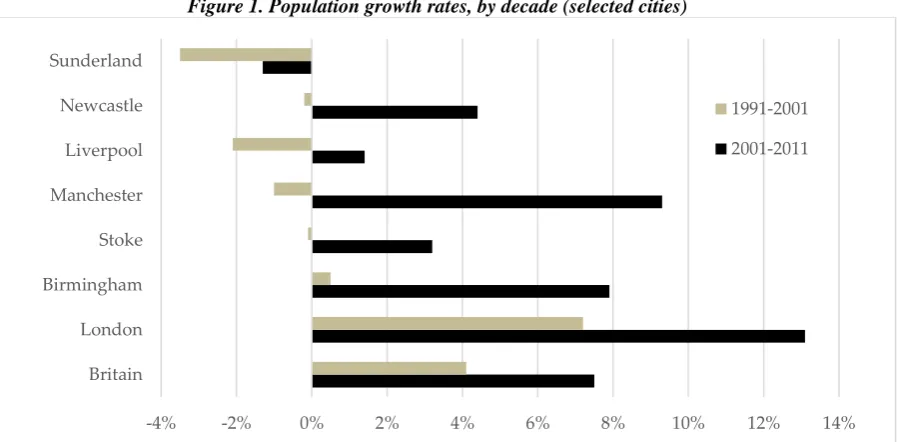
[image:2.595.78.527.190.411.2]The relative growth of British cities since the turn of the millennium represents a significant change from the period between the Second World War and the mid-1990s. London, for example, lost two million residents in the half-century after the war, only to see that loss completely reverse in the last two decades. As shown in Figure 1, positive population growth in cities such as Manchester and Newcastle during the 2000s represented an even more recent turnaround: these cities all had declining populations in the 1990s. The turnaround has not been uniform across the country, however: for example, Sunderland continued to shrink in the 2000s, while growth in Liverpool was far more muted than some other cities. There are three trends evident in Figure 1: first, the continued strength of London; second, the recent improvement in the performance of some cities; and third, the variation in performance, which is apparent even for neighbouring cities.
Figure 1. Population growth rates, by decade (selected cities)
Note: The table shows population growth for a selection of English Cities. Source: Cheshire, Overman, Nathan (2014), based on Rice and Overman (2008)..
3. FORCES AT WORK
Two commonly suggested factors contributing to the dominance of London, and by extension the South, are the finance sector and the globally oriented nature of the London economy. Financial services are clearly important, but most of London’s long-term job growth has come outside finance or those sectors closely linked to it. For example, London has strengths in a range of business and information services well beyond the financial sector. And while London is a preferred location for the super-rich, this is a tiny, if much publicised, minority. For example, in terms of property transactions, recent increases in foreign demand are swamped by increases in demand from first-time buyers and other sources of domestic demand. It is domestic sources of demand that drive the London housing market.
In fact, what is most distinctive about London’s economy is its competitive strength and skill levels across a wide range of services. A large part of the superior economic performance of London (and the broader South East) comes from the concentration of skilled workers who would be paid relatively well wherever they lived. In turn, that concentration is partly because London provides greater opportunities for such individuals to use and develop their talents.
All of this means that London has higher wages, more expensive housing and a greater general cost of living, with the gap in all of these rising as wage inequality has grown since the late 1970s. But at least for those who are young, able and willing to economise on housing costs, London offers opportunities that are simply not available elsewhere. And since many London residents later move on to other areas of the country, the city also acts as a source of highly skilled workers for local economies throughout the UK.
The recent economic performance of British cities is essentially driven by two interconnected phenomena. First, the structure of the economy has shifted towards activities that tend to benefit more from urban locations – this is true of both the general shift from manufacturing to services and of shifts within those broad areas. Second, at the same time as cities have become more important as places of production, they have also become more important as places of consumption. The fact that the structural shift has tended to benefit more skilled workers means that these two changes have reinforced one another: successful cities have attracted higher skilled workers, who in turn have made those places more successful.
-4% -2% 0% 2% 4% 6% 8% 10% 12% 14%
Britain London Birmingham Stoke Manchester Liverpool Newcastle Sunderland
1991-2001
108
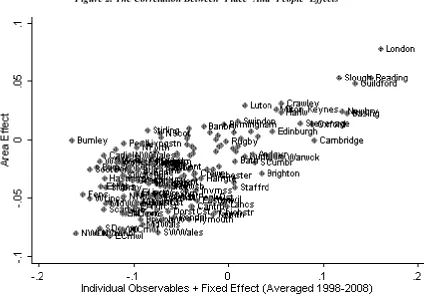
Indeed, research suggests that these two factors explain not only the resurgence of British cities, but also their likely economic future. Gibbons et al (2014) study hundreds of thousands of workers as they moved around the country, allowing the decomposition of wages into an ‘area effect’, driven by where people live, and a ‘people effect’, driven by the kind of people that live in an area (both shown in Figure 2). They find that people effects were the most important factor underpinning area differences in wages across locations.
[image:3.595.90.515.229.528.2]But area effects do play some role. The evidence suggests that the pure size of a place plays the most important role. Bigger places make it easier to interact with other firms and other people, including buying and selling from them or exchanging ideas with them. These benefits from size, or ‘agglomeration economies’, tend to be self-reinforcing. As a place becomes more productive, it attracts more people and firms, which, in turn, makes it more productive.
Figure 2. The Correlation Between ‘Place’ And ‘People’ Effects
Note: Plots area effects against average area predicted wage based on both individual fixed effects and observed individual characteristics estimated from the UK NES/ASHE data sets.
Source: Gibbons et al (2014).
Aside from size, there are three other factors that are systematically related to ‘area effects’ on wages. Firstly, if a place itself isn’t big, the next best thing is to be well connected to places that are big and successful – such as commuter towns around London. Secondly, it also helps to have lots of skilled workers because higher skilled workers earn even more when they are surrounded by lots of other higher skilled workers. Lastly, it helps if an area has one of the activities that do well in cities, such as advertising, or one that is doing well nationally, such as management consultancy.
4. THE ROLE OF POLICY
109
Policymakers have other channels through which they can affect the economic performance of cities, however. First, it is important to note that while there are many benefits from urban growth, there are also costs – and as cities grow, so too do the costs of living and doing business in a city. Policy can have a very large effect on these costs and this, in turn, can have a big impact on urban economic performance. The weight of evidence shows that policy in Britain works to increase the costs of living. One key figure is that between 1970 and 2006, real housing price growth in Britain averaged 4.5% per annum, the highest rate in the OECD and well above the rates seen in, for example, the United States (a little over 2%) or Germany (close to zero).
Unlike Spain or Ireland, which experienced similar price increases while building many more houses per capita, the UK’s housing price increases were a function of building too few houses in areas where people want to live. This, in turn, is down to the fact that the UK’s planning system strongly constrains the supply of land. Hilber and Vermeulen (2015) estimate that a local authority that moved from the average level of ‘restrictiveness’ to no restrictions would have houses that were about 35% cheaper. That might seem extreme, but even moving from the average restrictiveness in the South East to the restrictiveness of local authorities in the North East would see housing 25% cheaper. These are significant costs of the planning regime – and they are not just limited to housing. Cheshire & Hilber (2008) examine the impact of supply restrictions on the cost of office space, by comparing the cost of renting space with the cost of developing it. (Central here is the idea that large mark-ups of revenues over costs should be arbitraged away by commercial developers unless they are constrained by planning policy.) The research gives a rough measure of the regulatory ‘tax’ imposed by the planning system: in the West End of London, the tax is around 800%; in Canary Wharf, it’s around 320%.
Two common responses to such figures are firstly that the built heritage of cities such as London needs protection and secondly that these cities are already too crowded. But central Paris is attractive too and the estimated regulatory tax there is 305% - and about half this in La Defense. The other typical objection is that London is already crowded, but downtown Manhattan imposes a regulatory ‘tax’ that is less than 50%. This isn’t just a problem for London: Birmingham imposes a 250% tax rate. To put this in perspective, in the mid-2000s, office rents in Birmingham were comparable to office rents in San Francisco. Such high rents make it easier to understand the difficulties of British cities in attracting private sector employers.
There are two important implications of these findings. First, these restrictions make the UK’s more successful cities very expensive. In fact, the productivity effect of living in our more successful cities is far outweighed by the cost of living effect. People who choose to live in those cities are compensated by the urban amenities. But the amenities aren’t sufficient to compensate the many people who are priced out of more successful areas: posh restaurants are cold comfort for the urban poor.
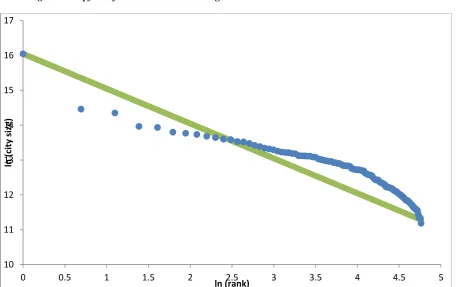
Secondly, there is a case to be made that planning restrictions are having a major impact on the UK’s urban system as a whole. In particular, they may make some of its ‘second-tier’ cities too small, which could have important implications for their economic performance given the link between city size and productivity. This is shown by an empirical regularity called Zipf’s Law. Applied to cities, Zipf’s Law suggests that the second largest city should be half the size of the largest, the third largest city should be a third the size of the largest, and so on. To a reasonable approximation, this law holds for the relative sizes of cities in most countries.
But, as shown in Figure 3, Zipf’s Law does not hold in Britain where its second-tier cities appear to be too small. Most people infer from this that London is too big. But, comparing it to Britain’s smaller cities (those ranked 25th and lower), London is about the right size. The issue is that the rest of our urban population tends to be ‘spread out’ across a number of moderately large cities. Zipf’s law would require some of those cities to become much larger and some to become much smaller.
110
Figure 3. Zipf Plot for British Cities Showing Britain’s “Second Tier” Cities are Undersized
Note: The figure plots 2011 population of British cities against their rank in the urban hierarchy. The fact that the second tier of cities appear to be too small can be seen from observing that they lie below the zipf line (which roughly summarises the relationship between the size and rank of cities that holds across many different countries). In contrast, note that medium-sized cities sit above the zipf line. Data is from the 2011 Census.
Source: Cheshire, Overman, Nathan (2014), based on Rice and Overman (2008)..
Political considerations matter, too. In a democratic system, place-based interventions tend to involve a lot of what might be termed ‘jam-spreading’: spending money in a city like Manchester is seen as ‘unfair’ if similar policies are not pursued in less successful urban areas. As a result, what money is spent gets spread around rather than trying to build on the successes. The combination of supply constraints and “jam-spreading” has led to cities like Manchester being smaller than they otherwise would have been, with fundamental implications for the economic performance of those cities and the wider British economy.
Focusing more on our relatively successful cities would raise very difficult questions about what happens in the places ‘left behind’. Of course, they should not be ‘abandoned’, but the policy mix in these areas needs to be more realistic about their prospects. The balance of spending should be strongly tilted towards human capital – ensuring better education and training for local people – and away from physical capital, such as new buildings and transport infrastructure that will do little, if anything, to turn these places around. In the UK, as in Ireland, this is a very difficult policy prescription for constituency-based politicians. But the economic performance of cities is vitally important – and improving that performance requires a serious debate about what urban policy can and should do better.
5. CONCLUSION
There are large variations in economic performance across the cities and regions of the UK and on some measures, they have widened since the global financial crisis. All the party manifestos promise action to reduce them, but there is little difference between them in terms of the policies that they would pursue to meet this objective. The traditional policy mix – central government investments in local growth projects, transport and other infrastructure, funding for business support and access to finance, and a host of other interventions – has not been effective. There is a growing recognition that greater local control may be needed to improve policy effectiveness, although there is disagreement about the form this devolution should take. Whatever happens, it is important that policies that have wide scale impacts (such as transport and housing) are coordinated across local areas. Greater experimentation at the local level, combined with effective evaluation, would help improve policy, but this is highly unlikely given short-term political pressures.
10 11 12 13 14 15 16 17
0 0.5 1 1.5 2 2.5 3 3.5 4 4.5 5
ln
(
ci
ty si
ze
)
111
London’s strong economic performance plays a large part in explaining widening disparities. Providing an effective counter-balance to London may require policy aimed at ‘rebalancing’ to be more spatially focused – for example, on Manchester. Concentrating resources in this way is controversial and difficult for constituency- based politicians (in both central and local government).
Ultimately, it is helpful to remember that we ultimately care about the effect of policies on people more than on places. Efforts to rebalance the economy should be judged on the extent to which they improve opportunities for all, rather than whether they narrow the gap between particular places.
References
Cheshire, Paul and Hilber, Christian (2008) ‘Office Space Supply Restrictions in Britain: The Political Economy of Market Revenge’, Economic Journal 118(529): F185-221.
Cheshire, Paul, and Hilber, Christian and Kaplanis, Ioannis (2011) ‘Evaluating the Effects of Planning Policies on the Retail Sector: Or Do Town Centre First Policies Deliver the Goods?’, SERC Discussion Paper No. 66. Cheshire, Paul and Overman, Henry G. and Nathan, Max (2014) Urban Economics and Urban Policy Challenging
Conventional Policy Wisdom, Edward Elgar ISBN: 978 1 78347 525 4
Criscuolo, Chiara, and Martin, Ralf, and Overman, Henry G. and Van Reenen, John (2019) ‘The Causal Effects of an Industrial Policy’, American Economic Review.
Gibbons, Stephen and Lyytikäinen, Teemu and Overman, Henry G. and Sanchis-Guarner, Rosa (2018) ‘New Road Infrastructure: The Effects on Firms’, Forthcoming, Journal of Urban Economics.
Gibbons, Stephen and Overman, Henry G. and Pelkonen, Panu (2014) Area Disparities in Britain: Understanding the Contribution of People vs. Place Through Variance Decompositions. Oxford Bulletin of Economics and
Statistics.
Hilber, C (2015) ‘UK Housing and Planning Policies: The Evidence from Economic Research’, CEP 2015 Election Analyses Series (http://cep.lse.ac.uk/election2015/).
Hilber, C. A., & Vermeulen, W. (2015). The impact of supply constraints on house prices in England. Economic Journal, 126(591), 358-405.
Lyons, R.C. (2019). ‘Ireland in 2040: Urbanization, demographics and housing’, Journal of the Statistical & Social Inquiry Society of Ireland.
McNally, S (2015) ‘Schools: The Evidence on Academies, Resources and Pupil Performance’, CEP 2015 Election Analyses Series (http://cep.lse.ac.uk/pubs/download/EA023.pdf).
Overman, Henry. G. (2013). 'The Economic Future of British Cities'. Centrepiece 18(1).
http://cep.lse.ac.uk/pubs/download/cp389.pdf.
Overman, Henry. G. (2017). 'The UK's Regional Divide: Can Policy Make a Difference?' Centre for Economic Performance (LSE). http://cep.lse.ac.uk/pubs/download/ea042.pdf
Overman, Henry. G. and Rice, Patricia (2008). Resurgent Cities and Regional Economic Performance, SERC policy paper number 1.
http://www.spatialeconomics.ac.uk/textonly/SERC/publications/download/sercpp001.pdf
Roland, I and A Valero (2015) ‘Productivity and Business Policies’, CEP 2015 Election Analyses Series