UTCP: compositional semantics for
shared-variable concurrency
Andrew Butterfield?[0000−0002−2337−2101]
Lero@TCD
School of Computer Science and Statistics Trinity College Dublin
Abstract. We present a Unifying Theories of Programming (UTP) se-mantics of shared variable concurrency that is fully compositional. Pre-vious work was based on mapping such programs, using labelling of deci-sion points and atomic actions, to action systems, which themselves were provided with a UTP semantics. The translation to action systems was largely compositional, but their dynamic semantics was based on having all the actions collected together. Here we take a more direct approach, albeit inspired by the action-systems view, based on an abstract notion of label generation, that then exploits the standard use of substitution in UTP, to obtain a fully compositional semantics.
The final publication is available at Springer via http://dx.doi.org/10. 1007/978-3-319-70848-5_16.
1
Introduction
In this paper we present a compositional semantics for a simple abstract shared-variable concurrent language, called the “Command” language presented in Figure 1 The Command language is very simple, with sequential composition
a ∈ Atom Atomic state-change actions
C::=hai Atomic Command
| C;;C Sequential Compostion
| C+C Non-deterministic Choice
| CkC Parallel Compostion
| C∗ Non-deterministic Iteration
Fig. 1.Command language syntax
?This work was supported, in part, by Science Foundation Ireland grants 10/CE/I1855
(C1;;C2), and only non-deterministic choices, for alternative execution paths (C1+C2) or deciding when to terminate a loop (C∗). The parallel composition (C1kC2) allows arbitrary interference by each side on any variables, all of which are considered here to be global and shared. The semantics we present does not itself need to deal explicitly with any shared variables, but simply assumes a shared state s and the existence of atomic state-change actions a. This Com-mand language corresponds directly to Concurrent Kleene Algebra (CKA)[14].
Our interest in this language stems from our general work within the Uni-fying Theories of Programming (UTP) framework[13], in which we seek to find ways to unify the semantics of a wide range of programming and specification languages, and language features, in order to be able to reason formally about systems built using a mix of such languages. The Command language in this paper is based on that introduced in the “Views” paper[10], which describes how a range of approaches to reasoning about shared-variable concurrency can be mapped down onto CKA, and the Command language. Approaches covered in [10] include various Separation logics[8], type-theories, Owicki-Gries[20], and Rely-Guarantee[17], among others. Our intention in developing a UTP semantics of the Command language is to be able to use it as a foundation on which to build UTP theories of the above approaches that will be easy to link together. In effect we hope to use the results of the Views paper as a conceptual architecture to organise our work.
Another independent motivation for this work is a research collaboration that led us to give a UTP semantics to a process modelling language called PML[1], which has the notion of basic actions that require certain resources to run, and which provide further resources as a result. Actions can be combined using se-quencing, selection, branching and iteration. We published initial work on a UTP semantics for PML[7], noting that it is essentially the same as the Command lan-guage. The semantics we gave in [7] was not compositional, however, and finding a fully compositional semantics was noted for future work.
Compositionality is important. By it we mean the property that the semantics of a composite construct can determined from the semantics of its parts, so for example, the meaning of the construct C1;;C2 would be determined by the meanings of C1 and C2, combined with the meaning of ;;. This property is desirable as without it both the semantics and any reasoning principle based on it would not scale up to large programs or systems.
2
Related Work
Key work was done on concurrent semantics in the 80s and 90s, with a strong focus on fully abstract denotational semantics. Notable work form this period includes that by Stephen Brookes[5] and Frank de Boer and colleagues[3]. Both looked at denotations based on the notion of sets of transition traces, these being sequences of pairs of before-after states. In order to get compositional-ity the traces of any program fragment had to have arbitrary “stuttering” and “mumbling” state-pairs added to capture the notion of outside interference. Full abstraction meant that the semantics had to identify programs like skip;;skip
withskip, while distinguishing betweenx:= 2 and x:= 1 ;;x:=x+ 1.
The first UTP theory in this area was presented in the UTPP paper[23]. This combined guarded commands[9] with the idea of action systems[2], interpreted in UTP as non-deterministic choice over guarded atomic actions, where disabled actions behave like the unit for that choice. This basic lattice-theoretic archi-tecture for the UTPP semantics forms the foundation and inspiration for the UTCP semantics presented here.
More recently, also inspired by [10], the “UTP Views” paper by van Staden[21], starts algebraically, looking at Kleene algebras over languages. Languages here are sets of strings over an alphabetA. He then takesA=Σ×Σ, which in effect encodes the Brookes model[5]. His semantics fits with the usual UTP approach to concurrency, in that it is based on traces as sequences of some notion of event.
All the compositional semantic frameworks we have discussed in this section are based on this notion of sets of transition traces, but we are seeking a semantics based on direct relations between before- and after-program states, without any explicit notion of traces. The reason for this is that the resulting UTP theory will have a form that will make it easier to link to concurrency approaches such as rely-guarantee, or separation logic, that are used with languages that are imperative and program-variable based.
There is however a semantics for shared-variable concurrency that is much closer in form to the one developed in this paper. This is the “actions with ax-ioms” approach of Lamport [18]. In this, the semantics of each language construct is given by a set of axioms, that are predicates over both program variables, and additional “auxiliary” variables that manage flow of control. The meaning of a composite is given by taking the axioms that describe each of its components, and combining them with appropriate renamings. This requires being able to identify specific sub-components of any given component, and a syntactical method for doing this is described.
3
UTP
The Unifying Theories of Programming framework [13] uses predicate calculus to define before-after relationships over appropriate collections of free observation variables. The before-variables are undashed, while after-variables have dashes. A simple approach would be to simply observe the values of program variables, in which case the before- and after-values of program variablevwould be repre-sented by observational variablesvandv0respectively. For example, the meaning of an assignment statement might be given as follows:
x:=e =b x0 =e∧ν0 =ν
The definition says that the assignment terminates, with the final value of vari-ablexset equal to the value of expressionein the before-state, while the other variables, denoted collectively here by ν, remain unchanged. This leads to a theory of partial correctness for imperative programs.
The theory can be extended to cover total correctness by introducing Boolean observations of program starting (ok) and termination (ok0). In this case, we find that we need a technique that allows us to identify predicates whose inter-pretation is nonsense, and eliminate them from any semantic theory we might construct. For example, the predicate¬ok∧ok0 describes a situation in which a program has not started, but has terminated.
In UTP we use the concept of healthiness conditions to specify which predi-cates are meaningful in the context of our theory. For the total correctness theory to work, we need to ensure that all predicates have the formok∧P =⇒ ok0∧Q, wherePandQdo not refer tookorok0. This is interpreted as saying, if the pro-gram is started andP holds true at the start, then the program will terminate withQbeing satisfied at the end.
A standard UTP approach is to define healthy predicates as being fixed-points of suitable idempotent, monotonic predicate transformers. For example, in the total correctness theory, we can define a predicate transformer H(P)=b
ok =⇒ P. A predicate D that satisfies D = (ok =⇒ D) is one that only asserts its behaviour once it is started (ok=true). Our healthiness conditions (Sec. 7) are expressed in this fashion.
An important characteristic of both the UTP theories referred to above, is that their predicates are interpreted as a relation between the before-state and after-state of a complete program execution.
Our focus in this introduction on how the predicates areinterpreted in terms of program state is important, because the theory presented in this paper involves yet more adjustments in interpretation, as explained in Sections 5 and 9.
In order to present our UTP semantics of shared-variable concurrency, we have to address an issue that Lamport’s semantics[18] faced, namely how to refer to sub-components and their semantics from within a composite. In particular he enunciates a number of principles at the start of his semantics. One identifies the need to know “who” carries out a specific action, while another says that we need to be able to transform a statement about commandCinto one about commandC within the context of some enclosing construct.
In the next section we introduce labels and their generators, which are our approach to addressing these concerns. We then follow-up with a description of the observation variables for our theory, how we handle atomic actions, healthi-ness conditions, and then the semantic definitions.
4
Labels
In order to manage flow-of-control, we need to be able to identify when every construct starts, is running, and ends. In some approaches in the literature, the program syntax allows for and requires explicit labels which are used for this purpose. In our semantics, and that in [19], these identifying labels are generated in a systematic way from the abstract syntax tree. We adopt the idea from [23] that flow of control is managed by an auxiliary variable whose value is the set of all labels of constructs that are able to execute.
We adopted the idea of a label-generator Given some notion of labels (l ∈
Lbs), we want a notion of a generator (g ∈Gen) that supports two operations:
new:Gen→Lbl×Genthat produces a new label and a new generator; while
split:Gen→Gen×Gensplits a generator into two new ones. In all cases we require that any labels obtained from new generators will not have been obtained previously from any of their parent generators.
To avoid long nested calls ofnew,splitand projectionsπ1, π2, we define the following terse label and generator expression syntax:
g∈GV ar Generator variables
G∈GExp::=g|G:|G1|G2
L∈LExp::=`G
HereG:denotes the generator left oncenewhas been run onG, with`Gdenoting the label so generated. Expressions G1 and G2 denote the two outcomes of applyingsplittoG. We uselabs(G) to denote all the labels thatGcan generate and we require the following laws to hold:
labs(G) ={`G} ∪labs(G:)∪labs(G1)∪labs(G2)
`G ∈/ labs(G:)
The simplest model for a generator that satisfies the above constraints is one that represents the label`G by the expressionGitself. The reason for this shorthand is that without it we would have to write something like the following1
π1(new(π2(new(π2(split(π2(new(π1(split(g)))))))))).
instead of `g1:2: . This notation is compact, and may appear very contrived. However it has one very strong advantage: it makes generators and their labels “relocatable”, in much the same way as some program code can be so consid-ered. The variable g can be viewed as a sort of “base”, with all of the labels generated from it being relative to that base. We can do this, in one way only, by substituting any generator expression forg. If we replaceg with something different, then we “shift” all the associated labels accordingly. Ifγ andσrange over sequences of :, 1 and 2, then
(`gγ)[gσ/g] =`gσγ (1)
In effect the substitution “relocates” generatorg by runningnew and spliton it as specified by σ, and any labels are in effect generated by this relocated generator using their γ specification. This simple use of substitution gives us a really easy way to compose program fragments in terms of their semantics. In fact this ability to “relocate” is how we manage Lamport’s principle that we must be able to talk about commandCin the context of an enclosing construct.
5
Observations
Any UTP theory has to clearly define its alphabet, that is, the set of observa-tional variables that define its domain of discourse. The theory presented here is inspired by UTPP[23] and uses some of the observations presented there: the values associated with all (shared) variables are not mentioned individually, but instead are lumped together; and we assume that all actions are labelled and that we can observe the set of labels that are considered to be “active”.
s, s0 :State (2)
ls, ls0 :PLbl (3)
Heresands0 denote the before- and after-values of the shared (variable) state, while lsandls0 denote the before- and after-values of the active label-set used for control-flow. In Lamport’s semantics[18] a series of temporal logic axioms are provided to track the dynamics of which constructs are starting, in progress, or finishing. We achieve the same effect using the label-sets.
The role of label-generators is rather different, however. They will be used to generate labels for statements, and we do not want these to change during the lifetime of the program. We will also want to be able to refer in a general
1
way to two key labels associated with any language construct, namely the label (in) that is used to enable the starting of a construct, and the label (out) that is used to signal that the construct has just terminated.
in, out:Lbl (4)
g:Gen (5)
These observations arestatic, in that their values do not change during program execution. Instead, these variables record context-sensitive information about how a language construct is situated with respect to its “neighbours”, in a way that permits a compositional approach. For details of how this works, see Section 8.3.
In effect we are exploiting the fact that our language is block-structured with only one entry and exit point for each construct, in order to be able to decouple the semantics of an atomic action from whatever might come next. Dealing with that is the responsibility of the semantics of language composites.
To summarise, our semantics is will be built using observable variabless, s0, ls, ls0, g, in, out
to describe basic atomic state-change actions that modify global shared states. The concurrent flow of control will be managed using the global dynamic label-set ls and the static association of a label generator g and two distinguished labelsin,out, with every language construct.
This brings us to an important distinction between the usual approach taken by UTP regarding the distinction between syntax and semantics. The usual approach, inspired by the slogan “programs are predicates”[11,12], is to treat syntax and semantics as the same thing. A program’s syntax is simply a short-hand notation for its semantics. So, the program text x := x+y is a predi-cate, a shorthand for the more verbose x0 = x+y ∧y0 = y 2 . in particu-lar, the notation for sequential composition, P;Q, is a shorthand for ∃obsm •
P[obsm/obs0]∧Q[obsm/obs], whereobs(obs0) refers to all the before- (after-) ob-servations. This “punning” between syntax and semantics largely works for theo-ries of sequential programs or local-state concurrency, mainly because sequences of code lead to simple semantic sequencing. However, in global shared-variable concurrency, code sequences get broken up by interference from parallel execu-tion threads, and there is no longer a simple correspondence between syntactical and semantic sequencing.
Here we shall use the notation P;Q to denote semantic sequential compo-sition, which means that the execution of P is immediately followed by the execution ofQ, without any intervening external interfence. We define it as fol-lows:
P;Q=b ∃sm, lsm•P[sm, lsm/s0, ls0]∧Q[sm, lsm/s, ls] (6) The key thing to note is that this definition makes no reference at all tog,inor
out, as these are static observations.
We also definesemanticskip (II), the unit for semantic sequential composi-tion, as
II =b ls0=ls∧s0 =s (7) 2
6
Atomic Actions
An atomic action (a) is simply a global state transformer whose effects, once started, occur immediately and completely, without any external interference. We can consider it be a relational predicate that only mentionssands0. Flow of control is managed by keeping a dynamic record of which labels are considered current, or “enabled”. The behaviour of an atomic action is that it exhibits none until its label is enabled. Noting that many atomic actions can be enabled at once, what happens is that one of actions is selected non-deterministically to run. The action so selected transforms the global state, and then the control-flow management marks its label as disabled, and enables labels of atomic action that can immediately follow it according to the control-flow structure of the program. As already stated, we useato denote the predicate describing the core global state-changes, and uselsandls0 to record the set of enabled labels both before and after the atomic action has run. We can define a predicate that captures the basic behaviour of such “flow-controlled” atomic action:
in∈ls∧a∧(ls0 = (ls\ {in})∪ {out}) (8)
In short: the action when itsin-label is inls, is that it performs the state-change specified bya, and replaces thein-label by theout-label, in the updated setls0
of enabled labels. Ifinis not inls, or predicateais not satisfied by the current value ofs, then the semantic predicate reduces tofalse.
The semantics of a running composite program, as per the action systems approach used in [23], is to imagine all of the labelled atomic actions collected into one large non-deterministic choice, itself in a loop that runs until some distinguished stop-label appears in the enabled label-set. The whole thing is ini-tialised by enabling at least one atomic actionin-label. The result of initialising and running this loop once will be once possible complete execution sequence of the program (assuming it terminates). In effect, the meaning of a shared-variable concurrent program is all the interleavings of atomic actions that are consistent with flow-of-control restrictions, with each interleaving being a series of atomic actions sequentially composedsemantically, using ; as defined in Eqn. 6.
Given that we will be sequentially composing a lot of predicates like 8, we shall introduce a shorthand notation that we refer to as a “basic action”, which refers to sets of labels calledE (enablers) andN (new):
A(E|a|N)=b E⊆ls∧a∧ls0= (ls\E)∪N hh·A-def·ii
The plan is to then produce some laws governing the semantic sequential compositions of basic actions (A(E1|a1|N1);A(E2|a1|N2)), but we quickly discover that in general the outcome cannot be expressed as a single instance of the formA(E |a|N). Consider A(l1 |a| l2);A(l2 |b |l3), in a starting state where bothl1andl2are inls. The overall result is a combined action that needs
the basic action idea to an eXtended basic action, where we explicitly identify the labels that we remove (R):
X(E|a|R|A)=b E⊆ls∧a∧ls0 = (ls\R)∪A hh·X-def·ii
Clearly A(E | a | N) = X(E | a | E | N). We can now prove the following composition law:
X(E1|a|R1|A1);X(E2|b|R2|A2) hh·X-then-X·ii =E2∩(R1\A1) =∅
∧X(E1∪(E2\A1) | a;b | R1∪R2 | (A1\R2)∪A2)
The conditionE2∩(R1\A1) =∅characterises all those cases were the second
X is enabled immediately after the firstX terminates (i.e., without any outside interference). This brings us to a very important aspect of how these predicates are to be interpreted. The semantic sequential composition of two basic actions captures the occurrence of both actions in sequence without any intervening interference, known as a mumbling step. This means that the first action once enabled, must be able to enable the second one without relying on some external agent. The expressionE2∩(R1\A1) is all of the labels inE2 that are removed (R1) by the first action, but are not added back in (A1). If this not empty then some of the labels from E2 will not be present, and so the second action has been disabled by the first. So the whole predicate reduces to false, indicating that it is not possible to observe those two actions in sequence, unless some other execution thread manages to add in the missing E2 labels in-between, as an interference step.
7
Healthiness
7.1 Wheels-within-Wheels
We are building a semantics based on predicates that define before-after relations on program states, s0 and label-setsls, ls0, using the static observations to put things in their syntactical context. In order to be able to extract the correct behaviour from this semantics, it was necessary to have a healthiness condition that effectively said that every program component, atomic or composite, has to be viewed as being willing to run as many times as necessary whenever its labels would appear inls. At its simplest, the semantics required every construct to be embedded in its own infinite loop, to ensure it was always ready to “go”. This lead to our use of the phrase “Wheels within Wheels” (WwW) to refer to this principle. This did not mean that everything ran forever, but that, in some sense, it should always be ready.
Technically we require any healthy UTCP program predicate to be equivalent to a non-deterministic choice of how many times it repeats itself, including zero, using UTP semantic sequential composition.
P0
b
=II hh·seq-0·ii
Pi+1
b
=P ;Pi hh·seq-i-plus-1·ii
WwW(P)=b W
i∈NP
Here we have introduced astuttering step, denoted by UTP’ssemantic skip (II). We note also, thatWwWis monotonic and idempotent.
It should be noticed that this theory underwent a large number of iterations before the WwW principle was finally elucidated properly and shown to give the right results. The number and complexity of the test calculations needed to debug, develop and validate the theory presented in this paper necessitated the development of a bespoke “UTP Calculator”[6].
7.2 Label-Set Invariants
The semantics we propose here depends on the careful management of when specific labels are, or are not, present in the global label-set ls. Key to the success of this semantics is a collection of label-set invariants which characterise proper label-set contents, which are preserved by all label-set manipulations performed by our semantic definitions. We have two kinds of invariants, both of which are concerned with the mutual disjointness, in some sense, of a collection of sets of labels. We introduce some shorthand notations to avoid excessively long predicates and expressions. We use ‘|’ as a separator between things meant to be disjoint, and commas to list subsets and/or set- elements that should be unioned together. So the fragmentA, b|M, N |x, Y is shorthand for the mutual disjointness ofA∪ {b}andM∪N and{x} ∪Y. To assert mutual set disjointness, we use the following shorthand, where the Li are label-sets,
{L1|L2|. . .|Ln}=b ∀i,j∈1...n•i6=j =⇒ Li∩Lj=∅ hh·short-disj-lbl·ii
We also want to assert that certain sets, necessarily mutually disjoint, can never have any of their elements in the global label-set, if any element from one of the other sets is present. Again, we have a shorthand:
[L1|L2|. . .|Ln]=b ∀i,j∈1...n•i=6 j =⇒ (Li∩ls=6 ∅ =⇒ Lj∩ls=∅)
hh·short-lbl-exclusive·ii
The first invariant we have, Disjoint Labels (DL) is simply one that asserts, for every construct, thatin,outand the labels ofg are all different.3
DL=b {in|labs(g)|out} hh·Disjoint-Labels·ii
We shall simplify further by stating that in the shorthands presented here that we use just simple g to denotelabs(g), soDL can we written as{in|g|out}. We also need stronger Label Exclusivity invariants, regarding which labels can, or cannot, occur in the global label set at any one time. There is not one such
3
The theory can be developed using only g as a static observation, and letting `g
invariant, but rather we have that some language constructs may define their own variation, in order to ensure that flow of control is correctly managed.
There is a general version of the invariant (LE) that holds for all language constructs that asserts that any point in time, only elements from of one of in,
labs(g) oroutcan be present inlsorls0 at any point in time:
LE= [b in|g|out]∧[in|g|out]0 hh·Exclusive-Labels·ii
Note that [in|g|out]0 is simply indicates that it refers tols0 rather thanls. So, in summary, we have that every healthy predicate describing a shared-variable concurrent program’s behaviour is of the form WwW(C) for some predicateC and also satisfiesDLandLE.
W(P)=b DL∧LE∧WwW(P) hh·W-def·ii
We note that many of the axioms for a given construct in the semantics of Lamport[18] exist to ensure the same properties regarding construct activation as the healthiness conditions described here.
8
Command Semantics
We present the full semantics of atomic commands first, then describe an im-portant classification of expressions and substitutions, before describing the se-mantics of the four composite command forms.
8.1 Atomic Commands
The atomic commandhaican be very simply expressed as basic action with the addition of healthiness conditions:
W(P)=b DL∧LE∧WwW(P) hh·W-def·ii hai=b W(A(in|a|out))) hh·sem:atomic·ii
Here we would expect that ifLEholds when this action starts, i.e. whenin∈ls
and it gets to run, thatLE0 should also hold, without∈ls0.
8.2 Grounded and Sound
Given that we have a distinction between static observations (g, in, out), and dynamic ones (s, s0, ls, ls0) it is worth extending this distinction to expressions and substitutions. The reason for this is to do with the fact that, by design, semantic sequential composition ignores the static variables. An expression or predicate is “ground” if the only variables present are static. TheDLhealthiness condition is ground, butLE is not, as it refers tolsandls0. Ground predicates
K satisfy some important laws, andLE satisfies something similar:
K;K = K
(K∧P) ;Q = K∧(P ;Q) = P ; (K∧Q)
K∧WwW(P) = WwW(K∧P)
P;;Q=b W(P[g:1, `g/g, out]∨Q[g:2, `g/g, in]) hh·sem:seq·ii
P kQ=b W(A(in|ii|`g1, `g2)∨ hh·sem:par·ii
P[g1::, `g1, `g1:/g, in, out]∨
Q[g2::, `g2, `g2:/g, in, out]∨
A(`g1:, `g2:|ii|out) )
P+Q=b W(P[g1/g]∨Q[g2/g] )
hh·sem:NDC·ii P∗=b W(A(in|ii|`g)∨ hh·sem:star·ii
A(`g|ii|`g:)∨
A(`g|ii|out)∨
[image:12.612.181.437.334.394.2]P[g::, `g:, `g/g, in, out] )
Fig. 2.Composite Semantics
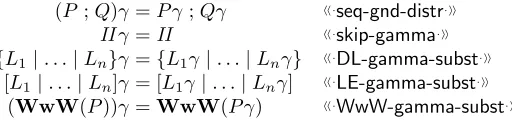
A substitution is also deemed “ground”, if all the the replacement expressions are ground, and the target variables are all static. A desired consequence of this is that ground substitutions γ will distribute through semantic sequential composition, semantic skip, both disjoint label-set notations, andWwW.
(P ;Q)γ=P γ;Qγ hh·seq-gnd-distr·ii
IIγ=II hh·skip-gamma·ii {L1|. . .|Ln}γ={L1γ|. . .|Lnγ} hh·DL-gamma-subst·ii
[L1|. . .|Ln]γ= [L1γ|. . .|Lnγ] hh·LE-gamma-subst·ii (WwW(P))γ=WwW(P γ) hh·WwW-gamma-subst·ii
Groundness is not enough, we also require substitutions to be “sound” in the sense that they cannot transform a situation that satisfies DL or LE into one that does not. A ground substitution ς, of the form [labs(G), I, O/g, in, out] is soundif{labs(G)|I|O}holds. We will see that all substitutions in the semantic definitions are sound, and that this is easy to check by inspection.
8.3 Composing Actions
The semantics of composite actions basically involves using the generator to produce a suitable number of labels, that are then used in zero or more “control-flow” actions of the form A(E | ii | N), where ii is atomic skip that simply asserts s0 = s. The left-over generator is then split as required, and then the components are “connected” into the relevant new labels and generators using sound substitutions. Finally the relevant healthiness conditions are applied. A key principle is to ensure that when any sub-component is “active”, that is, at least one of its labels is present in ls, that none of the labels of the parent, other than those explicitly shared with the sub-component, are themselves inls. This prevents a parent starting a spurious copy of a sub-component while that sub-component is actually running. The semantic definitions are listed in Fig. 2.
g
in
out
l
g11
g
P
outg in
Q
g
in out
P || Q
2
g
1:
g
g
1::2:
g
2::
g
l
g1:l
g2: [image:13.612.163.410.148.285.2]l
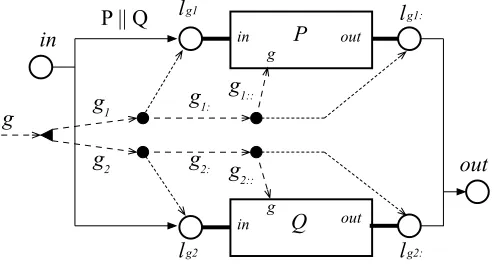
g2Fig. 3.Label and Generator “plumbing” forP kQ.
we generate two labels `g1 and `g1:, and leftover generator g1::. We then use a substitution to replace all references byP tog,inandoutwithg1::,`g1and`g1:, respectively. We do something similar with g2 and Q. We also add a top-level control action that is enabled by label in, and adds both `g1 and `g2 into ls, so enabling both P and Q to start. We then have another control-flow action that waits for both of `g1: and`g2: to appear inls, at which point they will be replaced by the top-leveloutlabel.
The similarity between our labels and the sub-statement notation of Lamport is quite striking. His parallel construct, called cobegin, labels the subcompo-nents with numbers from 1 upwards. So he refers toPwithincobeginPQcoend as (cobegin P Q coend,1). We call it P[g1::, . . . /g, . . .]. When for a con-struct P, we assert that in ∈ ls, he uses a predicate at(P). In the paral-lel case here, an assertion by us that `g1 ∈ ls, corresponds to his assertion
at(cobeginP Qcoend,1).
Given that the invariant LE, which is [in | labs(g) | out], is part of the definition ofW, then we have it satisfied, by definition, by any sub-components. From the perspective of the parent composite, this means that LEς also holds, where ς ranges over all the sound substitutions used in the definition of the parent’s semantics. For example, for program sequential composition, we not only assert [in|g|out], but can also infer [in|g:1|`g] and [`g|g:2|out].
effectively stop. How is this consistent with looping forever? To see the answer to this question, it helps to consider such simple examples, and this brings up the issue ofcalculation.
9
Calculations
Part of the validation of this his semantic theory was by a series of test calcula-tions done to ensure that it was making the right prediccalcula-tions about program be-haviour. This typically involved taking small programs with a few atomic actions and trying to simplify their semantic predicates down to a non-deterministic choice of atomic action sequences. Some of the calculations proved to be very long, repetitive and tedious, motivating the UTP-calculator development [6].
We shall start by sketching out a test calculation forhai, where the objective is to reduce it down to a predicate involving just basic atoms.
hai
=W(A(in|a|out))) hh·sem:atomic·ii
=DL∧LE∧WwW(A(in|a|out)) hh·W-def·ii
=DL∧LE∧W
iA(in|a|out)
i hh·WWW-as-NDC·ii
At this point what remains is to compute A(in|a|out)i fori∈
N. The cases ofi= 0,1 are straightforward. Computingi= 2 is easy:
A(in|a|out) ;A(in|a|out) hh·X-def·ii
=X(in|a|in|out) ;X(in|a|in|out) hh·X-then-X·ii
={in} ∩({in} \ {out}) =∅ ∧X(. . .) set theory =false∧X(. . .)
We see that A(in | a | out)2 = false, and as false is a zero for semantic sequential composition, we can deduce thatA(in|a|out)i=falsefor alli≥2. So our final result is
hai=DL∧LE∧(II∨A(in|a|out)) (9)
Ignoring the healthiness conditions, this boils down to two possible observations we can make ofhai: either we observe stuttering—no change in state or label-sets (II) or we see the complete execution of the underlyng basic actionA(in |a |
out).
Test calculations for simple usage of most of the composites is essentially the same. One slight complication is that the contents ofWwWin theses cases is a disjunction of terms, rather than a single basic action, so we first simplify these out, applying all substitutions, to get a termQof the form (II∨basic actions). We need to computeQifori≥2, and sequential composition distributes through disjunction, so we obtain resulting terms of the same form, by repeated appli-cation of law hh·X-then-X·ii. A large number of these have results with the set
hai;;hbi=II∨A(in|a|`g)∨A(`g|b|out)∨A(in|ab|out)
hai+hbi=II∨A(in|ii|`g1)∨A(in|ii|`g2)∨A(`g1|a|out)
∨A(`g2|b|out)∨A(in|a|out)∨A(in|b|out)
hai k hbi=II∨A(in|ii|`g1, `g2)∨A(`g1:, `g2:|ii|out)∨A(`g1|a|`g1:)
∨A(`g2|b|`g2:)∨A(in|a|`g1:, `g2)∨A(in|b|`g2:, `g1)
∨A(`g1, `g2|ba|`g1:, `g2:)∨A(`g1, `g2|ab|`g1:, `g2:)
∨A(`g2:, `g1|a|out)∨A(`g1:, `g2|b|out)∨A(in|ba|`g1:, `g2:)
∨A(in|ab|`g1:, `g2:)∨A(`g1, `g2|ba|out)∨A(`g1, `g2|ab|out)
∨A(in|ba|out)∨A(in|ab|out)
Fig. 4. Some Test Calculation Results. Hereab(ba) is short fora;b(b;a), and we have omitted theDLandLEinvariants for clarity.
terms vanish. There are other terms produced that do not vanish, but some of these can also be eliminated, because their enabling set violates the Label Ex-clusivity invariant. All remaining terms have the form X(E | a | R | N), and some of these can be immediately re-written toA(E|a|N), ifR=E. In every test calculation we have done it turns out that the others, where R 6=E can also be re-written, because LE says that none of R\E can be present in ls
when anything from E is present, so the removal of those labels is ineffective, as they are never present when that action is enabled. So, the outcome is that we get final results where every basic action can be written in the A-form. All of these aspects of these test calculations are supported by current versions of the tool described in [6]. If there is no use of the iteration construct (P∗), then all calculations terminate because there is always someifor whichQievaluates to false. Any use of the language iteration construct however results in having terms for all values ofi.
Some calculation results are shown in Fig. 4. If we look at the result for
hai;;hbiwe haveII, the stuttering step, andA(in|ab|out) which is the complete exection of both actions without interference (mumbling), andA(in|a|`g) that shows the execution ofa, to an intermediate point wherebhas yet to occur. These three observations are consistent with the idea that our predicates are relations between a starting state and some subsequent or final state. However we also have action A(`g | b | out), which is an observation that begins after action
a has already occured, and just observes the behaviour of b alone. What has happened with this UTP theory of concurrency is that it is now no longer insists that the “before” observation is pinned to be the start of the program. Now we are able to observe program behaviour that can both start and end at what are intermediate points in the lifetime of the program.
activates both a and b. The control flow action A(`g1:, `g2: | ii | out) delays termination until both atomic actions are done.
Finally, we stress that the explicit inclusion of labels in the final results is essential in order to ensure compositionality. In [7] we had the explicitrunform, and this reduced the semantics ofhaitoa, that ofhai+hbitoa∨bandhai k hbi
to ab∨ba. While this looks cleaner, it has lost too much information, and we cannot compose these further to get correct answers. With the explicitly labelled semantics presented here for UTCP, we can, for example, correctly compute (hai;;hbi)k hciby replacing the first ;; term by its expansion from Fig. 4.
10
Conclusions and Future Work
We have presented a compositional, denotational UTP semantics of shared-variable concurrency. It is “explicit” in the sense that it can enumerate all the observations that it is possible make of the program’s own behaviour, in any time-slot. As already explained, our semantics has a lot of similarities to the axiomatic action semantics of Lamport [18].
The usefulness of this theory is that it is in a form that makes it very easy for us to specialise it to cover other approaches to concurrency in the Views paper [10], as that paper shows how thay all link to the simple concurrent language whose semantics we have just supplied. These concurrency approaches include Rely-Guarantee[15,22], Owicki-Gries[20], and Concurrent Separation Logic[4]. This is precisely because it is formulated as a before-after relation, with the twist that before and after observations can occur at any time during program execution, with the obvious proviso that “before” precedes “after”.
While careful inspection and test calculations give us a high level of con-fidence in the validity of our semantics, we still need to demonstrate that the algebraic laws of Concurrent Kleene Algebra[14] can be derived from our se-mantics. We also need to show how the standard operational semantics can be recovered.
We also hope to use this semantics as a baseline for a program to apply UTP to model the various linked approaches discussed in the Views paper[10]. Of particular interest is to explore the connection between UTCP and rely-guarantee[16] approaches. In particular, given our idea of “before” and “after” being able to refer intermediate execution points, and that we can explicitly provide all atomic actions and their mumblings, we see a good opportunity to explore how this can be exploited to analyse how well one or more program steps satisfy their guarantee obligation, given a reliable environment.
References
1. Atkinson, D.C., Weeks, D.C., Noll, J.: Tool support for iterative software process modeling. Information & Software Technology 49(5), 493–514 (2007),http://dx. doi.org/10.1016/j.infsof.2006.07.006
2. Back, R.J.R., Kurki-Suonio, R.: Decentralization of process nets with centralized control. In: Proceedings of the Second Annual ACM SIGACT-SIGOPS Symposium on Principles of Distributed Computing. pp. 131–142. Montreal, Quebec, Canada (17–19 Aug 1983)
3. de Boer, F.S., Kok, J.N., Palamidessi, C., Rutten, J.J.M.M.: The failure of fail-ures in a paradigm for asynchronous communication. In: Baeten, J.C.M., Groote, J.F. (eds.) CONCUR ’91, 2nd International Conference on Concurrency Theory, Amsterdam, The Netherlands, August 26-29, 1991, Proceedings. Lecture Notes in Computer Science, vol. 527, pp. 111–126. Springer (1991), http://dx.doi.org/ 10.1007/3-540-54430-5_84
4. Brookes, S.: A revisionist history of concurrent separation logic. Electr. Notes Theor. Comput. Sci. 276, 5–28 (2011),https://doi.org/10.1016/j.entcs.2011. 09.013
5. Brookes, S.D.: Full abstraction for a shared-variable parallel language. Inf. Comput. 127(2), 145–163 (1996),http://dx.doi.org/10.1006/inco.1996.0056
6. Butterfield, A.: UTPCalc - A Calculator for UTP Predicates. In: Bowen, J.P., Zhu, H. (eds.) Unifying Theories of Programming - 6th International Symposium, UTP 2016, Reykjavik, Iceland, June 4-5, 2016, Revised Selected Papers. Lecture Notes in Computer Science, vol. 10134, pp. 197–216. Springer (2016),https://doi.org/ 10.1007/978-3-319-52228-9_10
7. Butterfield, A., Mjeda, A., Noll, J.: UTP Semantics for Shared-State, Concurrent, Context-Sensitive Process Models. In: Bonsangue, M., Deng, Y. (eds.) TASE 2016 10th International Symposium on Theoretical Aspects of Software Engineering. pp. 93–100. IEEE (Jul 2016)
8. Calcagno, C., O’Hearn, P.W., Yang, H.: Local action and abstract separation logic. pp. 366–378. IEEE Computer Society (2007),http://ieeexplore.ieee.org/xpl/ mostRecentIssue.jsp?punumber=4276538
9. Dijkstra, E.W.: A Discipline of Programming. Series in Automatic Computation, Prentice-Hall, Englewood Cliffs , NJ , USA (1976)
10. Dinsdale-Young, T., Birkedal, L., Gardner, P., Parkinson, M.J., Yang, H.: Views: compositional reasoning for concurrent programs. In: Giacobazzi, R., Cousot, R. (eds.) The 40th Annual ACM SIGPLAN-SIGACT Symposium on Principles of Programming Languages, POPL ’13, Rome, Italy - January 23 - 25, 2013. pp. 287–300. ACM (2013)
11. Hehner, E.C.R.: Predicative programming part i & ii. Commun. ACM 27(2), 134– 151 (Feb 1984)
12. Hoare, C.A.R.: Programs are predicates. In: Proc. of a discussion meeting of the Royal Society of London on Mathematical logic and programming languages. pp. 141–155. Prentice-Hall, Inc., Upper Saddle River, NJ, USA (1985)
13. Hoare, C.A.R., He, J.: Unifying Theories of Programming. Prentice-Hall Interna-tional, Englewood Cliffs, NJ (1998)
15. Jones, C.B.: Developing methods for computer programs including a notion of interference. Ph.D. thesis, University of Oxford, UK (1981)
16. Jones, C.B.: Development methods for computer programs including a notion of interference (PRG-25), 265 (06 1981)
17. Jones, C.B.: Tentative steps toward a development method for interfering pro-grams. ACM Trans. Program. Lang. Syst. 5(4), 596–619 (1983),http://doi.acm. org/10.1145/69575.69577
18. Lamport, L.: An Axiomatic Semantics of Concurrent Programming Languages, pp. 77–122. Springer Berlin Heidelberg, Berlin, Heidelberg (1985),https://doi.org/ 10.1007/978-3-642-82453-1_4
19. Lamport, L.: Turing lecture: The computer science of concurrency: the early years. Commun. ACM 58(6), 71–76 (2015),http://doi.acm.org/10.1145/2771951 20. Owicki, S.S., Gries, D.: An axiomatic proof technique for parallel programs I. Acta
Inf. 6, 319–340 (1976),https://doi.org/10.1007/BF00268134
21. van Staden, S.: Constructing the views framework. In: Naumann, D. (ed.) Unify-ing Theories of ProgrammUnify-ing - 5th International Symposium, UTP 2014, Sin-gapore, May 13, 2014, Revised Selected Papers. Lecture Notes in Computer Science, vol. 8963, pp. 62–83. Springer (2014), http://dx.doi.org/10.1007/ 978-3-319-14806-9_4
22. van Staden, S.: On rely-guarantee reasoning. In: Hinze, R., Voigtl¨ander, J. (eds.) Mathematics of Program Construction: 12th International Conference, MPC 2015, K¨onigswinter, Germany, June 29–July 1, 2015. Proceedings. pp. 30– 49. Springer International Publishing, Cham (2015),https://doi.org/10.1007/ 978-3-319-19797-5_2