The Effectiveness of Internal Audits and Their Impact on
System Improvement
Jelena Ugarak*, Davor Korčok*, Dragan Vuksanović*
*
Department for PhD studies - Engineering systems in management, Singidunum University, Republic of Serbia
Abstract- In order to be successful the companies shall identify the factors that affect its efficiency and effectiveness. Internal audit could be useful tool in that process since its purpose is collecting the evidence and evaluating it objectively to determine the extent to which audit criteria are fulfilled. In other words, internal audit can be used to evaluate the extent to which planned activities are realized and planned results are achieved. The process of conducting the internal audit is described in standard ISO 19011, however its realization depends only upon the company itself and its concepts of internal audit.
Index Terms- internal audit, effectiveness, system improvement
I. INTRODUCTION
nternal audit is one of the common requirements of standardized management systems. According to the ISO 19011:2011 definition an audit is a “systematic, independent and documented process for obtaining audit evidence and evaluating it objectively to determine the extent to which audit criteria are fulfilled”[1]. The systematic in this context means that there is an established methodology of carrying out the audit, and the independence refers to the impartiality of auditors. The absence of conflicts of interest must be ensured during the audit meaning that internal auditors can not audit their own activities. The objective evaluation in the context of internal audit means the evaluation of the actual situation, verification of numerical indicators, data and facts.
As stated by Peter Drucker "efficiency is doing things right; effectiveness is doing the right things"[2]. This means that effectiveness can be defined as the degree of the target achievement. In the context of internal audits, the effectiveness could be defined as the extent to which objectives of audit are achieved. And whether the audit will be effective depends on several factors, such as:
• established procedure or process of conducting the internal audit and audit program management,
• selection and competence of auditors, • availability of necessary resources,
• involvement of management and employees.
It should be noted that these factors also affect the efficiency of audit. For example, the established procedure, the use of internal audit management software solutions as well as the availability of auditors affect the duration of the internal audit.
The costs that are the result of carrying out an audit (involvement of people and resources) also significantly affect its efficiency. If an audit is effective, it does not mean that it is efficient too [3]. However, a well-established management system of audit program will contribute to increasing both, efficiency and effectiveness of the audit.
This paper presents the main results of an empirical study conducted among the companies in Serbia, dealing with the methodology used for conducting the internal audits of management systems and identification of factors that influence the effectiveness of internal audits. The research was conducted in period between April and June 2014 and it is the first study of its kind ever done in Serbia. The aim of the research was to determine the current situation and to address to the multiple benefits that organizations can accomplish by conducting internal audit effectively.
II. THE EMPIRICAL STUDY
[image:1.612.320.570.428.595.2]The concept of empirical research is shown in the Fig. 1.
Figure 1: The concept of research
In order to determine the existing practice it is necessary to identify the factors that influence the selection of auditors, to identify the basis on which the audits are planned, types of documents that are used during the audit, audit findings and the audit significance for the organization, the problems that organizations are facing when they are performing internal audits, etc.
The Fig. 2 and Fig. 3 summarize the basic typology of the companies interviewed. For determining the size of companies interviewed The European Commission Communication definition was used.
Figure 2: The type of companies interviewed
Figure 3: The size of companies interviewed
[image:2.612.108.225.233.345.2]The empirical study was conducted on a random sample of 34 companies that have been certified for at least one standardized management system that requires internal auditing (QMS, EMS, ISMS, FSMS, etc.). The majority of organizations that participated in the survey have implemented two standardized management systems, as shown in the Table 1.
Table I. The number of certified management systems per company Number of
systems certified
Number of companies
One 5 14.71%
Two 12 35.29%
Three 11 32.35%
Four 4 11.76%
Five 2 5.88%
Total 34 100%
Out of 29 organizations that had implemented more than one management system, 26 (89.66%) decided to establish the integrated management system. The majority of organizations (71%) have used the external consultation services for the establishment of the system. The average age of the system is 8.15 years, so certain level of maturity of quality and other management systems in companies is provided.
III. THE RESULTS OF THE STUDY
Planning the internal audit
The Fig. 4 shows that, on scale from 1 (least important) to 5 (most important), the most of the companies conduct the internal
audits in order to identify non-conformities. The monitoring of the achievement of the established KPIs is the least important reason for conducting an audit.
Figure 4: The reason for conducting an internal audit
The majority of companies (45%) plans the internal audit according to the organizational structure (the organizational units), while 36% of companies use the process approach. The procedures and work instructions are the most common audit criteria, while the results of the risk assessment is rarest taken into account when planning the internal audit (Table 2).
Table II. The internal audit criteria
Conducting the internal audit
[image:2.612.87.252.471.574.2]Regarding the frequency of conducting the audits, Kruskal-Wallis test showed no significant difference in the total number of audits of different size organizations (a significance level p=0.17>0.05). A review of the average values of ranks shows that the number of conducted audits is the biggest in large organizations (21.82), while the lowest in medium-sized organizations (13.90). The usual trend is to conduct a full auditing of the system once a year, and this practice is carried out by 45.16% of the companies. But, when it comes to the number of internal audits that should be carried out during the year, the companies have mostly opted for two audits of the system during the year (Table 3).
Table III. The number of audits that should be conducted annually Criteria
Frequency Standards
The internal company regulations
Procedures and
work instructions Legislation Risk assessment KPIs
Always 85.29% 73.53% 91.18% 73.53% 35.29% 41.2%
Sometimes 14.71% 26.47% 8.82% 23.53% 50.00% 50.0% Never 0.00% 0.00% 0.00% 2.94% 14.71% 8.8%
SIZE No. of answers
Mycro 3 2 66.67% 0 0 0 0 1 33.33%
Small 5 2 40.00% 1 20.00% 2 40.00% 0 0
Medium 15 4 26.67% 9 60.00% 1 6.67% 1 6.67%
Large 11 3 27.27% 2 18.18% 6 54.55% 0 0
Total 34 11 32.35% 12 35.29% 9 26.47% 2 5.88%
[image:2.612.328.562.628.709.2]The results also showed that there is a significant difference in the total duration of the internal audit when it comes to the organizations of different size (p = 0.003 <0.05). Large organizations have the highest ranking which means that the internal audits last longer as company’s size increases.
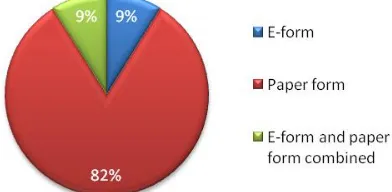
[image:3.612.73.269.231.327.2]Concerning the questions asked during the audit, most of the companies (85%) define the content of the audit questionnaire by themselves. Printed (paper) form of the questionnaire is still most commonly used during the audit (Fig. 5). And when in comes to the organizations with an integrated management system, 73% of them use an integrated questionnaire that complies all the requirements, while other 27% use a special questionnaire for each system.
Figure 5: The form of the questionnaire used during the audit
The use of internal audit management software solutions is not very common to the companies in Serbia. Only 11.7% of the companies use this kind of software, while only 36.7% have heard that this kind of software exists. The majority of companies (70.37%) stated that they would use software solutions for managing the internal audits.
[image:3.612.46.289.517.695.2]The Fig. 6 shows that almost a quarter of organizations that participated in the study (22.58%) faces no problem during the realization of internal audits. The rest of organizations have emphasized the poor motivation of internal auditors as the most common problem followed by an insufficient number of internal auditors and the resistance of employees.
Figure 6: The difficulties during the internal auditing
The auditors
The human resources involved in conducting internal audits are in-house in 71.8% of cases, while 28.13% of companies besides the employees engage external auditors as well. There is a positive correlation between the number of employees and the number of internal auditors per audit. It is expressed by Pearson's linear correlation coefficient (r = 0.886, and 78.49% of the common variance). On average, in one audit 2.24% of employees are engaged as the internal auditors.
When it comes to the ratio of the number of employees and total number of trained auditors, there is also a positive correlation, r = 0.848 and 71.91% of the common variance. On average, 3.35% of the total number of employees is trained to perform internal audits. The companies stated that, on average, 5% of the total number of employees should be trained to perform the audits.
Micro organizations usually form one, small two, medium, three, and large organizations usually form more than three teams of auditors when conducting the internal audit. The 42.86% of the organizations that had established an integrated management system is forming a special audit team for each system implemented.
As shown on the Fig. 7 the most important competencies that influence the selection of internal auditors are their organizational skills, objectiveness and knowledge of the company’s processes and products. The least significant, but still sufficiently important are the authority and power of persuasion and knowledge of risk management techniques.
The training of employees to perform internal audits in most organizations (50%) is carried out only externally (by external lecturers), while 26.47% of organizations is doing it internally and externally.
Also, an important aspect is the involvement of internal auditors in process of system implementation. In most companies (32.35%) more than half of internal auditors participated in the implementation of standardized management systems. In only 5.88% of the companies there was no involvement of internal auditors in the systems implementation.
The results showed that the greatest number of internal auditors belongs to the middle management level (Table 4).
Table IV. The auditors per management level Auditors
Yes No
Employees 32.35% 67.65%
Figure 7: The auditor’s competencies Regarding the auditors evaluation, 58.82% of organizations
never evaluate the auditors, while the remaining 41.18% does it only once a year.
The audit results
[image:4.612.89.526.61.316.2]The study has showed that the most frequent audit findings are noncritical non-conformities (the basis for correction and corrective action) and the opportunities for improvement (Table 5).
Table IV. The audit findings
The identification frequency Noncritical non-conformity 24.75%
Critical non-conformity 12.60% Potential non-conformity 22.95% Opportunity for improvement 24.75%
Commendation 14.95%
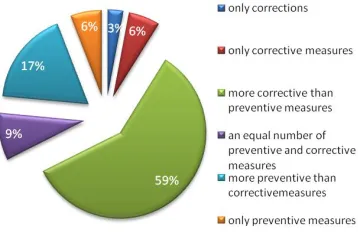
The highest number of the measures taken based on the internal audit findings have the corrective character (Fig. 8).
Figure 8: The measures taken based on the internal audit findings
One-Factor Analysis of Variance was used for analyzing the impact of the company size on the frequency of defining the proposals for improvement measures based on the audit findings. It was found that there was no statistically significant difference at p <0.05, F (3, 30) = 1.38, p = 0.267.
But, One-Factor Analysis of Variance showed a statistically significant difference between large and medium-sized organizations when comparing the percentage of participation of the corrective measures based on internal audit findings in total number of corrective measures taken during the year (F (3, 29)=2.04, p<0.05).
[image:4.612.55.280.459.554.2]The percentage of participation of corrective measures based on internal audit findings in total number of corrective measures taken during the year is shown in table below.
Table VI. The corrective measures The participation of corrective measures based on internal
audit findings in total number of corrective measures taken Answers
less than 50% 27.27%
around 50% 21.21%
more than 50% 51.52%
Next table shows the participation of preventive measures taken based on internal audit findings in total number of preventive measures taken during the year.
Table VII. The preventive measures The participation of preventive measures based on internal
audit findings in total number of preventive measures taken Answers
less than 50% 41.18%
around 50% 26.47%
more than 50% 32.35%
4.03
3.50 3.97
3.44 3.79
4.41
3.97 4.35
4.41
4.12 3.94
4.12 4.38
4.41 4.38
4.06
3.48 3.58
3.85
[image:4.612.82.261.604.720.2]The Table 8 shows that the majority of measures taken based on internal audit findings have corrective character.
Table VIII. The measures taken based on internal audit findings The participation of preventive and improvement
measures in total number of measures taken (based on internal audit findings)
Answers
less than 25% 26.47%
more than 25% and less than 50% 35.29%
exactly 50% 0.00%
more than 50% and less than 75% 23.53%
more than 75% 14.71%
[image:5.612.54.285.112.221.2]More than 50% of the total number of measures initiated based on internal audit findings are implemented on time or according to plan (Table 9).
Table IX. The realization of measures taken based on internal audit findings
None 0.00%
less than 50% 5.88% around 50% 8.82% more than 50% 55.88%
All 29.41%
[image:5.612.315.577.291.448.2]Regarding the follow up of the realization of measures taken, usually it is the responsibility of the Management Representative for Quality Management System or the Management Representative for Integrated Management System (Table 10).
Table X. The follow up of the realization of measures taken
Responsible function Yes No
Auditor 18.75% 81.25%
Lead Auditor 28.13% 71.88%
Process owner 46.88% 53.13%
Management Representative 62.50% 37.50%
Kruskal-Wallis test showed no significant difference in the frequency of follow up audits of different size organizations (p=0.953>0.05). A review of the average values of ranks shows that the frequency of follow up audits is highest in large companies.
The results show that the internal audit is considered most useful as the source for initiating the corrective measures (Fig. 9).
One-Factor Analysis of Variance shows that there is no statistically significant difference between the organizations of different sizes compared to the standpoint that internal audits can be the basis for business improvement (F (3, 30)=2.337, p=0.094). But, when the audits are considered as the source for initiating the corrective measures than there is statistically significant difference between the large and medium-sized organizations (F (3, 30) =4.321, p=0.012). The difference can be expressed by eta squared indicator is 0.3. Subsequent Tukey HSD test showed that the mean value of large organizations
(M=4.9) is significantly different from the mean value of medium-sized organizations (M=4).
Figure 9: The benefits of internal audits
The Figure 10 illustrates that the involvement of top management in the process of conducting internal audits and selection of internal auditors affect the performance of internal audits the most.
Figure 10: The factors affecting the internal audit performance IV. CONCLUSION
According to the results of research it can be concluded that there is underutilized potential of internal audits in terms of system improvement. The internal audits are considered mostly as a tool used for identification of non-conformities and as a main source for corrective and preventive measures in companies. Although the companies are paying attention to internal audits those audits mainly have corrective character and are aimed at identifying the non-conformities against the standard requirements and rules defined in system documentation. Most organizations neglect the results of risk assessments and key performance indicators when planning and conducting internal audits.
When it comes to the process of conducting an audit, it is evident that although there is a great interest in the application of information technology solutions that would facilitate and accelerate the process of audit planning and reporting, the companies in Serbia mostly do not use them. Moreover, most of the companies use a paper form of questionnaire during the audit from which they generate data for reports.
[image:5.612.59.275.416.493.2]Most of organizations report the internal audits results only to audit participants and management (82%). On the other hand, the resistance of employees towards internal audits is designated as one of the three most common problems when conducting the audit. Applying the principle of quality management system related to the involvement of employees [4], in this case in terms of informing employees on the importance and purpose of internal audits, as well as audit results, could decrease the resistance and at the same time increase the interest of employees regarding internal audits.
According to the responses given by organizations, the support of top management has the greatest impact on audit performance. But, members of the top management are rarely engaged as internal auditors. Ideally, at least one member of the top management should be a member of audit team, but the interest of managers can be encouraged by their participation in the final meetings, after internal audits, when the audit findings are being analyzed and improvement measures defined. The increase in interest and support of top management could influence and motivate other internal auditors at the same time.
The effectiveness of internal audits mostly depends on the competence of the people who carry out the audits, so selection and training of the auditors is of crucial importance. Training of auditors should include practical training like defining audit plan and audit questionnaires. Having in mind that organizations mostly carry out only theoretical training, which usually represents the explanation of ISO 19011 and other standard requirements, mainly due to lack of time for training preparation, the practical part of the training should be organized as part of the audit preparation process, through team work. The effectiveness of training should be monitored through the evaluation of auditors carried out after the audit. In accordance with the evaluation results additional trainings should be planned.
Certainly it is advisable that audits are carried out by internal auditors - employees in the different organizational units, as they are fully aware of the requirements, products, processes and the interdependencies of the processes in the organization. But, the internal auditors could easily lose focus due to paying too much attention to details or to the topics that affect their own work assignments, although it might not be the subject and criteria of the audit. In that case, the lead auditor should “direct” the auditors. On the other hand, external auditors are usually focused on the standard requirements, and there is a risk of failing to meet the demands regarding the audit "depth". Therefore, the selection of the auditor type (external or/and internal), lead auditor as well as the employees who will perform the audit (internal auditors) is of great importance for the effectiveness and efficiency of internal audits. The employees who were involved in the implementation of the system should be considered as possible auditors.
The results showed that there is no connection between the organization size and the frequency of audits. The organizations mainly conduct one audit during the year. But, is the one audit on annual basis enough? According to answers there should be two system audits per year. Conducting one audit per year, usually before the management review and certification/surveillance audit, is enough to meet the standard requirement, but certainly the audit would be more effective if observed as continuous process. Planning the internal audit as a continuous process of checking various areas, parts of the system, the processes and/or organizational units, in accordance with the results of the risk assessment, the level of system implementation, etc., certainly would contribute to the continuous improvement of the entire system, especially in the case of large and medium-sized organizations.
The internal audit is a tool that can significantly contribute to the improvement of the entire business system. But to achieve that, the organizations must change the way they perceive internal audit and consider all its potentials. First of all it is necessary to refocus from corrective to preventive action. Moreover, the audits should cover all aspects of the business system whenever it is possible. That is because the quality management system, or any other standardized management system, is a part of the business system, integrated into the existing management system. Accordingly, the audit objectives and criteria should be reviewed. The audit should not be a goal in itself. If the audit should contribute to overall system improvement then that is how it should be planned.
REFERENCES
[1] International Standard, (2011), ISO 19011:2011, Guidelines for auditing management systems, 2011
[2] Drucker, Peter F., (2006), “The Effective Executive: The Definitive Guide to Getting the Right Things Done”, New York: Collins, 2006.
[3] Karapetrović, S., & Willborn, W., (2010), “Effectiveness of Management system audits”, Tahnkčka dijagnostika, vol. 1, no. 2, pp 13-21, 2002 [4] International Standard, (2005), ISO 9000:2005, Quality management
systems - Fundamentals and vocabulary, 2005.
AUTHORS
First Author – Jelena Ugarak, M.Sc. Engineer of organizational
sciences, Quality Specialist at Robert Bosch d.o.o., Belgrade, Republic of Serbia, [email protected]
Second Author – Davor Korčok, M.Sc. Pharm. Specialist,
General Manager at Abela Pharm d.o.o., Belgrade, Republic of Serbia, [email protected]
Third Author – Dragan Vuksanović, M.Sc.Mechanical
Engineer, Leading Mechanical Constructor at Teleoptik-Gyroscopes d.o.o., Belgrade, Republic of Serbia,