Mermelshtine, Roni and Barnes, Jacqueline (2016) Maternal
responsive-didactic caregiving in play interactions with 10-month-olds and cognitive
development at 18 months. Infant and Child Development 25 (3), pp.
296-316. ISSN 1099-0917.
Downloaded from:
Usage Guidelines:
Please refer to usage guidelines at or alternatively
Maternal responsive-didactic caregiving in play interactions with 10-month-olds and cognitive development at 18 months
Infant and Child Development
Accepted for publication 10 January 2016
Roni Mermelshtine BSc MSc
Professor Jacqueline Barnes BSc, MSc PhD
Institute for the Study of Children, Families and Social Issues
Department of Psychological Sciences
ABSTRACT
Maternal responsive-didactic caregiving (RDC) and infant advanced object play were investigated in a sample of 400 mothers and their 10-month-old infants during video-recorded semi-structured play interactions. Three maternal behaviours: contingent response, cognitively stimulating language and autonomy promoting speech were coded and infant object play. Factor analysis confirmed the three maternal behaviours loaded onto one underlying factor, labelled RDC. Based on ecological and transactional theories of development, associations between RDC and infant (advanced object play), maternal (age, education, ethnicity and first language) and family (size and home adversity) factors were investigated. Multiple regressions (1) explored the predictors of maternal RDC; (2) tested the possible role of maternal RDC in predicting infant intellectual development at 18 months. At 10 months infants showing higher levels of play maturity experienced more maternal responsive and didactic feedback. All mother and family characteristics predicted variations in maternal RDC. Predicting 18-months cognitive development, RDC had significant effect over and above maternal education, home adversity and infant play. Mother’s first language remained significant, reflecting that RDC, in this investigation, relies heavily on language input. The findings highlight the importance of both contingent response and didactic contributions in interactions to subsequent cognitive
INTRODUCTION
Mother-infant interactions are commonly thought of as the ‘building blocks’ for child development, their quality and content influencing infant engagement and subsequent learning (Bornstein, 2002). Responsiveness, defined as the appropriate, contingent, prompt and reliable reactions to infants’ signals (Ainsworth, 1979; Bornstein, 1989) is said to be a key aspect of high quality mother-infant interactions (Svanberg, Barlow & Tigbe, 2013). More responsive interactions have been linked with enhanced language development (Tamis-Lemonda, Kuchirko & Song, 2014; Topping, Dekhinet & Zeedyk, 2013), higher cognitive abilities (Fuligni et al., 2013; Landry, Smith & Swank, 2006; Page, Wilhelm, Gamble & Card, 2010) and, in particular, more advanced executive functions (EF; Cuevas, Deater-Deckard, Kim-Spoon, Watson, Morasch & Bell, 2014; Bernier et al., 2012).
Didactic caregiving, the way in which parents stimulate and engage their infant with the surrounding environment, is said to play a unique role in enhancing cognitive development (McFadden & Tamis-LeMonda, 2013). This behaviour is expected to increase in quantity and complexity in relation to child skills (Bornstein, 2002), involves elaborating on and interpreting the external world outside the dyad, focusing the infant’s attention on the surrounding environment, supporting child autonomy and providing opportunities for learning.
Responsiveness
(or referential) language, related to children’s cognitive development (Song, Spier & Tamis-Lemonda, 2014), is also responsive to infant behaviour, likely to increase following infant object exploration and gestures (Tamis-LeMonda et al., 2013). One study found that mothers’ cognitively stimulating language at 10 months predicted child cognitive abilities at the same time point (Page et al., 2010) while responsivity did not, suggesting that responsiveness and didactic behaviour, though related, may represent two separate constructs.
Contradictory to Page and colleagues (2010), others have shown that when combined, responsive-didactic behaviours are relevant for predicting infants’ cognitive abilities. For example, McFadden and Tamis-LeMonda (2013) found that maternal responsive-didactic behaviours predicted infant cognitive ability at 15 and 25 months over and above child, mother and context characteristics. Additionally, instruments such as the Emotional Availability Scales (EAS; Biringen, 2008) aimed at assessing the affective quality of mother-child interactions can be considered to incorporate both responsive and didactic aspects of caregiving (Biringen, Derscheid, Vliegen, Closson & Easterbrooks, 2014). The EAS records maternal sensitivity, non-hostility and non-intrusiveness alongside maternal structuring behaviours that are pedagogical in nature, facilitate learning and promote of child autonomy (Biringen et al., 2014). More emotionally available interactions were found to relate to infants’ ability to better interpret human action as goal-directed at 7-months (Licata, Paulus, Thoermer, Kristen, Woodward & Sodian, 2014), as well as language development in 2 year-olds (Moreno, Klute & Robinson, 2008).
The present study explored the role of maternal responsive-didactic
the first aim was to determine whether maternal responsiveness and didactic behaviours represented a single factor or were three separate aspects of maternal behaviour. Mothers and 10 month olds were observed playing with several toys that would present a challenge for the infants. Thus, these mother-infant interactions were expected to operate in the Zone of Proximal Development (ZPD; Vygotsky, 1978), likely to yield variations in maternal scaffolding of infant play and their problem-solving strategies.
Scaffolding
Scaffolding is observed during learning-based interactions when parent interventions are adjusted according to children’s observed abilities, with the goal of encouraging and enabling the child to work independently (Wood, Bruner & Ross, 1976; Wood & Middleton, 1975). Parental scaffolding in infancy has been associated with children’s subsequent EF (Bernie et al., 2010; Hammond, Müller, Carpendale, Bibok & Liebermann-Finestone, 2012), cognitive and socio-emotional development (Landry et al., 2006; Lowe, Erickson, MacLean, Schrader & Fuller, 2013) and attachment security (Bigelow et al., 2010). It is argued that scaffolding consists of three core dimensions: contingent response, cognitive stimulation and promotion of autonomy (Mulvaney, McCartney, Bub & Marshall, 2006; Neitzel & Stright, 2003). These are interlinked and likely to operate in a feedback loop; the parent responds to the child’s activity in a contingent manner, providing the child with task-related cognitive stimulation that is followed by encouragement of autonomous play/task completion. The present study is designed to look at theoretically linked precursors of scaffolding labelled responsive-didactic caregiving.
information (Tamis-LeMonda, et al., 2014; Topping et al., 2013), representing one specific aspect of responsivity which can also be more general in terms of responding to moods, emotions or distress. Responding contingently is said to be especially important from the end of the first year throughout the second year when language is emerging and as activity and exploration increase (Tamis-LeMonda et al., 2013). At that age, play tends to transform from being indiscriminate and non-functional to being more functional and relational (Bigelow, MacLean & Proctor, 2004).
Cognitive stimulation refers to parental didactic input, or behaviours
associated with effortful teaching designed to facilitate child cognitive development (Fuligni & Brooks-Gunn, 2013). This has two functions: describing, interpreting and directing attention to the world surrounding the infant; and encouraging the baby to become involved with the environment by creating learning opportunities through observation and imitation (Bornstein, 2002). In the current investigation, both the quantity and quality of task-related cognitively stimulating language were recorded, since previous studies have found that more complex language in interactions with infants promoted the development of cognitive abilities (Lowe et al., 2013), language skills and emotion knowledge (Merz, et al., 2015), and vocabulary size (Song et al., 2014).
extent, though it could be argued that contingent response precedes promotion of autonomy, in turn leading to transfer of responsibility from parent to child. As infant play at the end of the first year is largely exploratory and not ‘end-producing’
(Bornstein, 2002), transfer of responsibility from mother to infant may not be clearly observed but language might explicitly encourage independent play.
Infant play and maternal responsive-didactic caregiving
Evidence suggests that both responsive and didactic caregiving influence child cognitive outcomes (McFadden & Tamis-LeMonda, 2013; Page et al., 2010; Song et al., 2014). Yet, the role of the infant in eliciting specific patterns of caregiving is not entirely clear. McFadden and Tamis-LeMonda’s (2013) study is limited in that it did not take account of infant behaviour during the interaction, an aspect addressed in this investigation. According to Bornstein (2002), in infancy the caregiver makes greater contributions, playing a more salient and active role in shaping infants’ early
experiences. In support of this Bigelow and Power (2014), observed that, in the first 3 months, maternal responsiveness was predictive of infant concurrent and future responsiveness in interactions, which in turn facilitated infant’s engagement in social interactions. In a different study, Bigelow and associates (2004) found a transactional relationship between maternal scaffolding and child functional play. When mothers presented a range of behaviours such as modelling, facilitating the child’s efforts and engaging in turn taking, the child was more likely to engage in more advanced play, than when mothers presented fewer scaffolding strategies. However, they also found that maternal skill at following infant activities was associated with more advanced play, meaning that maternal scaffolding also occurred in response to infant play.
subsequent development (Bornstein, Hendricks, Haynes & Painter, 2007; Henning, Striano & Lieven, 2005; Lugo-Gil & Tamis-LeMonda, 2008; Tamis-LeMonda et al., 2013; 2014). For instance, Bornstein and associates (2007) found that children’s language abilities at 20 months predicted maternal sensitivity and child
responsiveness, noting that children with extended vocabulary may be more
communicative, in turn eliciting more sensitive caregiving, and promoting language acquisition. Similarly Lugo-Gil and Tamis-LeMonda (2008) showed significant reciprocal effects between maternal behaviours and child cognitive abilities in the first three years suggesting that, although parenting behaviours may remain largely stable over time, parents tend to adapt their behaviour in accordance with their child’s current abilities.
In keeping with Tamis-LeMonda and associates’ (2013) assertion that mothers’ verbal response is contingent on infant play, and given that scaffolding is used as the guiding framework, it was assumed for the current study that maternal responsive and didactic behaviours would be presented as a reaction to infant play. Thus the second aim was to test whether child advanced object play predicted a higher level of maternal responsive-didactic caregiving, which in turn predicted more advanced infant cognitive abilities 8 months later. Significant associations found between infant advanced object play and RDC, would be consistent with (but not necessarily indicative of) the hypothesised child effect.
Maternal responsive-didactic caregiving and infant cognitive development in context
(Carr & Pike, 2012; Lowe et al., 2013; Neitzel & Stright, 2004). Associations between maternal age and responsive and didactic behaviours were also observed; Keown, Woodward and Field (2001) showed that teenage mothers were likely to be less responsive and less cognitively stimulating to their infants, a relationship said to be the principal explanation for the association between younger maternal age and lower child cognitive development. Fuligni and Brooks-Gunn (2013) found ethnic-group differences in the extent to which mothers were responsive and cognitively stimulating in interactions with their infants. Others did not observe differences in responsive-didactic behaviours as a function of maternal education or ethnic background, though being married and reporting fewer depressive symptoms were associated with more responsive and didactic behaviours (McFadden & Tamis-LeMonda, 2013).
Family context factors are also relevant mother-infant interactions and subsequent development. For example, a larger family size may reduce the quality and quantity of parent-infant interactions, which may impede intellectual
development (Steelman, Powell, Werum & Carter, 2002). Furthermore, adverse living conditions such as housing inadequacy and over-crowding, are said to be linked with maternal caregiving and subsequent child development (for review see Evans, Wells & Moch, 2003). The third study aim was to explore the relationship between maternal and context characteristics in relation to didactic-responsive caregiving.
development. Thus, in the final step of this investigation we tested whether maternal responsive-didactic behaviours predicted child cognitive abilities at 18 months, over and above infant play, maternal characteristics and home adversity. To provide ecological validity (Bornstein et al., 2007) both proximal and distal factors were included: proximal - maternal age, educational level, employment type and ethnic background; distal – adversity of living conditions.
To summarise, the aims of the present study were (1) to explore maternal individual variations in responsive-didactic caregiving; (2) establish whether infant level of play, mother and context characteristics are predictive of maternal
behaviours; and (3) test the role of maternal responsive and didactic caregiving at 10 months in predicting child cognitive development at 18 months. Hypotheses were:
(1) The ratings of the quality and quantity of maternal behaviours can be summarised by three latent factors corresponding to contingent response, cognitively stimulating language and promotion of autonomy. These three factors will represent an underlying latent construct of responsive-didactic caregiving.
(2) Maternal responsive-didactic caregiving will occur in response to infant advanced object play; more advanced play yielding more responsive and didactic input. Significant findings would be statistically consistent with, but may not be indicative of, the hypothesised child effect.
(4) Higher levels of responsive-didactic behaviours at 10 months will predict subsequent infant cognitive abilities above and beyond child, mother and contextual factors.
METHODS
Sample
The study participants were from the Families Children and Child Care study (FCCC) a longitudinal investigation into the possible effects of childcare on child development. Recruitment was in hospitals in North London and Oxfordshire, catering for demographically diverse populations. The sample (N=1,201) closely reflected the socio-demographic distribution of the area populations (Malmberg et al., 2005). Eligibility criteria were: mother over 16 at time of birth and sufficiently fluent for interview in English, and child a singleton with no congenital abnormalities.
Due to limited resources, a random sub-sample of 400 was chosen from the larger sample for the current study. Criteria for selection were that mother and child have complete information at 3, 10 and 18 months. Random selection was undertaken in two waves by the second author, who was not involved in the coding process. A selection variable was created in SPSS 20, which specified that every third person out of the possible 900+ participants with available data was included in the study.
Procedure
During the 10 months home visit, semi-structured play interactions between mother and infant were videotaped. Mothers were asked to ‘play as they normally would’, in 2.5 minute play segments, with a series of toys provided in a standardized sequential manner by the researcher. For the purpose of this study two play segments including toys that are likely to elicit maternal instruction behaviours were chosen: stacking rings and a shape-sorting box, totalling 5 minutes of videotaped interaction. These toys could be potentially challenging for 10-months-old infants in terms of fine motor skills and cognitive development, presenting a situation in which variations in mothers’ propensity to scaffold their child play to achieve ‘success’ could be
observed. These interactions were then coded for maternal responsiveness,
cognitively stimulating language, autonomy promoting language and infant advanced object play.
For reliability purposes, a master’s student was trained as the second coder. The training procedure included introduction to the concepts and behaviours covered in the coding scheme, this was followed by a period of coding maternal behaviours together and discussing any disagreements. Then each coder individually rated maternal behaviours in 10 cases that were not included in the study’s sample. Face to face training was spread over 3 weeks totalling10 working hours, ICCs of collapsed behavioural categories were no lower than .71.
Measures
Demographic characteristics
information about adverse living conditions was collected using the study-specific Environmental Adversity Index (EAI), composed of six adversity indicators: living in rented or insecure accommodation, no kitchen/no bath, 4+ stairs, no garden, no car and crowdedness. The EAI is an averaged composite measure of data collected at 3, 10 and 18 months; higher values reflecting more adversity (Malmberg et al., 2005). Maternal responsive-didactic caregiving
The three proposed factors of maternal responsive-didactic behaviours (RDC), identified to be theoretically linked with scaffolding, were coded using both
frequency counts and general impression codes. Based on their distribution, frequency counts were converted into codes ranging from 0-3 (0=behaviour not observed,
1=limited presentation of behaviour, 2=moderate presentation of behaviour and 3=behaviour presented substantially) to correspond with the general impression codes. The first author and the second coder double-rated 10% (N=40) of cases out of the 400 videotaped interactions. The first author coded a further 304 interactions (76%) and the second coder coded the remaining 56 cases. ICCs for collapsed codes were: contingent response (.86); cognitively stimulating language (.69); and
autonomy promoting language (.92). Contingent response
reciprocate to infant’s cues and address infant’s mood; and generally having an adult-centred focus on the task. Contingent response codes ranged between 0-3 (0=
maternal response non-contingent throughout; 1= maternal contingent response seen less frequently than non-contingent response; 2= maternal responses are mostly contingent; 3= mother consistently responds to infant in a contingent manner. Contingent response codes from both play segments were highly related (r=.67, p<.001) and were made into a composite measure ranging between 1- 6 (mean=4.69; SD=1.29).
Cognitively stimulating language
Following Ware, Brady, O’Brien, Berlin and Brooks-Gunn’s (2000) coding scheme of the three-bag assessment with Early Head Start mothers and their 14 months old infants, mothers’ use of language aimed at enhancing infants’ cognitive and language development was recorded as frequency counts of: descriptions of objects or situations; asking questions; elaborating on the ‘solution’ to the toy; making connections to infant existing knowledge and using complex vocabulary. A new episode was coded after a 3 second gap or at the start of a new sentence. Frequency counts alongside the type of verbalisation were considered before being converted into codes ranging from 0-3 per play segment (0= none; 1= 1- 4 episodes; 2= 5-9 episodes and at least 3 different types of behaviours; 3= 10 ≤ episodes of cognitively stimulating language of at least four different types of behaviours). A mother was considered consistently stimulating if she presented a range of
language-based behaviours under investigation. Cognitively stimulating language coded for both play segments correlated (r=.53, p<.001). The codes were added into a composite measure, ranging between 0-6 (mean=2.65; SD=1.23).
Autonomy promoting language
Based on Bernier (2010) the use of language such as providing hints, designed to encourage the infant to complete the task without maternal intervention was
recorded. Frequency counts (using the same definition of an episode as for cognitively stimulating language) were converted into codes, on the basis of distributions, and ranging from 0-3 per play segment (0= none; 1= 1episode; 2= 2-3 episodes; 3= 4 ≤ episodes of use of autonomy promoting language). Examples include “Now it’s your turn”; “try to fit the shape/ring yourself”; “mummy will show you how to do it and then you have a go”. Autonomy promoting language code for both play segments were associated (r=.43, p<.001). A composite measure was created ranging between 0-6 (mean=2.52; SD= 1.86).
Infant advanced object play
The extent to which the infant was engaged in advanced object play was coded in 15 x 10-second intervals for each play segment. Infant play was recorded
separately from maternal behaviours using a coding system broadly based on Bigelow et al. (2004). Bigelow and colleagues measured ‘functional play’, which was
infant advanced object play was then created by calculating the proportion of second intervals in which infants presented advanced object play out of the thirty 10-seconds segments observed with a possible range between 0-1. Infant advanced object play ranged between 0-.87 (mean= .15; SD= .13)
Outcome - infant cognitive development
At 18 months infant developmental assessments were conducted using the Bayley II Mental Development Index (MDI; BSID-II: Bayley, 1993). The MDI consists of two subscales, the motor scale and the mental scale. It aims to evaluate young children’s sensory-perception problem solving, early language development, knowledge and memory (Lowe, Erickson, Schrader & Duncan, 2012). The third and most recent version of the MDI (MDI III) was not available at the time the study was conducted.
Analytic Strategy
The randomly selected sub-sample was compared to the rest of the FCCC sample, to ascertain whether it was representative. Next a Confirmatory Factor Analysis (CFA) of the observed maternal behaviour was carried out in Mplus 7.3 (Muthén & Muthén, 2012), specifying three first order latent factors: contingent response; cognitively stimulating language; and autonomy promoting language. Although associations were observed between individual behavioural codes, these were treated as separate parameters to adjust for any possible variability as the observed interactions included two different toys (see Malmberg et al., 2007). It was important therefore to confirm that the behaviours were consistent although the apparatus were different. The first order factors were predicted to load onto a second order latent factor of responsive-didactic caregiving (RDC). All parameters
variances were fixed at 0 and 1 respectively. This procedure was carried out so that analyses would yield an optimal value along with other model estimates, reducing differences between predicted and observed variance-covariance matrices (Brown & Moore, 2012). Once factor structure fit was confirmed, the first and second order factor scores were exported into IBM SPSS 20. Bivariate analyses were then carried out between latent factor scores, child, mother and contextual factors and the
outcome, using Pearson correlation for continuous factors and t-test for categorical factors, to determine which covariates to include in the regression models.
In the next step, two multiple regression analyses were conducted, using the enter method, with entry in blocks. The first regression model tested whether infant advanced object play, maternal characteristics and contextual factors predicted maternal responsive didactic caregiving consisting of two steps, the first including infant play and the second comprising of maternal and contextual factors. The second regression model was conducted in three steps testing whether maternal responsive-didactic caregiving at 10 months predicted 18 month infant cognitive abilities, taking into account infant advanced play, maternal characteristics and context. The first and second steps of this model were identical to the first regression model. In the third step maternal responsive-didactic caregiving was added. A significant R² change would support the hypothesis that maternal behaviour is predictive of infant cognitive development above and beyond infant, mother and context characteristics.
RESULTS
Sample characteristics
all (91%) of the mothers resided with the child’s father, and 44.5% were educated to degree level or above. At their most recent employment 41.5% of mothers (N=166) were in a professional or managerial role, 16.8% (N=67) were in intermediate level employment and the remaining 41.8% (N=167) of mothers had history or current employment categorised as working class. Over half of the sample’s mothers were in some form of employment when child was 10-months-old (N=209; 52.8%).
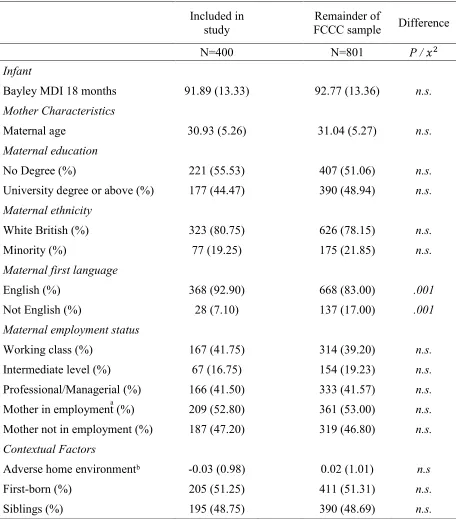
Mothers in the current study did not differ significantly from the rest of the FCCC sample in terms of age, ethnic background, education or employment status, family size, adverse home environment or child cognitive development assessed at 18 months. A significant difference was observed between the samples in the number of mothers who speak English as a first language [𝑥2 (1) = 22.98; p< .001]. This was to
be expected given that the coding scheme relied heavily on language, thus videotaped interactions in which the mother spoke in a different language to English were not included in the sample (see Table 1).
Confirmatory factor analysis (CFA) – Responsive- didactic caregiving
The CFA testing the factor structure of maternal responsive-didactic caregiving yielded an excellent model fit [𝑥2 (6) = 2.774, p= .837, RMSEA= .000,
comparative fit index FI= 1.000, TLI= 1.007] supporting the hypothesis that the three latent factors, contingent response, cognitively stimulating language and autonomy promoting language would load onto a second order factor of maternal responsive-didactic caregiving. RDC explained 27% of the variance in contingent response, 73% of cognitively stimulating language, and 50% of the variance in autonomy promoting language. Contingent response was positively associated with cognitively stimulating language and autonomy promoting language (r=.56, p<.001; r=.50, p<.001)
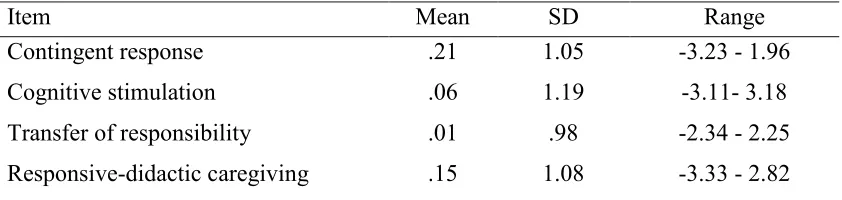
stimulating language and autonomy promoting language. The factor scores were then exported for further analyses in SPSS 20 (see Table 2 for means and standard
deviations of latent factor scores).
Bivariate correlations and mean comparisons
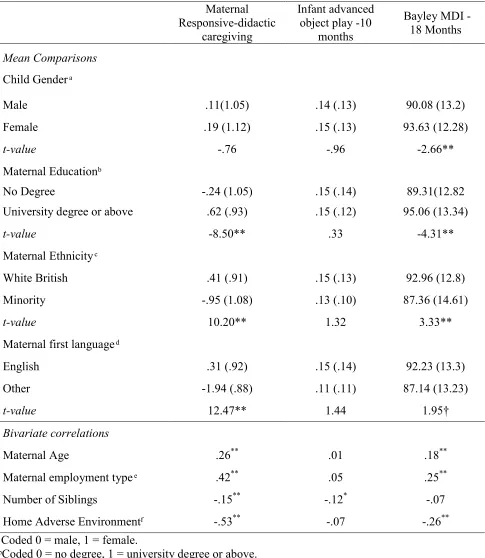
Prior to conducting the multiple regression analyses, bivariate correlations and independent sample t-tests for binary variables were carried out to determine which variables were associated with maternal RDC, infant advanced object play at 10 months and cognitive abilities at 18 months (see Table 3). Maternal RDC at 10
months was significantly associated with infant play at 10 months (r=.32, p<.001) and with child cognitive development at 18 months (r=.44, p<.001). A significant
relationship was found between infant advanced object play at 10 months and cognitive abilities at 18 months (r=.19, p<.001). Significant associations were observed between maternal RDC and all maternal and family characteristics. Child development at 18 months was significantly associated with maternal age, education, employment level, ethnic background and adverse home environment, but not with family size (see Table 3) which was therefore not included in the second multiple regression model. Due to multicollinearity with maternal education, maternal employment was not included in further analyses. Girls were more likely to have higher scores on the MDI than boys, thus child gender was controlled for in the final analysis. The way in which RDC is measured in this study heavily relies on language, therefore, whether mothers spoke English as a first language was also entered as a control variable in both regression models.
Maternal responsive-didactic caregiving (RDC), infant advanced play and cognitive
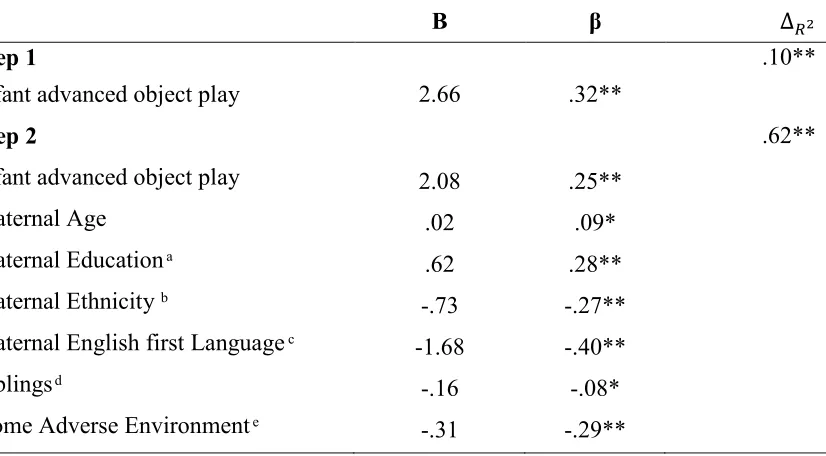
The next steps of the analyses included two multiple regression models. The first regression model tested whether infant advanced object play, mother and home characteristics predicted maternal RDC. Infant play was entered first followed by maternal characteristics and home adversity in the second step. As expected all variables significantly predicted maternal caregiving. Infant advanced play remained a significant predictor after taking maternal characteristic into account. Higher levels of maternal education and mother being older predicted higher levels of RDC, whereas being of a non-white ethnic background, speaking English as a second language, having more siblings and experiencing higher levels of home adverse environment predicted less RDC [F (7, 387) = 139.45, p<.001]. Infant play accounted for 10% of the variance in maternal RDC, whilst mother and home characteristics explained a further 62% of the variance in maternal RDC (see Table 4).
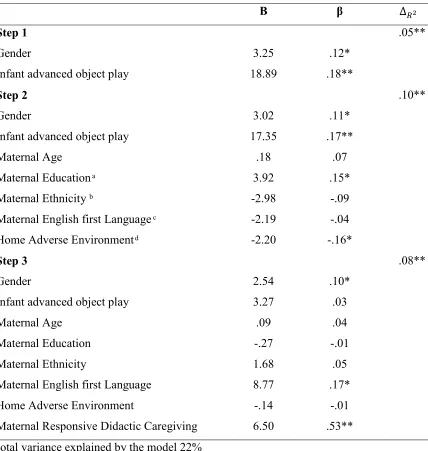
The second model to predict cognitive development at 18 months was carried out in three steps. In the first step infant advanced object play was entered, followed by maternal and home characteristics, with maternal RDC added in the final step. Family size was removed from the second regression model, as it was not associated with 18-month cognitive development. It was hypothesised that maternal RDC would predict child cognitive development over and above infant play, maternal
maternal RDC was taken into account these predictors were no longer significant. A standard deviation change in maternal RDC predicted over one-half a standard deviation increase in infant cognitive ability at 18 months. Child gender remained a significant predictor throughout, being female predicted better cognitive scores at 18 months. Interestingly, once RDC was included in the model, maternal English as a first language became a significant predictor, implying that maternal RDC, as recorded in this sample, heavily relies on language input (see Table 5). It is
noteworthy that a parsimonious model including only significant predictors entered simultaneously explained almost 23% of the variance in infant cognitive ability at 18 months [F (3, 383) = 38.67, p<.001]. All predictors remained significant: RDC
(β=.54, p<.001); English as first language (β=.19, P=.001); gender-girl (β=.10, p=.03). In light of the regression results a final analysis was carried out to test whether the effect of RDC on infant 18-months cognitive ability differ as a function of child gender and/or whether mother spoke English as a primary language. Interaction terms between maternal RDC and child gender, and RDC and maternal English as first language status were introduced to the parsimonious regression. The three remaining significant predictors were mean centred and multiplied to create the interaction items (Howell, 2012). The interaction between maternal RDC and child gender was not significant and no differences were observed in the parameter estimates of the
DISCUSSION
The present study aimed to elucidate the transactional nature of mother-infant interactions and their relationship with subsequent cognitive development. The longitudinal design enabled a test of whether infants’ contributions to interactions elicited specific maternal responsive-didactic behaviours that link with cognitive development. In addition, the possible correlates of maternal caregiving were explored to further understand the mechanisms by which mother characteristics and contexts influence intellectual abilities.
In the initial step it was found that maternal behaviours related to the three chief aspects of scaffolding, namely contingent response, cognitive stimulation and promotion of autonomy were observed in interactions between mothers and their 10-month-olds. The interactions were not ‘end-producing’ or the analysis sequential, thus the observed behaviours cannot be defined as scaffolding in the traditional sense. However, observational data are expected to be indicative of an underlying style of interaction or a general level of particular behaviours (Aspland & Gardner, 2003), and it has been shown that maternal behaviours remain stable over time (Bornstein & Tamis-LeMonda, 1990; Fuligni et al., 2013; Fuligni & Brooks-Gunn, 2013). Therefore, it is likely that such responsive-didactic behaviours may represent the antecedents of future contingent scaffolding.
with McFadden and Tamis-LeMonda (2013). They found in their study of
predominantly low-income USA mothers that a combined measure of responsive and didactic behaviours strongly predicted subsequent cognitive abilities over and above other maternal caregiving behaviours and characteristics. It is of note, however, that maternal language input explained a much larger proportion of the variance in RDC (about 74%), whereas contingent response accounted for a much lower proportion (14%). It is clear that in this investigation RDC is largely driven by individual differences in maternal language input, though it is also important to recognise that maternal language input is associated with mothers’ response to child behaviour. In relation to didactic input, a significant overlap was observed between cognitively stimulating language and autonomy promoting language. However, these constructs were differentiated with the assumption that cognitively stimulating language
represents referential language, whereas autonomy promoting language reflects more regulatory speech (see Tamis-Lemonda et al., 2013).
Infant advanced object play was found to predict maternal responsive and didactic caregiving confirming the expectation that infants who managed to ‘find the solution’ for the challenging toys would elicit more responsive and lexically varied input from their mothers and this in turn will enhance subsequent cognitive
development. Previous studies by Bornstein and colleagues (2007) and Lugo-Gil and Tamis-LeMonda (2008) support these findings that infants who are more advanced in their abilities attract more responsive and didactic feedback from their caregiver. This in turn provides the infant with a richer experience of the world and more
bidirectional relationship between maternal input and infant play (Bigelow et al., 2004). What is more, shared biological factors are likely to be implicated in
reciprocity between mother and infant as well as infant cognitive development and maternal propensity to interact in a particular way (Song et al., 2014), meaning that making assumptions about the direction of influence between mother and infant may be somewhat problematic.
Maternal characteristics and context predicted mothers’ tendency to be more or less responsive and didactic in her behaviour. Older maternal age predicted greater presentation of maternal RDC, as was shown by Keowen, et al. (2001). It was also found that having a higher level of education predicted more responsive-didactic caregiving. This is in keeping with previous findings, suggesting that higher levels of maternal education were associated with greater maternal sensitivity, more verbal input (Page et al., 2010) and more complex scaffolding strategies (Lowe et al., 2013) during mother-infant interactions.
Ethnicity was another factor in this study explaining variance in maternal responsive-didactic caregiving; mothers from white British ethnic background were likely to show more responsive-didactic behaviours. Previous research with ethnically diverse samples in the United States showed mixed findings. No significant
differences were found in didactic/responsive behaviours in mothers from Dominican, African-American and Mexican backgrounds (Tamis-LaMonda et al., 2013).
whether the differences in presentation of RDC as a function of ethnicity were related to mothers’ first language, whether mother spoke English as a first language was included as a covariate. The effect of ethnicity on RDC remained even after taking mother first language into consideration.
The context of the home environment was also predictive of maternal responsive and didactic behaviours. Family size, having more than one child, predicted less RDC, suggesting that as family size increase, mothers’ tend to invest less in interactions with their infants. However, it is of note that although family size was associated with maternal behaviours, a relationship with subsequent infant outcomes was not observed. Nevertheless, this was not the case for adverse living environment. Living in low-quality, over-crowded and insecure housing predicted both maternal RDC and child cognitive abilities. The Environmental Adversity Index used in this investigation to measure household adversity may reflect aspects of socioeconomic disparities and household disorder both associated with less
responsive and didactic caregiving. Socioeconomic status has been found to affect both didactic input (Hart & Risely, 1995; Lowe et al., 2013) and sensitive responding (Prime et al., 2015). A less-ordered, more chaotic home environment has been
associated with both negative and positive parent-child relationship (Coldwell, Pike & Dunn, 2006) and higher levels of intrusive, non-contingent and less didactic style of interaction (Matheny, Wachs, Ludwig & Phillips, 1995).
The findings suggest that maternal RDC is one mechanism by which context and maternal characteristics may influence cognitive development. The final
adverse home environment had the opposite effect. Infant advanced object play at 10 months was the strongest predictor of cognitive abilities 8 months later, but once maternal RDC was taken into consideration it was no longer predictive. A likely process is that infants who were more able at 10 months elicited their mothers’ responsiveness; mothers then responded in a more didactic manner, enhancing infants’ learning and cognitive abilities in turn. This emphasises infants’ impact on their own environment, which can promote or delay development (Song et al., 2014). Furthermore, maternal RDC predicted infant cognitive development above and beyond maternal education and adverse living conditions; this suggests that the associations between these factors and infant cognitive abilities are at least in part accounted for by variations in maternal RDC. This corresponds to recent findings showing that maternal responsive and didactic behaviours mediate the effects of socioeconomic indicators on children’s development of EF (Cuevas et al., 2014; Hackman et al., 2015), and receptive vocabulary (Prime et al., 2015).
Unlike other coding schemes such as Biringen’s (2008) EAS, aimed at evaluating the general affective quality of parent-child interactions, the coding scheme employed in this study largely focused on maternal language input in the context of cognitive development. As the coding was largely dependent on language it is perhaps not surprising that once maternal RDC was taken into consideration in the final model, maternal spoken language became a significant predictor of infant cognitive development at 18 months. The subsequent moderation analysis did not reveal a significant interaction between the two factors.
Strengths and limitations
were observed with the remainder of the FCCC participants on any demographic information increasing the generalisability of the findings. This representativeness is a strength providing evidence from UK mothers corresponding with findings from USA studies. It is also a limitation in that the FCCC sample did not include a large
proportion of ethnic minority families or mothers with no educational qualifications. A second strength is that specific behaviours recorded during a very brief interaction are associated with both context recorded by home visitors and maternal reports and with child outcomes 8 months later. A recent study by Prime et al. (2015) showed that a new, quick to administer instrument measuring maternal cognitive sensitivity at age three, had substantial overlaps with the gold standard measure of sensitivity. In addition to that it was found to predict child receptive vocabulary a year later.
There are a number of limitations to the study. The affective aspect of mother-infant interaction was not taken into account in this investigation, although it is often treated as an integral part of scaffolding interactions (Neitzel & Stright, 2003).
CONCLUSIONS
The findings of this study provide some evidence that that maternal
REFERENCES
Ainsworth, M. S. (1979). Infant–mother attachment. American Psychologist, 34(10),
932. DOI:10.1037/0003-066X.34.10.932
Aspland, H., & Gardner, F. (2003). Observational Measures of Parent‐ Child
Interaction: An Introductory Review. Child and Adolescent Mental Health, 8(3),
136-143. DOI: 10.1111/1475-3588.00061
Bayley, N. (1993). Bayley Scales of Infant Development (2nd ed.). New York: Psychological Corporation.
Belsky, J., Bakermans-Kranenburg, M. J., & Van IJzendoorn, M. H. (2007). For
better and for worse differential susceptibility to environmental influences.
Current Directions in Psychological Science, 16(6), 300-304.
DOI: 10.1111/j.1467-8721.2007.00525.
Belsky, J., Jaffee, S. R., Sligo, J., Woodward, L., & Silva, P. A. (2005).
Intergenerational transmission of warm, sensitive, stimulating parenting: a
prospective study of mothers and fathers of 3-Year-Olds. Child Development,
76(2), 384-396. DOI: 10.1111/j.1467-8624.2005.00852.x
Bernier, A., Carlson, S. M., Deschênes, M., & Matte-Gagné, C. (2012). Social factors
in the development of early executive functioning: a closer look at the caregiving
environment. Developmental Science, 15(1), 12-24. DOI:
10.1111/j.1467-7687.2011.01093.x
Bernier, A., Carlson, S. M., & Whipple, N. (2010). From external regulation to
self-regulation: Early parenting precursors of young children’s executive
functioning. Child Development, 81(1), 326-339. DOI:
Bigelow, A. E., MacLean, K., & Proctor, J. (2004). The role of joint attention in the
development of infants’ play with objects. Developmental Science, 7(5), 518-526.
DOI: 10.1111/j.1467-7687.2004.00375.x
Bigelow, A. E., MacLean, K., Proctor, J., Myatt, T., Gillis, R., & Power, M. (2010).
Maternal sensitivity throughout infancy: Continuity and relation to attachment
security. Infant Behavior and Development, 33(1), 50-60. DOI:10.1016/j.infbeh.2009.10.009
Bigelow, A. E., & Power, M. (2014). Effects of Maternal Responsiveness on Infant
Responsiveness and Behavior in the Still-Face Task. Infancy, 19(6), 558-584.
DOI: 10.1111/infa.12059
Biringen, Z. (2008). Emotional availability (EA) scales manual. Unpublished manual.
Boulder: Colorado State University.
Biringen, Z., Derscheid, D., Vliegen, N., Closson, L., & Easterbrooks, M. A. (2014).
Emotional availability (EA): Theoretical background, empirical research using
the EA Scales, and clinical applications. Developmental Review, 34(2), 114-167.
doi:10.1016/j.dr.2014.01.002
Bornstein, M. H. (Ed.). (1989). Maternal responsiveness: Characteristics and consequences. San Francisco: Jossey-Bass.
Bornstein, M. H. (Ed.). (2002). Parenting infants. In M. H. Bornstein (Ed.), Handbook of parenting: Vol. 1. Children and parenting (2nd ed., pp. 3–43). Mahwah, NJ: Lawrence Erlbaum Associates, Inc.
Bornstein, M. H., Hendricks, C., Haynes, O. M., & Painter, K. M. (2007). Maternal
sensitivity and child responsiveness: Associations with social context, maternal
characteristics, and child characteristics in a multivariate analysis. Infancy, 12(2),
Bornstein, M. H., & Tamis-LeMonda, C. S. (1990). Activities and interactions of
mothers and their firstborn infants in the first six months of life: Covariation,
stability, continuity, correspondence, and prediction. Child Development, 61(4),
1206-1217. DOI: 10.1111/j.1467-8624.1990.tb02854.x
Brown, T. A., & Moore, M. T. (2012). Confirmatory Factor Analysis. In R.H. Hoyle
(Ed.), Handbook of Structural Equation Modeling (pp. 361-379) New York: The
Guildford Press.
Carr, A., & Pike, A. (2012). Maternal scaffolding behavior: Links with parenting style and maternal education. Developmental Psychology, 48(2), 543.
DOI:10.1037/a0025888
Coldwell, J., Pike, A., & Dunn, J. (2006). Household chaos–links with parenting and
child behaviour. Journal of Child Psychology and Psychiatry, 47(11), 1116-1122.
DOI: 10.1111/j.1469-7610.2006.01655.x
Cuevas, K., Deater-Deckard, K., Kim-Spoon, J., Watson, A. J., Morasch, K. C., &
Bell, M. A. (2014). What's mom got to do with it? Contributions of maternal
executive function and caregiving to the development of executive function
across early childhood. Developmental Science, 17(2), 224-238.
DOI: 10.1111/desc.12073
Evans, G. W., Wells, N. M., & Moch, A. (2003). Housing and mental health: A
review of the evidence and a methodological and conceptual critique. Journal of
Social Issues, 59(3), 475-500. DOI: 10.1111/1540-4560.00074
Fuligni, A. S., & Brooks-Gunn, J. (2013). Mother–child interactions in Early Head
Start: Age and ethnic differences in low-income dyads. Parenting, 13(1), 1-26.
Fuligni, A. S., Brady-Smith, C., Tamis-LeMonda, C. S., Bradley, R. H.,
Chazan-Cohen, R., Boyce, L., & Brooks-Gunn, J. (2013). Patterns of supportive
mothering with 1-, 2-, and 3-year-olds by ethnicity in Early Head
Start. Parenting, 13(1), 44-57. DOI:10.1080/15295192.2013.732434
Grolnick, W. S., & Ryan, R. M. (1989). Parent styles associated with children's self-regulation and competence in school. Journal of Educational Psychology,81(2), 143. DOI:10.1037/0022-0663.81.2.143
Hackman, D. A., Gallop, R., Evans, G. W., & Farah, M. J. (2015). Socioeconomic
status and executive function: developmental trajectories and
mediation. Developmental Science. DOI: 10.1111/desc.12246
Hammond, S. I., Müller, U., Carpendale, J. I., Bibok, M. B., & Liebermann-Finestone, D. P. (2012). The effects of parental scaffolding on preschoolers' executive function. Developmental Psychology, 48(1), 271-281.
DOI:10.1037/a0025519
Hart B. & Risely T. R. (1995). Meaningful differences in the everyday experience of young American children. Baltimore MD: Paul H. Brookes Publishing Co. Henning, A., Striano, T., & Lieven, E. V. (2005). Maternal speech to infants at 1 and
3 months of age. Infant Behavior and Development, 28(4), 519-536.
doi:10.1016/j.infbeh.2005.06.001
Howell, D. (2012). Statistical methods for psychology. Belmont, CA: Cengage
Learning.
Keown, L. J., Woodward, L. J., & Field, J. (2001). Language development of
pre-school children born to teenage mothers. Infant and Child Development, 10(3),
Landry, S. H., Smith, K. E., & Swank, P. R. (2006). Responsive parenting: establishing early foundations for social, communication, and independent problem-solving skills. Developmental Psychology, 42(4), 627-642. DOI:10.1037/0012-1649.42.4.627
Licata, M., Paulus, M., Thoermer, C., Kristen, S., Woodward, A. L., & Sodian, B.
(2014). Mother–infant Interaction Quality and Infants' Ability to Encode Actions
as Goal-directed. Social Development, 23(2), 340-356. DOI: 10.1111/sode.12057
Lowe, J. R., Erickson, S. J., MacLean, P., Schrader, R., & Fuller, J. (2013). Association of maternal scaffolding to maternal education and cognition in toddlers born preterm and full term. Acta Paediatrica, 102(1), 72-77. DOI: 10.1111/apa.12037
Lowe, J. R., Erickson, S. J., Schrader, R., & Duncan, A. F. (2012). Comparison of the
Bayley II Mental Developmental Index and the Bayley III Cognitive Scale: are
we measuring the same thing? Acta Paediatrica, 101(2), e55-e58.
DOI: 10.1111/j.1651-2227.2011.02517.x
Lugo-Gil, J., & Tamis-LeMonda, C. S. (2008). Family resources and parenting
quality: Links to children’s cognitive development across the first 3 years. Child
Development, 79(4), 1065-1085. DOI: 10.1111/j.1467-8624.2008.01176.x
Malmberg, L.-E., Davies, B.,Walker, J., Barnes, J., Sylva, K., Stein, A., & Leach, P. (2005). The Families, Children and Child Care (FCCC) study in relation to area characteristics: Recruitment and sample description. Retrieved 05 January 2015 from http://www.familieschildrenchildcare.org/fccc_frames_home.html Malmberg, L. E., Stein, A., West, A., Lewis, S., Barnes, J., Leach, P., & Sylva, K.
(2007). Parent–infant interaction: A growth model approach. Infant Behavior and
Matheny Jr, A. P., Wachs, T. D., Ludwig, J. L., & Phillips, K. (1995). Bringing order out of chaos: Psychometric characteristics of the confusion, hubbub, and order scale. Journal of Applied Developmental Psychology, 16(3), 429-444.
DOI:10.1016/0193-3973(95)90028-4
McFadden, K. E., & Tamis-Lemonda, C. S. (2013). Maternal responsiveness,
intrusiveness, and negativity during play with infants: Contextual associations
and infant cognitive status in a low-income sample. Infant Mental Health
Journal, 34(1), 80-92. DOI: 10.1002/imhj.21376
Merz, E. C., Zucker, T. A., Landry, S. H., Williams, J. M., Assel, M., Taylor, H. B., ...& School Readiness Research Consortium. (2015). Parenting predictors of cognitive skills and emotion knowledge in socioeconomically disadvantaged preschoolers. Journal of Experimental Child Psychology, 132, 14-31.
DOI:10.1016/j.jecp.2014.11.010
Moreno, A. J., Klute, M. M., & Robinson, J. L. (2008). Relational and individual
resources as predictors of empathy in early childhood. Social Development,
17(3), 613-637. DOI: 10.1111/j.1467-9507.2007.00441.x
Mulvaney, M. K., McCartney, K., Bub, K. L., & Marshall, N. L. (2006).
Determinants of dyadic scaffolding and cognitive outcomes in first graders.
Parenting: Science and Practice, 6(4), 297-320. DOI:
10.1207/s15327922par0604_2
Muthén, L.K. and Muthén, B.O. (1998-2012). Mplus User’s Guide. Seventh Edition. Los Angeles, CA: Muthén & Muthén
Neitzel, C., & Stright, A. D. (2004). Parenting behaviours during child problem
solving: The roles of child temperament, mother education and personality, and
the problem-solving context. International Journal of Behavioral
Development, 28, 166–179. DOI: 10.1080/01650250344000370
Page, M., Wilhelm, M. S., Gamble, W. C., & Card, N. A. (2010). A comparison of maternal sensitivity and verbal stimulation as unique predictors of infant social– emotional and cognitive development. Infant Behavior and Development, 33(1), 101-110. DOI:10.1016/j.infbeh.2009.12.001
Pearson, R. M., Heron, J., Melotti, R., Joinson, C., Stein, A., Ramchandani, P. G., & Evans, J. (2011). The association between observed non-verbal maternal
responses at 12 months and later infant development at 18 months and IQ at 4 years: A longitudinal study. Infant Behavior and Development, 34(4), 525-533. DOI:10.1016/j.infbeh.2011.07.003
Prime, H., Browne, D., Akbari, E., Wade, M., Madigan, S., & Jenkins, J. M. (2015).
The development of a measure of maternal cognitive sensitivity appropriate for
use in primary care health settings. Journal of Child Psychology and Psychiatry,
56(4), 488-495. DOI: 10.1111/jcpp.12322
Rose, D., & O’Reilly, K. (1998). Final report of the ESRC review of government
social classifications. Swindon, UK: Economic and Social Research Council.
Song, L., Spier, E. T., & Tamis-Lemonda, C. S. (2014). Reciprocal influences
between maternal language and children's language and cognitive development in low-income families. Journal of Child Language, 41(02), 305-326.DOI:
Steelman, L. C., Powell, B., Werum, R., & Carter, S. (2002). Reconsidering the
effects of sibling configuration: Recent advances and challenges. Annual Review
of Sociology, 28, 243-269. http://www.jstor.org/stable/3069242
Svanberg, P. O., Barlow, J., & Tigbe, W. (2013). The Parent–Infant Interaction
Observation Scale: reliability and validity of a screening tool. Journal of
Reproductive and Infant Psychology, 31(1), 5-14.
DOI:10.1080/02646838.2012.751586
Tamis-LeMonda, C. S., Kuchirko, Y., & Song, L. (2014). Why is infant language
learning facilitated by parental responsiveness? Current Directions in
Psychological Science, 23(2), 121-126. DOI: 10.1177/0963721414522813
Tamis-LeMonda, C. S., Kuchirko, Y., & Tafuro, L. (2013). From action to
interaction: Infant object exploration and mothers' contingent responsiveness.
IEEE Transactions on Autonomous Mental Development, , 5(3), 202-209.
DOI:10.1109/TAMD.2013.2269905
Topping, K., Dekhinet, R., & Zeedyk, S. (2013). Parent–infant interaction and
children’s language development. Educational Psychology, 33(4), 391-426.
DOI:10.1080/01443410.2012.744159
Vygotsky, L. S. (1978). Mind in society: The development of higher psychological
processes. Cambridge, MA: Harvard University Press.
Ware, A. M., Brady, C. L., O’Brien, C., Berlin, L., & Brooks-Gunn J. (2000).
Child-Parent Interaction Rating Scales for the Three-Bag Assessment
14-Month Wave. New York NY: National Center for Children and Families
Teachers College, Columbia University.
Wood, D., Bruner, J. S., & Ross, G. (1976). The role of tutoring in problem
solving. Journal of Child Psychology and Psychiatry, 17(2), 89-100.
DOI: 10.1111/j.1469-7610.1976.tb00381.x
Wood, D., & Middleton, D. (1975). A study of assisted problem-solving. British
Journal of Psychology, 66(2), 181-191. DOI:
10.1111/j.2044-8295.1975.tb01454.x
ACKNOWLEDGEMENTS
Data for this study were drawn from the Families, Children and Childcare Study, funded by the Tedworth Charitable Trust and the Glass-House Trust and led by Dr. Penelope Leach and Professor Jacqueline Barnes in London and by Professor Alan Stein, Professor Kathy Sylva and Dr. Lars-Erik Malmberg in Oxford (see
www.familieschildrenchildcare.org). Study data are freely available to the research community. For information contact Professor Jacqueline Barnes, Department of Psychological Sciences, Birkbeck, University of London.
CONFLICT OF INTEREST
The authors have declared that there is no conflict of interest. FUNDING
Table 1: Characteristics of child, mother and contextual factors of the study sub-sample and the remainder of the FCCC sub-sample (mean and standard deviation in brackets for continuous factors, N and percentage in brackets for categorical factors)
Included in study
Remainder of
FCCC sample Difference
N=400 N=801 P / 𝑥2
Infant
Bayley MDI 18 months 91.89 (13.33) 92.77 (13.36) n.s.
Mother Characteristics
Maternal age 30.93 (5.26) 31.04 (5.27) n.s.
Maternal education
No Degree (%) 221 (55.53) 407 (51.06) n.s.
University degree or above (%) 177 (44.47) 390 (48.94) n.s. Maternal ethnicity
White British (%) 323 (80.75) 626 (78.15) n.s.
Minority (%) 77 (19.25) 175 (21.85) n.s.
Maternal first language
English (%) 368 (92.90) 668 (83.00) .001
Not English (%) 28 (7.10) 137 (17.00) .001
Maternal employment status
Working class (%) 167 (41.75) 314 (39.20) n.s.
Intermediate level (%) 67 (16.75) 154 (19.23) n.s.
Professional/Managerial (%) 166 (41.50) 333 (41.57) n.s. Mother in employmentͣ (%) 209 (52.80) 361 (53.00) n.s. Mother not in employment (%) 187 (47.20) 319 (46.80) n.s. Contextual Factors
Adverse home environmentᵇ -0.03 (0.98) 0.02 (1.01) n.s
First-born (%) 205 (51.25) 411 (51.31) n.s.
Siblings (%) 195 (48.75) 390 (48.69) n.s.
ͣ Mother is employed at 10 months
Table 2: Descriptive statistics (mean and standard deviation) for maternal responsive-didactic caregiving latent factor scores
Item Mean SD Range
Contingent response .21 1.05 -3.23 - 1.96
Cognitive stimulation .06 1.19 -3.11- 3.18
Transfer of responsibility .01 .98 -2.34 - 2.25
Table 3: Significant mean comparisons and bivariate correlation coefficients between observed maternal, infant behaviour and child cognitive outcome with demographic characteristics and contextual factors (for binary variables means are provided with standard deviations in brackets)
ͣ Coded 0 = male, 1 = female.
ᵇCoded 0 = no degree, 1 = university degree or above. ͨ Coded 0 = white British, 1 = minority
ͩ Coded 0 = English first language, 1 = English not first language
ͤCoded 1 = working class, 2 = intermediate, 3 = professional/managerial ᶠStandardised score of the environmental adversity index (EA
†p <.10; * p<.05; **p<.001
Maternal Responsive-didactic
caregiving
Infant advanced object play -10
months
Bayley MDI - 18 Months Mean Comparisons
Child Gender ͣ
Male .11(1.05) .14 (.13) 90.08 (13.2)
Female .19 (1.12) .15 (.13) 93.63 (12.28)
t-value -.76 -.96 -2.66**
Maternal Educationᵇ
No Degree -.24 (1.05) .15 (.14) 89.31(12.82
University degree or above .62 (.93) .15 (.12) 95.06 (13.34)
t-value -8.50** .33 -4.31**
Maternal Ethnicity ͨ
White British .41 (.91) .15 (.13) 92.96 (12.8)
Minority -.95 (1.08) .13 (.10) 87.36 (14.61)
t-value 10.20** 1.32 3.33**
Maternal first language ͩ
English .31 (.92) .15 (.14) 92.23 (13.3)
Other -1.94 (.88) .11 (.11) 87.14 (13.23)
t-value 12.47** 1.44 1.95†
Bivariate correlations
Maternal Age .26** .01 .18**
Maternal employment type ͤ .42** .05 .25**
Number of Siblings -.15** -.12* -.07
Table 4: Multiple regression analysis predicting maternal responsive-didactic caregiving from infant advanced object play, maternal and home characteristics
B β ∆𝑅2
Step 1 .10**
Infant advanced object play 2.66 .32**
Step 2 .62**
Infant advanced object play 2.08 .25**
Maternal Age .02 .09*
Maternal Education ͣ .62 .28**
Maternal Ethnicity ᵇ -.73 -.27**
Maternal English first Language ͨ -1.68 -.40**
Siblings ͩ -.16 -.08*
Home Adverse Environment ͤ -.31 -.29**
Total variance explained by the model 71%
B = Unstandardised coefficient; β = standardised coefficient; ∆𝑅2= R² change ͣ Coded 0 = no degree, 1 = university degree or above.
ᵇ Coded 0 = white British, 1 = minority.
ͨ Coded 0 = English first language, 1 = English not first language ͩ Coded 0 = only child, 1 = has siblings
Table 5: Multiple regression analysis predicting child cognitive abilities at 18 months (Bayley MDI BSID-II) from child, mother and home characteristics and maternal responsive didactic caregiving
Total variance explained by the model 22%
B = Unstandardised coefficient; β = standardised coefficient; ∆𝑅2= R² change ͣ Coded 0 = no degree, 1 = university degree or above.
ᵇ Coded 0 = white British, 1 = minority.
ͨ Coded 0 = English first language, 1 = English not first language ͩ Standardised score of the environmental adversity index (EAI)
*p <.05; **p<.001
B β ∆𝑅2
Step 1 .05**
Gender 3.25 .12*
Infant advanced object play 18.89 .18**
Step 2 .10**
Gender 3.02 .11*
Infant advanced object play 17.35 .17**
Maternal Age .18 .07
Maternal Education ͣ 3.92 .15*
Maternal Ethnicity ᵇ -2.98 -.09
Maternal English first Language ͨ -2.19 -.04
Home Adverse Environment ͩ -2.20 -.16*
Step 3 .08**
Gender 2.54 .10*
Infant advanced object play 3.27 .03
Maternal Age .09 .04
Maternal Education -.27 -.01
Maternal Ethnicity 1.68 .05
Maternal English first Language 8.77 .17*
Home Adverse Environment -.14 -.01