N A N O E X P R E S S
Open Access
Tunable spin-dependent Andreev
reflection in a four-terminal Aharonov-Bohm
interferometer with coherent indirect
coupling and Rashba spin-orbit interaction
Long Bai
1*, Rong Zhang
1and Chen-Long Duan
2Abstract
Using the nonequilibrium Green’s function method, we theoretically study the Andreev reflection(AR) in a
four-terminal Aharonov-Bohm interferometer containing a coupled double quantum dot with the Rashba spin-orbit interaction (RSOI) and the coherent indirect coupling via two ferromagnetic leads. When two ferromagnetic electrodes are in the parallel configuration, the spin-up conductance is equal to the spin-down conductance due to the absence of the RSOI. However, for the antiparallel alignment, the spin-polarized AR occurs resulting from the crossed AR (CAR) and the RSOI. The effects of the coherent indirect coupling, RSOI, and magnetic flux on the Andreev-reflected tunneling magnetoresistance are analyzed at length. The spin-related current is calculated, and a distinct swap effect emerges. Furthermore, the pure spin current can be generated due to the CAR when two ferromagnets become two half metals. It is found that the strong RSOI and the large indirect coupling are in favor of the CAR and the production of the strong spin current. The properties of the spin-related current are tunable in terms of the external parameters. Our results offer new ways to manipulate the spin-dependent transport.
Keywords: Aharonov-Bohm interferometer, Double quantum dot, Andreev reflection, Rashba spin-orbit interaction, Coherent indirect coupling
PACS: 73.63.Kv; 73.23.-b; 72.25.-b
Background
A quantum dot (QD) is an artificially low-dimensional structure that can be filled with electrons (or holes). Two or more QDs can be coupled to form multiple-QD sys-tems (i.e., artificial molecules). Because the degrees of freedom of the QDs are well controllable, it is possi-ble to add or remove the electrons in the QDs, and the QD system can be coupled via tunnel barriers to elec-trodes, in which electrons can be exchanged. Accordingly, the artificial molecule provides an excellent model sys-tem in which the thorough investigation of quantum many-body properties in a confined geometry can be per-formed [1-6]. Among the various multiple-QD systems,
*Correspondence: [email protected]
1College of Science, China University of Mining and Technology, Xuzhou, 221116, China
Full list of author information is available at the end of the article
an Aharonov-Bohm (AB) interferometer containing dou-ble QDs (DQDs) is of particular interest and importance, in which two QDs are embedded in the opposite arms of the AB ring, respectively, and they are coupled to each other via barrier tunneling. As a tunable two-level sys-tem, the parallel DQD system that can become one of the promising candidates for the quantum bit in quantum computation has received more attention [7-20]. How-ever, in an actual DQD system, the coherent indirect coupling between two QDs via a reservoir is very essen-tial. Kubo et al. introduced the parameterαcharacterizing the indirect coupling strength, and Gurvitz also indicated the fundamentality of the sign of the coherent indirect coupling parameter [21,22]. Kubo et al. investigated the pseudospin Kondo effect in a lateral DQD system using the slave-boson mean-field method and found that the
exotic pseudospin Kondo effect occurs when a coherent indirect coupling is presented through the common reser-voirs [23]. Recently, Kubo and co-workers calculated the shot noise and Kondo effect in a DQD structure with the coherent indirect coupling. Their results demonstrate that the coherent indirect coupling can generate a novel anti-ferromagnetic exchange phenomenon [24]. Trocha and Barnas´studied theoretically the spin-dependent transport through a DQD coupled to ferromagnetic leads. They observed that the Fano antiresonance of the linear con-ductance relies on the sign of the indirect coupling in the nondiagonal coupling elements [8]. Furthermore, the transport properties of a DQD system has been con-sidered in the orbital Kondo regime. That the Kondo temperature and Kondo resonances are susceptible to the coherent indirect coupling parameter is also revealed [25]. In addition, if a QD is formed in a semiconductor two-dimensional electron gas structure without the inversion symmetry in the growth direction, the Rashba spin-orbit interaction (RSOI) will emerge, and the RSOI can induce the spin-related phase factor in the tunneling matrix ele-ments and the spin-flip effect. The RSOI results from a relativistic effect at the low speed limit, and it can cou-ple the electron spin to its orbital motion, thus providing a possible way to control the spin degree of freedom by means of an external electric field. As a consequence, the coherent indirect coupling and the RSOI make the quan-tum transport through the QD systems rich and varied [26-30].
On the other side, the subgap transport through het-erostructures with nano-objects (such as QDs, molecules, nanowires, etc.) coupled to one conductor and another superconducting lead has attracted a great deal of atten-tion over the past years due to the fundamental physics and its potential applications [31-35]. Andreev reflection (AR) usually occurs in the hybrid systems, in which two electrons with opposite spins enter the superconductor from the normal metal region, leading to the formation of a Cooper pair in the superconducting region [36-38]. In comparison with the standard mechanism of nor-mal AR, the crossed AR (CAR) is a nonlocal dynamics process which occurs at the contact between a super-conductor and two normal leads, where two subgap electrons from different metals enter into the supercon-ductor and generate a Cooper pair there [39-42]. AR (or CAR) in nanoscopic heterostructures gives rise to a rich subgap structure in the current-voltage character-istics. Accordingly, understanding the AR and CAR has attracted theoretical and experimental attention mainly because the AR (or CAR) may create the entangled elec-trons in a solid-state device, and CAR can be readily probed by spin selection using ferromagnetic electrodes. This approach is almost unrealized for entangler devices, since projecting the spin will cause the destruction of
entanglement [43]. Based on the CAR, the controlled Cooper pair splitting has been realized in terms of a two-quantum dot Y-junction [44], which opens a possi-ble route towards a test of the Einstein-Podolsky-Rosen (EPR) paradox and Bell inequalities in solid-state sys-tems. Herrmann et al. used carbon nanotube DQD as Cooper pair beam splitters and realized the quan-tum optic-like experiments with spin-entangled electrons [45]. These results show that the CAR has an impor-tant application in testing a fundamental property of quantum mechanics.
To our knowledge, the AR in the DQD with a maxi-mum coupling |α| = 1 has been studied widely. How-ever, the quantum transport through a four-terminal AB interferometer including a DQD in the presence of the AR, the coherent indirect coupling, and RSOI is less explored. Motivated by recent theoretical and experimen-tal advances in the DQD systems [7-10,13,15,16,19,21-25,44,45], one may expect that the interplay of the coher-ent indirect coupling and the RSOI in the presence of the AR will add new physics to hybrid quantum sys-tems, which may have practical applications for future spintronics. Consequently, we investigate the AR in the above-mentioned system in this paper. It is found that the RSOI and a nonzero coherent indirect coupling cause the spin-polarized AR when the polarizations of two fer-romagnetic leads are parallel, but for antiparallel (AP) arrangement of the polarizations of two ferromagnetic leads, the CAR can contribute the spin-polarized AR con-ductance. We note that the convex shape of the Andreev-reflected tunneling magnetoresistance (ARTMR) versus the magnetic flux relies on the sign of the coherent indi-rect coupling parameter, and there are extreme values in the plot of the ARTMR versus the coherent indi-rect coupling parameter. Even the negative ARTMR also occurs. This is a spin valve effect in the AR process. It is interesting to note that the sign of the coherent indirect coupling parameter leads to the swap effect in the spin-polarized current plot, and the pure spin cur-rent can be produced when two ferromagnetic leads are fully polarized. The spin-dependent AR current can be controlled by means of the gate voltage, RSOI, mag-netic flux, and so on. These results provide the ways to manipulate the spin-dependent transport by means of the system parameters.
Methods
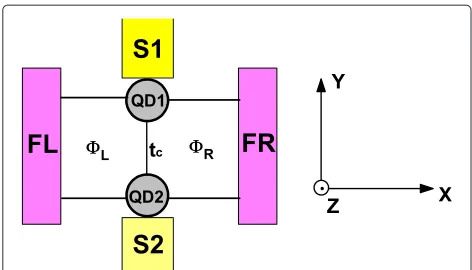
We consider a hybrid four-terminal AB interferome-ter including a parallel DQD coupled to two ferro-magnetic reservoirs and two superconductors as shown in Figure 1. The system is described by the following Hamiltonian:
Figure 1Schematic diagram of a four-terminal AB
interferometer (color on line).The AB interferometer contains a coupled DQD with magnetic flux applied perpendicular to rings.
whereHF is the Hamiltonian of the left and right ferro-magnetic electrodes
HF=
ν=L,R
kσ
εν,kσc†ν,kσcν,kσ. (2)
Here,c†ν,kσ(cν,kσ)is the creation (annihilation) operator in the leadνwith energyεν,kσ .HSrepresents two super-conducting reservoirs with chemical potentialμs=0 and the energy gap,
HS=
γ=1,2
kσ
εγ,kσc†γ,kσcγ,kσ+
k
(c†γ,k↑c†γ,−k↓+h.c.). (3)
HDQDin Equation 1 denotes the DQD Hamiltonian
HDQD=
iσ
εid†iσdiσ +tc
σ
(d1σ† d2σ+h.c.), (4)
in whichd†iσ(diσ,i=1, 2)represents the creation (annihi-lation) operator of the electron with energyεiin the doti; tcis the coupling strength taken as a real parameter. The last term,HT, in Equation 1 corresponds to the tunneling Hamiltonian between the DQD and four leads,
HT=
kiνσ
(Tν,(i)kc†ν,kσdiσ+h.c.)+
kiγ σ
(Tγ,(i)kc†γ,kσdiσ+h.c.),
(5)
where the tunneling matrix elements between the DQD and two ferromagnetic leads areTL,(1)k = |TL1|eiφ/4,TL,(2)k =
|TL2|e−iφ/4, TR,(1)k = |TR1|e−iφ/4e−iϕR1/4, and TR,(2)k =
|TR2|eiφ/4eiϕR2/4. The phase shift due to the total mag-netic flux threading into the AB ring is assumed to be
φ = 2π(L+R)/φ0with the flux quantumφ0 = h/e. The phase factorϕRicomes from the RSOI in doti, which is tunable in the experiments [46,47]. Tγ,(i)k = TS1(TS2) as the tunneling coupling between the DQD and two
superconductors is also assumed to be independent ofk andσ.
Using the nonequilibrium Green’s function technique, the spin-dependent current through the left ferromag-netic reservoir can be expressed as [48,49]
ILσ = ie
dε
2πTr(σˆzL{G <(ε)+F
L[Gr(ε)−Ga(ε)]}),
(6)
where Tr is the trace in the spin space;σˆzis a 4×4 matrix with Pauli matrixσzas its diagonal components;Gr,a,<(ε)
are retarded, advanced, and lesser Green’s functions in the generalized 4×4 Nambu notation.
Gr(t,t)= −iθ (t−t){(t),†(t)}, (7)
G<(t,t)=i†(t)(t), (8)
with the vector†=(d†1↑,d1↓,d†2↑,d2↓).
After some algebraic manipulations, the spin-depen-dent current can be derived from Equation 6:
IL↑= e
h
dε[T↑AR(ε)(fL−fL)+T↑CAR(ε)(fL−fR)
+T↑LR(ε)(fL−fR)+T↑QS(ε)(fL−fS)] ,
(9)
IL↓= e h
dε[T↓AR(ε)(fL−fL)+T↓CAR(ε)(fR−fL)
+T↓LR(ε)(fR−fL)+T↓QS(ε)(fS−fL)] , (10)
in whichTσARandTσCAR are the spin-dependent AR and CAR coefficients, respectively.TσLRrepresents the single-particle tunneling through FL-DQD-FR or FR-DQD-FL. TσQS corresponds to the probability of the quasiparticle tunneling among two superconductors and the left ferro-magnetic lead.fL(fL),fR(fR), andfSare Fermi-Dirac dis-tribution functions. The derivation of the spin-dependent current is minutely given in the Appendix.
Since we mainly focus on the AR process at zero temper-ature limit and set|eVL| = |eVR|< ,TσQSwill vanish. In the case ofeVL=eVR, the current from the quasiparticle tunneling through FL-DQD-FR or FR-DQD-FL becomes zero; as a consequence, the AR dominates the transport through the four-terminal AB interferometer.
Results and discussions
as the energy unit. Throughout the paper, the symmet-ric couplings with 1ν = ν2 = s = = 0.2and
|PL| = |PR|are considered as a typical case.
Conductance
Because we mostly investigate the AR within the super-conductor gap, in the limit of zero biasVL=VR→0, the spin-related AR and CAR conductances have the forms
GARσ = 2e 2
h T
AR
σ (εF) (11)
and
GCARσ = 2e 2
h T
CAR
σ (εF). (12)
It is well known that a DQD system with the maxi-mum coupling |α| = 1 has already been investigated. Indeed, such case is very special, and most experimental conditions correspond to |α| < 1; as a result,α charac-terizing the coherent indirect coupling between two QDs via two ferromagnetic electrodes is introduced (see the Appendix).|α|< 1 comes from the various factors, such as imperfections in the ferromagnetic reservoirs produc-ing the destructive quantum interference, the geometrical structure of the system, and so forth.
Let us begin with the case ofφ = 0 andϕR = π/2; for the different coherent indirect couplingα, Figure 2 shows the total AR conductance (GPσ = GAR(P)σ +GCAR(P)σ and GAPσ =GAR(AP)σ +GCAR(AP)σ ) as a function of Fermi energy εFfor parallel (P) and antiparallel (AP) configurations. In order to gain the clear physics, the Hamiltonian HDQD is diagonalized, and two energy eigenvalues are given as E± = 12[(ε1+ε2)±
(ε1−ε2)2+4tc2]; thus, when the Fermi level coincides with the E+ andE−, the resonant AR occurs and two peaks of AR conductances are located around the levelE± as illustrated in Figure 2a, b, c. For
α=0, it is clearly seen thatGP↑is always equal toGP↓in the P arrangement (PL = PR = 0.4), and the magnitudes of two peaks are equal. However, for the case of the AP con-figuration (PL = −PR = 0.4),GAP↑ =GAP↓ appears when α=0. Because the ferromagnetic leads have majority and minority electrons, the AR and the CAR are governed by the minority electrons for P configuration; thus, the AR and the CAR do not contribute the spin-polarized trans-port. For AP alignment, although the AR cannot produce the spin-polarized current, GAP
↑ = GAP↓ emerges due to
the CAR process, in which the CAR is governed by the majority electrons. This leads to the appearance of the spin-polarized conductance. Since two dots are indirectly coupled via two ferromagnetic leads, which is reflected in the nondiagonal coupled matrix elements (see Equations 15 and 16), α = 0 implies that the off-diagonal matrix
a
b
[image:4.595.306.540.87.405.2]c
Figure 2The AR conductance versus Fermi energy for P and AP configurations.(a)α=0, (b)α=0.5, and (c)α=1.0. Other parameters areε1=ε2=0,tc=0.5,φ=0, andϕR=π/2.
elements vanish due to complete destructive quantum interference; thus, two dots are totally decoupled through two ferromagnetic leads. The AR (or the CAR ) can hap-pen only through QD1 and QD2, respectively. This leads to the conductanceGP↑ = GP↓for the P arrangement and the equal height of two peaks (GAP
↑ orGAP↓ ) for the AP
configuration.
coherent indirect coupling and the RSOI play an impor-tant role in determining the feature of the AR conductance spectra.
To elucidate better the properties of the AR under P and AP configurations, in analogy with the conventional tun-neling magnetoresistance (TMR) effect of ferromagnetic tunnel junctions, the ARTMR is introduced and defined as
ARTMR= [(G AP
↑ +GAP↓ )−(GP↑+GP↓)]
(GAP↑ +GAP↓ ) . (13)
In Figure 3, we present theφdependence of ARTMR for differentα. The oscillation period of the ARTMR versus magnetic fluxφis 2π, and the sign of the ARTMR does not change. It is interesting to note that the convex shape of the ARTMR atφ =2nπ(nis an integer) relies on the sign of the coherent indirect coupling parameterα. In compar-ison to the case of|α| = 0.5, the magnitudes of ARTMR are considerably increased for|α| =1.0. This is because the reduction of the destructive interference results in the enhancement of ARTMR.
[image:5.595.307.540.87.266.2]As we know, the RSOI can induce the spin precession and may even cause the inter-dot spin-flip effect. Accord-ing to [26,27], the spin-dependent phase factor ϕR due to the RSOI can be expressed as ϕR = ϕR1 − ϕR2 = βm∗(L1−L2)/2, whereβis the RSOI strength,m∗is the electron effective mass, andLiis the length of doti.ϕRis tunable in experiments. It can reachπ/2 easily or can be larger experimentally [27]. In order to explore further the influence of the coherent indirect coupling and the RSOI on the ARTMR, the ARTMR as a function of the parame-terαfor differentϕRis shown in Figure 4. We can see from Figure 4 that ARTMR versusαexhibits the nonmonotonic features, and there exists the crossing point at α = 0.
[image:5.595.58.291.507.701.2]Figure 3ARTMR versus the magnetic fluxφwith differentα. Other parameters areε1=ε2=0,tc=0.5, andϕR=π/2.
Figure 4ARTMR versus the coherent indirect couplingαwith differentϕR.Other parameters areε1=ε2=0,tc=0.5, and
φ=0.
Sinceα=0 means that the coupling off-diagonal terms in Equation 16 are totally suppressed, as a consequence, the AMTMR is independent of the RSOI (see the Appendix). WhenϕRis relatively small, this corresponds to the weak RSOI strength; thus, the variation of the ARTMR withαis not smart (solid line and dashed line). However, the evo-lution of the ARTMR is very remarkable asϕR increases (dotted line and dash-dotted line), while the ARTMR first increases and decreases with the increases ofα, even the negative ARTMR also emerges, which corresponds to a spin valve effect in the AR process. This reflects that the strong RSOI gives rise to the significant variation of the ARTMR. We also observe that the maximum and mini-mum values appear in the curves of the ARTMR. These demonstrate that the optimal ARTMR can be tuned by means of the external parameters.
Spin-dependent current
a
b
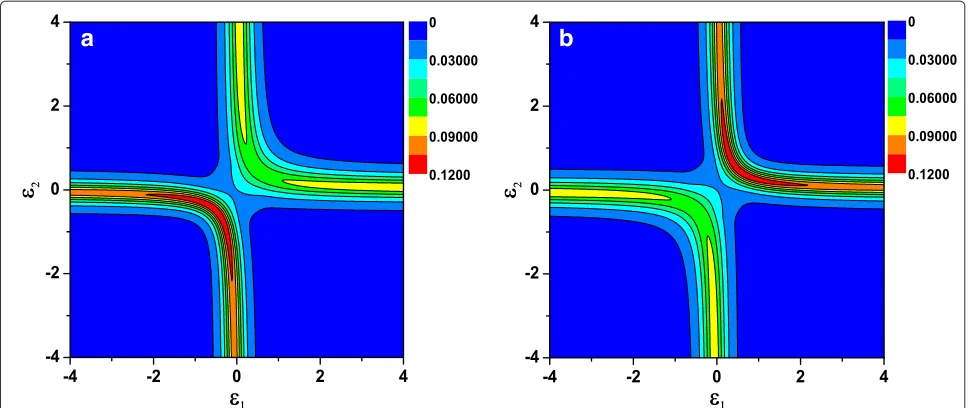
Figure 5Images of spin-polarized AR current current as a function of QD levelsε1andε2 (Color on line).(a)α= −0.5 and (b)α=0.5. Other parameters areφ=0,ϕR=0,tc=0.5, andPL=PR=0.4.
because one QD is in the on-resonance state and the other is in the off-resonance state. When bothε1andε2are close to the Fermi level by tuning the gate voltage, the maxi-malIs appears since DQD is in the on-resonance states. We also observe that, for α = 0.5 and α = −0.5, the spin-polarized current shows the opposite feature, which is a swap effect originating from the different sign of the parameterα. This indicates that the sign of the coherent indirect coupling parameter has a remarkable impact on the spin-polarized current.
As we know, when ferromagnets are fully polarized, two ferromagnets become half metals where all elec-trons have the same spin. AR is usually suppressed at the ferromagnet/superconductor interface. However, AR
still can occur, and the pure spin current can be gen-erated in the present system. For PL = −PR = 1.0 or PL = −PR = −1.0, i.e., two ferromagnetic leads become
two half metals; the normal AR vanishes due toTσAR(see Equations 21 and 25). However, CAR dominates the trans-port through the four-terminal AB interferometer for AP alignment. As a consequence, we can obtain the pure spin current via CAR and two half-metal reservoirs. Thus, this device may be used as a pure spin-current injector even in the absence of the RSOI. In Figure 6, we also depict AB oscillations of the spin current for different
α. For the case of α = 0.5, the magnitudes of the res-onant peaks and valleys are enhanced with the increase of the RSOI strength, and positions of peaks and valleys
a
b
Figure 6The spin current versus the magnetic fluxφfor differentϕR.(a)α=0.5 and (b)α=1.0. Other parameters areε1=ε2=0,tc=0.5,
[image:6.595.58.541.536.704.2]are also shifted to the left, as illustrated in Figure 6a, b. Since the RSOI gives rise to an extra spin-related phase factorϕR (see Equation 16), the curves of the spin cur-rent versus magnetic fluxφ move towards the left with the emergence of the RSOI phase, and the shifted mag-nitude of peaks (or valleys) is equal to ϕR as shown in Figure 6a, b. Physically, the increase ofϕR corresponds to the strong RSOI, which also favors the CAR process and the generation of the large spin current. When the DQD is fully coupled via two ferromagnetic reservoirs (α = 1.0), in comparison with the case ofα = 0.5, it is noted from Figure 6b that not only the positions of peaks and valleys are altered, but also the amplitudes of those are remarkably enhanced. This originates from the fact that the reduction of the destructive interference enhances the spin current for the case ofα = 1.0. These results indi-cate that the variation of the spin current is sensitive to the parameter α and the strength of the RSOI, and the interplay between them determines the nature of the spin current.
Conclusions
In this paper, we have analyzed the AR of a four-terminal AB interferometer containing a coupled DQD with with the RSOI and the coherent indirect coupling via two ferromagnetic leads. The formulas of the transmission coefficients are derived based on the framework of the nonequilibrium Green’s function technique. For P con-figuration, the spin-polarized AR can occur, stemming from the RSOI and a nonzero coherent indirect coupling. On the contrary, for AP configuration, the spin-polarized AR always happens because of the CAR mechanism. Under the introduction of the ARTMR, we find that the sign of the ARTMR versus the magnetic flux keeps invariable for different parameterα, but the convex shape of the ARTMR depends distinctly on the sign of the
parameter α. With the increase of the RSOI strength, the ARTMR versus the parameter α exhibits the more significant nonmonotonic features, and there exist the extreme values in the ARTMR plot, even the negative ARTMR also emerges. Since the energy levels of the DQD can be manipulated via the gate voltage, we can obtain the optimal spin-polarized current. A pure spin current can be generated via the CAR and two half-metal leads. Moreover, the strong RSOI and the reduction of the destructive interference (α=1) favor the enhancement of the spin current. Thus, this device may become an effec-tive spin-current generator, and the pure spin current is tuned in terms of the magnetic flux, the RSOI strength, and so forth. These results offer the ways to manipu-late the spin-dependent transport via the four-terminal AB setup.
Appendix
In this appendix, we present the derivation of the current formulas in detail.
Letgr(ε)andGr(ε)denote the retarded Green’s func-tion of the DQD without and with the coupling to the external reservoirs. In the Nambu space, gr(ε) can be given as
[gr(ε)]−1=
⎛ ⎜ ⎜ ⎝
ε−ε1 0 −tc 0
0 ε+ε1 0 tc
−tc 0 ε−ε2 0
0 tc 0 ε+ε2
⎞ ⎟ ⎟
⎠. (14)
Based on the following Dyson equation, the retarded Green’s function of the system can be written as [Gr(ε)]−1=[gr(ε)−1 − r], in which r = r
L + Rr +S1r +S2r . The lesser Green’s functionG<(ε) = Gr(ε)<Ga(ε), whereGa(ε)=[Gr(ε)]†and< =<L + R<+<S1+S2<. In the wide-band limit approximation, the retarded self-energy can be derived from the definition
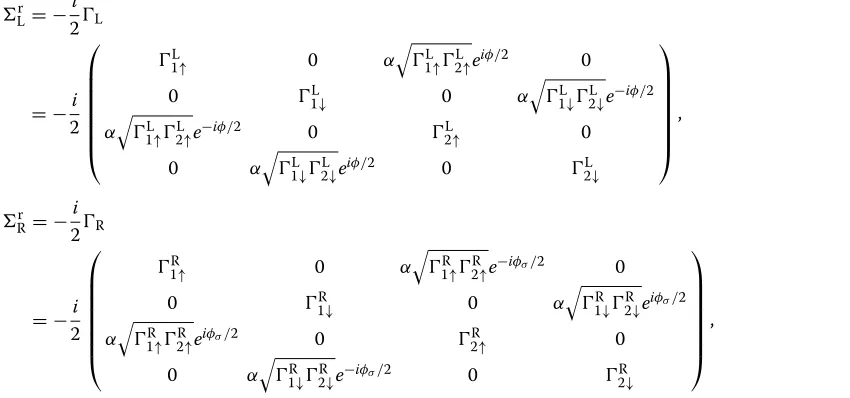
Lr = −i
2L
= −i
2
⎛ ⎜ ⎜ ⎜ ⎜ ⎜ ⎜ ⎝
L1↑ 0 α
L1↑2L↑eiφ/2 0
0 1L↓ 0 α
1L↓L2↓e−iφ/2 α
1L↑2L↑e−iφ/2 0 L
2↑ 0
0 α
1L↓2L↓eiφ/2 0 2L↓
⎞ ⎟ ⎟ ⎟ ⎟ ⎟ ⎟ ⎠
,
(15)
Rr = −i
2R
= −i
2
⎛ ⎜ ⎜ ⎜ ⎜ ⎜ ⎜ ⎝
R1↑ 0 α
1R↑R2↑e−iφσ/2 0
0 1R↓ 0 α
1R↓R2↓eiφσ/2
α
1R↑R2↑eiφσ/2 0 R
2↑ 0
0 α
1R↓R2↓e−iφσ/2 0 R
2↓
⎞ ⎟ ⎟ ⎟ ⎟ ⎟ ⎟ ⎠
,
S1r = −i
2S1= − i
21ρ1(ε)
⎛ ⎜ ⎜ ⎝
1 −ε 0 0
−
ε 1 0 0 0 0 0 0 0 0 0 0
⎞ ⎟ ⎟ ⎠,
(17)
S2r = −i
2S2= − i
22ρ2(ε)
⎛ ⎜ ⎜ ⎝
0 0 0 0 0 0 0 0 0 0 1 −ε 0 0−ε 1
⎞ ⎟ ⎟ ⎠,
(18)
where ijνσ = 2πkσTν,(i)k∗Tν,(j)kρνσ with ρνσ being the density of states of the spin σ band in the lead ν. We calculate the tunneling matrix element by means of the Bardeen’s formula, i.e., Tν,(ik) = 2
S[ψν,k(r)∇ψ (i)∗ d (r) − ψd(i)∗(r)∇ψν,k(r)]dS/2me, wheremeis the effective mass, S is the region of the integration,ψν,k(r)is the wave func-tion of evanescent mode of the leadν, andψd(i)is the wave function of an electron localized in the QDi. Considering the propagation of electrons in the reservoirν, this prop-agation process (the wave number dependence of Tν,(i)k) induces the coherent indirect coupling via the reservoirν
between two QDs, which is characterized with the param-eterαν. We assume that (Xi,Yi, 0) is the center position of
theith QD,X1 = X2 = XD andL = |Y1−Y2|. thus,αν is given byαν = α ∼ (2XD)3/[L2+(2XD)2]
3
2 based on [21]. We find|α| ≤ 1 and decreases withL, and|α| = 1 corresponds toL = 0. We defineα ≡ ν12σ/ν11σ22σν , in whichν11σ = 1σν ,ν22σ = 2σν . With the definition of the spin polarizationPν = (iν↑−νi↓)/(νi↑+iν↓)in the leadν, the tunneling matrix element can be written as
νi↑=iν(1+Pν)andνi↓=νi(1−Pν)withνi =(iν↑+ νi↓)/2.γ=1,2 = 2πkσ|T
(i)
γ,k|2Nγ σ,Nγ σ is the density
of states when the superconductor is the normal state, andργ(ε)is the modified BCS density of statesργ(ε) ≡ ρ(ε)= |ε√|θ (|ε|−)
ε2−2 +
εθ (−|ε|)
i√2−ε2. With the RSOI phase factor ϕR=ϕR1−ϕR2, the spin-dependent phase factor is given byφσ = φ+2σ ϕR. We mainly take account of the case of the symmetric coupling between two superconducting electrodes and DQD, that is,γ = s. According to the fluctuation-dissipation theorem, the lesser self-energy can be given asν< = Fν(aν −νr)andS<γ = iFγSγργ, whereργ ≡ρ(ε) =(|ε|/
√
ε2−2)θ (|ε| −).F ν andFγ are, respectively,
Fν=
⎛ ⎜ ⎜ ⎝
fν(ε−eVν) 0 0 0
0 fν(ε+eVν) 0 0
0 0 fν(ε−eVν) 0
0 0 0 fν(ε+eVν)
⎞ ⎟ ⎟ ⎠,
(19)
Fγ =
⎛ ⎜ ⎜ ⎝
fs(ε) 0 0 0
0 fs(ε) 0 0
0 0 fs(ε) 0
0 0 0 fs(ε) ⎞ ⎟ ⎟
⎠, (20)
in whichfν(ε−eVν)=fν,fν(ε+eVν)=fν, andfs(ε)are the
Fermi distribution functions. By substituting Equations 15 to 20) into Equation 6, we can obtain the spin-related current as shown in Equations 9 and 10. The AR (CAR) coefficients (TσAR and TσCAR) and the probability of the quasiparticle tunneling (TσLR andTσQS) can be calculated as
T↑AR(ε)=1L↑1L↓|Gr12(ε)|2+L1↑2L↓|Gr14(ε)|2
+L2↑L1↓|Gr32(ε)|2+2L↑2L↓|Gr34(ε)|2
+2αL1↓
1L↑L2↑Re[e−iφ/2Gr12(ε)Ga23(ε)]
+2α2
1L↑L1↓L2↑L2↓Re[e−iφGr12(ε)Ga43(ε)]
+2α2
1L↑L1↓L2↑L2↓Re[Gr14(ε)G23a (ε)]
+2αL1↑
1L↓L2↓Re[e−iφ/2Gr12(ε)Ga41(ε)]
+2αL2↓
1L↑L2↑Re[e−iφ/2Gr14(ε)Ga43(ε)]
+2αL2↑
1L↓L2↓Re[e−iφ/2Gr32(ε)Ga43(ε)] , (21)
T↑CAR(ε)=L1↑1R↓|Gr12(ε)|2+1L↑2R↓|Gr14(ε)|2
+1R↓2L↑|Gr32(ε)|2+L2↑2R↓|Gr34(ε)|2
+2α1L↑
1R↓2R↓Re[e−iφσ/2Gr
12(ε)Ga21(ε)]
+2α2
1L↑1L↓2R↑2R↓Re[ei(φ−φσ)/2Gr
34(ε)Ga21(ε)]
+2α2R↓
1L↑2L↑Re[eiφ/2Gr34(ε)Ga41(ε)]
+2α2
1L↑1L↓1R↓R2↓Re[ei(φ+φσ)Gr
32(ε)Ga41(ε)]
+2α1R↓
1L↑2L↑Re[e−iφ/2Gr12(ε)Ga23(ε)]
+2α2L↑
1R↓2R↓Re[e−iφσ/2Gr
34(ε)Ga23(ε)] , (22)
T↑LR(ε)=L1↑R1↓|Gr11(ε)|2+1L↑2R↑|Gr13(ε)|2
+1R↑2L↑|Gr31(ε)|2+L2↑R2↑|Gr33(ε)|2
+2α1L↑
1R↑2R↑Re[eiφσ/2Gr
13(ε)Ga11(ε)]
+2α2
1L↑2L↑1R↑2R↑Re[ei(φσ+φ)/2Gr
33(ε)G11a (ε)]
+2α2
1L↑2L↑1R↑2R↑Re[ei(φσ−φ)/2Gr
13(ε)G13a (ε)]
+2α2R↑
1L↑2L↑Re[eiφ/2Gr33(ε)Ga31(ε)]
+2α2L↑
1R↑2R↑Re[eiφσ/2Gr
33(ε)Ga13(ε)]
+2α1R↑
1L↑2L↑Re[eiφ/2Gr31(ε)Ga11(ε)] ,
T↑QS(ε)=sρ{1L↑[|G11r (ε)|2+ |Gr12(ε)|2+ |Gr13(ε)|2
+ |Gr14(ε)|2]+L2↑[|Gr31(ε)|2+ |Gr32(ε)|2 + |Gr33(ε)|2+ |Gr34(ε)|2]
+2α
1L↑L2↑Re[eiφ/2Gr32(ε)Ga21(ε)]
+2α
1L↑L2↑Re[eiφ/2Gr33(ε)Ga31(ε)]
+2α
1L↑L2↑Re[eiφ/2Gr34(ε)Ga41(ε)]
−21L↑ εRe[G
r
12(ε)Ga11(ε)+Gr14(ε)Ga31(ε)]
−22L↑ εRe[G
r
32(ε)Ga13(ε)+Gr33(ε)Ga43(ε)]
−2α
1L↑L2↑Re[eiφ/2Gr31(ε)Ga21(ε) +eiφ/2Gr34(ε)Ga31(ε)]
−2α
1L↑L2↑Re[eiφ/2Gr32(ε)Ga11(ε) +eiφ/2Gr33(ε)Ga41(ε)]},
(24)
T↓AR(ε)=L1↑1L↓|Gr21(ε)|2+2L↑1L↓|Gr23(ε)|2 +1L↑2L↓|Gr41(ε)|2+L2↑2L↓|Gr43(ε)|2 +2αL1↓
1L↑2L↑Re[e−iφ/2Gr23(ε)Ga12(ε)]
+2α2
1L↑L1↓2L↑2L↓Re[e−iφGr43(ε)Ga12(ε)]
+2α2
1L↑L1↓2L↑2L↓Re[Gr41(ε)G32a (ε)]
+2αL1↑
1L↓2L↓Re[e−iφ/2Gr41(ε)Ga12(ε)]
+2αL2↓
1L↑2L↑Re[e−iφ/2Gr43(ε)Ga14(ε)]
+2αL2↑
1L↓2L↓Re[e−iφ/2Gr32(ε)Ga43(ε)] , (25)
T↓CAR(ε)=1L↓1R↑|Gr21(ε)|2+L1↓2R↑|G23r (ε)|2
+R1↑L2↓|Gr41(ε)|2+2L↓2R↑|Gr43(ε)|2
+2αL1↓
R1↑R2↑Re[eiφσ/2Gr
23(ε)Ga12(ε)]
+2α2
L1↓L2↓R1↑R2↑Re[ei(φσ−φ)/2Gr
43(ε)Ga12(ε)]
+2α2
L1↓L2↓R1↑R2↑Re[ei(φσ+φ)/2Gr
23(ε)Ga14(ε)]
+2αR2↑
L1↓L2↓Re[eiφ/2Gr23(ε)Ga34(ε)]
+2αR1↑
L1↓L2↓Re[eiφ/2Gr21(ε)Ga14(ε)]
+2αL2↓
R1↑R2↑Re[eiφσ/2Gr
43(ε)Ga14(ε)]
(26)
T↓LR(ε)=1L↓R1↓|Gr22(ε)|2+1L↓2R↓|Gr24(ε)|2 +R1↓2L↓|Gr42(ε)|2+2L↓R2↓|Gr44(ε)|2 +2α1R↓
1L↓L2↓Re[eiφσ/2Gr
22(ε)Ga24(ε)]
+2α2
1L↓2L↓R1↓2R↓Re[e−i(φσ+φ)/2Gr
44(ε)Ga22(ε)]
+2α2
1L↓2L↓R1↓2R↓Re[ei(φσ−φ)/2Gr
24(ε)Ga24(ε)]
+2α2R↓
1L↓L2↓Re[eiφ/2G24r (ε)Ga44(ε)]
+2α2L↓
1R↓R2↓Re[e−iφσ/2Gr
44(ε)Ga24(ε)]
+2α1L↓
1R↑R2↑Re[e−iφσ/2Gr
24(ε)Ga22(ε)] , (27)
T↓QS(ε)=sρ{1L↓[|Gr21(ε)|2+ |G22r (ε)|2+ |Gr23(ε)|2+ |Gr24(ε)|2]
+2L↓[|G41r (ε)|2+ |Gr42(ε)|2+ |Gr43(ε)|2+ |Gr44(ε)|2]
+2α
L1↓2L↓Re[e−iφ/2Gr41(ε)Ga12(ε)]
+2α
L1↓2L↓Re[e−iφ/2Gr42(ε)Ga22(ε)]
+2α
L1↓2L↓Re[e−iφ/2Gr43(ε)Ga32(ε)]
+2α
L1↓2L↓Re[e−iφ/2Gr44(ε)Ga42(ε)]
−2L1↓ εRe[G
r
22(ε)Ga12(ε)+Gr24(ε)G32a (ε)]
−2L2↓ εRe[G
r
42(ε)Ga14(ε)+Gr44(ε)G34a (ε)]
−2α
L1↓2L↓Re[e−iφ/2Gr42(ε)Ga12(ε) +e−iφ/2Gr44(ε)Ga32(ε)]
−2α
L1↓2L↓Re[e−iφ/2Gr41(ε)Ga22(ε)
+e−iφ/2Gr43(ε)Ga42(ε)]}. (28)
Thus, we can investigate the quantum transport through our model system based on the above-mentioned equations.
Competing interests
The authors declare that they have no competing interests.
Authors’ contributions
LB established the physical model and the theoretical formalism. RZ and CLD carried out the numerical calculations and the establishment of the figures. LB performed the physical analysis and revised the manuscript. All the authors read and approved the final manuscript.
Acknowledgements
Author details
1College of Science, China University of Mining and Technology, Xuzhou,
221116, China.2School of Chemical Engineering and Technology, China
University of Mining and Technology, Xuzhou, 221116, China.
Received: 14 June 2012 Accepted: 21 November 2012 Published: 10 December 2012
References
1. Reimann SM, Manninen M:Electronic structure of quantum dots.Rev Mod Phys2002,74:1283.
2. Wang ZM:Self-Assembled Quantum Dots. New York: Springer; 2008. 3. Hanson R, Kouwenhoven LP, Petta JR, Tarucha S, Vandersypen LMK:Spins
in few-electron quantum dots.Rev Mod Phys2007,79:1212. 4. Andergassen S, Meden V, Schoeller H, Splettstoesse J, Wegewijs MR:
Charge transport through single molecules, quantum dots and quantum wires.Nanotechnology2010,21:272001.
5. Aleiner IL, Brouwer PW, Glazman LI:Quantum effects in Coulomb blockade.Phys Rep2002,358:309.
6. Dubi Y, Di Ventra M:Heat flow and thermoelectricity in atomic and molecular junctions.Rev Mod Phys2011,83:131.
7. Lu HZ, Lu¨R, Zhu BF:Tunable Fano effect in parallel-coupled double quantum dot system.Phys Rev B2005,71:235320.
8. Trocha P, Barnas J:Quantum interference and Coulomb correlation effects in spin-polarized transport through two coupled quantum dots.Phys Rev B2007,76:165432.
9. Kubala B, Konig BK:Flux-dependent level attraction in double-dot Aharonov-Bohm interferometers.Phys Rev B2002,65:245301. 10. Chi F, Yuan XQ, Zheng J:Double Rashba quantum dots ring as a spin
filter.Nanoscale Res Lett2008,3:343.
11. Liu YS, Chen H, Yang XF:Transport properties of an Aharonov-Bohm ring with strong interdot Coulomb interaction.J Phys Condens Matter
2007,19:246201.
12. Zitko R, Mravlje J, Haule K:Ground state of the parallel double quantum dot system.Phys Rev Lett2012,108:066602. 13. Fang TF, Luo HG:Tuning the Kondo and Fano effects in double
quantum dots.Phys Rev B2010,81:113402.
14. Krause T, Schaller G, Brandes T:Incomplete current fluctuation theorems for a four-terminal model.Phys Rev B2011,84:195113. 15. Loss D, Sukhorukov EV:Probing entanglement and nonlocality of
electrons in a double-dot via transport and noise.Phys Rev Lett2000, 84:1035.
16. Smirnov AY, Horing NJM, Mourokh LG:Aharonov-Bohm phase effects and inelastic scattering in transport through a parallel
tunnel-coupled symmetric double-dot device.Appl Phys Lett2578, 77:2000.
17. Sukhorukov EV, Burkard G, Loss D:Noise of a quantum dot system in the cotunneling regime.Phys Rev B2001,63:125315.
18. Mourokh LG, Horing NJM, Smirnov AY:Electron transport through a parallel double-dot system in the presence of Aharonov-Bohm flux and phonon scattering.Phys Rev B2002,66:085332.
19. Holleitner AW, Decker CR, Qin H, Eberl K, Blick RH:Coherent coupling of two quantum dots embedded in an Aharonov-Bohm
interferometer.Phys Rev Lett2001,87:256802.
20. Holleitner AW, Blick RH, Huttel AK, Eberl K, Kotthaus JP:Probing and controlling the bonds of an artificial molecule.Science2002,297:70. 21. Kubo T, Tokura Y, Hatano T, Tarucha S:Electron transport through
Aharonov-Bohm interferometer with laterally coupled double quantum dots.Phys Rev B2006,74:205310.
22. Gurvitz SA:Quantum interference in resonant tunneling single spin measurements.IEEE Trans Nanotechol2005,4:45.
23. Kubo T, Tokura Y, Hatano T, Tarucha S:Exotic pseudospin Kondo effect in laterally coupled double quantum dots.Phys Rev B2008, 77:041305(R).
24. Kubo T, Tokura Y, Hatano T, Tarucha S:Kondo effects and shot noise enhancement in a laterally coupled double quantum dot.Phys Rev B
2011,83:115310.
25. Trocha P:The role of the indirect tunneling processes and asymmetry in couplings in orbital Kondo transport through double quantum dots.J Phys Condens Matter2012,24:055303.
26. Sun QF, Xie XC:Bias-controllable intrinsic spin polarization in a quantum dot: proposed scheme based on spin-orbit interaction.
Phys Rev B2006,73:235301.
27. Sun QF, Wang J, Guo H:Quantum transport theory for nanostructures with Rashba spin-orbital interaction.Phys Rev B2005,71:165310. 28. Tserkovnyak Y, Akhanjee S:Spin-selective localization due to intrinsic
spin-orbit coupling.Phys Rev B2009,79:085114.
29. Wu MW, Jiang JH, Weng MQ:Spin dynamics in semiconductors.Phys Rep2010,493:61.
30. Stepanenko D, Rudner M, Halperin BI, Loss D:Singlet-triplet splitting in double quantum dots due to spin-orbit and hyperfine interactions.
Phys Rev B2012,85:075416.
31. Sun QF, Wang J, Lin TH:Resonant Andreev reflection in a
normal-metal-quantum dot-supercoductor system.Phys Rev B1999, 59:3831.
32. Koerting V, Andersen BM, Flensberg K, Paaske J:Nonequilibrium transport via spin-induced subgap states in
superconductor/quantum dot/normal metal cotunnel junctions.
Phys Rev B2010,82:245108.
33. Baranski J, Domanski T:Fano-type interference in quantum dots coupled between metallic and superconducting leads.Phys Rev B
2011,84:195424.
34. Xing YX, Wang J:Universal conductance fluctuations in mesoscopic systems with superconducting leads: beyond the Andreev approximation.Phys Rev B2010,82:245406.
35. Whitney RS, Jacquod P:Controlling the sign of magnetoconductance in Andreev quantum dots.Phys Rev Lett2009,103:247002.
36. Skadsem HJ, Brataas A, Martinek J, Tserkovnyak Y:Ferromagnetic resonance and voltage-induced transport in normal metal-ferromagnet-superconductor trilayers.Phys Rev B2011, 84:104420.
37. Golubov AA, Brinkman, Tanaka Y, Mazin II, Dolgov OV:Andreev spectra and subgap bound states in multiband superconductors.Phys Rev Lett 2009,103:077003.
38. Annunziata G, Cuoco M, Noce C, Sudbo A, Linder J:Spin-sensitive long-range proximity effect in ferromagnet/spin-triplet-superconductor bilayers.Phys Rev B2011,83:060508(R).
39. Morten JP, Brataas A, Belzig W:Circuit theory of crossed Andreev reflection.Phys Rev B2006,74:214510.
40. Golubev DS, Zaikin AD:Non-local Andreev reflection in superconducting quantum dots.Phys Rev B2007,76:184510. 41. Sothmann B, Futterer D, Governale M, Konig J:Probing the exchange
field of a quantum-dot spin valve by a superconducting lead.Phys Rev B2010,82:094514.
42. Futterer D, Governale M, Pala MG, Konig J:Nonlocal Andreev transport through an interacting quantum dot.Phys Rev B2009,79:054505. 43. Brauer J, Hubler F, Smetanin M, Beckmann D, Lohneysen HV:Nonlocal
transport in normal-metal/superconductor hybrid structures: role of interference and interaction.Phys Rev B2010,81:024515.
44. Hofstetter L, Csonka S, Nygardand C, Schonenberger S:Cooper pair splitter realized in a two-quantum-dot Y-junction.Nature2009, 461:960.
45. Herrmann LG, Portier F, Roche P, Yeyati AL, Kontos T, Strunk C:Carbon nanotubes as Cooper-pair beam splitters.Phys Rev Lett2010, 104:026801.
46. Nitta J, Akazaki T, Takayanagi H, Enoki T:Gate control of spin-orbit interaction in an invertedIn0.53Ga0.47As/In0.52Al0.48As heterostructure.Phys Rev Lett1997,78:1335.
47. Matsuyama T, Kursten R, Meissner C, Merkt U:Rashba spin splitting in inversion layers on p-type bulk InAs.Phys Rev B2000,61:15588. 48. Jauho AP, Haug H:Quantum Kinetics in Transport and Optics of
Semiconductors. Berlin: Springer; 2008.
49. Jauho AP, Wingreen NS, Meir Y:Time-dependent transport in interacting and noninteracting resonant-tunneling systems.Phys Rev B1994,50:5528.
doi:10.1186/1556-276X-7-670
Cite this article as:Baiet al.:Tunable spin-dependent Andreev reflection in a four-terminal Aharonov-Bohm interferometer with coherent indirect coupling and Rashba spin-orbit interaction.Nanoscale Research Letters2012