Calculation of Atomic Data and Gain
Coefficient for XUV & Soft X-Ray Laser
Emission from Ge XXIII
Wessameldin S. Abdelaziz
National Institute of Laser Enhanced Sciences, Cairo University, Giza, Egypt
Email:
[email protected]
Received 21 June 2014; revised 18 July 2014; accepted 12 August 2014
Copyright © 2014 by author and Scientific Research Publishing Inc.
This work is licensed under the Creative Commons Attribution International License (CC BY).
http://creativecommons.org/licenses/by/4.0/
Abstract
Energy levels, transition probabilities, oscillator strengths, and collision strengths have been
cal-culated for transitions in Ne-like Ge. The data refer to a 241 fine-structure levels belonging to the
configurations 1s
22s
22p
5nl, 1s
22s
12p
6nl (n = 3, 4, 5, 6; l = s, p, d, f, g and h), which have been
cal-culated by the fully relativistic flexible atomic code (FAC). These data are used in the
determina-tion of the reduced populadetermina-tion for the 241 fine structure levels and gain coefficients over a wide
range of electron densities (from 2 × 10
+20to 4 × 10
+22cm
−3) and at various electron plasma
tem-peratures (650, 850, 1050, 1250, 1450, 1650, 1850) eV by using the MATLAB R2013a Computer
program for solving simultaneous coupled rate equations. The reduced population for the 241 fine
structure levels the gain coefficients for those transitions with positive population inversion
fac-tor are determined and plotted against the electron density.
Keywords
Energy Levels, Transition Probabilities, Oscillator Strengths, Collision Strengths
1. Introduction
The concept for x-ray lasers went back to the 1965s, when it was based on the laser-produced plasmas by
elec-tron de-excitation having a promising interest science, which was first proposed by the Soviet scientists Gudzenko
and Shelepin
[1]
. They thought that the short wavelength laser in the x-ray region of the electromagnetic spectrum
needed a large energy gap which was sustained in the highly ionized ions. After ionization, in the equilibrium
plasma, ions having specific number of electrons such as 2 (helium-like), 10 (neon-like), 28 (nickel-like) and 46
lasers pumping methods are electron collisional excitation, photo excitation, charge transfer, electron collisional
recombination and de-electronic recombination pumping using a picosecond chirped pulse amplification (CPA)
pulse
[4]
, a capillary discharge
[5] [6]
and a free electron laser. However, the electron collisional excitation
pumping of the inner shell and outer shell of highly ionization states have shown a more stable and a higher
output
[7] [8]
. Thus, the electron collisional pumping proved to be the most efficient method in producing the
x-ray lasers.
Experimentally there exist in the literature some studies trying to develop high-efficiency X-ray laser with
significant gain, for example,
[3] [9]
proposed the original mechanism for demonstrating X-ray lasing by
reso-nant photo pumping. Several authors during the past three decades
[10] [11]
have studied this lasing mechanism
experimentally and theoretically, in the hope of developing high-efficiency X-ray laser. In another study by Qi,
N. and Krishnan, M.
[12]
, the shortest wavelength at which the significant gain had been measured using the
re-sonant photo pumping was in the beryllium-like carbon at 2163 Å, which was far from the X-ray spectral region.
In this paper, we calculate energy levels for 241 fine-structure states using a fully relativistic approach based
on Dirac equation (see
Table 1
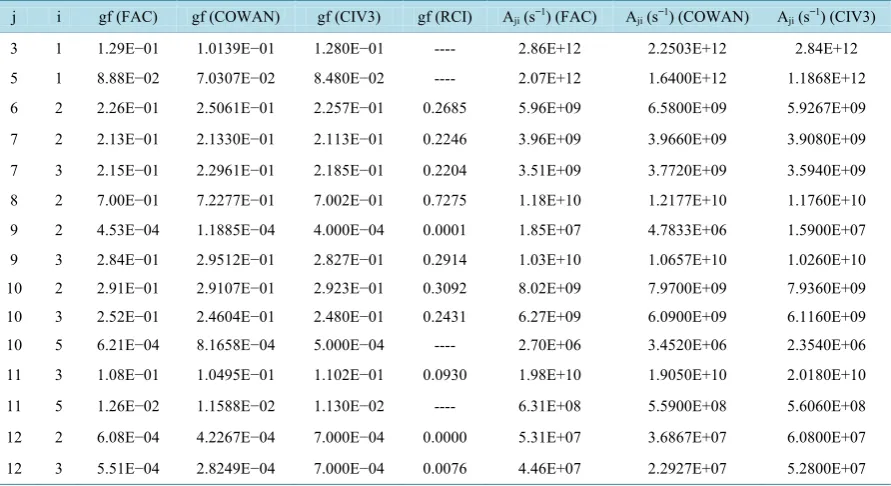
). Weighted Oscillator strengths, spontaneous radiative decay rates are calculated
in the single multipole approximation (see
Table 2
), and Collision strengths by electron impact using the
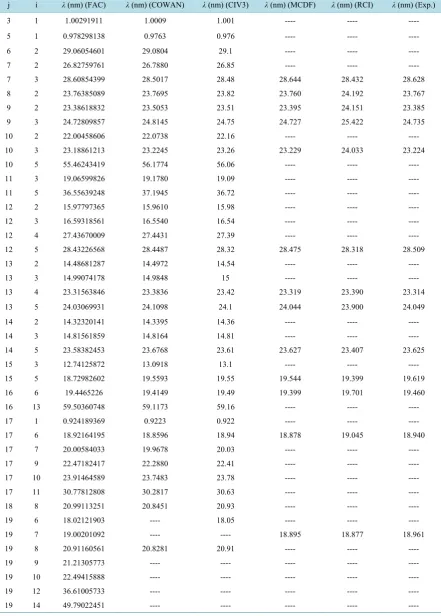
[image:2.595.92.537.359.724.2]facto-rization-interpolation method are calculated in the distorted wave approximation. Effective collision strengths
are calculated by interpolating the data from the collision strengths and integrating over Max wellian distribution
at different temperatures. Rate coefficients are calculated from effective collision strengths using a formula that
will be described later in this paper. Then, we predict the reduced population and gain coefficient for Ge XXIII
by a steady state equation in the collisional radiative model after achieving a population inversion between the
allowed transition states.
Table 1.
Energy levels of Ge XXIII, and their threshold energies (in eV).
Index Configuration JState π FAC COWAN NIST Exp. CIV3 MCDF RCI
Continued
Continued
Continued
Continued
Continued
Continued
[image:8.595.93.539.478.721.2]222 2s1\26p1\2 0o 2.15644E+03 --- --- --- --- --- --- 223 2s1\26p1\2 1o 2.15652E+03 --- --- --- --- --- --- 224 2s1\26p3\2 2o 2.15735E+03 --- --- --- --- --- --- 225 2s1\26p3\2 1o 2.15755E+03 --- --- --- --- --- --- 226 2s1\26d3\2 1e 2.16329E+03 --- --- --- --- --- --- 227 2s1\26d3\2 2e 2.16336E+03 --- --- --- --- --- --- 228 2s1\26d5\2 3e 2.16349E+03 --- --- --- --- --- --- 229 2s1\26d5\2 2e 2.16403E+03 --- --- --- --- --- --- 230 2s1\26f5\2 2o 2.16658E+03 --- --- --- --- --- --- 231 2s1\26f5\2 3o 2.16660E+03 --- --- --- --- --- --- 232 2s1\26f7\2 4o 2.16665E+03 --- --- --- --- --- --- 233 2s1\26f7\2 3o 2.16676E+03 --- --- --- --- --- --- 234 2s1\26g7\2 3e 2.16703E+03 --- --- --- --- --- --- 235 2s1\26g7\2 4e 2.16703E+03 --- --- --- --- --- --- 236 2s1\26h9\2 5o 2.16705E+03 --- --- --- --- --- --- 237 2s1\26h9\2 4o 2.16705E+03 --- --- --- --- --- --- 238 2s1\26g9\2 5e 2.16708E+03 --- --- --- --- --- --- 239 2s1\26h11\2 6o 2.16708E+03 --- --- --- --- --- --- 240 2s1\26h11\2 5o 2.16708E+03 --- --- --- --- --- --- 241 2s1\26g9\2 4e 2.16708E+03 --- --- --- --- --- --- Index: Level index. State Configuration: The configuration to which the level belongs (jj-coupling). Jπ: J is the Total angular momentum, π is the Parity. FAC: Energies from the FAC code (our calculation). COWAN: Energies from the COWAN code (also calculated). NIST: National Institute of Standards and Technology, http://www.nist.gov [24]. Exp.: Energies calculated experimentally [23]. CIV3: Energies from the CIV3 code [22]. MCDF: Energies from the MCDF code [23]. RCI: Energies from the RCI code [23].
Table 2.
Comparison between some weighted oscillator strengths, and transition probabilities for E1 transitions of Ge XXIII.
Continued
Continued
Continued
Continued
35 27 2.23E−02 ---- ---- ---- 4.24E+09 ---- 1.1170E+09 35 31 3.98E−01 ---- ---- 0.4009 1.39E+10 ---- 1.1860E+10 35 32 1.30E−01 ---- ---- ---- 3.60E+09 ---- 3.0320E+09 35 33 4.04E−02 ---- ---- 0.0403 1.02E+09 ---- 9.4340E+08 36 18 5.29E−01 ---- ---- ---- 1.22E+11 ---- 2.4014E+09 36 19 2.52E−02 ---- ---- ---- 5.79E+09 ---- 5.4543E+10 36 20 5.20E−04 ---- ---- ---- 1.19E+08 ---- 7.0343E+07 36 21 1.27E−02 ---- ---- ---- 2.82E+09 ---- 1.0570E+09 36 22 1.65E−01 ---- ---- ---- 3.59E+10 ---- 1.5700E+10 36 24 1.53E−03 ---- ---- ---- 2.44E+08 ---- 7.1843E+07 36 25 8.08E−02 ---- ---- ---- 1.26E+10 ---- 3.9943E+09 36 26 1.33E−01 ---- ---- ---- 2.04E+10 ---- 7.9014E+09 36 32 7.51E−01 ---- ---- ---- 1.54E+10 ---- 1.3070E+10 37 3 6.24E−04 ---- ---- ---- 5.14E+08 ---- 2.8880E+08 37 5 5.56E−04 ---- ---- ---- 3.70E+08 ---- 2.3160E+08 37 17 1.26E−03 ---- ---- ---- 4.51E+08 ---- 2.2120E+08 37 19 2.48E−02 ---- ---- ---- 8.57E+09 ---- ---- 37 20 1.04E−01 ---- ---- ---- 3.58E+10 ---- 1.7050E+10 37 21 1.20E−01 ---- ---- ---- 4.03E+10 ---- 1.7640E+10 37 22 1.48E−01 ---- ---- ---- 4.87E+10 ---- 2.1580E+10 37 23 3.73E−02 ---- ---- ---- 1.12E+10 ---- 4.3680E+09 37 24 3.98E−02 ---- ---- ---- 9.64E+09 ---- 4.2460E+09 37 25 4.45E−02 ---- ---- ---- 1.06E+10 ---- 3.8760E+09 37 26 1.42E−01 ---- ---- ---- 3.34E+10 ---- 1.3290E+10 37 27 3.24E−02 ---- ---- ---- 6.84E+09 ---- 1.6950E+09 37 31 8.53E−02 ---- ---- 0.0855 3.78E+09 ---- 3.5220E+09 37 32 1.24E−03 ---- ---- 0.0019 4.49E+07 ---- 2.9640E+07 37 33 5.14E−01 ---- ---- 0.5069 1.72E+10 ---- 1.4760E+10 38 6 1.56E−01 1.6368E−01 ---- ---- 2.09E+11 2.2080E+11 ---- 38 7 1.23E−01 1.3274E−01 ---- ---- 1.62E+11 1.7580E+11 ---- 38 8 3.78E−01 3.8548E−01 ---- ---- 4.83E+11 4.9520E+11 ---- 38 10 1.55E−01 1.4859E−01 ---- ---- 1.94E+11 1.8694E+11 ---- 38 12 1.32E−04 1.7701E−04 ---- ---- 1.47E+08 1.9826E+08 ---- 38 13 3.36E−03 3.0130E−03 ---- ---- 3.57E+09 3.2240E+09 ---- 38 14 9.20E−04 5.7810E−04 ---- ---- 9.74E+08 6.1580E+08 ---- i and j: The lower (i) and upper (j) levels of a transition as defined inTable 4. gf (nm) (FAC): Weighted oscillator strengths from the FAC code (our calculation). gf (nm) (COWAN): Weighted oscillator strengths from the COWAN code (also calculation). gf (nm) (CIV3): Weighted oscillator strengths from the CIV3 code [22]. gf (nm) (RCI): Weighted oscillator strengths from the RCI code [23]. Aji (s−1) (FAC): Transition probabilities (in
nm) from the FAC code (our calculation). Aji (s−1) (COWAN): Transition probabilities (in nm) from the COWAN code (also calculation). Aji (s−1)
(CIV3): Transition probabilities (in nm) from the CIV3 code [22].
2. Gain Coefficient Computations
The possibility of laser emission from plasma of Ge XXIII ion via electron collisional pumping, in the XUV and
soft X-ray spectral regions is investigated at different plasma temperatures and plasma electron densities. The
d e e d
j ji e ji ji e i ij i ij i ij
i j i j i j i j i j i j
N
A
N
C
C
N
N C
N C
N A
< < > < > >
+
+
=
+
+
∑
∑
∑
∑
∑
∑
(1)
where
N
jand
N
iis the fractional population of level
j
and
i
respectively,
N
eis the electron density,
ji
A
is the Einstein coefficient for spontaneous radiative decay from
j
to
i
; and
eij
C
and
dji
C
represent the rate
coefficient for collisional excitation and de-excitation respectively. The actual population density
N
Jof the
th
j
level can be calculated from the equation of identity
[15] [16]
.
exp
jid e i
ji ij j e
E
g
C
C
g
kT
∆
=
(2)
where
g
iand
g
jare the statistical weights of the lower and upper levels, respectively.
The electron impact excitation rates usually are expressed via the effective collision strengths
γ
jias
6 1 2
8.6287 10
d ji ij j eC
g T
γ
−
×
=
(3)
where the values of
γ
jiand
A
jiare obtained by
[17]
.
The actual population density
N
Jof the
j
thlevel is obtained from the following identity
[17]
,
J j i
N
=
N N
×
(4)
where
N
Iis the quantity of ions which reached to the ionization stage
I
[17]
,
I I e avg
N
=
f N Z
(5)
where
N
eis the electron density,
Z
avgis the average degree of ionization and
f
Iis the fractional abundance
of the ionization states which can be calculated from the relation
[17]
. Since the populations calculated from
Equation (1) are normalized such that,
241 1
1
J J IN
N
==
∑
(6)
where 241 is the number of all the levels of the ion under consideration, the quantity actually obtained from
Eq-uation (1) is the fractional population
N N
J I. After the calculation of levels population, the quantities
N g
j jand
N g
i ican be calculated. Application of electron collisional pumping, the collision in the laser ion plasma
will transfer the pumped quanta to other levels, and will result in population inversions between the upper and
lower levels. Once a population inversion has been ensured a positive gain through
F
>
0
[18]
is obtained.
j j i
j j i
g
N
N
F
N
g
g
=
−
(7)
where
N g
j jand
N g
i iare the reduced populations of the upper level and lower level respectively.
Equa-tion (7) has been used to calculate the gain coefficient (
α
) for Doppler broadening of the various transitions in
the Ge XXIII ion.
1 2 3
8
π
2
π
ij
ji ji j
i
M
A N F
KT
λ
α
=
(8)
where
M
is the ion mass
λ
ijis the transition wavelength in cm (see
Table 3
),
T
iis the ion temperature in
K
and
j
,
I
represents the upper and lower transition levels respectively.
As seen from Equation (8), the gain coefficient is expressed in terms of the upper state density
( )
N
j. This
quantity
N
jdepends on how the upper state is populated, as well as on the density of the initial source state.
The source state is often the ground state for the particular ion.
3. Results and Discussions
3.1. Energy Levels
Table 3.
Comparison between some wavelengths (
λ
) for E1 transitions of Ge XXIII (in nm).
Continued
Continued
Continued
Continued
37 33 19.9898721 ---- 20.94 ---- 19.959 19.925 38 6 3.15614026 3.1459 ---- ---- ---- ---- 38 7 3.18493053 3.1753 ---- ---- ---- ---- 38 8 3.23443596 3.2238 ---- ---- ---- ---- 38 10 3.27002 3.2577 ---- ---- ---- ---- 38 12 3.46419347 3.4529 ---- ---- ---- ---- 38 13 3.5432683 3.5300 ---- ---- ---- ---- 38 14 3.55319554 3.5395 ---- ---- ---- ---- i and j: The lower (i) and upper (j) levels of a transition as defined inTable 4. λ (nm) (FAC): Transition wavelengths (in nm) from the FAC code (our calculation). λ (nm)(COWAN): Transition wavelengths (in nm) from the COWAN code (also calculation). λ (nm) (CIV3): Transition wave-lengths (in nm) from the CIV3 code [22]. λ (nm) (MCDF): Transition wavelengths (in nm) from the MCDF code [23]. λ (nm) (RCI): Transition wa-velengths (in nm) from the RCI code [23]. λ (nm) (Exp.): Transition wavelengths (in nm) calculated experimentally [23].
2s
12p
6nl (n = 3, 4, 5, 6; l = s, p, d, f, g and h) configurations in Ne-like Ge ions are presented in
Table 1
. The
main components of the computed Eigen vectors are also given in these tables in the jj-coupling schemes. For
Ge XXIII, the agreement between FAC, MCDF, and other theoretical and experimental energies
[19]-[23]
with
the values available at the National Institute of Standards and Technology (NIST)
[24]
and is within values less
than 0.5% for a majority of levels.
3.2. Radiative Decay Rates
The oscillator strengths
( )
f
ijand radiative rates
( )
A
ij(in
s
−1) for a transition
i
→
j
are related by the
follow-ing expression
2 16 2
2 2
1.49 10
8
π
j j
ij ij ji ij ji
i i
mc
f
A
A
e
ω
ω
λ
λ
ω
ω
−
=
=
×
where
m
and
e
are the electron mass and charge, respectively,
c
is the velocity of light,
λ
ijis the transition
wa-velength in Å and
ω
iand
ω
jare the statistical weights of the lower
i
and upper
j
levels, respectively.
Simi-larly, the oscillator strength
( )
f
ij…
(Dimensionless) and the line strength
S
(in atomic units,
1 a. u. = 6.46 10 cm eus
×
−36 2⋅
2) are related by the
following standard equations. For the electric dipole (E1) transitions,
18
1 1
3 3
2.0261 10
Eand
303.75
Eji ij
j ij j ij
A
S
f
S
ω λ
ω λ
×
=
=
The wavelengths, transition probabilities, and weighted oscillator strengths, for E1transitions calculated using
the (FAC) are reported in
Table 2
and
Table 3
for Ge XXIII. We present a comparison between our results and
other theoretical transition probabilities for allowed E1 transitions for Ge XXIII in tables respectively. It shows
that our results are in a good agreement with the other theoretical and experimental results
[22] [23]
.
Table 2
shows a comparison between the FAC, MCDF, RCI, and other theoretical weighted oscillator strength
[22] [23]
values for some transitions among the levels of the 1s
22s
22p
5nl, 1s
22s
12p
6nl (n = 3, 4, 5, 6; l = s, p, d, f, g and
h) configurations for Ge XXIII. Generally, there are no discrepancies between our FAC, COWAN, CIV3,
MCDF, RCI, and experimental
calculations and the agreement is within ≤20% for strong transitions.
3.3. Level Population
The reduced population densities are calculated for 241 finestructure levels arising from 1s
22s
22p
6nl, 1s
22s
22p
5nl, 1s
22s
12p
6nl (n = 3, 4, 5, 6; l = s, p, d, f, g and h) configurations that emit radiation in the XUV and soft
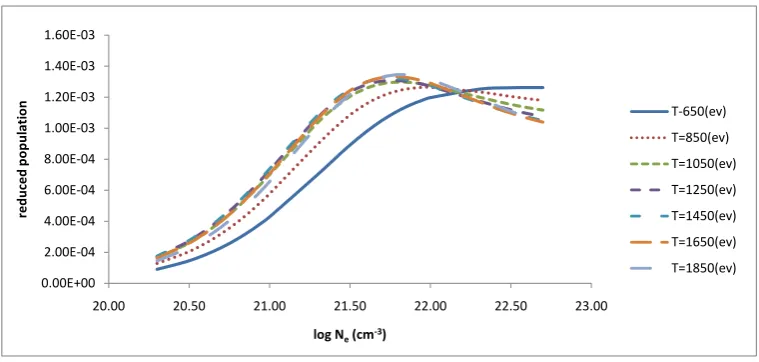
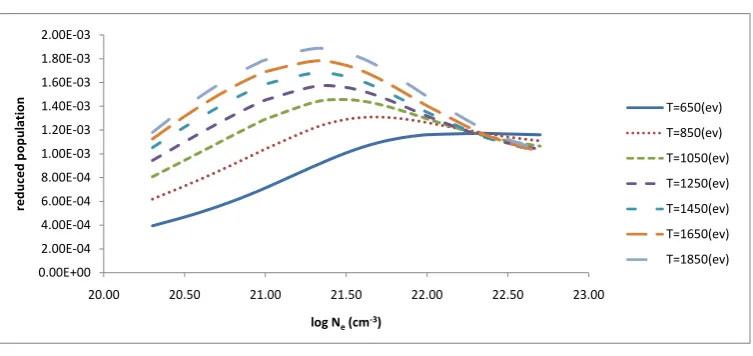
X-ray spectral regions. The calculations were performed by solving the coupled rate Equation (1)
simultaneous-ly using MATLAB R2013acomputer program. The present calculations for the reduced populations as a
func-tion of electron densities are plotted in
Figure 1
to
Figure 4
for levels (5, 15, 33, 37) of the configurations
Figure 1.
Reduced population of level (2p
1\23s
1\2)
1for Ge XXIII after electron collisional pumping as a
[image:19.595.125.504.291.479.2]function of the electron density at temperatures (650, 850, 1050, 1250, 1450, 1650, and 1850) eV.
Figure 2.
Reduced population of level (2p
1\23p
1\2)
0for Ge XXIII after electron collisional pumping as a
function of the electron density at temperatures (650, 850, 1050, 1250, 1450, 1650, and 1850) eV.
Figure 3.
Reduced population of level (2s
1\23p
1\2)
1for Ge XXIII after electron collisional pumping as a
function of the electron density at temperatures (650, 850, 1050, 1250, 1450, 1650, and 1850) eV.
0.00E+00 5.00E-04 1.00E-03 1.50E-03 2.00E-03 2.50E-03
20.00 20.50 21.00 21.50 22.00 22.50 23.00
re du ce d p op ul at io n
log Ne(cm-3)
t=650(ev) T=850(ev) T=1050(ev) T=1250(ev) "T=1450(ev) T=1650(ev) T=1850(ev) 0.00E+00 1.00E-03 2.00E-03 3.00E-03 4.00E-03 5.00E-03 6.00E-03
20.00 20.50 21.00 21.50 22.00 22.50 23.00
re du ce d p ou la tio n
log Ne(cm-3)
T=650(ev) T=850(ev) T=1050(ev) T=1250(ev) T=1450(ev) T=1650(ev) T=1850(ev) 0.00E+00 2.00E-04 4.00E-04 6.00E-04 8.00E-04 1.00E-03 1.20E-03 1.40E-03 1.60E-03
20.00 20.50 21.00 21.50 22.00 22.50 23.00
re du ce d p op ul at io n
log Ne(cm-3)
[image:19.595.124.504.515.696.2]Figure 4.
Reduced population of level (2s
1\23d
5\2)
2for Ge XXIII after electron collisional pumping as a
function of the electron density at temperatures (650, 850, 1050, 1250, 1450, 1650, and 1850) eV.
1650, and 1850) eV for Ge XXIII ion. In the calculation we took into account spontaneous radiative decay rate
and electron collisional processes between all levels under the study. The behavior of level populations of the
various ions can be explained as follows: in general at low electron densities the reduced population density is
proportional to the electron density, where excitation to an excited state is followed immediately by radiative
decay, and collisional mixing of excited levels can be ignored. This result is in agreement with that of Feldman
et al
.
[19]-[21]
. At high electron densities (Ne > 5 × 10
22), the radiative decay to all the levels will be negligible
compared to collisional depopulations and all the level populations become independent of the electron density
and are approximately equal (see
Figures 1
to
4
).
3.4. Radiative Lifetime
The lifetimes are determined almost entirely from the allowed and the strong inter combination transitions. The
radiative lifetime
τ
jof an excited atomic state
j
, is related to the atomic transition probability
A
jiby:
1
j
ji i
A
τ =
∑
(9)
where the sum is extended over all the lower states which can be reached from the upper state by radiative
de-cay.
Table 4
contains the present results of radiative lifetime for the upper and lower laser levels for the Ge XXIII.
3.5. Inversion Factor
As we mentioned before, laser amplification will occur only if there is population inversion, or in other words,
for positive inversion factor F > 0. However, large amplification, the gain exceeds all losses and ensures laser
emission. In order to work in the XUV and X-ray spectral regions, we have selected transitions between any two
levels producing photons with wavelengths between 12 and 52 nm. The electron density at which the population
reaches corona equilibrium approximately equals to A/D, where A is the radiative decay rate and D is the
colli-sional de-excitation rate
[19] [21]
. The population in version is largest where the electron collisions
de-excitation rate for the upper level is comparable to the radiative decay rate for this level.
3.6. Gain Coefficient
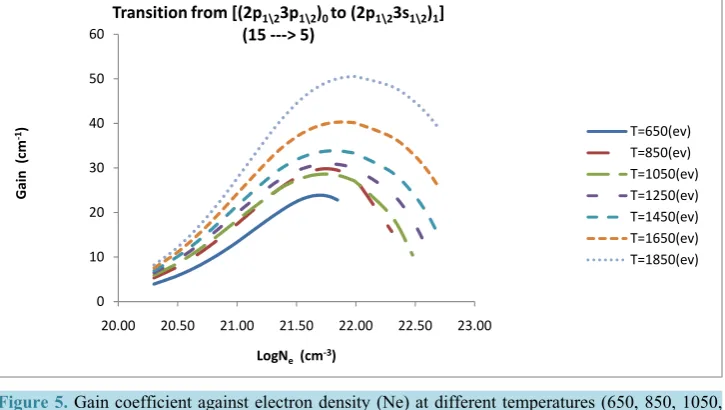
As a result of population inversion there will be positive gain in laser medium. Equation (8) has been used to
calculate gain coefficient for the Doppler broadening of various transitions in the Ge XXIII ion. Our results for
the maximum gain coefficient in cm
−1for those transitions having appositive inversion factor F > 0 in the case
of Ge XXIII ion at different temperatures are calculated (see
Table 4
) and plotted against electron density in
Figure 5
and
Figure 6
. The figures show that the population inversions occur for several transitions in the Ge
0.00E+002.00E-04 4.00E-04 6.00E-04 8.00E-04 1.00E-03 1.20E-03 1.40E-03 1.60E-03 1.80E-03 2.00E-03
20.00 20.50 21.00 21.50 22.00 22.50 23.00
re
du
ce
d p
op
ul
at
io
n
log Ne(cm-3)
Figure 5.
Gain coefficient against electron density (Ne) at different temperatures (650, 850, 1050,
1250, 1450, 1650, 1850) eV.
Figure 6.
Gain coefficient against electron density (Ne) at different temperatures (650, 850, 1050,
1250, 1450, 1650, 1850) eV.
XXIII ion, however, the largest gain occurs for the Ge XXIII ion at (2s
1\23d
5\2)
2---(2s
1\23p
3\2)
1transition. These
short wavelength laser transitions can be produced using plasmas created by optical lasers as the lasing medium.
For Ge XXIII ion the rates for electron collisional excitation from the 1s
22s
22p
6ground state to the 1s
22s
12p
63d
configuration are greater than the rates for excitation from the ground state to the 1s
22s
12p
63p state. For electron
densities and electron temperatures that are typical of laboratory high-density plasma sources, such as laser
pro-duced plasmas, it is possible to create a quasi-stationary population inversion between the 2s
12p
63d and 2s
12p
63p states in Ge XXIII ion. Our calculations have shown that under favorable conditions large laser gains for
this transition in the XUV and soft X-ray regions of the spectrum can be achieved in the Ge XXIII. The gain
calculations were performed at electron temperatures equal to (650, 850, 1050, 1250, 1450, 1650, and 1850) eV
at different electron densities. It is obvious that the gain increases with the temperature. We also find that some
wavelengths for the lasing transitions in
Table 4
are much closed to the values of it in the ref.
[23]
which give us
the accurate wavelength calculated experimentally, although we Ignores some physical processes in the our rate
equation.
4. Conclusions
The analysis of how the electron collisional pumping (ECP) is suitable for attaining population inversion and
0 10 20 30 40 50 60
20.00 20.50 21.00 21.50 22.00 22.50 23.00
G
ain
(
cm
-1)
LogNe(cm-3)
Transition from [(2p
1\23p
1\2)
0to (2p
1\23s
1\2)
1]
(15 ---> 5)
T=650(ev) T=850(ev) T=1050(ev) T=1250(ev) T=1450(ev) T=1650(ev) T=1850(ev)
0 20 40 60 80 100
20.00 20.50 21.00 21.50 22.00 22.50 23.00
G
ain
(c
m
-1)
LogNe(cm-3)