Enabling Reusability in Agile Software Development
Sukhpal Singh
M.E. (S.E.) Thapar University, PatialaInderveer Chana
Ph.D. (C.S.E.) Thapar University, PatialaABSTRACT
Software Engineering Discipline is constantly achieving momentum from past two decades. In last decade, remarkable progress has been observed. New process models that are introduced from time to time in order to keep pace with multidimensional demands of the industry. New software development paradigms are finding its place in industry such as Agile Software Development, Reuse based Development and Component based Development. But different software development models fail to satisfy many needs of software industry. As aim of all the process models is same, i.e., to get quality product, reduce time of development, productivity improvement and reduction in cost. Still, no single process model is complete in itself. Software industry is moving towards Agile Software Development. Agile development does not obviously fit well for building reusable artifacts. However, with careful attention, and important modifications made to agile processes, it may be possible to successfully adapt and put on agile methods to development of reusable objects. The model being proposed here combines the features of Agile Software Development and reusability.
General Terms
Software engineering, Software development, Software reuse.
Keywords
Agile software development, Reusability, Agile methodologies.
1.
INTRODUCTION
Essence of Agile Software Development is rapid development and less cost. Thus, it somewhere compromises with quality and also unable to provide reusability of its developed components. Agile Software Development provides specific solutions whereas Reuse and Component based Development have faith in generalized solutions. We need reusable artifacts to attain reusability. Reusable artifacts are code and other components (analysis and design documents, patterns, etc.) that can be reused from one project to another. In order to create components that are reusable, a big-depiction view must be taken while they are being developed, rather than simply aiming on the current use. What other types of systems might be able to benefit from this component? How many different ways might one want to use it? What are the requirements of the domain, as compare to simply this application in the domain? These are a few of the questions that must be asked when thinking about making components reusable and more general-purpose. When developing reusable artifacts, agile development’s Documentation, Software Quality Assurance, Application-Specific Development, and Continuous Redesign assumptions may not be valid.
1.1 Agile Software Development
Agile Software Development (ASD) methods and techniques are being followed in the industry from the last decade to get
quality product and to reduce development time. Rapid development and ability to accommodate changes at any level of development gives the competitive advantage to the agile processes over traditional processes. Bring comparatively new to software engineering; research on agile processes is going on as to combine light-weight processes and other processes. Recent research shows that only limitation of ASD is its inability to reuse components those are developed through agile processes. On the whole rapid software development ignores reusability. Japanese projects also exhibited higher levels of reuse while spending more time on product design as compared to American teams which spend more time on actual coding and concludes that Indian firms are doing great job in combining conventional best practices, such as specification and review, with more flexible techniques that should enable them to respond more effectively to customer demands. If such a trend is replicated across the broader population, it suggests the Indian software industry is likely to experience continued growth and success in future [1].
1.2 Evolution of Software Development
Processes
The evolution of software development processes have been summarized in Fig. 1. Waterfall model was being followed where requirements are fixed and the next phase starts when the earlier one finished. It’s the representative of the traditional methods [13]. To overcome the limitations of waterfall model evolutionary model and spiral model comes into picture where prototype is first made and then that is converted to the working software. But all have one common limitation that no process could handle the change of requirements at later phases. Agile development which includes many methodologies as XP, SCRUM, Lean Software Development, Feature Driven Development (FDM), Test Driven Development etc. is being accepted in industry because of adaptation to change even at the later stages of the development and also for rapid development [2].
1.3 Reusability
Fig. 1: The Evolution of Software Process Models
2.
LITERATURE REVIEW
2.1
Philosophies
for
Agile
Software
Development
A common ground for agile software development was defined in 2001, when 17 experienced and recognized software development “gurus”, inventors and practitioners of different agile software development methods gathered together. Participants agreed and signed The Manifesto for Agile Software Development [3]. This manifesto declares the main values of agile software development [6]: “We are uncovering better ways of developing software by doing it and helping others does it. Through this work we have come to value:
• Individuals and interactions over processes and tools. • Working software over comprehensive documentation. • Customer collaboration over contract negotiation. • Responding to change over following a plan.
That is, while there is value in the items on the right, we value the items on the left more” [4].
2.2
Agile Methodologies
There are a variety of software development processes that currently claim to be agile. Space does not allow us to give an overview of all of the agile processes we have reviewed. However, since Extreme Programming (XP) is probably the most well-known agile process (Beck, 2000; Strigel, 2001), we use it to illustrate representative agile process concepts [10].
2.2.1 Extreme Programming (XP)
It can be argued that the popularity of XP helped pave the way for other agile processes. Kent Beck, one of the chief architects of XP [7], states that XP is a “lightweight” development method that is tolerant of changes in requirements [17]. It is “extreme” in that “XP takes commonsense principles and practices to extreme levels”. XP is based on the following values:
Communication and Feedback: Face-to-face and frequent communication among developers and between developers and customers is important to the “health” of the project and the products under development. Feedback, through delivery of working code increments at frequent intervals, is also considered critical to the production of software that satisfies customer needs.
Simplicity: XP assumes that it is more efficient to develop software for current needs rather than attempt to design flexible and reusable solutions. Under such an assumption, developers pursue the simplest solutions that satisfy current needs.
Responsibility: The responsibility of producing high-quality code rests ultimately with the developers.
XP consists of technical and managerial practices that are integrated in a complementary manner. The architects of XP take great care to point out that the individual techniques and practices of XP are not new; it is the manner in which they are woven together that is unique. They also stress that the techniques and practices have proven their worth in industrial software development environments [9].
2.2.2 XP Process and Practices
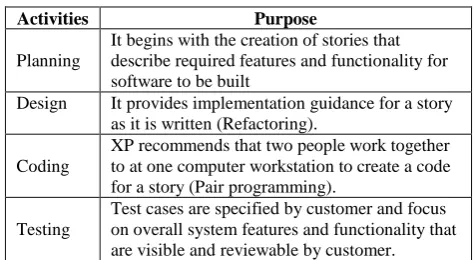
The four core activities [17] given by Roger S. Pressman have been summarized in Table 2.1.
Table 2.1: The four core activities of XP
Activities Purpose
Planning
It begins with the creation of stories that describe required features and functionality for software to be built
Design It provides implementation guidance for a story as it is written (Refactoring).
Coding
XP recommends that two people work together to at one computer workstation to create a code for a story (Pair programming).
Testing
Test cases are specified by customer and focus on overall system features and functionality that are visible and reviewable by customer. Pair programming [11], one of the more well-known XP practices, is a technique in which two programmers work together to develop a single piece of code (Fraser et al, 2000; Williams et al, 2000; Williams & Upchurch, 2001).
Refactoring occurs when a change to the internal structure of a system preserves the externally observable functionality of the system [17]. Refactoring is especially effective when large changes can be decomposed into smaller steps that can be carried out using refactoring’s that have been developed by fowler and others.
2.2.3 Agile Approaches
Refactoring: Refactoring is a fundamental to Agile Development. Refactoring is a development process for restructuring an existing code, altering its internal structure without changing its external behaviour [17]. It’s a process of improvement to an existing software artefact. It improves the design of the software and makes software easier to understand. It helps to avoid errors and to maintain, and modify a program with more accuracy and speed. Code duplication is the main cause for bad smells in code. Eclipses (java), Jbuilder (Java), ReSharper (.NET), and Refactor for Visual Basic are a few names [8].
TDD (Test Driven Development): TDD is one of the most profound agile development practices. It TDD is an 1950
Code and Fix Model Ad-hoc
Plan Driven Change Driven
1960 1970 1980 1990 2000 Stagewise
Model Waterfall
Model
Agile Software Development
Spiral Model
Evolutionary Model
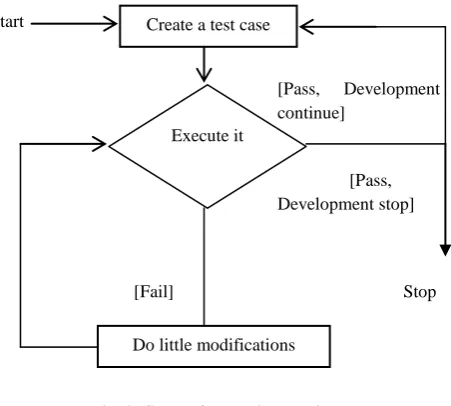
[image:2.595.309.547.367.497.2]evolutionary approach to development which instructs to have TFD (Test First Design) intent. TDD actually helps to meet deadlines by eliminating debugging time, minimizing design speculation and re-work, and reducing the cost and fear of changing working code [12]. TDD starts with writing a test to fail and then coding is being done to pass that test. If written code pass the test then code refactoring is being done otherwise again the code is being written and tested. It’s a way to do unit testing. The cycle is repeated till the dead end. Unit framework family of open source tools is a very common used tool support for TDD in agile development. TDD is basically the combination of Test First Design and Refactoring [5]. The steps of Test first Design has been summarized in Fig. 2 in the form of flowchart.
Start
[Pass, Development
continue]
[Pass,
Development stop]
[image:3.595.315.544.71.217.2][Fail] Stop
Fig. 2: Steps of Test First Design
[image:3.595.59.285.234.437.2]2.3 Agile Software Development and SPI
One key research area related to agile processes is in software process improvement (SPI). The differences [14] between software improvement initiatives of Traditional and Agile development have been summarized in Table 2.2.Table 2.2: Underlying differences of Traditional and Agile Software Development and SPI
Criteria
Traditional Software Development
and SPI
Agile Software Development and SPI
Process control
Control on organization
level
Self-organizing teams Primary means
of knowledge transfer
Document based knowledge
transfer
Face to face communication
Immediate focus of process improvement
Improvement of organisational
software development
process
Improvement of daily working practices of
ongoing projects
Software development
Process
Universal approach and
repeatable solution to provide high
assurance
Flexible approach adapted with collective
understanding of contextual needs to
provide faster development times, responsiveness to rapid
changes, Increased customer satisfaction and lower defect rates.
2.4 Reusability
To share code between different applications is considered to be the reusability but a variety of assets [15] can be reused across software development processes are summarized in Table 2.3.
Table 2.3: Possible Assets for Reuse Intermediate
Artefacts
Implemented Artefacts
Project Management and
Quality Assurance
Artefacts
Requirements System Process models
Architectures
Frameworks, components, modules, packages
Planning models
Designs
UML models, interfaces,
patterns
Cost models
Algorithms Libraries
Review and inspection forms Documentations Test cases Analysis models
Reusability increases not only the productivity of the developers but also the reliability and maintainability of the software products. Many software companies have repository to support the reusability. Object-Orientation also offers reusability. No of techniques are available to support reusability. Considerable research and development is going on in reuse; industry standards like CORBA have been created for component interaction; and much domain specific architecture, toolkits, application generators and other related products that support reuse and open systems have been developed [16].
2.5
Reusability
in
Agile
Software
Development
There are three ways or technologies discussed one by one below, by which reusability can be incorporated in agile software development.
Create a test case
Execute it
[image:3.595.53.282.564.744.2]2.5.1 Component Based Development (CBD)
CBD is a reusability approach that can be found in Microsoft .NET Framework and J2EE (Java2 Enterprise Edition). Component Based Software Engineering (CBSE) process identifies not only candidate components but also qualifies each components interface, adapts components to remove architectural mismatches, assembles components into selected architectural style, and updates components [20].
2.5.2 Refactoring to Design Patterns
To provide a software system quality in terms of reusability, flexibility and extendibility, refactoring is a significant solution [5]. Use of design patterns in an application increases reusability and maintainability. One new emerging approach that refactoring to design patterns seems to have promising future in reusability discipline. Research is going on in the field of pattern mining as to find new approaches and new tools. Refactoring has been gained much more attention in the object oriented software development. Refactoring to Patterns suggests that using patterns to improve an existing design is better than using patterns early in a new design. We improve designs with patterns by applying sequences of low-level design transformations. A design pattern is not a finished design that can be transformed directly into code. It is a description or template for how to solve a problem that can be used in many different situations. Object oriented design patterns typically show relationship, interactions between classes or objects, without specifying the final application classes or objects that are involved.
2.5.3 Reusable Architectures
Reusable architectures can be developed from reusable architectural patterns [18] as in FIM architecture [19] which operates at three different levels of reuse: Federation, domain and application. They focus on how non-functional property reusability relates to the software architecture of a system. They presented a suggested software process model for reuse based software development approach.
2.6 Risk Analysis
From the past we learnt that any new development has some associated risks. Major risk is where the decisions are made on the vision and on the future scope of the project. Although
its probability is low because we are considering that the team members are experts but its impact is high on project and on the organization itself. Another risk is technical risk which is a common to all of the organizations that what if the technology changes. A new technology comes in the market. Risk related to design patterns is of time as sometimes more than one design pattern seems to be the solution. Risk related to repository is that the assets are kept there which are not being used since a long time. It’s related to the maintenance of the repository. The impact is low if the repository is small but as the repository grows the impact will also grow as the time to find the asset will increase.
2.7 Limited Support for Building Reusable
Artifacts in Agile
Reusable artifacts are code and other components (analysis and design documents, patterns, etc.) that can be reused from one project to another, in their entirety or at least in a major part. In order to create components that are reusable, a big-picture view must be taken while they are being developed, rather than simply focusing on the current application [21]. This separation of the product-specific development environment from the reusable artifact development environment is a primary feature of the reuse-oriented framework called the Experience Factory developed by researchers at the University of Maryland at College Park (Basili, Caldiera, & Rombach, 1994). Continuous redesign is difficult when we are not developing application-specific artifacts.
3. PROPOSED SOLUTION
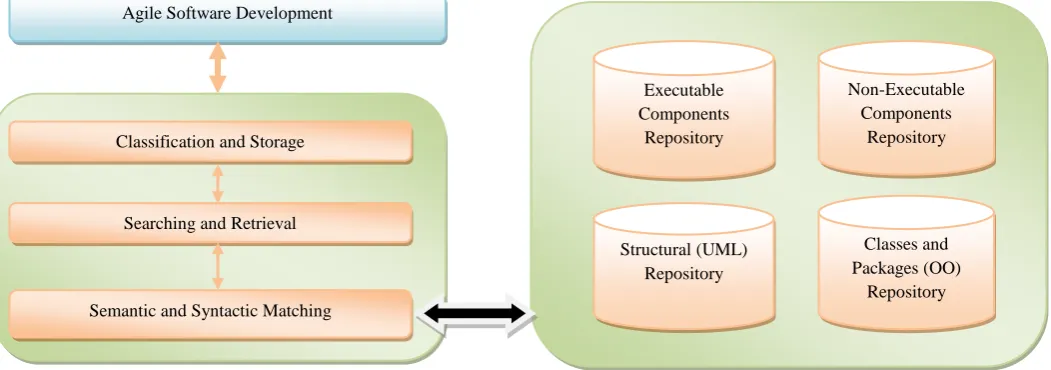
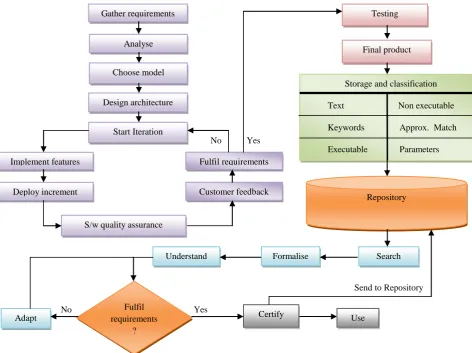
A model capable of classifying, storing, searching and retrieving the components from the agile repository by using pattern matching algorithms has been proposed in this work is shown in Fig. 3. There are some different storage and retrieval methods are available for the classification of components in software library. This model will help to make searching faster based on classification of components. The flowchart of proposed model is shown in Fig. 4.
[image:4.595.41.567.548.733.2].
Fig. 3: Proposed Model
Agile Software Development
Classification and Storage
Searching and Retrieval
Semantic and Syntactic Matching
Executable Components
Repository
Non-Executable Components
Repository
Structural (UML) Repository
Classes and Packages (OO)
No Yes
[image:5.595.59.532.84.437.2]
Send to Repository
No Yes
Fig. 4: Flowchart of Proposed Model
3.1 Storage and retrieval criteria
3.1.1 Information retrieval methods
[image:5.595.50.283.613.677.2]These are methods that depend on a textual analysis of software assets. It is important to acknowledge that the storage and retrieval of software assets is nothing but a specialized instance of information storage and retrieval. The registration component is retrieved with other information by using text “software reuse” is shown in Table 3.1.
Table 3.1: Informational retrieval methods Component
name
Component id
Label Language
registration Text_6562 software reuse C++
3.1.2 Descriptive methods
These are methods that depend on a textual description of software asset. While information retrieval methods represent assets by some form of text, descriptive methods rely on an abstract surrogate of the asset, typically a set of keywords, or a set of facet definitions. The feedback component is retrieved
with other information by using keyword “Agility” is shown in Table 3.2.
Table 3.2: Descriptive methods
Component name
Component id Keyword Language
feedback Key_6522 Agility Java
3.1.3 Operational semantics methods
These are methods that depend on the operational semantics of software assets. This can be applied to executable code, and proceed by matching candidate assets against a user query on the basis of the candidates behaviour on sample inputs. The update.exe executable component is retrieved with other information by writing the executable name “update” is shown in Table 3.3.
Table 3.3: Operational semantics methods
Component name Component id Executable
update.exe Exe_4329 update
Gather requirements
Analyse
Start Iteration Choose model
Design architecture
Testing
Final product
Storage and classification Text Non executable Keywords Approx. Match Executable Parameters
Understand
Adapt
Formalise Search
Fulfil requirements
Customer feedback
S/w quality assurance Deploy increment
Implement features
Repository
Fulfil requirements
?
3.1.4 Denotational semantics methods
These are methods that depend on the denotational semantic definition of software assets are shown in Table 3.4. Unlike operational methods, they can also be applied to non-executable assets (such as specifications). The initial requirements non-executable component is retrieved with other information by writing the non-executable name “requirements” is shown in Table 3.4.
Table 3.4: Denotational semantics methods Component
name
Component id Non Executable
Initial requirements
nonExe_7215 requirements
3.1.5 Topological methods
[image:6.595.308.550.92.398.2]The main feature of topological methods is their goal, which is to identify library assets that minimize some measure of distance to the user query. The Support component is retrieved with other information by writing the identity “port” is shown in Table 3.5.
Table 3.5: Topological methods
Component name
Component id Identity
Support Id_1213 port
3.1.6 Structural methods
[image:6.595.50.287.375.434.2]The main discriminating feature of structural methods is the nature of the software asset they are dealing with: typically, they do not retrieve executable code, but rather program patterns, which are subsequently instantiated to fit the user’s needs. The class name city is retrieved with other information by writing the package name “state” is shown in Table 3.6.
Table 3.6: Structural methods
Package Class Pattern Language
State City Object
oriented
Java
3.1.7 Analysis of accessing criteria
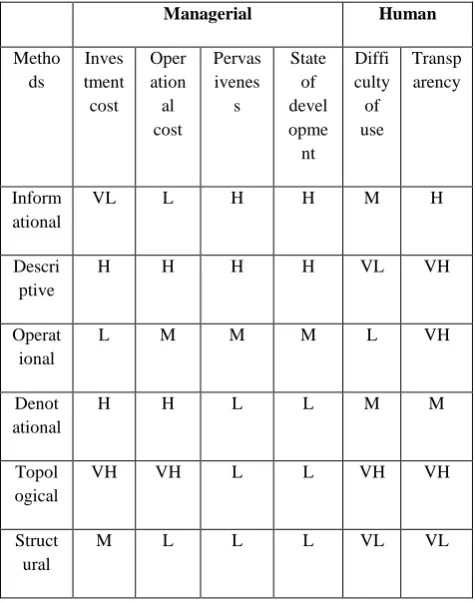
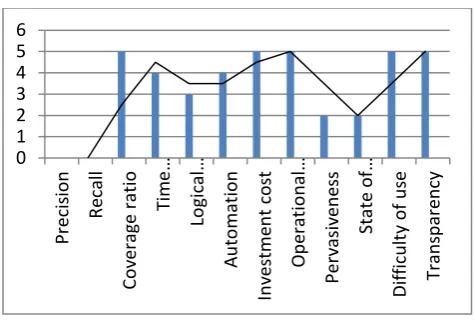
The technical, managerial and human criteria have been summarized in Table 3.7 and Table 3.8. The abbreviations used in these tables are VL=Very Low, L=Low, M= Medium, H= High, VH= Very High. The Analysis of retrieving criteria has been shown in Fig. 5.
Table 3.7: Summary of Technical criteria
Technical
Method s
Preci sion
Rec all
Cove rage ratio
Time compl exity
Logic al compl
exity
Autom ation
Informa tional
M H L L M H
Descrip tive
H H VH VL L VH
Operati onal
VH H H M M VH
Denotat ional
VH H H VH VH M
Topolo gical
U U VH H M H
Structur al
VH VH VH VL L VH
Table 3.8: Summary of managerial and human criteria
Managerial Human
Metho ds
Inves tment
cost Oper ation al cost
Pervas ivenes s
State of devel opme nt
Diffi culty
of use
Transp arency
Inform ational
VL L H H M H
Descri ptive
H H H H VL VH
Operat ional
L M M M L VH
Denot ational
H H L L M M
Topol ogical
VH VH L L VH VH
Struct ural
[image:6.595.310.548.439.741.2] [image:6.595.53.280.561.622.2]
Fig. 5: Analysis of accessing criteria
4.
ADVANTAGE
OF
PROPOSED
APPROACH
Essence of Agile Software Development is rapid software development with reduced overheads. This proposed model will help to make searching faster based on classification of components and introducing reusability in Agile Software Development. It will be accepted widely if pattern based architecture designing, design patterns, UML based analysis and designing is incorporated. Pattern based architecture oriented agile development and use of OO patterns as refactoring to design patterns will make a space for reusability and reusable artifacts.
4.1 Related Work
We had conducted a survey on the number of approaches existing for Agile Software Development [7, 17] and Reusability [19] individually, but the proposed model combines both Agile Software Development and Reusability into a single approach for achieving efficient classification, storage and retrieval of software components. Presently there is no such approach as presented in proposed model which combines Agile Software Development and Reusability.
5. CONCLUSION AND FUTURE SCOPE
5.1 Conclusion
Agile Software Development has encouraging future in the software industry and is capable of fulfilling the requirements of the industry. Thus, at times it compromises with quality and is incapable of providing reusability of its developed modules. Agile Software Development offers particular solutions whereas Reuse and Component based Development believe in generalized solutions. Reuse based software engineering and agile development is an open research area in fast growth.
5.2 Future Scope
The future scope of this work is to analyze and to incorporate risk factors in Agile Software Development systematically and find the critical success factors of the agile software development process and also identify the various risk factors using risk analysis of introducing reusability in agile software development and offer a model that will help us to achieve reusability in Agile Software Development. Reusability can
also be automated in agile software development using an automated tool.
6. REFERENCES
[1] Salo O., “Enabling Software Process Improvement in Agile Software Development Teams and Organizations”, ESPOO 2006, VTT Publications 618, pp149 +app.96 pp. [2] Jim Highsmith: “Agile Software Development
Ecosystems”, Addison-Wesley, 2002
[3] Cusumano M., MacCormack A., Kemerer C.F., and Crandall W., “A Global Survey of Software Development Practices”, available at http://ebusiness.mit.edu/research/papers/178_Cusumano_ Intl_Comp.pdf.
[4] Agile Manifesto, http://www.agilemanifesto.org, last accessed: 5-11-2011
[5] Zannier C., “Tool Support for Refactoring to Design Patterns “, Conference on OOP System Language and Applications, Companion of the 17th annual ACP SIGPLAN Conference on OOP Systems, Languages and Applications, Seattle, Washington, 2002, pp. 122-123. [6] Murauskaite A., Adomauskas V., “Bottlenecks in Agile
Software Development using Theory of Constraints (TOC) Principles”, Master’s Thesis, Gothenburg, Sweden 2008.
[7] Turk D., France R., and Rumpe B., “Limitations of Agile Software Processes”, 3rd International Conference on XP and Agile Processes in Software Engineering (XP 2002), May 2002.
[8] Dyba T., and Dingsoyr T., “Empirical Studies and Agile Software Development: A Systematic Review”, Information and Software Technology, 2008, vol. 50, pp. 833-859.
[9] Hansson C., Dittrich Y., Gustafsson B., and Zarnak S. , “How Agile are Industrial Software Development Practices?”, Journal of Systems and Software , Sept. 2006, vol. 79, issue 9, pp. 1295-1311.
[10] Cronholm S., “Using Agile Methods? Expected Effects”, 17th International Conference on Information Systems Development (ISD 2008), Paphos, Cyprus, Aug 25- 27, 2008.
[11] Hanssen G. K., and Faegri T.E., “Process Fusion: An industrial Case Study on Agile Software Product Line Engineering”, Journal of Systems and Software, 2008, vol. 81, pp. 843-854.
[12] Ge X., Paige R. F., Polack F.A.C., Chivers H., and Brooke P.J., “Agile Development of Secure Web Applications”, Proceedings of the 6th International Conference on Web Engg. 2006, pp. 305-312.
[13] Boehm B., and Turner R., “Balancing Agility and Discipline: Evaluating and Integrating Agile and Plan-Driven methods”, ICSE 2004, pp. 718-719.
[16] Garlen D., Allen R., and Ockerbloom J., “Architectural Mismatch: Why Reuse is So Hard”, IEEE Software, November1995, vol. 12, no 6, pp 17-26.
[17] Pressman R. S., “Software Engineering”, 7th edition, McGraw Hill Education, 2009.
[18] Gomma H. and Farrukh G.A., “Composition of Software Architectures from Reusable Architecture Patterns”, Foundations of Software Engineering, Proceedings of 3rd International Workshop on Software Architecture, Orlando, Florida, US, 1998, pp. 45-48.
[19] Gomma H., and Farukh G. A., “A Reusable Architecture for Federated Client/Server Systems”, Proceedings of the
1999 Symposium on Software Reusability, Los Angeles, California, US, 1999, pp. 113-121.
[20] Paulisch F., Siemens AG,” Software Architecture and Reuse – an Inherent Conflict?” 3rd International Conference on Software Reuse, Nov. 1994, pp. 214. [21] K.S. J., and Dr. Vasantha R., “A New Process Model for